
Fisheries Management Measures within Scottish Inshore Marine Protected Areas (MPAs) and Proposed Priority Marine Feature (PMF) Management Areas - Site and Area Proposal Document
This document describes the process, justification and evidence used to develop site and area specific fisheries management measures. It outlines key information for each site and area including their features, and risks of potential pressures.

15. Sites in the Shetland Isles Region
15.1 Mousa to Boddam NCMPA and Mousa SAC
15.1.1 Description and background
The NCMPA encompasses sandeel grounds around the island of Mousa and off the coast at Boddam in south-east Shetland. These are considered the most consistent and reliable sandeel recruitment areas around Shetland. The sandeel populations here are dependent upon an influx of young fish from a large spawning area situated to the west and north of Orkney.
The SAC is located off the east coast of Shetland Mainland, it is a designated marine site recognized for its rocky reefs, submerged sea caves, and its importance to harbour seals. The site covers approximately 530 hectares and is aimed at protecting habitats and species of European importance.
Mousa supports one of the largest and most northerly harbour seal populations in the UK, with the island’s rocky tidal pools providing essential shelter for pupping, breeding, and moulting. The reefs and submerged sea caves host diverse marine life and are shaped by strong hydrodynamic conditions.
Further information, including Conservation and Management Advice (CMA) can be found on Sitelink by searching for each site individually.
Further information on MPAs, the wider network and protected areas management is available at Scottish Government MPA policy page.
15.1.2 Protected features
The Mousa to Boddam NCMPA has been designated to protect:
- Marine Geomorphology of the Scottish Shelf Seabed; and
- Sandeels
The Mousa SAC has been designated to protect:
- Harbour seal;
- Reef; and
- Sea caves
Sea caves and Marine Geomorphology of the Scottish Shelf Seabed are not discussed further as they are not a protected feature for which fisheries management measures are required.
15.1.3 Conservation Objectives
The condition of sandeels in the Mousa to Boddam MPA is uncertain. The Conservation Objective is to conserve this protected feature.
Reef feature is in favourable condition at Mousa SAC and therefore the Conservation Objectives seek to maintain this condition.
Harbour seals are in unfavourable condition at Mousa SAC and therefore the Conservation Objectives seek to restore favourable condition by supporting recovery.
Additional details, including the Conservation Objectives are provided in the Conservation and Management Advice documents produced for this NCMPA and SAC and can be found on Sitelink by searching for each site individually.
15.1.4 Pressure from fishing activity
Fishing activities can exert significant pressures on the protected features of the NCMPA and SAC. Sandeels are highly sensitive to targeted fishing and bottom‑contact gear, which can disturb sediments, alter burrowing and spawning conditions, and reduce population density. Their recovery potential is uncertain, though connectivity to adjacent spawning grounds may provide some resilience.
Reefs are particularly sensitive to bottom‑contact fishing gear such as trawls, dredges, and set nets, which can damage reef structures, detach sessile organisms, and cause smothering and siltation. Recovery varies with the intensity of impact and local water movement.
Harbour seals are indirectly affected by fishing through disturbance at haul‑out sites, entanglement in gear, and underwater noise. These pressures are most acute during breeding and moulting seasons, when disturbance can reduce pup survival and disrupt resting behaviour.
Additional details are provided in the Conservation and Management Advice documents produced for this NCMPA and SAC (section 6) and can be found on Sitelink by searching for each site individually.
Other resources include:
- The Feature Activity Sensitivity Tool (FeAST) which allows users to investigate the sensitivity of marine features (habitats, species, geology and landforms) in Scotland's seas, to pressures arising from human activities;
- Fisheries Guidance Notes which provide summaries of evidence on the interaction between fishing gears and specific habitats and species.
15.1.5 Fisheries management advice relevant to proposed fisheries management measures
NatureScot provides risk-based advice to help manage activities that may impact protected features and their Conservation Objectives. See section 2.3 for more detail. Full fisheries management advice is found in the CMA documents which can be found be searching each site individually on Sitelink and has been summarised below for the management measures proposed:
Demersal mobile/active gear
NCMPA
Sandeels – reduce or limit pressures. Management measures to reduce or limit demersal mobile/active fishing gear that can remove prey species and/or cause abrasion of prey-supporting habitat (e.g. sandeel habitat) should be considered.
SAC
Remove or avoid pressures is recommended for reefs
Hydraulic (diver and vessel)
NCMPA
Remove or avoid pressures: The exclusion of hydraulic fishing methods from habitat supporting sandeels within the site is recommended
SAC
Remove or avoid pressures is recommended for reefs
Netting (Bottom-set gill nets including tangle and trammel nets. Drift nets, purse seine, ring-nets and fyke nets.)
SAC
Reduce or limit pressures: (entanglement) associated with the use of nets is recommended for harbour seal
15.1.6 Proposed fisheries management measures
The proposed management measures for the NCMPA and SAC are being proposed jointly:
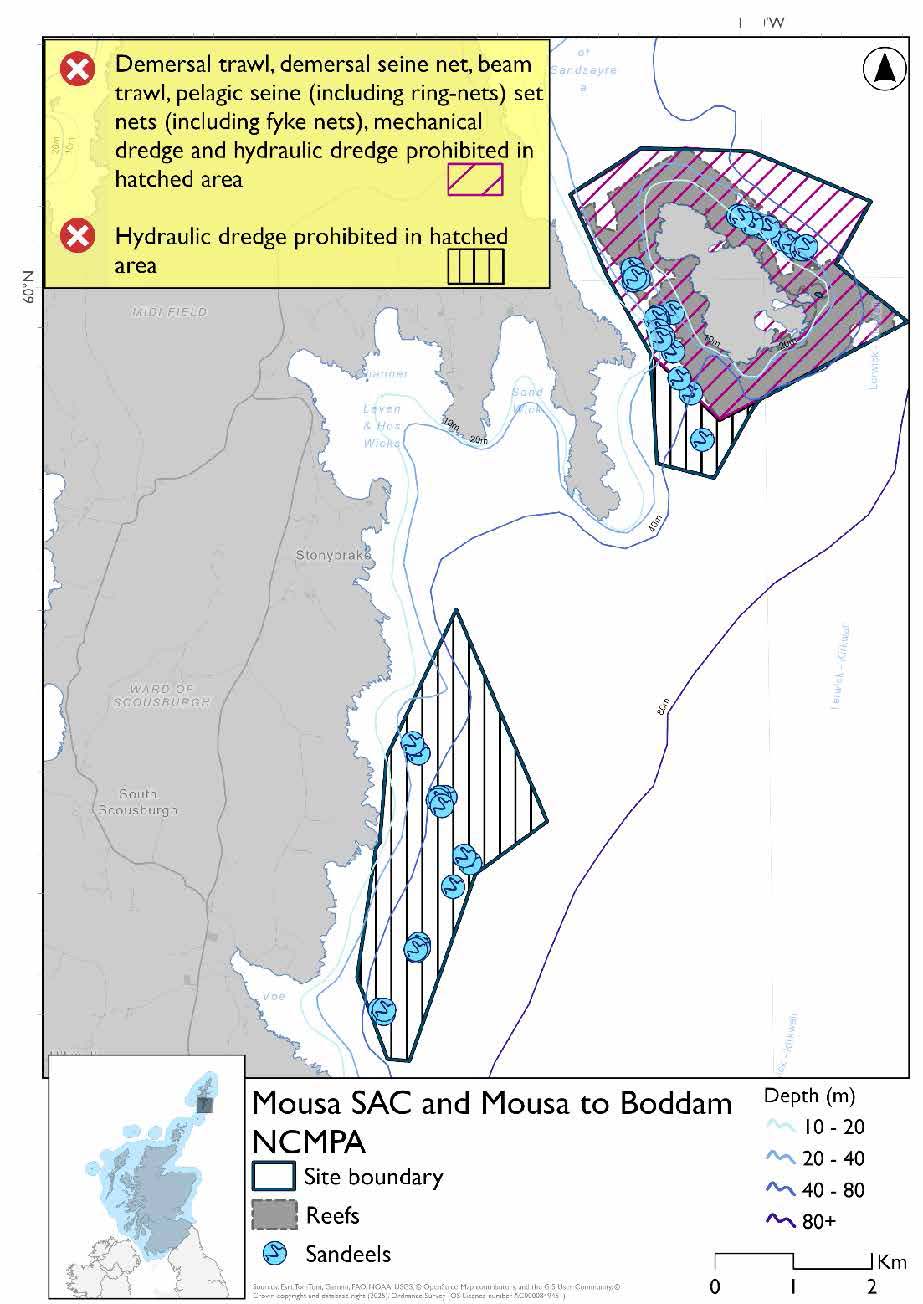
Option One
- Set nets (including fyke nets), pelagic seine (including ring-nets), demersal trawls and seines, beam trawls and mechanical dredge prohibited in part of the site
- Full site closure to hydraulic dredge
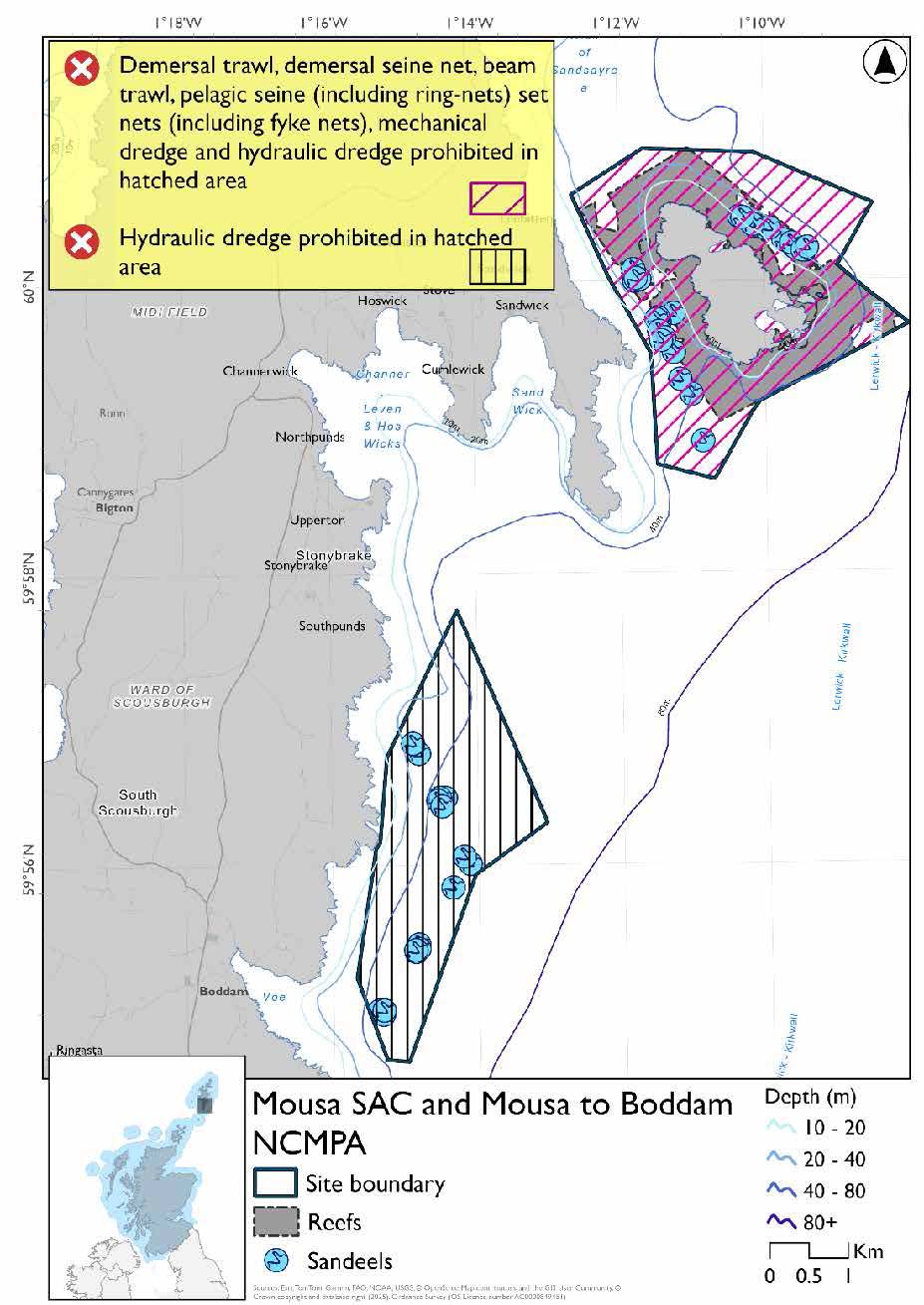
Option Two
- Mousa area of the NCMPA and SAC prohibits set nets (including fyke nets), pelagic seine (including ring-nets), demersal trawls or seines, beam trawls, mechanical dredge and hydraulic dredge
- Boddam area of the NCMPA prohibits hydraulic dredge
Rationale for developed measures
The basis for the proposed fisheries management measures for each site has been determined by the management advice for fishing activities provided by NatureScot, which can be found on their website or Sitelink as signposted throughout this document. The Fisheries Assessment for each site assesses the impacts from existing fishing activities on the protected features using the tests from the legislation relevant for the type of MPA being considered. The assessment outlines how the proposed measures address any impacts identified that could hinder the conservation objectives of the MPA.
15.1.7 Other fisheries management measures currently applying to this site
There are already management measures in place. An effort has been made to identify existing measures which affect each individual site or area, however the list may not be exhaustive. These measures are outlined below, and the proposals for further management being consulted on now are in addition to these existing measures:
- Fishing for sandeel is prohibited within the Scottish zone, which is defined as the sea adjacent to Scotland up to the 200 nautical miles limit
- Under the Shetland Regulating Order, Scallop dredging prohibited in part of the site.
Other conservation measures can be found in section 7 of the CMA documents which can be found be searching each site individually on Sitelink.
15.2 Fetlar to Haroldswick NCMPA
15.2.1 Description and background
The Fetlar to Haroldswick NCMPA is located where the North Sea meets the Atlantic Ocean, creating a dynamic and high-energy marine environment. This convergence results in strong tidal flows and turbulent mixing of waters, which, combined with the area's complex geography of islands, open coastlines, and sheltered bays, supports an exceptional diversity of marine habitats and species.
The NCMPA’s clear, shallow waters are ideal for the growth of maerl beds, a type of red seaweed with a hard chalky skeleton that carpets the seabed and provides shelter for a wide range of marine life, including commercially important fish. In the narrow channels between islands, tide-swept coarse sands host burrowing bivalves such as tellins and surf clams, alongside worms, shrimp-like crustaceans, and sand hoppers. These habitats are complemented by luxuriant growths of sugar kelp, bootlace weed, and other seaweeds, which thrive in the nutrient-rich, fast-moving waters.
In slightly deeper areas, horse mussel beds support dense communities of brittlestars, starfish, sea urchins, feather stars, sponges, and soft corals like dead man’s fingers. These habitats are not only ecologically rich but also visually striking, forming vibrant underwater landscapes.
The NCMPA also plays a vital role in supporting seabirds. It overlaps with the seaward area of the Fetlar SPA, which is designated for breeding populations of Arctic tern, Arctic skua, and fulmar. Additionally, the rich seabed habitats within the MPA provide important foraging grounds for one of Scotland’s largest colonies of black guillemots, with over 2,000 individuals recorded.
Further information, including Conservation and Management Advice (CMA) can be found on Sitelink.
Further information on MPAs, the wider network and protected areas management is available at Scottish Government MPA policy page.
15.2.2 Protected features
The Fetlar to Haroldswick MPA has been designated to protect:
- Black guillemot;
- Circalittoral sand and coarse sediment communities;
- Horse mussel beds;
- Kelp and seaweed communities on sublittoral sediment;
- Maerl beds;
- Marine Geomorphology of the Scottish Shelf Seabed; and
- Shallow tide-swept coarse sands with burrowing bivalves
Marine Geomorphology of the Scottish Shelf Seabed are not discussed further as they are not a protected feature for which fisheries management measures are required.
15.2.3 Conservation Objectives
All of the marine habitat features are in favourable condition at Fetlar to Haroldswick NCMPA and therefore the Conservation Objectives seek to conserve this condition.
Black guillemot are in unfavourable condition at Fetlar to Haroldswick NCMPA and therefore the Conservation Objectives seek to recover this condition.
Additional details, including the Conservation Objectives are provided in the Conservation and Management Advice document produced for this NCMPA can be found on Sitelink.
15.2.4 Pressure from fishing activity
Fishing activities pose risks to black guillemots primarily through bycatch and entanglement in nets, which can cause injury or mortality. Vessel movements linked to fishing also create visual disturbance, disrupting foraging behaviour during the breeding season. Degradation of kelp forests, a key feeding habitat, further reduces prey availability and impacts population health.
Seabed habitats such as circalittoral sand and coarse sediment communities, horse mussel beds, kelp and seaweed beds, maerl beds, and shallow tide‑swept sands with burrowing bivalves are all highly sensitive to bottom‑contact fishing gear. Physical disturbance, abrasion, smothering, and sediment removal can displace or damage organisms, reduce biodiversity, and disrupt sediment structure. Recovery is often slow, particularly for horse mussel and maerl beds, which have low recruitment and growth rates, meaning even small‑scale impacts can have long‑lasting consequences.
Gear use and vessel movements can alter hydrodynamic conditions and sediment supply, undermining habitat stability and associated communities like maerl and bivalves. These features show low resilience, with recovery dependent on the scale and duration of disturbance.
Additional details are provided in the Conservation and Management Advice document produced for this NCMPA (section 6) and can be found on Sitelink.
Other resources include:
- The Feature Activity Sensitivity Tool (FeAST) which allows users to investigate the sensitivity of marine features (habitats, species, geology and landforms) in Scotland's seas, to pressures arising from human activities;
- Fisheries Guidance Notes which provide summaries of evidence on the interaction between fishing gears and specific habitats and species.
15.2.5 Fisheries management advice relevant to proposed fisheries management measures
NatureScot provides risk-based advice to help manage activities that may impact protected features and their Conservation Objectives. See section 2.3 for more detail. The CMA document also sets out the full fisheries management advice that has been summarised below for the management measures proposed:
Demersal mobile/active gear
Reduce or limit pressures (removal of prey species and abrasion of prey-supporting habitat) associated with fishing that has the potential to damage seabed habitat (in particular, sandeel habitat, herring spawning grounds) should be considered for black guillemot
Remove or avoid pressures is recommended for maerl and horse mussel beds, kelp and seaweed communities on sublittoral sediment,
Reduce or limit is recommended for circalittoral sand and coarse sediment communities and shallow tide-swept coarse sands with burrowing bivalves. Some existing management measures are already in place.
Management measures to reduce or limit demersal mobile/active fishing within the Shetland Carbonate Production Area are recommended. This should focus on avoiding impacts on the most sensitive carbonate-producing habitats within the area e.g. maerl beds and horse mussel beds. Some existing management measures in place.
Hydraulic (diver or vessel)
Remove or avoid pressures: (removal of prey species and disturbance of prey-supporting habitat) associated with hydraulic fishing that has the potential to damage seabed habitat (in particular, sandeel habitat, herring spawning grounds) is recommended.
Remove or avoid pressures is recommended for maerl and horse mussel beds – some existing management measures in place
Reduce or limit pressures is recommended for kelp and seaweed communities on sublittoral sediment, circalittoral sand and coarse sediment communities and shallow tide-swept coarse sands with burrowing bivalves – some existing management measures in place.
Reduce or limit pressures Management measures to reduce or limit hydraulic gears within the Shetland Carbonate Production Area are recommended. This should focus on avoiding impacts on the most sensitive carbonate-producing habitats within the area e.g. maerl beds and horse mussel beds.
Static gear
Remove or avoid pressures: (entanglement) associated with the use of all static nets (including bottom set nets, drift nets, fyke nets). Spatial exclusion of all static nets in areas identified as being important for black guillemot (as identified from habitat and dive depth preferences) is recommended.
Pelagic gear
Pelagic fishing for herring/sprat may occur within or around the NCMPA. It is recommended that a principle objective of the management of the fishery should be ensuring that the fishing activity does not prevent or disrupt the availability of prey species for the qualifying features, i.e. it should be considered as part of a broader ecosystem-based approach to management of this fishery.
15.2.6 Proposed fisheries management measures
The proposed management measures for Fetlar to Haroldswick NCMPA are:
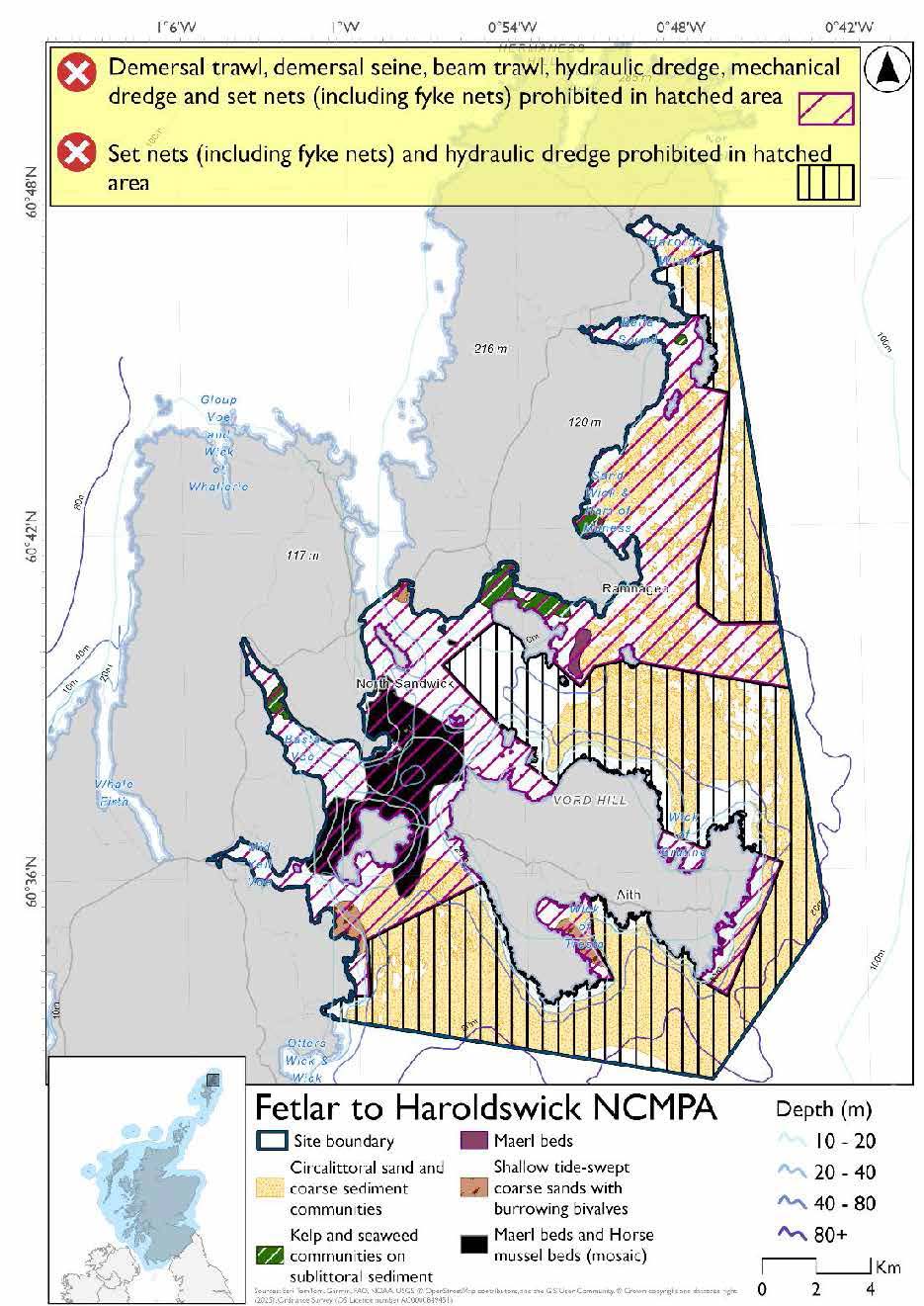
Option One
- Demersal trawl and seine, beam trawl and mechanical dredge prohibited in part of the site
- Set nets (including fyke nets) and hydraulic dredge prohibited throughout site
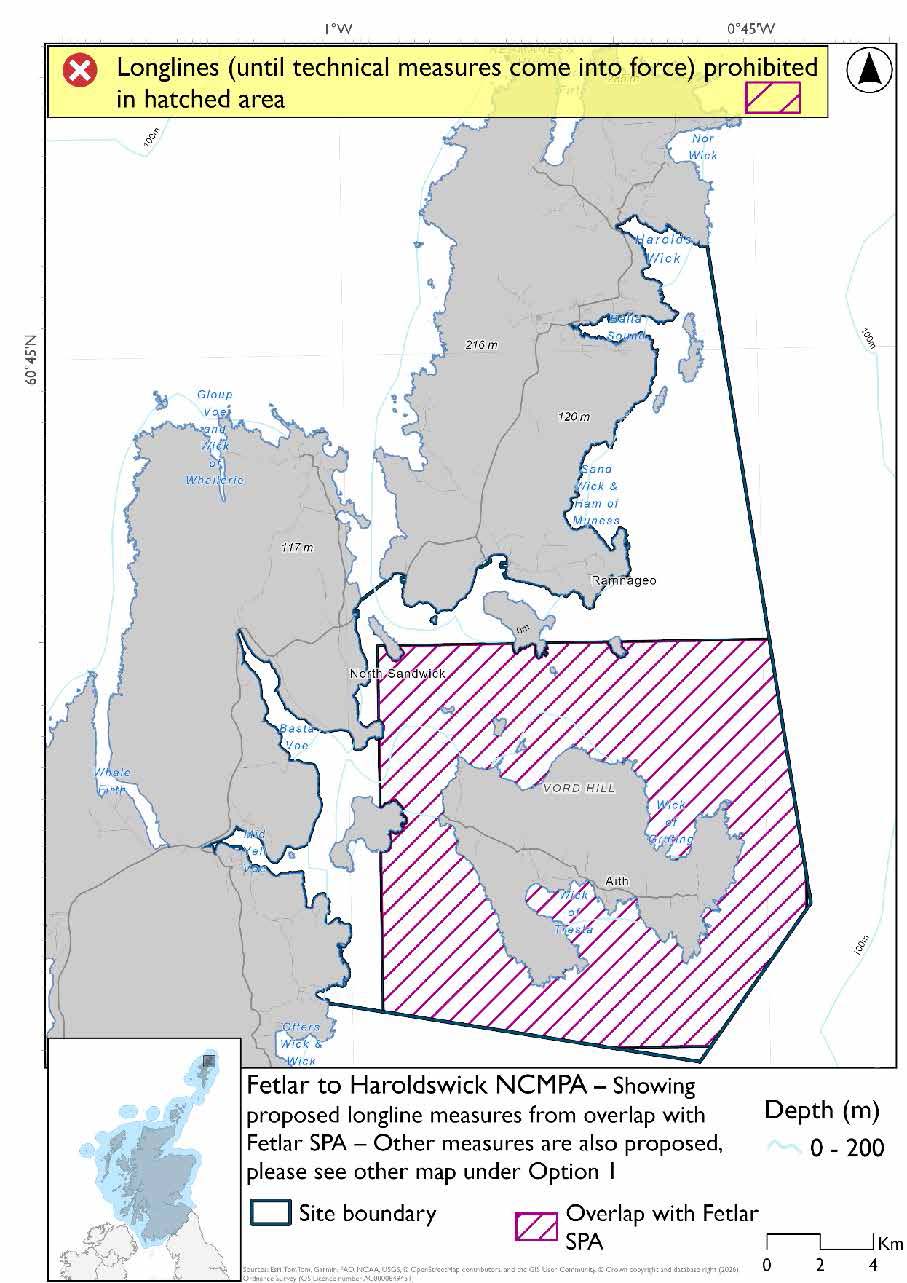
- Longlines (until technical measures come into force) prohibited in part of the site from the overlap with the Fetlar SPA (see second map under option 1)
Option Two*
- Full site closure to demersal trawl and seine, beam trawl, set nets (including fyke nets), mechanical dredge and hydraulic dredge
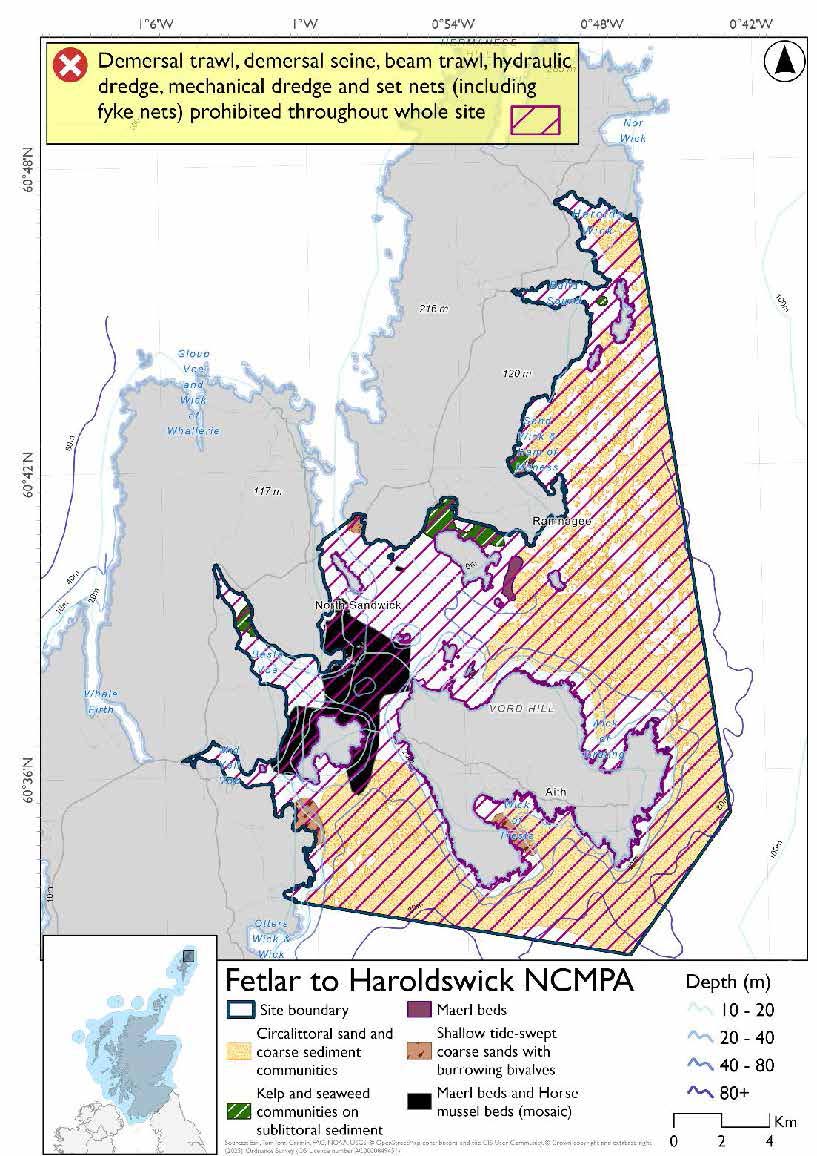
*The measures for Option 2 proposals only come from gear types prohibited in non-overlapping areas. Overlapping restrictions may still apply from overlapping sites or areas dependent on the decisions taken for that site or area.
Overlapping sites included in this consultation
This NCMPA overlaps with the Bluemull and Colgrave Sounds and Fetlar SPAs.
Rationale for developed measures
The basis for the proposed fisheries management measures for each site has been determined by the management advice for fishing activities provided by NatureScot, which can be found on their website or Sitelink as signposted throughout this document. The Fisheries Assessment for each site assesses the impacts from existing fishing activities on the protected features using the tests from the legislation relevant for the type of MPA being considered. The assessment outlines how the proposed measures address any impacts identified that could hinder the conservation objectives of the MPA.
15.2.7 Other fisheries management measures currently applying to this site
There are already management measures in place. An effort has been made to identify existing measures which affect each individual site or area, however the list may not be exhaustive. These measures are outlined below, and the proposals for further management being consulted on now are in addition to these existing measures:
- Fishing for sandeel is prohibited within the Scottish zone, which is defined as the sea adjacent to Scotland up to the 200 nautical miles limit
- Under the Shetland Regulating Order, Scallop dredging prohibited in part of the site
- Under the Shetland Shellfish Management Organisation (SSMO)
Spatial Management Plan, hydraulic and suction dredging is banned
Other conservation measures can be found in section 7 of the CMA.
15.3 Papa Stour SAC
15.3.1 Description and background
The SAC, located off the west coast of Shetland, is a marine protected site recognised for its outstanding biodiversity and geological features. The SAC spans over 2,000 hectares and is notable for its rugged underwater terrain, shaped by powerful Atlantic swells and cold northern waters. The site includes extensive reef systems and submerged sea caves, both of which are listed as Annex I habitats due to their ecological importance. The reefs are formed on hard rock substrates and support rich kelp forests and diverse algal communities, with minimal grazing pressure from sea urchins. These habitats provide shelter and feeding grounds for a wide array of marine life, including soft corals, jewel anemones, and feather stars.
Further information, including Conservation and Management Advice (CMA) can be found on Sitelink.
Further information on MPAs, the wider network and protected areas management is available at Scottish Government MPA policy page.
15.3.2 Protected features
The Papa Stour SAC has been designated to protect:
- Reef; and
- Sea caves
Sea caves are not discussed further as they are not a protected feature for which fisheries management measures are required.
15.3.3 Conservation Objectives
The reef feature is in favourable condition at Papa Stour SAC and therefore the Conservation Objectives seek to maintain this condition.
Additional details, including the Conservation Objectives are provided in the Conservation and Management Advice document produced for this SAC and can be found on Sitelink.
15.3.4 Pressure from fishing activity
Fishing activities can exert pressures on the protected features of Papa Stour SAC, particularly the Annex I rocky reefs. Rocky reefs are highly sensitive to bottom‑contact gear such as trawls and dredges, which can physically damage reef structures and dislodge sessile organisms like sponges and corals. Sediment resuspension from gear movement can also cause smothering and siltation, disrupting water flow and nutrient exchange, with harmful effects on filter feeders.
Additional details are provided in the Conservation and Management Advice document produced for this SAC (section 6) and can be found on Sitelink.
Other resources include:
- The Feature Activity Sensitivity Tool (FeAST) which allows users to investigate the sensitivity of marine features (habitats, species, geology and landforms) in Scotland's seas, to pressures arising from human activities;
- Fisheries Guidance Notes which provide summaries of evidence on the interaction between fishing gears and specific habitats and species.
15.3.5 Fisheries management advice relevant to proposed fisheries management measures
NatureScot provides risk-based advice to help manage activities that may impact protected features and their Conservation Objectives. See section 2.3 for more detail. The CMA document also sets out the full fisheries management advice that has been summarised below for the management measures proposed:
Demersal mobile/active gear
Remove or avoid pressures is recommended for reefs
Hydraulic (diver or vessel)
Remove or avoid pressures is recommended for reefs
15.3.6 Proposed fisheries management measures
The proposed management measures for Papa Stour SAC are as follows:
Option One
- Demersal trawl and seine, beam trawl and mechanical dredge prohibited in part of the site covering the reef habitat
- Full site closure to hydraulic dredge
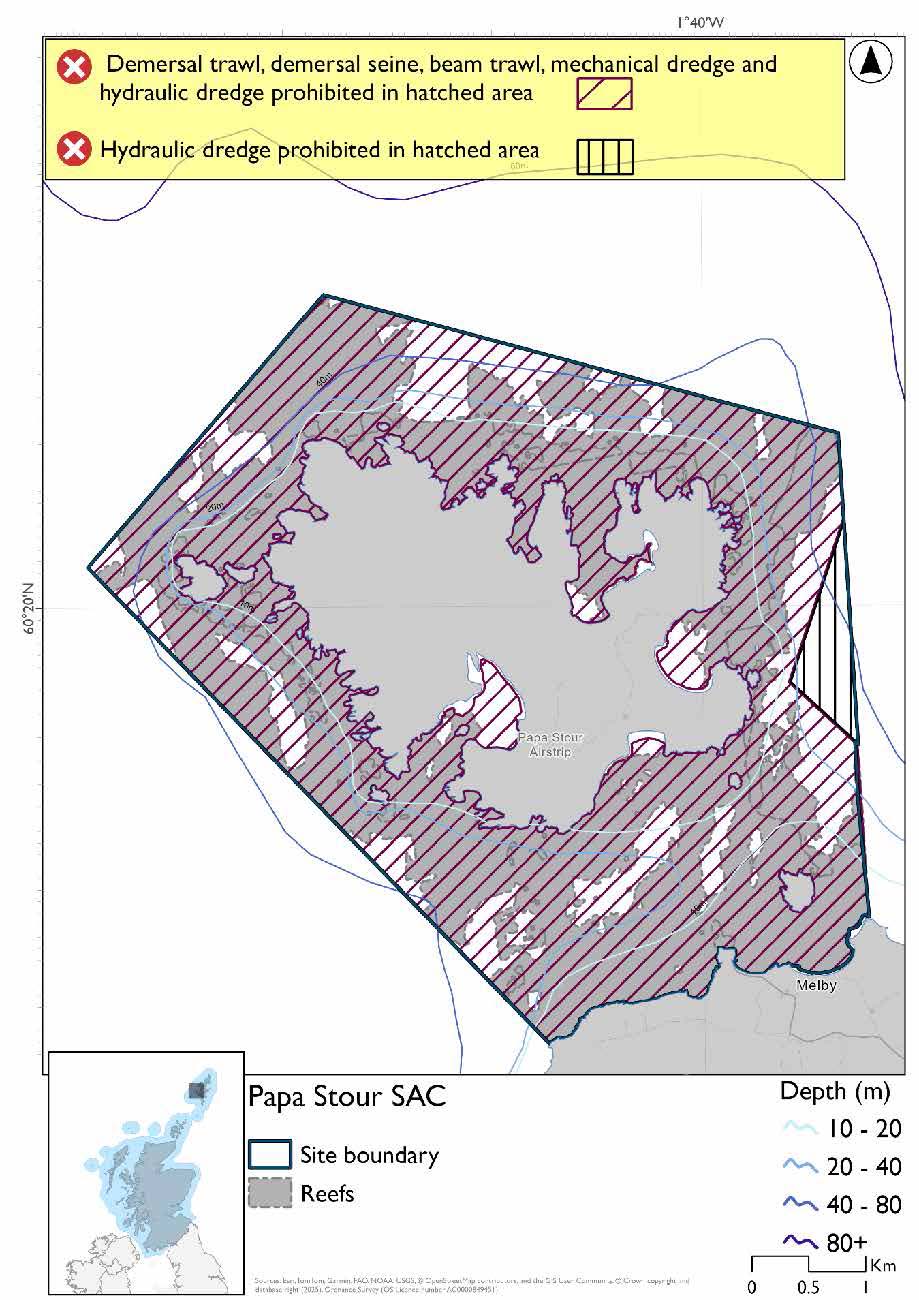
Option Two
- Full site closure to demersal trawl and seine, beam trawl, mechanical dredge and hydraulic dredge
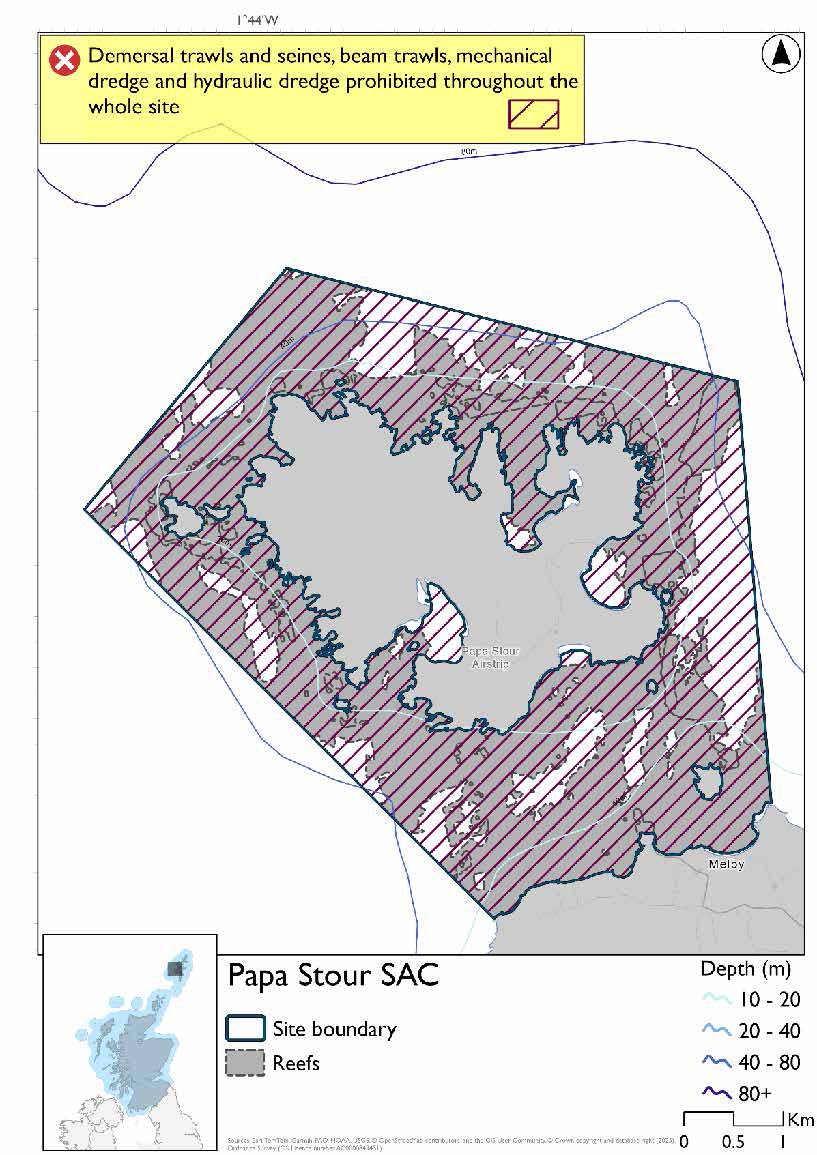
Rationale for developed measures
The basis for the proposed fisheries management measures for each site has been determined by the management advice for fishing activities provided by NatureScot, which can be found on their website or Sitelink as signposted throughout this document. The Fisheries Assessment for each site assesses the impacts from existing fishing activities on the protected features using the tests from the legislation relevant for the type of MPA being considered. The assessment outlines how the proposed measures address any impacts identified that could hinder the conservation objectives of the MPA.
15.3.7 Other fisheries management measures currently applying to this site
There are already management measures in place. An effort has been made to identify existing measures which affect each individual site or area, however the list may not be exhaustive. These measures are outlined below, and the proposals for further management being consulted on now are in addition to these existing measures:
- Fishing for sandeel is prohibited within the Scottish zone, which is defined as the sea adjacent to Scotland up to the 200 nautical miles limit
Other conservation measures can be found in section 7 of the CMA.
15.4 Sullom Voe SAC
15.4.1 Description and background
Sullom Voe SAC is the most northerly SAC in the UK designated for large shallow inlets and bays. It is also the only Scottish example of a ria, a drowned river valley, known locally as a “voe.” Covering approximately 2,691 hectares, the site is characterized by its sheltered marine environment, which supports a rich diversity of boreal-arctic species. These communities are unique to Shetland and not represented elsewhere in the UK’s SAC network. The intertidal zones near the mouth of the voe feature lagoons colonized by bivalves, polychaete worms, and the sea cucumber. Sublittoral areas contain poorly mixed muddy sediments that host horse mussels, sea pens and complex burrowing communities. Additionally, organically enriched shell-sand and gravel substrates support a range of bivalves, amphipods, and other invertebrates. The site encompasses key habitats including shallow bays, estuarine areas, and deeper marine channels, adjacent tidal rivers, mudflats, sandflats, and lagoons, which contribute to the site's ecological diversity.
Further information, including Conservation and Management Advice (CMA) can be found on Sitelink.
Further information on MPAs, the wider network and protected areas management is available at Scottish Government MPA policy page.
15.4.2 Protected features
The Sullom Voe SAC has been designated to protect:
- Lagoons;
- Large shallow inlets and bays; and
- Reefs
Lagoons are not discussed further as they are not a protected feature for which fisheries management measures are required.
15.4.3 Conservation Objectives
All of the protected features are in favourable condition at Sullom Voe SAC and therefore the Conservation Objectives seek to maintain this condition.
Additional details, including the Conservation Objectives are provided in the Conservation and Management Advice document produced for this SAC and can be found on Sitelink.
15.4.4 Pressure from fishing activity
Fishing activities exert significant pressures on the protected features of Sullom Voe SAC, particularly reefs and large shallow inlets and bays. Reefs, including rocky reefs and horse mussel beds, are highly sensitive to bottom‑contact gear such as trawls and dredges, which can damage reef structures, dislodge sessile organisms, and cause smothering and siltation that disrupt water flow and nutrient exchange.
Horse mussel beds are especially sensitive due to their slow recovery and sporadic recruitment, making them less resilient to repeated disturbance.
Large shallow inlets and bays are exposed to a wide range of fishing‑related pressures, including sediment disruption, reduced water clarity, introduction of invasive species, and microbial contamination from fishing vessels. These impacts can lower species diversity, alter habitat structure, and increase vulnerability to further environmental stress.
Additional details are provided in the Conservation and Management Advice document produced for this SAC (section 6) and can be found on Sitelink.
Other resources include:
- The Feature Activity Sensitivity Tool (FeAST) which allows users to investigate the sensitivity of marine features (habitats, species, geology and landforms) in Scotland's seas, to pressures arising from human activities;
- Fisheries Guidance Notes which provide summaries of evidence on the interaction between fishing gears and specific habitats and species.
15.4.5 Fisheries management advice relevant to proposed fisheries management measures
NatureScot provides risk-based advice to help manage activities that may impact protected features and their Conservation Objectives. See section 2.3 for more detail. The CMA document also sets out the fisheries management advice that has been summarised below:
Demersal mobile/active gear
Remove or avoid pressures is recommended for reefs and horse mussel beds.
Reduce or limit pressures is recommended for large shallow inlets and bays.
Hydraulic (diver or vessel)
Remove or avoid pressures is recommended for reefs.
15.4.6 Proposed fisheries management measures
The proposed management measures for Sullom Voe SAC are as follows:
Option One*
- Demersal trawl and seine, beam trawl, mechanical dredge and hydraulic dredge prohibited in part of the site covering all the reef habitat and most of the large shallow inlets and bays
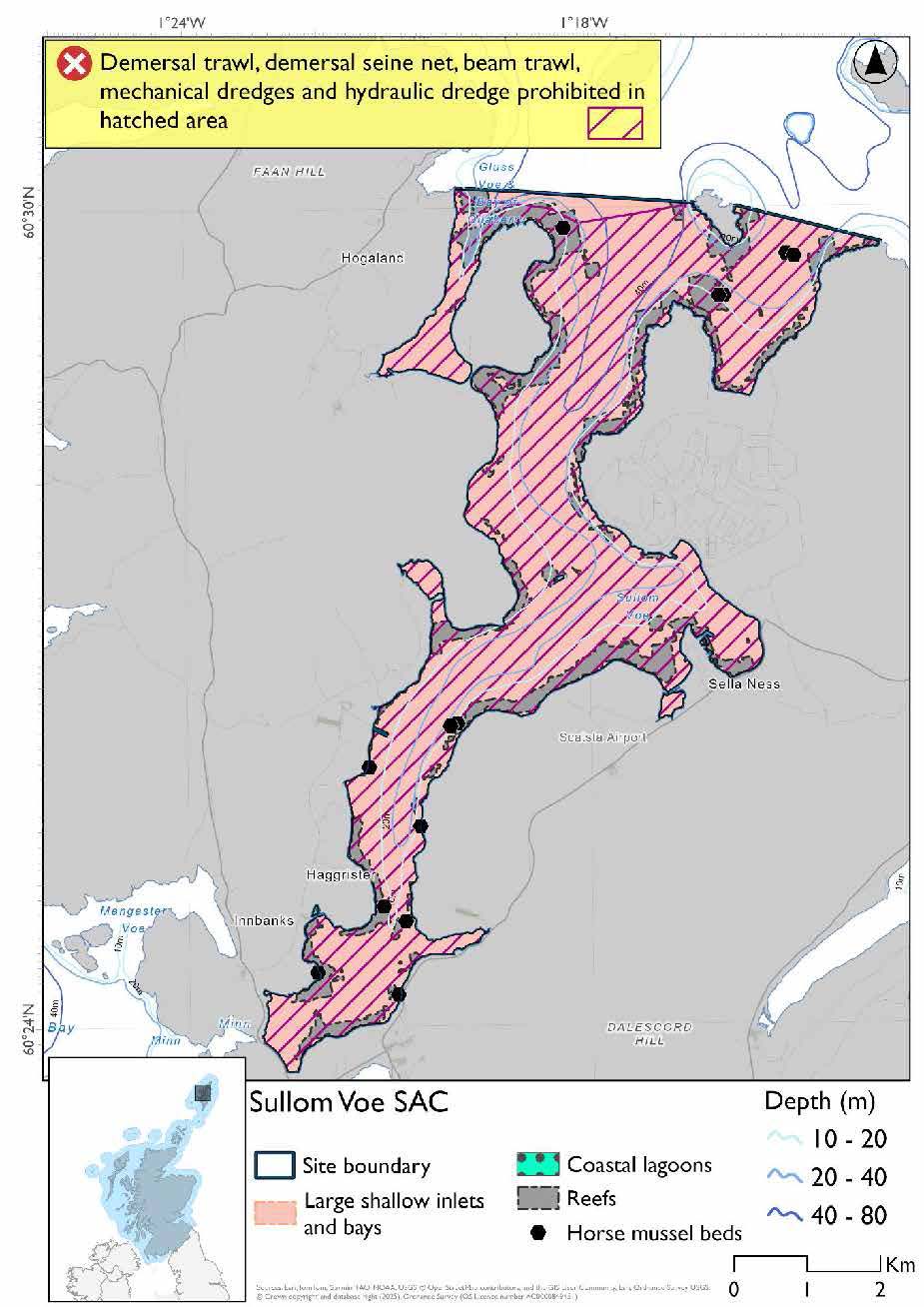
*This site will have other fisheries management measures that may apply from the overlapping portions with the Yell Sound Coast SAC that aren’t shown on the map for this option.
- Yell Sound Coast SAC would prohibit set nets (including fyke nets) and pelagic seine (including ring nets) in the overlapping area.
Please check the Option 1 or single management overlapping site map to see proposed demersal mobile measures under Option 1.
Option Two*
- Full site closure to demersal trawl and seine, beam trawl, mechanical dredge and hydraulic dredge
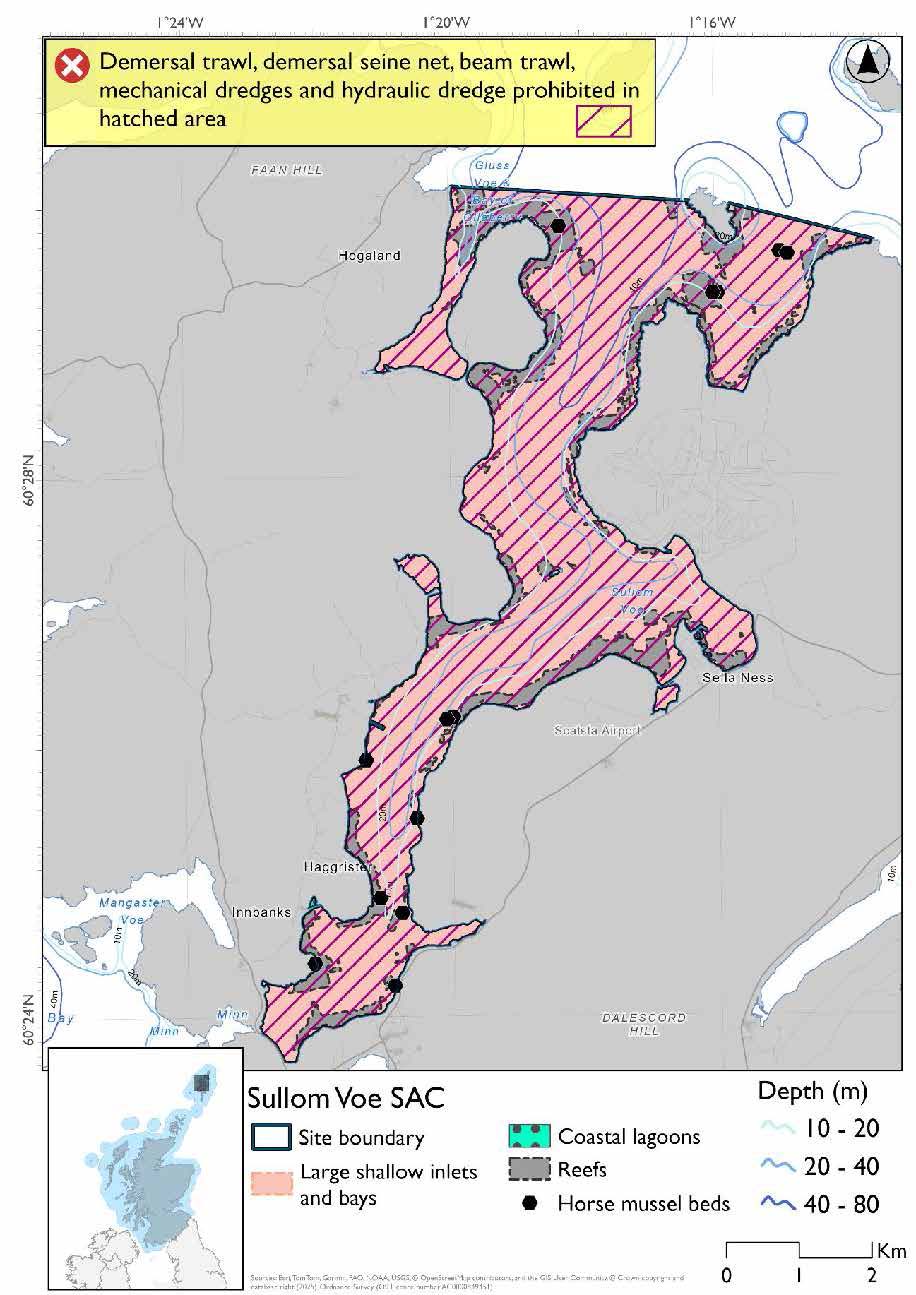
*The measures for Option 2 proposals only come from gear types prohibited in non-overlapping areas. Overlapping restrictions may still apply from overlapping sites or areas dependent on the decisions taken for that site or area.
Overlapping site included in this consultation
This SAC overlaps with the Yell Sound Coast SAC.
Rationale for developed measures
The basis for the proposed fisheries management measures for each site has been determined by the management advice for fishing activities provided by NatureScot, which can be found on their website or Sitelink as signposted throughout this document. The Fisheries Assessment for each site assesses the impacts from existing fishing activities on the protected features using the tests from the legislation relevant for the type of MPA being considered. The assessment outlines how the proposed measures address any impacts identified that could hinder the conservation objectives of the MPA.
15.4.7 Other fisheries management measures currently applying to this site
There are already management measures in place. An effort has been made to identify existing measures which affect each individual site or area, however the list may not be exhaustive. These measures are outlined below, and the proposals for further management being consulted on now are in addition to these existing measures:
- Fishing for sandeel is prohibited within the Scottish zone, which is defined as the sea adjacent to Scotland up to the 200 nautical miles limit
- Under the Shetland Regulating Order, Scallop dredging prohibited in part of the site.
Other conservation measures can be found in section 7 of the CMA.
15.5 Yell Sound Coast SAC
15.5.1 Description and background
The Yell Sound Coast SAC encompasses a diverse coastal and marine environment. The site includes rocky shores, low-lying peatland coastlines, and a network of islands and skerries, creating a rich mosaic of habitats. These varied landscapes support important ecological communities and provide critical habitat for marine mammals, making the area one of high conservation value. The site spans approximately 1,544 hectares, and its shape reflects the need to protect both terrestrial and adjacent marine habitats that support foraging, breeding, and resting behaviours of the designated species. Harbour seals thrive in this area, with Yell Sound representing the most northerly SAC in the UK designated for this species. The rocky shores and secluded islands provide ideal haul-out and breeding sites, supporting more than 1% of the UK harbour seal population.
Further information, including Conservation and Management Advice (CMA) can be found on Sitelink.
Further information on MPAs, the wider network and protected areas management is available at Scottish Government MPA policy page.
15.5.2 Protected features
Yell Sound Coast SAC has been designated to protect:
- Harbour seal
- Otter
Otter are not discussed further as they are not a protected feature for which fisheries management measures are required.
15.5.3 Conservation Objectives
Harbour seal are in unfavourable condition at Yell Sound Coast SAC due to reductions in numbers using the site and therefore the Conservation Objectives seek to restore favourable condition by supporting recovery.
Additional details, including the Conservation Objectives are provided in the Conservation and Management Advice document produced for this SAC and can be found on Sitelink.
15.5.4 Pressure from fishing activity
Fishing activities can exert multiple pressures on harbour seals, particularly through entanglement in fishing gear, which can cause injury or death, especially among younger or inexperienced individuals. Underwater noise from vessels and equipment used in fishing operations can disrupt communication, navigation, and foraging, leading to stress and displacement, especially during sensitive periods like breeding and moulting.
Disturbance from fishing-related activity may alter haul-out behaviour, reduce resting time, and in severe cases, lead to site abandonment. During breeding, such disruptions can interrupt lactation or separate mothers from pups, reducing pup survival.
Additional details are provided in the Conservation and Management Advice document produced for this SAC (section 6) and can be found on Sitelink.
Other resources include:
- The Feature Activity Sensitivity Tool (FeAST) which allows users to investigate the sensitivity of marine features (habitats, species, geology and landforms) in Scotland's seas, to pressures arising from human activities;
- Fisheries Guidance Notes which provide summaries of evidence on the interaction between fishing gears and specific habitats and species.
15.5.5 Fisheries management advice relevant to proposed fisheries management measures
NatureScot provides risk-based advice to help manage activities that may impact protected features and their Conservation Objectives. See section 2.3 for more detail. The CMA document also sets out the full fisheries management advice that has been summarised below for the management measures proposed:
Netting (Bottom-set gill nets including tangle and trammel nets. Drift nets, purse seine, ring-nets and fyke nets.)
Reduce or limit pressures - (entanglement) associated with the use of nets is recommended.
15.5.6 Proposed fisheries management measures
The proposed management measure for Yell Sound Coast SAC is as follows:
Single Proposed Management Option*
- Full site closure to set nets (including fyke nets) and pelagic seine (including ring nets)
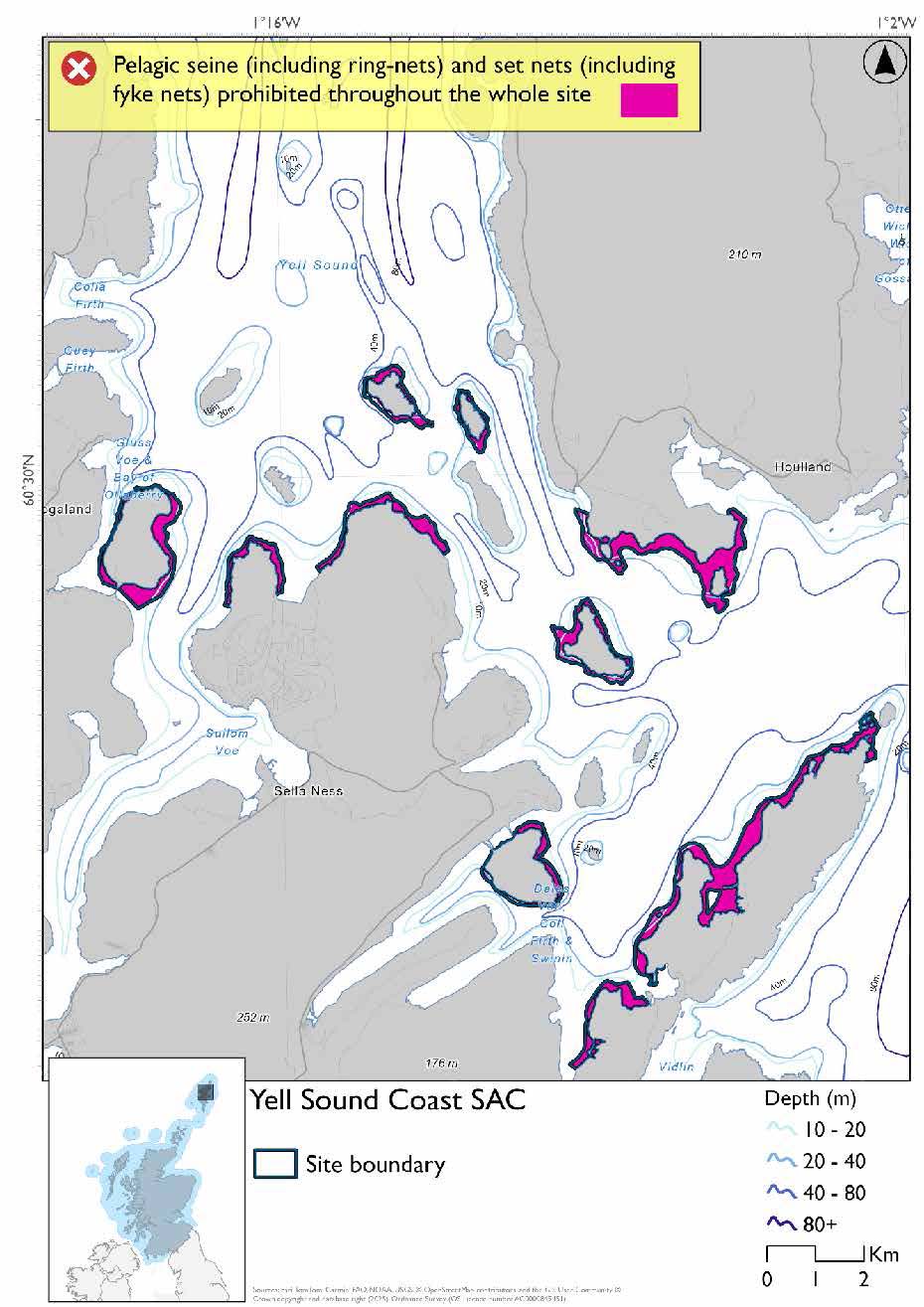
A full site level of protection from the specified gear has been identified as the only suitable option in enabling the achievement of the desired level of protection for the feature in question.
*This site will have other demersal mobile measures that may apply from the overlapping portions with the Sullom Voe SAC, East Mainland Coast, Shetland SPA and Lunna Ness, North (Shetland) proposed PMF management area that aren’t shown on the map for this option.
- Sullom Voe SAC and Lunna Ness, North (Shetland) proposed PMF management area would prohibit demersal trawl, demersal seine, beam trawl, mechanical dredge and hydraulic dredge in the overlapping area
- East Mainland Coast, Shetland SPA would prohibit hydraulic dredge in the overlapping area
Please check the Option 1 or single management overlapping site and area maps to see proposed demersal mobile measures under Option 1.
Overlapping sites and areas included in this consultation
This SAC overlaps with the Sullom Voe SAC, East Mainland Coast, Shetland SPA and Lunna Ness, North (Shetland) proposed PMF management area.
Rationale for developed measures
The basis for the proposed fisheries management measures for each site has been determined by the management advice for fishing activities provided by NatureScot, which can be found on their website or Sitelink as signposted throughout this document. The Fisheries Assessment for each site assesses the impacts from existing fishing activities on the protected features using the tests from the legislation relevant for the type of MPA being considered. The assessment outlines how the proposed measures address any impacts identified that could hinder the conservation objectives of the MPA.
15.5.7 Other fisheries management measures currently applying to this site
There are already management measures in place. An effort has been made to identify existing measures which affect each individual site or area, however the list may not be exhaustive. These measures are outlined below, and the proposals for further management being consulted on now are in addition to these existing measures:
- Fishing for sandeel is prohibited within the Scottish zone, which is defined as the sea adjacent to Scotland up to the 200 nautical miles limit
Other conservation measures can be found in section 7 of the CMA.
15.6 Bluemull and Colgrave Sounds SPA
15.6.1 Description and background
The Bluemull and Colgrave Sounds SPA stretches from the north coast of Yell through Bluemull Sound and down through Colgrave Sound to the south of Hascosay. Covering an area of approximately 38.23 km², the SPA encompasses a mix of sheltered inshore waters and deeper offshore zones, with depths generally less than 40 metres inshore but increasing rapidly to the south of Fetlar, ideal conditions for red-throated divers to hunt small fish and invertebrates.
The coastline within the SPA is predominantly cliff-lined, interspersed with sandy beaches and bays, creating a varied and productive marine environment. The seabed is largely composed of gravel and sand, supporting a rich diversity of benthic organisms such as polychaete worms, gastropods, bivalve molluscs, and small fish. These prey species are vital for the waterbirds that frequent the area, making the site ecologically significant.
The SPA’s sheltered waters and rich feeding grounds provide ideal conditions for breeding and foraging, making it a key location for maintaining the favourable conservation status of red-throated divers. Management of the site focuses on minimising disturbance, safeguarding prey availability, and maintaining the integrity of the marine habitats that support this sensitive species.
Further information, including Conservation and Management Advice (CMA) can be found on Sitelink.
Further information on MPAs, the wider network and protected areas management is available at Scottish Government MPA policy page.
15.6.2 Protected features
The Bluemull and Colgrave Sounds SPA has been designated to protect:
- Red-throated diver
Red-throated divers in the Bluemull and Colgrave Sounds SPA are protected within the SPA throughout the year, irrespective of the season for which they qualified as a protected feature.
15.6.3 Conservation Objectives
Red-throated divers are in favourable condition at Bluemull and Colgrave Sounds SPA. Therefore, the Conservation Objectives for the Bluemull and Colgrave Sounds SPA seek to maintain this condition.
Additional details, including the Conservation Objectives are provided in the Conservation and Management Advice document produced for this SPA and can be found on Sitelink.
15.6.4 Pressure from fishing activity
Fishing activity poses several pressures on the red-throated diver, particularly during the breeding season when the species is concentrated in sheltered inshore waters.
The most direct risk comes from entanglement in fishing gear and incidental bycatch, which can lead to injury or mortality. Divers are especially sensitive to static nets and other passive gear types deployed in nearshore areas where they forage. In addition to physical harm, red-throated divers are highly sensitive to visual disturbance caused by vessel traffic and fishing operations. Such disturbance can alter their behaviour, reduce foraging efficiency, and lead to displacement from preferred feeding areas, even if the activity does not result in direct contact.
Fishing also indirectly affects red-throated divers by influencing prey availability, particularly small fish like sandeels, which are a key food source. Overfishing or habitat degradation linked to fishing practices can reduce prey abundance, impacting the birds’ ability to meet energetic demands during breeding.
Additional details are provided in the Conservation and Management Advice document produced for this SPA (section 6) and can be found on Sitelink.
Other resources include:
- The Feature Activity Sensitivity Tool (FeAST) which allows users to investigate the sensitivity of marine features (habitats, species, geology and landforms) in Scotland's seas, to pressures arising from human activities;
- Fisheries Guidance Notes which provide summaries of evidence on the interaction between fishing gears and specific habitats and species.
15.6.5 Fisheries management advice relevant to proposed fisheries management measures
NatureScot provides risk-based advice to help manage activities that may impact protected features and their Conservation Objectives. See section 2.3 for more detail. The CMA document also sets out the full fisheries management advice that has been summarised below for the management measures proposed:
Hydraulic gear
Remove or avoid pressures (removal of prey species and disturbance of prey-supporting habitat) associated with hydraulic fishing that has the potential to damage seabed habitat (in particular, sandeel habitat) is recommended.
Static gear
Remove or avoid pressures (entanglement) associated with the use of all static nets (whether bottom set or in the water column). Spatial exclusion of static nets in areas identified as being important for red-throated divers (as identified from habitat and dive depth references) between April to mid-September each year is recommended.
Pelagic gear
Pelagic fishing for herring/sprat may occur within or around the SPA. It is recommended that a principal objective of the management of the fishery should be ensuring that the fishing activity does not prevent or disrupt the availability of prey species for red-throated divers, i.e. it should be considered as part of a broader ecosystem-based approach to management of this fishery.
For the SPAs advice has also been provided on maximum dive depth and seasonality for protected features of each site and can be found in the Fishing Activity Further Advice and Evidence document. Supplementary advice can also be found on NatureScot’s website.
15.6.6 Proposed fisheries management measures
The proposed management measures for Bluemull and Colgrave Sounds SPA are as follows:
Option One*
- Set nets (including fyke nets) prohibited between April and mid-September in areas shallower than 21m based on presence and maximum dive depth for red-throated diver
- Pelagic set nets prohibited between April and mid-September in areas deeper than 21m based on presence of red-throated diver
- Set nets (including fyke nets) prohibited in part of the site that overlaps with the Fetlar to Haroldswick NCMPA
- Longlines (until technical measures come into force) prohibited in part of the site that overlaps with Fetlar SPA
- Full site closure to hydraulic dredge
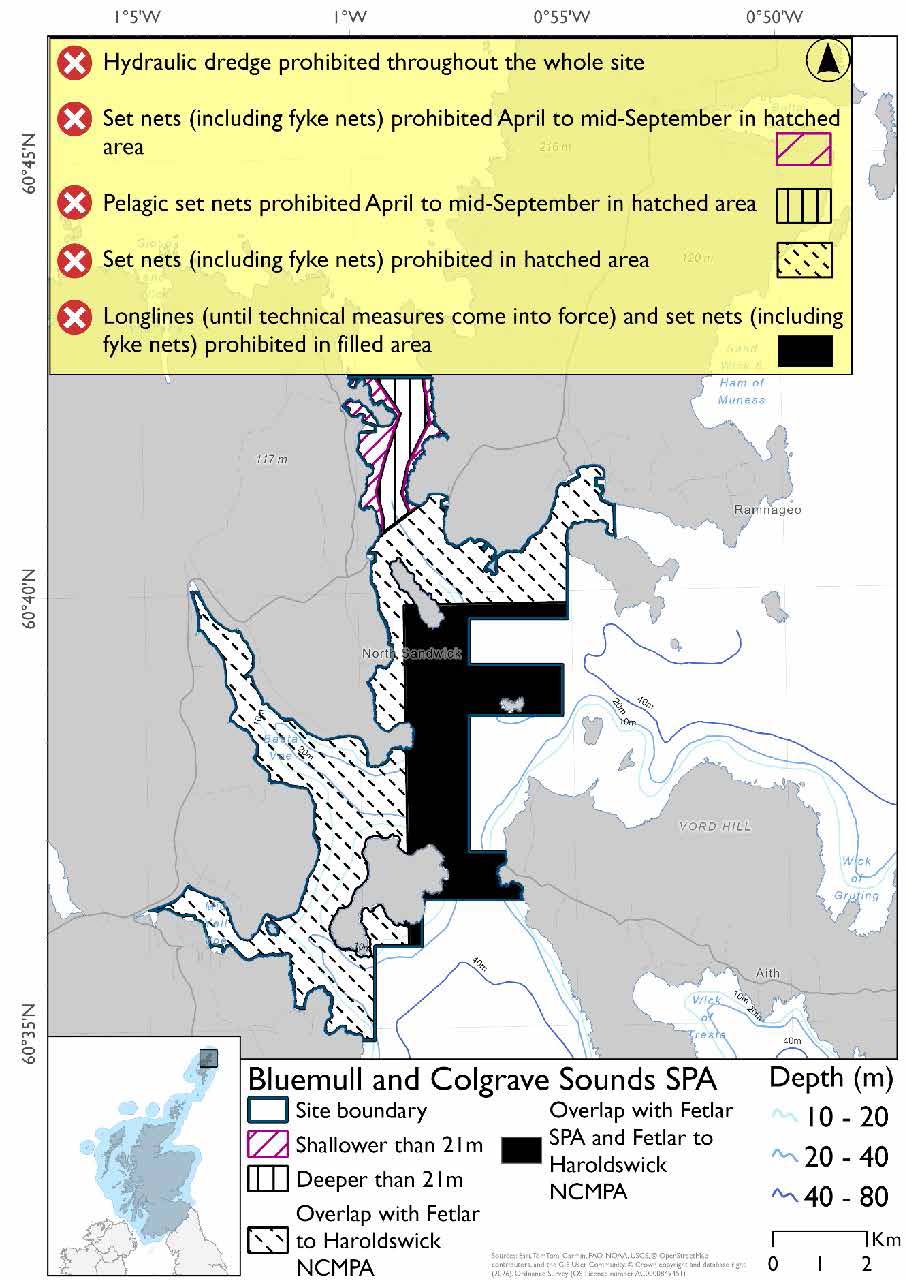
*This site will have other demersal mobile measures that may apply from the overlapping portions with the Fetlar to Haroldswick NCMPA that aren’t shown on the map for this option.
- Fetlar to Haroldswick NCMPA has zoned measures for demersal trawl and seine, beam trawl and mechanical dredge. Measures would depend on where overlap occurs.
Please check the Option 1 or single management overlapping site map to see proposed demersal mobile measures under Option 1.
Option Two*
- Full site closure to set nets (including fyke nets) and hydraulic dredge
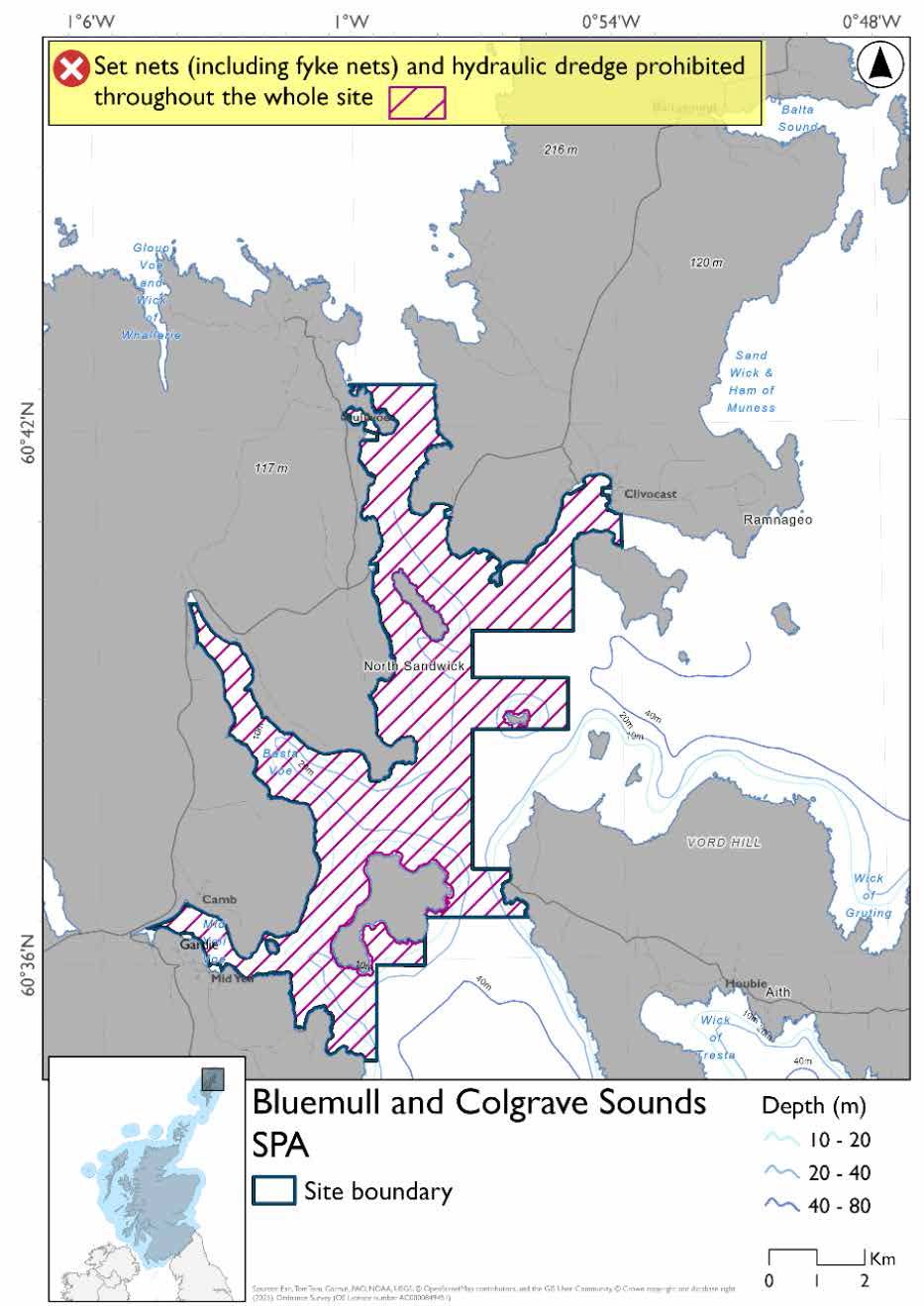
*The measures for Option 2 proposals only come from gear types prohibited in non-overlapping areas. Overlapping restrictions may still apply from overlapping sites or areas dependent on the decisions taken for that site or area.
Overlapping sites included in this consultation
This SPA overlaps Fetlar to Haroldswick NCMPA and Fetlar SPA.
Rationale for measures development
The basis for the proposed fisheries management measures for each site has been determined by the management advice for fishing activities provided by NatureScot, which can be found on their website or Sitelink as signposted throughout this document. The Fisheries Assessment for each site assesses the impacts from existing fishing activities on the protected features using the tests from the legislation relevant for the type of MPA being considered. The assessment outlines how the proposed measures address any impacts identified that could hinder the conservation objectives of the MPA.
15.6.7 Other fisheries management measures currently applying to this site
There are already management measures in place. An effort has been made to identify existing measures which affect each individual site or area, however the list may not be exhaustive. These measures are outlined below, and the proposals for further management being consulted on now are in addition to these existing measures:
- Fishing for sandeel is prohibited within the Scottish zone, which is defined as the sea adjacent to Scotland up to the 200 nautical miles limit;
- Under the Shetland Regulating Order, Scallop dredging prohibited in part of the site
- Under the Shetland Shellfish Management Organisation (SSMO) Spatial Management Plan, hydraulic dredging is banned
Other conservation measures can be found in section 7 of the CMA.
15.7 East Mainland Coast, Shetland SPA
15.7.1 Description and background
The East Mainland Coast, Shetland SPA is a marine site of high ecological importance located along the eastern coastline of Shetland. It stretches from Fish Holm and Lunna Ness in the north, encompassing Whalsay, and extends southward to the north coast of Bressay. Covering approximately 233.33 km², the SPA includes a mix of sheltered inshore waters, cliff-lined coasts, and sandy bays, creating a rich and varied marine environment.
The SPA supports internationally important populations of red-throated diver (breeding), great northern diver (non-breeding), and Slavonian grebe (non-breeding). These species rely heavily on shallow, sheltered inshore waters for foraging and resting. The boundary was drawn to include areas where these birds are most frequently observed and where they concentrate during the breeding and overwintering seasons.
For red-throated divers, the boundary includes nearshore feeding grounds adjacent to inland breeding sites, which are essential during the summer months. For great northern divers and Slavonian grebes, the SPA covers wintering habitats that provide rich prey availability.
The seabed within the SPA is predominantly composed of gravel and sand, supporting a diverse community of benthic organisms such as polychaete worms, gastropods, bivalve molluscs, and small fish. These prey species are vital for the waterbirds that frequent the area, making the site particularly valuable for seabird conservation. Water depths are generally less than 40m, although they increase rapidly in the northern part of the site.
Further information, including Conservation and Management Advice (CMA) can be found on Sitelink.
Further information on MPAs, the wider network and protected areas management is available at Scottish Government MPA policy page.
15.7.2 Protected features
The East Mainland Coast, Shetland SPA has been designated to protect:
- Great northern diver;
- Slavonian grebe; and
- Red-throated diver
The protected features of the East Mainland Coast, Shetland SPA are protected within the SPA throughout the year, irrespective of the season for which they qualified as a protected feature.
15.7.3 Conservation Objectives
The protected features of East Mainland Coast, Shetland SPA are in favourable condition. Therefore, the Conservation Objective for the East Mainland Coast, Shetland SPA seek to maintain this condition.
Additional details, including the Conservation Objectives are provided in the Conservation and Management Advice document produced for this SPA and can be found on Sitelink.
15.7.4 Pressure from fishing activity
Fishing activities can exert significant pressures on the great northern diver, Slavonian grebe, and red‑throated diver through both direct harm and indirect ecological disruption. All three species are sensitive to entanglement and bycatch in static nets and traps, particularly in inshore waters during wintering and breeding seasons when birds are concentrated in specific areas.
Disturbance from fishing vessels can cause behavioural changes and displacement, with Slavonian grebes and great northern divers showing avoidance responses to boats over large distances. Red‑throated divers are especially sensitive to visual disturbance during breeding, which can disrupt foraging and nesting behaviour.
Additional details are provided in the Conservation and Management Advice document produced for this SPA (section 6) and can be found on Sitelink.
Other resources include:
- The Feature Activity Sensitivity Tool (FeAST) which allows users to investigate the sensitivity of marine features (habitats, species, geology and landforms) in Scotland's seas, to pressures arising from human activities;
- Fisheries Guidance Notes which provide summaries of evidence on the interaction between fishing gears and specific habitats and species.
15.7.5 Fisheries management advice relevant to proposed fisheries management measures
NatureScot provides risk-based advice to help manage activities that may impact protected features and their Conservation Objectives. See section 2.3 for more detail. The CMA document also sets out the full fisheries management advice that has been summarised below for the management measures proposed:
Hydraulic gear
Remove or avoid pressures (removal of prey species and disturbance of prey-supporting habitat) associated with hydraulic fishing that has the potential to damage seabed habitat (in particular, sandeel habitat) is recommended.
Currently hydraulic dredges are not permitted in Shetland inshore waters under the SSMO Regulations; this position should be retained.
Static gear
Remove or avoid pressures (entanglement) associated with the use of all static nets. Spatial exclusion of static nets in areas identified as being important for divers and grebes (as identified from habitat and dive depth preferences) between mid-September and mid-May each year is recommended.
Remove or avoid pressures (entanglement) associated with all static nets (whether bottom set or in the water column). Spatial exclusion of static nets in areas identified as being important for red-throated diver (as identified from habitat and dive depth preferences) between April and mid-September each year is recommended.
Pelagic gear
Pelagic fishing for herring/sprat may occur within or around the SPA. It is recommended that a principal objective of the management of the fishery should be ensuring that the fishing activity does not prevent or disrupt the availability of prey species for divers or Slavonian grebe, i.e. it should be considered as part of a broader ecosystem-based approach to management of this fishery.
For the SPAs advice has also been provided on maximum dive depth and seasonality for protected features of each site and can be found in the Fishing Activity Further Advice and Evidence document. Supplementary advice can also be found on NatureScot’s website.
15.7.6 Proposed fisheries management measures
The proposed management measures for East Mainland Coast, Shetland SPA are as follows:
Option One*
- Set nets (including fyke nets) prohibited in areas down to 21m based on presence of red-throated diver and great northern diver and maximum dive depth for red-throated diver
- Demersal set nets (including fyke nets) prohibited October till mid-May and pelagic set nets prohibited in areas deeper than 21m but shallower than 55m based on the presence of red-throated diver and great northern diver and the maximum dive depth for great northern diver
- Pelagic set nets prohibited in areas deeper than 55m based on presence of red-throated diver and great northern diver
- Demersal set nets (including fyke nets) and pelagic seine (including ring-nets) prohibited in part of the site that overlaps with the Yell Sound Coast SAC
- Full site closure to hydraulic dredge
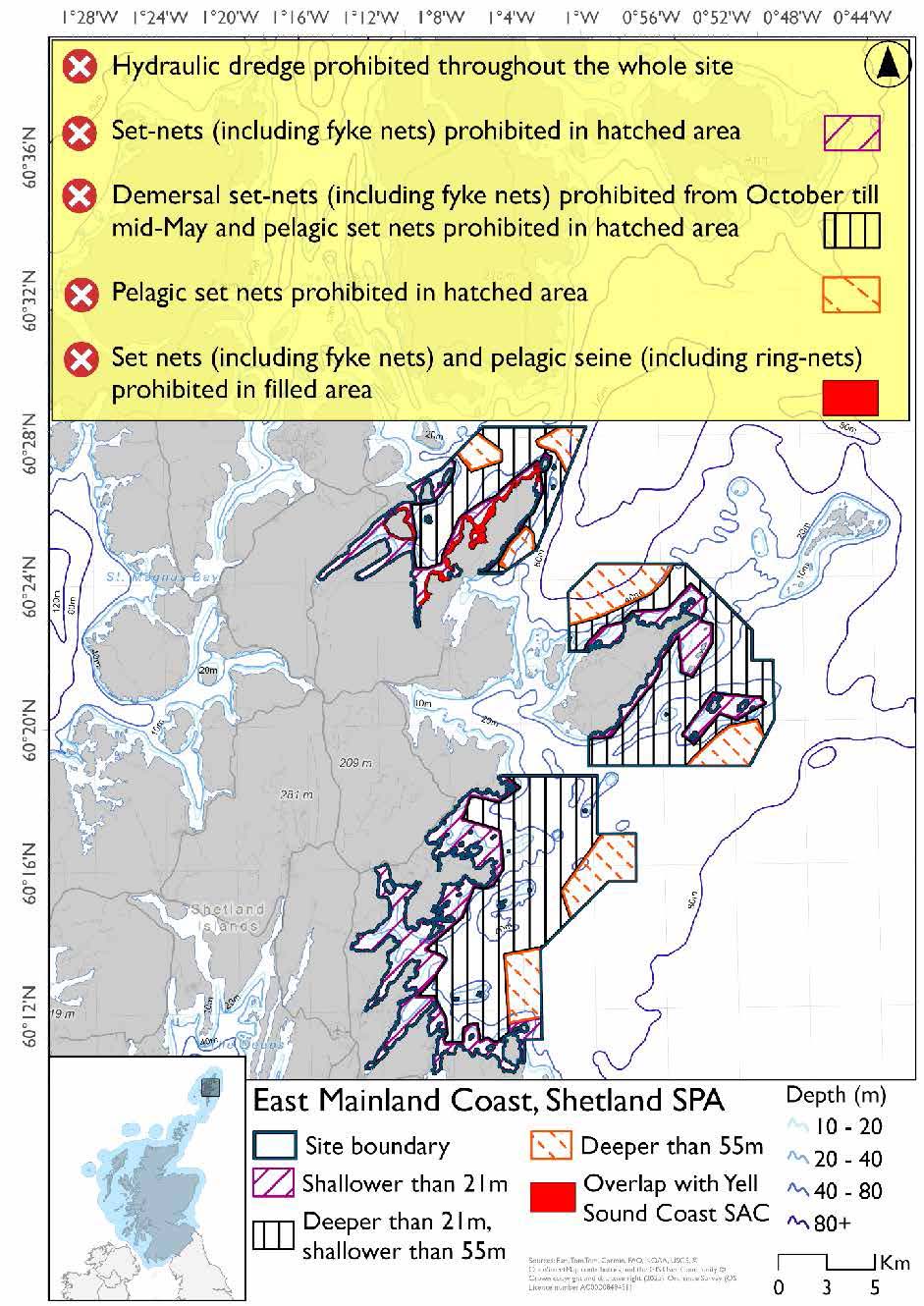
*This site will have other demersal mobile measures that may apply from the overlapping portions with the proposed PMF management areas that aren’t shown on the map for this option.
- The proposed PMF management areas would prohibit all demersal mobile gear from the entire area that overlaps. (see section below for overlapping areas)
Please check the Option 1 or single management overlapping area maps to see proposed demersal mobile measures under Option 1.
Option Two*
- Full site closure to set nets (including fyke nets) and hydraulic dredge
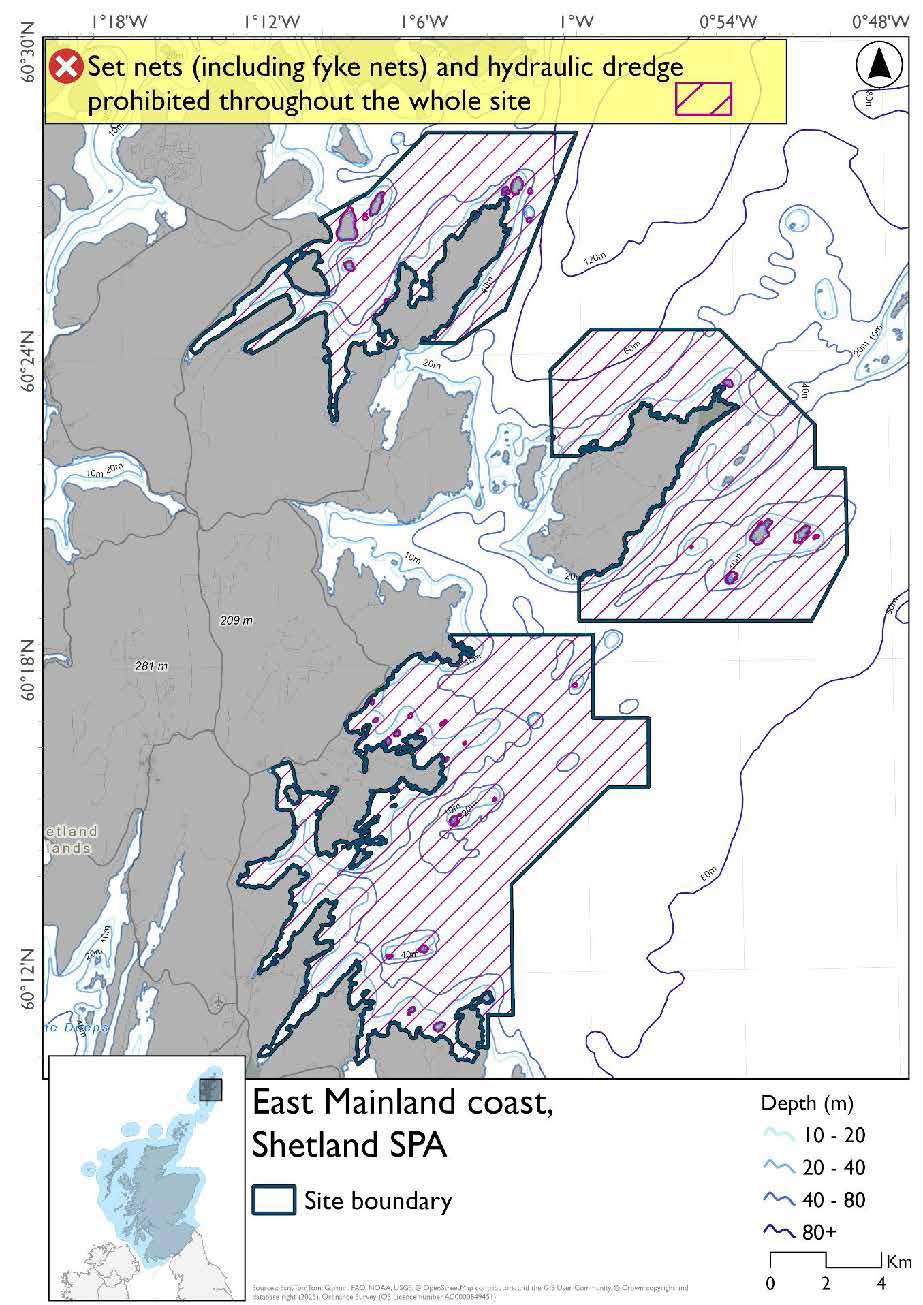
*The measures for Option 2 proposals only come from gear types prohibited in non-overlapping areas. Overlapping restrictions may still apply from overlapping sites or areas dependent on the decisions taken for that site or area.
Overlapping site and areas included in this consultation
This SPA overlaps the Wadbister Voe (Shetland) and Lunna Ness, North (Shetland) proposed PMF management areas and Yell Sound Coast SAC.
Rationale for developed measures
The basis for the proposed fisheries management measures for each site has been determined by the management advice for fishing activities provided by NatureScot, which can be found on their website or Sitelink as signposted throughout this document. The Fisheries Assessment for each site assesses the impacts from existing fishing activities on the protected features using the tests from the legislation relevant for the type of MPA being considered. The assessment outlines how the proposed measures address any impacts identified that could hinder the conservation objectives of the MPA.
15.7.7 Other fisheries management measures currently applying to this site
There are already management measures in place. An effort has been made to identify existing measures which affect each individual site or area, however the list may not be exhaustive. These measures are outlined below, and the proposals for further management being consulted on now are in addition to these existing measures:
- Fishing for sandeel is prohibited within the Scottish zone, which is defined as the sea adjacent to Scotland up to the 200 nautical miles limit
- Under the Shetland Regulating Order, Scallop dredging prohibited in part of the site
- Under the Shetland Shellfish Management Organisation (SSMO) Spatial Management Plan, hydraulic dredging is banned
Other conservation measures can be found in section 7 of the CMA.
15.8 Fair Isle SPA
15.8.1 Description and background
The Fair Isle SPA is located on Fair Isle, a remote island situated between mainland Shetland and Orkney. The site is internationally recognised for its importance to breeding seabirds and was designated to protect species of European conservation concern.
The SPA encompasses the entire island and its surrounding cliffs, covering a total area of approximately 768 hectares. The island’s rugged terrain includes steep sea cliffs, coastal heath, and maritime grasslands, which provide ideal nesting habitats for a wide range of seabird species. The surrounding waters are also ecologically rich, supporting the foraging needs of birds during the breeding season.
Fair Isle SPA supports significant populations of Arctic skua, great skua, fulmar, guillemot, and puffin, among others. These species are part of a larger seabird assemblage that regularly exceeds the threshold for international importance. The site is particularly notable for its dense breeding colonies, which are among the most studied in the UK, contributing valuable long-term data to national seabird monitoring programmes.
Further information, including Conservation and Management Advice (CMA) can be found on Sitelink.
Further information on MPAs, the wider network and protected areas management is available at Scottish Government MPA policy page.
15.8.2 Protected features
The Fair Isle SPA has been designated to protect:
- Arctic skua;
- Arctic tern;
- Fair Isle wren;
- Fulmar;
- Gannet;
- Great skua;
- Guillemot;
- Kittiwake;
- Puffin;
- Razorbill; and
- Shag
Fair Isle wren are not discussed further as they are not a protected feature for which fisheries management measures are required.
The protected features of the Fair Isle SPA are protected within the SPA throughout the year, irrespective of the season for which they qualified as a protected feature.
15.8.3 Conservation Objectives
The following protected features are in favourable condition at the Fair Isle SPA: great skua, gannet and fulmar. Therefore, the Conservation Objectives seek to maintain this condition.
The following protected features are in unfavourable condition at the Fair Isle SPA: Arctic skua, Arctic tern, puffin, kittiwake, guillemot, shag and razorbill. Therefore, the Conservation Objectives seek to restore this condition
Additional details, including the Conservation Objectives, are provided in the Conservation and Management Advice document produced for this SPA and can be found on Sitelink.
15.8.4 Pressure from fishing activity
Fishing activities can exert several key pressures on the seabird populations of the Fair Isle SPA, primarily through bycatch, prey depletion, and disturbance. Species such as puffins, guillemots, razorbills, fulmars, kittiwakes, Arctic terns, and shags are sensitive to accidental entanglement in surface nets and longlines, with risks heightened during breeding and moulting when birds are less mobile and concentrated in coastal waters.
Prey depletion is a widespread concern, as many of these species rely heavily on forage fish like sandeels. Overfishing and habitat degradation reduce food availability, impacting breeding success and adult survival, with puffins, kittiwakes, fulmars, and skuas particularly sensitive to declines in prey abundance. Increased turbidity from fishing activities such as dredging can also impair the foraging efficiency of diving species including auks, terns, and shags.
Disturbance from fishing vessels and operations further disrupts seabird behaviour. Visual and noise disturbance can displace guillemots, razorbills, and shags from foraging areas, while Arctic terns and skuas are especially sensitive to disruption at breeding colonies, sometimes leading to nest abandonment or egg failure.
Additional details are provided in the Conservation and Management Advice document produced for this SPA (section 6) and can be found on Sitelink.
Other resources include:
- The Feature Activity Sensitivity Tool (FeAST) which allows users to investigate the sensitivity of marine features (habitats, species, geology and landforms) in Scotland's seas, to pressures arising from human activities;
- Fisheries Guidance Notes which provide summaries of evidence on the interaction between fishing gears and specific habitats and species.
15.8.5 Fisheries management advice relevant to proposed fisheries management measures
NatureScot provides risk-based advice to help manage activities that may impact protected features and their Conservation Objectives. See section 2.3 for more detail. The CMA document also sets out the full fisheries management advice that has been summarised below for the management measures proposed:
Hydraulic gear
Remove or avoid pressures (removal of prey species and disturbance of prey-supporting habitat) associated with hydraulic fishing that has the potential to damage seabed habitat (in particular, sandeel habitat, herring spawning grounds) is recommended.
Static gear (drift nets and bottom set nets inc. fyke nets)
Remove or avoid pressures (entanglement) associated with the use of all static nets. Spatial exclusion of all static nets in areas identified as being important for auks, gannet and shag (as identified from habitat and dive depth preferences) is recommended.
Pelagic gear
Pelagic fishing for herring/sprat may occur within or around the SPA. It is recommended that a principal objective of the management of the fishery should be ensuring that the fishing activity does not prevent or disrupt the availability of prey species i.e. it should be considered as part of a broader ecosystem-based approach to management of this fishery.
Longlining (not including jigging)
Long-lining (pelagic and demersal) may occur within or around the SPA(s). Current understanding is that long-line fisheries are largely restricted to offshore waters. Site-specific measures for long-lining are not currently considered appropriate due to the scale of the fishery, and the wide-spread interaction with seabirds. However, there is evidence of seabird bycatch in long-line (not jigging) fisheries therefore it is recommended this requires wider seas management measures.
For the SPAs advice has also been provided on maximum dive depth and seasonality for protected features of each site and can be found in the Fishing Activity Further Advice and Evidence document. Supplementary advice can also be found on NatureScot’s website.
15.8.6 Proposed fisheries management measures
The proposed management measures for Fair Isle SPA are as follows:
Option One
- Set nets (including fyke nets) prohibited in areas shallower than 64.5m based on presence and maximum dive depth for shag
- Demersal set nets (including fyke nets) prohibited February till end of August due to presence and maximum dive depth for guillemot and pelagic set nets prohibited due to presence of shag in areas deeper than 64.5m but shallower than 177m
- Full site closure to longlines (until technical measures come into force) and hydraulic dredge
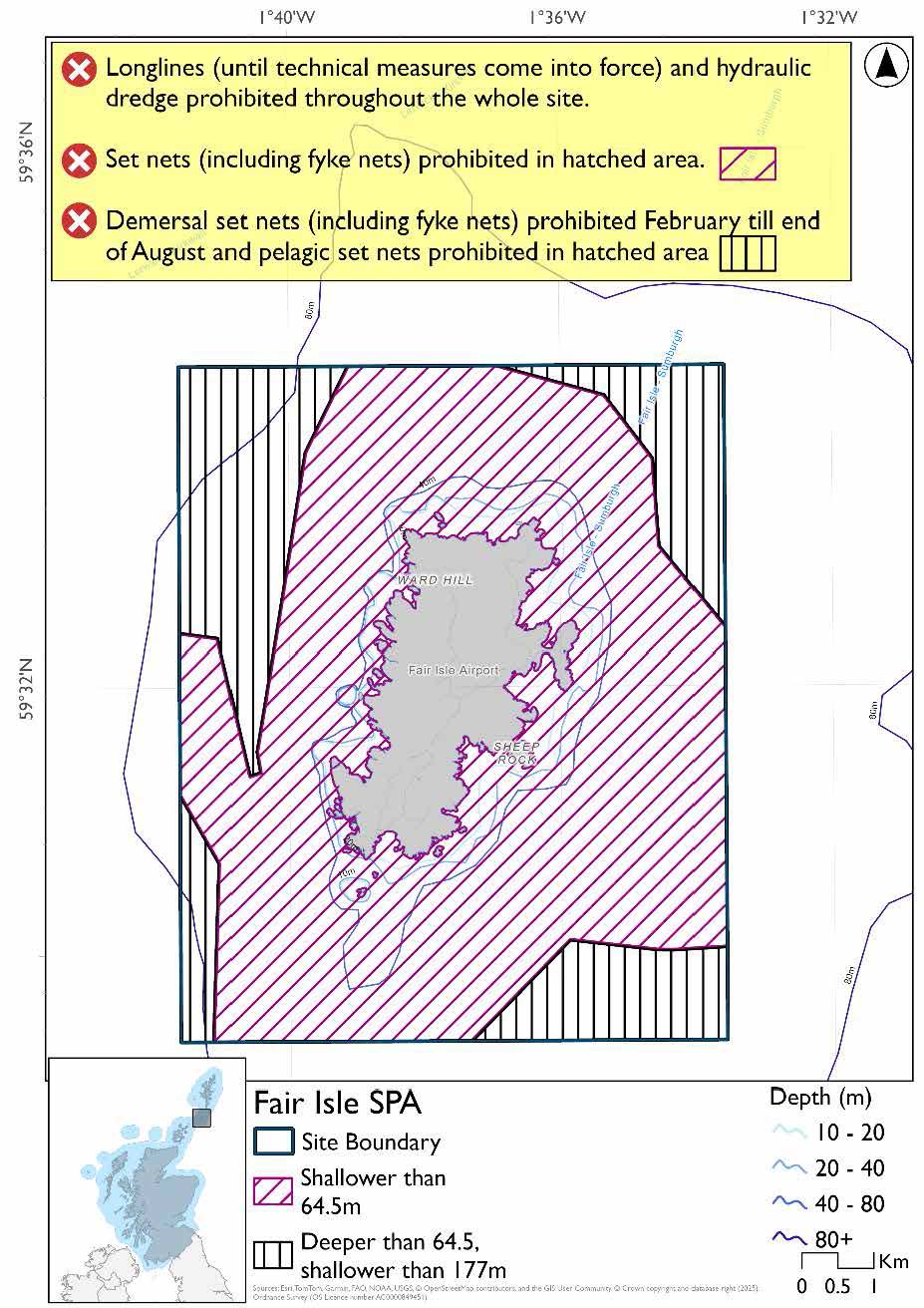
Option Two
- Full site closure to longlines (until technical measures come into force), set nets (including fyke nets) and hydraulic dredge
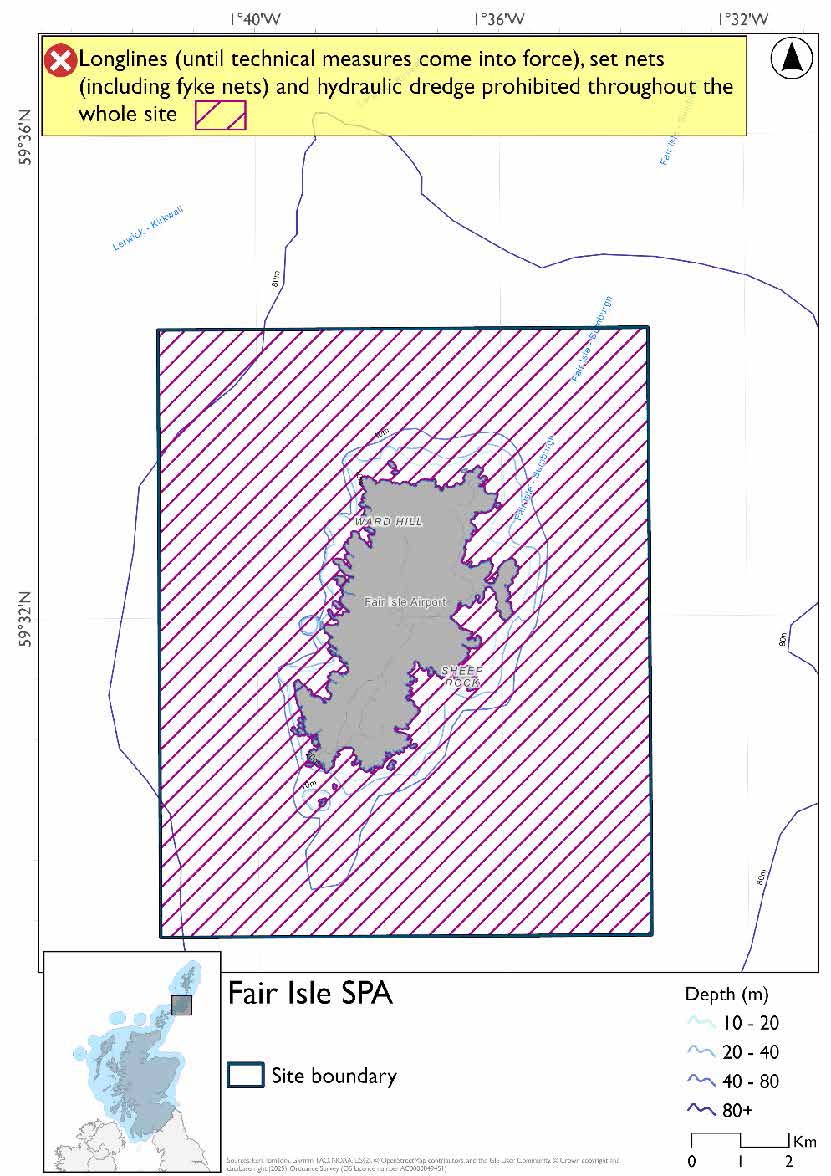
Rationale for developed measures
The basis for the proposed fisheries management measures for each site has been determined by the management advice for fishing activities provided by NatureScot, which can be found on their website or Sitelink as signposted throughout this document. The Fisheries Assessment for each site assesses the impacts from existing fishing activities on the protected features using the tests from the legislation relevant for the type of MPA being considered. The assessment outlines how the proposed measures address any impacts identified that could hinder the conservation objectives of the MPA.
15.8.7 Other fisheries management measures currently applying to this site
There are already management measures in place. An effort has been made to identify existing measures which affect each individual site or area, however the list may not be exhaustive. These measures are outlined below, and the proposals for further management being consulted on now are in addition to these existing measures:
- Fishing for sandeel is prohibited within the Scottish zone, which is defined as the sea adjacent to Scotland up to the 200 nautical miles limit
Other conservation measures can be found in section 7 of the CMA.
15.9 Fetlar SPA
15.9.1 Description and background
The Fetlar SPA is located on the island of Fetlar in Shetland and was designated to protect internationally important populations of breeding seabirds. The SPA covers approximately 16,965 hectares, with around 85% of the site comprising marine waters, reflecting the ecological link between land-based breeding habitats and surrounding foraging areas.
Fetlar is renowned for its diverse coastal habitats, including cliffs, moorland, grassland, and wetland areas, which support a rich assemblage of seabirds. These protected species rely on the island’s terrestrial habitats for nesting and the adjacent marine environment for feeding, particularly during the breeding season.
Further information, including Conservation and Management Advice (CMA) can be found on Sitelink.
Further information on MPAs, the wider network and protected areas management is available at Scottish Government MPA policy page.
15.9.1 Protected features
The Fetlar SPA has been designated to protect:
- Arctic skua
- Arctic tern
- Dunlin
- Fulmar
- Great skua
- Red-necked phalarope
- Whimbrel
Dunlin, red-necked phalarope and whimbrel are not discussed further as they are not a protected feature for which fisheries management measures are required.
The protected features of the Fetlar SPA are protected within the SPA throughout the year, irrespective of the season for which they qualified as a protected feature.
15.9.2 Conservation Objectives
The following protected features are in favourable condition at the Fetlar SPA: fulmar. Therefore, the Conservation Objectives seek to maintain this condition.
The following protected features are in unfavourable condition at the Fetlar SPA: Arctic skua, Arctic tern and great skua. Therefore, the Conservation Objectives seek to restore this condition.
Additional details, including the Conservation Objectives, are provided in the Conservation and Management Advice document produced for this SPA and can be found on Sitelink.
15.9.3 Pressure from fishing activity
Fishing activities can exert several pressures on the seabird populations of the Fetlar SPA, primarily through bycatch, prey depletion, and habitat disturbance. Species such as Arctic terns, great skuas, Arctic skuas, and fulmars are sensitive to accidental capture in longline and surface fisheries, with fulmars among the most frequently caught seabirds in UK waters. These incidents cause direct mortality and reduce breeding success.
Prey depletion is a major concern, as many species rely heavily on forage fish like sandeels, which are sensitive to overfishing and environmental change. Declines in sandeel abundance have been linked to poor breeding outcomes in skuas and terns, while reduced prey availability more broadly impacts adult survival and chick provisioning.
Disturbance from fishing vessels further disrupts seabird behaviour. Arctic terns and skuas are particularly sensitive to visual disturbance at nesting sites, which can lead to nest abandonment or egg failure.
Additional details are provided in the Conservation and Management Advice document produced for this SPA (section 6) and can be found on Sitelink.
Other resources include:
- The Feature Activity Sensitivity Tool (FeAST) which allows users to investigate the sensitivity of marine features (habitats, species, geology and landforms) in Scotland's seas, to pressures arising from human activities;
- Fisheries Guidance Notes which provide summaries of evidence on the interaction between fishing gears and specific habitats and species.
15.9.4 Fisheries management advice relevant to proposed fisheries management measures
NatureScot provides risk-based advice to help manage activities that may impact protected features and their Conservation Objectives. See section 2.3 for more detail. The CMA document also sets out the full fisheries management advice that has been summarised below for the management measures proposed:
Hydraulic gear
Remove or avoid pressures (removal of prey species and disturbance of prey-supporting habitat) associated with hydraulic fishing that has the potential to damage seabed habitat (in particular, sandeel habitat, herring spawning grounds) is recommended.
Pelagic gear
Pelagic fishing for herring/sprat may occur within or around the SPA. It is recommended that a principal objective of the management of the fishery should be ensuring that the fishing activity does not prevent or disrupt the availability of prey species i.e. it should be considered as part of a broader ecosystem-based approach to management of this fishery.
Longlining (not including jigging)
Long-lining (pelagic and demersal) may occur within or around the SPA(s). Current understanding is that long-line fisheries are largely restricted to offshore waters. Site-specific measures for long-lining are not currently considered appropriate due to the scale of the fishery, and the wide-spread interaction with seabirds. However, there is evidence of seabird bycatch in long-line (not jigging) fisheries therefore it is recommended this requires wider seas management measures.
For the SPAs advice has also been provided on maximum dive depth and seasonality for protected features of each site. This does not apply for Fetlar SPA. Supplementary advice can also be found on NatureScot’s website.
15.9.5 Proposed fisheries management measures
The proposed management measure for Fetlar SPA is as follows:
Single Proposed Management Option*
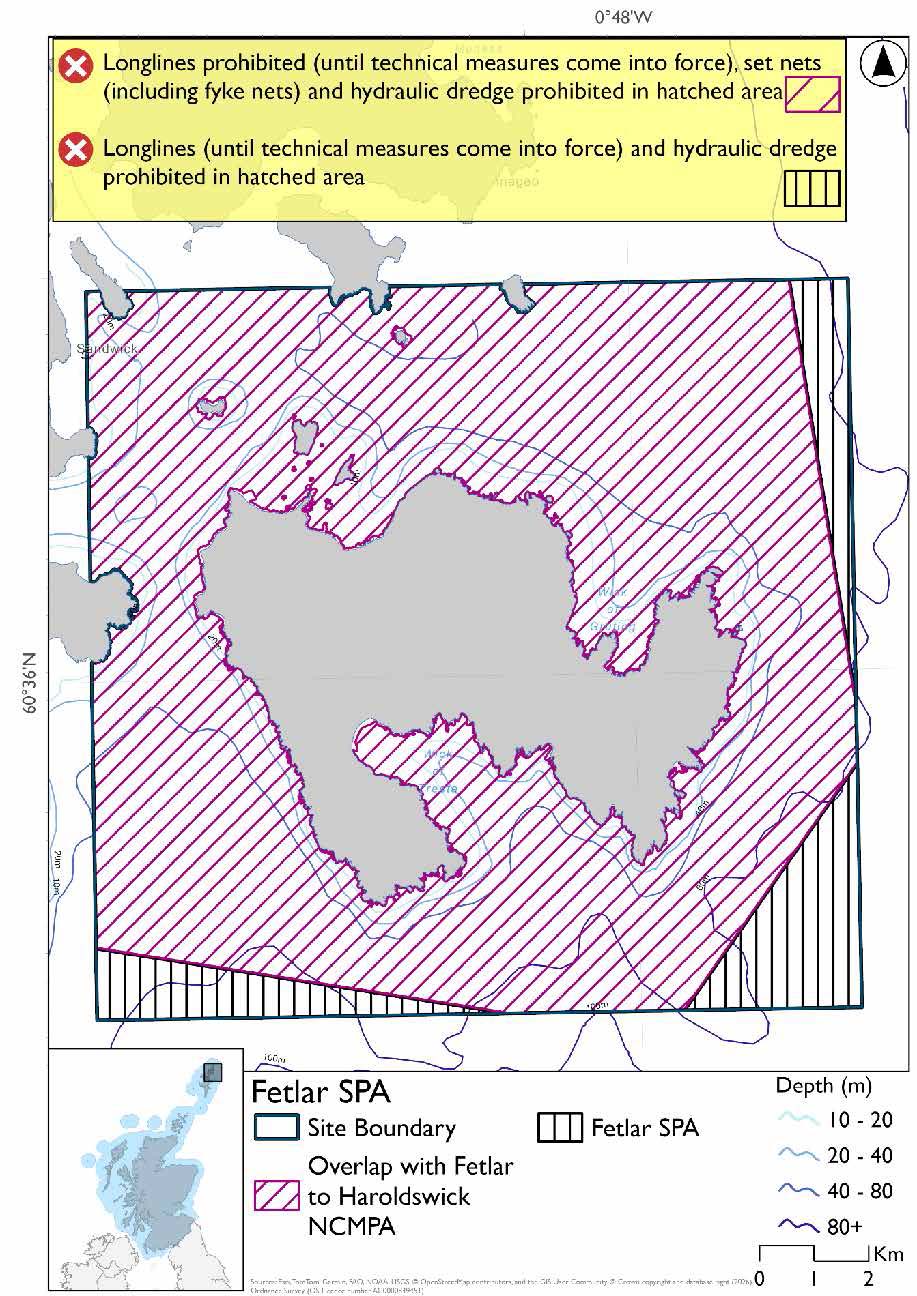
- Full site closure to longlines (until technical measures come into force) and hydraulic dredge
- Set nets (including fyke nets) prohibited in part of the site from the overlapping measures from the Fetlar to Haroldswick NCMPA
A full site level of protection from the specified gear has been identified as the only suitable option in enabling the achievement of the desired level of protection for the feature in question.
*This site will have other demersal mobile measures that may apply from the overlapping portions with the Fetlar to Haroldswick NCMPA that aren’t shown on the map for this option.
- Fetlar to Haroldswick NCMPA has zoned measures for demersal trawl and seine, beam trawl and mechanical dredge. Measures would depend on where overlap occurs.
Please check the Option 1 or single management overlapping site map to see proposed demersal mobile measures under Option 1.
Overlapping sites included in this consultation
This SPA overlaps the Fetlar to Haroldswick NCMPA and Bluemull and Colgrave Sounds SPA.
Rationale for developed measures
The basis for the proposed fisheries management measures for each site has been determined by the management advice for fishing activities provided by NatureScot, which can be found on their website or Sitelink as signposted throughout this document. The Fisheries Assessment for each site assesses the impacts from existing fishing activities on the protected features using the tests from the legislation relevant for the type of MPA being considered. The assessment outlines how the proposed measures address any impacts identified that could undermine the conservation objectives of the MPA.
15.9.6 Other fisheries management measures currently applying to this site
There are already management measures in place. An effort has been made to identify existing measures which affect each individual site or area, however the list may not be exhaustive. These measures are outlined below, and the proposals for further management being consulted on now are in addition to these existing measures:
- Fishing for sandeel is prohibited within the Scottish zone, which is defined as the sea adjacent to Scotland up to the 200 nautical miles limit
- Under the Shetland Regulating Order, Scallop dredging prohibited in part of the site
- Under the Shetland Shellfish Management Organisation (SSMO) Spatial Management Plan, hydraulic dredging is banned
Other conservation measures can be found in section 7 of the CMA.
15.10 Foula SPA
15.10.1 Description and background
The Foula SPA is located on Foula, the most westerly of the Shetland Islands, approximately 20 km west of the Shetland Mainland. The SPA protects the terrestrial breeding habitats and adjacent marine foraging areas used by a diverse assemblage of seabirds. Located on the remote island of Foula, the SPA includes the island itself and a 2 km marine extension, covering a total area of approximately 7,985 hectares. This configuration reflects the ecological requirements of the site’s qualifying bird species, which rely on both land and sea during the breeding season.
The SPA encompasses both the island itself and a marine extension that reaches approximately 2 km offshore, covering a total area of 7,985.49 hectares. The site includes a diverse range of habitats such as sea cliffs, mire, heathland, grasslands, and adjacent coastal waters, all of which support a rich assemblage of breeding seabirds.
Foula SPA was designated for regularly supporting populations of European importance. The site also qualifies for its seabird assemblage, regularly supporting over 250,000 individual seabirds, including nationally important populations of kittiwake, razorbill, Arctic skua, and fulmar.
The SPA’s designation reflects the island’s role as one of the largest seabird colonies in Britain, with steep cliffs and productive surrounding waters offering ideal nesting and foraging conditions. The marine extension ensures protection of the seabed, water column, and surface, safeguarding the feeding grounds adjacent to the breeding sites. Together, the terrestrial and marine components of Foula SPA form a critical refuge for seabirds, contributing significantly to the UK’s network of protected areas and the broader goal of maintaining favourable conservation status for these species.
Further information, including Conservation and Management Advice (CMA) can be found on Sitelink.
Further information on MPAs, the wider network and protected areas management is available at Scottish Government MPA policy page.
15.10.2 Protected features
Foula SPA has been designated to protect:
- Arctic skua;
- Arctic tern;
- Fulmar;
- Great skua;
- Guillemot;
- Kittiwake;
- Leach’s petrel;
- Puffin;
- Razorbill;
- Red-throated diver; and
- Shag
The protected features of the SPA are protected within the relevant SPA throughout the year, irrespective of the season for which they qualified as a protected feature.
15.10.3 Conservation Objectives
Breeding red-throated diver are in favourable condition at Foula SPA. Therefore, the Conservation Objectives for this protected feature seek to maintain this condition within the Foula SPA.
Breeding Arctic tern, Arctic skua, puffin, kittiwake, guillemot, shag, Leach’s petrel, fulmar, great skua and razorbill are in unfavourable condition at Foula SPA. Therefore, the Conservation Objectives for these protected features seek to restore this condition within the Foula SPA.
Additional details, including the Conservation Objectives, are provided in the Conservation and Management Advice document produced SPA and can be found on Sitelink.
15.10.4 Pressure from fishing activity
Fishing activities can exert a range of pressures on the protected features of the Foula SPA, with many showing sensitivity to bycatch, prey depletion, and disturbance. Red‑throated divers, auks (including guillemot, razorbill, and puffin), shags, kittiwakes, and fulmars are sensitive to accidental entanglement in static nets, surface gears, and longlines, leading to injury or mortality, particularly during breeding and moulting periods when birds are less mobile and concentrated in specific areas.
Prey depletion is a critical concern, as many species rely heavily on forage fish such as sandeels, which are sensitive to overfishing and habitat degradation. Declines in prey availability reduce breeding success and survival rates for puffins, kittiwakes, skuas, and fulmars, while increased turbidity from fishing activities like dredging further impairs the foraging efficiency of diving species such as auks, terns, and shags.
Disturbance from fishing vessels and operations can displace seabirds from key foraging and nesting areas. Visual and noise disturbance is particularly disruptive for guillemots, razorbills, shags, and red‑throated divers, which may abandon feeding grounds or nesting sites, reducing energy intake and reproductive success during critical life stages.
Additional details are provided in the Conservation and Management Advice document produced for this SPA (section 6) and can be found on Sitelink.
Other resources include:
- The Feature Activity Sensitivity Tool (FeAST) which allows users to investigate the sensitivity of marine features (habitats, species, geology and landforms) in Scotland's seas, to pressures arising from human activities;
- Fisheries Guidance Notes which provide summaries of evidence on the interaction between fishing gears and specific habitats and species.
15.10.5 Fisheries management advice relevant to proposed fisheries management measures
NatureScot provides risk-based advice to help manage activities that may impact protected features and their Conservation Objectives. See section 2.3 for more detail. The CMA document also sets out the full fisheries management advice that has been summarised below for the management measures proposed:
Hydraulic gear
Remove or avoid pressures (removal of prey species and disturbance of prey-supporting habitat) associated with hydraulic fishing that has the potential to damage seabed habitat (in particular, sandeel habitat, herring spawning grounds) is recommended.
Static Gear
Remove or avoid pressures (entanglement) associated with the use of all static nets. Spatial exclusion of all static nets in areas identified as being important for auks, shags and red-throated diver (as identified from habitat and dive depth preferences) is recommended.
Pelagic gear
Pelagic fishing for herring/sprat may occur within or around the SPA. It is recommended that a principal objective of the management of the fishery should be ensuring that the fishing activity does not prevent or disrupt the availability of prey species i.e. it should be considered as part of a broader ecosystem-based approach to management of this fishery
Longlining (not including jigging)
Long-lining (pelagic and demersal) may occur within or around the SPA(s). Current understanding is that long-line fisheries are largely restricted to offshore waters. Site-specific measures for long-lining are not currently considered appropriate due to the scale of the fishery, and the wide-spread interaction with seabirds. However, there is evidence of seabird bycatch in long-line (not jigging) fisheries therefore it is recommended this requires wider seas management measures.
Reduce or limit pressures (bycatch) associated with any pelagic or bottom-set long-line fishing is recommended, where wider seas measures overlap with Seas off Foula SPA, with particular regard to fulmars and petrels.
For the SPAs advice has also been provided on maximum dive depth and seasonality for protected features of each site and can be found in the Fishing Activity Further Advice and Evidence document. Supplementary advice can also be found on NatureScot’s website.
15.10.6 Proposed fisheries management measures
The proposed management measures for Foula SPA are as follows:
Option One
- Set nets (including fyke nets) prohibited in areas shallower than 64.5m based on presence of shag and guillemot and maximum dive depth for shag
- Demersal set nets (including fyke nets) prohibited February till end of August due to presence and maximum dive depth for guillemot and pelagic set nets prohibited due to presence of shag in areas deeper than 64.5m but shallower than 177m
- Full site closure to longlines (until technical measures come into force) and hydraulic dredge
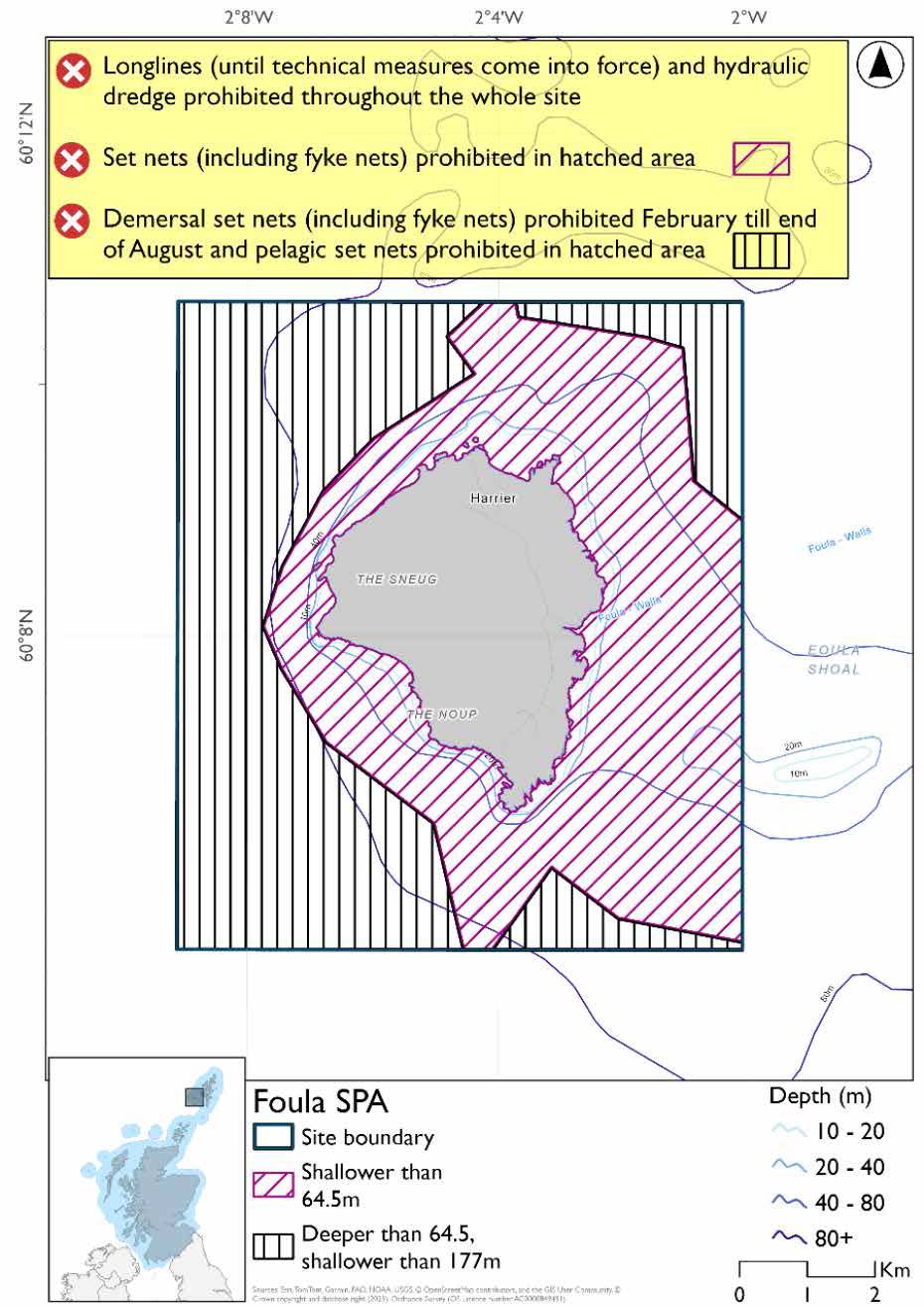
Option Two
- Full site closure to longlines (until technical measures come into force), set nets (including fyke nets) and hydraulic dredge
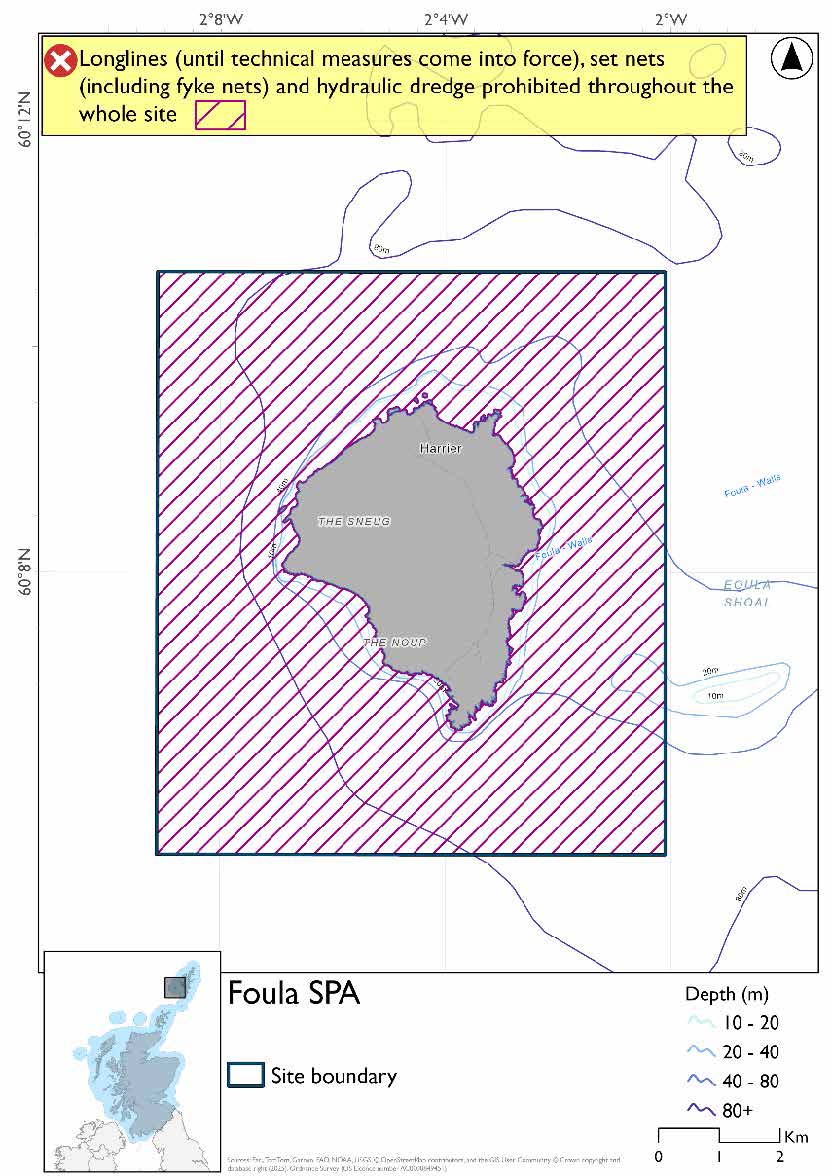
Rationale for developed measures
The basis for the proposed fisheries management measures for each site has been determined by the management advice for fishing activities provided by NatureScot, which can be found on their website or Sitelink as signposted throughout this document. The Fisheries Assessment for each site assesses the impacts from existing fishing activities on the protected features using the tests from the legislation relevant for the type of MPA being considered. The assessment outlines how the proposed measures address any impacts identified that could hinder the conservation objectives of the MPA..
15.10.7 Other fisheries management measures currently applying to this site
There are already management measures in place. An effort has been made to identify existing measures which affect each individual site or area, however the list may not be exhaustive. These measures are outlined below, and the proposals for further management being consulted on now are in addition to these existing measures:
- Fishing for sandeel is prohibited within the Scottish zone, which is defined as the sea adjacent to Scotland up to the 200 nautical miles limit
- All gears excluded apart from pelagic gear (purse seine and trawl) in part of the site from 01 January to 15 March each year
Other conservation measures can be found in section 7 of the CMA.
15.11 Hermaness, Saxa Ford and Valla Field SPA
15.11.1Description and background
Hermaness, Saxa Vord and Valla Field SPA is located at the northern tip of Unst in Shetland, covering approximately 6,833 hectares, of which around 76% is marine. The site includes dramatic sea cliffs rising 100–200m, maritime heath, blanket bog, and a 2 km marine extension offshore. The SPA is internationally significant for its seabird populations, supporting more than 157,500 individuals during the breeding season. These populations represent substantial proportions of UK and global totals for some species, particularly gannet and great skua.
Further information, including Conservation and Management Advice (CMA) can be found on Sitelink.
Further information on MPAs, the wider network and protected areas management is available at Scottish Government MPA policy page.
15.11.2 Protected features
The Hermaness, Saxa Vord and Valla Field SPA Special Protection Area (SPA) has been designated to protect eight species of breeding seabirds:
- Fulmar;
- Gannet;
- Great skua;
- Guillemot;
- Kittiwake;
- Puffin;
- Red-throated diver; and
- Shag
The protected features of the Hermaness, Saxa Vord and Valla Field SPA are protected within the SPA throughout the year, irrespective of the season for which they qualified as a protected feature.
15.11.3 Conservation Objectives
The following protected feature is in favourable condition at the Hermaness, Saxa Vord and Valla Field SPA: gannet. Therefore, the Conservation Objectives seek to maintain this condition.
The following protected features are in unfavourable condition at the Hermaness, Saxa Vord and Valla Field SPA: guillemot, kittiwake, puffin, red-throated diver, great skua, fulmar and shag. Therefore, the Conservation Objectives seek to restore this condition.
Additional details, including the Conservation Objectives, are provided in the Conservation and Management Advice document produced for this SPA and can be found on Sitelink.
15.11.4 Pressure from fishing activity
Fishing activities exert multiple pressures on the seabirds of the Hermaness, Saxa Vord and Valla Field SPA, primarily through bycatch, prey depletion and disturbance. Species including puffins, guillemots, kittiwakes, shags, fulmars, gannets, and red‑throated divers are sensitive to entanglement in surface and pelagic nets, leading to direct mortality. This risk is compounded by the depletion of key prey species such as sandeels, where reduced availability undermines foraging efficiency, breeding success, and population viability.
Disturbance from fishing vessels and associated activity further disrupts seabird behaviour. Guillemots and shags are sensitive to visual and noise disturbance, while red‑throated divers and great skuas show strong displacement responses during breeding. Nesting fulmars and skuas are particularly sensitive to repeated human intrusion, which can cause nest abandonment or egg failure. Increased turbidity from fishing operations also impairs the foraging efficiency of diving species such as puffins and gannets.
Additional details are provided in the Conservation and Management Advice document produced for this SPA (section 6) and can be found on Sitelink.
Other resources include:
- The Feature Activity Sensitivity Tool (FeAST) which allows users to investigate the sensitivity of marine features (habitats, species, geology and landforms) in Scotland's seas, to pressures arising from human activities;
- Fisheries Guidance Notes which provide summaries of evidence on the interaction between fishing gears and specific habitats and species.
15.11.5 Fisheries management advice relevant to proposed fisheries management measures
NatureScot provides risk-based advice to help manage activities that may impact protected features and their Conservation Objectives. See section 2.3 for more detail.
The CMA document also sets out the full fisheries management advice that has been summarised below for the management measures proposed:
Hydraulic gear
Remove or avoid pressures (removal of prey species and disturbance of prey-supporting habitat) associated with hydraulic fishing that has the potential to damage seabed habitat (in particular, sandeel habitat, herring spawning grounds) is recommended.
Static gear (drift nets and bottom set nets inc. fyke nets)
Remove or avoid pressures (entanglement) associated with the use of all static nets. Spatial exclusion of all static nets in areas identified as being important for auks and gannet, shag and red-throated diver (as identified from habitat and dive depth preferences) is recommended.
Pelagic gear
Pelagic fishing for herring/sprat may occur within or around the SPA. It is recommended that a principal objective of the management of the fishery should be ensuring that the fishing activity does not prevent or disrupt the availability of prey species i.e. it should be considered as part of a broader ecosystem-based approach to management of this fishery.
Longlining (not including jigging)
Long-lining (pelagic and demersal) may occur within or around the SPA(s). Current understanding is that long-line fisheries are largely restricted to offshore waters. Site-specific measures for long-lining are not currently considered appropriate due to the scale of the fishery, and the wide-spread interaction with seabirds. However, there is evidence of seabird bycatch in long-line (not jigging) fisheries therefore it is recommended this requires wider seas management measures.
For the SPAs advice has also been provided on maximum dive depth and seasonality for protected features of each site and can be found in the Fishing Activity Further Advice and Evidence document. Supplementary advice can also be found on NatureScot’s website.
15.11.6 Proposed fisheries management measures
The proposed management measures for Hermaness, Saxa Ford and Valla Field SPA are as follows:
Option One
- Set nets (including fyke nets) prohibited in areas shallower than 64.5m based on presence and maximum dive depth for shag
- Demersal set nets (including fyke nets) prohibited February till end of August due to presence and maximum dive depth for guillemot and pelagic set nets prohibited in areas deeper than 64.5m due to presence for shag
- Full site closure to longlines (until technical measures come into force) and hydraulic dredge
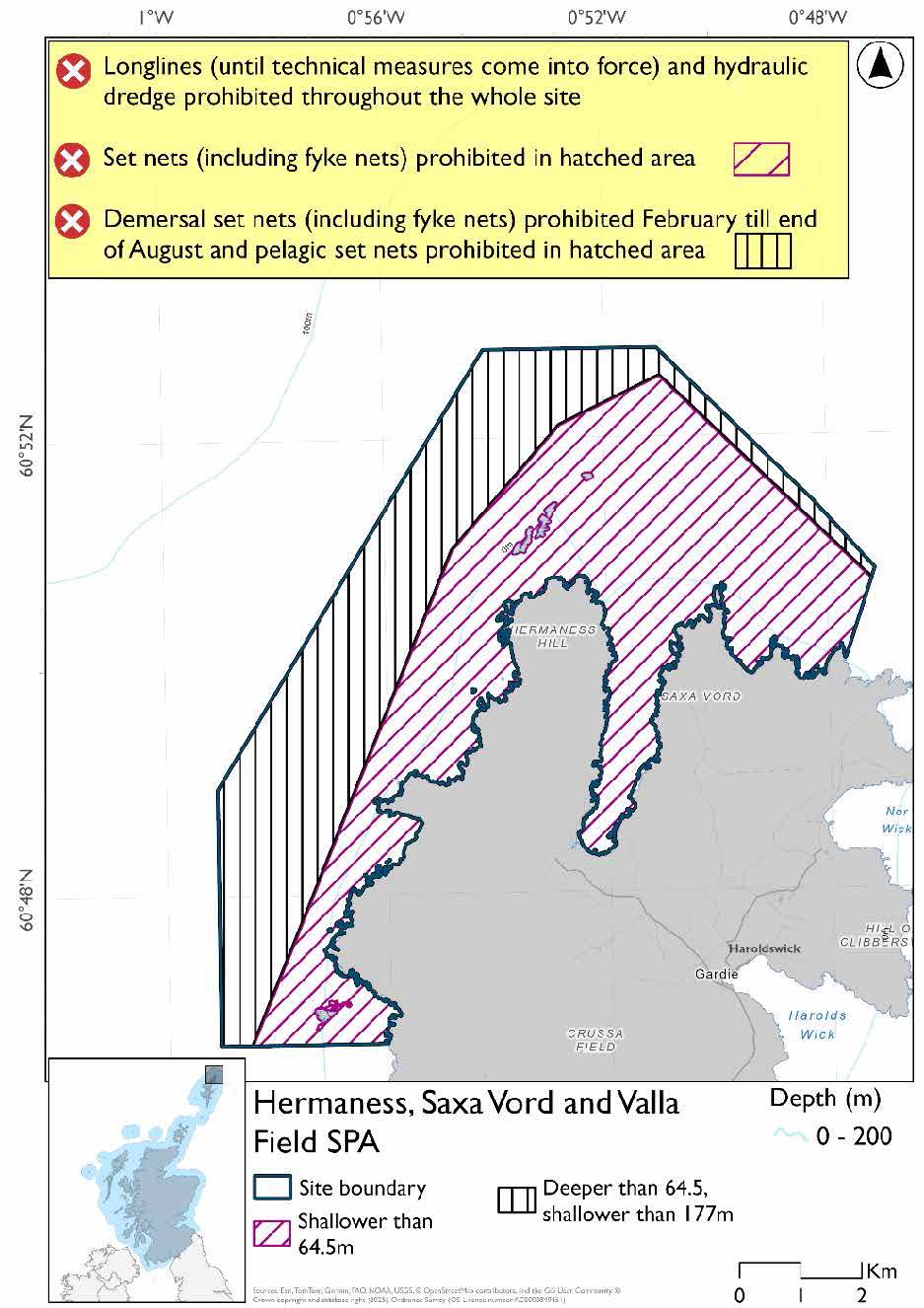
Option Two
- Full site closure to longlines (until technical measures come into force), set nets (including fyke nets) and hydraulic dredge
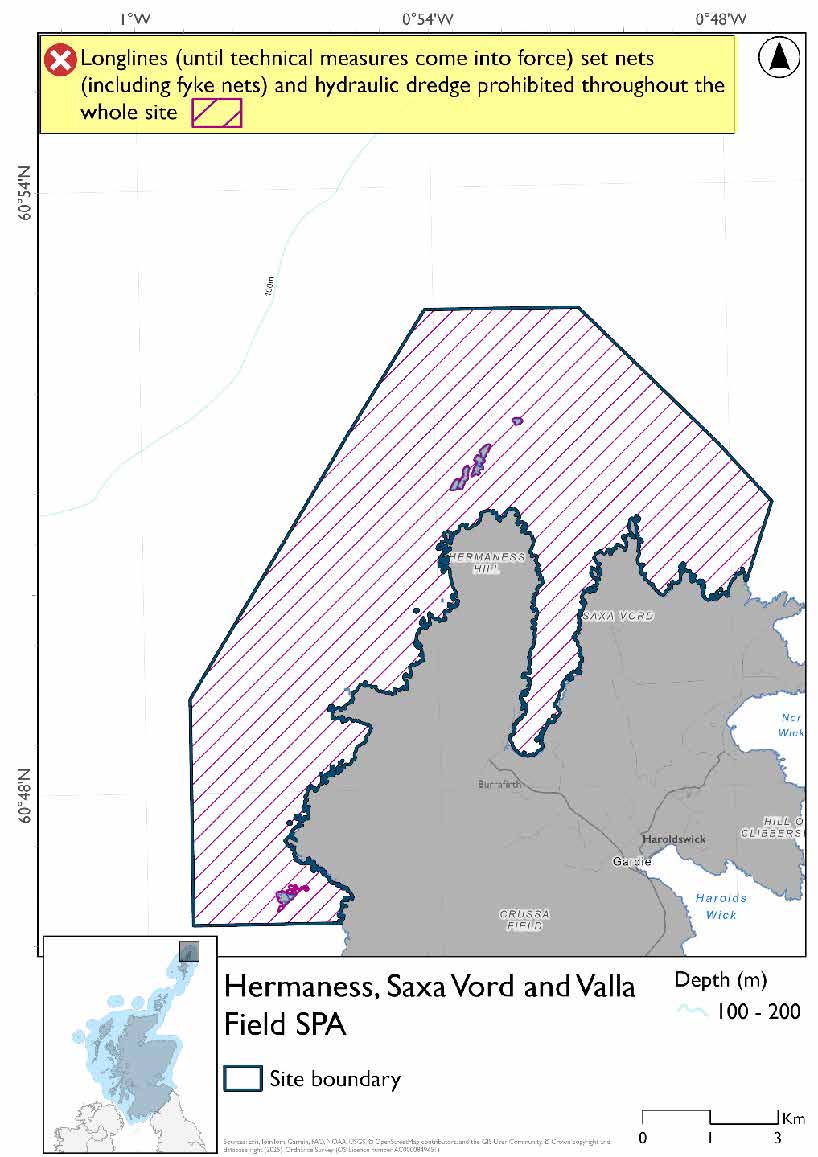
Rationale for developed measures
The basis for the proposed fisheries management measures for each site has been determined by the management advice for fishing activities provided by NatureScot, which can be found on their website or Sitelink as signposted throughout this document. The Fisheries Assessment for each site assesses the impacts from existing fishing activities on the protected features using the tests from the legislation relevant for the type of MPA being considered. The assessment outlines how the proposed measures address any impacts identified that could hinder the conservation objectives of the MPA.
15.11.7 Other fisheries management measures currently applying to this site
There are already management measures in place. An effort has been made to identify existing measures which affect each individual site or area, however the list may not be exhaustive. These measures are outlined below, and the proposals for further management being consulted on now are in addition to these existing measures:
- Fishing for sandeel is prohibited within the Scottish zone, which is defined as the sea adjacent to Scotland up to the 200 nautical miles limit
- Under the Shetland Shellfish Management Organisation (SSMO) Spatial Management Plan, hydraulic dredging is banned
Other conservation measures can be found in section 7 of the CMA.
15.12 Noss SPA
15.12.1 Description and background
Noss SPA is located on the island of Noss, just off the east coast of mainland Shetland, approximately 5 km from Lerwick. The site is renowned for its dramatic cliffs, coastal heathlands, and rich marine environment, which together provide ideal breeding and foraging conditions for a variety of seabird species. The SPA includes both terrestrial and marine components, with a seaward extension of around 2 km to encompass the adjacent waters, seabed, and airspace. This reflects the ecological connectivity between land and sea that is vital for seabird life cycles, safeguarding the ecological connectivity between nesting sites and feeding grounds, particularly for species such as gannet, kittiwake, and guillemot.
The SPA is designated for its internationally important populations of breeding seabirds. These species rely on the site’s cliffs for nesting and the surrounding marine area for feeding. Noss is particularly notable for its gannet colony, one of the largest in the UK, which contributes significantly to the species’ conservation status at a national and European level.
Further information, including Conservation and Management Advice (CMA) can be found on Sitelink.
Further information on MPAs, the wider network and protected areas management is available at Scottish Government MPA policy page.
15.12.2 Protected features
The Noss has been designated to protect:
- Fulmar;
- Gannet;
- Great skua;
- Guillemot;
- Kittiwake; and
- Puffin
The protected features of the Noss SPA are protected within the SPA throughout the year, irrespective of the season for which they qualified as a protected feature.
15.12.3 Conservation Objectives
The following protected feature is in favourable condition at Noss SPA: gannet. Therefore, the Conservation Objectives seek to maintain this condition.
The following protected features are in unfavourable condition at Noss SPA: Puffin, kittiwake, guillemot, great skua and fulmar. Therefore, the Conservation Objectives seek to restore this condition.
Additional details, including the Conservation Objectives, are provided in the Conservation and Management Advice document produced for this SPA and can be found on Sitelink.
15.12.4 Pressure from fishing activity
Fishing activities exert multiple pressures on the seabird populations of the Noss SPA, primarily through bycatch, prey depletion and disturbance. Species such as puffins, guillemots, kittiwakes, great skuas, fulmars, and gannets are all vulnerable to accidental entanglement in surface, pelagic, and longline fisheries, with fulmars and gannets among the most frequently caught. These direct mortality risks are compounded by prey depletion, as declines in forage fish like sandeels reduce food availability, impair foraging efficiency, and undermine breeding success across puffins, kittiwakes, skuas, and fulmars. Increased turbidity from fishing operations further limits the ability of diving species to locate prey.
Disturbance from fishing vessels adds another layer of impact, displacing sensitive species from foraging and nesting areas. Guillemots, shags, divers, and skuas are particularly affected by visual and noise disturbance, which can lead to nest abandonment, egg failure, or reduced reproductive success.
Additional details are provided in the Conservation and Management Advice document produced for this SPA (section 6) and can be found on Sitelink.
Other resources include:
- The Feature Activity Sensitivity Tool (FeAST) which allows users to investigate the sensitivity of marine features (habitats, species, geology and landforms) in Scotland's seas, to pressures arising from human activities;
- Fisheries Guidance Notes which provide summaries of evidence on the interaction between fishing gears and specific habitats and species.
15.12.5 Fisheries management advice relevant to proposed fisheries management measures
NatureScot provides risk-based advice to help manage activities that may impact protected features and their Conservation Objectives. See section 2.3 for more detail. The CMA document also sets out the full fisheries management advice that has been summarised below for the management measures proposed:
Hydraulic gear
Remove or avoid pressures (removal of prey species and disturbance of prey-supporting habitat) associated with hydraulic fishing that has the potential to damage seabed habitat (in particular, sandeel habitat, herring spawning grounds) is recommended.
Static gear (drift nets and bottom set nets inc. fyke nets)
Remove or avoid pressures (entanglement) associated with the use of all static nets. Spatial exclusion of all static nets in areas identified as being important for auks (as identified from habitat and dive depth preferences) is recommended.
Pelagic gear
Pelagic fishing for herring/sprat may occur within or around the SPA. It is recommended that a principal objective of the management of the fishery should be ensuring that the fishing activity does not prevent or disrupt the availability of prey species i.e. it should be considered as part of a broader ecosystem-based approach to management of this fishery.
Longlining (not including jigging)
Long-lining (pelagic and demersal) may occur within or around the SPA(s). Current understanding is that long-line fisheries are largely restricted to offshore waters. Site-specific measures for long-lining are not currently considered appropriate due to the scale of the fishery, and the wide-spread interaction with seabirds. However, there is evidence of seabird bycatch in long-line (not jigging) fisheries therefore it is recommended this requires wider seas management measures.
For the SPAs advice has also been provided on maximum dive depth and seasonality for protected features of each site and can be found in the Fishing Activity Further Advice and Evidence document. Supplementary advice can also be found on NatureScot’s website.
15.12.6 Proposed fisheries management measures
The proposed management measures for Noss SPA are as follows:
Option One
- Set nets (including fyke nets) prohibited February till end of September in areas shallower than 34m based on presence and maximum dive depth for gannet
- Demersal set nets (including fyke nets) prohibited February till end of August, based on presence and maximum dive depth for guillemot, and pelagic set nets prohibited February till end of September in areas deeper than 34m but shallower than 177m based on presence for gannet
- Full site closure to longlines (until technical measures come into force) and hydraulic dredge
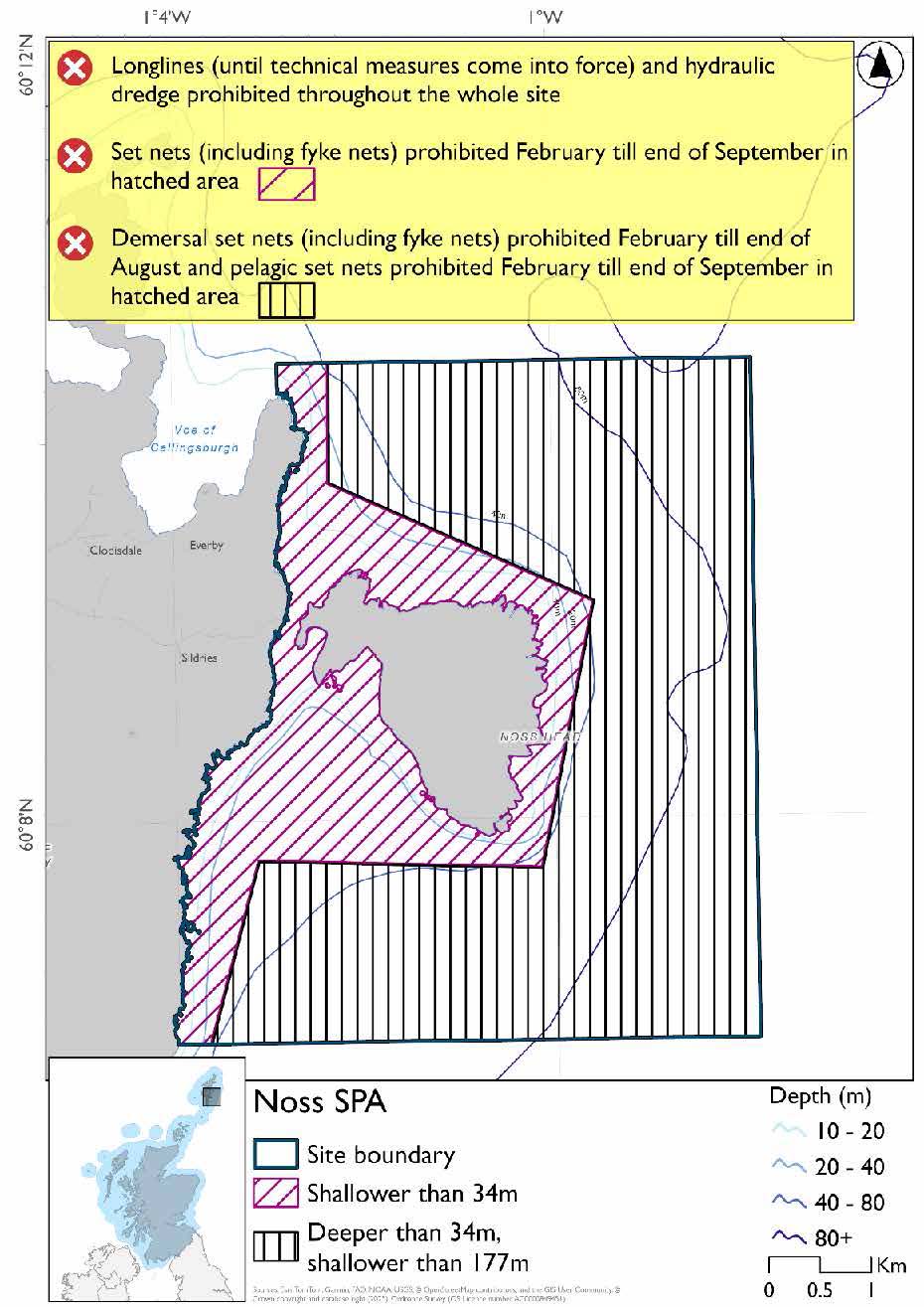
Option Two
- Full site closure to longlines (until technical measures come into force), set nets (including fyke nets) and hydraulic dredge
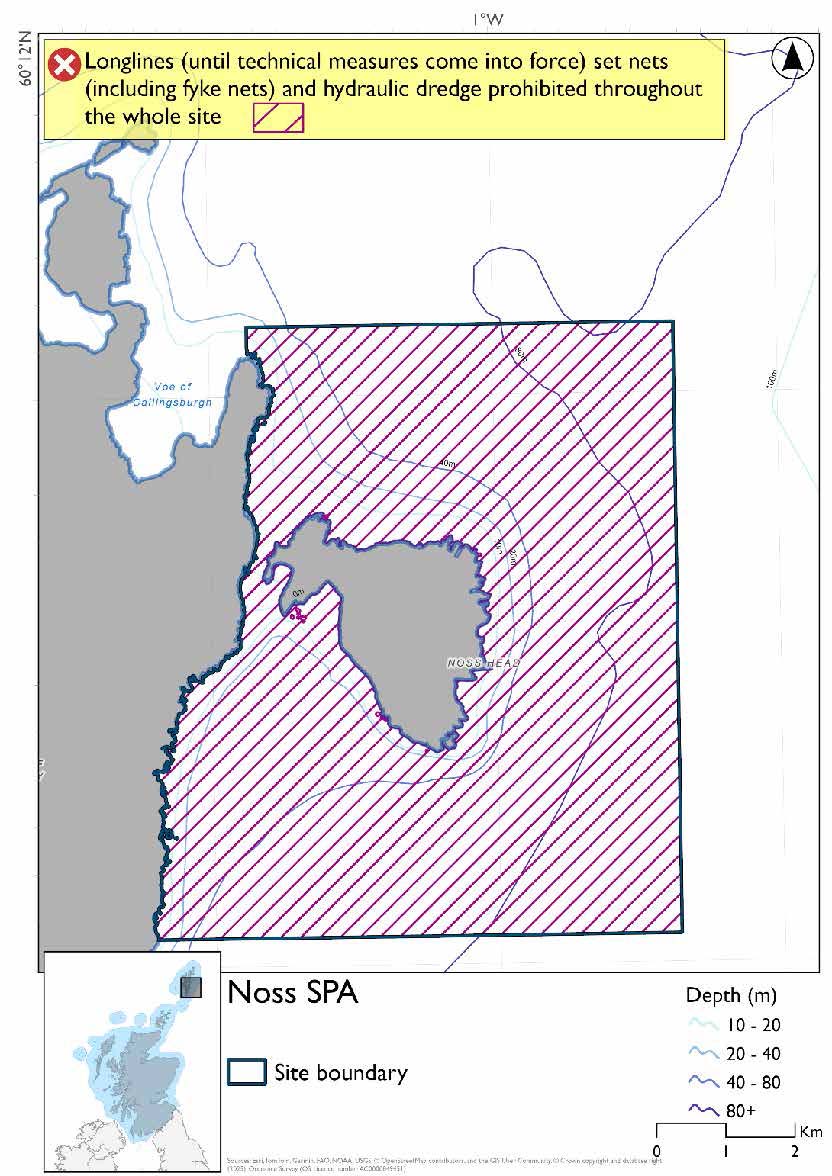
Rationale for developed measures
The basis for the proposed fisheries management measures for each site has been determined by the management advice for fishing activities provided by NatureScot, which can be found on their website or Sitelink as signposted throughout this document. The Fisheries Assessment for each site assesses the impacts from existing fishing activities on the protected features using the tests from the legislation relevant for the type of MPA being considered. The assessment outlines how the proposed measures address any impacts identified that could hinder the conservation objectives of the MPA.
15.12.7 Other fisheries management measures currently applying to this site
There are already management measures in place. An effort has been made to identify existing measures which affect each individual site or area, however the list may not be exhaustive. These measures are outlined below, and the proposals for further management being consulted on now are in addition to these existing measures:
- Fishing for sandeel is prohibited within the Scottish zone, which is defined as the sea adjacent to Scotland up to the 200 nautical miles limit
Other conservation measures can be found in section 7 of the CMA.
15.13 Seas off Foula SPA
15.13.1 Description and background
The Seas off Foula SPA is a large marine site located approximately 15 km west of Shetland, surrounding the remote island of Foula. Covering an expansive area of around 3,412 km², the SPA includes both inshore and offshore waters, with depths ranging from less than 50m near Foula to over 150m in the northwest. Most of the site lies within the 30–80m depth range, which is particularly suitable for supporting sandeel populations, a key prey species for many seabirds.
This SPA was designated to protect internationally important populations of seabirds that forage at sea during both the breeding and non-breeding seasons. During the breeding season, the site supports species such as great skua, fulmar, Arctic skua, guillemot, and puffin. In the non-breeding season, it continues to support significant numbers of great skua, fulmar, and guillemot, reflecting its year-round ecological importance. For example, great skuas, which form the largest marine aggregation in the UK around Foula, were found to forage extensively in the surrounding waters, justifying the inclusion of a large offshore area.
Further information, including Conservation and Management Advice (CMA) can be found on Sitelink.
As this SPA overlaps into the offshore region there is more detailed additional information on JNCCs website.
Further information on MPAs, the wider network and protected areas management is available at Scottish Government MPA policy page.
15.13.2 Protected features
Seas off Foula SPA has been designated to protect:
- Arctic skua;
- Fulmar;
- Great skua;
- Guillemot; and
- Puffin
The protected features of the SPA are protected within the relevant SPA throughout the year, irrespective of the season for which they qualified as a protected feature.
15.13.3 Conservation Objectives
Guillemot and fulmar are in favourable condition at the Seas off Foula SPA. Therefore the Conservation Objectives currently seek to maintain this condition.
Arctic skua, great skua, and puffin are in unfavourable condition at the Seas off Foula SPA. Therefore, the Conservation Objectives are to restore this condition.
Additional details, including the Conservation Objectives are provided in the Conservation and Management Advice document produced for this SPA and can be found on Sitelink.
15.13.4 Pressure from fishing activity
Fishing activities can exert significant pressures on the seabird species of the Seas off Foula SPA, particularly fulmars, guillemots, puffins, and skuas. The most direct risks come from bycatch and entanglement in surface nets and longline fisheries, with fulmars frequently recorded in bycatch incidents and guillemots and puffins especially sensitive during their flightless moult period. Skuas, including great skuas, are also susceptible to capture in longline gear, though population‑level impacts remain uncertain.
Indirect pressures arise from prey depletion, as all species rely heavily on forage fish such as sandeels, which are sensitive to overfishing. Declines in sandeel abundance have been linked to reduced breeding success in skuas and energy stress in puffins, guillemots, and fulmars. Disturbance from fishing vessels further compounds these impacts, displacing birds from key foraging areas and disrupting breeding behaviour, particularly for fulmars, guillemots, and skuas.
Together, bycatch, prey depletion, and disturbance represent the most significant fishing‑related threats to these seabirds, undermining breeding success, survival, and long‑term population resilience.
Additional details are provided in the Conservation and Management Advice document produced for this SPA (section 6) and can be found on Sitelink.
Other resources include:
- The Feature Activity Sensitivity Tool (FeAST) which allows users to investigate the sensitivity of marine features (habitats, species, geology and landforms) in Scotland's seas, to pressures arising from human activities;
- Fisheries Guidance Notes which provide summaries of evidence on the interaction between fishing gears and specific habitats and species.
15.13.4 Fisheries management advice relevant to proposed fisheries management measures
NatureScot provides risk-based advice to help manage activities that may impact protected features and their Conservation Objectives. See section 2.3 for more detail. The CMA document also sets out the full fisheries management advice that has been summarised below for the management measures proposed:
Hydraulic gear
Remove or avoid pressures (removal of prey species and disturbance of prey-supporting habitat) associated with hydraulic fishing that has the potential to damage seabed habitat (in particular, sandeel habitat, herring spawning grounds) is recommended.
Static Gear
Remove or avoid pressures (entanglement) associated with the use of all static nets. Spatial exclusion of all static nets in areas identified as being important for auks (as identified from habitat and dive depth preferences) is recommended.
Pelagic gear
Pelagic fishing for herring/sprat may occur within or around the SPA. It is recommended that a principal objective of the management of the fishery should be ensuring that the fishing activity does not prevent or disrupt the availability of prey species i.e. it should be considered as part of a broader ecosystem-based approach to management of this fishery
Longlining (not including jigging)
Long-lining (pelagic and demersal) may occur within or around the SPA(s). Current understanding is that long-line fisheries are largely restricted to offshore waters. Site-specific measures for long-lining are not currently considered appropriate due to the scale of the fishery, and the wide-spread interaction with seabirds. However, there is evidence of seabird bycatch in long-line (not jigging) fisheries therefore it is recommended this requires wider seas management measures.
Reduce or limit pressures (bycatch) associated with any pelagic or bottom-set long-line fishing is recommended, where wider seas measures overlap with Seas off Foula SPA, with particular regard to fulmars and petrels.
For the SPAs advice has also been provided on maximum dive depth and seasonality for protected features of each site and can be found in the Fishing Activity Further Advice and Evidence document. Supplementary advice can also be found on NatureScot’s website.
15.13.5 Proposed fisheries management measures
The proposed management measures for Seas off Foula SPA are as follows:
Option One
- Set nets (including fyke nets) prohibited in areas down to 177m based on presence and maximum dive depth for guillemot
- Pelagic set nets prohibited in areas deeper than 177m based on presence of guillemot
- Full site closure to longlines (until technical measures come into force) and hydraulic dredge
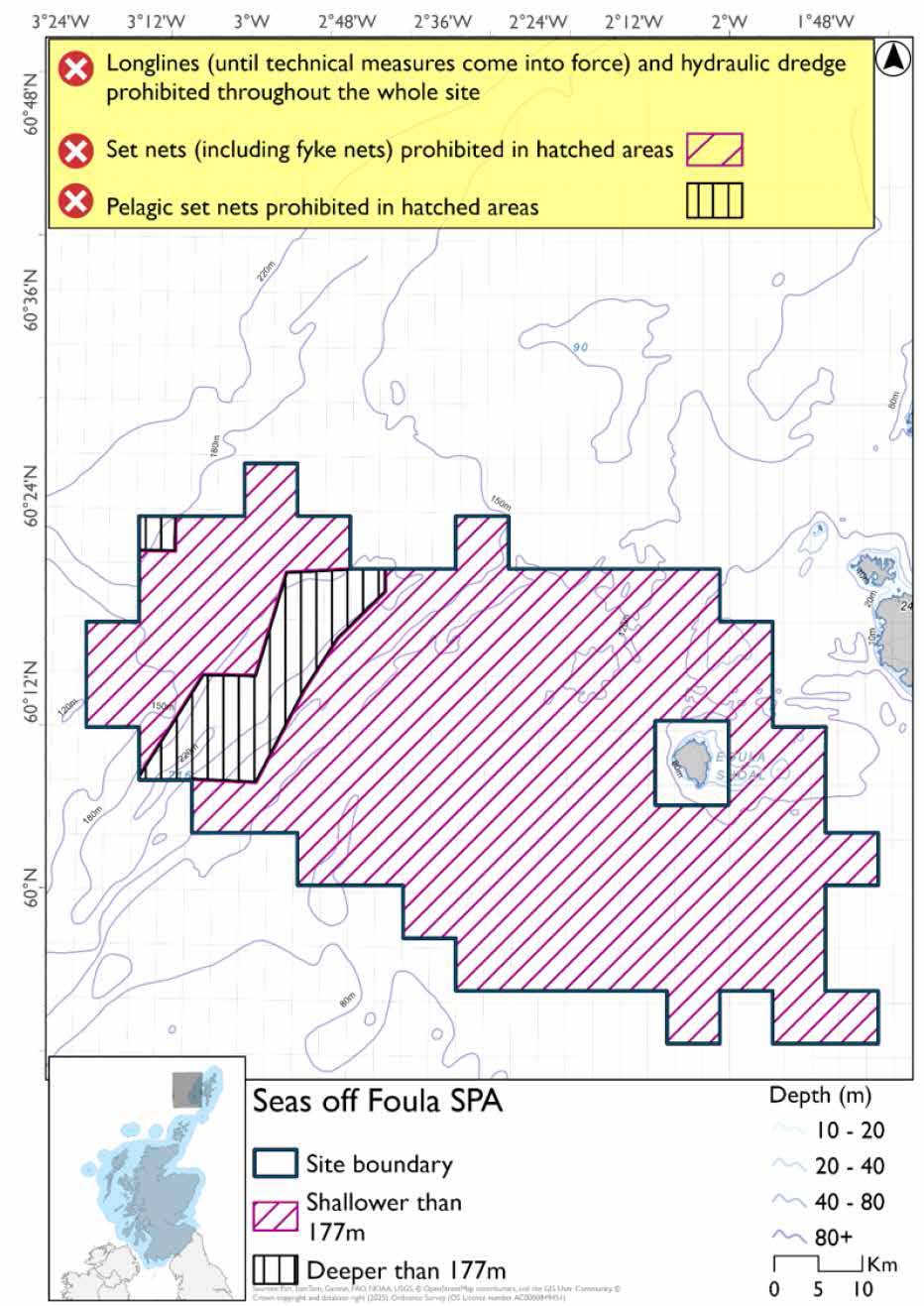
Option Two
- Full site closure to longlines (until technical measures come into force), set nets (including fyke nets) and hydraulic dredge
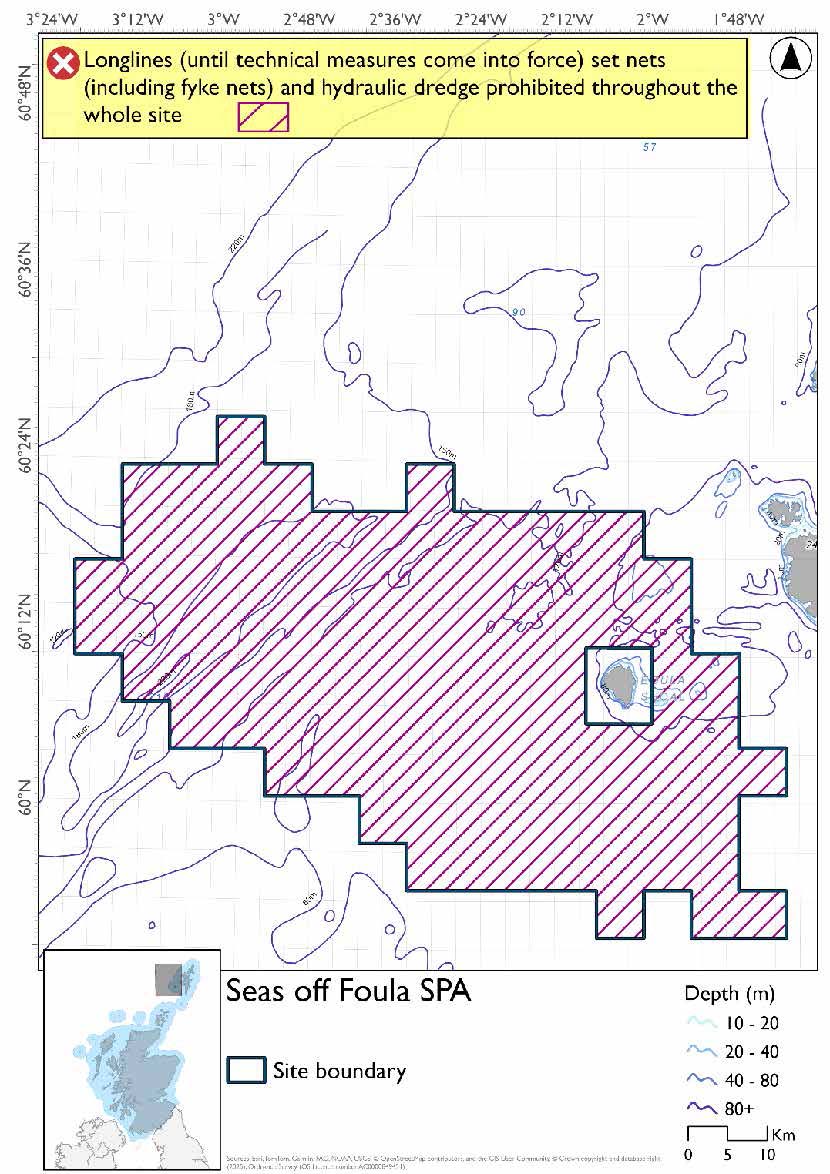
Rationale for developed measures
The basis for the proposed fisheries management measures for each site has been determined by the management advice for fishing activities provided by NatureScot, which can be found on their website or Sitelink as signposted throughout this document. The Fisheries Assessment for each site assesses the impacts from existing fishing activities on the protected features using the tests from the legislation relevant for the type of MPA being considered. The assessment outlines how the proposed measures address any impacts identified that could hinder the conservation objectives of the MPA.
15.13.6 Other fisheries management measures currently applying to this site
There are already management measures in place. An effort has been made to identify existing measures which affect each individual site or area, however the list may not be exhaustive. These measures are outlined below, and the proposals for further management being consulted on now are in addition to these existing measures:
- Fishing for sandeel is prohibited within the Scottish zone, which is defined as the sea adjacent to Scotland up to the 200 nautical miles limit
- All gears excluded apart from pelagic gear (purse seine and trawl) in part of the site from 01 January to 15 March and 01 November to 31 December each year
- Prohibited to deploy any bottom set gillnet, entangling net and trammel net at any position where the charted depth is greater than 200m
Other conservation measures can be found in section 7 of the CMA.
15.14 Sumburgh Head SPA
15.14.1 Description and background
Sumburgh Head SPA is located at the southern tip of mainland Shetland and is recognised for its dramatic cliffs, boulder beaches, and rich marine environment. The site’s steep cliffs provide ideal nesting habitat, while the surrounding waters are crucial for feeding. The SPA overlaps with the Sumburgh Head SSSI and includes a marine extension that reaches approximately 2 km offshore, encompassing the seabed, water column, and surface to protect essential foraging areas.
The SPA is relatively compact but ecologically significant, it supports around 700 breeding pairs of Arctic tern representing 2% of the UK population. It also supports more than 20,000 individual seabirds. Notably, the site hosts nationally important populations of guillemot, kittiwake and fulmar, with an estimated 35,000 seabirds using the site during the breeding season.
Further information, including Conservation and Management Advice (CMA) can be found on Sitelink.
Further information on MPAs, the wider network and protected areas management is available at Scottish Government MPA policy page.
15.14.2 Protected features
The Sumburgh Head Special Protection Area (SPA) has been designated to protect four species of breeding seabirds:
- Arctic tern;
- Fulmar;
- Guillemot; and
- Kittiwake
The protected features of the Sumburgh Head SPA are protected within the SPA throughout the year, irrespective of the season for which they qualified as a protected feature.
15.14.3 Conservation Objectives
The following protected features are in favourable condition at the Sumburgh Head SPA: fulmar and guillemot. Therefore, the Conservation Objectives seek to maintain this condition.
The following protected features are in unfavourable condition at the Sumburgh Head SPA: Arctic tern and kittiwake. Therefore, the Conservation Objectives seek to restore this condition.
Additional details, including the Conservation Objectives, are provided in the Conservation and Management Advice document produced for this SPA and can be found on Sitelink.
15.14.4 Pressure from fishing activity
Fishing activities exert multiple pressures on the seabird populations of the site, primarily through bycatch, prey depletion and disturbance. Species such as Arctic terns, kittiwakes, guillemots, and fulmars are all sensitive to accidental capture in longline and surface fishing gears, with fulmars among the most frequently caught. These direct mortality risks are compounded by prey depletion, particularly of sandeels, which undermines foraging efficiency, chick provisioning, and breeding success across all species. Increased turbidity from fishing operations further reduces the ability of diving birds like guillemots and terns to locate prey effectively.
Disturbance from fishing vessels can add further stress, displacing sensitive species from foraging and nesting areas. Arctic terns are especially sensitive to visual disturbance at colonies, guillemots to noise and displacement from key habitats, and fulmars to repeated intrusion at nesting sites, which can lead to nest abandonment.
Additional details are provided in the Conservation and Management Advice document produced for this SPA (section 6) and can be found on Sitelink.
Other resources include:
- The Feature Activity Sensitivity Tool (FeAST) which allows users to investigate the sensitivity of marine features (habitats, species, geology and landforms) in Scotland's seas, to pressures arising from human activities;
- Fisheries Guidance Notes which provide summaries of evidence on the interaction between fishing gears and specific habitats and species.
15.14.5 Fisheries management advice relevant to proposed fisheries management measures
NatureScot provides risk-based advice to help manage activities that may impact protected features and their Conservation Objectives. See section 2.3 for more detail. The CMA document also sets out the full fisheries management advice that has been summarised below for the management measures proposed:
Hydraulic gear
Remove or avoid pressures (removal of prey species and disturbance of prey-supporting habitat) associated with hydraulic fishing that has the potential to damage seabed habitat (in particular, sandeel habitat, herring spawning grounds) is recommended.
Static gear (drift nets and bottom set nets inc. fyke nets)
Remove or avoid pressures (entanglement) associated with the use of all static nets. Spatial exclusion of all static nets in areas identified as being important for guillemot (as identified from habitat and dive depth preferences) is recommended.
Pelagic gear
Pelagic fishing for herring/sprat may occur within or around the SPA. It is recommended that a principal objective of the management of the fishery should be ensuring that the fishing activity does not prevent or disrupt the availability of prey species i.e. it should be considered as part of a broader ecosystem-based approach to management of this fishery.
Longlining (not including jigging)
Long-lining (pelagic and demersal) may occur within or around the SPA(s). Current understanding is that long-line fisheries are largely restricted to offshore waters. Site-specific measures for long-lining are not currently considered appropriate due to the scale of the fishery, and the wide-spread interaction with seabirds. However, there is evidence of seabird bycatch in long-line (not jigging) fisheries therefore it is recommended this requires wider seas management measures.
For the SPAs advice has also been provided on maximum dive depth and seasonality for protected features of each site and can be found in the Fishing Activity Further Advice and Evidence document. Supplementary advice can also be found on NatureScot’s website.
15.14.6 Proposed fisheries management measures
The proposed management measures for Sumburgh Head SPA are as follows:
Option One
- Set nets prohibited (including fyke nets) February till end of August in areas down to 177m based on presence and maximum dive depth for guillemot
- Full site closure to longlines (until technical measures come into force) and hydraulic dredge
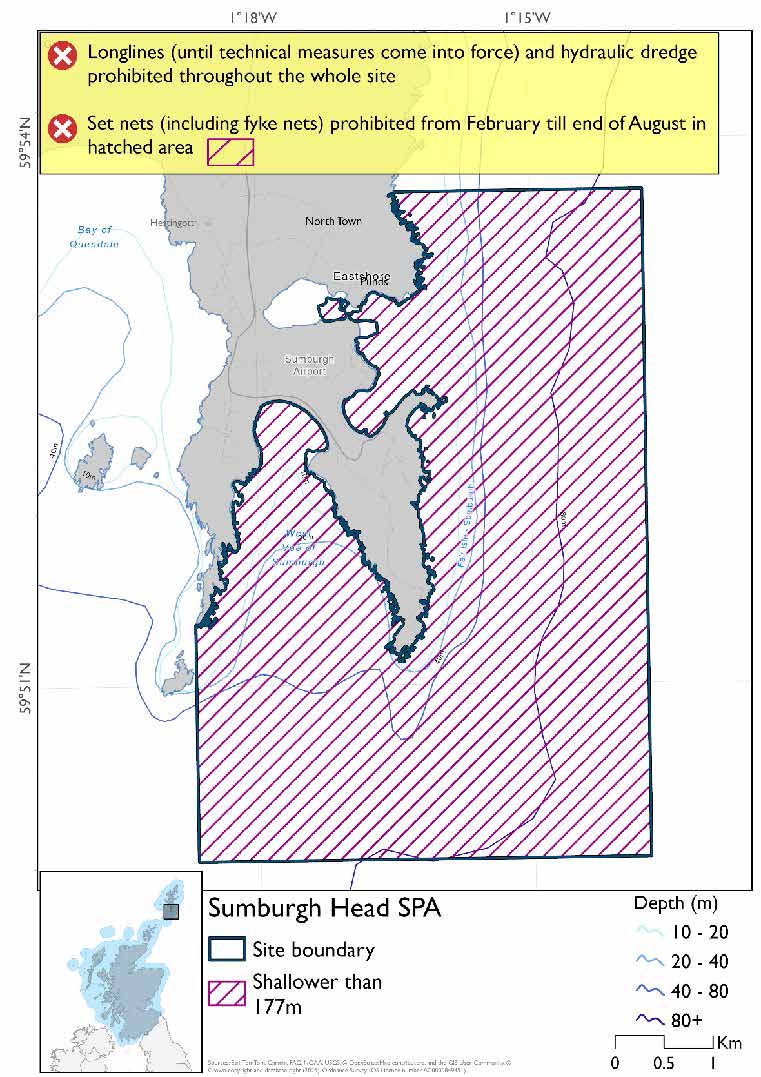
Option Two
- Full site closure to longlines (until technical measures come into force), set nets (including fyke nets) and hydraulic dredge
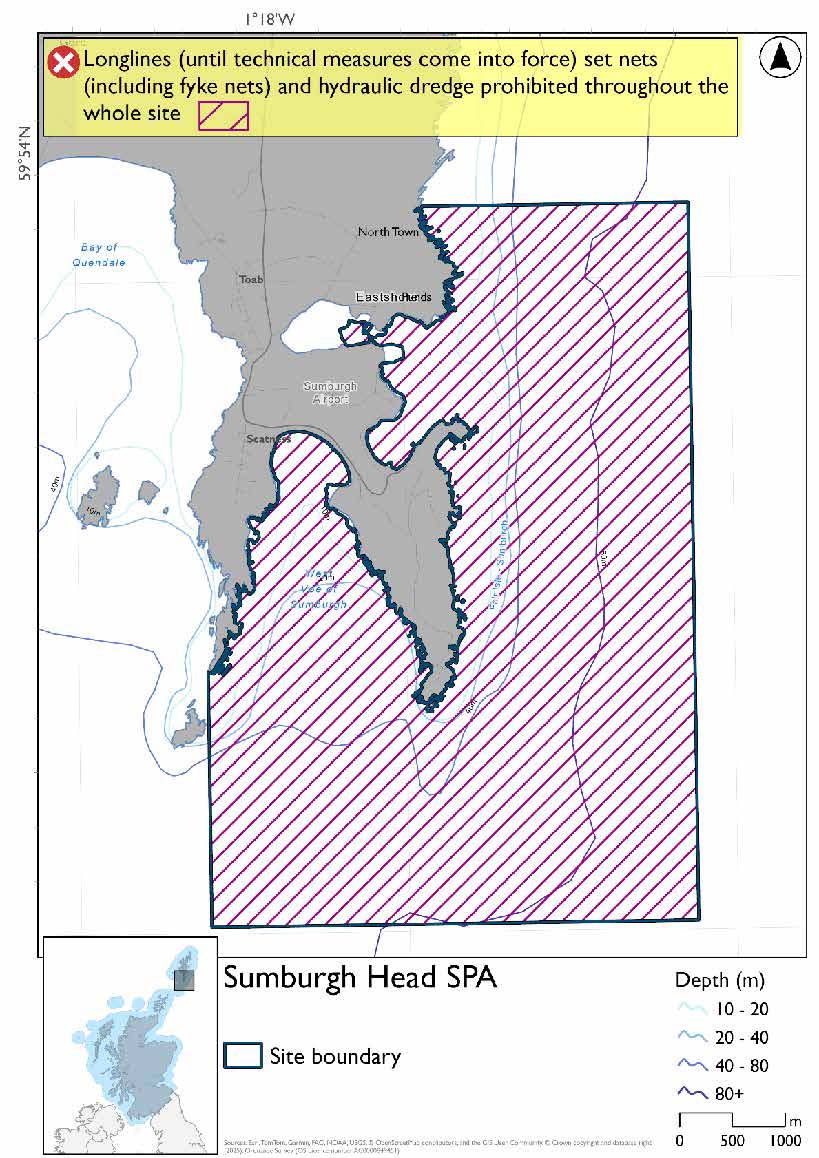
Rationale for developed measures
The basis for the proposed fisheries management measures for each site has been determined by the management advice for fishing activities provided by NatureScot, which can be found on their website or Sitelink as signposted throughout this document. The Fisheries Assessment for each site assesses the impacts from existing fishing activities on the protected features using the tests from the legislation relevant for the type of MPA being considered. The assessment outlines how the proposed measures address any impacts identified that could hinder the conservation objectives of the MPA.
15.14.7 Other fisheries management measures currently applying to this site
There are already management measures in place. An effort has been made to identify existing measures which affect each individual site or area, however the list may not be exhaustive. These measures are outlined below, and the proposals for further management being consulted on now are in addition to these existing measures:
- Fishing for sandeel is prohibited within the Scottish zone, which is defined as the sea adjacent to Scotland up to the 200 nautical miles limit
- Under the Shetland Shellfish Management Organisation (SSMO) Spatial Management Plan, hydraulic dredging is banned
Other conservation measures can be found in section 7 of the CMA.
Contact
Email: marine_biodiversity@gov.scot