
Fisheries Management Measures within Scottish Inshore Marine Protected Areas (MPAs) and Proposed Priority Marine Feature (PMF) Management Areas - Site and Area Proposal Document
This document describes the process, justification and evidence used to develop site and area specific fisheries management measures. It outlines key information for each site and area including their features, and risks of potential pressures.

13. Sites in the Orkney Islands Region
13.1 Papa Westray NCMPA
13.1.1 Description and background
The Papa Westray NCMPA comprises the coastal waters surrounding Papa Westray and the Holm of Papa Westray in Orkney, covering an area of inshore marine habitat around much of the island. The site encompasses inshore waters around the island, including shallow coastal waters and rocky shores that provide critical foraging habitat.
The site is internationally important for its population of black guillemots. More than 400 individuals breed here each year, nesting in crevices and burrows along the rocky coastline. The waters also support other seabirds which forage in the area.
The NCMPA also includes important geodiversity features representative of the Marine Geomorphology of the Scottish Shelf Seabed, including sedimentary processes that maintain shell‑rich sands and associated benthic habitats. The site encompasses the seabed, water column and surface waters that are essential for feeding and supporting prey species on which seabirds depend.
Further information, including Conservation and Management Advice (CMA) can be found on Sitelink.
Further information on MPAs, the wider network and protected areas management is available at Scottish Government MPA policy page.
13.1.2 Protected features
The Papa Westray MPA has been designated to protect:
- Black guillemot; and
- Marine Geomorphology of the Scottish Shelf Seabed
Marine Geomorphology of the Scottish Shelf Seabed is not discussed further as it is not a protected feature for which fisheries management measures are required.
13.1.3 Conservation Objectives
All of the biodiversity features are in favourable condition at Papa Westray NCMPA and therefore the Conservation Objectives seek to conserve this condition.
Additional details, including the Conservation Objectives, are provided in the Conservation and Management Advice document produced for this NCMPA and can be found on Sitelink.
13.1.4 Pressure from fishing activity
Fishing activities exert multiple pressures on black guillemots, with entanglement and bycatch in coastal gill and set nets posing the most direct threat. Localised heavy bycatch can cause population impacts. Indirect pressures arise from prey depletion and habitat damage, as guillemots rely on kelp‑associated benthic prey; bottom‑contact gears and commercial extraction reduce prey abundance and degrade kelp habitats, lowering body condition and breeding success. Increased vessel movements add further disturbance, reducing feeding efficiency near colonies and causing displacement. Discarded gear can create risks through entanglement, while changes to discard regimes alter food availability. Combined, these pressures drive both immediate mortality and longer term declines in population resilience.
Additional details are provided in the Conservation and Management Advice document produced for this NCMPA (section 6) and can be found on Sitelink.
Other resources include:
- The Feature Activity Sensitivity Tool (FeAST) which allows users to investigate the sensitivity of marine features (habitats, species, geology and landforms) in Scotland's seas, to pressures arising from human activities;
- Fisheries Guidance Notes which provide summaries of evidence on the interaction between fishing gears and specific habitats and species.
13.1.5 Fisheries management advice relevant to proposed fisheries management measures
NatureScot provides risk-based advice to help manage activities that may impact protected features and their Conservation Objectives. See section 2.3 for more detail. The CMA document also sets out the full fisheries management advice that has been summarised below for the management measures proposed:
Hydraulic (diver or vessel)
Remove or avoid pressures (removal of prey species and disturbance of prey-supporting habitat) associated with hydraulic fishing that has the potential to damage seabed habitat (in particular, sandeel habitat, herring spawning grounds) is recommended.
Static gear (including bottom set nets, drift nets, fyke nets)
Remove or avoid pressures (entanglement) associated with the use of all static nets. Spatial exclusion of all static nets in areas identified as being important for black guillemot (as identified from habitat and dive depth preferences) is recommended.
Pelagic gear
Pelagic fishing for herring/sprat may occur within or around the SPA. It is recommended that a principle objective of the management of the fishery should be ensuring that the fishing activity does not prevent or disrupt the availability of prey species for the qualifying features, i.e. it should be considered as part of a broader ecosystem-based approach to management of this fishery.
13.1.6 Proposed fisheries management measures
The proposed management measure for Papa Westray NCMPA is as follows:
Single Proposed Management Option
- Full site closure to set nets (including fyke nets) and hydraulic dredge
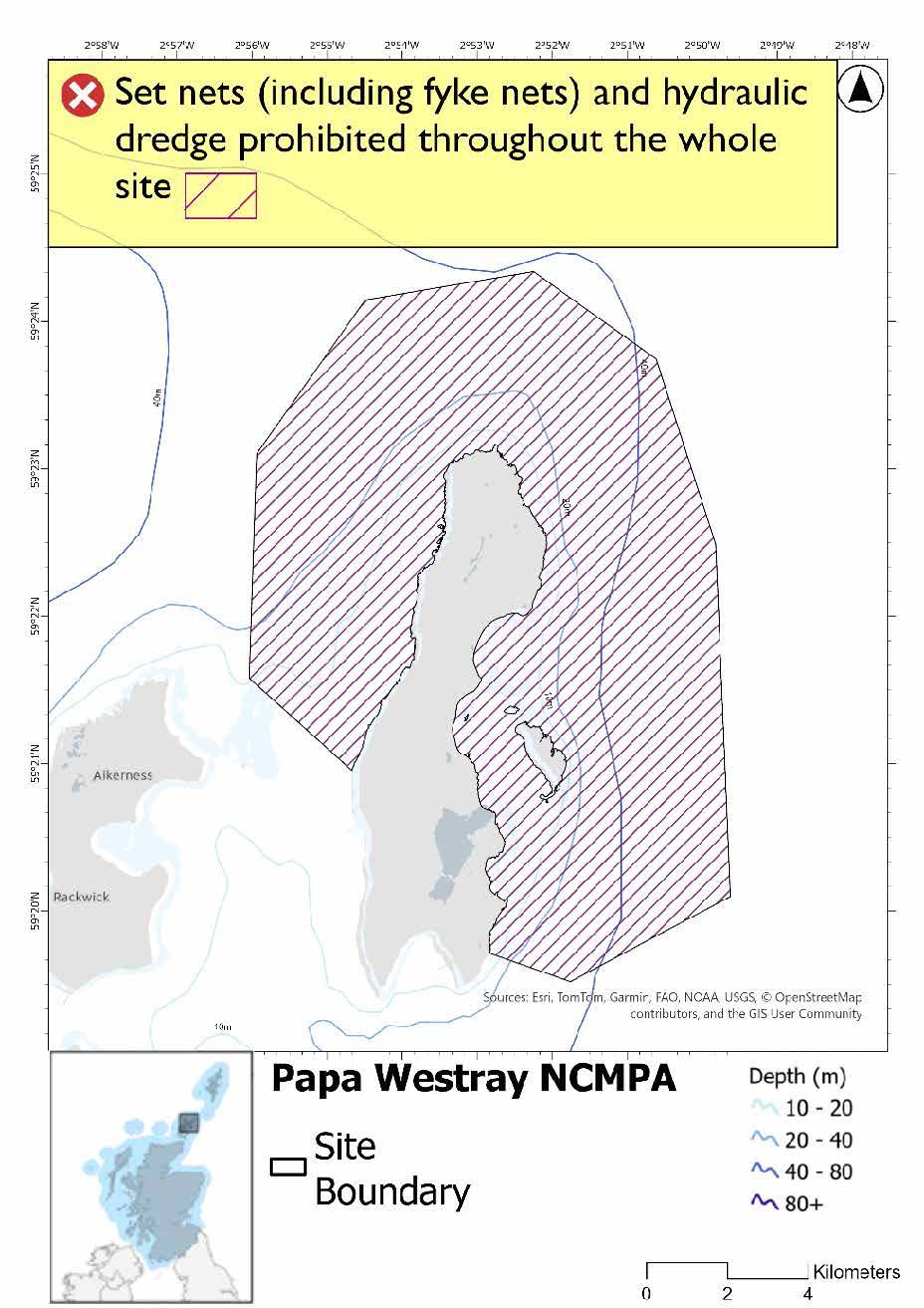
A full site level of protection from the specified gear has been identified as the only suitable option in enabling the achievement of the desired level of protection for the feature in question.
Rationale for developed measures
The basis for the proposed fisheries management measures for each site has been determined by the management advice for fishing activities provided by NatureScot, which can be found on their website or Sitelink as signposted throughout this document. The Fisheries Assessment for each site assesses the impacts from existing fishing activities on the protected features using the tests from the legislation relevant for the type of MPA being considered. The assessment outlines how the proposed measures address any impacts identified that could hinder the conservation objectives of the MPA.
13.1.7 Other fisheries management measures currently applying to this site
There are already management measures in place. An effort has been made to identify existing measures which affect each individual site or area, however the list may not be exhaustive. These measures are outlined below, and the proposals for further management being consulted on now are in addition to these existing measures:
- Fishing for sandeel is prohibited within the Scottish zone, which is defined as the sea adjacent to Scotland up to the 200 nautical miles limit
Other conservation measures can be found in section 7 of the CMA.
13.2 Faray and Holm of Faray SAC
13.2.1 Description and background
Located in the northern part of Orkney, the Faray and Holm of Faray SAC spans approximately 781 hectares and comprises two uninhabited islands with an integrated terrestrial and marine system. The site is predominantly marine, with around 80% consisting of sea inlets and coastal waters, while the remaining area includes a mosaic of sand dunes, beaches, sea cliffs, grasslands, wetlands and freshwater pools. The SAC supports the UK’s second-largest grey seal breeding colony, with its configuration encompassing both land and adjacent marine habitats essential for breeding, pupping, resting and foraging. Key features such as accessible shorelines, sheltered sea inlets and freshwater pools are particularly important for pup survival and maternal care. Together, these habitats form a coherent ecological unit that sustains the long-term viability of the grey seal population and underpins the conservation importance of the site.
Further information, including Conservation and Management Advice (CMA) can be found on Sitelink.
Further information on MPAs, the wider network and protected areas management is available at Scottish Government MPA policy page.
13.2.2 Protected features
Faray and Holm of Faray SAC has been designated to protect:
- Grey seal
13.2.3 Conservation Objectives
Grey seal is in unfavourable condition at Faray and Holm of Faray SAC and therefore the Conservation Objectives seek to restore this condition.
Additional details, including the Conservation Objectives, are provided in the Conservation and Management Advice document produced for this SAC and can be found on Sitelink.
13.2.4 Pressure from fishing activity
Fishing activities can exert multiple pressures on harbour seals, particularly through entanglement in fishing gear, which can cause injury or death, especially among younger or inexperienced individuals. Underwater noise from vessels and equipment used in fishing operations can disrupt communication, navigation, and foraging, leading to stress and displacement, especially during sensitive periods like breeding and moulting.
Disturbance from fishing-related activity may alter haul-out behaviour, reduce resting time, and in severe cases, lead to site abandonment. During breeding, such disruptions can interrupt lactation or separate mothers from pups, reducing pup survival.
Additional details are provided in the Conservation and Management Advice document produced for this SAC (section 6) and can be found on Sitelink.
Other resources include:
- The Feature Activity Sensitivity Tool (FeAST) which allows users to investigate the sensitivity of marine features (habitats, species, geology and landforms) in Scotland's seas, to pressures arising from human activities;
- Fisheries Guidance Notes which provide summaries of evidence on the interaction between fishing gears and specific habitats and species.
13.2.5 Fisheries management advice relevant to proposed fisheries management measures
NatureScot provides risk-based advice to help manage activities that may impact protected features and their Conservation Objectives. See section 2.3 for more detail. The CMA document also sets out the full fisheries management advice that has been summarised below for the management measures proposed:
Netting (Bottom-set gill nets including tangle and trammel nets. Drift nets, purse seine, ring-nets and fyke nets.)
Reduce or limit pressures - (entanglement) associated with the use of nets is recommended.
13.2.6 Proposed fisheries management measures
The proposed management measure for Faray and Holm of Faray SAC is as follows:
Single Proposed Management Option
- Full site closure to set nets (including fyke nets) and pelagic seine (including ring-nets)
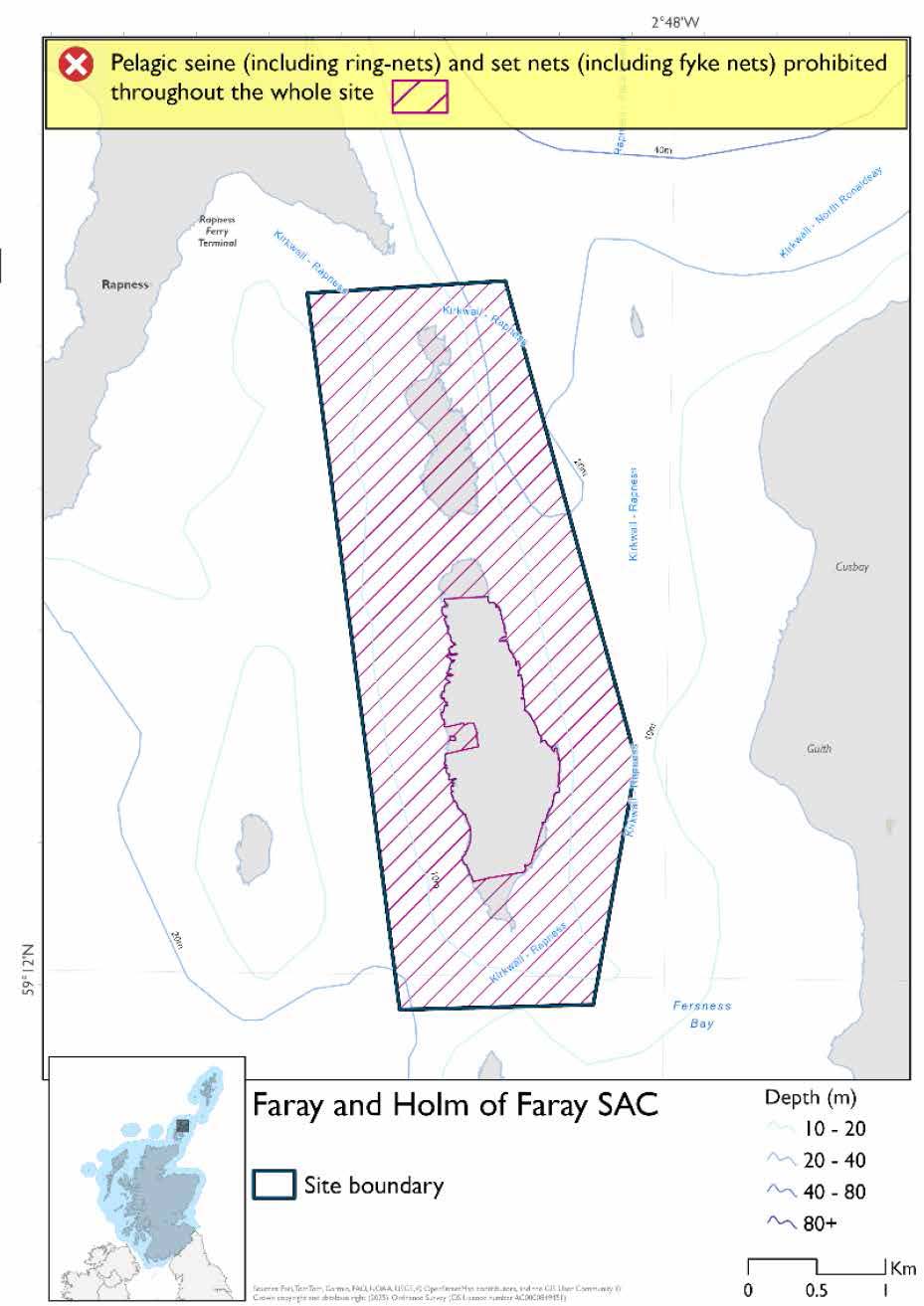
A full site level of protection from the specified gear has been identified as the only suitable option in enabling the achievement of the desired level of protection for the feature in question.
Rationale for developed measures
The basis for the proposed fisheries management measures for each site has been determined by the management advice for fishing activities provided by NatureScot, which can be found on their website or Sitelink as signposted throughout this document. The Fisheries Assessment for each site assesses the impacts from existing fishing activities on the protected features using the tests from the legislation relevant for the type of MPA being considered. The assessment outlines how the proposed measures address any impacts identified that could hinder the conservation objectives of the MPA.
13.2.7 Other fisheries management measures currently applying to this site
There are already management measures in place. An effort has been made to identify existing measures which affect each individual site or area, however the list may not be exhaustive. These measures are outlined below, and the proposals for further management being consulted on now are in addition to these existing measures:
- Fishing for sandeel is prohibited within the Scottish zone, which is defined as the sea adjacent to Scotland up to the 200 nautical miles limit
Other conservation measures can be found in section 7 of the CMA.
13.3 Calf of Eday SPA
13.3.1 Description and background
Calf of Eday SPA is a protected seabird site in Orkney, Scotland, designated for its internationally important breeding populations. The site includes the island of Calf of Eday and a surrounding marine extension, covering 2,669 hectares of coastal cliffs, heathland, and offshore waters.
The site is ecologically significant. It regularly supports around 30,000 seabirds, including nationally important populations of cormorant, great black-backed gull, guillemot, fulmar, and kittiwake. These species depend on the island’s cliffs for nesting and the surrounding waters for feeding, especially during the breeding season.
Further information, including Conservation and Management Advice (CMA) can be found on Sitelink.
Further information on MPAs, the wider network and protected areas management is available at Scottish Government MPA policy page.
13.3.2 Protected features
The Calf of Eday Special Protection Area (SPA) has been designated to protect five species of breeding seabirds:
- Cormorant;
- Fulmar;
- Great black-backed gull;
- Guillemot; and
- Kittiwake
The protected features of the Calf of Eday SPA are protected within the SPA throughout the year, irrespective of the season for which they qualified as a protected feature.
13.3.3 Conservation Objectives
The following protected features are in favourable condition at Calf of Eday SPA: cormorant and fulmar. Therefore, the Conservation Objectives seek to maintain this condition.
The following protected features are in unfavourable condition at Calf of Eday SPA: kittiwake, guillemot, and great black-backed gull. Therefore, the Conservation Objectives seek to restore this condition.
Additional details, including the Conservation Objectives, are provided in the Conservation and Management Advice document produced for this SPA and can be found on Sitelink.
13.3.4 Pressure from fishing activity
Fishing activities exert significant pressures on protected seabird species, primarily through bycatch, prey depletion and disturbance. Kittiwakes, guillemots, and fulmars are highly sensitive to accidental capture in surface and longline fisheries, leading to direct mortality and population declines. These species, along with others, are also sensitive to reductions in prey abundance caused by industrial fishing and climate change, which undermines foraging success and breeding outcomes. Increased turbidity from fishing operations further impairs the ability of diving species such as guillemots and kittiwakes to locate prey effectively.
Cormorants and great black‑backed gulls face similar risks, with bycatch and prey depletion impacting survival. Cormorants are additionally subject to licensed control and persecution in some regions, contributing to elevated adult mortality.
Fulmars are particularly sensitive to disturbance during incubation, while displacement from vessel activity is a shared concern across guillemots, gulls, and cormorants.
Additional details are provided in the Conservation and Management Advice document produced for this SPA (section 6) and can be found on Sitelink.
Other resources include:
- The Feature Activity Sensitivity Tool (FeAST) which allows users to investigate the sensitivity of marine features (habitats, species, geology and landforms) in Scotland's seas, to pressures arising from human activities;
- Fisheries Guidance Notes which provide summaries of evidence on the interaction between fishing gears and specific habitats and species.
13.3.5 Fisheries management advice relevant to proposed fisheries management measures
NatureScot provides risk-based advice to help manage activities that may impact protected features and their Conservation Objectives. See section 2.3 for more detail. The CMA document also sets out the full fisheries management advice that has been summarised below for the management measures proposed:
Hydraulic gear
Remove or avoid pressures (removal of prey species and disturbance of prey-supporting habitat) associated with hydraulic fishing that has the potential to damage seabed habitat (in particular, sandeel habitat) is recommended.
Static gear (drift nets and bottom set nets inc. fyke nets)
Remove or avoid pressures (entanglement) associated with the use of all static nets. Spatial exclusion of all static nets in areas identified as being important for guillemot and cormorant (as identified from habitat and dive depth preferences) is recommended.
Pelagic gear
Pelagic fishing for herring/sprat may occur within or around the SPA. It is recommended that a principal objective of the management of the fishery should be ensuring that the fishing activity does not prevent or disrupt the availability of prey species i.e. it should be considered as part of a broader ecosystem-based approach to management of this fishery.
Longlining (not including jigging)
Long-lining (pelagic and demersal) may occur within or around the SPA(s). Current understanding is that long-line fisheries are largely restricted to offshore waters. Site-specific measures for long-lining are not currently considered appropriate due to the scale of the fishery, and the wide-spread interaction with seabirds. However, there is evidence of seabird bycatch in long-line (not jigging) fisheries therefore it is recommended this requires wider seas management measures.
For the SPAs advice has also been provided on maximum dive depth and seasonality for protected features of each site and can be found in the Fishing Activity Further Advice and Evidence document. Supplementary advice can also be found on NatureScot’s website.
13.3.6 Proposed fisheries management measures
The proposed management measures for Calf of Eday SPA are as follows:
Option One
- Set nets (including fyke nets) prohibited in areas shallower than 33m based on presence and maximum dive depth for cormorant
- Demersal set nets (including fyke nets) prohibited from February till end of August, based on presence and maximum dive depth for guillemot, and pelagic set nets prohibited in areas deeper than 33m but shallower than 177m based on presence of cormorant
- Full site closure to longlines (until technical measures come into force) and hydraulic dredge
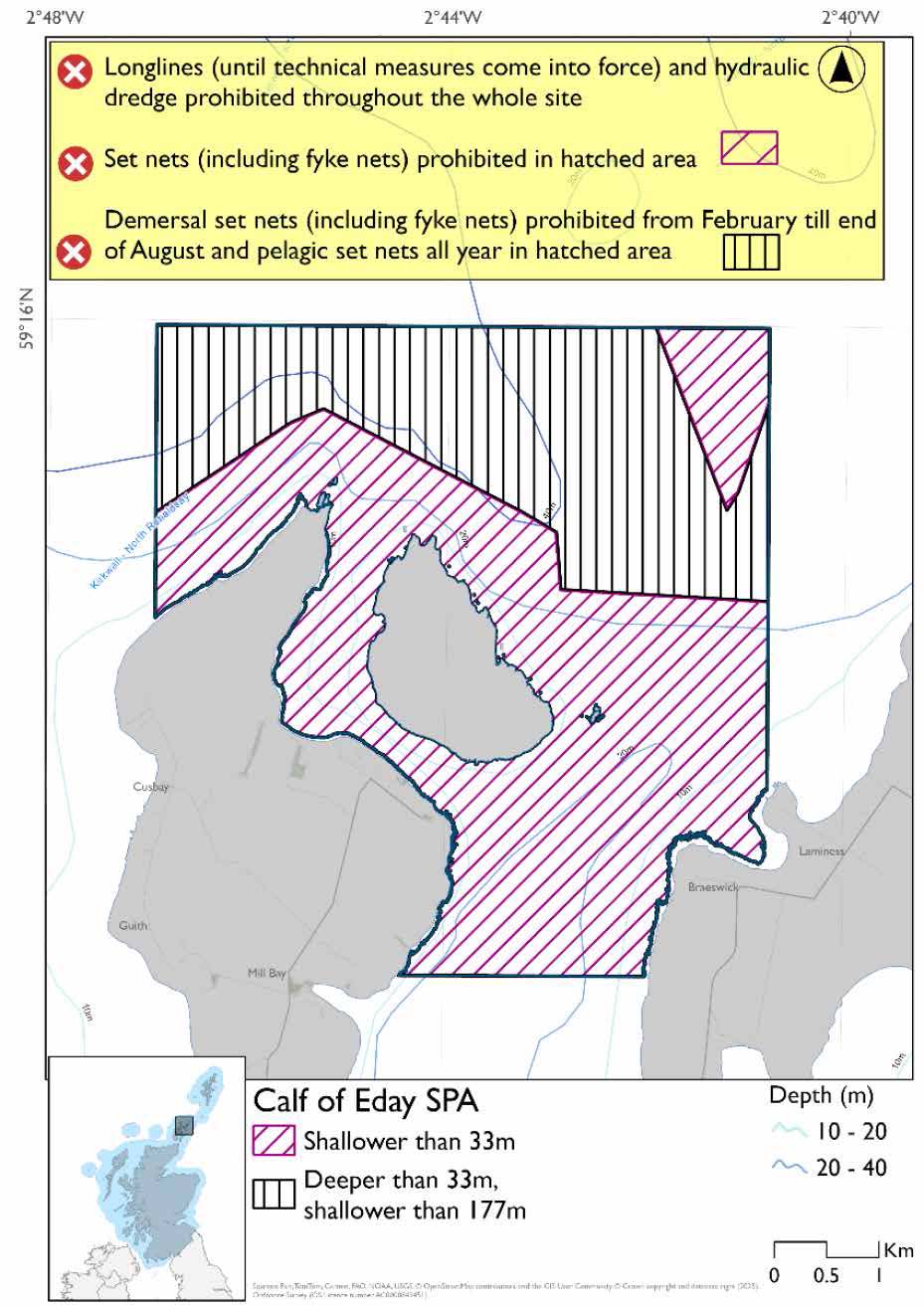
Option Two
- Full site closure to longlines (until technical measures come into force), set nets (including fyke nets) and hydraulic dredge
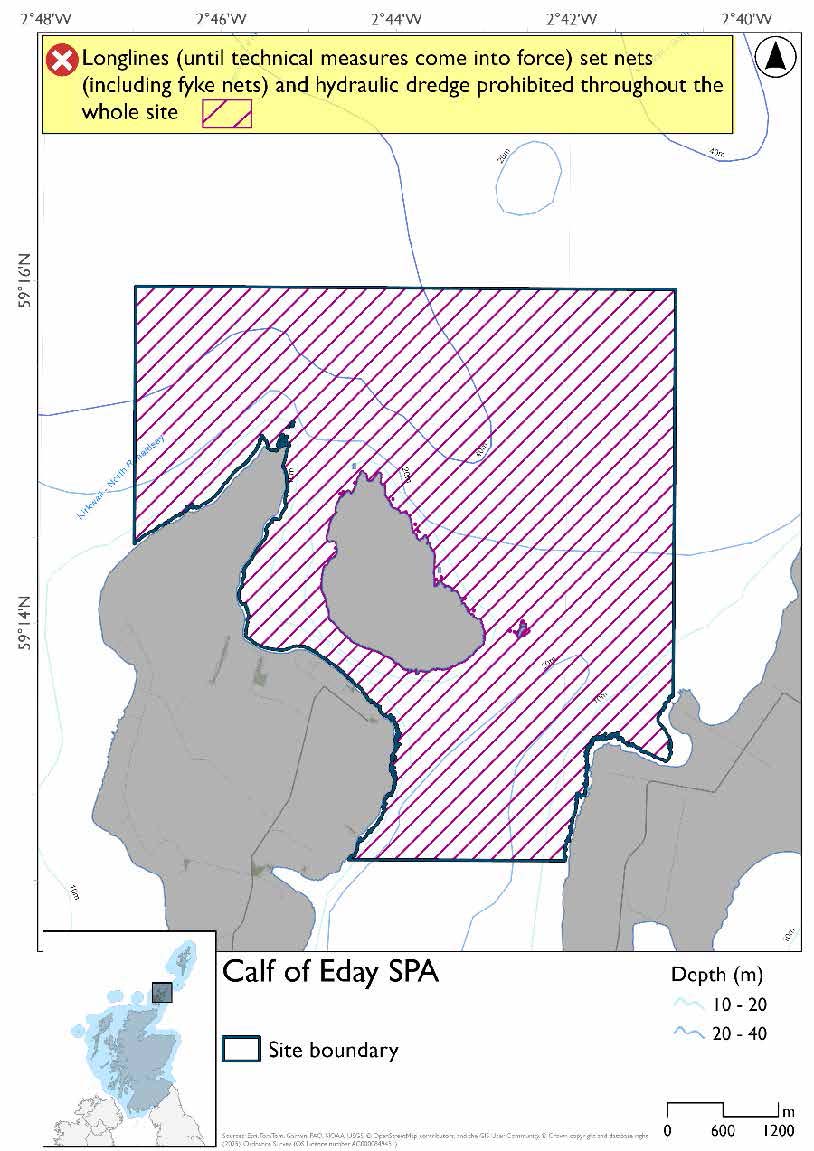
Rationale for developed measures
The basis for the proposed fisheries management measures for each site has been determined by the management advice for fishing activities provided by NatureScot, which can be found on their website or Sitelink as signposted throughout this document. The Fisheries Assessment for each site assesses the impacts from existing fishing activities on the protected features using the tests from the legislation relevant for the type of MPA being considered. The assessment outlines how the proposed measures address any impacts identified that could hinder the conservation objectives of the MPA.
13.3.7 Other fisheries management measures currently applying to this site
There are already management measures in place. An effort has been made to identify existing measures which affect each individual site or area, however the list may not be exhaustive. These measures are outlined below, and the proposals for further management being consulted on now are in addition to these existing measures:
- Fishing for sandeel is prohibited within the Scottish zone, which is defined as the sea adjacent to Scotland up to the 200 nautical miles limit
Other conservation measures can be found in section 7 of the CMA.
13.4 Copinsay SPA
13.4.1 Description and background
Copinsay SPA is a significant seabird conservation site in Orkney, Scotland, designated for its large and diverse breeding populations. The SPA covers the island of Copinsay, its surrounding islets, and a seaward extension of roughly 2 km, creating a compact terrestrial–marine site of about 3,607.7 hectares that lies approximately 4 km off the east coast of Orkney Mainland.
The site includes the full Copinsay SSSI footprint: steep cliffs, rocky shores, maritime heath and grassland that provide nesting habitat for large seabird colonies. These terrestrial components contain the cliff ledges, nesting terraces and adjacent vegetated slopes used by qualifying species such as guillemot, kittiwake, fulmar and great black‑backed gull. The marine extension explicitly encompasses the seabed, water column and surface/airspace within the seaward margin so that nearby feeding grounds, flight corridors and local foraging hotspots used during the breeding season are captured alongside the island colonies.
Further information, including Conservation and Management Advice (CMA) can be found on Sitelink.
Further information on MPAs, the wider network and protected areas management is available at Scottish Government MPA policy page.
13.4.2 Protected features
The Copinsay SPA has been designated to protect four species of seabird:
- Fulmar;
- Great black-backed gull;
- Guillemot
- Kittiwake
The protected features of the Copinsay SPA are protected within the SPA throughout the year, irrespective of the season for which they qualified as a protected feature.
13.4.3 Conservation Objectives
The following protected feature is in favourable condition at Copinsay SPA: fulmar. Therefore, the Conservation Objectives seek to maintain this condition.
The following protected features are in unfavourable condition at Copinsay SPA: kittiwake, guillemot, and great black-backed gull. Therefore, the Conservation Objectives seek to restore this condition.
Additional details, including the Conservation Objectives, are provided in the Conservation and Management Advice document produced for this SPA and can be found on Sitelink.
13.4.4 Pressure from fishing activity
Fishing activities can exert significant pressures on kittiwakes, guillemots, great black‑backed gulls, and fulmars, primarily through bycatch, prey depletion and disturbance. Accidental capture in surface and longline fisheries is a common threat, with fulmars and guillemots particularly sensitive. Prey depletion, especially of sandeels, driven by industrial fishing and environmental change, reduces breeding success and survival across all four species.
Disturbance from fishing vessels and associated activity adds further stress, with displacement noted for kittiwakes, guillemots, and gulls. Guillemots are especially sensitive to visual and noise disturbance, while increased turbidity from fishing operations impairs their foraging efficiency.
Additional details are provided in the Conservation and Management Advice document produced for this SPA (section 6) and can be found on Sitelink.
Other resources include:
- The Feature Activity Sensitivity Tool (FeAST) which allows users to investigate the sensitivity of marine features (habitats, species, geology and landforms) in Scotland's seas, to pressures arising from human activities;
- Fisheries Guidance Notes which provide summaries of evidence on the interaction between fishing gears and specific habitats and species.
13.4.5 Fisheries management advice relevant to proposed fisheries management measures
NatureScot provides risk-based advice to help manage activities that may impact protected features and their Conservation Objectives. See section 2.3 for more detail. The CMA document also sets out the full fisheries management advice that has been summarised below for the management measures proposed:
Hydraulic gear
Remove or avoid pressures (removal of prey species and disturbance of prey-supporting habitat) associated with hydraulic fishing that has the potential to damage seabed habitat (in particular, sandeel habitat, herring spawning grounds) is recommended.
Static gear (drift nets and bottom set nets inc. fyke nets)
Remove or avoid pressures (entanglement) associated with the use of all static nets. Spatial exclusion of all static nets in areas identified as being important for guillemot (as identified from habitat and dive depth preferences) is recommended.
Pelagic gear
Pelagic fishing for herring/sprat may occur within or around the SPA. It is recommended that a principal objective of the management of the fishery should be ensuring that the fishing activity does not prevent or disrupt the availability of prey species i.e. it should be considered as part of a broader ecosystem-based approach to management of this fishery.
Longlining (not including jigging)
Long-lining (pelagic and demersal) may occur within or around the SPA(s). Current understanding is that long-line fisheries are largely restricted to offshore waters. Site-specific measures for long-lining are not currently considered appropriate due to the scale of the fishery, and the wide-spread interaction with seabirds. However, there is evidence of seabird bycatch in long-line (not jigging) fisheries therefore it is recommended this requires wider seas management measures.
For the SPAs advice has also been provided on maximum dive depth and seasonality for protected features of each site and can be found in the Fishing Activity Further Advice and Evidence document. Supplementary advice can also be found on NatureScot’s website.
13.4.6 Proposed fisheries management measures
The proposed management measures for Copinsay SPA are as follows:
Option One*
- Set nets (including fyke nets) prohibited from February till end of August down to 177m, based on presence and maximum dive depth for guillemot
- Set nets (including fyke nets) prohibited in the overlapping area with Scapa Flow SPA
- Full site closure to longlines (until technical measures come into force) and hydraulic dredge
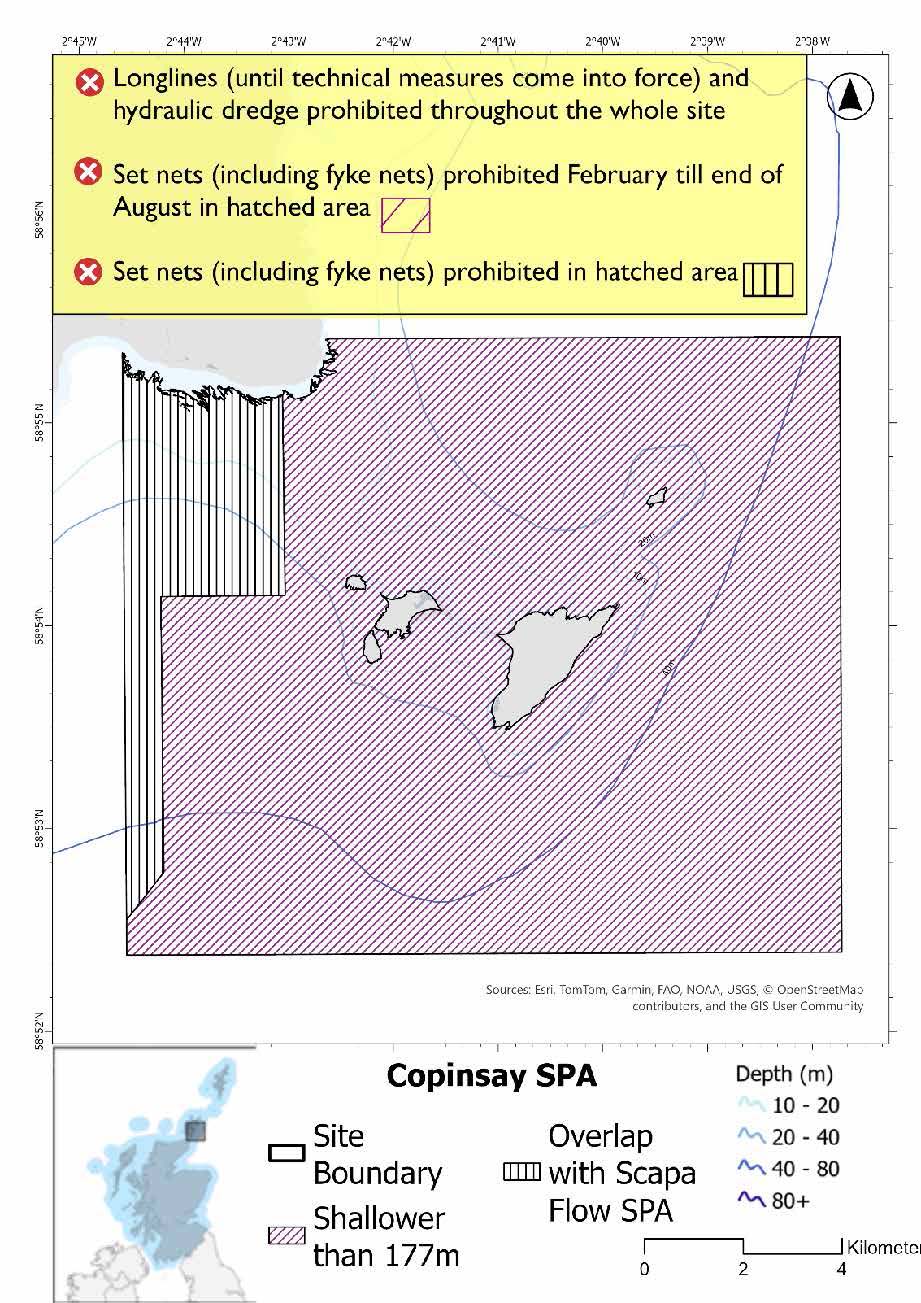
*This site will have other demersal mobile measures that may apply from the overlapping portions with the proposed PMF management area that aren’t shown on the map for this option.
- The proposed PMF management areas would prohibit all demersal mobile gear from the entire area that overlaps. (see section below for overlapping area)
Please check the Option 1 or single management overlapping area map to see proposed demersal mobile measures under Option 1.
Option Two*
- Full site closure to longlines (until technical measures come into force), set nets (including fyke nets) and hydraulic dredge
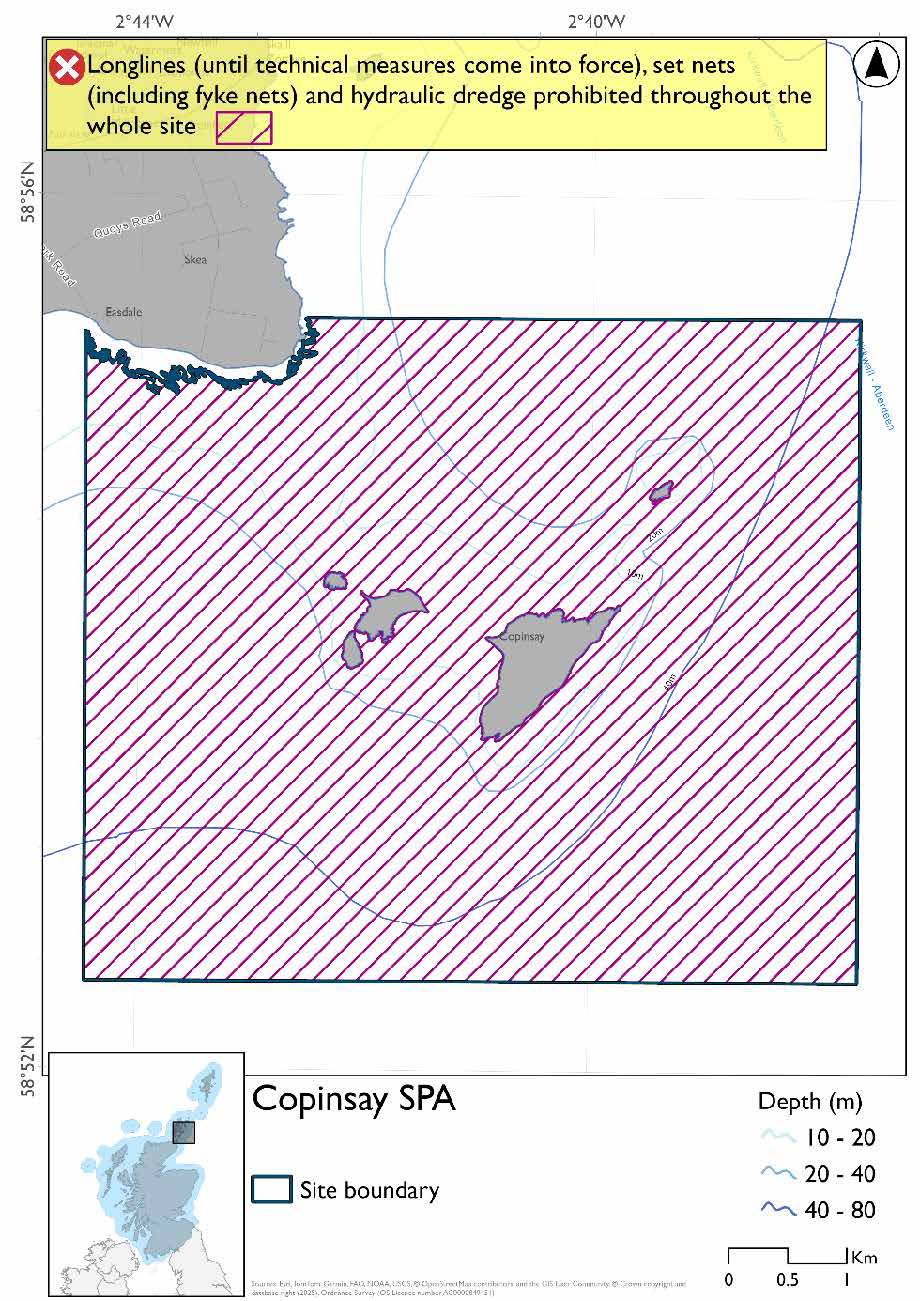
*The measures for Option 2 proposals only come from gear types prohibited in non-overlapping areas. Overlapping restrictions may still apply from overlapping sites or areas dependent on the decisions taken for that site or area.
Overlapping site and area included in this consultation
This SPA overlaps with the Scapa Flow SPA and Copinsay (Orkney) proposed PMF management areas.
Rationale for developed measures
The basis for the proposed fisheries management measures for each site has been determined by the management advice for fishing activities provided by NatureScot, which can be found on their website or Sitelink as signposted throughout this document. The Fisheries Assessment for each site assesses the impacts from existing fishing activities on the protected features using the tests from the legislation relevant for the type of MPA being considered. The assessment outlines how the proposed measures address any impacts identified that could hinder the conservation objectives of the MPA.
13.4.7 Other fisheries management measures currently applying to this site
There are already management measures in place. An effort has been made to identify existing measures which affect each individual site or area, however the list may not be exhaustive. These measures are outlined below, and the proposals for further management being consulted on now are in addition to these existing measures:
- Fishing for sandeel is prohibited within the Scottish zone, which is defined as the sea adjacent to Scotland up to the 200 nautical miles limit
Other conservation measures can be found in section 7 of the CMA.
13.5 Hoy SPA
13.5.1 Description and background
Hoy SPA covers the northern and western two-thirds of Hoy Island in Orkney, along with a 2 km marine extension, protecting both upland breeding habitats and surrounding coastal waters.
The site spans approximately 18,124 hectares, incorporating Hoy’s mountainous terrain, high sea cliffs, and adjacent marine environment. The boundary includes Old Red Sandstone uplands, heath, bogs, alpine vegetation, and Britain’s most northerly native woodland. These terrestrial features support a rich assemblage of moorland and cliff-nesting birds.
The marine extension reaches 2 km offshore, encompassing the seabed, water column, and airspace. This ensures protection of vital foraging areas and flight paths used by seabirds during the breeding season. The boundary overlaps with the Hoy SSSI, reinforcing protection across both land and sea.
Further information, including Conservation and Management Advice (CMA) can be found on Sitelink.
Further information on MPAs, the wider network and protected areas management is available at Scottish Government MPA policy page.
13.5.2 Protected features
The Hoy SPA has been designated to protect:
- Arctic skua;
- Fulmar;
- Great black-backed gull;
- Great skua;
- Guillemot;
- Kittiwake;
- Peregrine;
- Puffin; and
- Red-throated diver
Peregrine are not discussed further as they are not a protected feature for which fisheries management measures are required.
The protected features of the Hoy SPA are protected within the SPA throughout the year, irrespective of the season for which they qualified as a protected feature.
13.5.3 Conservation Objectives
The following protected features are in favourable condition at Hoy SPA: red-throated diver. Therefore, the Conservation Objectives seek to maintain this condition.
The following protected features are in unfavourable condition at Hoy SPA: Arctic skua, puffin, kittiwake, guillemot, great black-backed gull, great skua, and fulmar. Therefore, the Conservation Objectives seek to restore this condition.
Additional details, including the Conservation Objectives, are provided in the Conservation and Management Advice document produced for this SPA and can be found on Sitelink.
13.5.4 Pressure from fishing activity
Fishing activities exert significant pressures on protected seabird species, primarily through bycatch and prey depletion. Fulmars and skuas face high risks from longline and surface gears, while auks (including puffins and guillemots), kittiwakes, gulls, and divers are prone to capture or entanglement in nets, leading to direct mortality.
Indirect impacts arise from reduced prey availability, particularly of sandeels and other forage fish, driven by fisheries practices and declines in discards. This affects skuas, fulmars, kittiwakes, auks and gulls, resulting in lower breeding success, reduced chick survival, and long‑term population declines.
Changes in fisheries also alter foraging behaviour and prey distribution, increasing competition for food and kleptoparasitism among skuas (behaviour in which one animal steals food or other resources that another animal has obtained rather than finding or catching the resource itself), and forcing species to forage further afield or in riskier areas where they may experience additional pressures.
These shifts raise energetic costs and exposure to further threats.
Additional details are provided in the Conservation and Management Advice document produced for this SPA (section 6) and can be found on Sitelink.
Other resources include:
- The Feature Activity Sensitivity Tool (FeAST) which allows users to investigate the sensitivity of marine features (habitats, species, geology and landforms) in Scotland's seas, to pressures arising from human activities;
- Fisheries Guidance Notes which provide summaries of evidence on the interaction between fishing gears and specific habitats and species.
13.5.5 Fisheries management advice relevant to proposed fisheries management measures
NatureScot provides risk-based advice to help manage activities that may impact protected features and their Conservation Objectives. See section 2.3 for more detail. The CMA document also sets out the full fisheries management advice that has been summarised below for the management measures proposed:
Hydraulic gear
Remove or avoid pressures (removal of prey species and disturbance of prey-supporting habitat) associated with hydraulic fishing that has the potential to damage seabed habitat (in particular, sandeel habitat, herring spawning grounds) is recommended.
Static gear (drift nets and bottom set nets inc. fyke nets)
Remove or avoid pressures (entanglement) associated with the use of all static nets. Spatial exclusion of all static nets in areas identified as being important for auks and red-throated divers (as identified from habitat and dive depth preferences) is recommended.
Pelagic gear
Pelagic fishing for herring/sprat may occur within or around the SPA. It is recommended that a principal objective of the management of the fishery should be ensuring that the fishing activity does not prevent or disrupt the availability of prey species i.e. it should be considered as part of a broader ecosystem-based approach to management of this fishery.
Longlining (not including jigging)
Long-lining (pelagic and demersal) may occur within or around the SPA(s). Current understanding is that long-line fisheries are largely restricted to offshore waters. Site-specific measures for long-lining are not currently considered appropriate due to the scale of the fishery, and the wide-spread interaction with seabirds. However, there is evidence of seabird bycatch in long-line (not jigging) fisheries therefore it is recommended this requires wider seas management measures.
For the SPAs advice has also been provided on maximum dive depth and seasonality for protected features of each site and can be found in the Fishing Activity Further Advice and Evidence document. Supplementary advice can also be found on NatureScot’s website.
13.5.6 Proposed fisheries management measures
The proposed management measures for Hoy SPA are as follows:
Option One*
- Set nets (including fyke nets) prohibited February till mid-September in areas down to 21m based on presence and maximum dive depth for red-throated diver
- Demersal set nets (including fyke nets) prohibited February till end of August and pelagic set nets prohibited February till mid-September in areas deeper than 21m but shallower than 177m based on presence of red-throated diver and guillemot and maximum dive depth for guillemot
- Set nets (including fyke nets) prohibited in the overlapping area with Scapa Flow SPA
- Full site closure to longlines (until technical measures come into force) and hydraulic dredge
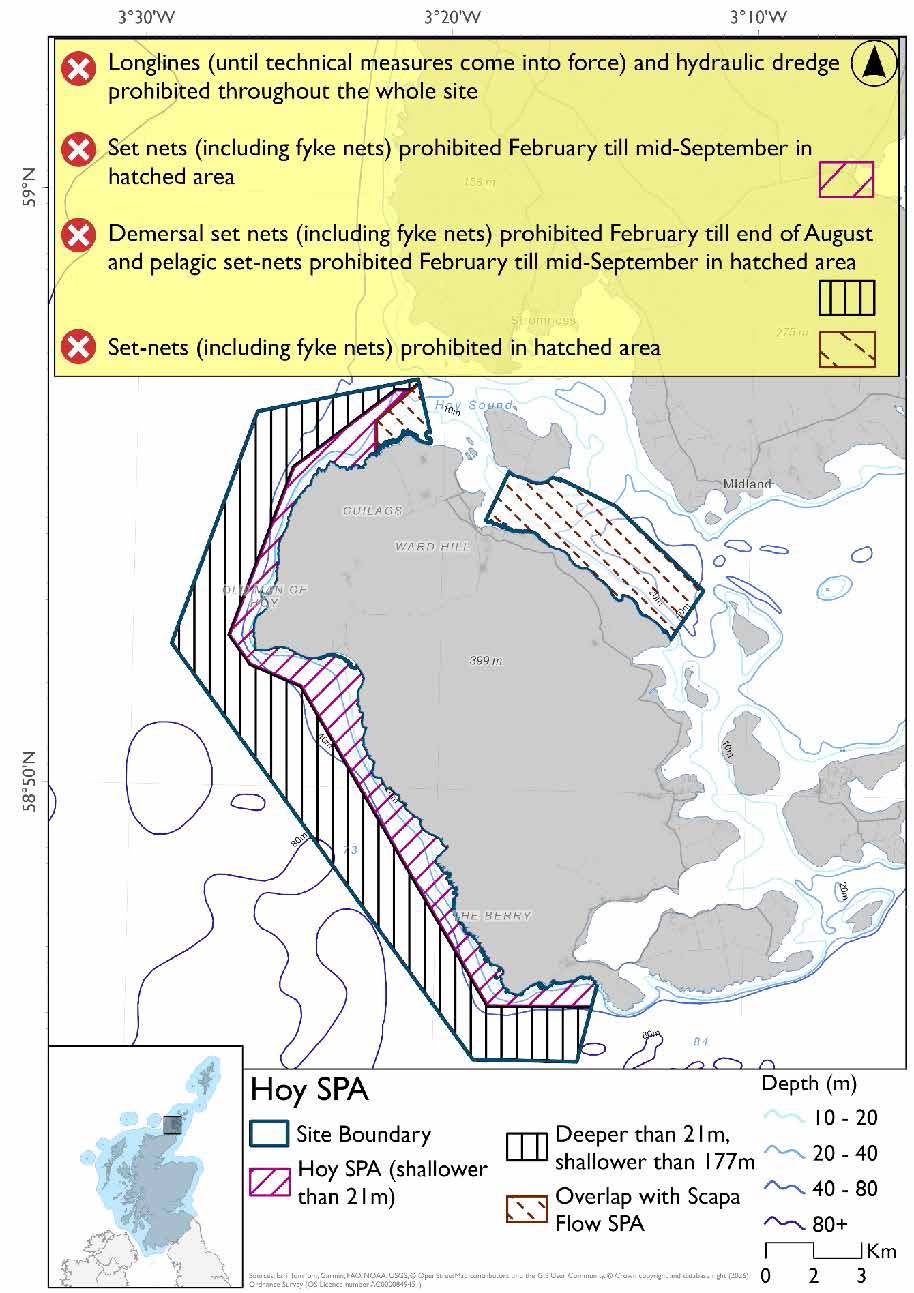
*This site will have other demersal mobile measures that may apply from the overlapping portions with the proposed PMF management areas, that aren’t shown on the map.
- The proposed PMF management areas would prohibit all demersal mobile gear from the entire area that overlaps. (see section below for overlapping areas)
Please check the overlapping area maps to see proposed demersal mobile measures.
Option Two*
- Full site closure to longlines (until technical measures come into force), set nets (including fyke nets) and hydraulic dredge
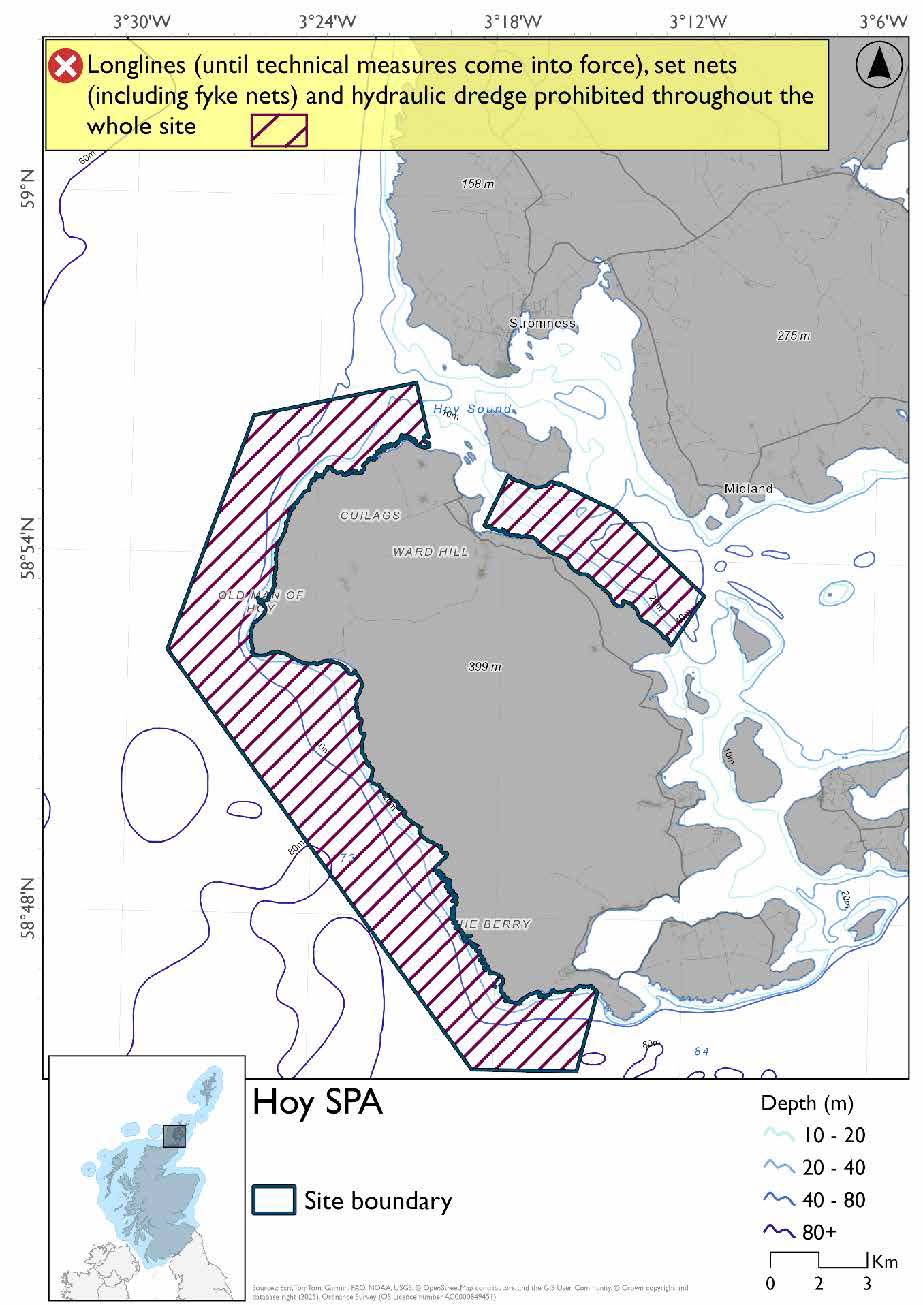
*The measures for Option 2 proposals only come from gear types prohibited in non-overlapping areas. Overlapping restrictions may still apply from overlapping sites or areas dependent on the decisions taken for that site or area.
Overlapping site and areas included in this consultation
This SPA overlaps with the Scapa Flow SPA and Hoy Sound (East) to South Walls (Orkney) and Hoy Sound (Orkney) proposed PMF management areas.
Rationale for measures developed
The basis for the proposed fisheries management measures for each site has been determined by the management advice for fishing activities provided by NatureScot, which can be found on their website or Sitelink as signposted throughout this document. The Fisheries Assessment for each site assesses the impacts from existing fishing activities on the protected features using the tests from the legislation relevant for the type of MPA being considered. The assessment outlines how the proposed measures address any impacts identified that could hinder the conservation objectives of the MPA.
13.5.7 Other fisheries management measures currently applying to this site
There are already management measures in place. An effort has been made to identify existing measures which affect each individual site or area, however the list may not be exhaustive. These measures are outlined below, and the proposals for further management being consulted on now are in addition to these existing measures:
- Fishing for sandeel is prohibited within the Scottish zone, which is defined as the sea adjacent to Scotland up to the 200 nautical miles limit
- Mobile or active gear prohibited across part of the site from 01 May till 30 September.
Other conservation measures can be found in section 7 of the CMA.
13.6 Marwick Head SPA
13.6.1 Description and background
Marwick Head SPA is located on the west coast of Mainland Orkney and covers approximately 224 hectares. The boundary includes the vertical sandstone cliffs of Marwick Head and a 1km marine extension offshore. The site is celebrated for its towering cliffs and exposed coastal habitats, which provide essential nesting and foraging grounds for large colonies of seabirds.
The marine extension covers the seabed, water column, and surface. This extension reflects the ecological link between cliff nesting sites and surrounding feeding areas, which is crucial for the life cycles of seabirds. The SPA boundary overlaps with the Marwick Head SSSI, reinforcing its conservation value.
Marwick Head supports internationally significant populations of breeding seabirds. It regularly hosts over 75,000 individuals, including guillemot (37,700 individuals, 1.1% of the Western European population) and kittiwake (7,700 pairs, 2% of the GB population). These species depend on the cliffs for nesting and the adjacent waters for feeding, making the site vital for their survival and conservation.
Further information, including Conservation and Management Advice (CMA) can be found on Sitelink.
Further information on MPAs, the wider network and protected areas management is available at Scottish Government MPA policy page.
13.6.2 Protected features
The Marwick Head SPA has been designated to protect:
- Guillemot; and
- Kittiwake
The protected features of the Marwick SPA are protected within the SPA throughout the year, irrespective of the season for which they qualified as a protected feature.
13.6.3 Conservation Objectives
The following protected features are in unfavourable condition at Marwick Head SPA: kittiwake and guillemot. Therefore, the Conservation Objectives for these protected features seek to restore this condition.
Additional details, including the Conservation Objectives, are provided in the Conservation and Management Advice document produced for this SPA and can be found on Sitelink.
13.6.4 Pressure from fishing activity
Fishing activities exert significant pressures on kittiwakes and guillemots, primarily through bycatch, prey depletion, and habitat disturbance. Accidental capture in surface nets and other fishing gears is the main direct threat, causing immediate mortality and reducing adult survival, with guillemots particularly sensitive to entanglement during foraging.
Indirect impacts arise from prey depletion, driven by commercial fishing and changes in discard regimes. Declines or redistribution of key forage species such as sandeels reduce food availability, lowering breeding success and chick survival. Kittiwakes, reliant on near‑surface prey, and guillemots, feeding in the water column, are both forced to travel farther and expend more energy when prey becomes scarce.
Fishing‑related habitat changes further worsen foraging conditions. Seabed disturbance and resuspension increase turbidity, impairing guillemots’ ability to locate prey, while altered prey distribution reduces kittiwakes’ access to surface forage. These shifts also heighten competition and change foraging behaviour, increasing exposure to additional threats.
Additional details are provided in the Conservation and Management Advice document produced for this SPA (section 6) and can be found on Sitelink.
Other resources include:
- The Feature Activity Sensitivity Tool (FeAST) which allows users to investigate the sensitivity of marine features (habitats, species, geology and landforms) in Scotland's seas, to pressures arising from human activities;
- Fisheries Guidance Notes which provide summaries of evidence on the interaction between fishing gears and specific habitats and species.
13.6.5 Fisheries management advice relevant to proposed fisheries management measures
NatureScot provides risk-based advice to help manage activities that may impact protected features and their Conservation Objectives. See section 2.3 for more detail. The CMA document also sets out the full fisheries management advice that has been summarised below for the management measures proposed:
Hydraulic gear
Remove or avoid pressures (removal of prey species and disturbance of prey-supporting habitat) associated with hydraulic fishing that has the potential to damage seabed habitat (in particular, sandeel habitat, herring spawning grounds) is recommended.
Static gear (drift nets and bottom set nets inc. fyke nets)
Remove or avoid pressures (entanglement) associated with the use of all static nets. Spatial exclusion of all static nets in areas identified as being important for protected features (as identified from habitat and dive depth preferences) is recommended.
Pelagic gear
Pelagic fishing for herring/sprat may occur within or around the SPA. It is recommended that a principal objective of the management of the fishery should be ensuring that the fishing activity does not prevent or disrupt the availability of prey species i.e. it should be considered as part of a broader ecosystem-based approach to management of this fishery.
Longlining (not including jigging)
Long-lining (pelagic and demersal) may occur within or around the SPA(s). Current understanding is that long-line fisheries are largely restricted to offshore waters. Site-specific measures for long-lining are not currently considered appropriate due to the scale of the fishery, and the wide-spread interaction with seabirds. However, there is evidence of seabird bycatch in long-line (not jigging) fisheries therefore it is recommended this requires wider seas management measures.
For the SPAs advice has also been provided on maximum dive depth and seasonality for protected features of each site and can be found in the Fishing Activity Further Advice and Evidence document. Supplementary advice can also be found on NatureScot’s website.
13.6.6 Proposed fisheries management measures
The proposed management measures for Marwick Head SPA are as follows:
Option One
- Set nets (including fyke nets) prohibited from February till end of August in areas down to 177m based on presence and maximum dive depth for guillemot
- Full site closure to hydraulic dredge
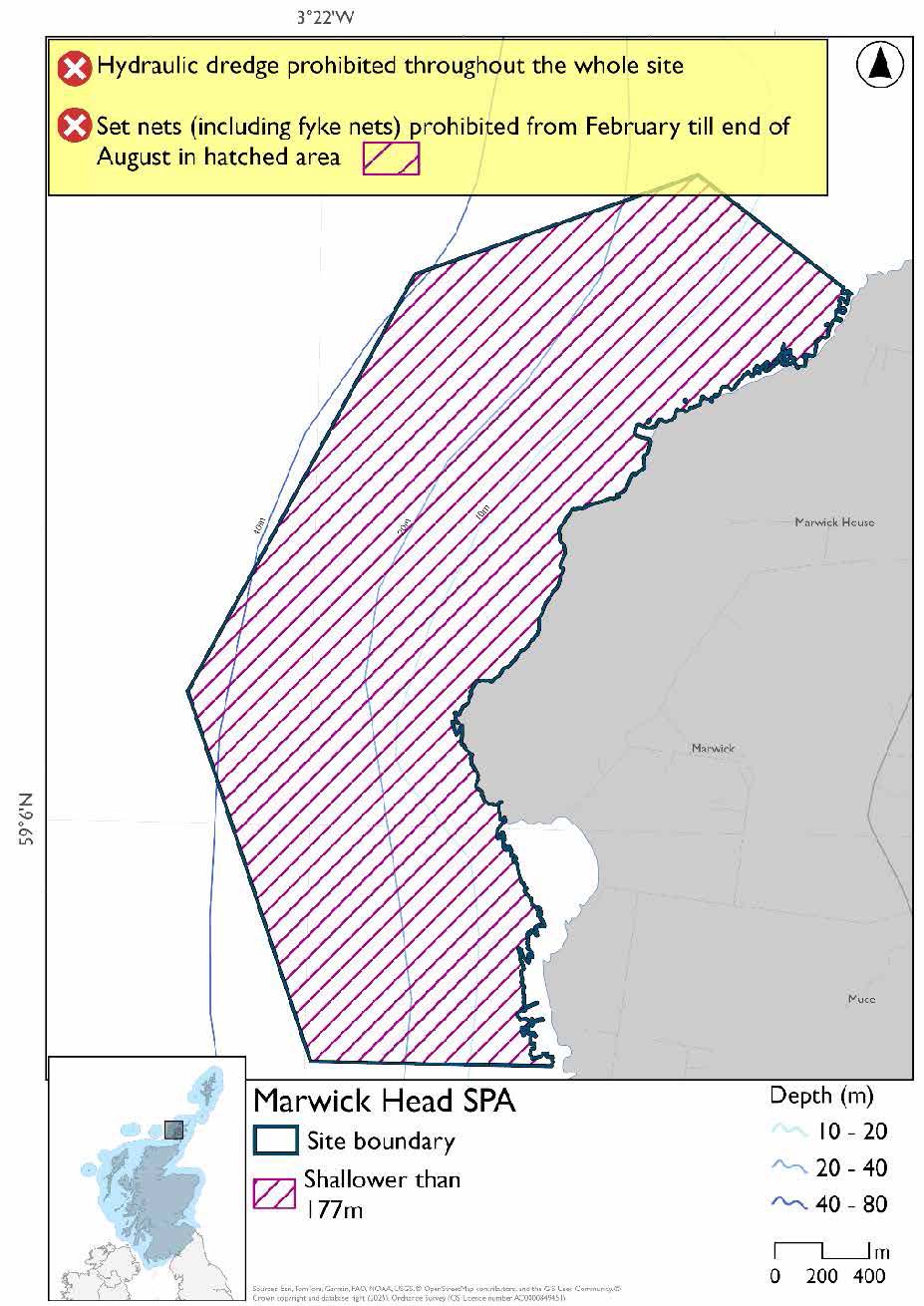
Option Two
- Full site closure to set nets (including fyke nets) and hydraulic dredge
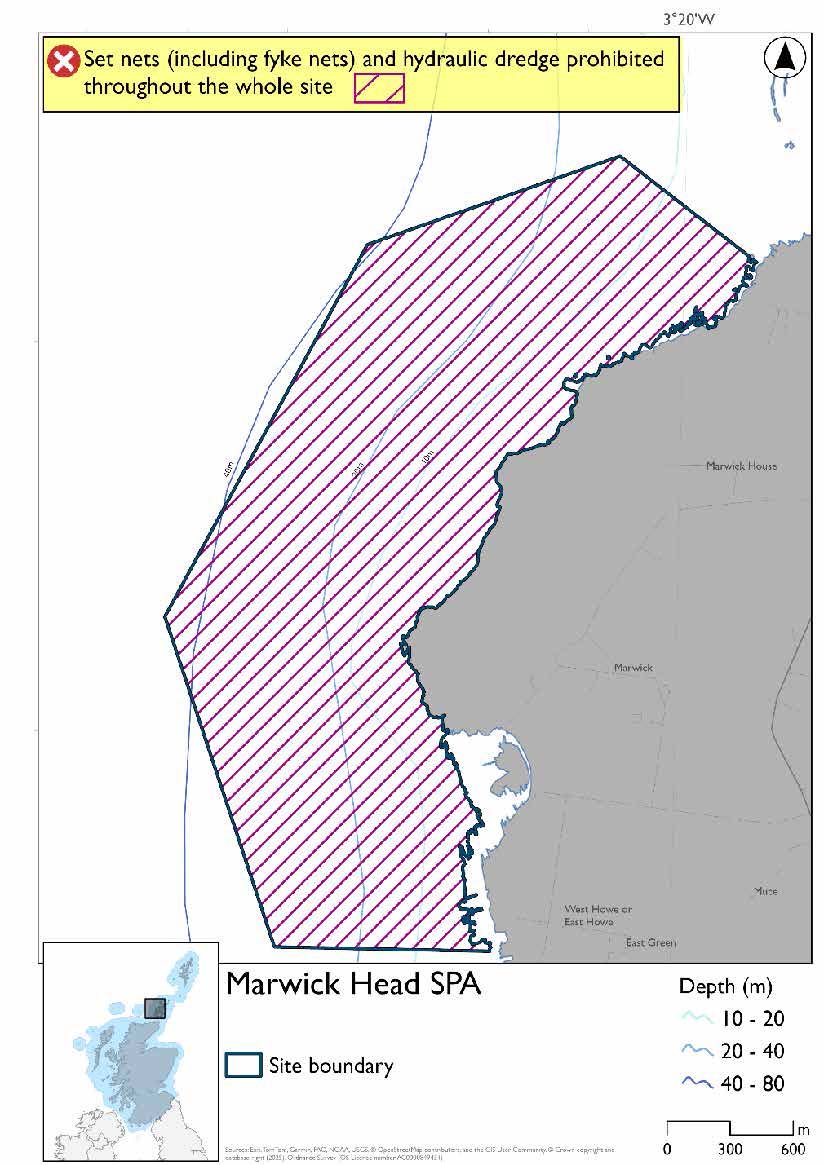
Rationale for developed measures
The basis for the proposed fisheries management measures for each site has been determined by the management advice for fishing activities provided by NatureScot, which can be found on their website or Sitelink as signposted throughout this document. The Fisheries Assessment for each site assesses the impacts from existing fishing activities on the protected features using the tests from the legislation relevant for the type of MPA being considered. The assessment outlines how the proposed measures address any impacts identified that could hinder the conservation objectives of the MPA.
13.6.7 Other fisheries management measures currently applying to this site
There are already management measures in place. An effort has been made to identify existing measures which affect each individual site or area, however the list may not be exhaustive. These measures are outlined below, and the proposals for further management being consulted on now are in addition to these existing measures:
- Fishing for sandeel is prohibited within the Scottish zone, which is defined as the sea adjacent to Scotland up to the 200 nautical miles limit
Other conservation measures can be found in section 7 of the CMA.
13.7 North Orkney SPA
13.7.1 Description and background
North Orkney SPA is a large marine site located to the north of Orkney Mainland, extending from Deerness in the east to Eynhallow in the west and encompassing a network of sheltered bays, sounds and tidal channels among islands including Rousay, Egilsay, Wyre and Shapinsay. The SPA covers approximately 98,318 hectares and is entirely marine in extent, including the seabed, water column and overlying airspace.
The site comprises predominantly shallow coastal waters, generally less than 20m deep, with a seabed of mud, sand and gravel, alongside features such as maerl beds and diverse invertebrate communities that provide important feeding resources for seabirds and waterfowl. These habitats underpin the ecological importance of the area, supporting high densities of birds through the availability of benthic and pelagic prey.
North Orkney SPA has internationally important populations of non-breeding great northern diver and Slavonian grebe, as well as breeding red-throated diver and regularly occurring migratory species such as velvet scoter. The site also supports other waterbirds including long-tailed duck and red-breasted merganser, which use the area for feeding, roosting and moulting during the non-breeding season.
Further information, including Conservation and Management Advice (CMA) can be found on Sitelink.
Further information on MPAs, the wider network and protected areas management is available at Scottish Government MPA policy page.
13.7.2 Protected features
The North Orkney SPA has been designated to protect:
- Great northern diver;
- Red-throated diver;
- Slavonian grebe; and
- Velvet scoter
The protected features of the North Orkney SPA are protected within the SPA throughout the year, irrespective of the season for which they qualified as a protected feature.
13.7.3 Conservation Objectives
All protected features of the North Orkney SPA are in favourable condition. Therefore, the Conservation Objectives are to maintain this condition.
Additional details, including the Conservation Objectives, are provided in the Conservation and Management Advice document produced for this SPA and can be found on Sitelink.
13.7.4 Pressure from fishing activity
Fishing activities exert significant pressures on great northern divers, red‑throated divers, Slavonian grebes, and velvet scoters, primarily through bycatch, prey depletion, and disturbance. Accidental entanglement in nets and other fishing gears is the main direct threat, causing immediate mortality and reducing local wintering and breeding populations.
Indirect impacts arise from prey depletion, as commercial fisheries and changes in discard practices reduce the availability of forage fish and benthic prey. This forces divers and scoters to forage further or in suboptimal areas, lowering breeding success, body condition, and long‑term resilience.
Fishing‑related vessel activity and disturbance amplify these risks by causing displacement and evasive behaviour that reduce foraging efficiency and increase energetic costs. Slavonian grebes and velvet scoters are particularly sensitive, while red‑throated divers are sensitive in sheltered inshore waters during the breeding season, where disturbance can limit access to key feeding areas.
Additional details are provided in the Conservation and Management Advice document produced for this SPA (section 6) and can be found on Sitelink.
Other resources include:
- The Feature Activity Sensitivity Tool (FeAST) which allows users to investigate the sensitivity of marine features (habitats, species, geology and landforms) in Scotland's seas, to pressures arising from human activities;
- Fisheries Guidance Notes which provide summaries of evidence on the interaction between fishing gears and specific habitats and species.
13.7.5 Fisheries management advice considered
NatureScot provides risk-based advice to help manage activities that may impact protected features and their Conservation Objectives. See section 2.3 for more detail. The CMA document also sets out the full fisheries management advice that has been summarised below for the management measures proposed:
Hydraulic gear
Remove or avoid pressures (removal of prey species and disturbance of prey-supporting habitat) associated with hydraulic fishing that has the potential to damage seabed habitat (in particular, sandeel habitat) is recommended.
Static gear (drift nets and bottom set nets inc. fyke nets)
Remove or avoid pressures (entanglement) associated with the use of all static nets. Spatial exclusion of all static nets in areas identified as being important for protected features (as identified from habitat and dive depth preferences) is recommended.
Divers and grebes between mid-August and May, red-throated diver between April and mid-September and velvet scoter between September and mid-April each year is recommended.
Pelagic gear
Pelagic fishing for herring/sprat may occur within or around the SPA. It is recommended that a principal objective of the management of the fishery should be ensuring that the fishing activity does not prevent or disrupt the availability of prey species i.e. it should be considered as part of a broader ecosystem-based approach to management of this fishery.
For the SPAs advice has also been provided on maximum dive depth and seasonality for protected features of each site and can be found in the Fishing Activity Further Advice and Evidence document. Supplementary advice can also be found on NatureScot’s website.
13.7.6 Proposed fisheries management measures
The proposed management measures for North Orkney SPA are as follows:
Option One*
- Set nets (including fyke nets) prohibited in areas down to 21m based on presence and maximum dive depth for red-throated diver
- Demersal set nets (including fyke nets) prohibited September till mid-May and pelagic set nets prohibited in areas down to 35m (deeper than 21m but shallower than 35). This is based on presence of red-throated diver, velvet scoter and great-northern diver and maximum dive depth for velvet scoter
- Demersal set nets (including fyke nets) prohibited October to mid-May and pelagic set nets prohibited based on presence of red-throated diver, velvet scoter and great-northern diver and maximum dive depth for great-northern diver
- Longlines (until technical measures come into force) prohibited in overlapping areas with Rousay SPA
- Full site closure to hydraulic dredge
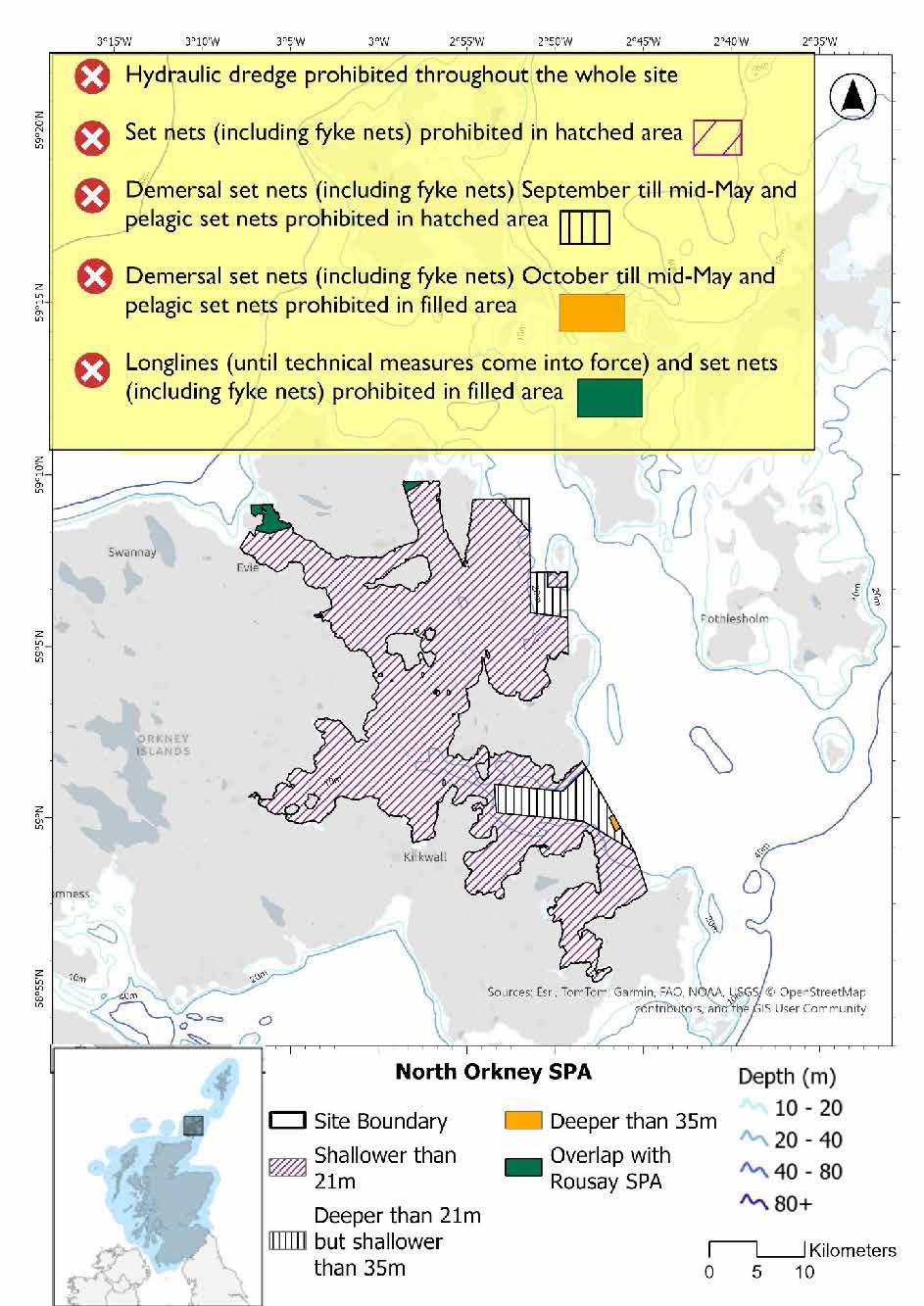
*This site will have other demersal mobile measures that may apply from the overlapping portions with the proposed PMF management area that aren’t shown on the map for this option.
- The proposed PMF management areas would prohibit all demersal mobile gear from the entire area that overlaps. (see section below for overlapping areas)
Please check the Option 1 or single management overlapping area map to see proposed demersal mobile measures under Option 1.
Option Two*
- Full site closure to set nets (including fyke nets) and hydraulic dredge
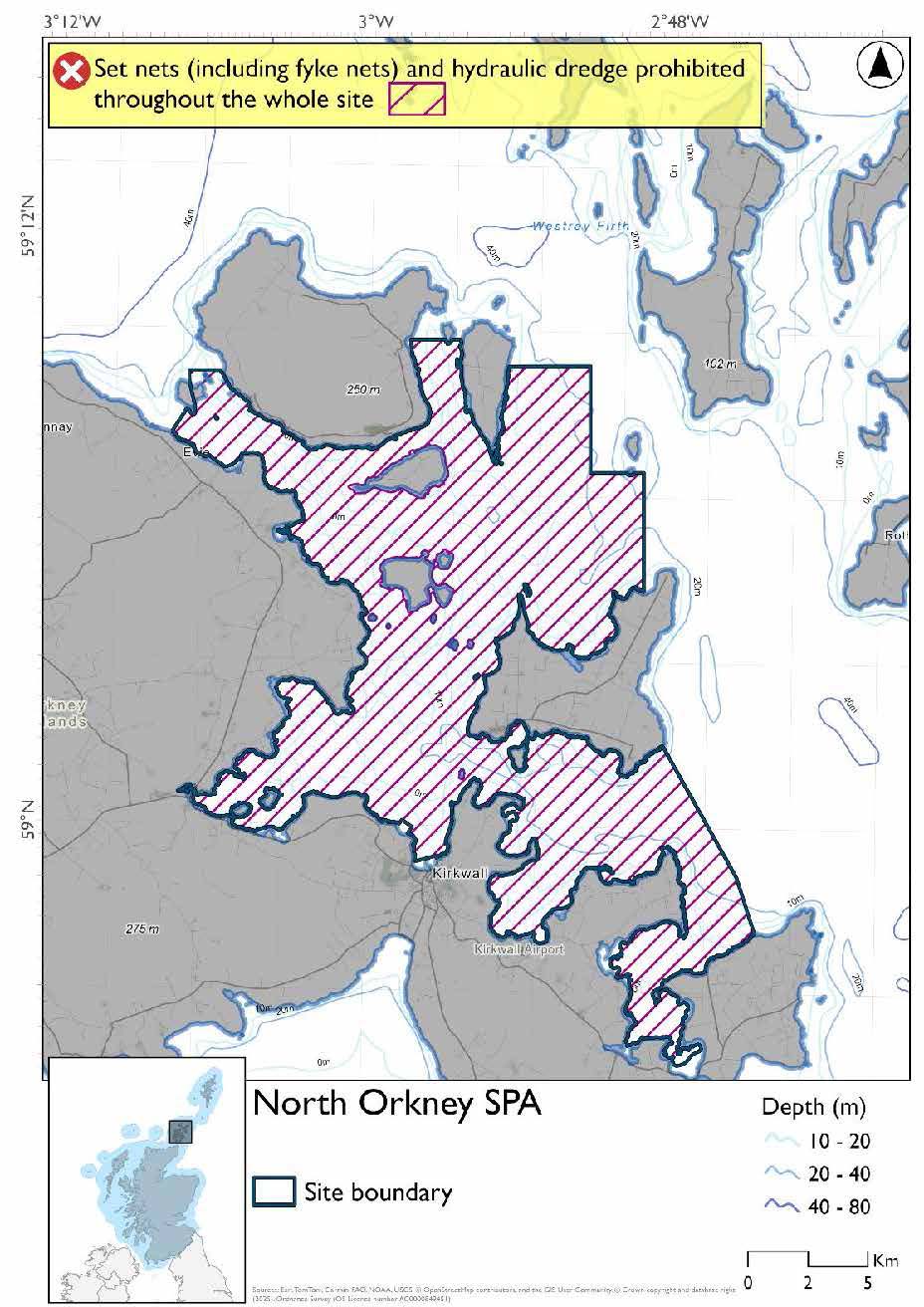
*The measures for Option 2 proposals only come from gear types prohibited in non-overlapping areas. Overlapping restrictions may still apply from overlapping sites or areas dependent on the decisions taken for that site or area.
Overlapping site and area included in this consultation
This SPA overlaps with the Rousay SPA and Orkney Sounds and Firths (South) proposed PMF management area.
Rationale for measures development
The basis for the proposed fisheries management measures for each site has been determined by the management advice for fishing activities provided by NatureScot, which can be found on their website or Sitelink as signposted throughout this document. The Fisheries Assessment for each site assesses the impacts from existing fishing activities on the protected features using the tests from the legislation relevant for the type of MPA being considered. The assessment outlines how the proposed measures address any impacts identified that could hinder the conservation objectives of the MPA.
13.7.7 Other fisheries management measures currently applying to this site
There are already management measures in place. An effort has been made to identify existing measures which affect each individual site or area, however the list may not be exhaustive. These measures are outlined below, and the proposals for further management being consulted on now are in addition to these existing measures:
- Fishing for sandeel is prohibited within the Scottish zone, which is defined as the sea adjacent to Scotland up to the 200 nautical miles limit
- Dredge, beam trawl, demersal trawl or demersal seine net is prohibited across part of the site.
Other conservation measures can be found in section 7 of the CMA.
13.7 Rousay SPA
13.7.1 Description and background
Rousay SPA is located on the island of Rousay, off the north‑east coast of Mainland Orkney, and covers approximately 5,480 hectares. The site includes extensive sea cliffs, maritime heath and grassland along the north‑west and north‑east coasts of the island, with its terrestrial component overlapping the Rousay SSSI. A marine extension of approximately 2 km surrounds the coastline, incorporating the seabed, water column and surface waters to form a combined terrestrial–marine site.
The SPA is internationally important populations of breeding seabirds and regularly supports around 30,000 seabirds. The cliffed coastlines and adjacent vegetated slopes provide essential nesting habitat for species such as Arctic tern, Arctic skua, kittiwake, guillemot and fulmar, offering suitable ledges, burrows and sheltered areas for breeding colonies.
The marine extension captures the surrounding coastal waters used by seabirds for feeding, commuting and territorial behaviour during the breeding season. By encompassing adjacent foraging areas and flight corridors, it ensures protection of the key ecological links between nesting sites and marine feeding grounds.
Further information, including Conservation and Management Advice (CMA) can be found on Sitelink.
Further information on MPAs, the wider network and protected areas management is available at Scottish Government MPA policy page.
13.7.2 Protected features
The Rousay Special Protection Area (SPA) has been designated to protect:
- Arctic skua;
- Arctic tern;
- Fulmar;
- Guillemot; and
- Kittiwake
The protected features of the Rousay SPA are protected within the SPA throughout the year, irrespective of the season for which they qualified as a protected feature.
13.7.3 Conservation Objectives
The following protected feature is in favourable condition at Rousay SPA: fulmar. Therefore, the Conservation Objectives seek to maintain this condition.
The following protected features are in unfavourable condition at Rousay SPA: Arctic skua, Arctic tern, kittiwake and guillemot. Therefore, the Conservation Objectives seek to restore this condition.
Additional details, including the Conservation Objectives, are provided in the Conservation and Management Advice document produced for this SPA and can be found on Sitelink.
13.7.4 Pressure from fishing activity
Fishing activities exert multiple pressures on seabird populations, primarily through bycatch, prey depletion, disturbance, and habitat change. Longline fisheries pose particular risks to skuas, terns, and fulmars, while surface nets and other gears threaten kittiwakes, auks, and gulls, causing immediate mortality.
Indirect impacts arise from prey depletion, as commercial fishing and changes to discard regimes reduce the availability of key forage species such as sandeels and other small pelagic or benthic prey. This lowers breeding success and chick survival in skuas, kittiwakes, guillemots, terns, and fulmars. The loss of discards and altered prey distribution also force birds to forage farther or in less suitable areas, increasing energetic costs, competition, and exposure to additional threats, with kleptoparasitic species (an animal that lets another animal do the hard work, like hunting or gathering, and then swoops in to take the food) such as skuas particularly affected.
Fishing activity further alters habitat and water quality, with seabed disturbance and resuspension increasing turbidity and impairing prey detection for water‑column foragers such as guillemots. Vessel presence associated with fisheries adds disturbance and displacement reducing foraging efficiency for surface‑feeding species.
Additional details are provided in the Conservation and Management Advice document produced for this SPA (section 6) and can be found on Sitelink.
Other resources include:
- The Feature Activity Sensitivity Tool (FeAST) which allows users to investigate the sensitivity of marine features (habitats, species, geology and landforms) in Scotland's seas, to pressures arising from human activities;
- Fisheries Guidance Notes which provide summaries of evidence on the interaction between fishing gears and specific habitats and species.
13.7.5 Fisheries management advice relevant to proposed fisheries management measures
NatureScot provides risk-based advice to help manage activities that may impact protected features and their Conservation Objectives. See section 2.3 for more detail. The CMA document also sets out the full fisheries management advice that has been summarised below for the management measures proposed:
Hydraulic gear
Remove or avoid pressures (removal of prey species and disturbance of prey-supporting habitat) associated with hydraulic fishing that has the potential to damage seabed habitat (in particular, sandeel habitat, herring spawning grounds) is recommended.
Static gear (drift nets and bottom set nets inc. fyke nets)
Remove or avoid pressures (entanglement) associated with the use of all static nets. Spatial exclusion of all static nets in areas identified as being important for auks (as identified from habitat and dive depth preferences) is recommended.
Pelagic gear
Pelagic fishing for herring/sprat may occur within or around the SPA. It is recommended that a principal objective of the management of the fishery should be ensuring that the fishing activity does not prevent or disrupt the availability of prey species i.e. it should be considered as part of a broader ecosystem-based approach to management of this fishery.
Longlining (not including jigging)
Long-lining (pelagic and demersal) may occur within or around the SPA(s). Current understanding is that long-line fisheries are largely restricted to offshore waters. Site-specific measures for long-lining are not currently considered appropriate due to the scale of the fishery, and the wide-spread interaction with seabirds. However, there is evidence of seabird bycatch in long-line (not jigging) fisheries therefore it is recommended this requires wider seas management measures.
For the SPAs advice has also been provided on maximum dive depth and seasonality for protected features of each site and can be found in the Fishing Activity Further Advice and Evidence document. Supplementary advice can also be found on NatureScot’s website.
13.7.6 Proposed fisheries management measures
The proposed management measures for Rousay SPA are as follows:
Option One*
- Set nets (including fyke nets) prohibited February till end of August in areas down to 177m based on presence and maximum dive depth for guillemot
- Set nets (including fyke nets) prohibited in areas that overlap with the North Orkney SPA
- Full site closure to longlines (until technical measures come into force) and hydraulic dredge
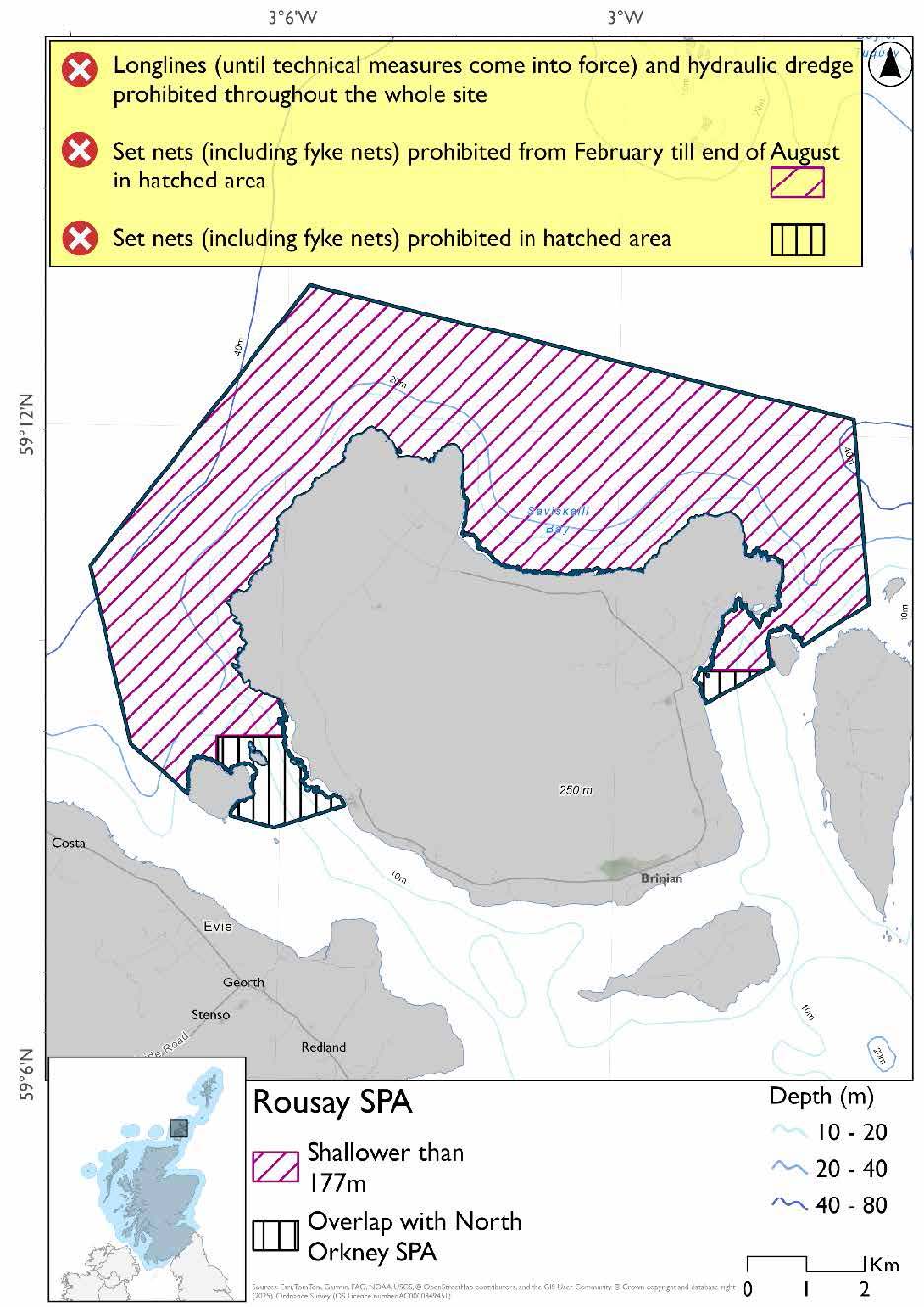
*This site will have other demersal mobile measures that may apply from the overlapping portions with the proposed PMF management area that aren’t shown on the map for this option.
- The proposed PMF management areas would prohibit all demersal mobile gear from the entire area that overlaps. (see section below for overlapping area)
Please check the Option 1 or single management overlapping area map to see proposed demersal mobile measures under Option 1.
Option Two*
- Full site closure to longlines (until technical measures come into force), set nets (including fyke nets) and hydraulic dredge
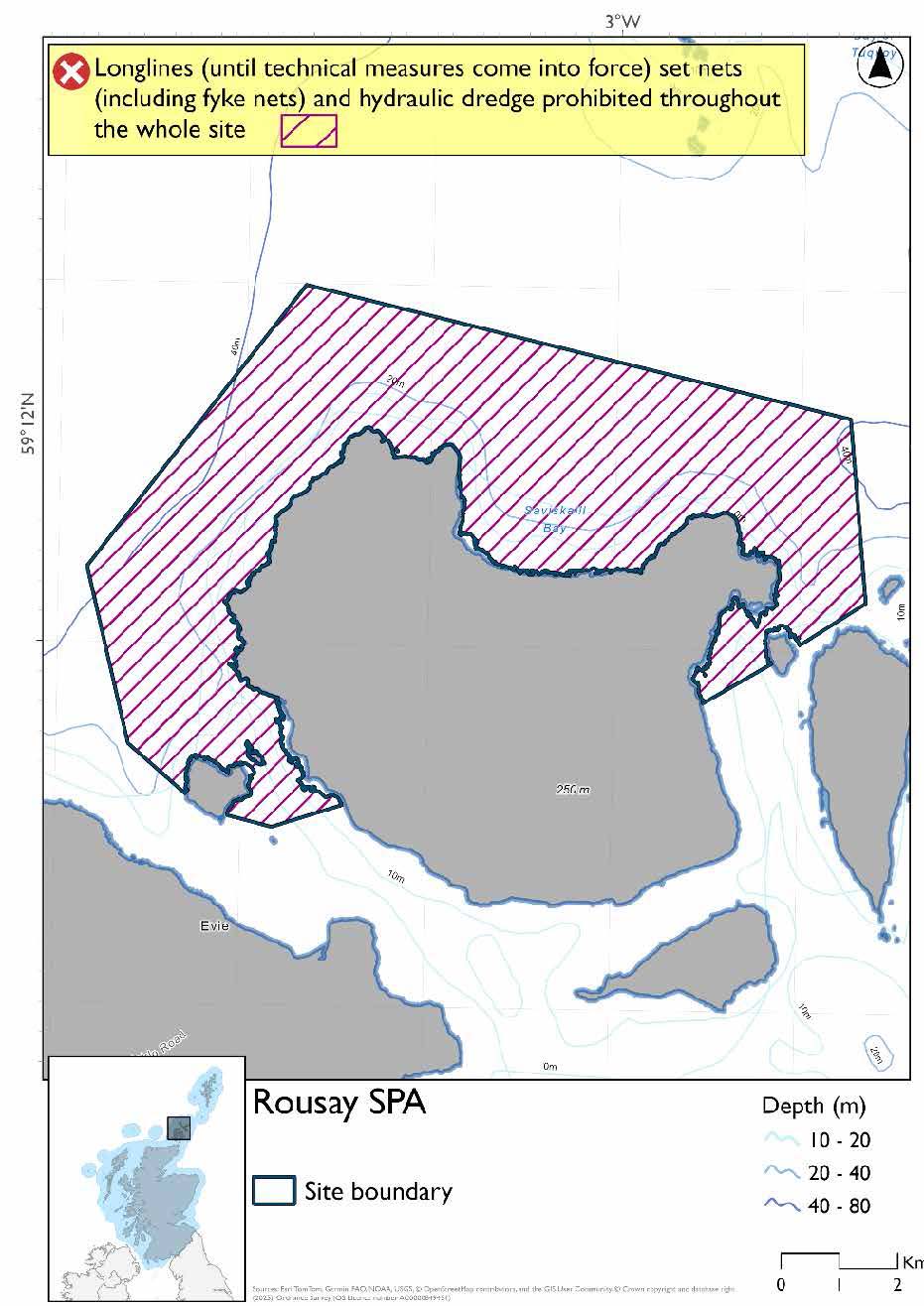
*The measures for Option 2 proposals only come from gear types prohibited in non-overlapping areas. Overlapping restrictions may still apply from overlapping sites or areas dependent on the decisions taken for that site or area.
Overlapping site and area included in this consultation
This SPA overlaps with the North Orkney SPA and Orkney Sounds and Firths (South) proposed PMF management area.
Rationale for developed measures
The basis for the proposed fisheries management measures for each site has been determined by the management advice for fishing activities provided by NatureScot, which can be found on their website or Sitelink as signposted throughout this document. The Fisheries Assessment for each site assesses the impacts from existing fishing activities on the protected features using the tests from the legislation relevant for the type of MPA being considered. The assessment outlines how the proposed measures address any impacts identified that could hinder the conservation objectives of the MPA.
13.7.7 Other fisheries management measures currently applying to this site
There are already management measures in place. An effort has been made to identify existing measures which affect each individual site or area, however the list may not be exhaustive. These measures are outlined below, and the proposals for further management being consulted on now are in addition to these existing measures:
- Fishing for sandeel is prohibited within the Scottish zone, which is defined as the sea adjacent to Scotland up to the 200 nautical miles limit
- Dredge, beam trawl, demersal trawl or demersal seine net is also prohibited across part of the site.
Other conservation measures can be found in section 7 of the CMA.
13.8 Scapa Flow SPA
13.8.1 Description and background
Scapa Flow SPA lies within the sheltered waters of Scapa Flow in the southern and central Orkney archipelago, bounded by Mainland Orkney and islands including Hoy, Flotta and South Ronaldsay. The site covers approximately 78,121 hectares and comprises a fully marine system of enclosed bays, sounds and channels that provide extensive sheltered habitat for marine birds.
The SPA consists predominantly of inshore and intertidal habitats, with seabeds of sand, mud and mixed sediments that support rich benthic communities. These habitats provide important feeding resources for diving and wintering waterbirds, underpinning the ecological importance of the site.
Scapa Flow is internationally important for populations of wintering and non‑breeding diving birds, including great northern diver, black‑throated diver, Slavonian grebe and long‑tailed duck, as well as species such as eider, red‑breasted merganser and shag. These birds rely on the sheltered waters for feeding, roosting and moulting, particularly during the non‑breeding season.
The SPA includes the seabed, water column and airspace, ensuring protection of prey resources, key foraging areas and flight corridors. Together, these features create a coherent ecological unit that supports significant proportions of national wintering populations and underpins the site’s conservation importance.
Further information, including Conservation and Management Advice (CMA) can be found on Sitelink.
Further information on MPAs, the wider network and protected areas management is available at Scottish Government MPA policy page.
13.8.2 Protected features
The Scapa Flow SPA has been designated to protect:
- Black-throated diver;
- Eider;
- Great northern diver;
- Long-tailed duck;
- Red-breasted merganser;
- Red-throated diver;
- Shag; and
- Slavonian grebe
The protected features of the Scapa Flow SPA are protected within the SPA throughout the year, irrespective of the season for which they qualified as a protected feature.
13.8.3 Conservation Objectives
All protected features in the Scapa Flow SPA are in favourable condition. Therefore, the Conservation Objectives are to maintain this condition.
Additional details, including the Conservation Objectives, are provided in the Conservation and Management Advice document produced for this SPA and can be found on Sitelink.
13.8.4 Pressure from fishing activity
Fishing activities exert significant pressures on great northern, black‑throated and red‑throated divers, Slavonian grebes, velvet scoters, long‑tailed ducks, red‑breasted mergansers, shags, and eiders, primarily through bycatch, prey depletion, and disturbance. Accidental entanglement in nets, longlines, and near‑seabed gear is the principal direct threat, causing immediate mortality and local population losses.
Indirect impacts arise from prey depletion and altered discard regimes, as reductions in forage fish, benthic prey, and fisheries discards lower food availability. This diminishes body condition, breeding success, and survival in divers, shags, eiders, and scoters, while forcing birds to forage further or shift feeding sites.
Fishing‑related vessel activity and habitat disturbance amplify these pressures, displacing birds from key feeding areas and raising energetic costs. Divers and grebes show strong avoidance responses to vessels, while shags and eiders are behaviourally sensitive to boat movements, reducing foraging efficiency and increasing exposure to other risks.
Additional details are provided in the Conservation and Management Advice document produced for this SPA (section 6) and can be found on Sitelink.
Other resources include:
- The Feature Activity Sensitivity Tool (FeAST) which allows users to investigate the sensitivity of marine features (habitats, species, geology and landforms) in Scotland's seas, to pressures arising from human activities;
- Fisheries Guidance Notes which provide summaries of evidence on the interaction between fishing gears and specific habitats and species.
13.8.5 Fisheries management advice relevant to proposed fisheries management measures
NatureScot provides risk-based advice to help manage activities that may impact protected features and their Conservation Objectives. See section 2.3 for more detail. The CMA document also sets out the full fisheries management advice that has been summarised below for the management measures proposed:
Hydraulic gear
Remove or avoid pressures (removal of prey species and disturbance of prey-supporting habitat) associated with hydraulic fishing that has the potential to damage seabed habitat (in particular, sandeel habitat) is recommended.
Static gear (drift nets and bottom set nets inc. fyke nets)
Remove or avoid pressures (entanglement) associated with the use of all static nets. Spatial exclusion of all static nets in areas identified as being important for protected species (as identified from habitat and dive depth preferences) is recommended.
For great northern diver, black throated diver and Slavonian grebe between mid-August and May, red-throated diver between April and mid-September and long-tailed duck between mid-September and May each year is recommended. Shags maximum dive depth and presence covers the site all year.
Pelagic gear
Pelagic fishing for herring/sprat may occur within or around the SPA. It is recommended that a principal objective of the management of the fishery should be ensuring that the fishing activity does not prevent or disrupt the availability of prey species i.e. it should be considered as part of a broader ecosystem-based approach to management of this fishery.
For the SPAs advice has also been provided on maximum dive depth and seasonality for protected features of each site and can be found in the Fishing Activity Further Advice and Evidence document. Supplementary advice can also be found on NatureScot’s website.
13.8.6 Proposed fisheries management measures
The proposed management measures for Scapa Flow SPA are as follows:
Option One*
- Set nets including (fyke nets) prohibited in areas shallower than 64.5m based on the presence and maximum dive depth for shag
- Pelagic set nets prohibited in areas deeper than 64.5m based on the presence of shag
- Longlines (until technical measures come into force) prohibited in overlapping areas with Hoy and Copinsay SPAs
- Full site closure to hydraulic dredge
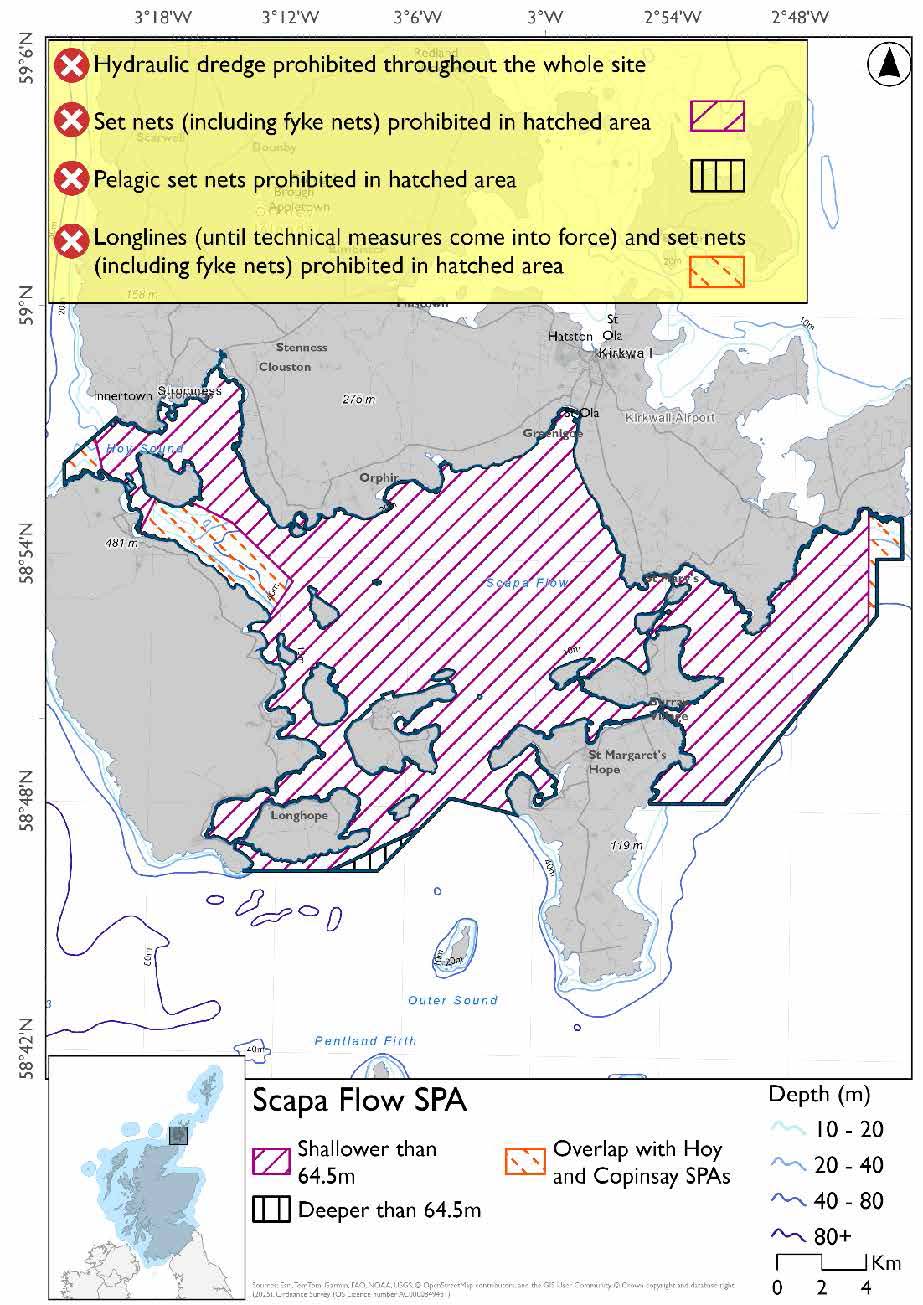
*This site will have other demersal mobile measures that may apply from the overlapping portions with the proposed PMF management areas that aren’t shown on the map for this option.
- The proposed PMF management areas would prohibit all demersal mobile gear from the entire area that overlaps. (see section below for overlapping areas)
Please check the Option 1 or single management overlapping area maps to see proposed demersal mobile measures under Option 1.
Option Two*
- Full site closure to set nets (including fyke nets) and hydraulic dredge
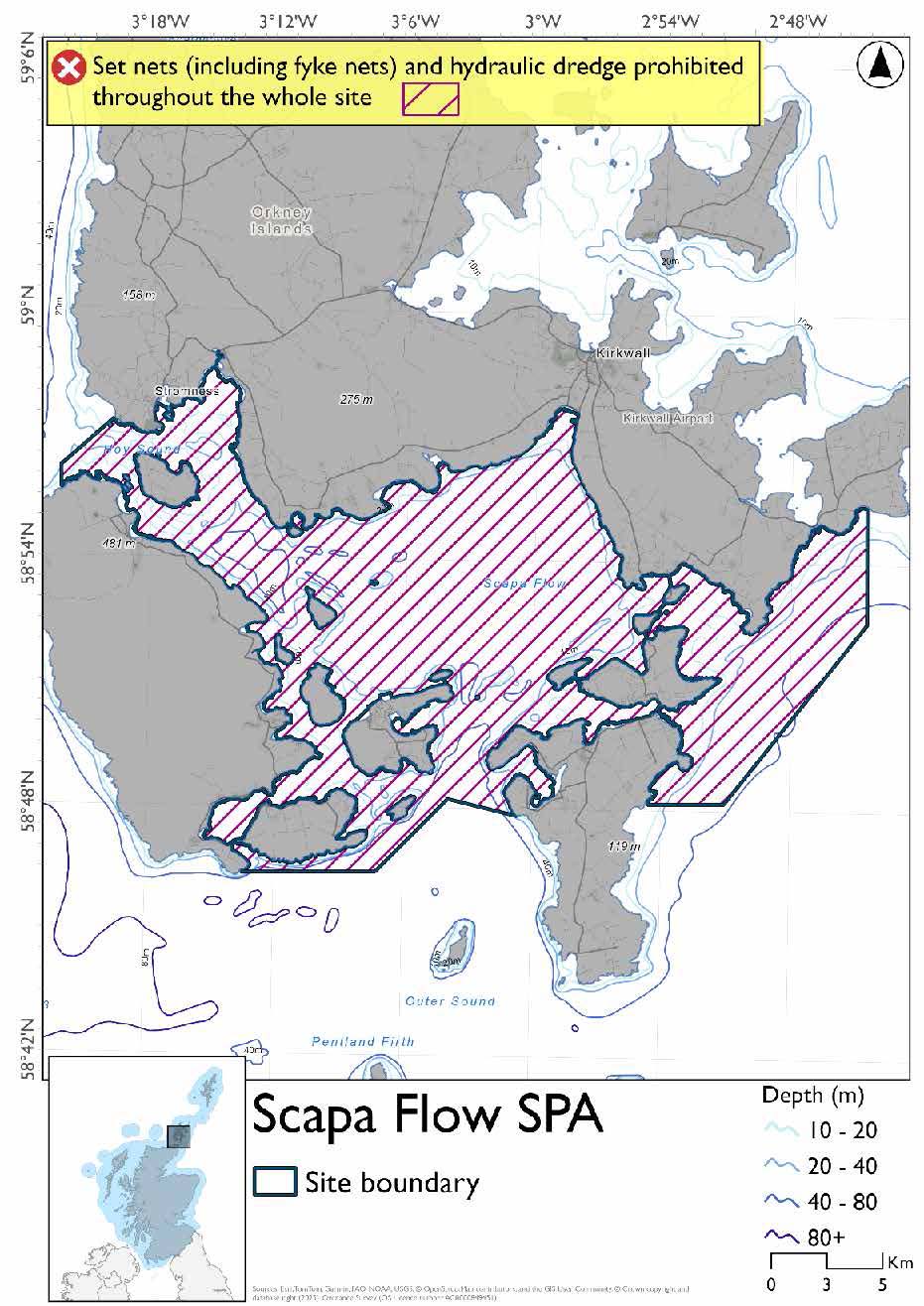
*The measures for Option 2 proposals only come from gear types prohibited in non-overlapping areas. Overlapping restrictions may still apply from overlapping sites or areas dependent on the decisions taken for that site or area.
Overlapping sites and areas included in this consultation
This SPA overlaps with the Hoy and Copinsay SPAs and Hoy Sound (East) to South Walls (Orkney), Widewall Bay (Orkney) and Hoy Sound (Orkney) proposed PMF management areas.
Rationale for measures development
The basis for the proposed fisheries management measures for each site has been determined by the management advice for fishing activities provided by NatureScot, which can be found on their website or Sitelink as signposted throughout this document. The Fisheries Assessment for each site assesses the impacts from existing fishing activities on the protected features using the tests from the legislation relevant for the type of MPA being considered. The assessment outlines how the proposed measures address any impacts identified that could hinder the conservation objectives of the MPA.
13.8.7 Other fisheries management measures currently applying to this site
There are already management measures in place. An effort has been made to identify existing measures which affect each individual site or area, however the list may not be exhaustive. These measures are outlined below, and the proposals for further management being consulted on now are in addition to these existing measures:
- Fishing for sandeel is prohibited within the Scottish zone, which is defined as the sea adjacent to Scotland up to the 200 nautical miles limit
- Mobile or active gear prohibited across the whole site from 01 May till 30 September.
Other conservation measures can be found in section 7 of the CMA.
13.9 Sule Skerry and Sule Stack SPA
13.9.1 Description and background
Sule Skerry and Sule Stack SPA comprises two remote islets located approximately 60 km west of Mainland Orkney. The site includes the low vegetated island of Sule Skerry and the steep, largely bare rock formation of Sule Stack, both of which provide important nesting habitat for large seabird colonies. The SPA covers approximately 16,276 hectares and includes a marine extension of around 2 km surrounding the islands, incorporating the seabed, water column and surface waters. The terrestrial component overlaps with Sule Skerry and Sule Stack SSSIs, forming an integrated terrestrial/marine site.
The SPA supports internationally important seabird populations, regularly holding around 100,000 birds. The exposed cliffs, rocky ledges and limited vegetation provide ideal breeding conditions for a range of species, including one of the UK’s few breeding populations of Leach’s storm‑petrel on Sule Skerry. The site’s isolation and minimal human disturbance further enhance its suitability for seabird colonies.
The surrounding marine environment is essential for feeding, commuting and territorial behaviour during the breeding season. The marine extension captures nearby foraging areas and flight corridors, ensuring protection of the ecological links between nesting sites and the offshore feeding grounds on which these species depend.
Further information, including Conservation and Management Advice (CMA) can be found on Sitelink.
Further information on MPAs, the wider network and protected areas management is available at Scottish Government MPA policy page.
13.9.2 Protected features
The Sule Skerry and Sule Stack SPA has been designated to protect:
- Gannet;
- Guillemot;
- Leach’s petrel;
- Puffin;
- Shag; and
- Storm petrel
The protected features of the Sule Skerry and Sule Stack SPA are protected within the SPA throughout the year, irrespective of the season for which they qualified as a protected feature.
13.9.3 Conservation Objectives
The following protected features are in favourable condition at Sule Skerry and Sule Stack SPA: puffin, guillemot, and gannet. Therefore, the Conservation Objectives seek to maintain this condition.
The following protected features are in unfavourable condition at Sule Skerry and Sule Stack SPA: shag, storm petrel and Leach’s petrel. Therefore, the Conservation Objectives seek to restore this condition.
Additional details, including the Conservation Objectives, are provided in the Conservation and Management Advice document produced for this SPA and can be found on Sitelink.
13.9.4 Pressure from fishing activity
Fishing activities exert multiple pressures on these seabird species, primarily through bycatch, prey depletion and disturbance. Accidental capture in surface, pelagic, and near‑seabed gears is the main direct threat, with gannets and shags particularly sensitive to multiple gear types, while auks such as puffins and guillemots are prone to entanglement in surface nets. Storm‑petrels show lower, although still, exposure to gillnet operations.
Indirect impacts arise from prey depletion and altered discard regimes, as reduced stocks of forage fish and benthic prey lower body condition, breeding success, and chick survival for auks, shags, and gannets. Birds are forced to travel further or switch to less profitable prey, increasing energetic costs and exposure to additional risks.
Fishing‑related habitat change and disturbance further impair foraging efficiency. Seabed disturbance and turbidity reduce prey detection for water‑column feeders such as guillemots and gannets, while vessel activity displaces shags and inshore‑feeding auks, reducing feeding time and efficiency.
Additional details are provided in the Conservation and Management Advice document produced for this SPA (section 6) and can be found on Sitelink.
Other resources include:
- The Feature Activity Sensitivity Tool (FeAST) which allows users to investigate the sensitivity of marine features (habitats, species, geology and landforms) in Scotland's seas, to pressures arising from human activities;
- Fisheries Guidance Notes which provide summaries of evidence on the interaction between fishing gears and specific habitats and species.
13.9.5 Fisheries management advice considered
NatureScot provides risk-based advice to help manage activities that may impact protected features and their Conservation Objectives. See section 2.3 for more detail. The CMA document also sets out the full fisheries management advice that has been summarised below for the management measures proposed:
Hydraulic gear
Remove or avoid pressures (removal of prey species and disturbance of prey-supporting habitat) associated with hydraulic fishing that has the potential to damage seabed habitat (in particular, sandeel habitat, herring spawning grounds) is recommended.
Static gear (drift nets and bottom set nets inc. fyke nets)
Remove or avoid pressures (entanglement) associated with the use of all static nets. Spatial exclusion of all static nets in areas identified as being important for auks and shag (as identified from habitat and dive depth preferences) is recommended.
Pelagic gear
Pelagic fishing for herring/sprat may occur within or around the SPA. It is recommended that a principal objective of the management of the fishery should be ensuring that the fishing activity does not prevent or disrupt the availability of prey species i.e. it should be considered as part of a broader ecosystem-based approach to management of this fishery.
Longlining (not including jigging)
Long-lining (pelagic and demersal) may occur within or around the SPA(s). Current understanding is that long-line fisheries are largely restricted to offshore waters. Site-specific measures for long-lining are not currently considered appropriate due to the scale of the fishery, and the wide-spread interaction with seabirds. However, there is evidence of seabird bycatch in long-line (not jigging) fisheries therefore it is recommended this requires wider seas management measures.
For the SPAs advice has also been provided on maximum dive depth and seasonality for protected features of each site and can be found in the Fishing Activity Further Advice and Evidence document. Supplementary advice can also be found on NatureScot’s website.
13.9.6 Proposed fisheries management measures
NatureScot also provided amalgamated season advice for this site but individual seasonality for species has been used to develop consultation options.
The proposed management measures for Sule Skerry and Sule Stack SPA are as follows:
Option One
- Set nets (including fyke nets) prohibited in areas shallower than 65m based on presence and maximum dive depth for shag
- Demersal set nets (including fyke nets) prohibited February till end of August and pelagic set nets prohibited in areas deeper than 65m but shallower than 177m based on presence of guillemot and shag and maximum dive depth for guillemot
- Full site closure to longlines (until technical measures come into force) and hydraulic dredge
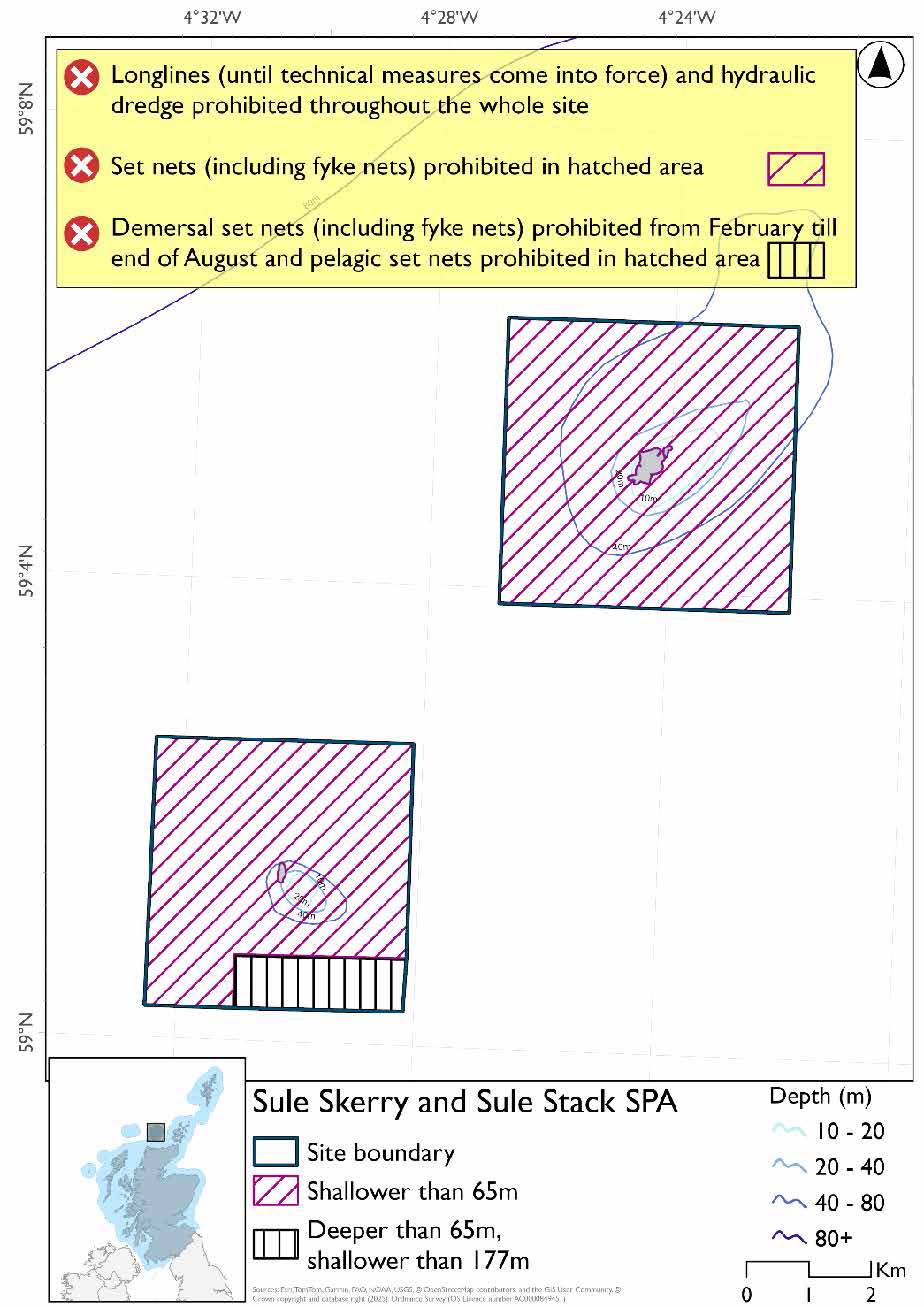
Option Two
- Full site closure to longlines (until technical measures come into force), set nets (including fyke nets) and hydraulic dredge
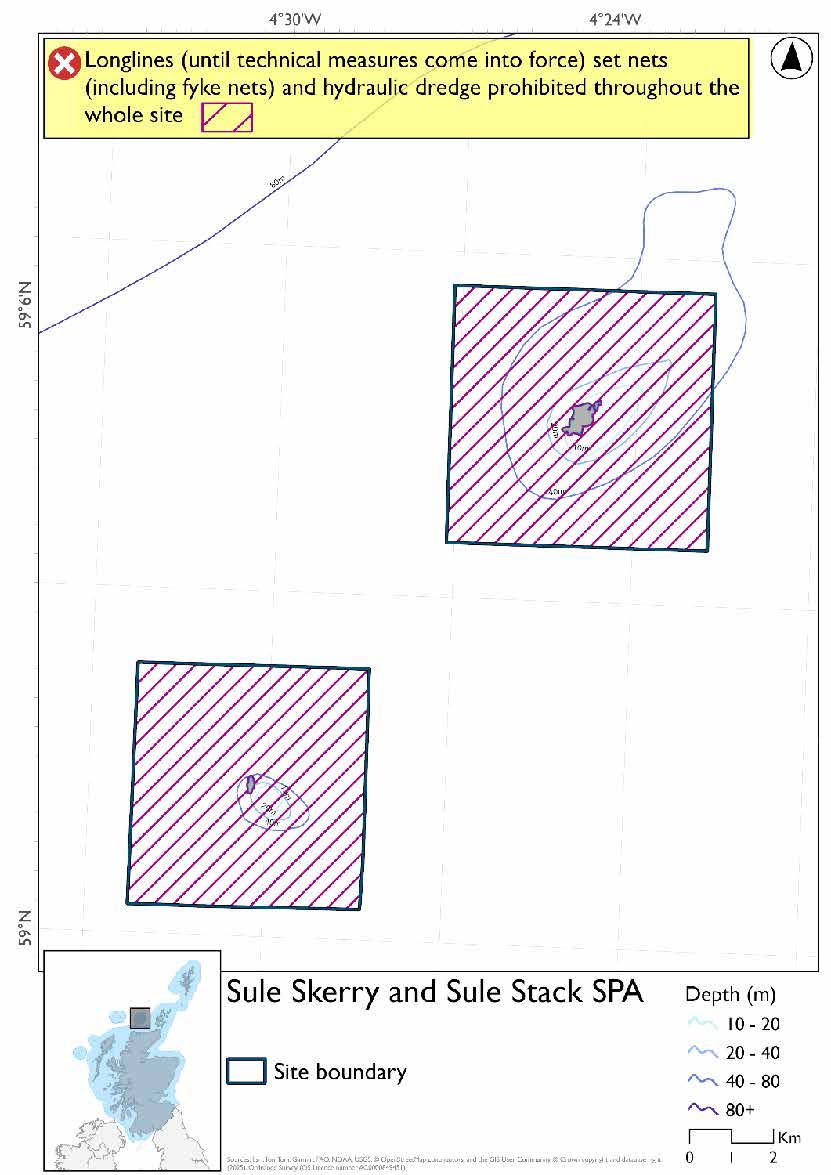
Rationale for measures development
The basis for the proposed fisheries management measures for each site has been determined by the management advice for fishing activities provided by NatureScot, which can be found on their website or Sitelink as signposted throughout this document. The Fisheries Assessment for each site assesses the impacts from existing fishing activities on the protected features using the tests from the legislation relevant for the type of MPA being considered. The assessment outlines how the proposed measures address any impacts identified that could hinder the conservation objectives of the MPA.
13.9.7 Other fisheries management measures currently applying to this site
There are already management measures in place. An effort has been made to identify existing measures which affect each individual site or area, however the list may not be exhaustive. These measures are outlined below, and the proposals for further management being consulted on now are in addition to these existing measures:
- Fishing for sandeel is prohibited within the Scottish zone, which is defined as the sea adjacent to Scotland up to the 200 nautical miles limit
Other conservation measures can be found in section 7 of the CMA.
13.10 West Westray SPA
13.10.1 Description and background
West Westray SPA lies along an approximately 8 km stretch of sea cliffs on the west coast of the island of Westray, Orkney. The site covers around 1,812 hectares and includes steep sandstone cliffs, rocky shores, and adjacent areas of maritime heath and coastal grassland, forming an important breeding habitat for large seabird colonies. The terrestrial component overlaps with the Westray and Noup Head SSSI, creating a continuous area of protected coastal habitat.
The SPA extends seaward by approximately 2 km, incorporating the seabed, water column and surface waters to form an integrated terrestrial/marine site. This extension ensures protection of the nearshore marine environment used by seabirds for feeding, commuting and territorial behaviour during the breeding season.
West Westray SPA supports internationally important seabird populations, regularly holding around 113,000 birds. The cliff faces and ledges provide ideal nesting sites for species such as guillemot, kittiwake, razorbill and fulmar, while the surrounding waters supply rich feeding grounds essential to their breeding success.
Further information, including Conservation and Management Advice (CMA) can be found on Sitelink.
Further information on MPAs, the wider network and protected areas management is available at Scottish Government MPA policy page.
13.10.2 Protected features
The West Westray Special Protection Area (SPA) has been designated to protect:
- Arctic skua;
- Arctic tern;
- Fulmar;
- Guillemot;
- Kittiwake; and
- Razorbill
The protected features of the West Westray SPA are protected within the SPA throughout the year, irrespective of the season for which they qualified as a protected feature.
13.10.3 Conservation Objectives
The following protected feature is in favourable condition at West Westray SPA: fulmar. Therefore, the Conservation Objectives seek to maintain this condition.
The following protected features are in unfavourable condition at West Westray SPA: Arctic tern, Arctic skua, kittiwake, guillemot and razorbill. Therefore, the Conservation Objectives seek to restore this condition.
Additional details, including the Conservation Objectives, are provided in the Conservation and Management Advice document produced for this SPA and can be found on Sitelink.
13.10.4 Pressure from fishing activity
Fishing activities can exert multiple pressures on seabird populations, primarily through bycatch, prey depletion and disturbance. Longline and surface gears pose high risks to fulmars and skuas, while surface nets frequently catch auks such as guillemots and razorbills, as well as kittiwakes, which can cause mortality.
Indirect impacts arise from prey depletion and altered discard regimes, with reduced availability of sandeels and other forage species lowering body condition, breeding success, and chick survival across skuas, terns, kittiwakes, auks, and fulmars. The decline in discards particularly harms kleptoparasitic species (an animal that lets another animal do the hard work, like hunting or gathering, and then swoops in to take the food) such as skuas and species dependent on predictable discard pulses.
Fishing‑related habitat disturbance further compounds these pressures. Seabed disruption and sediment resuspension increase turbidity, impairing foraging efficiency for dive‑feeding species such as guillemots and razorbills. Vessel activity associated with fisheries also causes displacement and behavioural disturbance, reducing feeding efficiency and raising energetic costs.
Risks from discarded gear add another layer of impact, with entanglement particularly affecting fulmars. Changes in fishing practices can also force birds to forage farther or switch to suboptimal prey, amplifying exposure to gear and environmental hazards. Together, these pressures drive both immediate mortality and longer‑term declines in reproductive success and population resilience.
Additional details are provided in the Conservation and Management Advice document produced for this SPA (section 6) and can be found on Sitelink.
Other resources include:
- The Feature Activity Sensitivity Tool (FeAST) which allows users to investigate the sensitivity of marine features (habitats, species, geology and landforms) in Scotland's seas, to pressures arising from human activities;
- Fisheries Guidance Notes which provide summaries of evidence on the interaction between fishing gears and specific habitats and species.
13.10.5 Fisheries management advice considered
NatureScot provides risk-based advice to help manage activities that may impact protected features and their Conservation Objectives. See section 2.3 for more detail. The CMA document also sets out the full fisheries management advice that has been summarised below for the management measures proposed:
Hydraulic gear
Remove or avoid pressures (removal of prey species and disturbance of prey-supporting habitat) associated with hydraulic fishing that has the potential to damage seabed habitat (in particular, sandeel habitat, herring spawning grounds) is recommended.
Static gear (drift nets and bottom set nets inc. fyke nets)
Remove or avoid pressures (entanglement) associated with the use of all static nets. Spatial exclusion of all static nets in areas identified as being important for auks (as identified from habitat and dive depth preferences) is recommended.
Pelagic gear
Pelagic fishing for herring/sprat may occur within or around the SPA. It is recommended that a principal objective of the management of the fishery should be ensuring that the fishing activity does not prevent or disrupt the availability of prey species i.e. it should be considered as part of a broader ecosystem-based approach to management of this fishery.
Longlining (not including jigging)
Long-lining (pelagic and demersal) may occur within or around the SPA(s). Current understanding is that long-line fisheries are largely restricted to offshore waters. Site-specific measures for long-lining are not currently considered appropriate due to the scale of the fishery, and the wide-spread interaction with seabirds. However, there is evidence of seabird bycatch in long-line (not jigging) fisheries therefore it is recommended this requires wider seas management measures.
For the SPAs advice has also been provided on maximum dive depth and seasonality for protected features of each site and can be found in the Fishing Activity Further Advice and Evidence document. Supplementary advice can also be found on NatureScot’s website.
13.10.6 Proposed fisheries management measures
The proposed management measures for West Westray SPA are as follows:
Option One
- Set nets (including fyke nets) prohibited February till end of August in areas down to 177m based on presence and maximum dive depth for guillemot
- Full site closure to longlines (until technical measures come into force) and hydraulic dredge
Option Two
- Full site closure to longlines (until technical measures come into force), set nets (including fyke nets) and hydraulic dredge
Rationale for measures development
The basis for the proposed fisheries management measures for each site has been determined by the management advice for fishing activities provided by NatureScot, which can be found on their website or Sitelink as signposted throughout this document. The Fisheries Assessment for each site assesses the impacts from existing fishing activities on the protected features using the tests from the legislation relevant for the type of MPA being considered. The assessment outlines how the proposed measures address any impacts identified that could hinder the conservation objectives of the MPA.
13.10.7 Other fisheries management measures currently applying to this site
There are already management measures in place. An effort has been made to identify existing measures which affect each individual site or area, however the list may not be exhaustive. These measures are outlined below, and the proposals for further management being consulted on now are in addition to these existing measures:
- Fishing for sandeel is prohibited within the Scottish zone, which is defined as the sea adjacent to Scotland up to the 200 nautical miles limit
Other conservation measures can be found in section 7 of the CMA.
Contact
Email: marine_biodiversity@gov.scot