
Fisheries Management Measures within Scottish Inshore Marine Protected Areas (MPAs) and Proposed Priority Marine Feature (PMF) Management Areas - Site and Area Proposal Document
This document describes the process, justification and evidence used to develop site and area specific fisheries management measures. It outlines key information for each site and area including their features, and risks of potential pressures.

10. Sites in the Moray Firth Region
10.1 Southern Trench NCMPA
10.1.1 Description and background
The Southern Trench NCMPA lies off the Aberdeenshire coast, stretching from Buckie in the west to Peterhead in the east, and hosts a fantastic range of marine life. Minke whales feeding at the surface offer a remarkable wildlife watching experience, while up to 250 m below in the darkness of the Southern Trench a diverse seabed community thrives on the muddy sea floor. The NCMPA also features a dynamic mixing zone of warm and cold waters, known as a front, that attracts shoals of herring, mackerel and cod to the area. The soft sands covering much of the seabed also provide abundant habitat for sandeels. The presence of these key prey species in turn draws top predators like minke whale.
Further information, including Conservation and Management Advice (CMA) can be found on Sitelink.
Further information on MPAs, the wider network and protected areas management is available at Scottish Government MPA policy page.
10.1.2 Protected features
The Southern Trench NCMPA has been selected to protect:
- Burrowed mud;
- Fronts;
- Minke whale;
- Shelf deeps;
- Quaternary of Scotland; and
- Submarine Mass Movement
Fronts, shelf deeps, Quaternary of Scotland and submarine mass movement are not discussed further as they are not a protected feature for which fisheries management measures are required.
10.1.3 Conservation Objectives
All of the biodiversity features are in favourable condition at Southern Trench NCMPA and therefore the Conservation Objectives seek to conserve this condition.
Additional details, including the Conservation Objectives are provided in the Conservation and Management Advice document produced for this NCMPA and can be found on Sitelink.
10.1.4 Pressure from fishing activity
Fishing gear poses several key pressures on protected features within the Southern Trench NCMPA:
Burrowed mud habitats: Highly sensitive to bottom-contact fishing gear that causes physical disturbance, such as seabed penetration, abrasion, and sediment resuspension. These impacts disrupt feeding, reproduction, and can lead to habitat degradation and slow recovery.
Minke whales: Sensitive to entanglement and incidental bycatch from fishing gear, which is a leading cause of mortality. Gear-related injuries such as lacerations and trauma are well documented.
Additional details are provided in the Conservation and Management Advice document produced for this NCMPA (section 6) and can be found on Sitelink.
Other resources include:
- The Feature Activity Sensitivity Tool (FeAST) which allows users to investigate the sensitivity of marine features (habitats, species, geology and landforms) in Scotland's seas, to pressures arising from human activities;
- Fisheries Guidance Notes which provide summaries of evidence on the interaction between fishing gears and specific habitats and species.
10.1.5 Fisheries management advice relevant to proposed fisheries management measures
NatureScot provides risk-based advice to help manage activities that may impact protected features and their Conservation Objectives. See section 2.3 for more detail. The CMA document also sets out the full fisheries management advice that has been summarised below for the management measures proposed:
Demersal mobile/active gear
Poses a risk to burrowed mud habitats and minke whales due to seabed abrasion and entanglement. Management measures should be considered to reduce or avoid pressure.
Hydraulic (diver or vessel)
Reduce or limit pressures Management measures to reduce or limit hydraulic fishing gear within areas of burrowed mud habitat should be considered.
Remove or avoid pressures the exclusion of hydraulic fishing methods from habitat supporting sandeels (as a key prey species of minke whales) within the site is recommended.
Static gear
Reduce or limit pressures: The further development and adoption of existing best practice to reduce or limit the risk of entanglement of minke whales in creel ropes and long lines is recommended.
Specific management measures haven’t been proposed for creels but the further development and adoption of existing best practice to reduce or limit entanglement of basking sharks and minke whales in creel ropes is being explored through the development of the Future Catching Policy under technical measures to reduce bycatch of marine sensitive species, specifically exploring the use of sinking ground lines in creels.
Exclusion of the use of drift nets and nets set on the seabed (tangle, trammel, gill) between June and October due to the risk of entanglement is recommended.
Pelagic gear
Reduce or limit pressures: The development and adoption of best practice to reduce or limit the risk of incidental catch of minke whales should be considered. Measures ensuring that fishing activity does not prevent or disrupt the availability of key prey species (e.g. herring, sprat) for minke whales are recommended.
10.1.6 Proposed fisheries management measures
The proposed management measures for Southern Trench NCMPA are as follows:
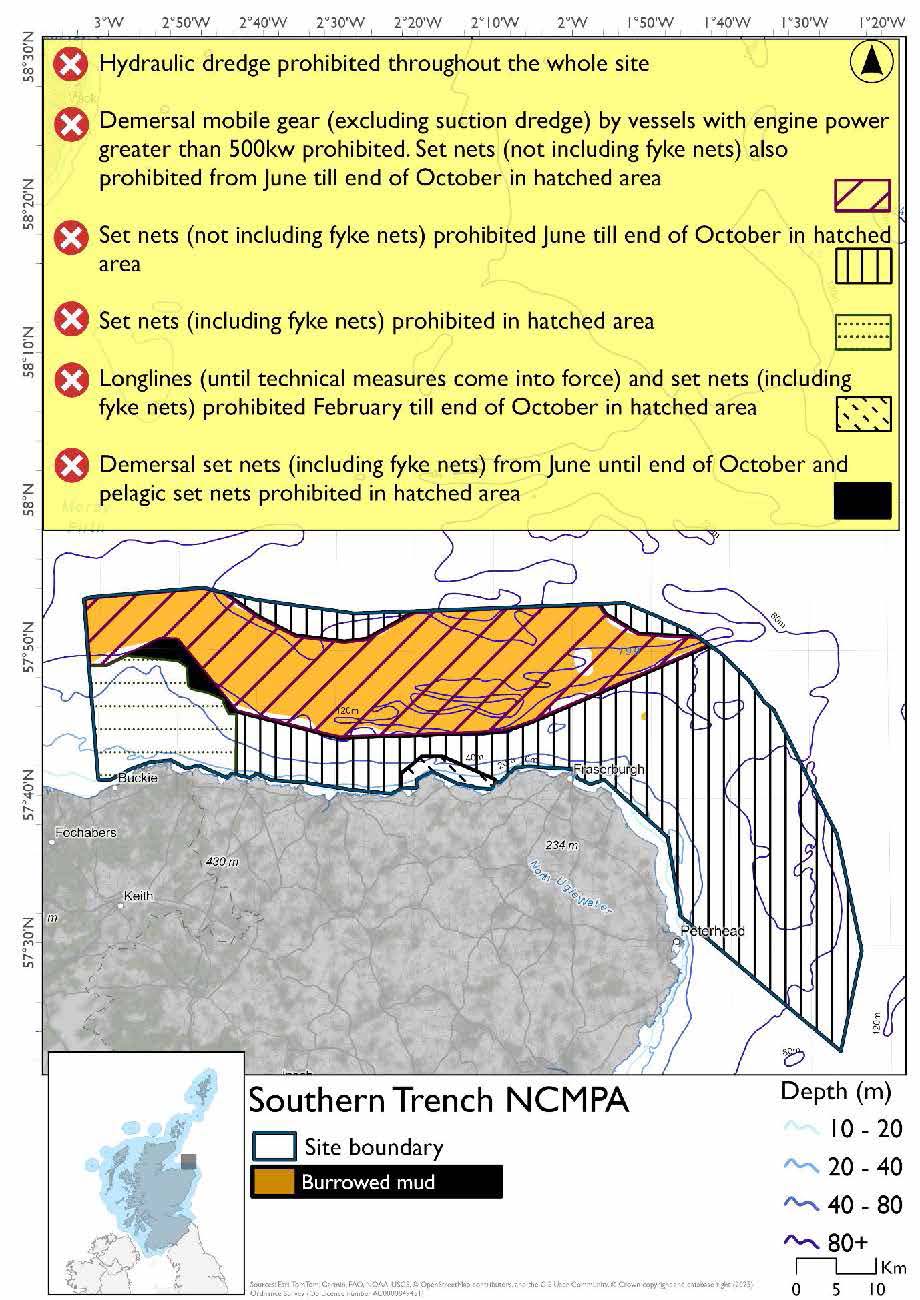
Option One
- Demersal trawls, demersal seine nets, beam trawls and mechanical dredge prohibited by vessels with engine power greater than 500kw in burrowed mud part of the site
- Set nets prohibited from June till end of October (not including fyke nets) in part of the site that doesn’t overlap with any other site
- Set nets (including fyke nets) prohibited in overlapping portion with the Moray Firth SPA that’s shallower than 64.5m
- Demersal set nets (including fyke nets) prohibited from June till end of October and pelagic set nets prohibited in part of the site that overlaps with the Moray Firth SPA that’s deeper than 64.5m
- Longlines (until technical measures come into force) and set nets (including fyke nets) from February till end of October prohibited in part of the site that overlaps with the Troup, Pennan and Lion’s Heads SPA
- Full site closure to hydraulic dredge
Option Two*
- Full site closure to demersal mobile gears (demersal trawls, demersal seine nets, beam trawls, mechanical dredge and hydraulic dredge) and set nets (not including fyke nets)
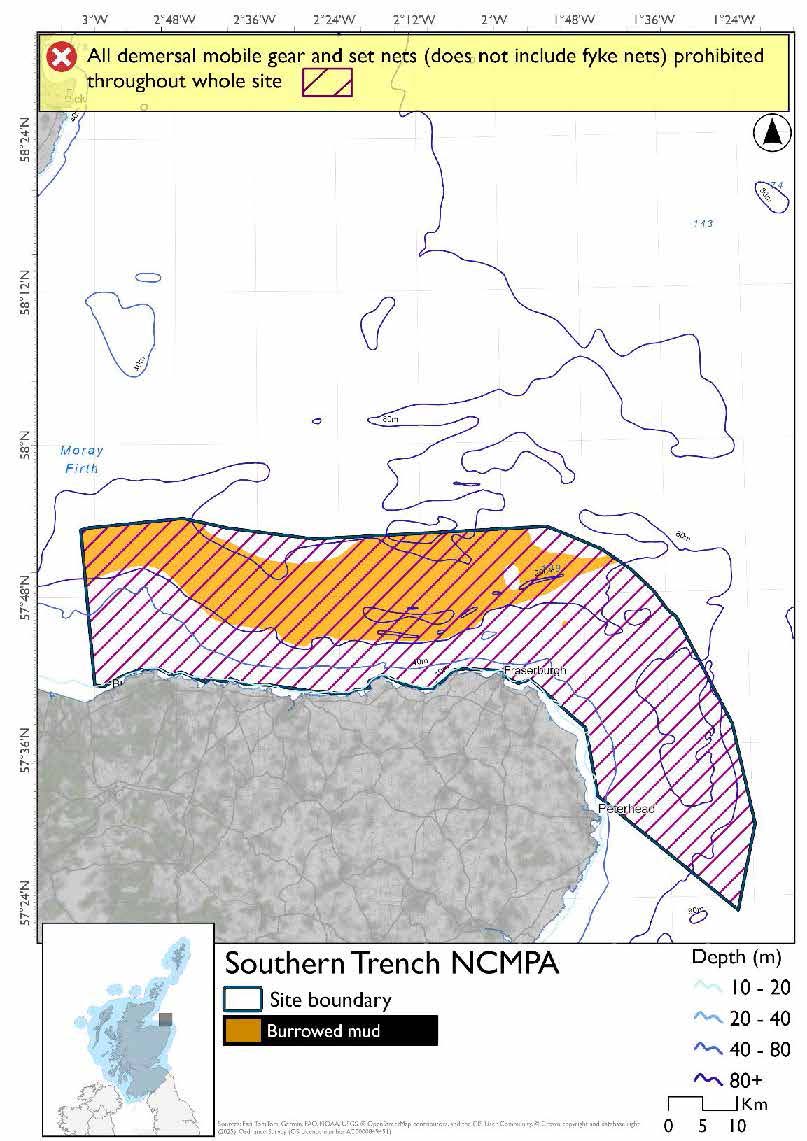
*The measures for Option 2 proposals only come from gear types prohibited in non-overlapping areas. Overlapping restrictions may still apply from overlapping sites or areas dependent on the decisions taken for that site or area.
Overlapping sites included in this consultation
This NCMPA overlaps with the Moray Firth SPA and Troup, Pennan and Lion’s Heads SPA.
Rationale for developed measures
The basis for the proposed fisheries management measures for each site has been determined by the management advice for fishing activities provided by NatureScot, which can be found on their website or Sitelink as signposted throughout this document. The Fisheries Assessment for each site assesses the impacts from existing fishing activities on the protected features using the tests from the legislation relevant for the type of MPA being considered. The assessment outlines how the proposed measures address any impacts identified that could hinder the conservation objectives of the MPA.
10.1.7 Other fisheries management measures currently applying to this site
There are already management measures in place. An effort has been made to identify existing measures which affect each individual site or area, however the list may not be exhaustive. These measures are outlined below, and the proposals for further management being consulted on now are in addition to these existing measures:
- Fishing for sandeel is prohibited within the Scottish zone, which is defined as the sea adjacent to Scotland up to the 200 nautical miles limit
- It shall be prohibited to deploy any bottom set gillnet, entangling net and trammel net at any position where the charted depth is greater than 200 m in part of the site - Derogations for hake and anglerfish. See Annex V Part C, 6.
Other conservation measures can be found in section 7 of the CMA.
10.2 East Caithness Cliffs NCMPA and East Caithness Cliffs SPA
10.2.1 Description and background
The East Caithness Cliffs, nearshore waters off the coast between Wick and Helmsdale, are protected both as a SPA and a NCMPA due to their exceptional ecological value. The SPA, designated in 1996, spans over 11,000 hectares and safeguards one of the UK’s most important seabird breeding sites, hosting around 300,000 nesting birds each year, including black guillemots, razorbills, fulmars, and kittiwakes. Complementing this, the NCMPA extends protection into the adjacent marine environment, covering vital feeding grounds within 2 km offshore that support these cliff-nesting species, particularly the black guillemot. This is the most important area on the east coast of the UK for black guillemots. Unlike other auks which feed offshore, the black guillemot is typically found feeding close inshore, rarely dispersing far from its breeding area even in winter. Together, these designations preserve a rich mosaic of terrestrial and marine habitats.
Further information, including Conservation and Management Advice (CMA) can be found on Sitelink by searching for each site individually.
Further information on MPAs, the wider network and protected areas management is available at Scottish Government MPA policy page.
10.2.2 Protected features
The East Caithness Cliffs NCMPA and SPA have been designated to protect eight species of breeding seabirds, breeding peregrine, black guillemot and their supporting habitats.
NCMPA features:
- Black guillemot
SPA features:
- Cormorant;
- Fulmar;
- Great black-backed gull;
- Guillemot;
- Herring gull;
- Kittiwake;
- Peregrine;
- Razorbill; and
- Shag
Peregrine are not discussed further as they are not a protected feature for which fisheries management measures are required.
The protected features of the East Caithness Cliffs SPA and NCMPA are protected within the sites throughout the year, irrespective of the season for which they qualified as a protected feature.
10.2.3 Conservation Objectives
The following protected features are in favourable condition at East Caithness Cliffs SPA and NCMPA: guillemot, kittiwake, fulmar and razorbill. Therefore, the Conservation Objectives seek to maintain this condition for the SPA features.
The following protected features are in unfavourable condition at East Caithness Cliffs SPA: cormorant, shag, great black-backed gull, herring gull and black guillemot. Therefore, the Conservation Objectives seek to restore this condition for the SPA features and recover this condition for black guillemot in the NCMPA.
Additional details, including the Conservation Objectives are provided in the Conservation and Management Advice document produced for this NCMPA and SPA and can be found on Sitelink. The CMA document is the same for both sites as management is being taken forward jointly.
10.2.4 Pressure from fishing activity
Fishing activities exert several pressures on the protected seabird features of the SPA, particularly during sensitive breeding and foraging periods. One of the most significant threats is accidental bycatch and entanglement in fishing gear, especially surface and long-line nets. Species such as black guillemot, kittiwake, guillemot, razorbill, shag, cormorant, gulls, and fulmar are all sensitive to this pressure, which can result in injury or mortality and has been documented across UK waters.
Another major concern is the depletion of prey resources due to intensive fishing, particularly of forage fish like sandeels. These small fish are a critical food source for many seabirds, and reductions in their abundance, whether from direct harvesting or habitat degradation, can lead to poor breeding success, reduced chick survival, and declines in adult condition. This is especially impactful for species such as kittiwake, guillemot, razorbill, shag, and fulmar, which rely heavily on marine prey during the breeding season.
Fishing activities may also indirectly degrade key feeding habitats. For example, bottom-contact gear can damage kelp forests and benthic zones, which are important for inshore feeders like the black guillemot. Loss of these habitats can reduce prey availability and disrupt foraging behaviour.
Additional details are provided in the Conservation and Management Advice documents produced for this NCMPA and SPA (section 6) can be found on Sitelink. The CMA document is the same for both sites as management is being taken forward jointly.
Other resources include:
- The Feature Activity Sensitivity Tool (FeAST) which allows users to investigate the sensitivity of marine features (habitats, species, geology and landforms) in Scotland's seas, to pressures arising from human activities;
- Fisheries Guidance Notes which provide summaries of evidence on the interaction between fishing gears and specific habitats and species.
10.2.5 Fisheries management advice relevant to proposed fisheries management measures
NatureScot provides risk-based advice to help manage activities that may impact protected features and their Conservation Objectives. See section 2.3 for more detail. Full fisheries management advice is found in the CMA documents which can be found on Sitelink. The CMA document is the same for both sites as management is being taken forward jointly and has been summarised below for the management measures proposed:
Hydraulic gear
It is recommended to remove or avoid pressures (removal of prey species and disturbance of prey-supporting habitat) associated with hydraulic fishing that has the potential to damage seabed habitat (in particular, sandeel habitat).
Static gear
The recommendation is to remove or avoid pressures (entanglement) associated with the use of all static nets (including bottom set nets, drift nets, fyke nets). Spatial exclusion of all static nets in areas identified as being important for black guillemot (as identified from habitat and dive depth preferences)
Pelagic gear
Pelagic fishing for herring/sprat may occur within or around the SPA or NCMPA. It is recommended that a principal objective of the management of the fishery should be ensuring that the fishing activity does not prevent or disrupt the availability of prey species i.e. it should be considered as part of a broader ecosystem-based approach to management of this fishery.
Longlining (not including jigging)
Long-lining (pelagic and demersal) may occur within or around the SPA(s). Current understanding is that long-line fisheries are largely restricted to offshore waters. Site-specific measures for long-lining are not currently considered appropriate due to the scale of the fishery, and the wide-spread interaction with seabirds. However, there is evidence of seabird bycatch in long-line (not jigging) fisheries therefore it is recommended this requires wider seas management measures.
For the SPAs advice has also been provided on maximum dive depth and seasonality for protected features of each site and can be found in the Fishing Activity Further Advice and Evidence document. Supplementary advice can also be found on NatureScot’s website.
10.2.6 Proposed fisheries management measures
The proposed management measure for East Caithness Cliffs NCMPA and SPA is as follows:
Single Proposed Management Option
- Full site closure to longlines (until technical measures come into force), set nets (including fyke nets) and hydraulic dredge
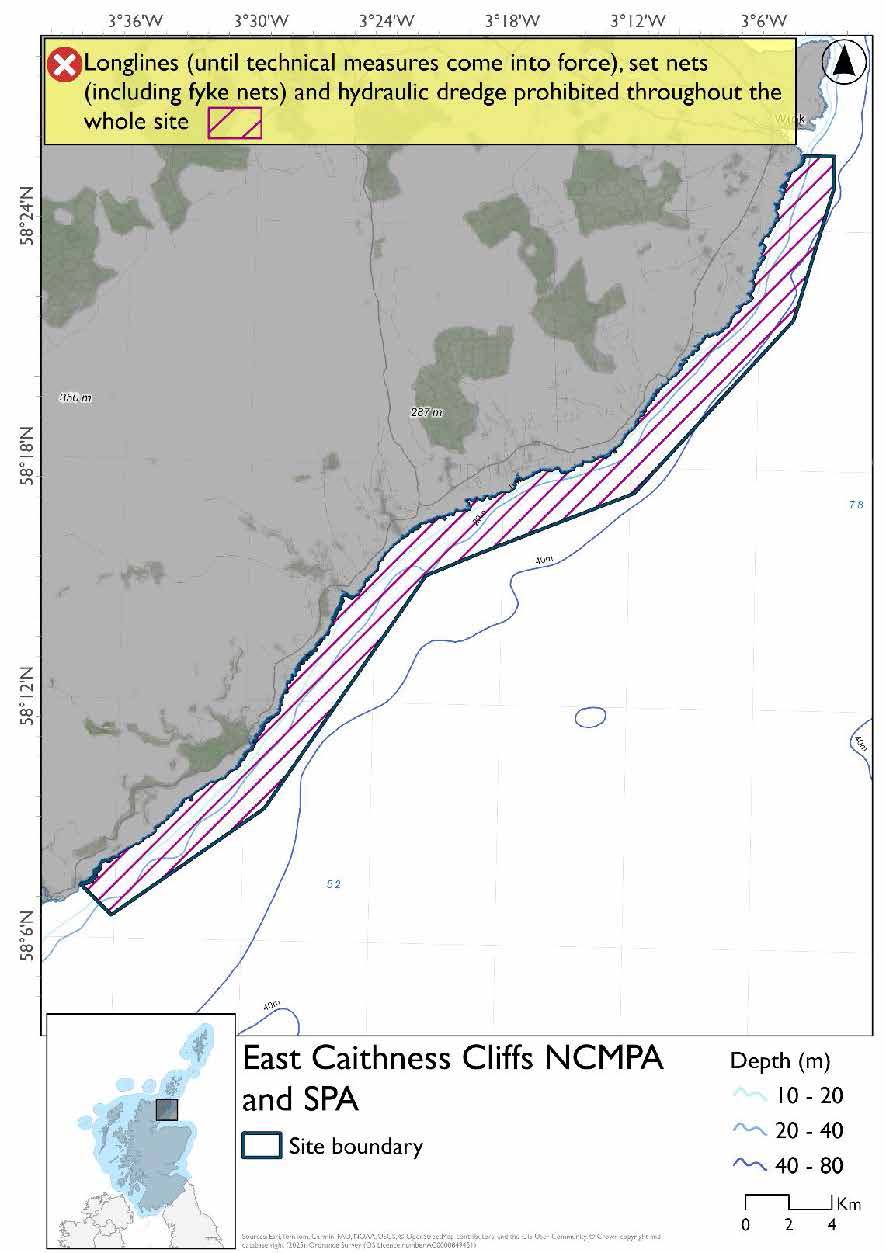
A full site level of protection from the specified gear has been identified as the only suitable option in enabling the achievement of the desired level of protection for the feature in question.
Overlapping site included in this consultation
This NCMPA and SPA overlaps with the Moray Firth SPA.
Rationale for developed measures
The basis for the proposed fisheries management measures for each site has been determined by the management advice for fishing activities provided by NatureScot, which can be found on their website or Sitelink as signposted throughout this document. The Fisheries Assessment for each site assesses the impacts from existing fishing activities on the protected features using the tests from the legislation relevant for the type of MPA being considered. The assessment outlines how the proposed measures address any impacts identified that could hinder the conservation objectives of the MPA.
10.2.7 Other fisheries management measures currently applying to this site
There are already management measures in place. An effort has been made to identify existing measures which affect each individual site or area, however the list may not be exhaustive. These measures are outlined below, and the proposals for further management being consulted on now are in addition to these existing measures:
- Fishing for sandeel is prohibited within the Scottish zone, which is defined as the sea adjacent to Scotland up to the 200 nautical miles limit
- Fishing with any towed gear with a codend mesh size of less than 32 mm or static nets less than 30 mm mesh size shall be prohibited for the conservation of Juvenile Herring. (Seasonal March to October).
Other conservation measures can be found in section 7 of the CMA which can be found on Sitelink. The CMA document is the same for both sites as management is being taken forward jointly.
10.3 Dornoch Firth and Morrich More SAC and Moray Firth SAC
10.3.1 Description and background
Situated on the northeast coast of Scotland, the Dornoch Firth and Morrich More SAC spans approximately 8,700 hectares. The site covers extensive areas of mudflats, sandflats, saltmarshes, and sand dunes, including the largest and most complete dune system in the UK. This includes areas used by common seal whose habitat use extends into adjacent freshwater and terrestrial zones.
The Moray Firth SAC is a vast and ecologically significant marine protected area located off the northeast coast of Scotland, encompassing approximately 151,000 hectares. The SAC was designated to protect the resident population of bottlenose dolphins and associated subtidal sandbanks. It includes areas critical for feeding, breeding, and social interaction, ensuring the ecological integrity of the population. Additionally, the SAC encompasses sandbanks slightly covered by seawater all the time, which support rich benthic communities and serve as important prey habitats for the dolphins.
Further information, including Conservation and Management Advice (CMA) can be found on Sitelink by searching for each site individually.
Further information on MPAs, the wider network and protected areas management is available at Scottish Government MPA policy page.
10.3.2 Protected features
The Dornoch Firth and Morrich More SAC has been designated to protect:
- Estuaries;
- Harbour seal;
- Intertidal mudflats and sandflats;
- Otter;
- Reef; and
- Subtidal sandbanks
Otter is not discussed further as they are not a protected feature for which fisheries management measures are required.
Moray Firth SAC has been designated to protect:
- Bottlenose dolphin; and
- Subtidal sandbanks
10.3.3 Conservation Objectives
Dornoch Firth and Morrich More SAC:
Reefs and harbour seal are currently in unfavourable condition at Dornoch Firth and Morrich More SAC and therefore the Conservation Objectives seek to restore this condition.
Estuaries, subtidal sandbanks and intertidal mudflats and sandflats, are currently in favourable condition at Dornoch Firth and Morrich More SAC and therefore the Conservation Objectives seek to maintain this condition
Moray Firth SAC:
Subtidal sandbanks and bottlenose dolphin are currently in favourable condition at Moray Firth SAC and therefore the Conservation Objectives seek to maintain this condition.
Additional details, including the Conservation Objectives are provided in the Conservation and Management Advice document produced for these SACs and can be found on Sitelink by searching for each site individually. Management is being taken forward jointly but sites have separate CMA documents.
10.3.4 Pressure from fishing activity
Dornoch Firth and Morrich More:
Fishing activities exert pressures on estuarine environments. Estuaries are highly dynamic and sensitive ecosystems, and the use of demersal mobile or active fishing gear can disturb sediments and alter hydrodynamic conditions. Such disturbance degrades habitat quality and ecological function, with particular consequences for migratory fish that rely on these areas.
Intertidal mudflats and sandflats are sensitive to fishing pressures. Practices such as bait digging, tractor dredging for cockles, and gathering blue mussels for bait disrupt sediment structure and biological communities. These habitats typically have low resilience, and their recovery depends on the scale of disturbance and site‑specific environmental conditions.
Rocky reef habitats are also at risk from fishing activities. Tractor dredging, demersal mobile gear, and static gear such as creels can detach sessile organisms and impair water flow, reducing the effectiveness of filter feeders. While recovery is possible, it varies depending on the intensity of the impact and local water movement.
Subtidal sandbanks are sensitive to physical disturbance from demersal mobile or active fishing gear. Such activities destabilise sediments and disrupt benthic communities, with resilience limited by the frequency and nature of the pressure.
Harbour seals are highly sensitive to disturbance linked to fishing. Activities such as cockle gathering, bait digging, and the use of static gear can cause behavioural changes, reduce resting time, and even lead to mother‑pup separation. In addition, underwater noise from vessels and gear poses risks to seal health and can alter site usage patterns.
Moray Firth SAC:
Subtidal sandbanks can be sensitive to physical disturbance. These habitats can also have a low resilience to the introduction or spread of invasive non-native species and can be sensitive to changes in water quality. This feature is sensitive to impacts from demersal mobile/active gears.
Bottlenose dolphin are considered sensitive to:
- Removal of non-target and target species (i.e. entanglement of bottlenose dolphins in fishing gears and removal of their prey species).
- Underwater noise. Noise disturbance may cause marine mammals to relocate, interfere with communication, navigation, foraging, and may disrupt social bonds. Many forms of harassment may elicit a stress response.
- Death or injury by collision
Further information on feature sensitivity can be found in the UK Dolphin and Porpoise Conservation Strategy and section 6 of the respective CMAs which can be found on Sitelink by searching for each site individually.
Other resources include:
- The Feature Activity Sensitivity Tool (FeAST) which allows users to investigate the sensitivity of marine features (habitats, species, geology and landforms) in Scotland's seas, to pressures arising from human activities;
- Fisheries Guidance Notes which provide summaries of evidence on the interaction between fishing gears and specific habitats and species.
10.3.5 Fisheries management advice relevant to proposed fisheries management measures
NatureScot provides risk-based advice to help manage activities that may impact protected features and their Conservation Objectives. See section 2.3 for more detail. Full fisheries management advice is found in the CMA documents which can be found be searching each site individually on Sitelink and has been summarised below for the management measures proposed:
Demersal mobile/active gear
For subtidal sandbanks and estuaries reduce or limit pressures is recommended.
Remove or avoid pressures is recommended where seagrass beds and horse mussel beds are present.
For reefs remove or avoid pressure is recommended.
Hydraulic (diver or vessel)
For subtidal sandbanks and estuaries reduce or limit pressure from all hydraulic methods (e.g. diver or vessel) is recommended. Remove or avoid pressures is recommended where seagrass beds and horse mussel beds are present.
For bottlenose dolphin the advice is to remove or avoid pressures. The exclusion of hydraulic fishing methods from habitat supporting sandeels (as a key supporting prey species of bottlenose dolphins) within the site is recommended.
Static gear
For harbour seal reduce or limit pressures (entanglement) associated with the use of nets is recommended. This includes bottom-set gill nets such as tangle and trammel nets, drift nets, gill nets set in water column, purse seine and ring net and fyke nets.
For bottlenose dolphins remove or avoid pressures. The exclusion of the use of drift nets and nets set on the seabed (tangle, trammel, gill) to avoid the risk of entanglement/bycatch is recommended.
Pelagic gear
Bottlenose dolphin reduce or limit pressures. The development and adoption of best practice to reduce or limit the risk of incidental catch of bottlenose dolphins should be considered. Measures ensuring that fishing activity does not prevent or disrupt the availability of key prey species (e.g. herring, sprat) for bottlenose dolphins is recommended.
10.3.6 Proposed fisheries management measures
The proposed management measures for Dornoch Firth and Morrich More and Moray Firth SAC are as follows:
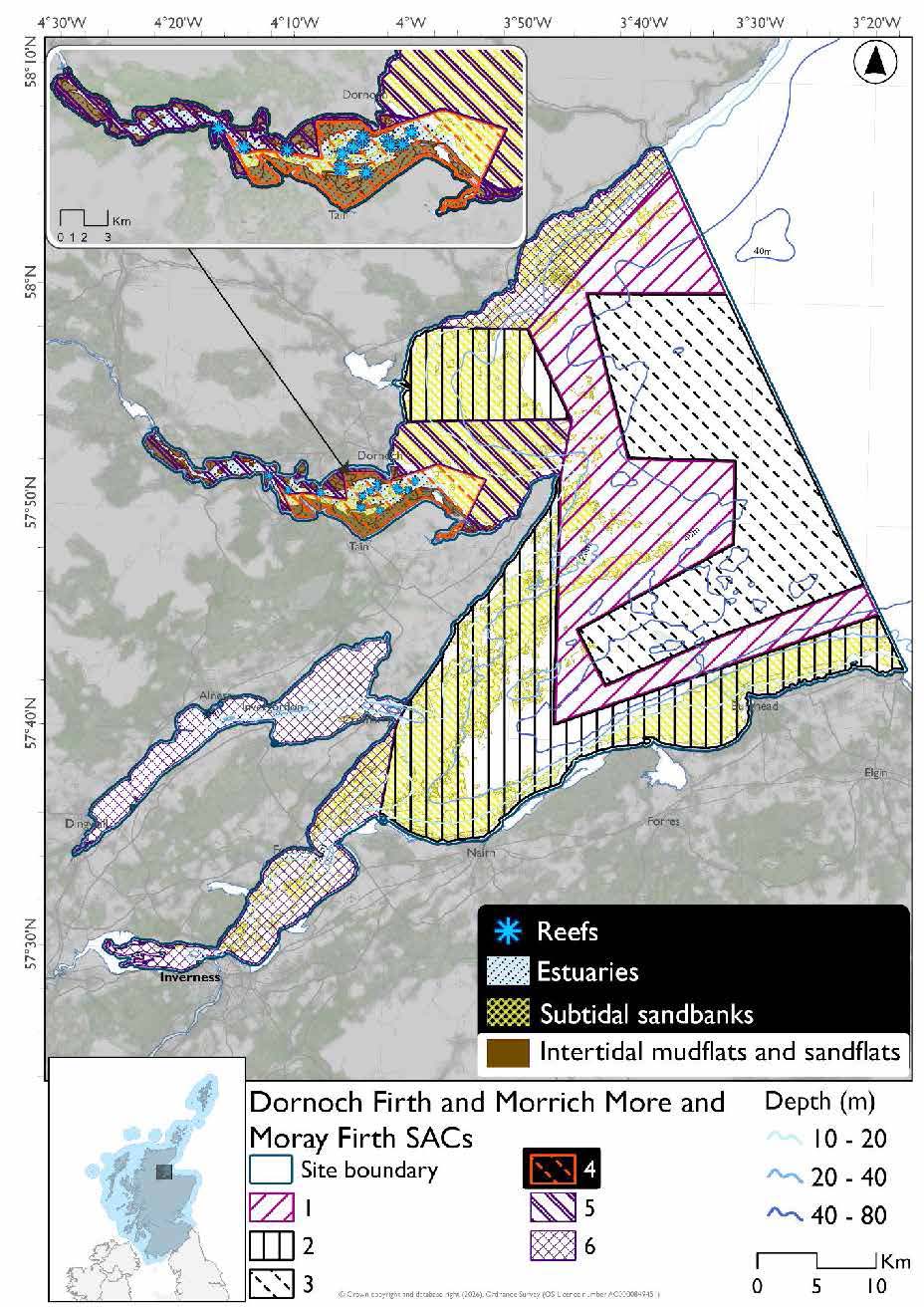
Option 1
- Beam trawl, set nets (including fyke nets) and hydraulic dredge prohibited (Hatching 1)
- Beam trawl, set nets (including fyke nets), mechanical dredges and hydraulic dredge prohibited (Hatching 2)
- Beam trawl, set nets (not including fyke nets) and hydraulic dredge prohibited (Hatching 3)
- Demersal trawl, demersal seine net, beam trawl, mechanical dredge, hydraulic dredge, set nets (including fyke nets) and pelagic seine (including ring-nets) prohibited (Tain Mussel Fishery exempt) (Hatching 4)
- Demersal trawl, demersal seine net, beam trawl, mechanical dredge, hydraulic dredge, pelagic seine (including ring-nets) and set nets (including fyke nets) prohibited (Hatching 5)
- Demersal trawl, demersal seine net, beam trawl, set nets (including fyke nets), mechanical dredges and hydraulic dredge prohibited (Hatching 6)
Option 2*
- Full site closure for both SACs to hydraulic dredge, demersal trawls and seine, beam trawl and mechanical dredge. (Tain mussel fishery exempt)
- Full site closure to set nets (including fyke nets) and pelagic seine (including ring-nets) for Dornoch Firth and Morrich More SAC
- Full site closure to set nets (not including fyke nets) for Moray Firth SAC
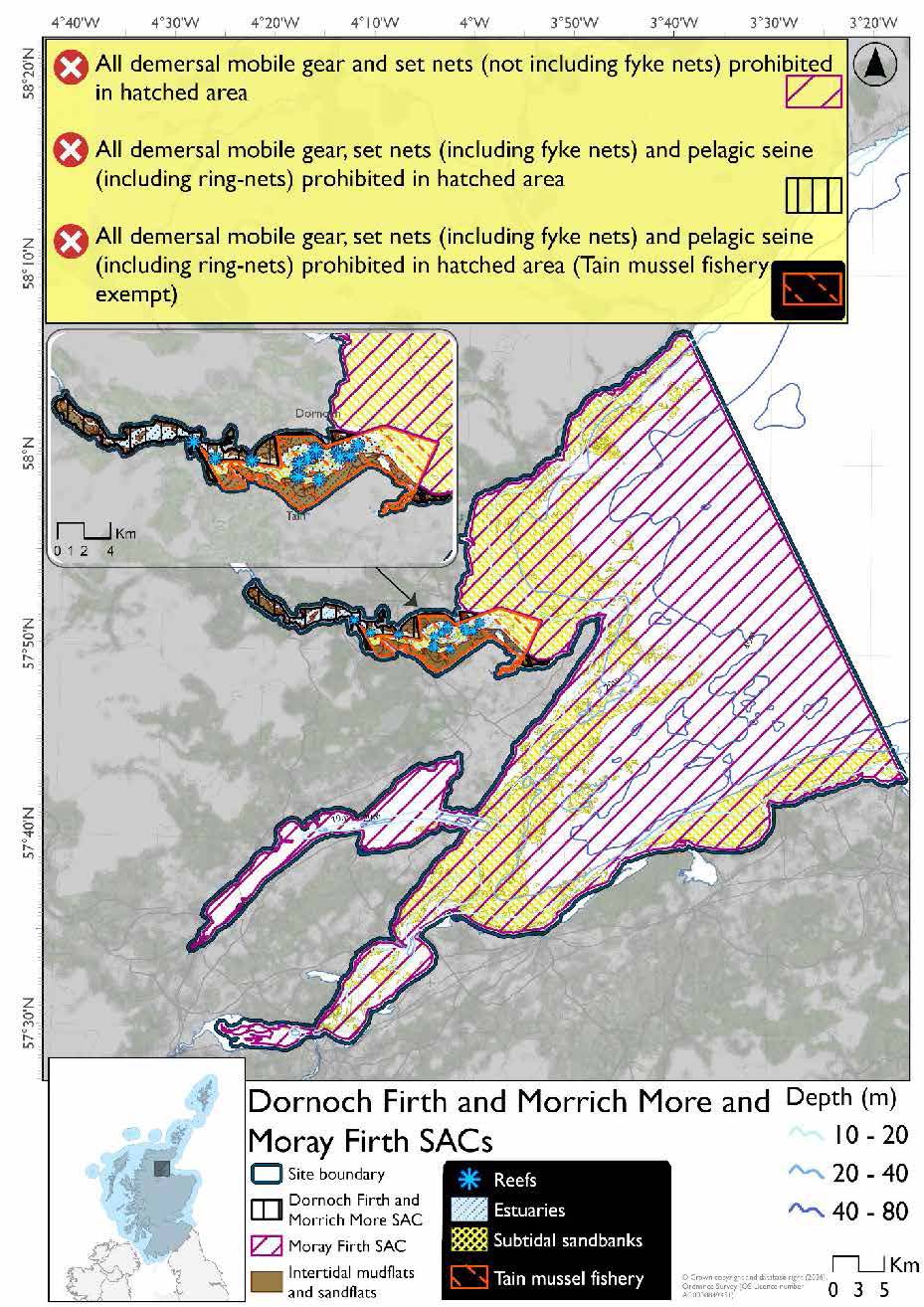
*The measures for Option 2 proposals only come from gear types prohibited in non-overlapping areas. The restrictions that may come from the overlapping area with the Moray Firth SPA will come from the measures implemented for that site.
Overlapping site included in this consultation
These SACs overlap with the Moray Firth SPA.
Rationale for developed measures
The basis for the proposed fisheries management measures for each site has been determined by the management advice for fishing activities provided by NatureScot, which can be found on their website or Sitelink as signposted throughout this document. The Fisheries Assessment for each site assesses the impacts from existing fishing activities on the protected features using the tests from the legislation relevant for the type of MPA being considered. The assessment outlines how the proposed measures address any impacts identified that could hinder the conservation objectives of the MPA.
10.3.7 Other fisheries management measures currently applying to this site
There are already management measures in place. An effort has been made to identify existing measures which affect each individual site or area, however the list may not be exhaustive. These measures are outlined below, and the proposals for further management being consulted on now are in addition to these existing measures:
- Fishing for sandeel is prohibited within the Scottish zone, which is defined as the sea adjacent to Scotland up to the 200 nautical miles limit
- Fishing with any towed gear with a codend mesh size of less than 32nmm or static nets less than 30 prohibited in part of the site between 01 October and 31 March
- Inverness Firth - Fishing for sea fish with mobile or active gear prohibited in part of the site
- Dornoch Firth - Fishing for sea fish with mobile or active gear prohibited in part of the site
- Cromarty Firth - Fishing for sea fish with mobile or active gear prohibited in part of the site
- Dredging (but not suction dredging) for mussels is excepted (Tain mussel fishery). There are further restrictions for fishing for lobsters, shrimp and with parlour creels.
Other conservation measures can be found in section 7 of the CMA documents which can be found be searching each site individually on Sitelink.
10.4 Moray Firth SPA
10.4.1 Description and background
The Moray Firth SPA comprises an extensive area of inshore and coastal waters on the north‑east coast of Scotland, extending from Caithness in the north to Aberdeenshire in the east. The site covers over 170,000 hectares of marine habitat and includes a diverse range of environments such as open sea, shallow coastal waters, estuaries and sea inlets. These waters support nationally and internationally important populations of marine and migratory birds, particularly non‑breeding waterfowl such as common scoter and eider, as well as foraging areas for species including shag. The SPA encompasses the water column, seabed and surface waters that are critical for feeding, resting and moulting, with many species reliant on benthic prey and associated habitats. As part of the wider network of SPAs, the Moray Firth SPA provides essential habitat for birds during key stages of their life cycles, particularly in the winter period when large aggregations depend on the site’s rich marine resources.
Further information, including Conservation and Management Advice (CMA) can be found on Sitelink.
Further information on MPAs, the wider network and protected areas management is available at Scottish Government MPA policy page.
10.4.2 Protected features
The Moray Firth SPA has been designated to protect:
- Comon scoter;
- Eider;
- Goldeneye;
- Great northern diver;
- Long-tailed duck;
- Red-breasted merganser
- Red-throated diver;
- Scaup;
- Shag;
- Slavonian grebe; and
- Velvet scoter
The protected features of the Moray Firth SPA are protected within the SPA throughout the year, irrespective of the season for which they qualified as a protected feature.
10.4.3 Conservation Objectives
Moray Firth SPA was designated in 2020. The waterfowl species have not been assessed since designation however corroborative evidence suggests there is no reason to suspect deterioration in their condition since designation. Therefore, the Conservation Objectives for the waterfowl qualifying features at the Moray Firth SPA seek to maintain this condition.
The condition of shag at the Moray Firth SPA is considered to be unfavourable and consequently, the Conservation Objectives seek to restore favourable condition.
Additional details, including the Conservation Objectives are provided in the Conservation and Management Advice document produced for this SPA and can be found on Sitelink.
10.4.4 Pressures from fishing activity
Fishing activity exerts multiple pressures on protected bird species, primarily through entanglement in gear, incidental bycatch, disturbance from vessels, and impacts on prey availability. Species such as great northern, red-throated, and Slavonian grebes, eider, goldeneye, scoters (common and velvet), long-tailed ducks, shags, greater scaup, and red-breasted mergansers are all sensitive to bycatch and entanglement, with many also showing strong behavioural responses to vessel traffic and noise.
Grebes are particularly sensitive to disturbance from vessel movements and marine developments, while scaup are at risk in high-density wintering areas. Eiders and scoters face heightened sensitivity during flightless moult periods when escape from disturbance is limited. All of these diving species rely heavily on benthic prey such as bivalves, making them susceptible to prey depletion from commercial harvesting or habitat modification. Although some, like the eider, can switch prey, this adaptability is limited and may result in poor condition or mortality.
Additional details are provided in the Conservation and Management Advice document produced for this SPA (section 6) and can be found on Sitelink.
Other resources include:
- The Feature Activity Sensitivity Tool (FeAST) which allows users to investigate the sensitivity of marine features (habitats, species, geology and landforms) in Scotland's seas, to pressures arising from human activities;
- Fisheries Guidance Notes which provide summaries of evidence on the interaction between fishing gears and specific habitats and species.
10.4.5 Fisheries management advice relevant to proposed fisheries management measures
NatureScot provides risk-based advice to help manage activities that may impact protected features and their Conservation Objectives. See section 2.3 for more detail. The CMA document also sets out the full fisheries management advice that has been summarised below for the management measures proposed:
Hydraulic gear
Remove or avoid pressures (removal of prey species and disturbance of prey-supporting habitat) associated with hydraulic fishing that has the potential to damage seabed habitat (in particular, sandeel habitat).
Static gear (drift nets and bottom set nets inc. fyke nets)
Remove or avoid pressures (entanglement) associated with the use of all static nets. Spatial exclusion of all static nets in areas identified as being important (as identified from habitat and dive depth preferences) is recommended.
This is recommended between mid-September and May for divers and grebes and between August and May for seaduck.
Pelagic gear
Pelagic fishing for herring/sprat may occur within or around the SPA. It is recommended that a principal objective of the management of the fishery should be ensuring that the fishing activity does not prevent or disrupt the availability of prey species i.e. it should be considered as part of a broader ecosystem-based approach to management of this fishery.
For the SPAs advice has also been provided on maximum dive depth and seasonality for protected features of each site and can be found in the Fishing Activity Further Advice and Evidence document. Supplementary advice can also be found on NatureScot’s website.
10.4.6 Proposed fisheries management measures
The proposed management measures for Moray Firth SPA are as follows:
Option One*
- Set nets (including fyke nets) prohibited in areas down to 64.5m and pelagic set nets prohibited in areas deeper than 64.5m based on presence and maximum dive depth of shag
- Longlines (until technical measures come into force) prohibited in part of the site that overlaps with the East Caithness Cliffs SPA
- Pelagic seine (including ring-nets) prohibited in part of the site that overlaps with the Dornoch Firth and Morrich More SAC
- Demersal set nets (not including fyke nets) prohibited from June till end of October and pelagic set nets prohibited in overlapping area with Southern Trench NCMPA deeper than 64.5m based on presence and maximum dive depth of shag and static net seasonal measures for minke whale from the NCMPA
- Full site closure to hydraulic dredge
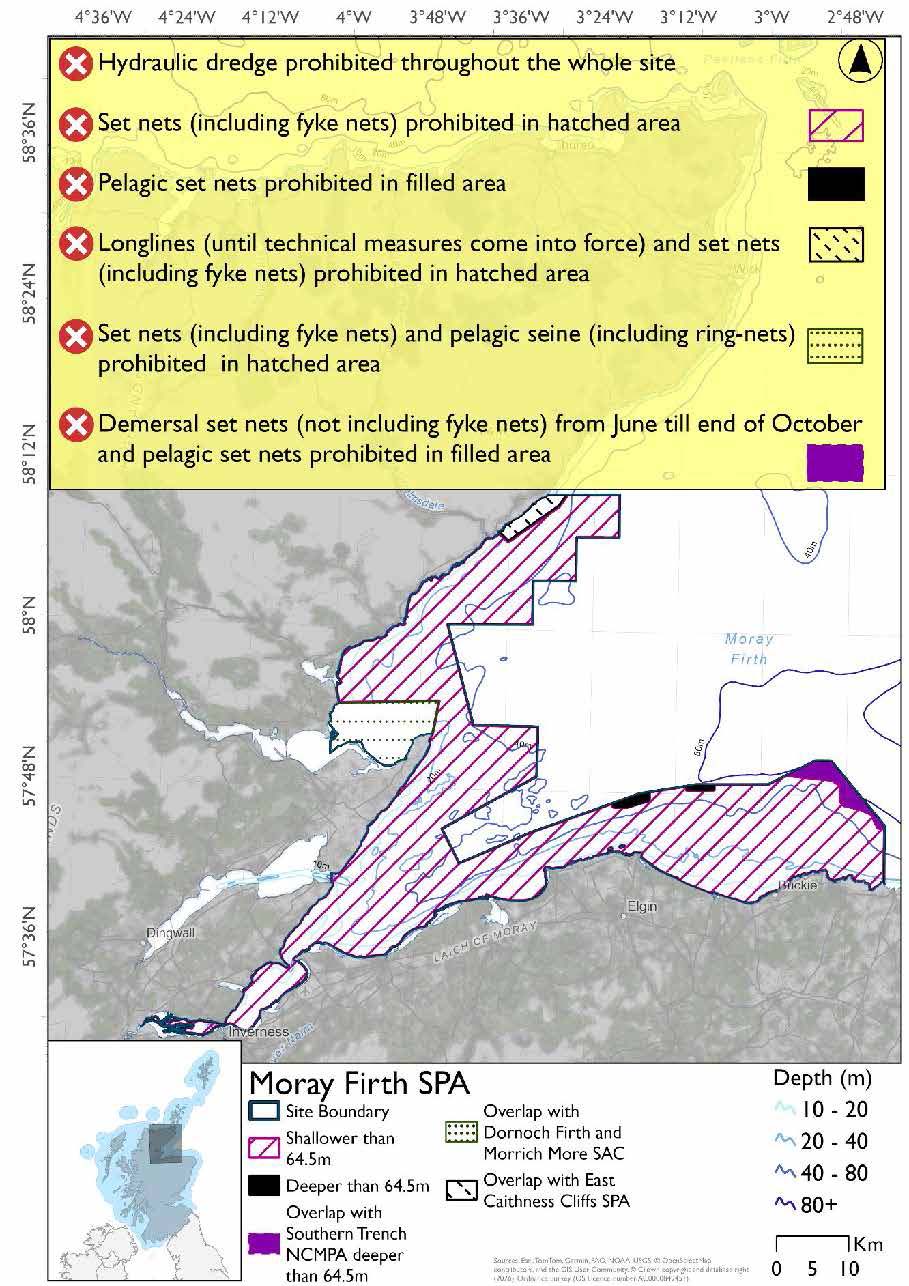
*This site will have other demersal mobile measures that may apply from the overlapping portions with the Dornoch Firth and Morrich More and Moray Firth SACs that aren’t shown on the map for this option.
- Dornoch Firth and Morrich More SAC would prohibit demersal trawls and seines, beam trawls and mechanical dredge in the overlapping areas. Mechanical dredge exempt in Tain Mussel Fishery.
- Moray Firth SAC has zoned areas so demersal trawls and seines, beam trawls and mechanical dredge could be prohibited in overlapping areas.
Please check the Option 1 overlapping site map to see proposed demersal mobile measures under Option 1.
Option Two*
- Full site closure to set nets (including fyke nets) and hydraulic dredge
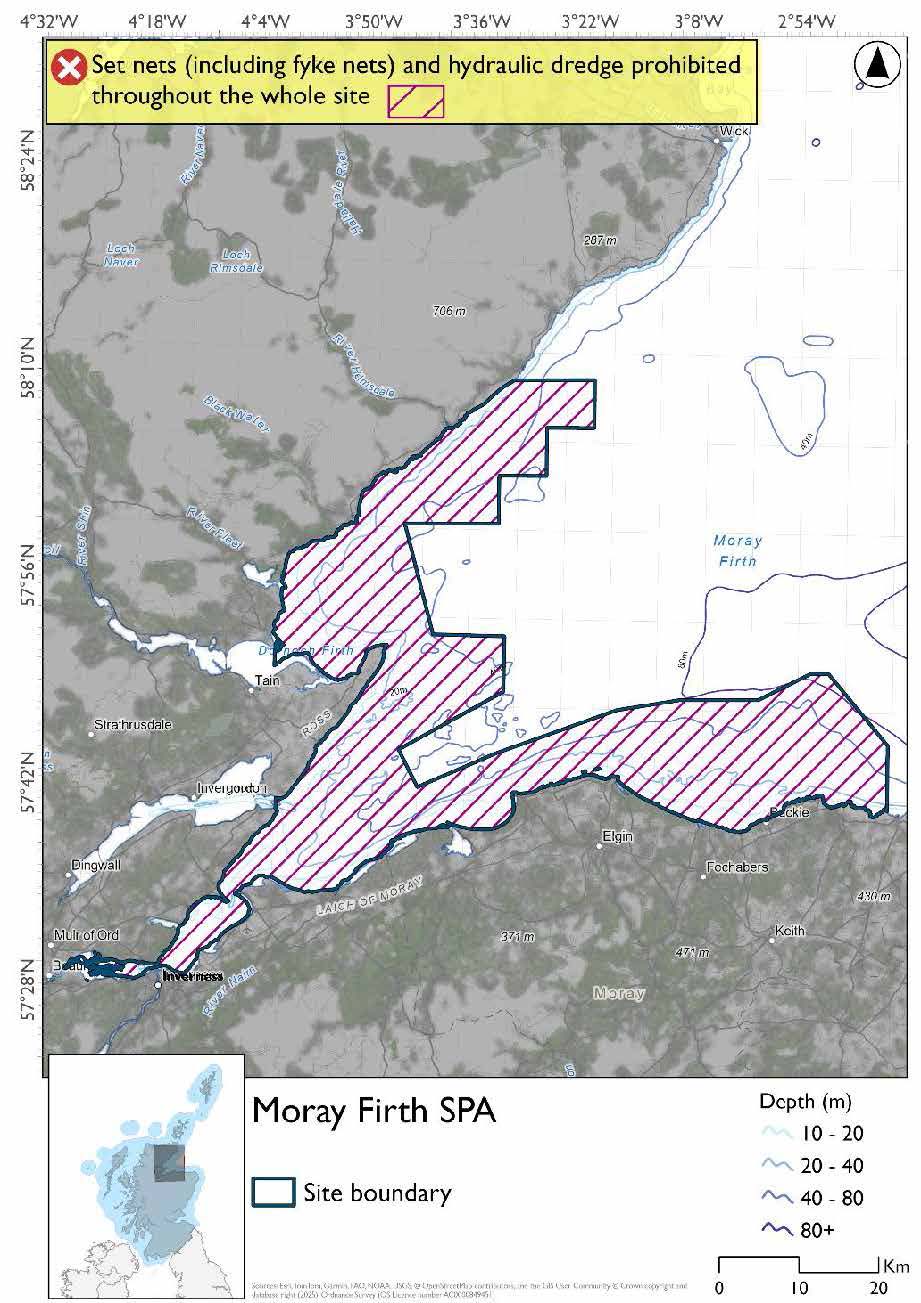
*The measures for Option 2 proposals only come from gear types prohibited in non-overlapping areas. Overlapping restrictions may still apply from overlapping sites or areas dependent on the decisions taken for that site or area.
Overlapping sites included in this consultation
This SPA overlaps with the East Caithness Cliffs and Southern Trench NCMPAs, Dornoch Firth and Morrich More and Moray Firth SACs and East Caithness Cliffs SPA.
Rationale for developed measures
The basis for the proposed fisheries management measures for each site has been determined by the management advice for fishing activities provided by NatureScot, which can be found on their website or Sitelink as signposted throughout this document. The Fisheries Assessment for each site assesses the impacts from existing fishing activities on the protected features using the tests from the legislation relevant for the type of MPA being considered. The assessment outlines how the proposed measures address any impacts identified that could hinder the conservation objectives of the MPA.
10.4.7 Other fisheries management measures currently applying to this site
There are already management measures in place. An effort has been made to identify existing measures which affect each individual site or area, however the list may not be exhaustive. These measures are outlined below, and the proposals for further management being consulted on now are in addition to these existing measures:
- Fishing for sandeel is prohibited within the Scottish zone, which is defined as the sea adjacent to Scotland up to the 200 nautical miles limit
- Fishing with any towed gear with a codend mesh size of less than 32nmm or static nets less than 30 prohibited in part of the site between 01 October and 31 March
- Inverness Firth - Fishing for sea fish with mobile or active gear prohibited in part of the site
- Dornoch Firth - Fishing for sea fish with mobile or active gear prohibited in part of the site (Tain mussel fishery exempt)
Other conservation measures can be found in section 7 of the CMA.
10.5 Troup, Pennan and Lion`s Heads SPA
10.5.1 Description and background
The Troup, Pennan and Lion’s Heads SPA is a protected coastal area in northeast Scotland, covering around 3,367 hectares of dramatic sea cliffs and extending about 2 km offshore. It was designated to safeguard vital seabird populations and their habitats, with the marine extension added to protect feeding and movement areas.
This site supports over 20,000 breeding seabirds annually, including internationally important numbers of kittiwakes, guillemots, and fulmars. In 1995, the cliffs hosted around 150,000 individual seabirds across nine species, making it one of the UK’s most significant breeding sites.
The cliffs and adjacent maritime grasslands provide nesting and foraging habitats, while the marine extension ensures protection of the surrounding waters essential for seabird survival. The SPA overlaps with other conservation areas like SSSIs and nature reserves, and is managed to maintain or restore seabird populations through monitoring and targeted conservation efforts.
Further information, including Conservation and Management Advice (CMA) can be found on Sitelink.
Further information on MPAs, the wider network and protected areas management is available at Scottish Government MPA policy page.
10.5.2 Protected features
The Troup, Pennan and Lion’s Heads SPA has been designated to protect five species of breeding seabirds, a seabird breeding assemblage, and their supporting habitats:
- Fulmar;
- Guillemot;
- Herring gull;
- Kittiwake; and
- Razorbill
The protected features of the Troup, Pennan and Lion’s Heads SPA are protected within the SPA throughout the year, irrespective of the season for which they qualified as a protected feature.
10.5.3 Conservation Objectives
The following protected feature is in favourable condition at Troup, Pennan and Lion’s Heads SPA: razorbill. Therefore, the Conservation Objectives seek to maintain this condition.
The following protected features are in unfavourable condition at Troup, Pennan and Lion’s Heads SPA: kittiwake, guillemot, herring gull and fulmar. Therefore, the Conservation Objectives seek to restore this condition.
Additional details, including the Conservation Objectives are provided in the Conservation and Management Advice document produced for this SPA and can be found on Sitelink.
10.5.4 Pressures from fishing activity
Several seabird species in UK waters are sensitive to fishing-related pressures, particularly accidental bycatch and reductions in prey availability. Kittiwakes, guillemots, razorbills, herring gulls, and fulmars are all sensitive to entanglement in fishing gears, with surface nets and long-lines posing the greatest risks.
Prey depletion linked to overfishing or shifts in fishery practices further compounds these impacts, reducing food availability during critical breeding and moulting periods. Kittiwakes are especially affected by changes in prey abundance, which can undermine breeding success and survival. Guillemots and razorbills face similar challenges, with reduced prey resources limiting their ability to sustain populations. Herring gulls are also exposed to bycatch and ecosystem-level changes that alter prey abundance. Fulmars are among the most frequently taken in long-line fisheries and remain highly sensitive to surface gear, with prey reduction adding further stress to their populations.
Together, these pressures highlight the dual risks of direct mortality from bycatch and indirect impacts from prey depletion, both of which threaten the resilience of seabird populations in UK marine ecosystems.
Additional details are provided in the Conservation and Management Advice document produced for this SPA (section 6) and can be found on Sitelink.
Other resources include:
- The Feature Activity Sensitivity Tool (FeAST) which allows users to investigate the sensitivity of marine features (habitats, species, geology and landforms) in Scotland's seas, to pressures arising from human activities;
- Fisheries Guidance Notes which provide summaries of evidence on the interaction between fishing gears and specific habitats and species.
10.5.5 Fisheries management advice relevant to proposed fisheries management measures
NatureScot provides risk-based advice to help manage activities that may impact protected features and their Conservation Objectives. See section 2.3 for more detail. The CMA document also sets out the full fisheries management advice that has been summarised below for the management measures proposed:
Hydraulic gear
Remove or avoid pressures (entanglement) associated with the use of all static nets. Spatial exclusion of all static nets in areas identified as being important for kittiwake, guillemot, razorbill and fulmar (as identified from habitat and dive depth preferences) is recommended.
Static gear (drift nets and bottom set nets inc. fyke nets)
Remove or avoid pressures (entanglement) associated with the use of all static nets. Spatial exclusion of all static nets in areas identified as being important for kittiwake, guillemot, razorbill and fulmar (as identified from habitat and dive depth preferences) is recommended.
Pelagic gear
Pelagic fishing for herring/sprat may occur within or around the SPA. It is recommended that a principal objective of the management of the fishery should be ensuring that the fishing activity does not prevent or disrupt the availability of prey species i.e. it should be considered as part of a broader ecosystem-based approach to management of this fishery.
Longlining (not including jigging)
Long-lining (pelagic and demersal) may occur within or around the SPA(s). Current understanding is that long-line fisheries are largely restricted to offshore waters. Site-specific measures for long-lining are not currently considered appropriate due to the scale of the fishery, and the wide-spread interaction with seabirds. However, there is evidence of seabird bycatch in long-line (not jigging) fisheries therefore it is recommended this requires wider seas management measures.
For the SPAs advice has also been provided on maximum dive depth and seasonality for protected features of each site and can be found in the Fishing Activity Further Advice and Evidence document. Supplementary advice can also be found on NatureScot’s website.
10.5.6 Proposed fisheries management measures
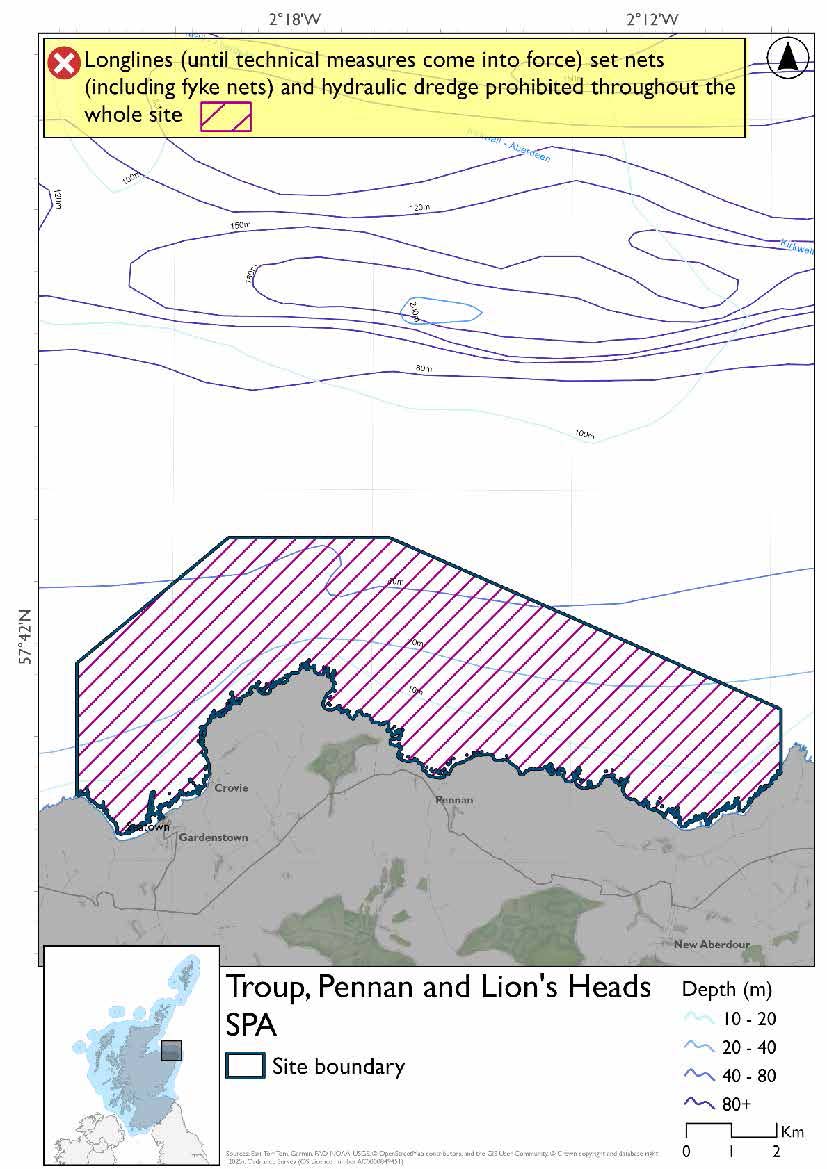
The proposed management measures for Troup, Pennan and Lion’s Heads SPA are as follows:
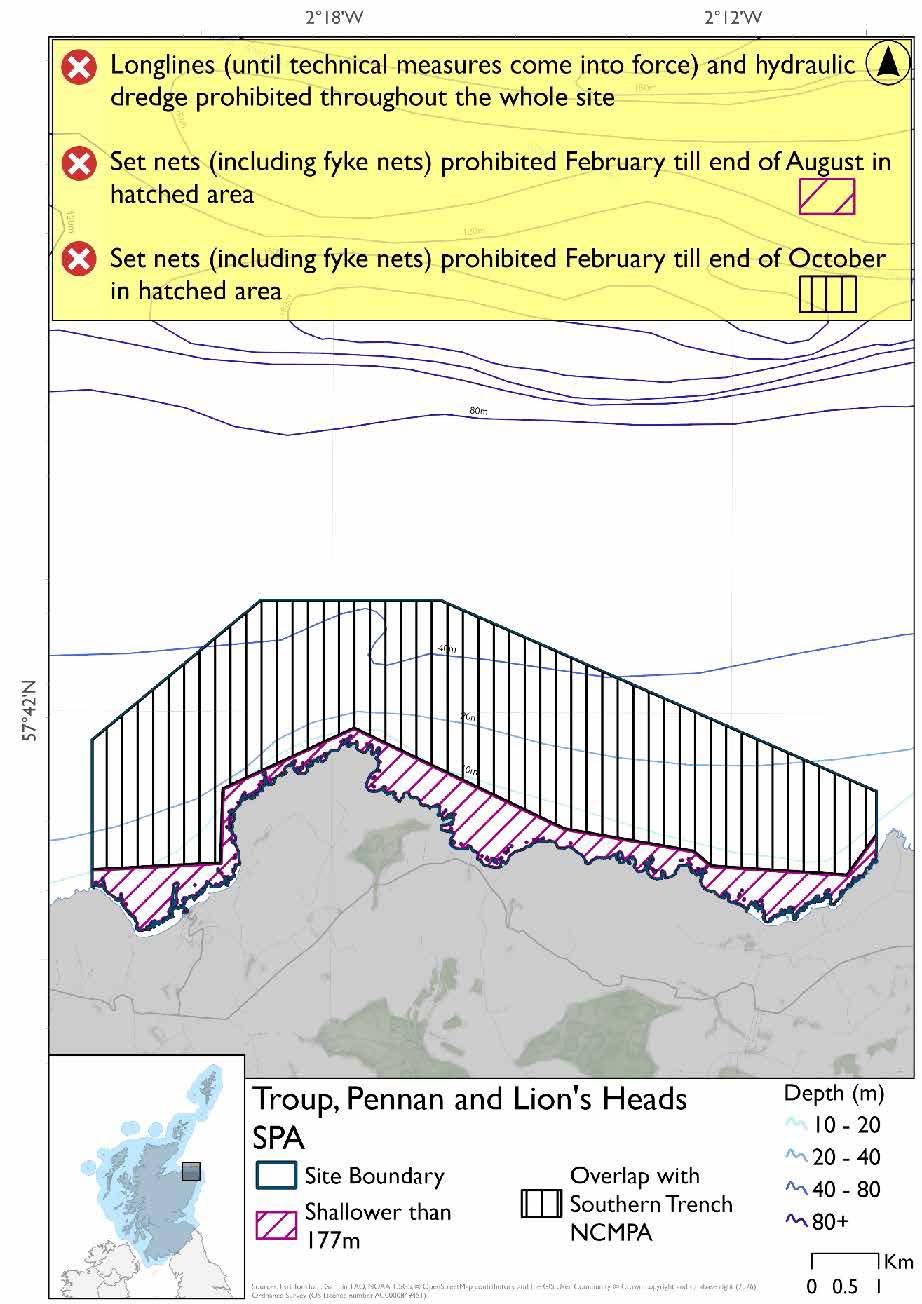
Option One
- Set nets (including fyke nets) prohibited February till end of August in areas down to 177m based on presence and maximum dive depth for guillemot
- Set nets (including fyke nets) prohibited February till end of October in areas overlapping the Southern Trench NCMPA
- Full site closure to longlines (until technical measures come into force) and hydraulic dredge
Option Two
- Full site closure to longlines (until technical measures come into force), set nets (including fyke nets) and hydraulic dredge
Overlapping site included in this consultation
This SPA overlaps with the Southern Trench NCMPA.
Rationale for developed measures
The basis for the proposed fisheries management measures for each site has been determined by the management advice for fishing activities provided by NatureScot, which can be found on their website or Sitelink as signposted throughout this document. The Fisheries Assessment for each site assesses the impacts from existing fishing activities on the protected features using the tests from the legislation relevant for the type of MPA being considered. The assessment outlines how the proposed measures address any impacts identified that could hinder the conservation objectives of the MPA..
10.5.7 Other fisheries management measures currently applying to this site
There are already management measures in place. An effort has been made to identify existing measures which affect each individual site or area, however the list may not be exhaustive. These measures are outlined below, and the proposals for further management being consulted on now are in addition to these existing measures:
- Fishing for sandeel is prohibited within the Scottish zone, which is defined as the sea adjacent to Scotland up to the 200 nautical miles limit
Other conservation measures can be found in section 7 of the CMA.
Contact
Email: marine_biodiversity@gov.scot