
Fisheries Management Measures within Scottish Inshore Marine Protected Areas (MPAs) and Proposed Priority Marine Feature (PMF) Management Areas - Site and Area Proposal Document
This document describes the process, justification and evidence used to develop site and area specific fisheries management measures. It outlines key information for each site and area including their features, and risks of potential pressures.

11. Sites in the North Coast Scottish Marine Region
11.1 Cape Wrath SPA
11.1.1 Description and background
The Cape Wrath SPA lies at the northwestern tip of mainland Scotland, in Sutherland. It protects a rugged stretch of sea cliffs and coastal waters that are internationally important for breeding seabirds.
The site encompasses dramatic sandstone cliffs and headlands, rising steeply from the Atlantic Ocean. These cliffs provide extensive nesting ledges and crevices, while the surrounding marine environment offers rich feeding grounds of fish, molluscs, and crustaceans. The exposed location and isolation make Cape Wrath one of the most significant seabird sites in northern Scotland.
The SPA supports large colonies of kittiwake, guillemot, razorbill, puffin, and fulmar, all present in internationally important numbers. The seabirds depend on the productive waters around the headland to rear their chicks, making the site vital for their survival.
Further information, including Conservation and Management Advice (CMA) can be found on Sitelink.
Further information on MPAs, the wider network and protected areas management is available at Scottish Government MPA policy page.
11.1.2 Protected features
The Cape Wrath SPA has been designated to protect:
- Fulmar;
- Guillemot;
- Kittiwake;
- Puffin; and
- Razorbill
The protected features of the Cape Wrath SPA are protected within the SPA throughout the year, irrespective of the season for which they qualified as a protected feature.
11.1.3 Conservation Objectives
The following protected features are in favourable condition at Cape Wrath SPA: guillemot and razorbill. Therefore, the Conservation Objectives seek to maintain this condition.
The following protected features are in unfavourable condition at Cape Wrath SPA: puffin, kittiwake and fulmar. Therefore, the Conservation Objectives seek to restore this condition.
Additional details, including the Conservation Objectives are provided in the Conservation and Management Advice document produced for this SPA and can be found on Sitelink.
11.1.4 Pressures from fishing activity
Auks (puffins, guillemots, and razorbills), kittiwakes, and fulmars all face significant pressures from human and fishing activities. Accidental bycatch is a major direct threat: auks are prone to capture in surface nets, kittiwakes are sensitive to bycatch in surface gears, and fulmars are among the seabirds most affected by longline and surface fisheries. These interactions cause immediate mortality and reduce adult survival.
All three groups are also sensitive to prey depletion, whether driven by climate change or fisheries practices, which lowers body condition, breeding success, and chick survival. Loss of sandeels and other forage species is particularly critical, forcing birds to forage further or switch to less suitable prey.
Disturbance and displacement add further pressures. Kittiwakes and auks may be displaced by vessel activity, with guillemots and razorbills especially sensitive to visual and noise disturbance. Fulmars are prone to nest desertion if repeatedly disturbed during incubation. Increased turbidity from seabed disturbance further impairs foraging efficiency for water‑column feeders such as guillemots and razorbills.
Additional details are provided in the Conservation and Management Advice document produced for this SPA (section 6) and can be found on Sitelink.
Other resources include:
- The Feature Activity Sensitivity Tool (FeAST) which allows users to investigate the sensitivity of marine features (habitats, species, geology and landforms) in Scotland's seas, to pressures arising from human activities;
- Fisheries Guidance Notes which provide summaries of evidence on the interaction between fishing gears and specific habitats and species.
11.1.5 Fisheries management advice relevant to proposed fisheries management measures
NatureScot provides risk-based advice to help manage activities that may impact protected features and their Conservation Objectives. See section 2.3 for more detail. The CMA document also sets out the full fisheries management advice that has been summarised below for the management measures proposed:
Hydraulic gear
Remove or avoid pressures (removal of prey species and disturbance of prey-supporting habitat) associated with hydraulic fishing that has the potential to damage seabed habitat (in particular, sandeel habitat) is recommended.
Static gear (drift nets and bottom set nets inc. fyke nets)
Remove or avoid pressures (entanglement) associated with the use of all static nets. Spatial exclusion of static nets in areas identified as being important for auks (as identified from habitat and dive depth preferences) is recommended.
Pelagic gear
Pelagic fishing for herring/sprat may occur within or around the SPA. It is recommended that a principal objective of the management of the fishery should be ensuring that the fishing activity does not prevent or disrupt the availability of prey species i.e. it should be considered as part of a broader ecosystem-based approach to management of this fishery.
Longlining (not including jigging)
Long-lining (pelagic and demersal) may occur within or around the SPA(s). Current understanding is that long-line fisheries are largely restricted to offshore waters. Site-specific measures for long-lining are not currently considered appropriate due to the scale of the fishery, and the wide-spread interaction with seabirds. However, there is evidence of seabird bycatch in long-line (not jigging) fisheries therefore it is recommended this requires wider seas management measures.
For the SPAs advice has also been provided on maximum dive depth and seasonality for protected features of each site and can be found in the Fishing Activity Further Advice and Evidence document. Supplementary advice can also be found on NatureScot’s website.
11.1.6 Proposed fisheries management measures
The proposed management measures for Cape Wrath SPA are as follows:
Option One
- Set nets (including fyke nets) prohibited from February till end of August in areas down to 177m based on presence and maximum dive depth for guillemot
- Full site closure to longlines (until technical measures come into force) and hydraulic dredge
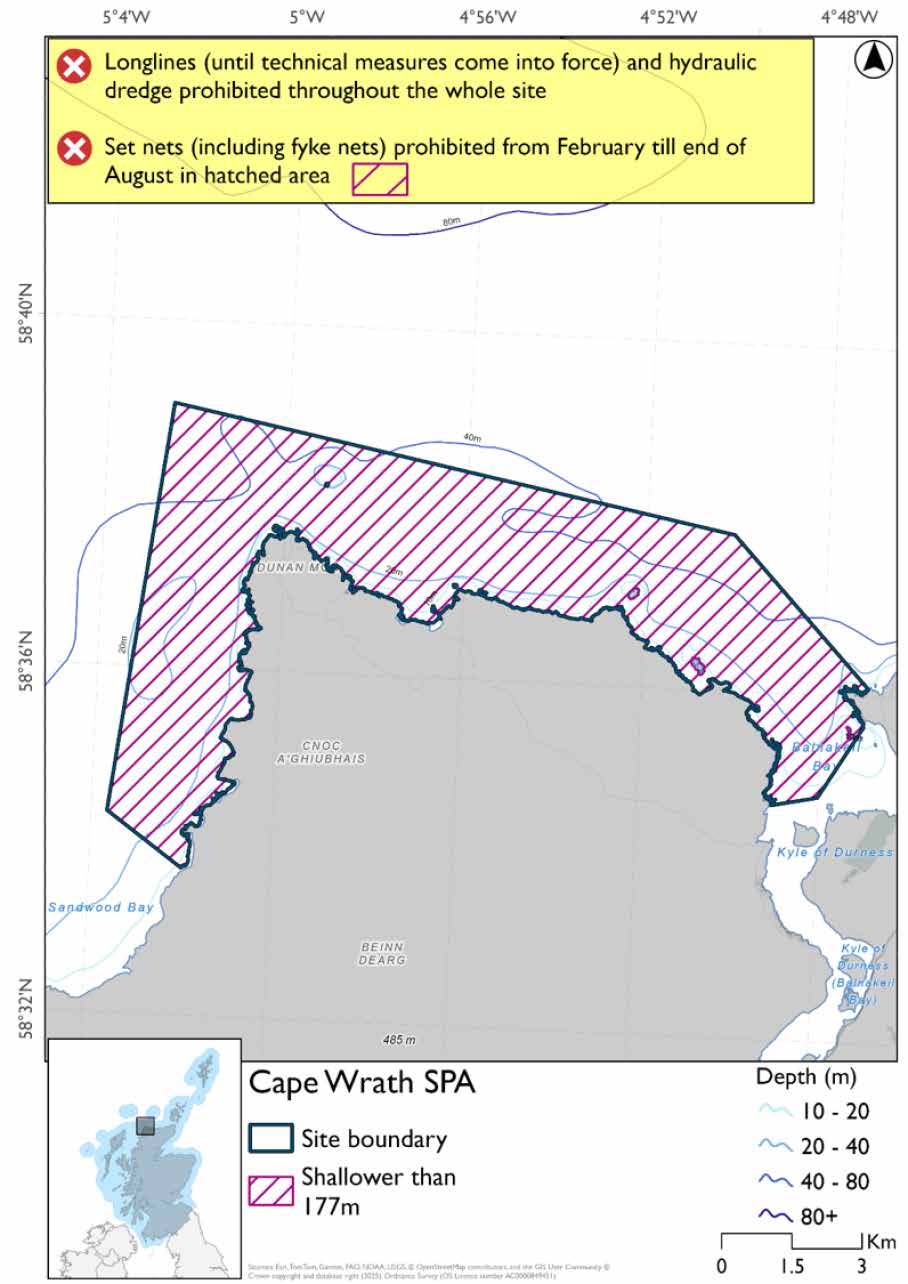
Option Two
- Full site closure to longlines (until technical measures come into force), set nets (including fyke nets) and hydraulic dredge
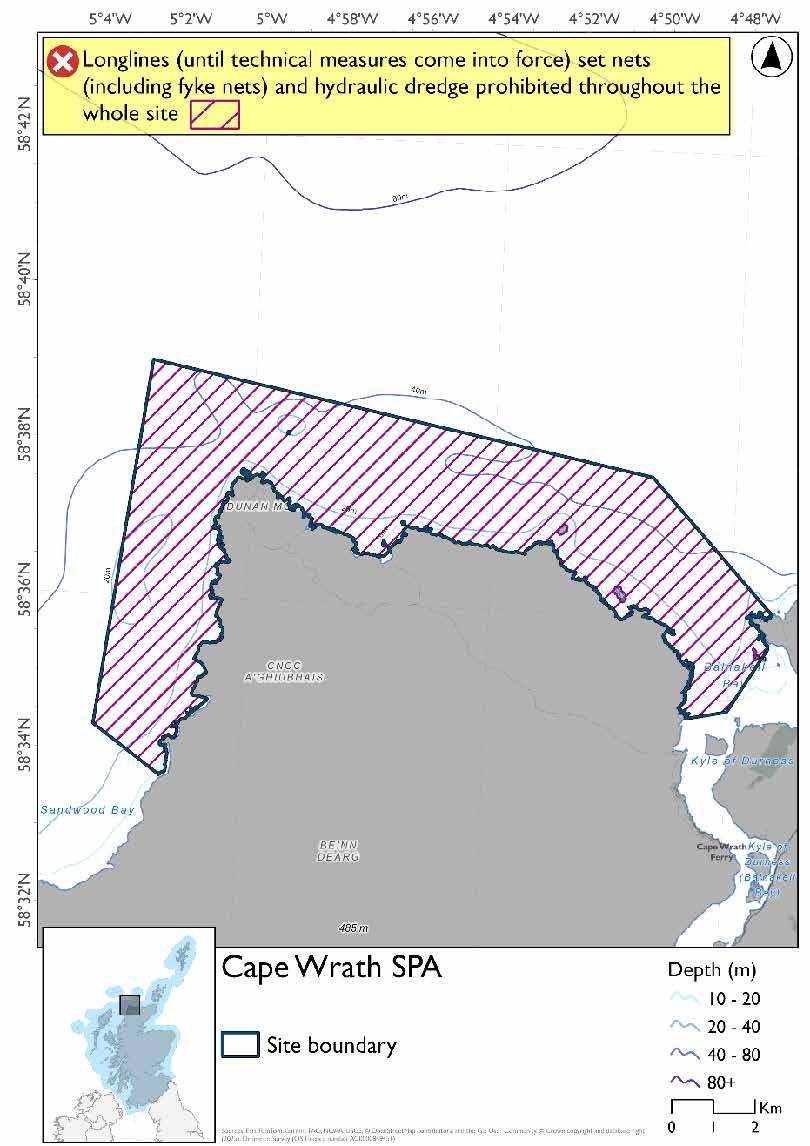
Rationale for developed measures
The basis for the proposed fisheries management measures for each site has been determined by the management advice for fishing activities provided by NatureScot, which can be found on their website or Sitelink as signposted throughout this document. The Fisheries Assessment for each site assesses the impacts from existing fishing activities on the protected features using the tests from the legislation relevant for the type of MPA being considered. The assessment outlines how the proposed measures address any impacts identified that could hinder the conservation objectives of the MPA.
11.1.7 Other fisheries management measures currently applying to the site
There are already management measures in place. An effort has been made to identify existing measures which affect each individual site or area, however the list may not be exhaustive. These measures are outlined below, and the proposals for further management being consulted on now are in addition to these existing measures:
- Fishing for sandeel is prohibited within the Scottish zone, which is defined as the sea adjacent to Scotland up to the 200 nautical miles limit
Other conservation measures can be found in section 7 of the CMA.
11.2 North Caithness Cliffs SPA
11.2.1 Description and background
The North Caithness Cliffs SPA encompasses cliffs and nearshore waters (out to around 2 km). The SPA is made up of five distinct sites separated by stretches of undesignated coastline. The SPA habitats support large concentrations of breeding seabirds as well as breeding peregrine. The SPA supports large concentrations of breeding seabirds and peregrine, including puffin, kittiwake, guillemot, fulmars, and razorbills. The SPA marine habitat supports a variety of resources including molluscs, crustaceans and fish species the seabirds feed on. The seacliffs support a wide diversity of vegetation types. The site also has tremendous cultural significance with the fast currents, large waves and birds of the Pentland Firth.
Further information, including Conservation and Management Advice (CMA) can be found on Sitelink.
Further information on MPAs, the wider network and protected areas management is available at Scottish Government MPA policy page.
11.2.2 Protected features
The North Caithness Cliffs SPA has been designated to protect:
- Fulmar;
- Guillemot;
- Kittiwake;
- Peregrine;
- Puffin; and
- Razorbill
Peregrine are not discussed further as they are not a protected feature for which fisheries management measures are required.
The protected features of the North Caithness Cliffs SPA are protected within the SPA throughout the year, irrespective of the season for which they qualified as a protected feature.
11.2.3 Conservation Objectives
The following protected features are in favourable condition at North Caithness Cliffs SPA: guillemot, fulmar and razorbill. Therefore, the Conservation Objectives seek to maintain this condition.
The following protected features are in unfavourable condition at North Caithness Cliffs SPA: Puffin and kittiwake. Therefore, the Conservation Objectives seek to restore this condition.
Additional details, including the Conservation Objectives are provided in the Conservation and Management Advice document produced for this SPA and can be found on Sitelink.
11.2.4 Pressures from fishing activity
Accidental bycatch and entanglement in surface, pelagic and near‑seabed gears are the main direct fishing threats for auks, kittiwakes and fulmars, causing immediate mortality and reduced adult survival. fulmars and terns face particular risk from long‑line gears, while guillemots, razorbills and puffins are most exposed to surface nets; localized heavy bycatch can drive sharp population declines.
The principal indirect impact is prey depletion and altered discard regimes. Commercial removal of forage fish (notably sandeels) and reductions in discards lower food availability, degrade body condition and reduce breeding success across auks, kittiwakes and fulmars and force birds to travel further or switch to less profitable prey.
Fishing‑related habitat damage and increased turbidity from bottom‑contact gears impair water‑column foragers such as guillemots and gannets, reducing prey capture rates. Vessel activity tied to fisheries also causes disturbance and displacement that reduce foraging efficiency and raise energetic costs, particularly near colonies and inshore feeding grounds.
Additional details are provided in the Conservation and Management Advice document produced for this SPA (section 6) and can be found on Sitelink.
Other resources include:
- The Feature Activity Sensitivity Tool (FeAST) which allows users to investigate the sensitivity of marine features (habitats, species, geology and landforms) in Scotland's seas, to pressures arising from human activities;
- Fisheries Guidance Notes which provide summaries of evidence on the interaction between fishing gears and specific habitats and species.
11.2.5 Fisheries management advice relevant to proposed fisheries management measures
NatureScot provides risk-based advice to help manage activities that may impact protected features and their Conservation Objectives. See section 2.3 for more detail. The CMA document also sets out the full fisheries management advice that has been summarised below for the management measures proposed:
Hydraulic gear
It is recommended to remove or avoid pressures (removal of prey species and disturbance of prey-supporting habitat) associated with hydraulic fishing that has the potential to damage seabed habitat (in particular, sandeel habitat, herring spawning grounds).
Static gear (drift nets and bottom set nets inc. fyke nets)
Remove or avoid pressures (entanglement) associated with the use of all static nets. Spatial exclusion of all static nets in areas identified as being important for auks (as identified from habitat and dive depth preferences) is recommended.
Pelagic gear
Pelagic fishing for herring/sprat may occur within or around the SPA. It is recommended that a principal objective of the management of the fishery should be ensuring that the fishing activity does not prevent or disrupt the availability of prey species i.e. it should be considered as part of a broader ecosystem-based approach to management of this fishery.
Long-lining (not including jigging)
Long-lining (pelagic and demersal) may occur within or around the SPA(s). Current understanding is that long-line fisheries are largely restricted to offshore waters. Site-specific measures for long-lining are not currently considered appropriate due to the scale of the fishery, and the wide-spread interaction with seabirds. However, there is evidence of seabird bycatch in long-line (not jigging) fisheries therefore it is recommended this requires wider seas management measures.
For the SPAs advice has also been provided on maximum dive depth and seasonality for protected features of each site and can be found in the Fishing Activity Further Advice and Evidence document. Supplementary advice can also be found on NatureScot’s website.
11.2.6 Proposed fisheries management measures
The proposed management measures for North Caithness Cliffs SPA are as follows:
Option One
- Set nets (including fyke nets) prohibited from February till end of August in areas down to 177m based on presence and maximum dive depth for guillemot
- Full site closure to longlines (until technical measures come into force) and hydraulic dredge
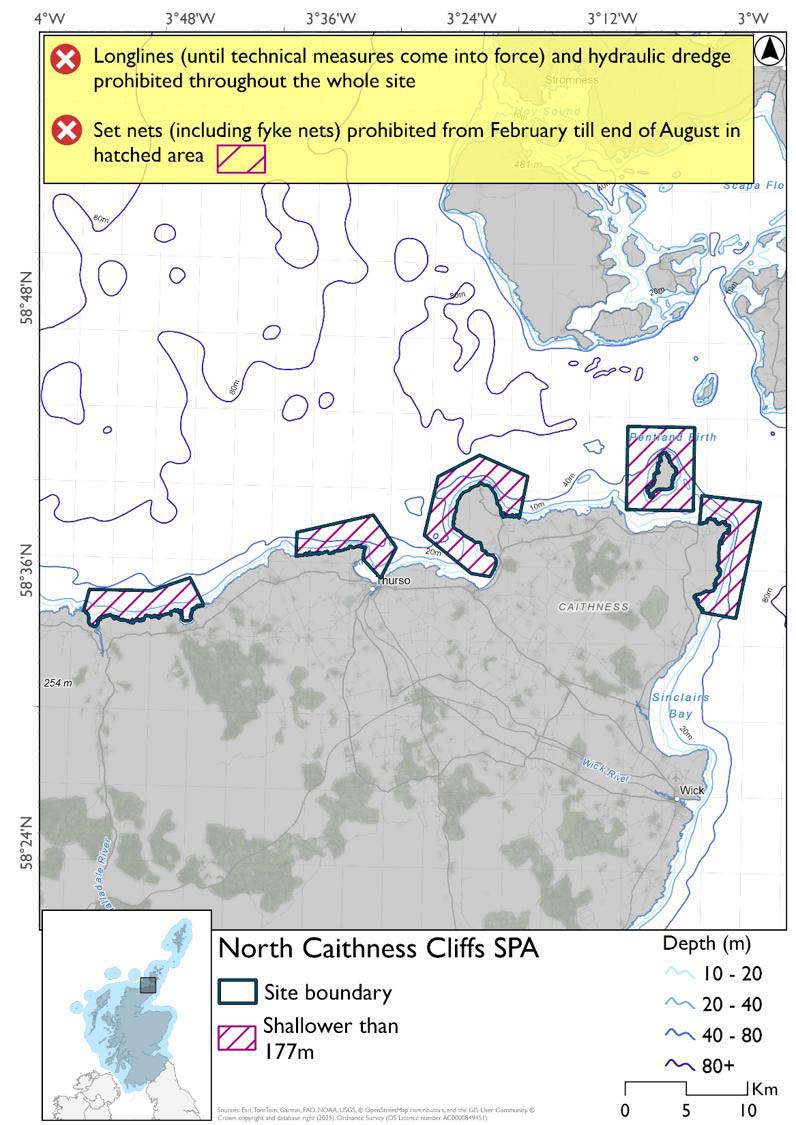
Option Two
- Full site closure to longlines (until technical measures come into force), set nets (including fyke nets) and hydraulic dredge
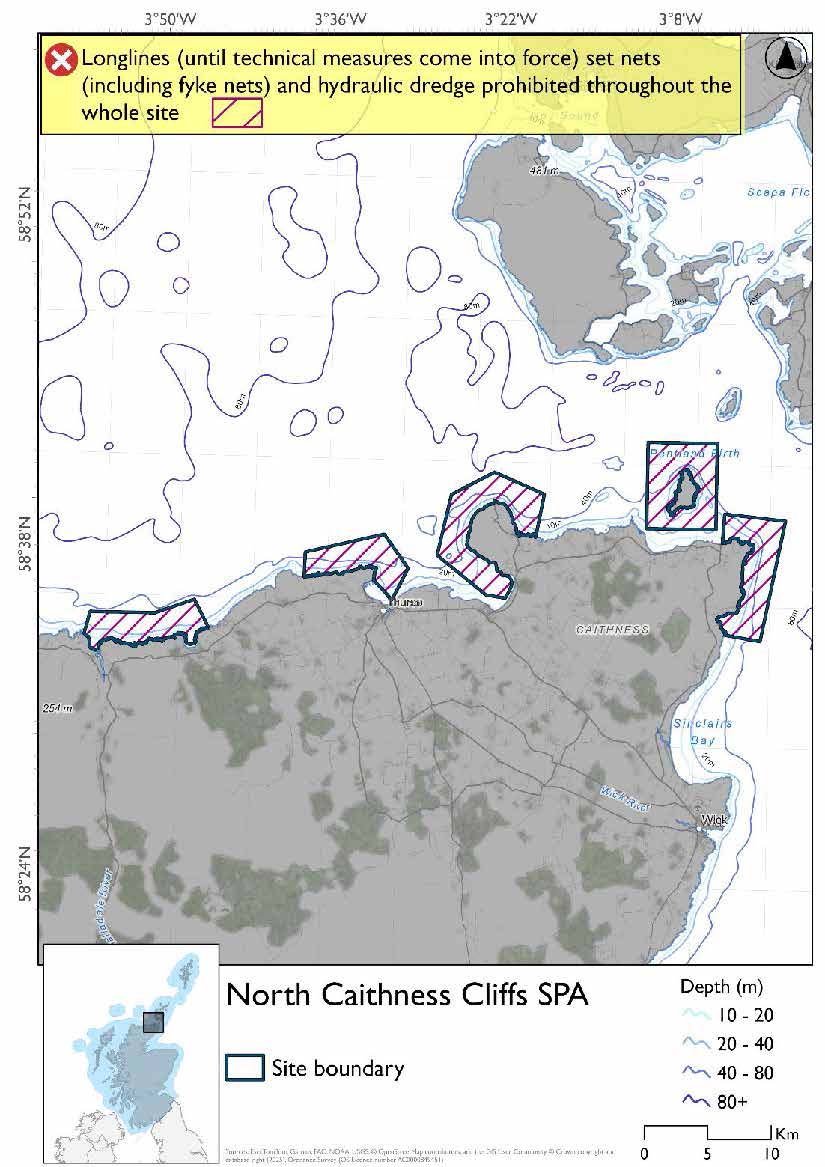
Rationale for developed measures
The basis for the proposed fisheries management measures for each site has been determined by the management advice for fishing activities provided by NatureScot, which can be found on their website or Sitelink as signposted throughout this document. The Fisheries Assessment for each site assesses the impacts from existing fishing activities on the protected features using the tests from the legislation relevant for the type of MPA being considered. The assessment outlines how the proposed measures address any impacts identified that could hinder the conservation objectives of the MPA.
11.2.7 Other fisheries management measures currently applying to the site
There are already management measures in place. An effort has been made to identify existing measures which affect each individual site or area, however the list may not be exhaustive. These measures are outlined below, and the proposals for further management being consulted on now are in addition to these existing measures:
- Fishing for sandeel is prohibited within the Scottish zone, which is defined as the sea adjacent to Scotland up to the 200 nautical miles limit
- Overlapping existing fisheries measures occurs in the southern part of the SPA: No person shall fish for and take any species of Demersal or Pelagic fish, molluscs or crustaceans in the designated area due to SEPA closure overlaps with the Western area at Buldoo
- Prohibition of mobile gear overlaps with SPA areas at Thurso and Dunnet, aimed at conservation of juvenile fish stocks and to reduce gear conflict.
- Fishing for sea fish with a dredge, beam trawl, demersal trawl or demersal seine net is prohibited in the Noss Head and Sinclair Bay Protected Area. Fishing for horse mussels is prohibited.
Other conservation measures can be found in section 7 of the CMA.
Contact
Email: marine_biodiversity@gov.scot