
Fisheries Management Measures within Scottish Inshore Marine Protected Areas (MPAs) and Proposed Priority Marine Feature (PMF) Management Areas - Site and Area Proposal Document
This document describes the process, justification and evidence used to develop site and area specific fisheries management measures. It outlines key information for each site and area including their features, and risks of potential pressures.

12. Sites in the North East Scottish Marine Region
12.1 Buchan Ness to Collieston Coast SPA
12.1.1 Description and background
The Buchan Ness to Collieston Coast SPA stretches for about 15 km along the Aberdeenshire coast, running south from Peterhead to Collieston. It is dominated by rugged granite and quartzite cliffs, broken only by the sandy bay at Cruden Bay. These cliffs rise steeply from the North Sea and provide ideal nesting ledges and crevices for seabirds.
The site is internationally important for its breeding seabird colonies. It supports large numbers of kittiwakes, guillemots, razorbills, puffins, and fulmars, making it one of the most significant cliff-nesting sites in northeast Scotland.
The adjacent nearshore waters provide rich feeding grounds of fish, molluscs, and crustaceans, which are critical for chick-rearing. Cliff-top grasslands and heath add ecological diversity, supporting vegetation that complements the seabird habitats.
Further information, including Conservation and Management Advice (CMA) can be found on Sitelink.
Further information on MPAs, the wider network and protected areas management is available at Scottish Government MPA policy page.
12.1.2 Protected features
The Buchan Ness to Collieston Coast SPA has been designated to protect:
- Guillemot;
- Fulmar;
- Herring gull;
- Kittiwake; and
- Shag
The protected features of the Buchan Ness to Collieston Coast SPA are protected within the SPA throughout the year, irrespective of the season for which they qualified as a protected feature.
12.1.3 Conservation Objectives
The following protected feature is in favourable condition at the Buchan Ness to Collieston Coast SPA: guillemot. Therefore, the Conservation Objectives seek to maintain this condition.
The following protected features are in unfavourable condition at the Buchan Ness to Collieston Coast SPA: kittiwake, shag, herring gull, and fulmar. Therefore, the Conservation Objectives seek to restore this condition.
Additional details, including the Conservation Objectives are provided in the Conservation and Management Advice document produced for this SPA and can be found on Sitelink.
12.1.4 Fisheries management advice relevant to proposed fisheries management measures
NatureScot provides risk-based advice to help manage activities that may impact protected features and their Conservation Objectives. See section 2.3 for more detail. The CMA document also sets out the full fisheries management advice that has been summarised below for the management measures proposed:
Hydraulic gear
Remove or avoid pressures (removal of prey species and disturbance of prey-supporting habitat) associated with hydraulic fishing that has the potential to damage seabed habitat (in particular, sandeel habitat).
Static gear (drift nets and bottom set nets inc. fyke nets)
Remove or avoid pressures (entanglement) associated with the use of all static nets. Spatial exclusion of all static nets in areas identified as being important for auks (as identified from habitat and dive depth preferences) is recommended.
Pelagic gear
Pelagic fishing for herring/sprat may occur within or around the SPA. It is recommended that a principal objective of the management of the fishery should be ensuring that the fishing activity does not prevent or disrupt the availability of prey species i.e. it should be considered as part of a broader ecosystem-based approach to management of this fishery.
Longlining (not including jigging)
Long-lining (pelagic and demersal) may occur within or around the SPA(s). Current understanding is that long-line fisheries are largely restricted to offshore waters. Site-specific measures for long-lining are not currently considered appropriate due to the scale of the fishery, and the wide-spread interaction with seabirds. However, there is evidence of seabird bycatch in long-line (not jigging) fisheries therefore it is recommended this requires wider seas management measures.
For the SPAs advice has also been provided on maximum dive depth and seasonality for protected features of each site and can be found in the Fishing Activity Further Advice and Evidence document. Supplementary advice can also be found on NatureScot’s website.
12.1.5 Pressure from fishing activity
Fishing activities can exert two principal pressures on breeding seabirds: accidental bycatch and prey depletion. Kittiwakes, guillemots, shags, herring gulls, and fulmars are all sensitive to capture in fishing nets and gears, with shags and fulmars identified as particularly sensitive to bycatch in surface, pelagic, and long‑line fisheries. These interactions can cause direct mortality and reduce population resilience.
In addition, all of these species are highly dependent on the availability of key prey resources such as sandeels, mussels, and other forage fish. Fisheries targeting these species or altering prey abundance can undermine adult survival, breeding success, and body condition. The impacts of prey depletion are most severe during sensitive periods such as breeding, moulting, or chick‑rearing, when birds are less able to compensate for food shortages.
Additional details are provided in the Conservation and Management Advice document produced for this SPA (section 6) and can be found on Sitelink.
Other resources include:
- The Feature Activity Sensitivity Tool (FeAST) which allows users to investigate the sensitivity of marine features (habitats, species, geology and landforms) in Scotland's seas, to pressures arising from human activities;
- Fisheries Guidance Notes which provide summaries of evidence on the interaction between fishing gears and specific habitats and species.
12.1.6 Proposed fisheries management measures
The proposed management measure for the Buchan Ness to Collieston Coast SPA is as follows:
Single Proposed Management Option
- Full site closure to longlines (until technical measures come into force), set nets (including fyke nets) and hydraulic dredge.
Full site closure to set nets (including fyke nets) is due to the presence and depths of protected species which between them utilise the entire site throughout the year (February till end of August in areas down to 177m, based on presence and maximum dive depth of guillemot, and from September till end of January in areas down to 65m, based on presence and maximum dive depth for shag).
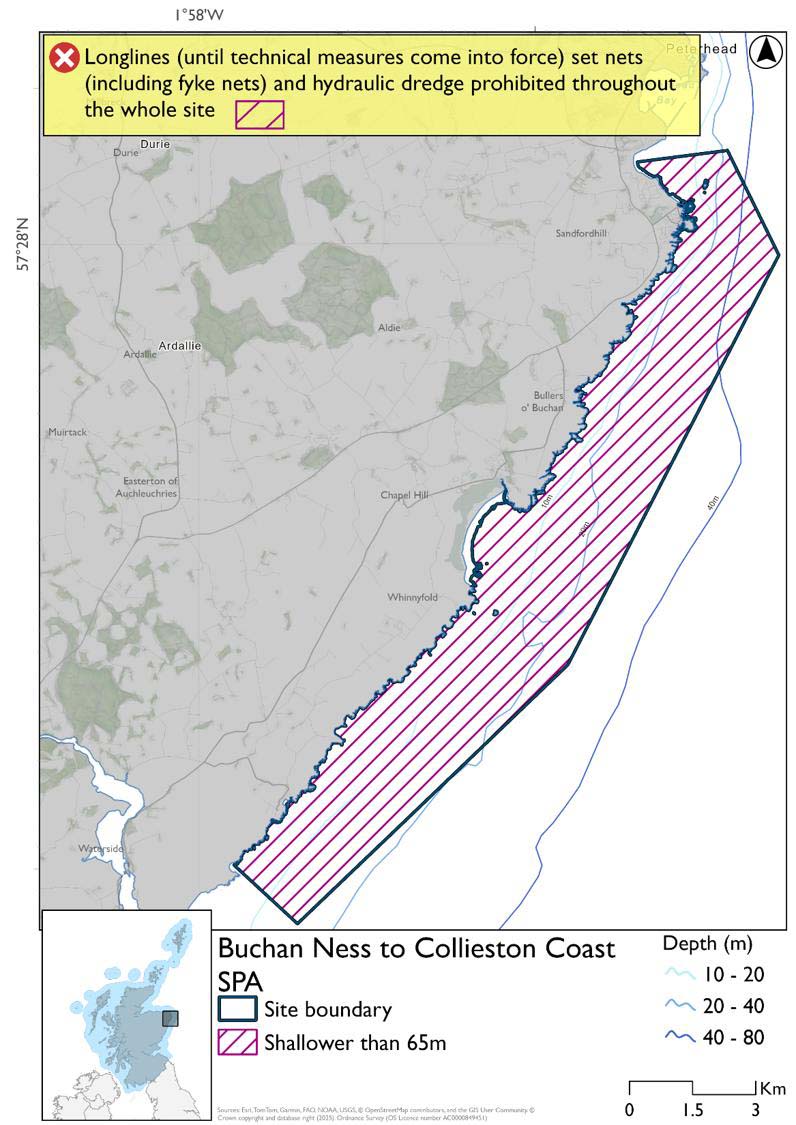
A full site level of protection from the specified gear has been identified as the only suitable option in enabling the achievement of the desired level of protection for the feature in question.
Overlapping site included in this consultation
This SPA overlaps with the Ythan Estuary, Sands of Forvie and Meikle Loch SPA.
Rationale for developed measures
The basis for the proposed fisheries management measures for each site has been determined by the management advice for fishing activities provided by NatureScot, which can be found on their website or Sitelink as signposted throughout this document. The Fisheries Assessment for each site assesses the impacts from existing fishing activities on the protected features using the tests from the legislation relevant for the type of MPA being considered. The assessment outlines how the proposed measures address any impacts identified that could hinder the conservation objectives of the MPA.
12.1.7 Other fisheries management measures currently applying to this site
There are already management measures in place. An effort has been made to identify existing measures which affect each individual site or area, however the list may not be exhaustive. These measures are outlined below, and the proposals for further management being consulted on now are in addition to these existing measures:
- Fishing for sandeel is prohibited within the Scottish zone, which is defined as the sea adjacent to Scotland up to the 200 nautical miles limit
Other conservation measures can be found in section 7 of the CMA.
12.2 Fowlsheugh SPA
12.2.1 Description and background
The Fowlsheugh SPA lies about 4 km south of Stonehaven on the Aberdeenshire coast. It encompasses a three‑kilometre stretch of sheer basalt and sandstone cliffs rising 30–60 m above the North Sea. The site protects one of the largest mainland seabird colonies on Scotland’s east coast. Each summer, more than 115,000 breeding seabirds crowd the cliffs. The colony includes internationally important numbers of guillemot, razorbill, kittiwake, puffin, and fulmar, making Fowlsheugh a vital stronghold for cliff‑nesting species in northeast Scotland.
The site consists of inshore waters with rocky and sandy substrates, supporting a diverse range of invertebrates and fish species. These waters are essential feeding grounds for cliff-nesting birds, ensuring close ecological connectivity between nesting colonies and their food resources. Narrow strips of cliff‑top grassland and heath add ecological diversity, while offshore waters also support grey seals and dolphins, contributing to the wider richness of the site.
Further information, including Conservation and Management Advice (CMA) can be found on Sitelink.
Further information on MPAs, the wider network and protected areas management is available at Scottish Government MPA policy page.
12.2.2 Protected features
Fowlsheugh SPA has been designated to protect:
- Fulmar;
- Guillemot;
- Herring gull;
- Kittiwake: and
- Razorbill
The protected features of Fowlsheugh SPA are protected within the SPA throughout the year, irrespective of the season for which they qualified as a protected feature.
12.2.3 Conservation Objectives
The following protected features are in favourable condition at Fowlsheugh SPA: guillemot, and razorbill. Therefore, the Conservation Objectives seek to maintain this condition.
The following protected features are in unfavourable condition at Fowlsheugh SPA: kittiwake, herring gull and fulmar. Therefore, the Conservation Objectives seek to restore this condition.
Additional details, including the Conservation Objectives are provided in the Conservation and Management Advice document produced for this SPA and can be found on Sitelink.
12.2.4 Pressure from fishing activity
Fishing activities exert two principal pressures on these seabird species: accidental bycatch and prey depletion. Kittiwakes, guillemots, razorbills, herring gulls, and fulmars are all sensitive to capture in fishing nets and gears, with fulmars and shags identified as particularly sensitive to long‑line and surface fisheries. Bycatch can cause direct mortality and reduce population resilience, particularly during sensitive periods such as breeding or moulting when birds are less able to recover from losses.
In addition, all of these species depend heavily on the availability of key prey resources such as sandeels and other forage fish. Fisheries targeting these prey, or altering their abundance, can undermine adult survival, breeding success, and chick provisioning. The impacts of prey depletion are most severe during breeding and chick‑rearing, when food shortages directly affect reproductive success and long‑term population stability.
Additional details are provided in the Conservation and Management Advice document produced for this SPA (section 6) and can be found on Sitelink.
Other resources include:
- The Feature Activity Sensitivity Tool (FeAST) which allows users to investigate the sensitivity of marine features (habitats, species, geology and landforms) in Scotland's seas, to pressures arising from human activities;
- Fisheries Guidance Notes which provide summaries of evidence on the interaction between fishing gears and specific habitats and species.
12.2.5 Fisheries management advice relevant to proposed fisheries management measures
NatureScot provides risk-based advice to help manage activities that may impact protected features and their Conservation Objectives. See section 2.3 for more detail. The CMA document also sets out the full fisheries management advice that has been summarised below for the management measures proposed:
Hydraulic gear
Remove or avoid pressures (removal of prey species and disturbance of prey-supporting habitat) associated with hydraulic fishing that has the potential to damage seabed habitat (in particular, sandeel habitat, herring spawning grounds) is recommended.
Static gear (drift nets and bottom set nets inc. fyke nets)
Remove or avoid pressures (entanglement) associated with the use of all static nets. Spatial exclusion of all static nets in areas identified as being important for auks (as identified from habitat and dive depth preferences) is recommended.
Pelagic gear
Pelagic fishing for herring/sprat may occur within or around the SPA. It is recommended that a principal objective of the management of the fishery should be ensuring that the fishing activity does not prevent or disrupt the availability of prey species i.e. it should be considered as part of a broader ecosystem-based approach to management of this fishery.
Longlining (not including jigging)
Long-lining (pelagic and demersal) may occur within or around the SPA(s). Current understanding is that long-line fisheries are largely restricted to offshore waters. Site-specific measures for long-lining are not currently considered appropriate due to the scale of the fishery, and the wide-spread interaction with seabirds. However, there is evidence of seabird bycatch in long-line (not jigging) fisheries therefore it is recommended this requires wider seas management measures.
For the SPAs advice has also been provided on maximum dive depth and seasonality for protected features of each site and can be found in the Fishing Activity Further Advice and Evidence document. Supplementary advice can also be found on NatureScot’s website.
12.2.6 Proposed fisheries management measures
The proposed management measures for the Fowlsheugh SPA are as follows:
Option One
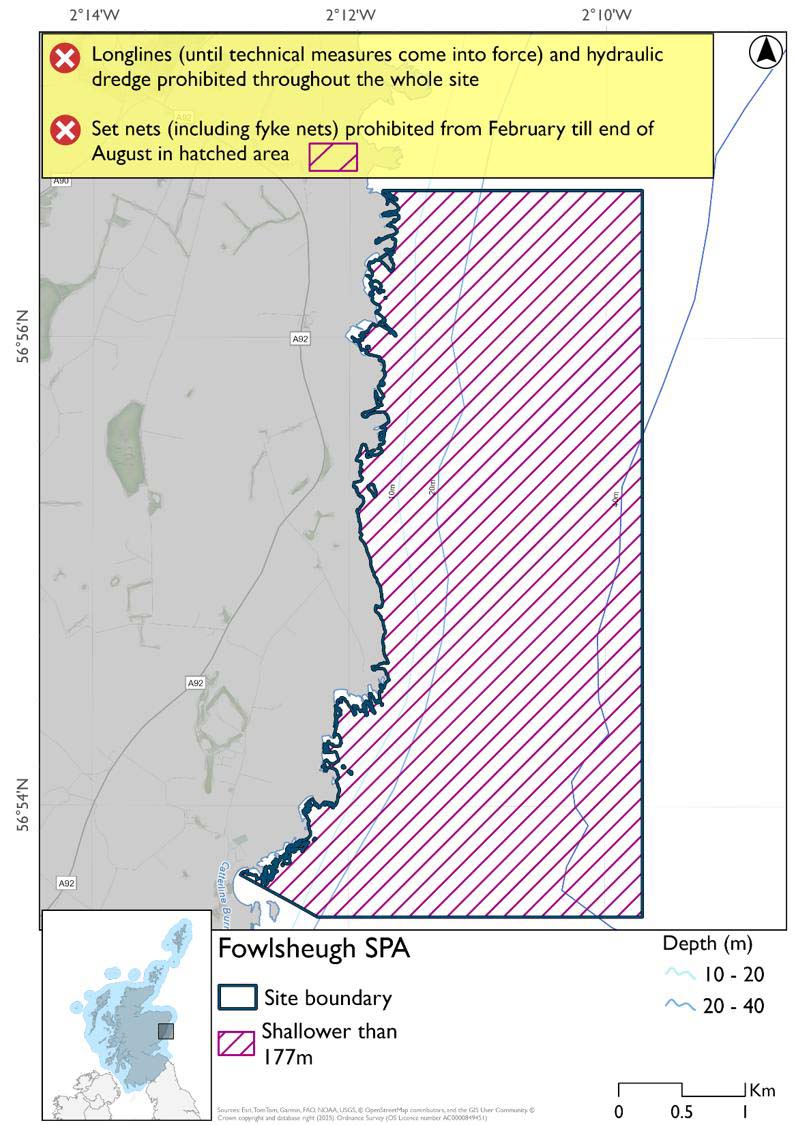
- Set nets (including fyke nets) prohibited from February till end of August in areas down to 177m based on presence and maximum dive depth for guillemot
- Full site closure to longlines (until technical measures come into force) and hydraulic dredge
Option Two
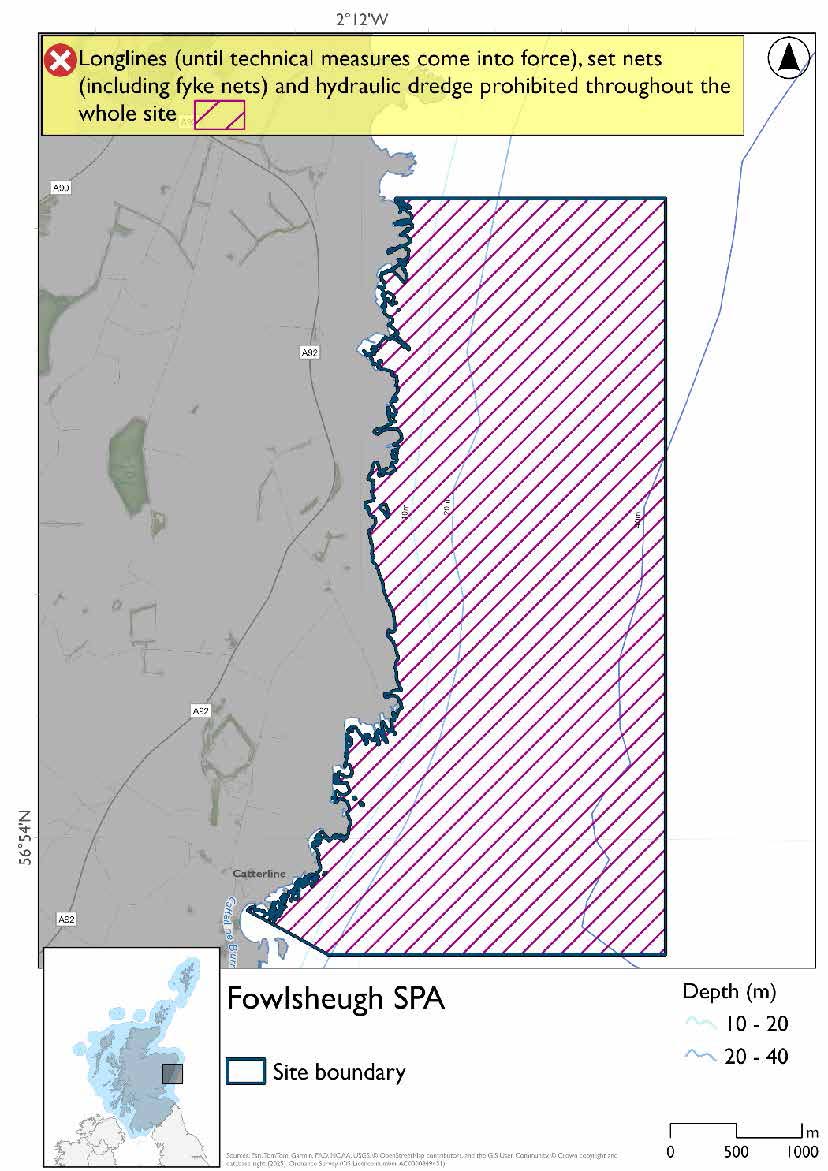
- Full site closure to longlines (until technical measures come into force), set nets (including fyke nets) and hydraulic dredge
Rationale for developed measures
The basis for the proposed fisheries management measures for each site has been determined by the management advice for fishing activities provided by NatureScot, which can be found on their website or Sitelink as signposted throughout this document. The Fisheries Assessment for each site assesses the impacts from existing fishing activities on the protected features using the tests from the legislation relevant for the type of MPA being considered. The assessment outlines how the proposed measures address any impacts identified that could hinder the conservation objectives of the MPA.
12.2.7 Other fisheries management measures currently applying to this site
There are already management measures in place. An effort has been made to identify existing measures which affect each individual site or area, however the list may not be exhaustive. These measures are outlined below, and the proposals for further management being consulted on now are in addition to these existing measures:
- Fishing for sandeel is prohibited within the Scottish zone, which is defined as the sea adjacent to Scotland up to the 200 nautical miles limit
- Fishing for sea fish with mobile or active gear prohibited in part of the site
Other conservation measures can be found in section 7 of the CMA.
12.3 Ythan Estuary, Sands of Forvie and Meikle Loch SPA
12.3.1 Description and background
The Ythan Estuary, Sands of Forvie and Meikle Loch SPA lies on the northeast coast of Scotland, about 18 km north of Aberdeen. It encompasses the tidal estuary of the River Ythan, the extensive dune system of the Sands of Forvie, and the freshwater Meikle Loch. Together, these habitats form a mosaic of estuarine mudflats, sand dunes, and loch waters that are vital for both breeding seabirds and wintering waterfowl.
The site is internationally important for its tern colonies. It supports significant numbers of sandwich, common, and little terns, representing notable proportions of the UK breeding populations. The estuary and loch also provide feeding and roosting grounds for migratory geese and other waterbirds, making the site ecologically valuable throughout the year.
The estuarine waters supply rich feeding grounds of fish, molluscs, and crustaceans, sustaining the seabird populations. Meanwhile, the Sands of Forvie dunes host a wide diversity of vegetation, including lichen-rich heath and specialized dune flora. This combination of marine and terrestrial resources underpins the ecological richness of the SPA.
Further information, including Conservation and Management Advice (CMA) can be found on Sitelink.
Further information on MPAs, the wider network and protected areas management is available at Scottish Government MPA policy page.
12.3.2 Protected features
The Ythan Estuary, Sands of Forvie and Meikle Loch SPA has been designated to protect seven species:
- Common tern;
- Eider;
- Lapwing;
- Little tern;
- Pink-footed goose;
- Redshank; and
- Sandwich tern
Pink-footed goose, lapwing and redshank are not discussed further as they are not a protected feature for which fisheries management measures are required.
The protected features of the Ythan Estuary, Sands of Forvie and Meikle Loch SPA are protected within the SPA throughout the year, irrespective of the season for which they qualified as a protected feature.
12.3.3 Conservation Objectives
The following protected features are in favourable condition at the Ythan Estuary, Sands of Forvie and Meikle Loch SPA: little tern, Sandwich tern and common tern. Therefore, the Conservation Objectives seek to maintain this condition.
The following protected features are in unfavourable condition: Eider. Therefore, the Conservation Objectives seek to restore this condition.
Additional details, including the Conservation Objectives are provided in the Conservation and Management Advice document produced for this SPA and can be found on Sitelink.
12.3.4 Pressure from fishing activity
Fishing activities can significantly affect seabirds and waterfowl through both direct and indirect pressures. For species such as terns, the depletion of food‑fish stocks caused by fishing reduces prey availability and impacts breeding success. Disturbance from vessels and gear can also disrupt nesting colonies, where sensitivity to human activity is greatest.
Similarly, eiders are sensitive to entanglement as bycatch in static and demersal gear, while also suffering from reductions in bivalve prey stocks such as mussels and cockles targeted by fisheries. Loss of prey resources can lead to poor body condition and increased mortality, particularly during the moulting season when mobility is restricted.
Additional details are provided in the Conservation and Management Advice document produced for this SPA (section 6) and can be found on Sitelink.
Other resources include:
- The Feature Activity Sensitivity Tool (FeAST) which allows users to investigate the sensitivity of marine features (habitats, species, geology and landforms) in Scotland's seas, to pressures arising from human activities;
- Fisheries Guidance Notes which provide summaries of evidence on the interaction between fishing gears and specific habitats and species.
12.3.5 Fisheries management advice relevant to proposed fisheries management measures
NatureScot provides risk-based advice to help manage activities that may impact protected features and their Conservation Objectives. See section 2.3 for more detail. The CMA document also sets out the full fisheries management advice that has been summarised below for the management measures proposed:
Hydraulic gear
Remove or avoid pressures (removal of prey species and disturbance of prey-supporting habitat) associated with hydraulic fishing that has the potential to damage seabed habitat (in particular, sandeel habitat).
Static gear (drift nets and bottom set nets inc. fyke nets)
Remove or avoid pressures (entanglement) associated with the use of all static nets. Spatial exclusion of static nets in areas identified as being important for Eider (as identified from habitat and dive depth preferences) is recommended.
Pelagic gear
Pelagic fishing for herring/sprat may occur within or around the SPA. It is recommended that a principle objective of the management of the fishery should be ensuring that the fishing activity does not prevent or disrupt the availability of prey species for terns, i.e. it should be considered as part of a broader ecosystem-based approach to management of this fishery.
For the SPAs advice has also been provided on maximum dive depth and seasonality for protected features of each site and can be found in the Fishing Activity Further Advice and Evidence document. Supplementary advice can also be found on NatureScot’s website.
12.3.6 Proposed fisheries management measures
The proposed management measure for the Ythan Estuary, Sands of Forvie and Meikle Loch SPA is as follows:
Single Proposed Management Option
- Full site closure to set nets (including fyke nets) in areas down to 60m based on the presence and maximum dive depth for eider, and hydraulic dredge. Presence and maximum dive depths of protected species cover the entire site throughout the year
- Longlines (until technical measures come into force) prohibited in part of the site from the overlapping measures from the Buchan Ness to Collieston Coast SPA
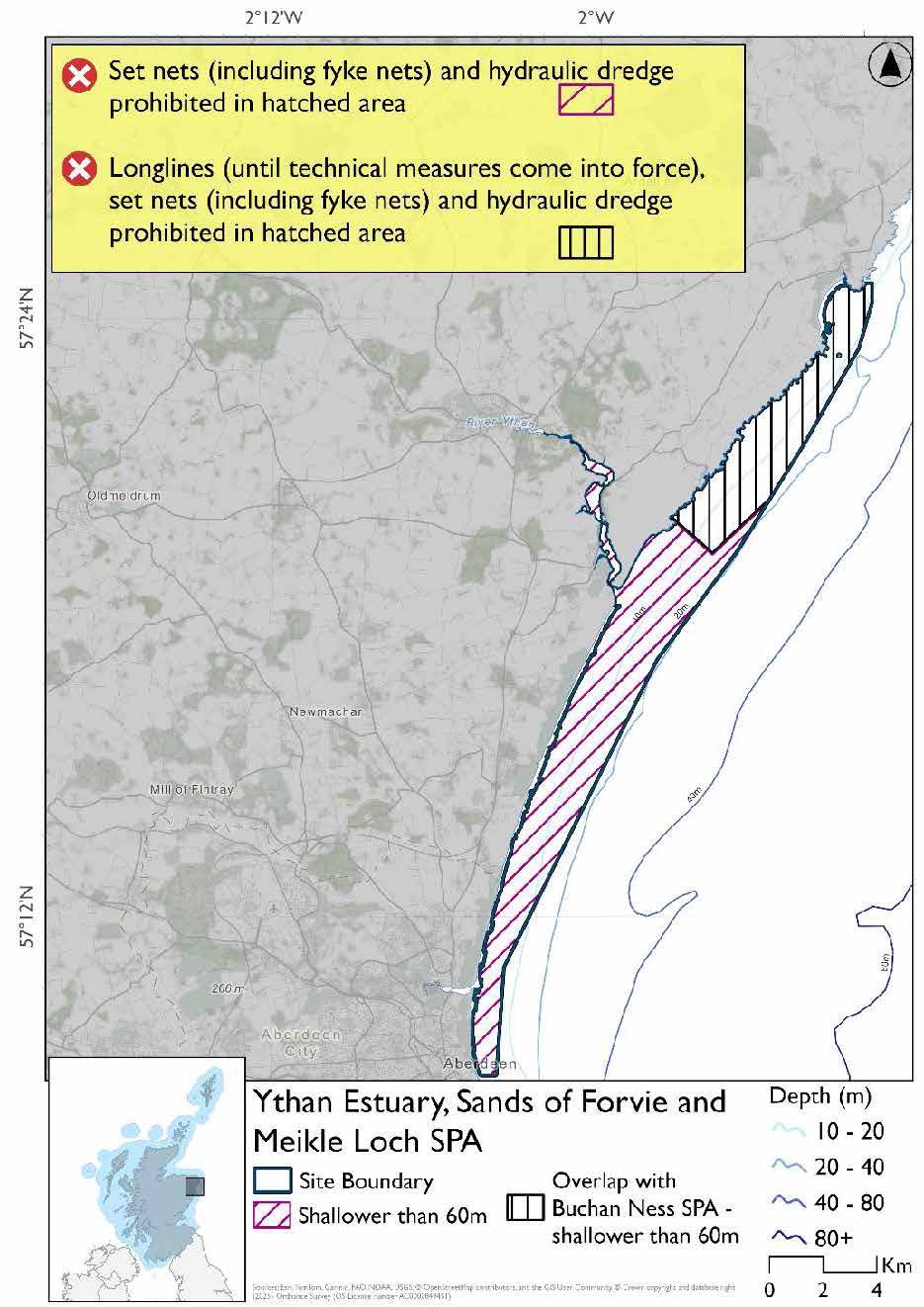
A full site level of protection from the specified gear has been identified as the only suitable option in enabling the achievement of the desired level of protection for the feature in question.
Overlapping site
This SPA overlaps with the Buchan Ness to Collieston Coast SPA.
Rationale for developed measures
The basis for the proposed fisheries management measures for each site has been determined by the management advice for fishing activities provided by NatureScot, which can be found on their website or Sitelink as signposted throughout this document. The Fisheries Assessment for each site assesses the impacts from existing fishing activities on the protected features using the tests from the legislation relevant for the type of MPA being considered. The assessment outlines how the proposed measures address any impacts identified that could hinder the conservation objectives of the MPA.
12.3.7 Other fisheries management measures currently applying to this site
There are already management measures in place. An effort has been made to identify existing measures which affect each individual site or area, however the list may not be exhaustive. These measures are outlined below, and the proposals for further management being consulted on now are in addition to these existing measures:
- Fishing for sandeel is prohibited within the Scottish zone, which is defined as the sea adjacent to Scotland up to the 200 nautical miles limit
Other conservation measures can be found in section 7 of the CMA.
Contact
Email: marine_biodiversity@gov.scot