
Scotland's wellbeing economy monitor: July 2025
The Wellbeing Economy Monitor (WEM) tracks progress towards creation of a wellbeing economy using a broad range of indicators with a particular emphasis where the economy and economic policy play a significant role in contributing to wellbeing outcomes.
9. Local wellbeing: produced/financial capital
9.1 Employees below real living wage
Source: Annual Survey of Hours and Earnings
Why is it important to a wellbeing economy
Evidence has suggested not earning the real living wage is linked with negative wellbeing outcomes such as being unable to afford basic necessities and being unable to spend time with family[22]. This indicator helps measure progress towards Fair Work commitments, including the NPF fair work and business outcome to ensure we have ‘thriving and innovative businesses, with quality jobs and fair work for everyone’.
What this indicator measures
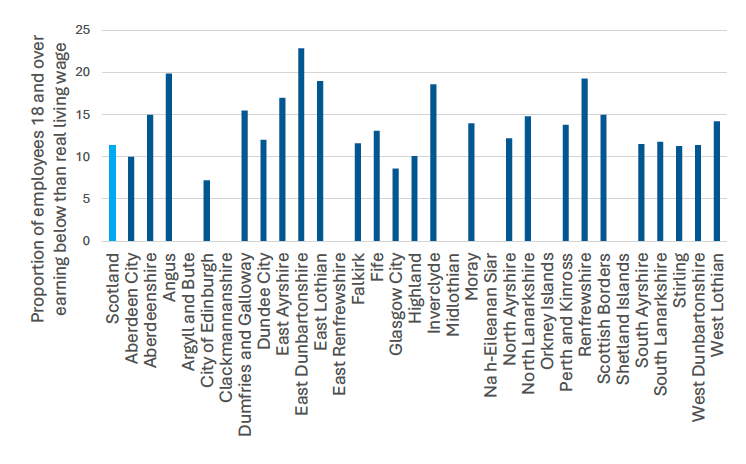
This indicator measures the proportion of employees aged 18 or over who are earning less than the real living wage in 2024. Real living wage rates are calculated annually by the Resolution Foundation based on evidence on UK living standards[23].
Status of indicator
For Scotland as a whole, an estimated 11.4 per cent of employees aged 18 and over earned below the real living wage in 2024. The local authority with the highest proportion of employees earning below the real living wage was East Dunbartonshire (22.9 per cent) followed by Angus (19.9 per cent). The local authority with the lowest proportion of employees earning below the real living wage was Edinburgh (7.2 per cent) followed by Glasgow (8.6 per cent). The cities tended to have less employees being paid below the real living wage than more rural areas (with Dundee at 12.0 per cent and Aberdeen at 10.0 per cent).
9.2 Social enterprises per 10,000 people
Source: Social Enterprises in Scotland Census
Why is it important to a wellbeing economy
Social enterprises help ensure that valued local resources are nurtured, protected, and used to the benefit of those in the local area. This indicator helps us measure progress towards the NPF Communities outcome, “we live in communities that are inclusive, empowered, resilient and safe”. The main beneficiaries of social enterprises have been reported to be those with mental health issues, disabilities, or addictions, the long term unemployed, young people leaving care and older people[24].
What this indicator measures
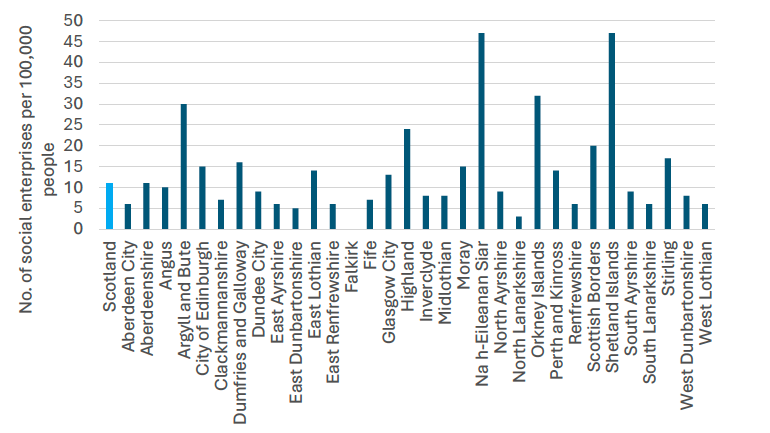
This indicator measures the number of organisations per 10,000 people in the local population that trade for the common good in 2021. Therefore this indicator allows us to get an idea of both the prevalence of, and potential opportunity for, organisations operating locally that derive revenue from sale of goods and services in pursuit of a social or environmental mission.
Status of indicator
For Scotland as a whole, there were 11 social enterprises per 10,000 people. The island local authorities had above average proportions of social enterprises per 10,000 people: Na h-Eileanan Siar and the Shetland Islands both have 47 per 10,000 people and Orkney has 32 per 10,000 people. Cities and more urban local authorities tended to have much lower rates of social enterprises per 10,000 people. For example Dundee, North Lanarkshire and East Dunbartonshire had 9, 3 and 5 per 10,000 people respectively.
Contact
Email: james.miller@gov.scot