
Scotland's wellbeing economy monitor: July 2025
The Wellbeing Economy Monitor (WEM) tracks progress towards creation of a wellbeing economy using a broad range of indicators with a particular emphasis where the economy and economic policy play a significant role in contributing to wellbeing outcomes.
7. National wellbeing: human capital
7.1 Children poverty: children in low income and material deprivation
Source: Poverty and Income Inequality in Scotland 2021-24
Why is it important to a wellbeing economy
The effects of poverty on children can be lifelong, with impacts on health, education, and employment outcomes. This indicator helps measure progress towards national child poverty commitments, including the Child Poverty (Scotland) Act 2017, and the NPF Children and Young People outcome.
What this indicator measures
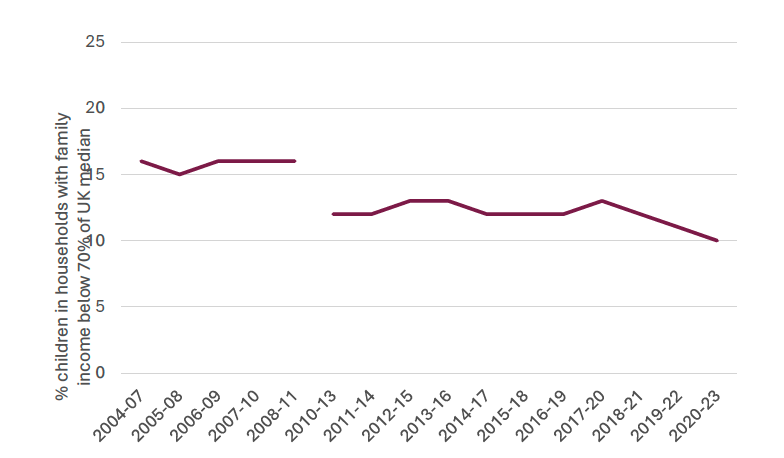
This indicator measures the proportion of children in low income families who also cannot afford basic goods and activities seen as material necessities in society.
A threshold of household income being below 70 per cent UK median income after housing costs is used. This differs from other measures in this monitor, which use a threshold of 60 per cent to flag those in poverty. The 60 per cent threshold is often used as a headline measure of relative poverty, while the 70 per cent threshold is used in conjunction with material deprivation to assess the combined impact of low income and disadvantage (and is consistent with DWP reporting practices).
Status of indicator
The percentage of children in combined low income and material deprivation has been trending downwards since 2017-20. In 2020-23, the proportion was 10 per cent, a fall of 3 per cent from 2017-20.
7.2 Preventable deaths
Source: Avoidable Mortality (National Records of Scotland)
Why is it important to a wellbeing economy
A wellbeing economy contributes to citizens living long and healthy lives. It helps measure progress towards the wider NPF Health outcome “we are healthy and active”.
What this indicator measures
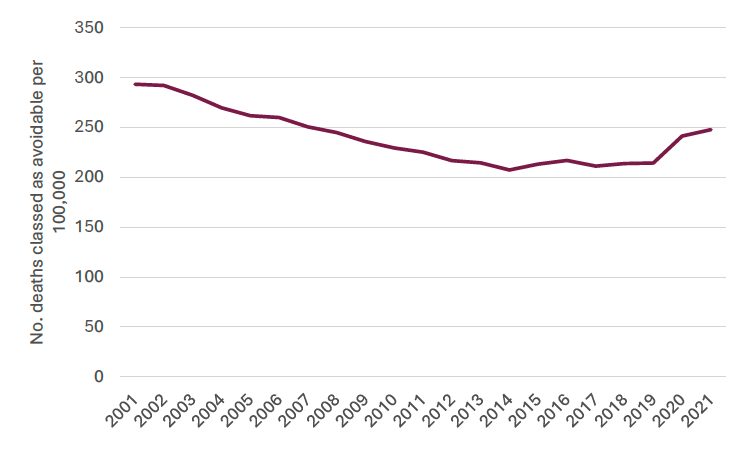
This indicator measures age-standardised death rate per 100,000 of the population. This indicator tells us the number of deaths from causes that could have been prevented through effective public health and primary prevention interventions. It is based on an international definition by the OECD/Eurostat and looks only at deaths under the age of seventy-five.
Status of indicator
Over the time series, preventable deaths in Scotland fell from 2001 to 2014, then remained consistent from 2014 to 2019, then rose from 2019 to 2021. This was because 2020-2021 figures included deaths from COVID-19. When excluding deaths from COVID-19, the rate stayed broadly consistent with previous years.
7.3 Relative poverty
Source: Poverty and child poverty data
Why is it important to a wellbeing economy
Poverty can have severe impacts on the health, education, and employment outcomes faced by individuals. This indicator helps measure progress towards reducing poverty in Scotland.
What this indicator measures
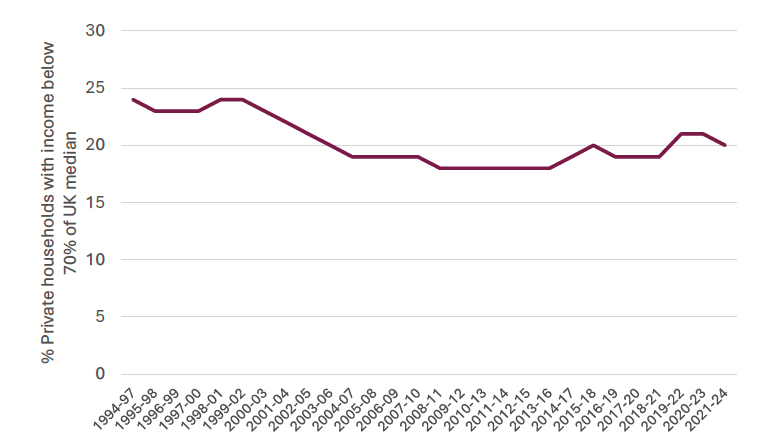
This indicator measures the percentage of individuals in private households with incomes below 60 per cent of the UK median.
Status of indicator
The percentage of households in relative poverty was 21 per cent in 2020-2023, the same as in 2019-2022.
7.4 Low educational attainment
Source: Scottish Government analysis of ONS Annual Population Survey
Why is it important to a wellbeing economy
Skills enable people to participate in the labour market and lead more fulfilling lives[20]. Evidence suggests that for those with low life satisfaction, education is important and may function as a positive buffer against shocks by opening different life trajectories[21].
What this indicator measures
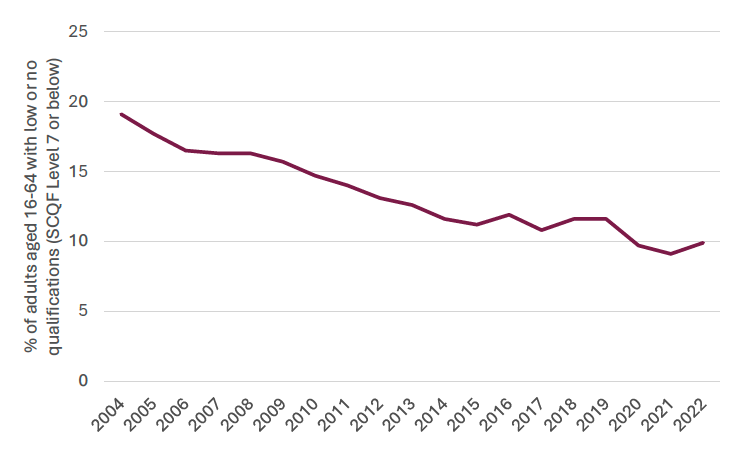
This indicator measures the proportion of adults aged 16 to 64 whose highest qualification was SCQF level 4 or below (SCQF level 4 is equivalent to the current National 4 level). The use of SCQF level 4 or below to define those with low or no qualifications is similar but not identical to the internationally accepted definition used by OECD. It is recognised that some people outside the 16-64 age group will have issues around literacy and numeracy which also need to be addressed. This indicator also does not tell us about the relevance of people's qualifications or about the skills they may have acquired for which they do not have formal qualifications.
Status of indicator
The estimated proportion of people in Scotland aged 16-65 with low or no qualifications in 2022 was 9.9 per cent, up from 9.1 per cent in 2021.
Contact
Email: james.miller@gov.scot