
Scotland's wellbeing economy monitor: July 2025
The Wellbeing Economy Monitor (WEM) tracks progress towards creation of a wellbeing economy using a broad range of indicators with a particular emphasis where the economy and economic policy play a significant role in contributing to wellbeing outcomes.
10.7 Influence over local decisions
Source: Scottish Household Survey
Why is it important to a wellbeing economy
A greater level of local decision making empowers citizens, allowing them to contribute to better governance by increasing responsiveness to local experiences and perspectives.
What this indicator measures
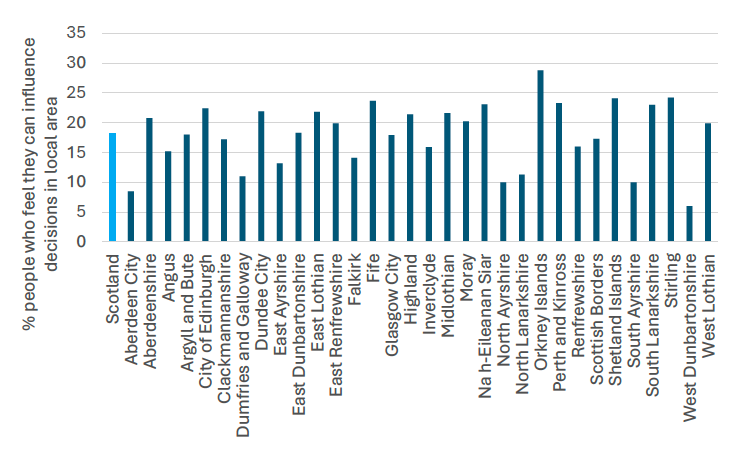
This indicator tells us the percentage of people who agree with the statement "I can influence decisions affecting my local area“ in 2023.
Status of indicator
For Scotland as a whole, 18.2 per cent of people felt they could influence local decisions. There was a high variability between local authorities for this indicator, with the highest being Orkney (28.8 per cent), Stirling (24.2 per cent), Shetland (24.1 per cent), Perth and Kinross (23.2 per cent) and Na h-Eileanan Siar (23.1 per cent). The lowest scoring local authorities were West Dunbartonshire (6 per cent), followed by Aberdeen (8.5 per cent), South Ayrshire (10 per cent), Dumfries and Galloway (11 per cent) and North Lanarkshire (11.3 per cent).
It should be noted that the results are taken from survey data, with relatively small sample sizes for some local authorities. This leads to relatively large sampling errors for local authority results – that is, the differences between the survey results and the true values if the whole population had been surveyed. This also contributes to variations in year-to-year data
Contact
Email: james.miller@gov.scot