
Scotland's wellbeing economy monitor: July 2025
The Wellbeing Economy Monitor (WEM) tracks progress towards creation of a wellbeing economy using a broad range of indicators with a particular emphasis where the economy and economic policy play a significant role in contributing to wellbeing outcomes.
12. Local wellbeing: human capital
12.1 Children in low income families
Source: Local area statistics
Why it is important to a wellbeing economy:
A wellbeing economy should allow children to grow up loved, safe and respected, and this will increase the likelihood of them reaching their full potential. The effects of poverty on children can be life-long, with impacts on health, education, and employment outcomes. For example, evidence suggests children in lower income households are more likely to have high rates of emotional and behavioural difficulties, and experience of child poverty can be a key predictor of youth homelessness[34].
What this indicators measures
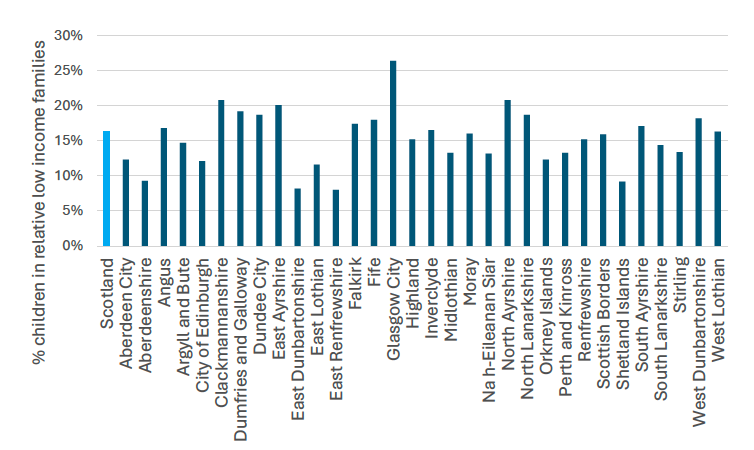
This indicator tells us the percentage of children living in relative low-income families before housing costs in 2024. The term 'relative low income' here refers to being below the poverty threshold (earning less than 60 per cent of the national median). The measure is based on administrative DWP and HMRC data on recipients of Child Benefit and at least one other household benefit (Universal Credit, tax credits or Housing Benefit).
Status of indicator
Across Scotland, 16.3 per cent of children were in relative low income families in 2024. Large differences exist between local authorities for child poverty, with the area where the least children were in relative low income families being East Renfrewshire (8 per cent) followed by East Dunbartonshire (8.2 per cent). The area with the highest percentage of children in relative low income families was Glasgow (26.4 per cent).
12.2 Low educational attainment
Source: Scottish Government analysis of ONS Annual Population Survey dataset
Why is it important to a wellbeing economy
Skills enable people to participate in the labour market and lead more fulfilling lives[35]. Evidence suggests that for those with low life satisfaction, education is important and may function as a positive buffer against shocks by opening different life trajectories[36].
What this indicator measures
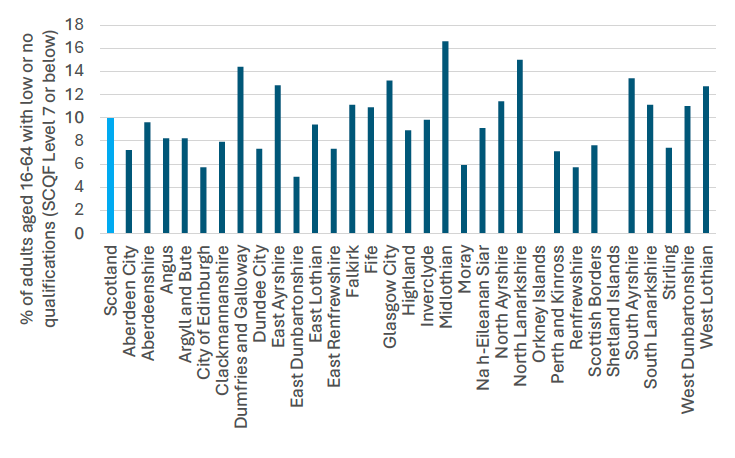
This indicator measures the proportion of adults aged 16 to 64 whose highest qualification was SCQF level 4 or below (SCQF level 4 is equivalent to the current National 4 level). The use of SCQF level 4 or below to define those with low or no qualifications is similar but not identical to the internationally accepted definition used by OECD. It is recognised that some people outside the 16-64 age group will have issues around literacy and numeracy which also need to be addressed. This indicator also does not tell us about the relevance of people's qualifications or about the skills they may have acquired for which they do not have formal qualifications.
Status of indicator
An estimated 9.9 per cent of adults in Scotland aged 16-64 had low or no qualifications in 2022, with large differences across local authorities. Midlothian had the highest estimated proportion of adults with low or no qualifications at 16.6 per cent, with North Lanarkshire (15.0 per cent), Dumfries and Galloway (14.4 per cent) and Glasgow (13.2 per cent) also having a high proportion. Local authorities with the lowest estimated proportion of adults with low or no qualifications included East Dunbartonshire (4.9 per cent), Renfrewshire and Edinburgh (both 5.7 per cent).
12.3 Healthy life expectancy
Source: Healthy Life Expectancy
Why is it important to a wellbeing economy
A wellbeing economy can contribute to citizens living longer, healthier lives. Evidence suggests the social, economic, and environmental conditions in which we are born, live, grow and age can have a greater impact on population health than healthcare or individual behaviours. These 'building blocks of health', also known as the determinants of health, include fair work, housing, childcare, education, and income. When these building blocks are missing or damaged, health and wellbeing declines.
What this indicator measures
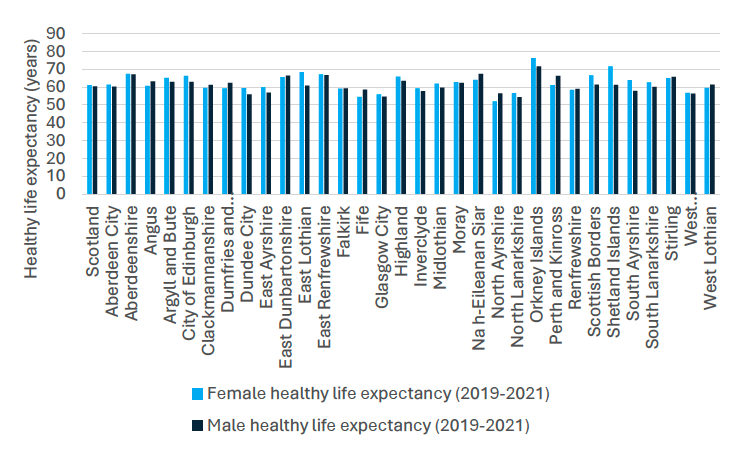
This indicator measures healthy life expectancy (HLE) at birth between 2019-2021. This combines mortality data with survey information on the general health of the population to provide an estimate of the average number of years that people are living in good health. HLE estimates are calculated for three-year averages and these estimates are designed to be consistent and comparable with HLE estimates produced across the UK.
Status of indicator
The Scottish healthy life expectancy for females in 2019-2021 was 61.07 years. The local authority with the highest female healthy life expectancy was Orkney (76.36 years). North Ayrshire had the lowest female healthy life expectancy of 52.07 years.
Healthy male life expectancy tended to be lower for males, at 60.39 years for Scotland as a whole. Orkney also had the highest male healthy life expectancy at 71.62 years. Glasgow had the lowest at 54.75 years.
12.4 Attendance at cultural events and places of culture
Source: Cultural engagement in Scotland (2023) Findings from the SHS
Why is it important to a wellbeing economy
Culture shapes individual preferences, cognition, and perception. Who we are, what we think and how we behave is shaped by the culture around us. A wellbeing economy should support diverse creative talent.
What this indicator measures
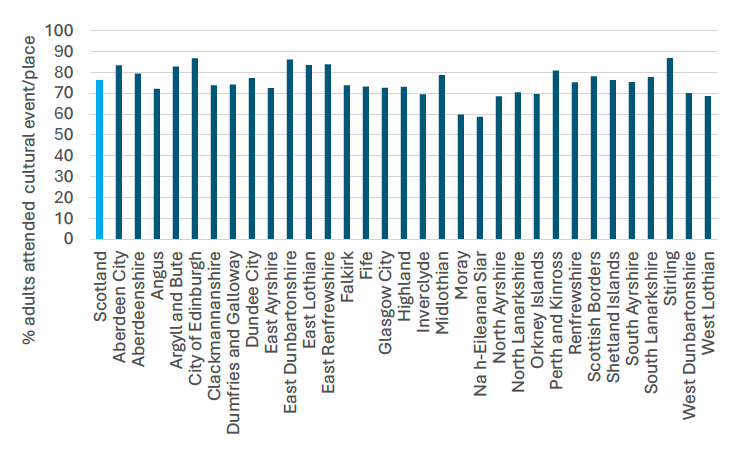
This indicator measures the percentage of adults who have visited a cultural venue or attended a cultural event in the last 12 months in 2023. A cultural event or venue includes cinemas, libraries, classical music, museums, art galleries, book festivals, and cultural venues[37].
Figure 30: Attendance at cultural events and places of culture (2023)
Status of indicator
Across Scotland, 76.3 per cent of adults had attended a cultural event or venue in the last 12 months (including cinema). The local authorities with the highest proportion of people who had attended a cultural event or venue was Stirling (86.9 per cent) and Edinburgh (86.8 per cent), followed by East Dunbartonshire at 86.2 per cent. The local authority with the lowest proportion of people who had attended a cultural event or venue in the last 12 months was Na h-Eileanan Siar at 58.7 per cent.
12.5 Participation in a cultural activity
Source: Cultural engagement in Scotland (2023) Findings from the Scottish Household Survey
Why is it important to a wellbeing economy
Participating in a cultural activity can be educational, fun and stress reducing. Participation can help to give individuals a rich sense of identity and honour, which can add meaning and purpose to life.
What this indicator measures
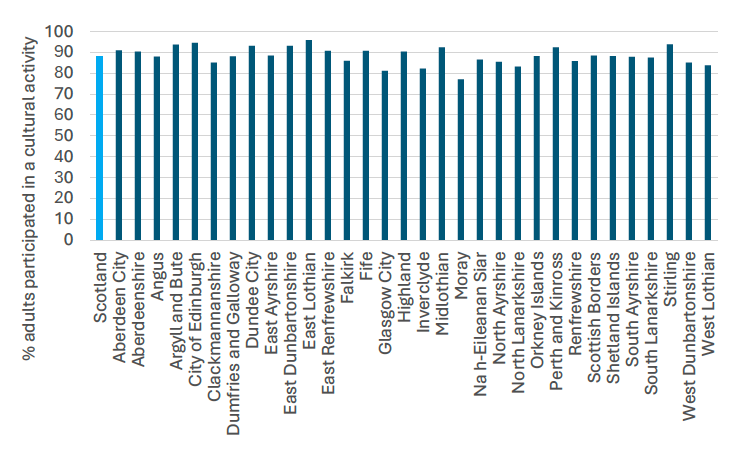
This indicator measures the percentage of adults that participated in any cultural activity[38] in the last 12 months in 2023. This includes reading books, dancing, playing a musical instrument, taking part in a play (including backstage), singing in a group or choir, painting, drawing, printmaking, sculpture, photography as an artistic activity, film- or video-making as an artistic activity, using a computer to produce artwork or crafts, crafts such as knitting or pottery, creative writing, etc.
Status of indicator
88.2 per cent of adults across Scotland had participated in a cultural activity (including reading) in the last 12 months. This was highest in East Lothian (95.9 per cent) and Edinburgh (94.6 per cent). The lowest was Moray at 77.1 per cent.
Contact
Email: james.miller@gov.scot