
Scotland's wellbeing economy monitor: July 2025
The Wellbeing Economy Monitor (WEM) tracks progress towards creation of a wellbeing economy using a broad range of indicators with a particular emphasis where the economy and economic policy play a significant role in contributing to wellbeing outcomes.
11. Local wellbeing: natural capital
11.1 Greenhouse gas emissions per capita (tCO2e)
Source: UK local authority greenhouse gas emissions statistics
Why is it important to a wellbeing economy
A wellbeing economy will contribute to tackling the global climate emergency. Achieving this outcome means ending our contribution to climate change.
What this indicator measures
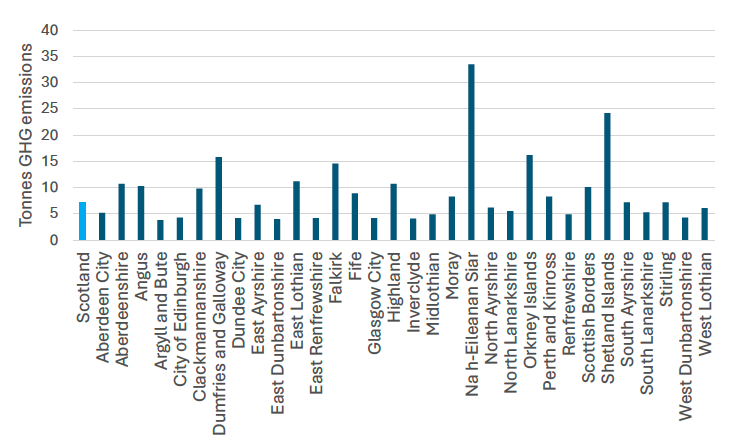
This indicator measures Scotland's greenhouse gas emissions since 2005. It captures the greenhouse gas emissions that are produced within Scotland's territory (or economic sphere), including a share of emissions from international aviation and shipping. The basket of greenhouse gases consists of carbon dioxide, methane, nitrous oxide, and the four F-gases (hydrofluorocarbons, perfluorocarbons, sulphur hexafluoride, and nitrogen trifluoride). Emissions are allocated on an ”end user” basis. where emissions are distributed to locations according to the point of energy consumption (or point of emission if not energy related). Except for the energy industry, emissions from the production of goods are assigned to where the production takes place. Therefore, emissions from the production of goods which are exported will be included, and emissions from the production of goods which are imported are excluded. However, emissions from waste management have been spatially distributed using an approach analogous to the fuel end-user basis, distributing UK total emissions from waste management proportionally to the waste arising in each local authority, rather than to the location of waste management facilities. For example, emissions from landfills are distributed based on estimates of biogenic waste arising in each local authority.
There are unavoidable differences between the methodologies used in the estimation of greenhouse gas emissions for local authorities, and for a devolved administration’s, such as Scotland’s dataset. For example, where electricity sales cannot be successfully allocated to specific local authorities due to lack of information.
Status of indicator
The local authority with the highest greenhouse gas emissions per capital was Na h-Eileanan Siar (33.5 tonnes) followed by Shetland (24.2 tonnes). The lowest per capita was Argyll and Bute (3.8 tonnes) followed by East Dunbartonshire (4 tonnes).
11.2 Live within a 5-minute walk of their local green or blue space
Source: Scottish Household Survey
Why is it important to a wellbeing economy
A natural environment is a source of satisfaction, improves mental wellbeing, allows people to recover from the stress of everyday life and to perform physical activity. Having access to green and blue spaces is an essential part of our quality of lives[32].
What this indicator measures
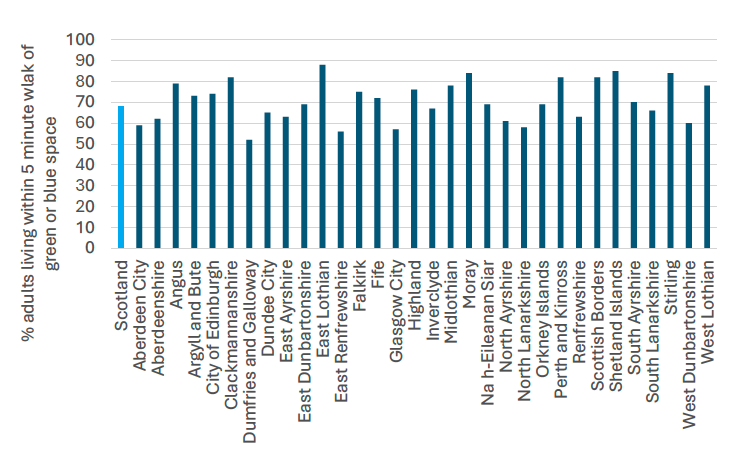
This indicator measures the proportion of adults who live within a 5-minute walk of their local green or blue space in 2023. Green and blue space is described as comprising ‘public green or open spaces in the chosen geographic area, for example a park, countryside, wood, play area, canal path, riverside or beach.
Status of indicator
Across Scotland, 68 per cent of people reported living within a 5 minute walk of their local green or blue space. In 2023, East Lothian had the highest proportion of people who reported living near a green or blue space at 88 per cent, and Dumfries and Galloway (52 per cent) had the lowest.
However, it should be noted that the results are taken from survey data, with relatively small sample sizes for some local authorities. This leads to relatively large sampling errors for local authority results – that is, the differences between the survey results and the true values if the whole population had been surveyed. This also contributes to variations in year-to-year data – for example, the percentage of people who reported living within a 5 minute walk of their local green or blue space in Dumfries and Galloway has varied from 85 per cent to 52 per cent between 2019 and 2023. It is also worth noting that the survey question is framed in terms of how long the respondent thinks it would take the interviewer (not interviewee) to walk to the nearest green or blue space to avoid variation due to differences in the ability to walk of interviewees
Contact
Email: james.miller@gov.scot