
National Missing Persons Framework for Scotland 2025
The National Missing Persons Framework for Scotland (2025) provides updated roles and responsibilities of respective agencies, standardising key practice from a wealth of good practice across Scotland, that aims to help and safeguard those who go missing through multi-agency working.
Conclusion – Supporting some of our most vulnerable people
It is clear, through local and national practice, progress is being made to limit the harm associated with people going missing. Multi-agency working practices are being implemented by agencies across Scotland’s local authorities, building understanding of people going missing in their areas and responding when people of concern have or may go missing.
Information sharing when necessary is key to preventing and limiting harm of individuals. The National Framework and national conferences have highlighted the importance of information sharing and the positive pro-active work of partners in local agencies. The Framework Implementation Project has helped to build this practice with agencies, aiming to safeguard people at risk within our communities but we must strive to do more and ensure more consistent information sharing pathways are in place.
As has been highlighted through the HMICS inspection, the policing response is robust and effective but the inclusion of partner organisations including local authorities, education, health and third sector are crucial to achieving positive outcomes for people who go missing. Multi-agency working and practice is being implemented and taken forward in local areas but it is not universal across Scotland and we can improve particularly through the wider inclusion of chief officers groups, child and adult protection.
That is why we have brought this Framework up to date with what has been learned over the last eight years. Positive steps have been taken but it is important that we continue to try and improve our working and develop practice. It has been noted that where good partnership practice is occurring it can, at times, regress when an influential individual moves on.
Through this Framework, the Scottish Government is encouraging all agencies linked to people going missing to work together. This Framework is guidance but we must ensure that we do not reduce our focus on people going missing, it requires our constant attention to prevent harm and provide support to people who are vulnerable and at risk of going missing.
Annex A - References
1. HM Inspectorate of Constabulary in Scotland. (2024). Thematic Inspection of Police Response to Missing Persons in Scotland.
Thematic Inspection of Police Response to Missing Persons in Scotland
2. Missing People. (2022). Experiences of Reporting a Child or Adult Missing to Police. Experiences of Reporting Missing People
3. Missing People. (2022). The Nature and Scale of Harm Experienced by Missing Adults in the UK. Missing Adults Research
4. Scottish Police Authority, Corporate Performance Report, Q4 2024-25. Quarterly Policing Performance Report Q4 2024-25
5. National Crime Agency. (2017-18). Missing Persons Statistical Bulletins.
Downloads - National Crime Agency
6. Railway Children. (2015). The Value of Return Home Interviews and Follow Up Support when Young People Go Missing
The Value of Return Home Interviews
7. Missing People. (2019). A Safer Return: An analysis of the value of return home interviews in identifying risk and ensuring returning missing children are supported.
8. Police Scotland. (2017-18). Missing Persons Annual Report.
Missing Persons Annual Report 2017-18
9. Scottish Government. (2017). National Missing Persons Framework for Scotland. National Missing Persons Framework for Scotland - gov.scot
10. Scottish Government. (2022). NHS Public Protection Accountability and Assurance Framework.
NHS Public Protection Accountability Assurance Framework
11. Scottish Government. (2021, Updated 2023). National Guidance for Child Protection in Scotland.
12. Scottish Government. (2022). Adult Support and Protection (Scotland) Act 2007 - Code of Practice.
Adult Support and Protection (Scotland) Act 2007: Code of Practice
13. Information Commissioners Office, Data Sharing (2023).
A 10 step guide to sharing information to safeguard children | ICO
14. Stevenson, E., & Thomas, S. D. M. (2018). A 10 year follow-up study of young people reported missing to the police for the first time in 2005. Journal of youth studies, 21(10), 1361-1375. doi:10.1080/13676261.2018.1468874
15. Stevenson, O.; Parr, H. ;Woolnough, P.; Fyfe, N. (2013). Geographies of Missing People: Processes, Experiences, Responses. (Glasgow: The University of Glasgow). Geographies of Missing People – Processes, experiences, responses
Annex B - Information and Guidance on ‘missing’
Children and Young People’s Centre for Justice. (2022). More than ‘Safe and Well’: Evaluation of Barnardo’s Missing Service.
More than ‘Safe and Well’: Evaluation of Barnardo’s Missing Service
Missing People and Children’s Society. (2024). Good Practice Guidance - Supporting Unaccompanied Children who arrive in the UK and are at risk of going missing. Missing Unaccompanied Children - Good Practice Guidance
National Police Chief’s Council. (2024). County Lines Strategic Threat Risk Assessment. County Lines - Strategic Threat Risk Assessment
Parr, H. and Stevenson, O. (2013). Missing People, Missing Voices: Stories of Missing Experience, (Glasgow: University of Glasgow).
Missing People, Missing Voices: Stories of Missing Experience - Enlighten Publications
Scottish Government. (2022). Children Missing from Education (Scotland): Guidance for Local Authorities
Children Missing from Education (Scotland): Guidance for Local Authorities - gov.scot
Scottish Government. (2025). Home Education Guidance.
Home education guidance - gov.scot
Shelter Scotland. (2011). Running away and future homelessness – the missing link? Running away and future homelessness - the missing link? - Shelter Scotland
The Children’s Society. (2011). Still Running 3: Early Findings from our third national survey of young runaways.
Annex C - Risk Assessment
When a person is reported missing, a risk assessment will be undertaken by Police Scotland and thereafter categorised as low, medium or high. This risk assessment will be carried out jointly with partners, when they are involved, to capture all information that will assist in determining the correct category of risk. Police officers have been issued with an aide memoire consisting of 25 questions to assist in determining the most appropriate risk category – the questions are produced below.
Missing Person Low Risk Status
Low Risk is deemed as any person that goes missing where there is low risk of harm to that person or others.
Missing Person Medium Risk Status
Medium Risk is a missing person that is likely to place themselves in danger or they are a threat to themselves or others.
Missing Person High Risk Status
High Risk is a missing person where the risk posed is immediate and there are substantial grounds for believing that the Missing Person:
1. Is in danger through their own vulnerability; and / or
2. May have been the victim of a serious crime; and / or
3. The risk posed is immediate and there are substantial grounds for believing that the public is in danger.
Tolerable Risk
The Not at Home Policy was adopted nationally in 2019, and captures the considerations around the absent category for children who are care experienced. Not at Home categorises circumstances where a child or young person living in care is absent, and there are grounds to believe that this absence involves no apparent risk, or where the level of risk is a tolerable one not meeting the threshold for a Police led missing person’s investigation.
Where a child is “Not at Home” and their absence carries a tolerable risk, or no apparent risk, the Care Provider should record and conduct investigations to locate the child. There is no requirement to contact the Police. A child should only be placed in this category if previously agreed with the case holder that this might be an appropriate response.
All episodes of a child being “Not at Home” must be recorded and made available when the child’s situation is being reviewed – this information may also be valuable in assessing the risk during a missing episode. If there is any escalation of either frequency or concerns then consideration must be given to having this reviewed with partners.
Risk Assessment Determination
Vulnerability
1. Is there any identified risk of suicide?
2. Is criminality suspected to be a factor in the disappearance?
3. Is the Missing Persons vulnerable due to age, infirmity or other similar factor?
4. Are there any known adverse effects if prescribed medication is not available to the Missing Person?
5. Does the missing person have dementia, medical or mental health conditions, physical illnesses or disabilities?
6. Does the missing person have problems interacting safely with others when finding themselves in unfamiliar circumstances?
7. Is there a dependency on drugs, alcohol, medication or other substances?
8. Is the Missing Person on the Child Protection Register?
9. Do the current/previous weather conditions present additional risk? Consider all circumstances including age and clothing.
Influences
10. Are there family/relationship problems or recent history of family conflict and/or abuse?
11. Is the missing person a victim or perpetrator of domestic violence?
12. Is there an on-going personal issue linked to racial, sexual, homophobic, the local community or any cultural issues?
13. Was the missing person involved in a violent and/or hate crime incident prior to disappearance?
14. Are there any school, college, university, employment or financial problems?
15. Is forced marriage or ‘honour’ based abuse an issue?
16. Is the missing person the victim of sexual exploitation, human trafficking or prostitution? If so, is going missing likely to place them at risk of considerable harm.
Behaviour
17. Are the circumstances of going missing different from normal behaviour patterns?
18. Is there a reason for the missing person to go missing?
19. Are there any indications that preparations have been made for absence?
20. What was the missing person intending to do when last seen? Did they fail to complete their intentions?
21. Has the missing person disappeared previously and were they exposed to harm on such occasions?
22. Is the missing person a risk to others? And if so, in what way?
23. Are there other unlisted factors which the officer or supervisor considers relevant in the assessment of risk?
Mental Health
24. Does the Missing Person have a mental health condition (excluding dementia)?
25. Does this Missing Person have dementia or a specific progressive neurological disorder?
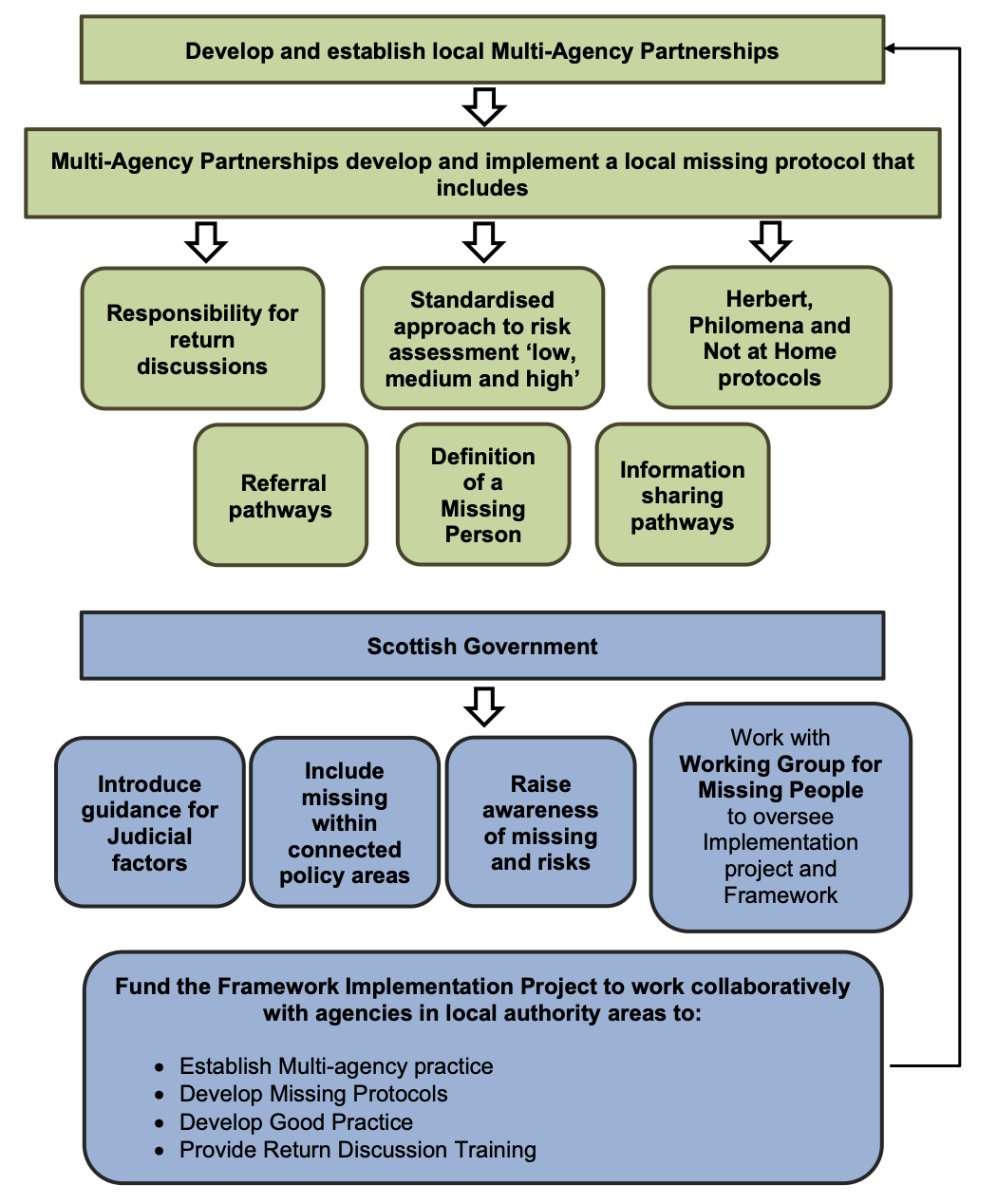
Annex D – Good Practice and Actions Diagram
This Framework sets out key actions to help prevent, locate and safeguard people who have gone missing. To continue to enhance missing practice across Scotland and working with Police Scotland, relevant agencies in local authority areas should:
Contact
Email: contactus@gov.scot