
Free School Meals Test of Change: Evaluation of expanded eligibility for S1-S3 pupils in receipt of Scottish Child Payment
An evaluation of the Free School Meals Test of Change, which expanded eligibility for free school meals to S1-S3 pupils in families receiving Scottish Child Payment in selected secondary schools
7. Perceived impacts for pupils and parents
Key findings
- There was positivity towards the Test of Change among pupils, parents, and professionals. This was especially about the potential financial savings for families.
- Survey data suggests three quarters (74%) of parents noted an improvement in their financial situation, with half saving over £11 weekly. This tended to be put towards other household expenses.
- Among surveyed parents in the relevant subgroup, 62% reported a positive change in their wellbeing and/or stress levels compared with before the expansion.
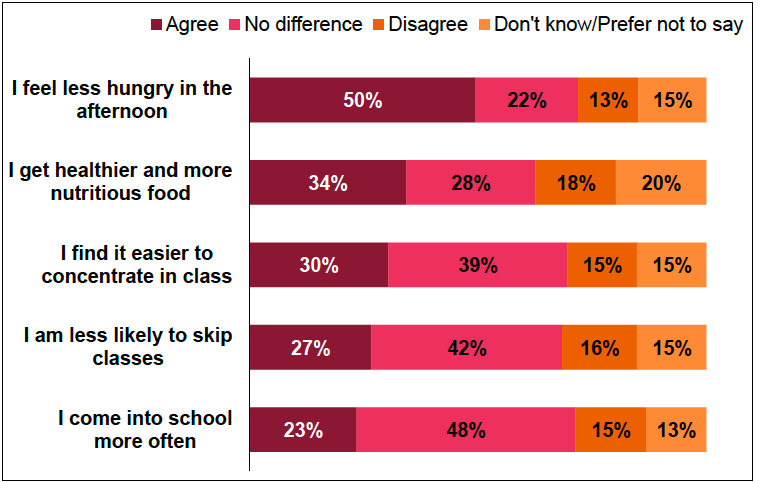
- Among surveyed pupils who reported eating school meals, the most commonly reported perceived benefit was feeling less hungry in the afternoon (50%).
- Smaller proportions reported perceived benefits for attendance, concentration or eating more healthily. specifically. However, participants generally viewed school meals as healthier than many options available from local shops, takeaways or other food outlets
- Across the qualitative interviews, participants generally described either positive or neutral impacts of the Test of Change for newly eligible pupils and their families. While this mainly focused on monetary savings and reduced financial pressure, there was also some evidence to suggest parents may have experienced improved mental wellbeing due to the Test of Change.
Reported parental impacts
Monetary savings
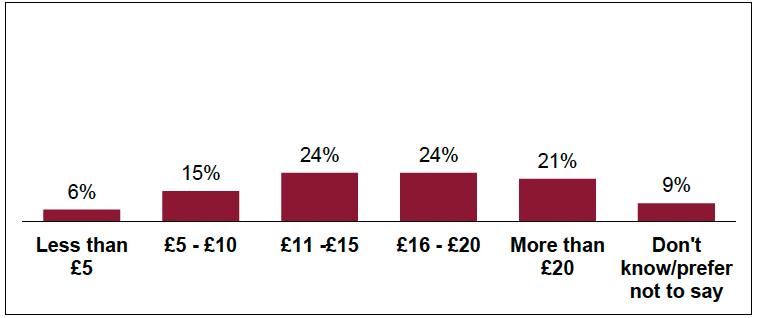
The main reported benefit of the Test of Change identified in qualitative interviews with professionals, parents and pupils was the financial saving and associated benefits for families. In the parent survey, around half (48%) of parents who said their child became eligible for FSM due to the ToC said they saved £11-£20 a week (see Chart 7.1). Around a fifth (21%) said they saved more than £20 a week, with the same proportion reporting lower savings of up to £10 a week. A final 9% were unsure or preferred not to say. Among survey respondents from larger families, 32% reported saving more than £20 per week, compared with 21% across the relevant survey subgroup overall.
“It made things easier [...] to deal with money [because] I was only paying for one child and the rest of the children were all getting, like, the free school meals.” - Parent (from a large family)
Base: Parents who said their child became eligible for FSM as part of the Test of Change (n=265)
Use of savings
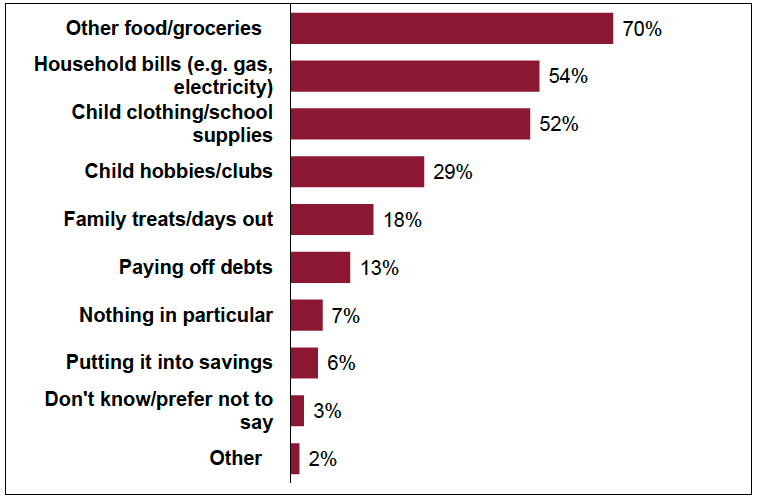
When asked how the money previously allocated for school lunches was now being used, the parents we interviewed typically mentioned using the money to help with the overall household budget. Among parents reporting savings, the money was most commonly redirected to household expenses, with 70% of families spending the money saved from FSM on other food and groceries at the home, followed by 54% spending it on household bills, and a similar proportion (52%) spending it on children’s clothing, shoes or school supplies (see Chart 7.2). However, some families used the saved money on family treats/days out (18%), paying off debts (13%), or putting money into savings (6%).
“It's made it a bit easier for me with money situation… it goes towards the shopping and some kind of bill, something like that. Anything really. Not one, not one particular thing, just whatever's needing paid.” - Parent
"It's a couple of hundred quid extra left over [per month] probably to go to our shopping." - Parent
“It's probably […] around about £40 a month for school dinners, give or take. And that £40, because it's a single income household, it's beneficial to have that in my bank account rather than having it in the school's bank." - Parent
Base: Parents who said their child became eligible for FSM as part of the Test of Change who said they saved money (n=241)
Note: respondents could select more than one answer; percentages may sum to more than 100%.
Reduced financial pressure
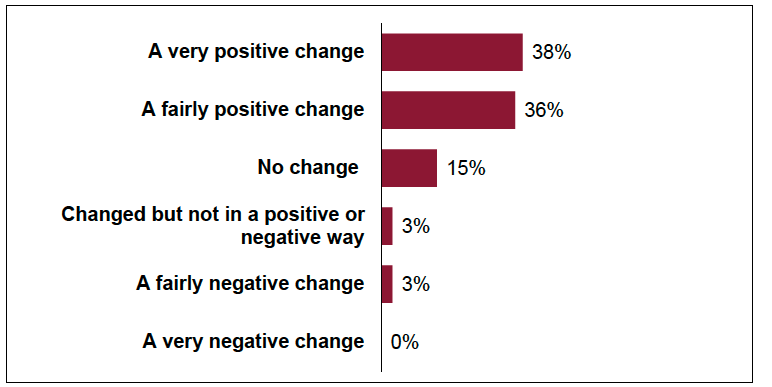
In the parent survey, 74% of respondents reported a positive change in their family’s financial situation when compared to before the FSM Test of Change, while 3% reported a negative change. Some parents in the qualitative research reported that they appreciated the savings and described the saving as making a meaningful difference to their weekly disposable income. The programme and savings were described as relieving financial stress and improving peace of mind.
Base: Parents who said their child became eligible for FSM as part of the Test of Change (265)
Parents interviewed from single-income households and those with large families (defined as 3 or more children) particularly appreciated the alleviation of financial pressure (both identified as part of the six priority family groups at greatest risk for child poverty by the Scottish Government).
Single-parent households, in particular, expressed the positive value of the FSM to them.
“As I said, as a single parent, [FSM] made it a lot easier for me, especially with two kids. So it's made it a bit easier for me with money situation.” - Parent
“I know that he's getting a school dinner [and] it's benefited me financially. […] But, yeah, being a single parent, [it] has definitely helped me." - Parent
However, FSM allowances did not always cover the full cost of school lunches for all families. In the qualitative interviews, there were parents who described topping up their children’s school meal allowance, as they wanted their children to be able to get a snack or a treat at break time. There were also parents who felt that the FSM amount did not cover what their child needed. This was especially the case for ‘fussy eaters’ or children with additional support needs who may need to purchase more than one meal due to not liking what they got. While savings from FSM represented a smaller proportion of the money these families spent on school lunches, parents in this position still felt some financial relief, as they spent less than before.
The financial impacts of the Test of Change were limited by ongoing financial strains, in line with wider pressures on household finances. A few families explained that, while money was being saved, which was helpful, the money was not necessarily freed up for leisure. For families who were under financial strain, such as large families, the money did not increase disposable income for leisure or non-essential spending, as savings were absorbed by essential household costs.
“You never see that money, like it just goes on something else. […] I could not tell you. Yeah. It's not as If I'm using that £25 to go and, you know, buy myself a bottle of wine a week. [It’s] going on food shopping. You know, the cost of heating and everything is extortionate, fuel now is crazy. So, yeah, it's been used elsewhere to, you know, pay for the roof over our heads.” - Parent
Evidence from qualitative interviews suggested that financial benefits of FSM could also be reduced where pupils accrued debt through over-spending (either for themselves or buying food for friends). In some schools, staff described this as a widespread issue. One parent taking part in this research reported currently paying off school meal debt as part of a standing order for ninety pounds a month.
“Now I've got a standing order for ninety pound a month, which defeats the purpose of the free school dinners, because we need that [money].” - Parent
“A lot of times still like, you know, if your account goes over like, I don't know, like even like 50p, you have to bring it into the school and pay it back. From like August, they were emailing my mum for months that I owed £2.80 […] I didn't really know what it was for.” - Child
Wellbeing impacts
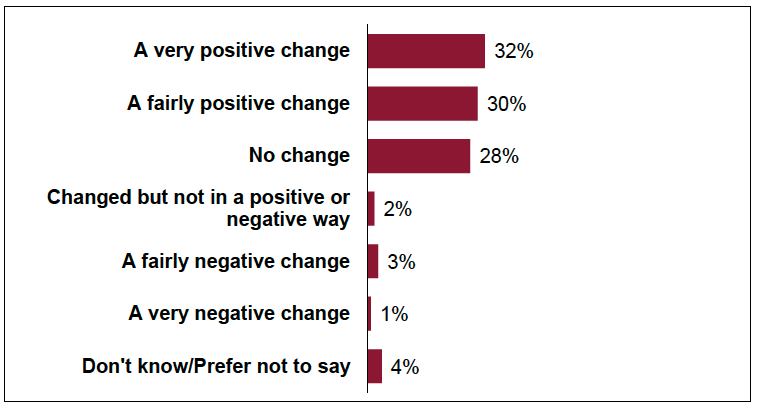
Among parents taking part in qualitative interviews who reported a change in wellbeing, experiences were predominantly positive. Of the parent surveyed, 62% felt that their wellbeing and/or stress levels had experienced a positive change, while 28% experienced no change. Only 2% of parents felt their wellbeing had changed, but not in a positive or negative way, while 4% of parents had experienced a negative change (See Chart 7.4). There was not a follow up question in the survey which captured the direct reasons behind these answers, although more detailed views and experiences of parents were- captured in qualitative interviews.
Base: Parents who said their child became eligible for FSM as part of the Test of Change (265)
These responses describe perceived change over the same period as the Test of Change; they do not establish that the Test of Change caused the reported change in wellbeing or stress.
Parents linked improvements in wellbeing to reduced stress due to FSM relieving financial pressure. Pupils who were interviewed in the qualitative research also felt that their parents may be less stressed because of this.
“Maybe it's, like, easier on them like […] they know that they don't have to pay as much money in my card. […] Like, just like a bit lighter on them.” - Pupil, S2
Furthermore, there was a suggestion that parents experienced reduced mental load around preparing food for their children. This was especially the case for packed lunches but also took pressure off preparing dinner when parents could rely on school meals to provide their child with a hot, nutritionally balanced meal during the day.
“It removed the stress in […] making a packed lunch and removed the [mental load]. Basically, it's one less thing to do in the morning routine, make sure that they've got something to eat. " - Senior teacher
“[Sometimes] I'm like, oh, how can I string this [out], like this random stuff that I've got left and make a meal. But just having that assurance that he's had something hot already at the school means that maybe it can be a salad night or […] like beans on toast or whatever.” - Parent
Professionals in schools also highlighted that where they had simplified the FSM application processes, this minimised the effort and stigma associated with accepting financial help, which they felt may have improved parental wellbeing.
Finally, in some schools, FSM eligibility prompted conversations about whether families may benefit from wider sources of support.
Reported pupil impacts
In both the qualitative and quantitative evidence, pupils taking part generally described neutral or positive experiences of school meals. Of the pupils in the quantitative survey, half (50%) agreed that they felt less hungry in the afternoon when they have had a school meal, while 35% felt it made no difference or disagreed. The remaining 15% did not know or preferred not to say (see Chart 7.5).
Base: Pupils who have eaten school meals (652)
Note: base includes pupils who reported eating school meals at least sometimes; it is not restricted to pupils newly eligible through the Test of Change.
Some pupils noted feeling less anxious about the cost of food and not having enough money to pay for lunch.
“[Having the FSM makes me feel] less anxious about, like, being embarrassed if I go up and there's, like, not much left and, like, I can't get what I need or want.” - Pupil, S2
“It's relieving that my mum doesn't have to put money on every single week, and I find it's useful for people that, like, need it.” - Pupil, S1
“I think it's a big help to the families and the pupils. It means they're getting a proper meal each day for the lunch. As I said, we're a deprived area, so we see the kids that are really hungry. Because, I mean, some of them will come up and try again to get more food. So, we kind of top it up.” - School catering staff member
For those who felt neutral, it was usually because they were already taking school meals, or because they used their FSM allowance to supplement their daily lunch. While FSM is intended to support school lunch provision rather than cover all food pupils may want across the school day, the amount of food covered was sometimes seen as insufficient. Some professionals described occasionally providing leftover food to pupils who were still hungry or had insufficient credit available.
Both professionals and parents interviewed felt that the Test of Change would have a positive impact on pupils, particularly in comparison to going off-site to buy food. School staff reported that pupils were trying new foods more. Some professionals felt FSM could support attendance or learning, but while the evaluation explored perceptions of the impact on attendance and learning, there were no robust measures of these available, and participants acknowledged that any relationship would be difficult to isolate.
Reported effects on concentration and learning
Of the pupils surveyed, around three in ten (30%) felt getting a school meal made it easier to concentrate in class (see Chart 7.5). While pupils taking part in the qualitative research tended not to think this impacted them personally, those who did felt that this was both due to not feeling hungry and consuming less unhealthy foods.
“If you don't eat that much, then you could go hungry and that's all you'll be thinking about [in class].” - Pupil, S2
“[A school meal is] just better than having like a takeaway every single day. [...] If you keep getting takeaway, then I'll be a wee bit like, feeling sick, later on.” - Pupil, S3
In contrast to this, there were also pupils who felt that school meals made no difference to behaviour in class, or they had not noticed. There was a sense among pupils that those who misbehaved would have done so regardless of getting a school meal, and a suggestion that this was more linked to the kinds of foods pupils ate rather than whether they got food from school or not.
“I wouldn't say [school meals affect behaviour]. I would say, like, yeah, if they're [pupils] bad behaving, they're just bad behaving, you know?” - Pupil, S2
“I think [concentration in class] depends what you get [to eat]. Like, sometimes you can get muffins there and stuff, and, like, the more sugar it has in it makes people almost hyper and, like, unfocused." - Pupil, S1
Reported effects on attendance
Slightly lower proportions of pupils in the survey felt getting a school meal impacted on their attendance (27% said this made them less likely to skip classes and 23% said this made them more likely to come into school in general). However, in interviews, newly eligible pupils thought their attendance was unaffected by school meals.
Parents also did not think their child’s attendance was impacted by school meals. However, there was a belief that FSM could make a difference for other families, especially those on a lower income and children who may not otherwise have access to a full meal during the school day.
Reported effects on nutrition
Pupils reported feeling neutral to positive about the nutritional impacts of school meals. School meals were typically seen as more nutritious than food from external shops or food vendors, but there were mixed views on how well school meals compared to packed lunches. Survey data showed that just over a third (35%) of pupils agreed that they got healthier and more nutritious food through school meals than they would otherwise.
On the one hand, school meals were viewed positively by parents and pupils for having fruit and vegetable sides, being portion controlled, and providing alternatives to going out and getting less healthy food and fizzy drinks. On the other hand, school meals were also viewed negatively for having options perceived by some participants as less healthy, such as pizzinis (a folded, enclosed pizza) and sweet pastries, or not having large enough portions, resulting in children going out to buy less healthy food.
Among both pupils and parents, there were differing views on school meal portion sizes. Those who found it insufficient ended up supplementing school meals with other snacks and therefore spending more.
Participants commonly noted that nutritional benefits of school meals depended not only on the food available but also on the choices pupils made. While schools offered fruit, vegetables and balanced meal options, pupils acknowledged that they did not always choose these, and some parents expressed concern that children could still select less healthy items. However, school meals were still viewed more positively than food available outside of school.
“I work at Tesco, I've seen what they buy at lunchtime, cookies and cakes and I've seen one child actually come in and buy 24 cans of Irn-Bru, the 24 pack. So for their lunch, for all their friends, probably. So I don't like what they buy, so I'd rather she was [getting a school meal]. It's healthier and it's a warm meal.” - Parent
“At school she's kind of getting like fruit and she's getting like an actual proper meal and she's getting vegetables […]. So that's kind of giving her a good variety of what she should be actually having instead of just one thing.” - Parent
Among parents, suggestions for improvement to school meals included more vegetarian options and more simple foods to cater for ‘fussy eaters’. For example, one parent suggested building in more choice such as having sauces on the side rather than having strong flavours inherently part of a meal. Some parents wanted more information about what was on the menu, as they did not know what their children were eating.
Contact
Email: socialresearch@gov.scot