
Free School Meals Test of Change: Evaluation of expanded eligibility for S1-S3 pupils in receipt of Scottish Child Payment
An evaluation of the Free School Meals Test of Change, which expanded eligibility for free school meals to S1-S3 pupils in families receiving Scottish Child Payment in selected secondary schools
4. Engaging newly eligible families
Key findings
- While parents generally found application processes to be straightforward, initial requirements to upload SCP award letters (before the data share from Social Security Scotland was available) presented a barrier for some families. Applications were seen as most difficult for parents with English as an additional language, those with difficulty reading, and those with difficulty using online systems.
- Combining FSM with applications for larger benefits and removing additional SCP eligibility checks where Social Security Scotland data confirmed receipt of SCP simplified access and increased the likelihood that families received all entitlements.
- Combining LA and school communications across multiple channels was most effective, as reliance on a single sender or medium left some families unaware. Targeted messages to newly eligible families were preferred, while broad, untargeted communications could be overlooked or misunderstood.
- Earlier, pre-summer communications reduced start‑of‑term overload and gave families time to act, with ongoing reminders helping to increase awareness and uptake. Schools’ one‑to‑one engagement with pupils also helped address practical barriers to using the canteen.
- Pupils interviewed as part of this evaluation were typically not aware that they were entitled to the Test of Change FSM. All pupils selected to take part in this evaluation were eligible for the Test of Change.
- FSM was accessed through the same cashless systems as other pupils, with staff-only flags at tills, supporting discretion and reducing stigma.
- Periodic system outages required manual fallback and later reconciliation, increasing administrative workload and leading to repayments where families had been charged.
- The Test of Change helped to prevent school meal debt building for some families, but some pupils with existing debt fell outside eligibility for FSM.
Application and enrolment processes
Applications for families to enrol for the FSM Test of Change were either incorporated into LAs’ existing benefits application process or established as a separate, simpler application form. Since the LA already had data confirming the family was eligible, the application simply required families to agree to take part in the FSM Test of Change, rather than submit any proof of eligibility.
“It's just a simple return saying, ‘yes’. [It’s a] Microsoft form. It is really, really simple. And because we have the data already and we know who's eligible, all we needed them to do was to say yes.” - LA Professional
In one area, parents did not have to submit a form and could email or telephone to confirm take up of FSM. This approach also allowed the benefits team to ensure families were claiming any other benefits they may be entitled to. However, this approach was only feasible due to low numbers of newly eligible families.
“[The] finance person will be writing out to them all and they would just either phone or email back.” - LA Professional
In other areas, the application process was added into the existing system for benefits applications. These application processes were advertised more broadly on LA websites and social media, sometimes in addition to targeted communications to newly eligible families. (See the following section for more detail on communications with newly eligible families.) Applications for the FSM Test of Change tended to be found in the same place as applications for existing FSM provision and clothing grants, whether that be a form on the LA website or a centralised benefits portal.
Parents described the application process as “straightforward” and “easy”, even when there was a requirement to provide proof of receipt of SCP. However, it is worth noting that parents who participated in the qualitative research were more likely to be those who had successfully applied, rather than families who were deterred or unable to apply.
“I went and applied for it and I got it and it was the easiest application that I ever had to do.” - Parent
“It was quite straightforward. It was just ‘What were you wanting to apply for?’ Put in your details, national insurance details, stuff like that. And then I had to provide evidence of the award letters. It was just a case of taking a photo on my phone and uploading it on an application and that was it. It was really quite straightforward.” - Parent
However, one parent was frustrated at being required to upload a picture of her SCP award letter. She suggested instead having a centralised portal where you could access your benefits information and allowing you to apply for any other benefits you were eligible for.
“It said that I had to show my award letter from Scottish Child Payment. So I had to kind of go through all my papers to find that. I did actually find it, but I just thought it's a bit annoying that you get one award letter and if you lose that, you don't have another one. So it's quite convoluted that you've got to phone up and then you've got to request a new one and it takes five days. And I don't understand why you can't just like log in. […] [to see] what benefits you have.” - Parent
Among a small subgroup of surveyed parents (n=38) whose children were newly eligible for FSM but had not applied, 24% said it was because the application process was difficult. In explaining further, one parent said, “requires a letter confirming receipt of Scottish Child Payment, I don’t have a letter to show”. Professionals also said that applications were a barrier for some families to access the Test of Change.
Other barriers mentioned by professionals related to language, literacy and digital literacy. Several schools noted that many pupils came from households where English is an additional language. This could make it harder for families to access and understand information about FSM when communications were only provided in English. Schools suggested this may have discouraged or delayed applications, with some families never realising they could apply. Where information and processes were primarily online, there was a perception that a lack of digital literacy in some households added an additional hurdle.
“We have quite a high number of young people for which English is an additional language. So we have a really big language barrier amongst our families. We also have a barrier of digital literacy. I think there is an assumption that everybody is really comfortable using a laptop or a tablet and applying for things online. And that's not the case for many of our families. And yeah, third barrier is that literacy level and that confidence in going through the application process.” - Senior teacher
In response, some schools reported making FSM information available in multiple languages and inviting parents into school so staff could support them to complete application forms. These practical steps were viewed as helpful in principle. However, it was also noted that some families might feel uncomfortable seeking help, and there was a concern that this could result in pupils missing out on FSM in ways that are not immediately visible to schools or LAs.
Another way of supporting families with the application process was through financial inclusion support officers (FISOs) who were available to help with applications to access any benefits families may be eligible for. Additionally, some LAs streamlined application processes by incorporating FSM into applications for bigger benefits. As a result, families who applied for other benefits, such as council tax benefit or housing benefit, were supported to access FSM which they might not have applied for separately.
“It was recognised that families will apply for LA tax reductions, housing benefits, etc. Because the value is so significant that those grants are claimed for. Quite rightly so. So as part of the automatic process, the team work out free school meals, clothing grants, footwear grants, etc. And it makes it far easier for families, it increases the numbers of successful allocations.” - LA Professional
To improve the application process, parents said they would like to receive confirmation once the application was submitted, a timeframe for when they could expect to hear back, and clear confirmation once FSM was awarded.
“On [the] LA website you kind of can track where is your application, but it doesn't say anything really. [It] would be better if [it] maybe just said, ‘Your application will be looked at, I don't know, in a week's time’ or whatever.’” - Parent
Communication with newly eligible families
Parents’ awareness of the Test of Change varied considerably. While some parents were fully aware of the Test of Change and understood their eligibility, others reported that they had not heard about it until they were invited to participate in this evaluation. LAs and schools adopted a range of communication approaches, with variations in who was providing the information (the LA or the school), how it was shared, the timing and frequency of communications, and the information included.
Source of communications
In terms of who was responsible for communications with families, initial communications either came from LAs or secondary schools, with some areas taking both approaches. In some cases, primary schools also promoted the Test of Change as part of P7 pupils’ transition to secondary school.
It was suggested by school staff in two areas that parents may be more likely to read messages from the LA than school communications, whether that be emails from the school or parent portal messages. However, the evidence suggests that using multiple sources reduced the risk of families missing information. For example, among parents interviewed in one of the LA areas that sent information from both the LA and secondary schools, one parent only saw the information from the LA, three only saw information from the school, and one saw information from both.
Generally, parents who had seen communications about the Test of Change said they were satisfied with finding out about the Test of Change from either the LA or the school. There was a view that it was helpful to receive information from the school, as parents ended up needing to contact the school to ask questions about the Test of Change. Parents who did not see any communications about the Test of Change and only found out when invited to participate in this research did not have a strong preference for receiving information from the LA or the school. As long as they received the information, interviewed parents found the sender less important.
Mode of communication
Emails or letters were used to communicate to families in all LA areas. Other communications included notifications through a Parent Portal, social media posts, local news media, updates to school and LA websites, face-to-face communication with parents, monthly bulletins, and assemblies with pupils. When surveyed, 55% of parents said they found out about the Test of Change from an email or letter from the school or LA, 6% found out from another parent, 2% found out from school staff in person, and 25% heard it from somewhere else.
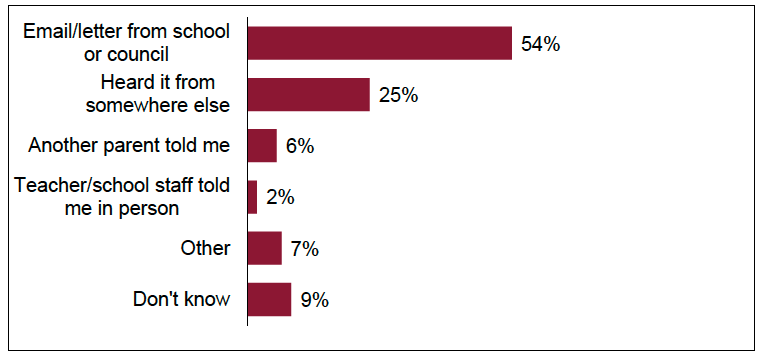
Note: respondents could select more than one answer; percentages may sum to more than 100%.
Base: (n = 963 Parents)
Parents did not show a clear preference in interviews for emails or letters, although it was noted that some parents do not have access to email. One view was that emails were better because they were checked more frequently, while another view was that letters were better because parents could have a physical copy of the information.
For those families that did not see any of the targeted or general communications, there were other ways of finding out about the Test of Change. In areas that linked FSM applications to other benefits, some parents who had not seen any communications about the Test of Change found out from LA benefits teams when applying for other benefits.
“So it actually came about because I had applied for Universal Credits and the person that helped me apply for it had said we'll apply for Scottish Child Payment. And then off the back of that, that's when I got told that because I had Scottish Child Payment, I was to put in for the clothing grant at the start of this term. And that's when I found out about the free school meals was through the clothing grant.” - Parent
Other parents who had not seen LA or school communications found out through word of mouth from other parents, with 6% of surveyed parents saying they found out about the Test of Change because another parent told them.
“Maybe if it's like more known to people. Because I had to tell quite a lot of the parents as well. Because there's a boy, there's a boy in my daughter's year and he wouldn't have lunch like most days […] Yeah, but [the boy’s mum], she never found out, so it was me that told her about it. And now her son can get food.” - Parent
While there was no obvious preference for any particular way of communicating the Test of Change, the evidence suggests that sharing the information through as many avenues as possible helped minimise the risk that families would miss out on the provision.
Targeting communication
While some LAs and schools targeted the emails and letters to families who were newly eligible, others shared information about the Test of Change with all families. However, one concern raised by parents was that they did not always realise communications sent to all families applied to them and would have preferred clear targeted communications informing them they were eligible. A similar concern was raised with social media posts, local news media, and updates to websites.
“The communication could be like a wee bit more broken down, like if you're in receipt of Scottish Child Payment or Universal Credits, that you could apply. […] I'm not sure if it hadn't been for […] applying for Universal Credits with the help of this other mum, that I would have even known that I could apply for it. Although I had seen the emails before coming out saying that this is now your time to apply, like application times now open or whatever, I don't think I would have automatically thought that I would be entitled to it.” - Parent
“I had read about it on social media and things like that, but I didn't know how it was coming about or how to get it or whatever. So I just kind of left it as it was.” - Parent
However, these broader awareness-raising campaigns were often paired with targeted communications from LAs and schools.
Despite the range of communications approaches taken by schools and LAs, around half (49%) of surveyed parents in the target group for the Test of Change (parents who said they received SCP) were not aware of the Test of Change, while the same proportion (49%) were somewhat or fully aware.
Among those who did not receive SCP, 27% were somewhat or fully aware and 68% were not aware of the Test of Change. This difference may have been a reflection of targeted communications directed at those who were newly eligible for the provision. Alternatively, it may reflect lower salience among parents not receiving SCP.
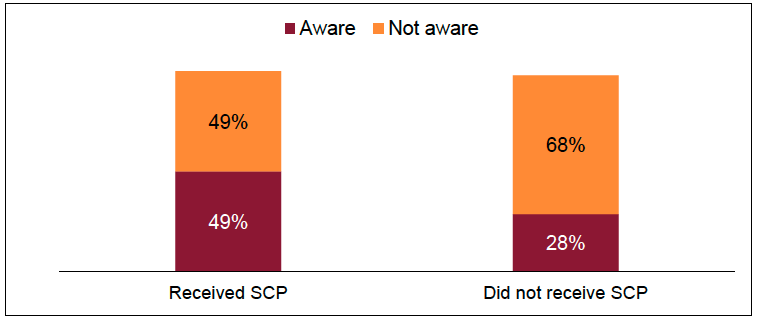
Base: (n = 2717 Parents)
Some LA leads shared that they had intentionally limited broader media campaigns because the provision was not available in all schools within the LA.
Generally, there was a preference among parents for targeted communications that clearly stated they were eligible to apply. However, targeted communications from secondary schools were more difficult where schools did not receive a list of newly eligible families from their LA when the Test of Change was first implemented.
While repeated targeted communications appeared to improve awareness among some eligible families, they could also become frustrating where parents had already decided not to use the provision. In these cases, some parents may have seen the repeated communications as intrusive rather than helpful.
“[I] started to get parents come back to me and say, I didn't apply for this. Stop, stop talking to my child, Stop pushing my child. […] Or I can't make my kids eat free meals. I can't make them eat if they don't want [to].” - Senior teacher
In a couple of cases, canteen staff also informed pupils about the provision, using sensitive wording to tell pupils they could get more food without saying they were getting FSM to ensure it was not stigmatising. However, one group of canteen staff raised the point that communicating the Test of Change should not be their role and better communication should come from the school or LA to ensure more pupils were aware of the provision. Another group of canteen staff suggested a session with pupils to let them know how they could best spend their allowance.
Content of communication
There were mixed views on the clarity of communication relating to the Test of Change among parents taking part in the evaluation. While there were parents who found communications to be clear, others suggested improvements, such as providing contact details for any queries, more detailed information about eligibility criteria, more information about how pupils use the FSM provision (e.g. how the funds are added to pupils’ accounts and how pupils pay with the funds), what the funds can be used for, and information about the duration of the entitlement.
“No one's told me if I have to apply for my second daughter because she's about to start secondary school in August. I have no information on how to or when to do it or if I have to do it or anything like that.” - Parent
Professionals also highlighted the importance of providing information in multiple languages to ensure that communications were accessible to families with English as an additional language.
Among LA professionals, there was a suggestion that in hindsight, a marketing toolkit or promotional pack from Scottish Government would help to facilitate clear communication of the Test of Change to families and media outlets. This was also seen as a potential way to limit the administrative burden on LAs and schools, particularly in areas with a high number of families with English as an additional language where communications may need to be translated into different languages. Concerns were also raised about the uncertainty surrounding the future of the pilot while awaiting policy decisions and potential negative reactions from families who may lose access to FSM when the pilot ends.
Communication timing
Regarding the timing of communications, parents in some LAs raised the point that the initial communications should have been sent sooner, ideally at the end of the previous school year, before the summer break.
"I suppose if it had been communicated sooner […] Then it would have been one less thing to have to do [to get] ready for school." - Parent
It was noted that schools send out a lot of communications to parents at the start of the school year, which can be overwhelming for parents. Sending the communications earlier and getting the applications done sooner would help relieve that pressure, and ensure the email was not missed among the rest.
“So normally like we get emails on a Monday of the school week of the school term starting. Because obviously, the teachers are put back in on the Monday and they're doing [an] in-service day […] you just get bombarded with emails constantly, which is not great. - Parent
In addition to initial communications at the start of the school year, some schools had ongoing communications with families about their eligibility for the Test of Change. This took several forms, including regular announcements in a monthly bulletin, follow up emails to newly eligible parents, or face-to-face conversations between pupils and guidance teams. While the monthly bulletins helped raise broader awareness, most of these ongoing communications were targeted towards families who were eligible but had not yet taken up the provision. To target follow up communications, the school required data on which pupils were not using the provision, which usually involved combining data on uptake from the catering system with the list of pupils eligible for the Test of Change. See Chapter 4 for more information about difficulties monitoring uptake of the Test of Change. Among schools that did not receive or have access to this data from their LA, it was felt that having this information would have allowed them to better support families.
Follow-up targeted emails to parents meant schools could contact families who may have missed the initial communications from LAs or schools. They could also address parents’ questions or concerns about how FSM worked and reassure parents that FSM entitlement was not identifiable when pupils bought food, helping to avoid any stigma that may arise from using FSM. It also let parents who applied for FSM know if their children were not using it.
“I didn't know that she wasn't using it, so, yeah, it enabled me to be able to have a chat with her.” - Parent
Pupils interviewed as part of this evaluation were typically not aware that they were entitled to FSM. It may be that they chose not to share this with the interviewer, but evaluators interpreted pupils’ responses as indicating genuine lack of awareness rather than reluctance to disclose entitlement. There was no sense of discomfort from pupils when being asked about their awareness of FSM. Some parents said they chose to tell their children about FSM to encourage them to take school meals. If their children had been eating school meals anyway, some parents did not feel the need to tell their children and some chose not to tell their children so they would not feel ‘different’.
Some schools sensitively incorporated discussions of FSM into pupil meetings with guidance teams if pupils were not taking up the provision. These one-to-one conversations between guidance teams and pupils allowed schools to increase awareness of FSM for pupils whose families may not have heard about it. It also allowed schools to address barriers to accessing FSM. For example, if pupils were not eating school meals because they were anxious about using the canteen, they could arrange a time to show them around the canteen and demonstrate how to order food. If the issue was with uncertainty about the food options, the canteen could arrange a tasting session.
“They may have asked them to come in at lunchtime to trial a lunch, or they may have asked them to come and have a visit with a senior member of staff.” - LA Professional
“There's been a few [cases] particularly where the pupils [new to the school] weren't familiar with the dining hall […] ‘I don't know where to go, how do I know what queue to go to and how do I know how to pre order’, you know, and that just put a few people off. But what [the school] did do, which was really good, was with those pupils who expressed that sort of challenge, they walked them through it […] and they now attend. So I think that confidence [helped].” - LA Professional
“[We] meet with young people one to one and remind them and tell them what needs to be done in terms of, do you know when you can use it? Do you know how to use it? Right, this is how you use it. Let's go around, we'll meet [catering staff], we'll meet some of the staff, we'll get your code. Take a picture of the code. This is how you use the pin pad.” - Senior teacher
Overall, early and ongoing communication with families through as many avenues as possible was seen by professionals as key to increasing awareness of the Test of Change among newly eligible families. However, this required schools and LAs to have access to timely and accurate eligibility and uptake data.
“Early communication with families and an ongoing dialogue with them around the reasons for the expansion, their potential entitlements, trying to normalise FSM and minimise stigma.” - Senior teacher
FSM credit and payment processes
Once enrolled in the Test of Change, pupils used FSM funding through the same payment methods as pupils who were not using FSM, including paying at the till with a pin number, fingerprint scanner, Young Scot card or meal card, or pre-ordering through a mobile app or kiosk. Tills would flag to catering staff when a pupil received FSM, but this was not visible to pupils.
The FSM daily credit was automatically added to pupils’ accounts each day and any remaining balance was cleared within one to two days. Some pupils were spending more than the daily FSM allocation, for example, if they bought school food at multiple points during the day. Families could add money to their child’s account in addition to the FSM allocation to cover any additional spending. If pupils spent more than they had in their account, whether that be money from FSM or from their family, families could accrue debt. While some schools’ tills showed a pupil’s balance, including negative balance, to pupils at the till, others only showed the balance to canteen staff. Generally, pupils were not denied food even if they did not currently have the funds to pay for it. However, there were instances described by pupils and catering staff when pupils had been told to choose different items or put items back if the cost exceeded the funds in their account. One pupil said that they were able to tell that another pupil received FSM because they were told by canteen staff that the items they had chosen for lunch were too expensive.
“If someone's got like, like a […] fizzy drink and, like, a panini. And then like a cookie, like, the lunch lady will go like, ‘oh, you can't get that because you're on the free school meal plan.’ And then they have to, like, put it back, like, the Rubicon and that and get, like, a water.” - Pupil
Debt was raised as a significant concern for some schools. As a result, one school had implemented a daily spending cap for all pupils, regardless of how much money pupils had in their accounts. The Test of Change was also seen as something that may help address high levels of school meal debt, since some of the families who were accruing debt began receiving support to pay for school meals through the Test of Change.
“I think this is how when people don't get the free school meals, the debt in the school is really bad. So then the government's just wiping it off, then it's starting up again.” - School catering staff member
However, professionals expressed some frustration that some pupils with levels of debt were not eligible for FSM through the Test of Change.
“I think we still see some of the kids who don't have enough on their accounts where we kind of think it should be rolled out to them all because some of them maybe don't get that benefit. […] There is some parents who are just on the bread line sort of thing. [...] We write kids names down every day if they don’t obviously have enough in their account because we still feed them and you're seeing the same weans’ names consistently.” - School catering staff member
Contact
Email: socialresearch@gov.scot