
Publication - Research and analysis
Free School Meals Test of Change: Evaluation of expanded eligibility for S1-S3 pupils in receipt of Scottish Child Payment
An evaluation of the Free School Meals Test of Change, which expanded eligibility for free school meals to S1-S3 pupils in families receiving Scottish Child Payment in selected secondary schools
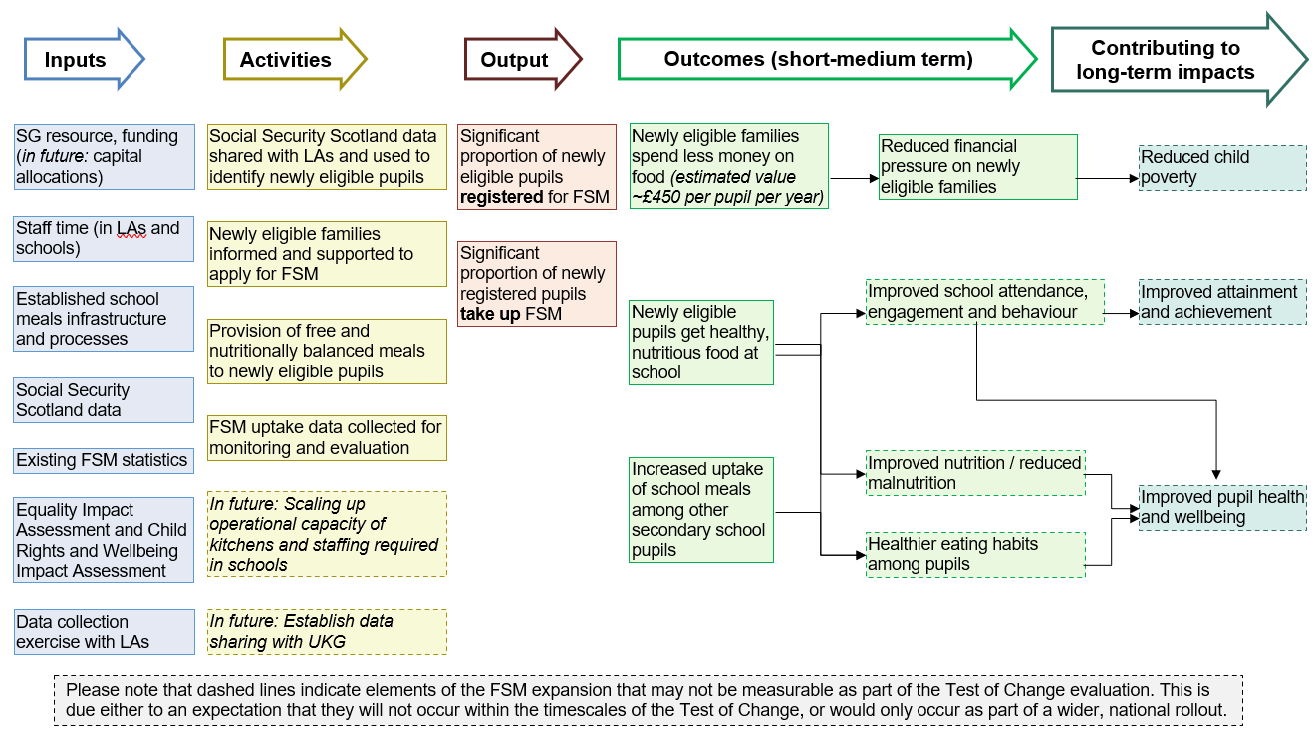
Appendix B – FSM Test of Change logic model
Inputs
Scottish Government resource and funding (in future: capital allocations); staff time in local authorities and schools; established school meals infrastructure and processes; Social Security Scotland data; existing FSM statistics; Equality Impact Assessment and Child Rights and Wellbeing Impact Assessment; and a data collection exercise with local authorities.
Activities
- Social Security Scotland data shared with local authorities and used to identify newly eligible pupils.
- Newly eligible families informed and supported to apply for FSM.
- Provision of free and nutritionally balanced meals to newly eligible pupils.
- FSM uptake data collected for monitoring and evaluation.
- In future: scaling up operational capacity of kitchens and staffing required in schools.
- In future: establish data sharing with the UK Government.
Outputs
- A significant proportion of newly eligible pupils are registered for FSM.
- A significant proportion of newly registered pupils take up FSM.
- Short- to medium-term outcomes
- Newly eligible families spend less money on food (estimated value approximately £450 per pupil per year), leading to reduced financial pressure on newly eligible families.
- Newly eligible pupils receive healthy, nutritious food at school.
- There is increased uptake of school meals among other secondary school pupils.
- These changes are expected to contribute to improved school attendance, engagement and behaviour; improved nutrition/reduced malnutrition; and healthier eating habits among pupils.
Contribution to longer-term impacts
- Reduced financial pressure on newly eligible families may contribute to reduced child poverty.
- Improved school attendance, engagement and behaviour may contribute to improved attainment and achievement.
- Improved nutrition/reduced malnutrition and healthier eating habits may contribute to improved pupil health and wellbeing.
- Note: Dashed lines indicate elements of the FSM expansion that may not be measurable as part of the Test of Change evaluation. This is either because they are not expected to occur within the timescales of the Test of Change, or would only occur as part of a wider national rollout.
Contact
Email: socialresearch@gov.scot