
Scottish National Adaptation Plan: annual report 2025 to 2026
The annual progress report setting out the delivery record over the past 12 months of the Scottish National Adaptation Plan relating to climate change.
Public Services and Infrastructure (PS)
SNAP3 Outcome: Public services are collaborating in effective, inclusive adaptation action.
The climate emergency requires us to collaborate. This outcome focuses on building the capacity of all Scotland’s public services and infrastructure networks to understand climate risks, adapt and act collaboratively with others in a place.
Objectives
PS1 – Public body duties and capacity
Providers of public services have the governance, culture, skills and resources for and are collaborating in effective and inclusive adaptation action.
Everybody should be able to reliably access the public services they need, such as health, education and social care. To support Scotland’s public services to adapt to increasing climate instability, Scottish Government published extensive new statutory guidance in March 2026. This guidance set out Scottish Ministers’ expectations for how all public bodies will take action on climate change. The 2026 guidance:
- Provides clarity of purpose that, to meet their statutory climate adaptation duty, all public bodies must: 1) plan for the delivery of their functions and services in Scotland’s changing climate, and 2) identify the national adaptation objectives from SNAP3 relevant to their functions and act in a way that supports the delivery of these objectives.
- Defines key actions and expected outcomes that demonstrate compliance with the adaptation duty, including that public bodies will work beyond their operational boundaries to help ensure the places they operate in are well-adapted.
- Aligns with Adaptation Scotland’s core resource for the public sector, the Adaptation Capability Framework, which was itself updated in December 2024 following publication of SNAP3.
- Strengthens appraisal pathways for climate-informed decision making, ensuring these implement CCC advice to plan for 2°C by 2050 and to assess the risks for 4°C of global warming by 2100.
- Provides new technical guidance for organisations with complex estates or essential service delivery roles. This guidance, for the first time, covers use of climate scenario analyses and planning for interdependencies and cascading impacts.
- Public bodies continue to report annually on how they are complying their statutory climate change duties, with summary findings published annually. Data from this reporting underpins SNAP3 indicators PS1.1 and PS1.2.
In 2025-26, the Scottish Government provided £400,000 to fully fund the Adaptation Scotland capability‑building service, supporting public bodies, businesses and communities to strengthen climate resilience. Adaptation Scotland plays an vital role in building public sector capability by providing clear leadership, practical tools and tailored support to help organisations integrate climate adaptation into governance, planning and service delivery.
Across the reporting period, Adaptation Scotland:
- Strengthened public sector leadership on adaptation through delivery of the Public Sector Climate Adaptation Network (PSCAN), supporting 75 organisations (including 26 local authorities) to assess and improve their adaptation maturity using the Adaptation Capability Framework.
- Enabled public bodies through PSCAN to work together, share learning and good practice, and build the confidence and influence needed to drive adaptation action, with monthly online meetings and two larger in‑person or hybrid events.
- Delivered place‑based adaptation at scale by supporting the development of Scotland’s Climate Ready Regions, including the launch of Climate Ready Tayside and progress towards national coverage.
- Delivered nationally significant tools for public services, including Building Climate‑Resilient Social Care: A Guide for Practitioners. Adaptation Scotland also used its knowledge and experience to develop and ensure the new statutory guidance and the Senior Leaders’ Adaptation Checklist were practical and usable.
- Provided secretariat support to the Climate Ready Infrastructure Scotland (CRIS) Forum, helping infrastructure owners and operators collaborate on shared climate risks and system interdependencies.
- Supported shared learning across the public sector on health, vulnerability and resilience, working with health and social care partners to embed climate adaptation into service planning and delivery.
In 2025–26, the Sustainable Scotland Network (SSN) played a central role in supporting the Scottish public sector to understand, plan for and respond to climate change risks. Acting as a national convenor and trusted intermediary, SSN strengthened leadership capability on adaptation, supported public bodies to interpret and respond to statutory duties, and created practical spaces for learning on the impacts of flooding, extreme weather and climate‑related health risks.
To support public sector during the reporting period, SSN:
- Provided national leadership support on adaptation, including the development and launch of a Climate Leaders’ Adaptation Checklist, designed to help senior leaders embed adaptation into governance, strategy and investment decisions.
- Convened regular Adaptation Sub‑Committee meetings, creating a cross‑sector forum to shape priorities, share learning and plan future adaptation support across the Scottish public sector.
- Delivered targeted learning events on priority climate risks, including flooding and flood resilience, and adverse weather and health, in partnership with Audit Scotland and Public Health Scotland.
- Embedded adaptation within national and local authority events, including the SSN Conference and Local Authority Forums, ensuring climate risk and resilience were considered alongside wider climate delivery and policy discussions.
- Supported alignment with scrutiny and assurance, working closely with Audit Scotland to improve understanding of expectations around flood risk, preparedness and governance.
- Supported the roll‑out of new Statutory Guidance on Public Bodies Climate Change Duties, helping members understand adaptation requirements and how they apply in practice.
- Launched a redeveloped SSN website and resources structure, creating a better platform to provide clearer adaptation advice, case studies and better use of Public Bodies Climate Change Duties reporting data.
- Strengthened links between adaptation, health and resilience through support to the Public Health and Climate Change partnership and other emerging sub‑groups.
In March 2026, the Scottish Government published ScotClimATE to support climate scenario analysis and adaptation planning.
- ScotClimATE is an online tool that enables users to explore how climate change is projected to affect the frequency and intensity of extreme weather events across Scotland under different levels of global warming.
- The tool supports forward‑looking planning for a +2°C world, while also allowing assessment of risks under higher warming scenarios of up to +4°C, in line with advice from the Climate Change Committee and strengthened statutory guidance from Scottish Government on climate scenario analysis.
- Results are presented through an interactive map of Scotland, with confidence intervals to support interpretation of uncertainty.
- This tool delivers on the findings of previous ClimatexChange research on using future climate scenarios to support today’s decision making and supports public bodies with the data needed for climate scenario analysis.
PS2 – Public service and infrastructure resilience
People can access the public services they need; and critical assets, systems and networks are resilient to the impacts of the changing climate.
To build public service and infrastructure resilience, we must adapt now to two degrees of global warming by 2050. In December 2025, the Scottish Government’s most senior civil servant (the Permanent Secretary) convened a first cross-sectoral Senior Leaders’ Climate Adaptation Summit since 2021. This event:
- United senior leaders from 81 public sector and infrastructure organisations, building strong consensus around a new +2°C central planning assumption over the next 25 years.
- Boosted momentum behind existing regional and national partnerships, highlighted the importance of protecting critical infrastructure, and encouraged innovative funding approaches.
- Enabled all senior leadership delegates to use the new SSN Leaders’ Climate Adaptation Checklist to benchmark their organisations and take away key adaptation tools for improvement.
Health and social care services
All Scottish health boards have now developed Climate Change Risk Assessments, with 19 Boards having also developed Adaptation Plans for their for their estates and services. A national summary report consolidating these assessments was published (NHSScotland Assure, January 2025), providing a Scotland-wide assessment of climate risk exposure across the NHS estate and highlighting common risk themes and priorities for adaptation.
Actions to build the climate resilience of Scotland’s health system since the last report include:
- Ongoing development of targeted flood risk assessments for six prioritised acute sites. These assessments will identify site-specific flood risks and define appropriate mitigation measures to improve resilience to current and projected future flood events.
- Launch of a new NHSScotland Climate Mapping Tool to support climate risk assessment and adaptation planning across NHS estate. This web-based, interactive platform has been developed using Esri’s ArcGIS Online system and integrates key national datasets, including SEPA flood risk maps, UKCP18 climate projections, among other relevant maps. The tool enables users to visualise climate-related hazards at facility level, improving understanding of exposure to risks such as flooding, extreme heat, and other climate impacts, and supporting more consistent, evidence-based decision-making.
- An Adaptation Resource Hub has been completed and published on the NSS NHSScotland Sustainability Action Programme SharePoint. The hub is accessible to all NHSScotland staff and brings together trusted tools, guidance, and case studies to support adaptation planning and implementation across the health system. This resource strengthens organisational capability and promotes knowledge sharing to accelerate delivery of adaptation actions.
The Scottish Government’s Programme for Government 2025-26 committed to developing adaptation guidance specifically for the social care sector, recognising that climate changes do not impact us equally, with some people uniquely vulnerable.
- The Building Climate-Resilient Social Care: Guidance for Practitioners is a very practical resource designed to help social care professionals integrate climate adaptation into care planning and service delivery. It was co-developed by Adaptation Scotland with practitioners and published in March 2026.
- The guidance is intended for social care practitioners, including Integration Joint Boards (IJBs), and partner organisations involved in care planning and delivery, helping ensure continuity of care, protect wellbeing and strengthen community resilience in a changing climate.
Climate Ready infrastructure networks
Critical infrastructure supports the essential services people rely on every day. While responsibility for different infrastructure sectors is shared between the Scottish and UK Governments, all infrastructure systems are connected. Climate related disruption in one sector can quickly affect others, with knock‑on impacts for communities, businesses and public services.
Established with an MoU in May 2025, the Climate Ready Infrastructure Scotland (CRIS) Forum brings together all of Scotland owners and operators of critical infrastructure, alongside academic partners, to build resilience to climate impacts. The Forum recognises that risks such as flooding, heat and severe weather do not affect assets in isolation. Instead, they can trigger cascading impacts across interconnected systems. CRIS allow organisations to work together at a national level, share adaptation learnings and take coordinated action, helping shift adaptation from isolated asset‑level responses to a more joined‑up, system‑wide approach.
Over the reporting period, the CRIS Forum:
- Brought together more than 50 organisations from transport, energy, water, digital and other infrastructure sectors as well academic partners to work on shared climate risks and resilience challenges
- Strengthened collaboration through a Memorandum of Understanding signed by more than 20 organisations, setting out a shared commitment to work collectively on climate adaptation
- Convened regular Forum meetings, supported by a small Steering Group, to agree priorities and coordinate activity.
- Led collaborative work to identify and map shared climate‑related risks and interdependencies, highlighting where impacts in one system could affect others.
- Commissioned and co‑developed a set of practical climate scenarios to test how extreme weather could trigger cascading risks across infrastructure systems, covering:
- prolonged drought and dry conditions
- extreme rainfall combined with severe winds
- excessive temperatures and fire‑weather conditions
- Worked with the University of Strathclyde and the Met Office to develop and test these scenarios, with findings shared at Forum meetings and national adaptation events to support real‑world application
- Delivered a national workshop on the impacts of Storm Eowyn, enabling infrastructure providers to share experiences, lessons learned and opportunities to improve coordination during extreme weather
- Members are now mobilising a Scotland-wide assessment of climate-related risk interdependencies. This will provide new, shared evidence on how risks propagate across infrastructure systems and where coordinated action is needed most.
Education services
Through delivery of the Learning for Sustainability action plan, the Scottish Government has continued to strengthen the current materials on climate adaptation available to educators to increase the depth and quality of understanding for practitioners in primary schools and also learners in primary and secondary schools undertaking project work on climate change.
- The Scottish Government has continued to fund the Climate Action Schools programme (delivered by Keep Scotland Beautiful) and the Global Citizenship in Schools (GCiS) programme (delivered by the Development Education Centres) which help to provide a range of sustainability, climate education and global citizenship activities and professional learning. As part of this work, the government continues to support delivery partners to engage with SNAP3’s children’s version and the Scottish Government’s Climate Adaptation policy team to best spotlight climate adaptation within the relevant programmes.
- Education Scotland has created a new practitioner guide on how education settings can become sustainable learning settings by 2030. This includes suggestions on taking positive actions for people and the planet, relevant climate adaptation activities and what this might look like in practice. A set of videos on care, hope and action have also been produced in which climate change and climate action feature strongly.
To work support Scottish universities and colleges to manage and anticipate climate risk, and adapt to climate change, during the reporting period:
- EAUC developed climate risk profiles for all Scottish college and university campuses and published a UK-wide Climate Risk Communications Pack for professionals within the post-16 education sector who want to communicate climate risk and adaptation clearly to their colleagues.
- The Scottish Funding Council (SFC) further embedded its Outcomes Framework and Assurance Model which seeks assurance from the college and university sector about how they use their SFC funding, including their response to the climate emergency as a cross-cutting theme in the framework. This will help SFC to understand how well colleges and universities are developing their thinking on adaptation. SFC also continued to fund EAUC, who support the sector to build climate resilience.
- The College Infrastructure Strategy was further progressed in 2025-26, with the completion of a baselining exercise that includes consideration of what is needed for the college estate to improve resilience to climate change, as well as meet emissions reduction targets.
Emergency services
Scotland’s blue light services continue to build their resilience to climate change and contribute to wider community resilience.
During the reporting period:
- Police Scotland continued to support communities during extreme weather through its Severe Weather Plan, underpinned by business continuity plans across all divisions. These arrangements help keep people safe, support emergency responders and ensure effective coordination and communication during climate‑related incidents. Alongside this, work progressed on a ten‑year Estates Masterplan, supported by an Adaptation Assessment Toolkit that assesses climate risks to buildings and informs long‑term decisions to improve the resilience of the police estate.
- Police Scotland also expanded its Green Leader Network to support site‑level biodiversity and wellbeing, maintaining key sites such as Tulliallan as parkland. Partnerships with environmental organisations and the Environmental and Wildlife Crime Unit strengthened delivery, supported by staff engagement through annual Sustainability Fayres and Green Leaders Conferences promoting climate adaptation and sustainable practice.
- Scottish Fire and Rescue Service (SFRS) reaffirmed the continued relevance of the 2022 Fire and Rescue Framework. Their Service Delivery Review is ongoing, following a 2025 public consultation on 23 options for future service configuration, with decisions expected in 2026. For SFRS’s response to the 2025 wildfire season and contributions to the development of Scotland’s first strategic action plan on wildfires see section C3 - Community Resilience.
- Scottish Ambulance Service (SAS) continued to build operational resilience, supported by director-level oversight.
Scotland’s devolved water and transport network services have dedicated objectives in SNAP3. Progress on adaptation actions in 2025-26 is described in the following two sections of this report.
PS3 – Scotland’s water resources
Partnerships for water resource planning and rainwater drainage networks are active in prioritised catchments to support drought resilience, flood resilience and climate resilient places.
Scotland experienced a significant period of water scarcity during 2025, driven by a combination of prolonged dry conditions and unusually high temperatures. SEPA reported that eastern Scotland experienced its driest hydrological year since 1976 (based on Met Office data), following below‑average rainfall through autumn and winter 2024–25, which limited groundwater recharge, and a record‑breaking hot March–August period, the hottest since Met Office records began in 1884.
These conditions led to record‑low river flows and groundwater levels in parts of the north‑east, with several rivers experiencing the highest number of low‑flow days ever recorded. While some recovery occurred later in the year following autumn rainfall, water resources in parts of eastern Scotland remained under strain, underlining the growing influence of climate change on Scotland’s water availability.
During 2025–26, the Scottish Government and its partners delivered a coordinated national response to manage water scarcity impacts and strengthen resilience:
- National coordination and monitoring: Scottish Government officials met weekly with SEPA, Scottish Water and key stakeholders throughout summer 2025, supported by 28 consecutive weekly water scarcity monitoring and management reports.
- Evidence‑led regulation and environmental protection: SEPA used real‑time river flow data and risk assessments to support proportionate, risk‑based regulatory decisions, prioritising protection of the aquatic environment while working with abstractors to maintain essential supplies where possible.
- Transparency and early risk communication: SEPA published seasonal water situation reports (Autumn 2025 and Winter 2025-26), strengthening early warning of risks, improving public understanding of conditions, and signposting actions to build resilience.
- Public and sector engagement: Government and partners communicated intensively with the public and water‑dependent sectors on water scarcity risks and expected behaviours, including targeted engagement with high‑risk abstractors such as agriculture, whisky and hydropower.
- Behaviour change messaging: Clear, consistent messaging on responsible water use was reinforced, including through Scottish Water’s “Water is always worth saving” campaign, supporting behaviour change during prolonged dry conditions.
- Improved digital access and guidance: SEPA launched an improved and more accessible water scarcity webpage, making advice and risk information clearer for abstractors, alongside a new data centre webpage clarifying SEPA’s regulatory role.
- Building long‑term resilience in agriculture and land use: In February 2026, the Centre of Expertise for Waters (CREW) published guidance on planning for water scarcity for farmers and growers, now embedded in the Sustainable and Regenerative Agriculture: Code of Practice, supporting earlier action and alignment between water regulation and climate adaptation objectives.
Scottish Water plays a key role in helping Scotland adapt to climate change. As the public body responsible for drinking water, wastewater services and major infrastructure assets, it manages significant risks from flooding, drought, coastal change and extreme weather. Through sustained investment, partnership working and the routine consideration of climate risk in planning and decision‑making, Scottish Water helped protect public health, the environment and essential services, while preparing its systems for future climate impacts. Across the reporting period, Scottish Water:
- Reduced the impact of heavy rainfall on sewer networks through long‑standing drainage partnerships with local authorities and stakeholders in Greater Glasgow, Edinburgh and the Lothians, and Dundee. This included nature‑based and property‑level solutions such as the Orchard Park Swale in Craigleith, removing over 2,100m² of roof drainage from combined sewers.
- Delivered major investment to reduce sewer flooding and environmental harm, including a £2.2m scheme in Stewarton and a £3m project in Edinburgh, as part of Scottish Water’s “Drain the Rain, Protect the Environment” approach.
- Strengthened drought resilience and water resource planning by updating climate modelling from UKCP09 to UKCP18, improving understanding of long‑term water supply and demand risks and informing future investment decisions.
- Improved demand management and water efficiency, including a smart domestic water monitoring trial in Dundee and continued progress in reducing leakage, which has fallen by 58% over the past 15 years.
- Embedded climate change into investment and design decisions by updating project appraisal processes to require consideration of future climate impacts under 2 and 4 degree pathways across water quality, wastewater treatment, flooding and coastal erosion.
- Invested £1 million directly into drinking water catchment management, supporting inspections, restoration work and resilience measures to protect source water quality as the climate changes.
- Delivered large‑scale peatland restoration across further Scottish Water landholdings in drinking water catchments, restoring 478 hectares during 2025-26, supporting carbon storage, water quality, biodiversity and long term catchment resilience.
- Developed processes to improve the resilience of assets exposed to flooding and coastal erosion, including working with local authorities as they develop their Coastal Change Adaptation Plans.
- Led customer behaviour change campaigns, including Nature Calls and Water Is Always Worth Saving, helping to reduce sewer blockages and support the long‑term resilience of wastewater systems.
- Maintained strong operational resilience during extreme weather, including drought response measures in Dundee and Angus, and innovative approaches to maintaining water supplies for island communities such as Skerries.
- Integrated climate adaptation using the 2 and 4 degree pathways to the 2080s into long‑term business planning, with the 2027–33 Business Plan identifying around £340 million of investment linked to adapting to climate change and securing service levels for customers across water resources, wastewater and flooding.
PS4 – Transport system
The transport system is prepared for current and future impacts of climate change and is safe for all users, reliable for everyday journeys and resilient to weather-related disruption.
Scotland’s transport infrastructure and networks are vital to communities, businesses and visitors, and are increasingly exposed to the impacts of climate change, including flooding, extreme heat, coastal change and severe weather.
In 2025–26, Transport Scotland and delivery partners continued to strengthen the resilience of the transport system through long‑term planning, targeted investment and improved understanding of climate risk. This work is guided by Transport Scotland’s Approach to Climate Change Adaptation and Resilience (ACCAR), with oversight provided through the ACCAR Governance Group, which coordinates adaptation activity across trunk roads, rail, aviation, maritime transport and active travel networks.
Trunk Roads
In October 2025, Transport Scotland published the Trunk Road Adaptation Plan (TRAP), providing a clear, action‑focused framework for strengthening the resilience of Scotland’s trunk road network.
- The TRAP is underpinned by a robust evidence base assessing current and future climate risks, including surface and river flooding, coastal flooding, extreme heat, high winds, landslides, river scour and cascading system risks.
- The Plan sets out 43 recommended actions to address vulnerabilities and improve the resilience of trunk roads to climate change impacts.
- Delivery of the TRAP actions will be overseen through the Vulnerable Locations Operations Group (VLOG), working in partnership with trunk road Operating Companies.
- Wider work continues to integrate biodiversity considerations into transport resilience, including the development of a Transport Scotland Biodiversity Strategy.
Rail
The rail network continues to build resilience through a progressively deeper understanding of climate risk and long‑term adaptation planning in Network Rail Scotland.
- Network Rail has co‑developed multi‑hazard climate scenario events to assess interdependencies and shared risks across critical infrastructure sectors.
- The Adaptation Pathways Programme was delivered throughout 2025–26, providing a structured, long‑term approach to planning and sequencing adaptation investment based on the latest climate science.
- In May 2025, Network Rail Scotland led the establishment of the Climate Ready Infrastructure Scotland (CRIS) Forum, bringing together infrastructure owners and operators, including Transport Scotland, to support coordinated adaptation action.
Aviation
Adaptation in the aviation sector continues to focus on maintaining safe and reliable operations through inspection‑led risk management and targeted intervention at Highlands and Islands Limited (HIAL) airports.
- Ongoing inspection and asset assessment informed adaptation responses to emerging climate risks during 2025–26.
- Periods of unusually hot weather caused accelerated surface deterioration at some airports, prompting resurfacing works to be brought forward at Kirkwall and Sumburgh Airports.
- These actions helped maintain operational safety and service continuity as exposure to extreme heat events increases.
Maritime
Work to strengthen the resilience of maritime transport focused on vessels, ports and coastal infrastructure, in partnership with operators, CalMac and North Link Ferries and asset owners, Caledonian Maritime Assets Ltd.
- Transport Scotland continued to work with ferry operators and port authorities to mitigate and adapt to the impacts of climate change, supporting the resilience of ferry services.
- Through Caledonian Maritime Assets Ltd, the effects of rising sea levels are being actively monitored to inform the design and upgrade of port infrastructure.
- Scottish Canals continues to embed climate resilience into canal design and operation, helping assets adapt to climate change while also protecting surrounding areas from flood risk. Examples of delivery include resilience improvements linked to hydro schemes along the Great Glen.
Active travel
Investment in active travel infrastructure continues to support resilient, accessible routes that can withstand the impacts of climate change.
- Funding through Transport Scotland’s Tier 2 Active Travel Infrastructure Fund and the National Cycle Network Programme supported projects in 2025–26 that improved the resilience and availability of active travel routes linked to key transport corridors.
- Projects focused on future‑proofing routes against increased flood risk, including weather‑adapted drainage and surface improvements.
- Delivered schemes included resilience works on routes such as the Tweed Trail in Peebles and along the Crinan Canal, improving reliability for users during extreme weather.
‘Public Services and Infrastructure’ Indicators
| Indicator | Ambition | Actual trend | Observations |
|---|---|---|---|
| PS1.1 – Level of risk assessment reported across the public sector | Increasing / improving trend | Increasing / improving trend | The proportion of public bodies having undertaken some form of risk assessment has increased over time. In 2021-22 more than a third (34%) had not undertaken any risk assessment. By 2024-25 fewer bodies (25%) reported not having undertaken any risk assessment and a majority (37%) reported undertaking a limited risk assessment. Since 2023/24 there has been a slight rise in those reporting undertaking a comprehensive or advanced risk assessment. 32% of public bodies had undertaken this level of risk assessment in 2023/24, compared to 38% in 2024/25. |
| PS1.2 – Level of adaptation action taken across the public sector | Increasing / improving trend | Increasing / improving trend | There have been minor shifts across categories since 2023/24, indicating some improvement overall, and with more bodies undertaking comprehensive and advanced action (33% undertaking this in 2024/25 compared to 27% in 2023/24). The share of bodies rated as having taken no action remains static at 26%. The proportion of those reporting haven taken comprehensive action has increased from 20% in 2023/24 to 24% in 2024/25. Around two-fifths (42%) continue to be rated as only taking limited action. |
| PS3.1 – Average per household water consumption | Decreasing / worsening trend | Decreasing / worsening trend | The 2024/25 Per Household Consumption value for unmeasured properties of 356.92 l/prop/ day, excluding underground supply pipe leakage, is down by 0.44% from 358.48 l/prop/day in 2023/24. Cooler summer temperatures may have contributed to the fall. |
| PS3.2 – Number of properties sewer flooded during the year due to severe weather | Maintaining trend | Too early to say | The were fewer instances of sewer flooding due to severe weather in 2024/25, compared with 2023/34, which may have been due to fewer high intensity storms. The number of properties affected per incident has also decreased, further indicating that rainfall severity has been less in comparison to 2023/24. It is currently too early to report on a trend for this indicator due to the variation in rainfall experienced in each year. Longer term time-series data will be required to assess the trend. |
| PS4.1 – Number of ferry service cancellations | Decreasing / worsening trend | Too early to say | In 2024-25 there were 6,425 weather related ferry service cancellations. This was a decrease from the previous year (2024-25) when 6,786 ferry services were cancelled in relation to weather conditions. Data around weather related ferry service cancellations are sensitive to frequency of severe weather events such as storms in a given year. A longer time series will be required to report on trends in ferry service resilience. |
| PS4.2 – Proportion of trunk roads which require close monitoring | Decreasing / worsening trend | Too early to say | In 2023-24 the proportion of trunk roads which require close monitoring of the state of the road surface in Scotland were as follows:
|
| PS4.3 – Proportion of Local Authority roads which may require maintenance | Decreasing / worsening trend | Maintaining trend | Across local authority level roads, the proportion which may require maintenance has stayed fairly consistent since 2019-20. In 2024-25 34% of local authority roads were rated as red or amber condition in the Scottish Road Maintenance Survey, consistent with the level reported in 2023/24. |
| PS4.4 – Number of weather related train delays | Decreasing / worsening trend | Too early to say | In 2025-26 there were 127,565 minutes of weather related train delays in Scotland. This figure remains higher than in 2020, although train services were operating a reduced timetable during the Covid pandemic. Data around weather related train delays is sensitive to frequency of severe weather events such as storms in a given year. A longer time series will be required to report on trends in train service resilience since the SNAP3 baseline in 2024. |
PS1.1 – Level of risk assessment reported across the public sector
Description: This indicator denotes the maturity of risk assessment undertaken by public bodies (local authorities, NHS boards, educational institutions, IJBs, transport partnerships, and other national and regional bodies). Responses are assessed as ‘None’, ‘Limited’, ‘Comprehensive’ or ‘Advanced[39]
Data source: Public Bodies Climate Change Duties Annual Compliance Reports / Sustainable Scotland Network
Ambition: Risk assessments are maturing over time
Actual trend: Risk assessments are maturing over time (shows modest gains, with 5% more bodies adopting a comprehensive approach).
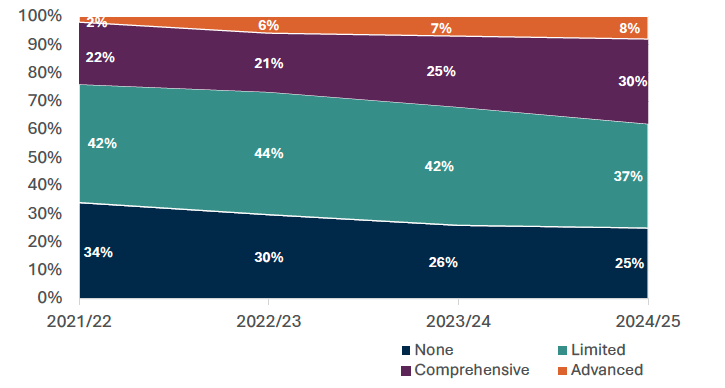
Risk assessment is a critical first step for organisations planning and taking action on climate adaptation. This indicator assesses progress on climate risk assessment for the public bodies who return Public Bodies Climate Change Duties annual compliance reports.
The proportion of public bodies having undertaken some form of risk assessment has increased over time. In 2021-22 more than a third (34%) had not undertaken any risk assessment. By 2024-25 fewer bodies (25%) reported not having undertaken any risk assessment and a majority (37%) reported undertaking a limited risk assessment. Since 2023/24 there has been a slight rise in those reporting undertaking a comprehensive or advanced risk assessment. 32% of public bodies had undertaken this level of risk assessment in 2023/24, compared to 38% in 2024/25.
All local authorities and NHS bodies have now completed some form of risk assessment, with the majority undertaking a comprehensive or advanced assessment. Limited assessments remain most common for the Others and the Education sectors, although the latter shows some progress with 5% of the sector having undertaken an advanced assessment for the first time.
Transport Partnerships and IJBs remain the lowest ranking sectors with significant majorities either not reporting, responding “not applicable”, or (in the case of most IJBs), referring to reports from the respective NHS board or local authority.
PS1.2 – Level of adaptation action taken across the public sector
Description: This indicator denotes the maturity of adaptation action being undertaken by public bodies (local authorities, NHS boards, educational institutions, IJBs, transport partnerships, and other national and regional bodies). Responses are assessed as ‘None’, ‘Limited’, ‘Comprehensive’ or ‘Advanced’[40]
Data source: Public Bodies Climate Change Duties Annual Compliance Reports / Sustainable Scotland Network
Ambition: Increasing over time
Actual trend: Increasing
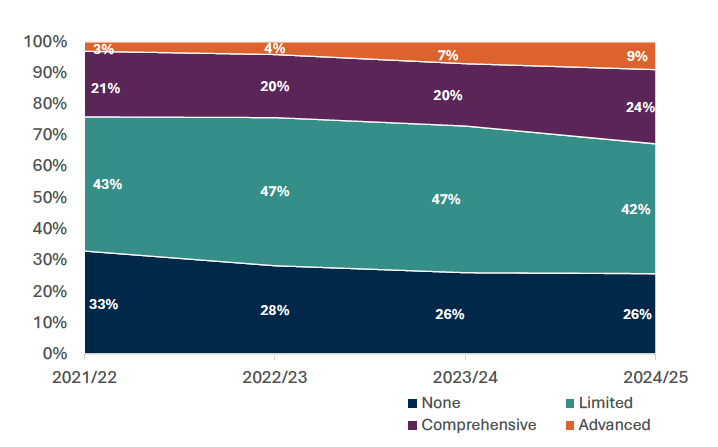
There have been minor shifts across categories since 2023/24, indicating some improvement overall, and with more bodies undertaking comprehensive and advanced action (33% undertaking this in 2024/25 compared to 27% in 2023/24). The share of bodies rated as having taken no action remains static at 26%. The proportion of those reporting haven taken comprehensive action has increased from 20% in 2023/24 to 24% in 2024/25. Around two-fifths (42%) continue to be rated as only taking limited action.
Local Authorities remains the most mature sector, with all 32 bodies taking some form of action, 81% of which demonstrate comprehensive or advanced action in 2024/25. Educational institutions demonstrate some progress, with 33% rated as having comprehensive or advanced action in 2024/25, compared to 21% during 2023/24. The Others sector demonstrates similar, but smaller scale, progress with 28% rated comprehensive or advanced, compared to 25% in 2023/24. NHS Boards have remained the same apart from a 5% slippage from limited to no action. This could reflects on the quality of the response rather than any material change in action, with longer time series data needed to confidently report on a trend. Evidence across indicators PS1.1 and PS1.2 might suggest that maturity in assessing risks from climate change does not appear to translate into action across the sector, so additional support may be needed to drive improvement.
Although IJBs and Transport Partnerships show modest improvements they still rank significantly lower than the other sectors, with none taking more than limited action.
PS3.1 – Average per household water consumption
Description: This indicator shows the average per household water consumption in Scotland for unmetered households
Data source: Scottish Water
Ambition: Decreasing over time
Actual trend: Too early to say
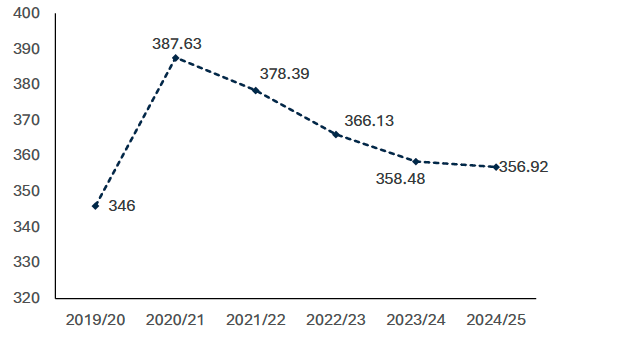
The 2024/25 Per Household Consumption value for unmeasured properties of 356.92 l/prop/ day, excluding underground supply pipe leakage, is down by 0.44% from 358.48 l/prop/day in 2023/24. Cooler summer temperatures may have contributed to the fall.
Reductions in water usage will increase the resilience of the water system to drought and increased demand from other wider pressures.
To note that the trend of historical per household consumption figures for 2020/21 to 2023/24 have been updated. During the reporting year it became apparent that a calculation error had caused previously provided figures to be incorrectly reported in the annual returns provided to the Water Industry Commissioner for Scotland. This did not alter the overall calculation of total domestic water consumption reported by Scottish Water, nor the decreasing trend in per household consumption reported in the 2025 SNAP3 update.
PS3.2 – Number of properties sewer flooded during the year due to severe weather
Description: This indicator provides a measure of the number of properties sewer flooded (internally) during the year due to severe weather in Scotland
Data source: Scottish Water
Ambition: Broadly maintained over time (not worsening with climate change impacts)
Actual trend: Too early to say
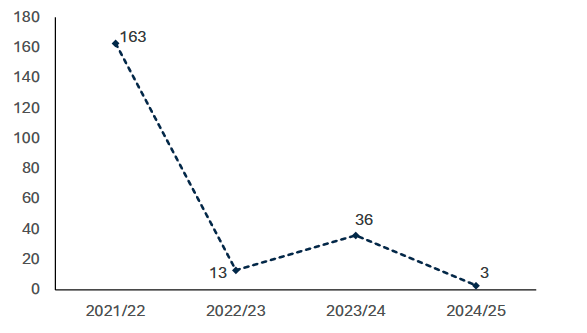
Climate change may increase the number of incidents of sewer flooding, due to the increased frequency and intensity of rainfall events. Sewer flooding can also be exacerbated by other factors such as urban growth and development, network changes and incidents unrelated to climate change. This can make it difficult to discern specific climate change impacts from individual events.
There were fewer instances of sewer flooding due to severe weather in 2024/25, compared with 2023/34, which may have been due to fewer high intensity storms. The number of properties affected per incident has also decreased, further indicating that rainfall severity has been less in comparison to 2023/24.
It is currently too early to report on a trend for this indicator due to the variation in rainfall experienced in each year. Longer term time-series data will be required to assess the trend.
2024/25 saw a return to similar conditions to those observed two years ago in 2022/23, where the level of rainfall experienced in most events was such that the sewer network was able to drain effectively resulting in less flooding due to overloaded sewers, with fewer higher intensity, short duration storms. Longer duration, lower intensity rainfall events meant that ground conditions were more permeable because of the relatively high levels of saturation.
PS4.1 – Number of ferry service cancellations
Description: This indicator shows the number of ferry service cancellations in Scotland as a result of weather conditions
Data source: Transport Scotland
Ambition: Decreasing over time
Actual trend: Too early to say
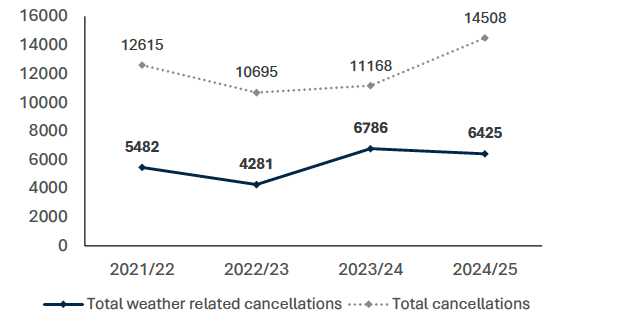
In 2024-25 there were 6,425 weather related ferry service cancellations. This was a decrease from the previous year (2024-25) when 6,786 ferry services were cancelled in relation to weather conditions.
Data around weather related ferry service cancellations are sensitive to frequency of severe weather events such as storms in a given year. A longer time series will be required to report on trends in ferry service resilience.
PS4.2 – Proportion of trunk roads which require close monitoring
Description: This indicator shows the proportion of trunk roads in Scotland which require close monitoring of the state of the road surface
Data source: Transport Scotland (Scottish Road Maintenance Condition Survey)
Ambition: Decreasing over time
Actual trend: Too early to say
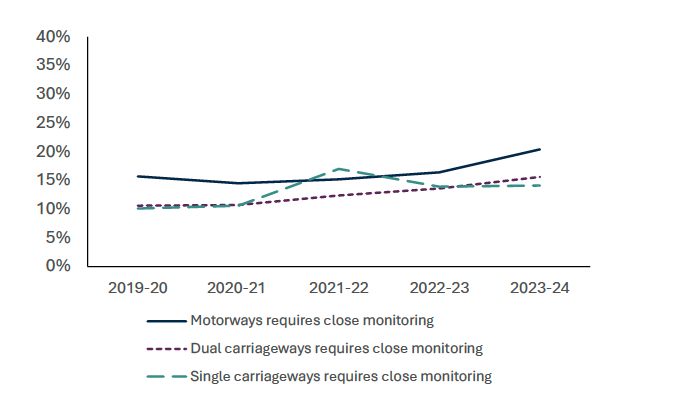
Note: data for this indicator has not been updated since the 2025 annual progress report. Due to issues with the most recent year’s traffic data, which is one of the inputs used to calculate residual life of the asset, figures for 2024/25 are not currently available. The next planned publication date for the data underpinning the indicator is March 2027, and so will be included in the 2027 SNAP3 progress report.
In 2023-24 the proportion of trunk roads which require close monitoring of the state
of the road surface in Scotland were as follows:
- 20.4% of motorways
- 15.6% of dual carriageway
- 14.1% of single carriageways
There has been an increase in the proportion of trunk roads requiring close
monitoring across each road type since 2019-20. In 2019-20, 15.7% of motorways
required close monitoring, while 10.6% and 10.1% of dual carriageways and single
carriageways respectively required close monitoring.
Trunk roads which are in good condition and don’t require close monitoring will be
more resilient to impacts of climate change such as severe weather events.
PS4.3 – Proportion of Local Authority roads which may require maintenance
Description: This indicator shows the proportion of Local Authority roads in Scotland which are reported as maybe requiring maintenance
Data source: Transport Scotland (data collected by WDM ltd using SCANNER vehicle for Scottish Road Maintenance Condition Survey)
Ambition: Decreasing over time
Actual trend: Maintaining
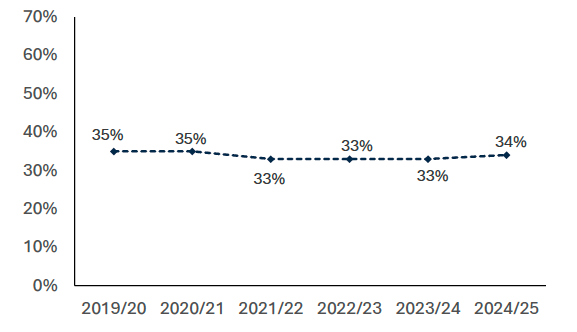
Red or Amber condition indicate that a road needs repair. Across local authority level roads, the proportion which may require maintenance has stayed fairly consistent since 2019-20. In 2024-25 34% of local authority roads were rated as red or amber condition in the Scottish Road Maintenance Survey, consistent with the level reported in 2023/24.
Local authority roads which are in good condition will be more resilient to impacts of climate change such as severe weather events.
PS4.4 – Number of weather related train delays
Description: This indicator shows the instances of reported weather related train delays in Scotland in minutes per year
Data source: Network Rail
Ambition: Decreasing over time
Actual trend: Too early to say
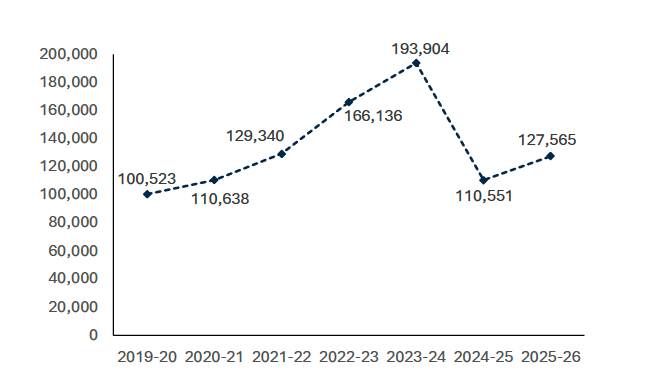
In 2025-26 there were 127,565 minutes of weather related train delays in Scotland. This figure remains higher than in 2020, although train services were operating a reduced timetable during the Covid pandemic. A more resilient train network should experience fewer weather related train delays.
Data around weather related train delays is sensitive to frequency of severe weather events such as storms in a given year. A longer time series will be required to report on trends in train service resilience since the SNAP3 baseline in 2024.