
Scottish National Adaptation Plan: annual report 2025 to 2026
The annual progress report setting out the delivery record over the past 12 months of the Scottish National Adaptation Plan relating to climate change.
Communities (C)
SNAP3 Outcome: Communities are creating climate-resilient, healthy and equitable places.
The climate emergency will change Scotland’s places. This outcome focuses on building the resilience of Scotland’s places and communities to flooding, coastal change, wildfire and other extreme events. The aim is to ensure all parts of Scotland have regional partnerships driving locally-led action, with a focus on vulnerability and using the power of Scotland’s culture, heritage and creativity.
Objectives
C1 – Regional and place-based collaborations
Regional collaborations are driving inclusive, effective and place-based adaptation action across all of Scotland
Climate Ready Regions is the Scottish Government’s flagship initiative for strengthening place‑based climate adaptation across Scotland. It supports regions to understand climate risks, agree shared priorities and deliver adaptation action at greater pace and scale. Recognising that climate impacts vary by place and often cut across sectors, the initiative brings together locally‑led partnerships - typically anchored by local authorities - with public bodies, communities, businesses and the third sector.
Building on established partnerships such as Climate Ready Clyde and Highland Adapts, Climate Ready Regions supports the SNAP3 commitment to establish regional adaptation partnerships across all of Scotland by 2029.
Across the reporting period, Climate Ready Regions provided £550,000 of targeted support, alongside local match‑funding and partner contributions, to strengthen and accelerate regional adaptation activity. Funding was tailored to partnership maturity, supporting the transition from partnership formation, through shared understanding and governance, to delivery. This investment:
- Supported Climate Ready Clyde as Scotland’s most mature partnership to co‑invest in nine on-the-ground adaptation projects including community‑scale property level flood resilience measures, rain gardens and natural flood management interventions. The partnership also developed a wider pipeline of larger-scale priority projects to improve regional climate resilience, strengthening readiness for future investment and delivery.
- Co‑funded Highland Adapts, Climate Ready Tayside and Climate Ready South East Scotland to agree priority locations, develop shared adaptation objectives and build capacity to design and deliver interventions.
- With this funding, Highland Adapts completed a region‑wide Climate Change Risk and Opportunity Assessment with input from over 50 organisations to guide regional priorities and investment; and Climate Ready South East Scotland developed its investment priorities, explored sustainable governance options, and addressed key evidence gaps.
- Enabled early establishment activity in Outer Hebrides, Argyll and Bute, Dumfries and Galloway, and Forth Valley, with funding to develop business cases, explore appropriate governance arrangements and undertake local stakeholder engagement as the first steps toward formal Climate Ready partnerships.
- Delivered the Climate Ready Regions Gathering 2026. The Gathering brought together emerging and established Climate Ready partnerships from across Scotland to share learning, strengthen connections and showcase examples of effective regional collaboration.
- Used the Gathering to strengthen national alignment and shared learning, helping partnerships learn from each other and build momentum towards Climate Ready partnerships being established across all regions of Scotland.
Responding to the climate emergency and ensuring a just transition requires partnership at all scales. The challenge is too big to face alone. For Scotland to flourish in a changing climate, we need to adapt together – central and local government, health boards, public bodies, communities, business, third sector, and individuals.
To further place‑based adaptation and resilience in 2025–26:
- The Climate Delivery Framework, jointly led by the Scottish Government and COSLA, completed its first full year of operation, strengthening shared national‑local oversight of climate delivery and supporting more coordinated, place‑based action.
- The Scottish Climate Intelligence Service (SCIS) received £1.1 million in the 2026–27 Scottish Budget, alongside local government contributions, providing additional climate data, evidence and analytical capacity to all 32 local authorities.
- Scotland’s first Regional Marine Plans were adopted for the Shetland Isles and Orkney Islands marine regions. This marked a significant milestone for marine planning in Scotland, enabling a more community led approach and supporting local approaches to climate mitigation, adaptation and coastal resilience. Regional Marine Plans can also support alignment of planning approaches across the land-sea interface, which can help address issues relating to coastal resilience and adaptation. (See NC5 for further information on the development of the National Marine Plan 2.)
- The Regional Marine Planning Forum was launched, bringing together regional planners, Local Coastal Partnerships, local authorities and consultation bodies to share learning and strengthen collaboration.
- COSLA and the Scottish Government continued to promote the Place Principle which establishes a clear vision for collaboration around place. This has supported joined‑up, collaborative approaches to place‑based climate adaptation, including continued use of the Place Standard Tool with a climate lens.
- Public Health Scotland continued delivery of its Climate Change and Sustainability Strategic Approach, supporting place‑based adaptation through a Health in All Policies approach and strengthening capacity to integrate health considerations into adaptation planning at national, regional and local levels though a Population Health and Climate Partnership.
C2 – Locally-led adaptation
Communities and individuals are supported, informed, and able to take locally led adaptation action, supporting local priorities and resilient, healthy, and equitable places
Every community is unique and so is how climate change impacts them. This objective recognises that climate change is complex, but there are meaningful actions that every community can take to address it and flourish together. It is both crucial and possible to adapt to the changing climate whilst tackling other local priorities such as such as housing, getting around, health, skills and jobs.
Scotland’s Climate Action Hub Network is the central pillar supporting community‑led action on climate change. Made up of 24 regional Hubs, the Network provides locally rooted, trusted support in every part of the country. Hubs works directly with communities to build awareness of climate change, strengthen skills and confidence, and help turn local ideas into practical action.
To enable all communities to build resilience and prepare for climate change, across the reporting period:
- The Scottish Government provided £6 million of funding for our network of Climate Action Hubs. 16 of the 24 Climate Action Hubs supported communities to adapt to the changing climate. This included building awareness and capacity building to enable groups to take action through events and training, small seed grants and taking climate impacts into account when developing local place plans. Specific examples:
- Argyll and Bute Climate Hub incorporated adaptation and climate resilience into their new accredited carbon literacy training, and shared this for use across the Network. By amplifying community voices and connecting grassroots action with local authorities, regional partnerships and national programmes, the Climate Action Hubs help communities shape and deliver climate action that reflects local priorities, reduces risk, and supports a fair transition to a climate‑resilient, net‑zero Scotland.
- Lanarkshire Climate Hub ran a ‘Climate Ready Places’ small grant programme, offering grants of up to £2k to community groups to enable them to raise awareness of climate impacts, gather local insights and initiate practical climate adaptation projects to build community resilience.
They supported six projects representing communities from a range of communities across Lanarkshire, including rural areas and suburban neighbourhoods. For example the Black Mount Community Development Trust ran two local workshops looking at local climate impacts such as flooding, food security and environmental degradation. This has led to a community orchard and edible hedgerow network project to support biodiversity and increase food security. Fruit trees and hedging samples have been planted across multiple sites. Other projects include a housing and energy efficiency project delivered by Newmains Development Trust and a Bee Highway project in Viewpark.
- Forth Valley Climate Hub ran 7 lunchtime learning sessions covering adaptation themes, open to any community groups, covering themes such as local resilience planning, and adapting our homes and buildings. A Forth Flood Forum has been in discussion throughout the year, involving regular meet ups, a series of outreach activities and 1-1 meetings to progress and shape what a forum gathering would serve so that the process is in co-production with groups who are working to build local flooding resilience.
They have gathered data around what those engaged communities can visualise as next steps and now seek to develop a forum that will act as a central hub that empowers communities through support, shared learning, and stronger collective influence—helping turn local knowledge into coordinated action and supporting communities across the Forth Valley to be more informed, confident and prepared to build climate resilience in their region.
- To support the adaptation work of the Climate Action Hubs, Adaptation Scotland provided targeted capacity‑building, including training sessions for Hub staff and the introduction of a “train‑the‑trainer” approach to widen reach and embed adaptation skills locally. Adaptation Scotland’s Community Climate Adaptation Routemap remains its core resource for locally led adaptation, providing a practical framework to help communities identify climate impacts, explore options and prioritise action to strengthen resilience and wellbeing. During 2025–26, Adaptation Scotland supported communities and trusted intermediaries to use the Routemap through workshops, training and tailored guidance, including piloting its use within Local Place Planning in Peebles.
Policies across SNAP3 support vulnerable groups, with the actions below supporting specific communities during the reporting period:
- The First Minister launched the Scottish Government’s new National Islands Plan in February 2026. The Plan is the product of extensive engagement with island communities, local authorities and a wide range of delivery partners. Under an overarching population retention and attraction theme, the Plan features a set of targeted interventions designed to sustain the long-term resilience of all Scotland’s islands. This includes commitments concerning the expansion of Climate Ready Regions partnerships to all island areas, a Climate Tips for Teachers resource pilot, Nature30 opportunities and island biodiversity. Alongside the Plan, an implementation route map has been published to set out indicative timescales and delivery partners for each commitment. Implementation of the Plan will commence in 2026-27, with close collaborating between Scottish Government, local authorities and island communities.
- Public Health Scotland (PHS) continued to lead delivery of the Adverse Weather and Health Plan (AWHP), strengthening Scotland’s ability to protect health from the impacts of climate‑related hazards such as heat, cold, flooding, drought and severe weather.
- By the end of December 2025, over 98,000 faster broadband connections had been delivered through the R100 programme. In its capacity as contracting authority for Project Gigabit in Scotland, the Scottish Government awarded two contracts: a £26 million local contract targeting 12,800 premises in the Scottish Borders and East Lothian and a £105 million regional contract targeting 68,000 premises in the North-East of Scotland. In 2026-27, the £600 million R100 contracts will continue to deliver gigabit capable connections across rural Scotland and Project Gigabit will also mobilise with the outcome of the two remaining procurements expected.
- The Scottish Government supports a network of Local Coastal Partnerships (LCPs) operating across Scotland’s coastline. These partnerships provide a locally led, community‑based approach to tackling environmental and coastal challenges, supporting sustainable development and building resilience to climate change. Acting as hubs of local knowledge and expertise, LCPs work closely with communities and partners to deliver projects that respond to local priorities while contributing to national aims such as marine education, environmental monitoring, and climate and nature resilience. Their work includes initiatives to address marine litter, coastal erosion and climate impacts. A key example is the Solway Coast and Marine Project (SCAMP), delivered with the Solway Firth Partnership. SCAMP is a coastal and marine nature restoration project, which is working with local communities to improve coastal resilience to the effects of climate change.
- The Addressing Depopulation Action plan has continued delivery in 2025-26. This has involved funding seven local authorities (Highland, Outer Hebrides, Argyll and Bute, Inverclyde, North Ayrshire, East Ayrshire and Dumfries and Galloway) to take forward locally-driven and tailored measures to support population attraction and retention at a community level. The interim evaluation of Phase One was conducted in Autumn 2025 and found early positive signs in the increased understanding of population challenges across Scotland.
C3 – Community resilience
Communities and individuals are able and supported to prepare for, respond to and recover from emergencies in a way that builds future climate resilience, complements the work of emergency responders and protects those with vulnerabilities to multiple risks.
Building community resilience to extreme weather and climate instability is increasingly important. When emergencies happen, the best recoveries will involve learning and equip us to deal with future disruptions in a way that is equitable and protects people with more vulnerabilities. Community resilience in Scotland is based on promoting a culture of preparedness, in which individuals, households, communities and organisations take responsibility to prepare for, respond to, and recover from emergencies.
To improve public information on hazards and emergencies related to severe weather:
- The Ready Scotland website is the Scottish Government’s central hub for helping people and communities prepare for and respond to emergencies, with a strong focus on extreme weather and climate‑related risks. It provides clear, practical advice on staying safe during events such as storms and flooding, supporting early preparedness and strengthening community resilience to the impacts of climate change.
- During the reporting period, Scottish Government completed work to create a new version of the Ready Scotland website. The update website offers increased accessibility through improved navigation, easier to read content across key preparedness areas and a more intuitive layout which has been designed with both partners and public in mind.
- In line with the commitments within the Adverse Weather and Health Plan, new pages were also published on the NHS Inform website to provide information to the public on how to prepare for hot and cold weather, flooding and drought. To explore the effectiveness of public health messaging relating to adverse weather events, the Scottish Government commissioned research through ClimateXChange to support evidence-based improvements to public health messaging.
Building flood resilience
Flooding is Scotland’s most severe climate‑related risk, affecting communities across the country and intensifying as the climate changes. The National Flood Risk Assessment (NFRA) published in December 2025 shows that around 400,000 properties - around one in eight across Scotland - are already in areas at medium risk of flooding.
Climate change is projected to exacerbate this challenge, with flood risk potentially rising to over 630,000 properties by 2100, driven by more frequent and intense rainfall, surface water flooding, and rising sea levels. Coastal areas are expected to experience the greatest proportional increase in risk, while surface water and small watercourses are projected to account for the largest increase in the total number of properties affected.
Flooding already costs Scotland an estimated £500 million each year, highlighting the growing importance of action to reduce exposure, manage impacts and strengthen resilience through long‑term, place‑based flood risk management.
To build flood resilience over the reporting period:
- Scottish Ministers and COSLA agreed to extend the existing flood resilience allocations that had been agreed in 2015 for an additional year, with £42 million being allocated from local government capital for flood resilience measures.
- The Scottish Government provided funding of £243,844 to the Scottish Flood Forum. This funding supports individuals and communities at risk of flooding and supports community resilience groups in flood risk areas to help them become more resilient to future flooding events. Funding the Scottish Flood Forum directly supports implementation of the National Flood Resilience Strategy published in December 2024.
SEPA is Scotland’s national flood forecasting, flood warning and strategic flood risk management and Hydrometric Monitoring Authority. To build flood resilience over the reporting period, SEPA:
- Updated national flood risk evidence though its 2025 National Flood Risk Assessment, with datasets published in March 2026 to identify the current and future risk of flooding to communities across Scotland.
- Advanced flood risk management planning, working alongside local authorities and other partners on the development of Flood Risk Management Plans that will set out actions that improve community resilience. The first phase of consultation for these plans was launched in January 2026, with the second phase planned to initiate in December 2026 and publication of plans following in December 2027.
- Strengthened flood evidence and monitoring by progressing a draft Hydrology Monitoring Framework using this work to inform SEPA’s Rapid Transformation Plan and draft Future Hydrometric Network Plan.
- Improved public access to flood data and information, including further enhancements to SEPA’s online tools such as the Check Your Long‑Term Flood Risk viewer, and publication of National Flood Risk Assessment datasets for the first time under an Open Government Licence.
- Published enhanced flood hazard mapping, including new national surface water and small watercourse flood maps in February 2025, incorporating future climate change impacts for the first time for this flood source, alongside user‑led research to improve map usability and communication of uncertainty.
- Supported flood resilience in planning, communities and education, including engagement in the National Planning Framework 4 Policy 22 Short Life Working Group; publication of updated flooding advice for planners; and launch of new online educational resources to help young people understand flood risk causes and impacts.
- Maintained national forecasting and warning services, continuing daily publication of the Scottish Flood Forecast and provision of the Flood Guidance Statement to emergency responders to support preparedness and coordinated response.
- Extended the reach of flood warnings, developing a Floodline API that enables real‑time integration of Floodline data into external digital platforms used by media, emergency services and other partners.
- Modernised flood and incident messaging by improving our Flood Warning Dissemination platform to support customer self‑management, trial automated flood warnings at selected locations, and disseminate water scarcity messaging through the same platform.
- Progressed coastal flood risk evidence, continuing modelling and assessment work for updates to coastal flood maps in south‑east Scotland, while contributing to national work on coastal change adaptation and working with Dynamic Coast. (For further information on coastal change action see Objective C6.)
Adapting to intensifying wildfire risk
In 2025, Scotland experienced its most severe wildfire season on record, with an increased frequency and scale of fires causing substantial damage to land, estates and biodiversity. A total of 241 wildfires were recorded during the year, including the largest wildfire ever documented in the UK, which burned almost 10,000 hectares around Carrbridge and Dava Moor. These incidents disrupted communities and infrastructure, placed sustained pressure on emergency services, and released significant quantities of stored carbon from peatland and other habitats.
Climate change has been a key factor in intensifying wildfire risk. Warmer temperatures, extended dry spells and reduced ground moisture, particularly in spring, have increased the likelihood of ignition and rapid fire spread. Scotland’s extensive peatlands, woodlands and upland landscapes are especially vulnerable under these conditions, with peat fires capable of smouldering underground for long periods and causing lasting environmental damage. The 2025 wildfire season reinforced that wildfires represent a growing and persistent climate risk, rather than a solely seasonal hazard.
In light of the changing climate and the impacts experienced during 2025, the Scottish Government undertook a comprehensive review of preparedness, planning and response arrangements for wildfires, ahead of the 2026 wildfire season. Ministers and officials engaged extensively with public bodies, external stakeholders and MSPs to ensure that lessons learned from the 2025 season were captured and acted upon. This engagement included:
- A Scottish Fire and Rescue Service (SFRS)‑commissioned debrief by the Scottish Multi‑Agency Resilience Training and Exercising Unit (SMARTEU), published on 25 September 2025, setting out observations and recommendations from the 2025 wildfire response.
- A cross‑public sector wildfires meeting on 9 October 2025, involving His Majesty’s Fire Service Inspectorate (HMFSI), SFRS, Police Scotland, Forestry and Land Scotland, Scottish Forestry, the National Park Authorities and NatureScot.
- A Ministerial Wildfires Summit on 14 October 2025, led by Jim Fairlie MSP and Siobhian Brown MSP, bringing together emergency services, land managers and environmental organisations.
- A Ministerial Statement and Parliamentary debate on 11 November 2025, led by Jim Fairlie MSP.
- An MSP Roundtable on Wildfires on 18 November 2025, hosted by Jim Fairlie MSP and Siobhian Brown MSP.
Drawing on this engagement and the operational learning from the 2025 wildfire season, the Scottish Government developed and published the Strategic Action Plan on Wildfires. The plan sets out 18 actions to strengthen preventative practices, national preparedness and the management of wildfire response in Scotland. This marks the start of an ongoing programme of work to improve Scotland’s resilience to wildfire risk for the 2026 wildfire season and beyond.
C4 – New and existing buildings
New buildings are designed for a future climate, and opportunities for adaptation in existing buildings are taken during maintenance or retrofit.
Climate-resilient places need buildings that are adaptable to our changing climate. Buildings constructed today need to be designed for the future climate. Many of Scotland’s existing buildings and wider built environment (such as streets and other urban spaces) will need to be adapted to projected increases in heavy rainfall, sea level rise and higher temperatures.
During the reporting period:
- The Scottish Government completed a review and update of building standards guidance relating to flooding and groundwater. This included revisions to guidance on flood risk assessments and resilient construction in flood risk areas. The changes were published in the updated Scottish Building Standards Technical Handbooks, which came into force on 6 April 2026. The Scottish Government has also initiated work to update building standards guidance on overheating in new buildings and options for assessing and mitigating risk, which will continue into the next reporting period.
- The Scottish Government allocated [over £330 million] to help households install clean heat and energy efficiency. This supported [over 20,000 – to be reviewed before final publication following HiB consolidated accounts review end of May ] households with long-term, sustainable measures through our heat in buildings programmes. Together, improved energy efficiency and ventilation can help reduce vulnerability to overheating. A number of our schemes, notably our Area Based Schemes and Warmer Homes Scotland, operate in line with PAS 2035 standards. These require consideration of ventilation needs, including extractor systems, trickle vents in glazing and airflow between rooms.
- To support building maintenance in a changing climate, Historic Environment Scotland (HES) delivered heritage sector education and training covering building repair, maintenance and conservation to over a thousand learners in 2025. HES also collaborated with NatureScot to quantify the impact of coastal erosion and accretion and habitat where marram grass is harvested for repairing thatched roofs on historic buildings. Work has begun on a new climate change risk assessment for the Properties in Care, covering a broader range of hazards and updated data sets since the first assessment.
- To support owners of traditional buildings, HES published a new guide on Air Source Heat Pumps in Traditional Buildings and answered 349 enquiries through its Technical Enquiries line. It has also engaged with traditional building owners through its delivery of talks through Scottish Lands and Estates.
C5 – Culture and historic environment
Scotland's historic environment is preparing for a future climate, and the transformational power of culture, heritage and creativity supports Scotland's adaptation journey.
This objective aims to address the threats from climate change to Scotland's historic environment, and realise the power of culture and creativity to support the transformations and transitions in society needed to live well in a different climate.
Actions across the reporting period to harness and support the climate resilience of Scotland’s cultural sector included:
- Through their collections, programming and public-facing content, the Scottish Government‑funded cultural bodies supported public debate on climate change and encouraged behavioural change across society.
- As organisations regarded in the Scottish Government’s Climate Change Public Engagement Strategy as ‘trusted messengers’, cultural bodies were also supported through the Climate Engagement Fund to influence public attitudes to climate change and promote climate action. For example, Glenkens Community & Arts Trust in Dumfries and Galloway partnered with Uist in the Outer Hebrides to produce a series of videos and reels for social media to showcase the action that young people in their communities are taking to both mitigate, and adapt to, climate change. By March 2026, the number of views exceeded 170,000.
- Scotland’s National Collections have incorporated public engagement on climate change into their strategic plans, while the National Performing Companies continued to deliver high‑quality outreach programmes supporting learning and engagement with the global climate crisis.
- Creative Scotland’s current Multi‑Year Funding (MYF) programme supports 263 organisations. Applicants were required to meet minimum scoring requirements against the Environmental Sustainability Funding Criteria, which includes adaptation as one of six assessed themes. The first tranche committed £60 million to cultural and creative organisations across Scotland in 2025–26. While the proportion of funding directly aligned with adaptation is not available, the funded cohort is delivering transformational change through their programmes and/or organisational practices.
- The final year of environmental reporting for Regularly Funded Organisations (the predecessor to MYF) was completed in July 2025. Individual feedback reports were issued by Culture for Climate Scotland, Creative Scotland’s delivery partner, aligned to the Environmental Sustainability Funding Criteria, including adaptation. An aggregated sector report is available, with adaptation case studies presented on pages 30 and 31.
- Feedback from this reporting cohort, alongside research undertaken for Creative Scotland in 2024-25, informed the development of a new partnership project focused on adapting the cultural sector’s estate. In response, Creative Scotland launched a £400,000 Adapted Cultural and Creative Buildings pilot fund, supported by National Lottery funding and delivered in partnership with the Scottish Futures Trust. The expression of interest opened on 25 February 2026 and closed on 25 March 2026.
- The annual Environmental Sustainability Review is published each Earth Day to satisfy a requirement of the Creative Scotland Climate Emergency and Sustainability Plan. It includes updates on organisational adaptation activity, our progress within the Adaptation Capability Framework as well as projects delivered by organisations in receipt of Creative Scotland funding. The third annual review was published on 22nd April 2026.
Actions across the reporting period to support the climate resilience of Scotland’s historic environment included:
- Historic Environment Scotland (HES) continued delivery towards the Our Past, Our Future strategy, including outcome 2 specifically on climate resilience. In partnership with VisitScotland, HES launched the Climate Change Adaptation Manual for Heritage Tourism in November 2025, providing sector‑specific guidance on identifying and responding to climate impacts.
- HES and Scottish Canals launched Lock 16: Scotland’s Centre of Excellence for Canals and Traditional Skills, supported through Growth Deal funding and the National Lottery Heritage Fund.
- Development continued on a Retrofit Centre for Traditional Buildings as part of the Research Infrastructure for Conservation and Heritage Science (RICHeS) programme, funded through the UKRI Arts and Humanities Research Council’s Infrastructure Fund.
- HES progressed the development of a new Climate Action Strategy to replace its Climate Action Plan 2020–2025, using a co‑production approach with key stakeholders.
- New guidance on adaptation for HES grant applicants was developed and published, strengthening the integration of climate resilience into funded heritage projects.
- HES delivered a national engagement programme, Talking About Heritage, exploring public values and attitudes toward heritage and change, including perceptions of climate change impacts.
- HES continued to fund and support SCAPE (Scotland’s Coastal Archaeology and the Problem of Erosion) to complete Coastal Zone Assessment Surveys, improving understanding of risks to coastal heritage assets.
C6 – Coastal communities
Coastal communities are preparing for and adapting to coastal erosion and sea level rise.
Most of Scotland’s cities and many of our communities and businesses are located at the coast or on estuaries or rivers with a tidal influence. Natural defences protect £14.5bn of assets at the coast and an estimated £1.2bn of assets will be threatened by 2050 if erosion rates continue. Important road and rail transport links and water treatment and drainage infrastructure is also located along the coast as well as valued recreational spaces including designated bathing waters and links golf courses. In total, £20 billion of assets, roads, rail and residential property, lie within 50m of our coast. Threats to our coastline have the potential to affect all aspects of society, economy and nature and, like other climate impacts, can cascade across sectors.
Across the 2025-26 reporting period, Scottish Government invested around £5 million through the Coastal Change Adaptation Fund (CCAF) to support coastal communities to prepare for and adapt to coastal erosion, flooding and sea level rise.
Key activities included:
- £2.82 million distributed directly to 19 coastal local authorities to support development of Coastal Change Adaptation Plans (CCAPs), strengthening local capacity to assess risk, engage communities and plan for long-term adaptation.
- £1.36 million provided to 7 local authorities to develop targeted coastal change case studies in priority locations, helping test and demonstrate adaptation approaches that can be scaled or replicated elsewhere.
- Ongoing development of a national coastal monitoring framework to enable improved coastal change monitoring and detailed information for local authorities and other stakeholders to inform local CCA planning decision‑making.
- Over half a million invested to procure airborne LiDAR surveys of prioritised sections of Scotland’s coastal zone, providing an enhanced evidence base to support the coastal monitoring framework, the Dynamic Coast project and enabling local authorities to make more informed decisions when developing and refining CCAPs.
- In addition to CCAF investment, £970,000 provided to SEPA to purchase additional nearshore wave buoys, improving Scotland’s coastal flood warning system to better protect lives and property. This funding enabled SEPA to procure eight new nearshore wave buoys, plugging an estimated 90% of identified coverage gaps and significantly improving confidence in coastal flood forecasting.
- A further £600,000 provided to SEPA to develop a national database of flood and coastal protection assets. This will address a key data gap and enable responsible authorities to plan maintenance and inspections more efficiently, while also supporting optimisation of Scotland’s flood maps in areas with flood defences to improve understanding of flood risk.
‘Communities’ Indicators
| Indicator | Ambition | Actual trend | Observations |
|---|---|---|---|
| C1.1 – Geographical coverage of regional adaptation collaboration | Increasing / improving trend | Increasing / improving trend | As of April 2026, 26 of 32 local authorities are covered by active adaptation partnerships or collaborations. This represents 81% of local authorities in Scotland, and an increase from 21 active partnerships reported in March 2025 (66% of local authorities in Scotland). |
| C2.1 – Proportion of adults viewing climate change as an immediate and urgent problem | Increasing / improving trend | Too early to say | In 2023, 74% of adults agreed that ‘climate change is an immediate and urgent problem’. There was no change in this figure between 2022 and 2023. However, the figure maintaining at 74% represents a marked increase from 2013 (46%), the first data point in this time series. Since data for this indicator has not been updated since 2023, it is too early to report on the trend since SNAP3 implementation in 2024. |
| C2.2 – Level of adaptation action being taken by people in Scotland | Increasing / improving trend | Too early to say | Data from the 2024 Scottish Climate Survey highlights that more than seven in ten (72%) of adults in Scotland reported taking at least one of the actions highlighted to support personal, household and/or community level adaptation.
|
| C3.1 – Number of people using flood forecasting and warning services | Increasing / improving trend | Too early to say | In 2025, SEPA had 472,325 views to their flood related SEPA websites, compared to 896,038 in 2024. This included 49,455 views to Scottish Flood Forecast, 96,043 views to SEPA Scot flooding, and 326,827 views to SEPA Org Live Flood updates. Significantly less flood warning messages were issued (55% reduction) by SEPA in 2025 compared to 2024. Despite this, at the end of 2025, 42,178 people were registered on the Floodline service, a 0.9% overall increase on 2024. |
| C3.2 – Proportion of adults who would offer support to people in their community during an emergency, such as a flood, who may not cope well | Increasing / improving trend | Too early to say | This indicator has remained broadly stable over time since 2019. Trend data is not yet available since the publication of SNAP3 in 2024. In 2024, 89% of adults in Scotland reported that they would offer support to people in their community during an emergency, such as a flood, who may not cope well. |
| C3.3 – Availability of flood insurance | Maintaining trend | Maintaining trend | The proportion of high risk households able to access quotes from insurers has remained broadly stable since 2024. 98% of high-risk households with claims were able to obtain 5 or more quotes from insurers through the Flood Re scheme in 2025. This compares to 99% in 2024. |
| C4.1 – Proportion of dwellings with urgent disrepair to critical elements | Decreasing / worsening trend | Maintaining trend | There proportion of dwellings with urgent disrepair to critical elements has remained broadly stable since 2019. Trend data is not yet available since the publication of SNAP3 in 2024. In 2019, an estimated 19% of dwellings had urgent disrepair to critical elements. The same proportion (19%) were found to have urgent disrepair to critical elements in 2024. |
| C5.1 – Historic Environment Scotland grant applications including adaptation measures | Increasing / improving trend | Too early to say | In 2024-25, 25 of 62 (40%) grant applications referenced climate change. In 2025-26, this figure increased to 88 of 91 (97%) grant applications. |
| C6.1 – Number of local authority Coastal Change Adaptation Plans published | Increasing / improving trend | Increasing / improving trend | Coastal Change Adaptation Plan guidance was published in February 2023. Since then, three local authorities have published a CCAP. An additional fourteen local authorities are currently working on a CCAP. |
C1.1 – Geographical coverage of regional adaptation collaboration
Description: This indicator measures the geographical coverage of active collaborations across Scotland on adaptation based on the percentage of local authorities covered by Regional Adaptation Partnerships. These collaborations do not have a set structure, but must actively address climate risks across organisational and/or local authority boundaries.
Data source: Adaptation Scotland
Ambition: Increasing over time
Actual trend: Increasing
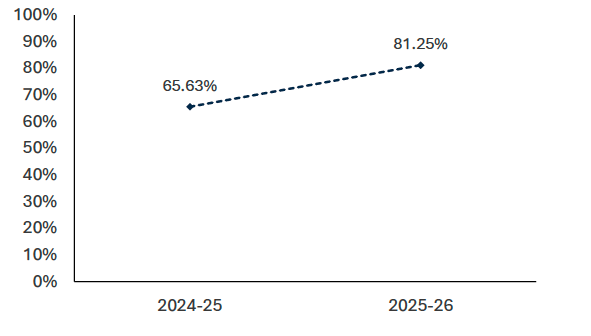
As of April 2026, 26 of 32 local authorities are covered by active adaptation partnerships or collaborations. This represents 81% of local authorities in Scotland, and an increase from 21 active partnerships reported in March 2025 (66% of local authorities in Scotland). Regional Adaptation Partnerships are a key driver of place-based adaptation. There are currently 10 active partnerships at various stages of maturity. These are summarised in the table below:
| Mature partnership | Developing partnership | Establishing partnership |
|---|---|---|
| Highland Adapts | Climate Hebrides | Argyll and Bute |
| Climate Ready Aberdeen | Climate Ready South East Scotland | Dumfries and Galloway |
| Climate Ready Aberdeenshire | Climate Ready Tayside | Forth |
| Climate Ready Clyde | N/a | N/a |
Between April 2025 and April 2026, the Adaptation Scotland programme has continued to support the establishment of a new adaptation partnership in Tayside, completing its move to a developing partnership by the end of the year. Establishment support has been given to the three new collaborations, Argyll and Bute, Forth and Dumfries and Galloway as they take the first steps in forming their partnerships. All three have benefitted from Scottish Government funding to develop business cases, investigate appropriate governance models and undertake stakeholder engagement.
Climate Ready Clyde, the most mature partnership, has taken a step towards delivery in 2025/26 with additional funding from Scottish Government allowing 10 on the ground adaptation projects to be trailed. These include pilot community property level flood resilience measures, raingardens and natural flood management. In addition, the funding has allowed a project pipeline for the next 5 years to be developed.
Highland Adapts used the Climate Ready Regions funding from Scottish Government to complete a comprehensive Climate Change Risk and Opportunity Assessment for the Highland Region, engaging over 50 participants from public, private and community sector organisation in its development.
The Climate Ready South East Scotland partnership also received Climate Ready Regions funding from the Scottish Government, using it to develop a Regional Adaptation Investment Portfolio, investigate preferred options for a sustainable partnership model aligned with wider regional governance structures, and work to resolve priority knowledge gaps the interactions between climate risk and health inequalities.
The Adaptation Scotland programme hosted the second Climate Ready Regions Gathering in February 2026, bringing together all the regional collaborations in Scotland to share knowledge and experience, gather insights and network.
C2.1 – Proportion of adults viewing climate change as an immediate and urgent problem
Description: This indicator shows the percentage of adults in Scotland viewing climate change as an immediate and urgent problem
Data source: Scottish Household Survey
Ambition: Increasing over time
Actual trend: Too early to say
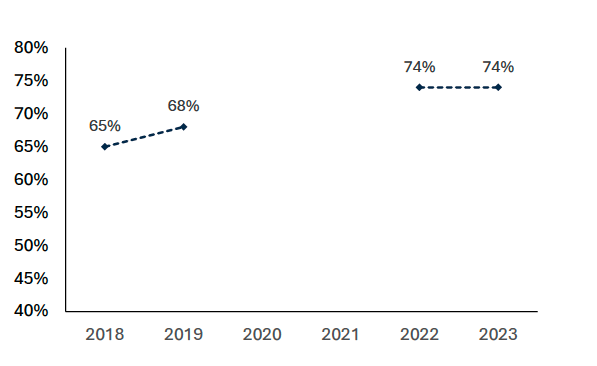
Note: data for this indicator has not been updated since the 2025 annual progress report. The data for 2025 will be available in late 2026 and included in the 2027 annual progress report.
In 2023, 74% of adults agreed that ‘climate change is an immediate and urgent problem’. There was no change in this figure between 2022 and 2023. However, the figure maintaining at 74% represents a marked increase from 2013 (46%), the first data point in this time series. Since data for this indicator has not been updated since 2023, it is too early to report on the trend since SNAP3 implementation in 2024.
While not a direct measure of awareness of climate impacts and risks, this indicator provides a general measure of public awareness of climate change.
C2.2 – Level of adaptation action being taken by people in Scotland
Description: This indicator highlights the proportion of adults in Scotland taking various types of actions to adapt to the impacts of climate change
Data source: Scottish Climate Survey
Ambition: Increasing over time
Actual trend: Too early to say
Note: data for this indicator has not been updated since the 2025 annual progress report. 2026 data will be available in 2027.
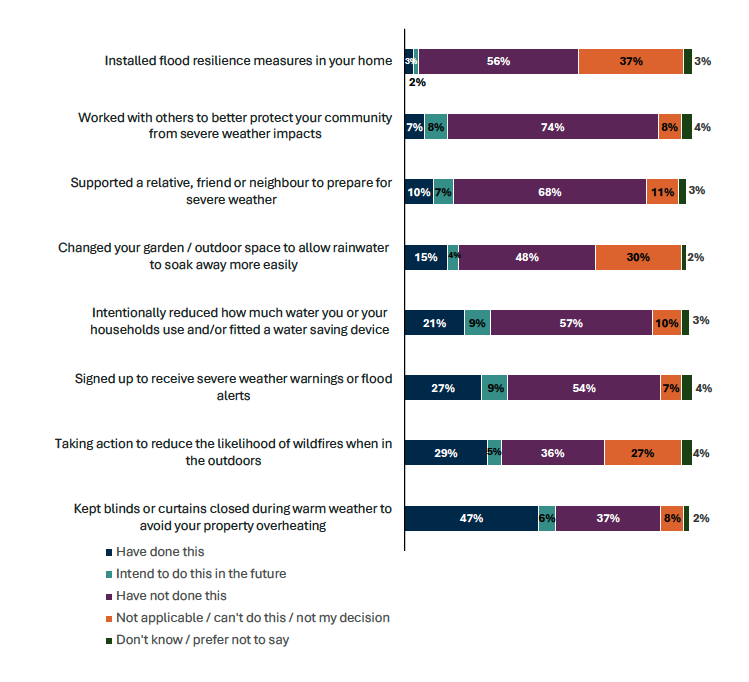
Data from the 2024 Scottish Climate Survey highlights that more than seven in ten (72%) of adults in Scotland reported taking at least one of the actions highlighted. These actions have been selected as key actions people in Scotland can take to adapt to climate change related impacts, such as those arising from severe weather events.
The most common action was keeping blinds or curtains closed during warm weather, with almost half of respondents (47%) reporting they had done this. The next most common adaptation actions were action to reduce the likelihood of wildfires when in the outdoors (29%), signing up to receive severe weather warnings or flood alerts (27%), and intentionally reducing how much water they or their household use and/or fitting a water saving device (21%). Fewer reported that they had changed their garden or outdoor space to allow rainwater to soak away more easily (15%), supported a relative, friend or neighbour to prepare for severe weather (10%) or worked with others to better protect their community from severe weather impacts (7%). Just three per cent of households said they had installed flood resilience measures in their home.
The 2024 survey was the first wave of the Scottish Climate Survey. This indicator will be updated using time series data when future waves of the survey report on this question. The next update is due in 2027 and will provide 2026 data. Since there is currently only one data point, it is not yet possible to report on trends for this indicator.
The survey also provides a range of other data around people’s experiences of, and behaviours around, severe weather and adaptation actions. The full report from the Scottish Climate Survey and data tables are available here.
C3.1 – Number of people using flood forecasting and warning services
Description: This indicator measures the number of users in Scotland accessing flood forecasting and warning services. This is measured by:
- Number of people using website services
- Number of people registered for Floodline
Data source: SEPA
Ambition: Increasing over time
Actual trend: Too early to say
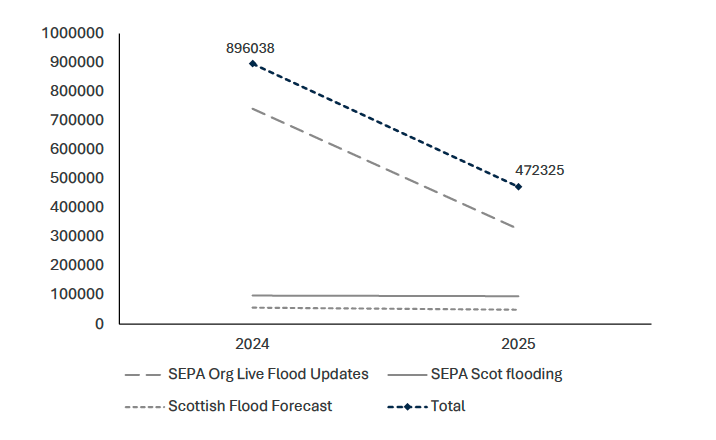
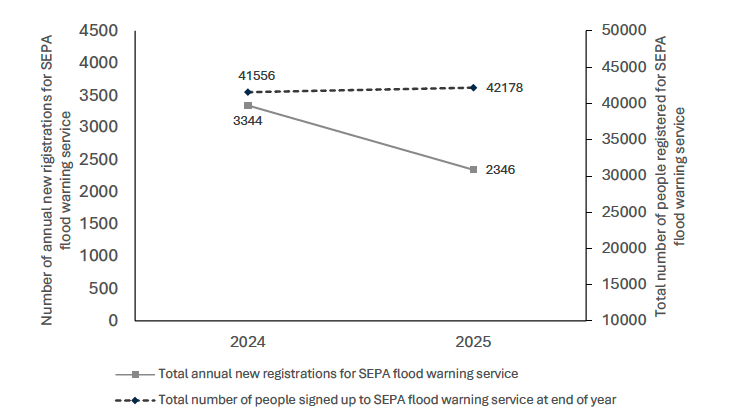
In 2025, SEPA had 472,325 views to their flood related SEPA websites, compared to 896,038 in 2024. This included 49,455 views to Scottish Flood Forecast, 96,043 views to SEPA Scot flooding, and 326,827 views to SEPA Org Live Flood updates. This decrease is likely to be a direct consequence of water scarcity conditions in 2025, particularly impacting eastern Scotland. 2025 was the hottest Scottish summer period (March-August) since records began. The hydrological year (October 2024 - September 2025) was the driest in eastern Scotland since 1976.
Significantly less flood warning messages were issued (55% reduction) by SEPA in 2025 compared to 2024. Despite this, at the end of 2025, 42,178 people were registered on the Floodline service, a 0.9% overall increase on 2024.
Registration and visits to flood related SEPA websites can be related to targeted media campaigns and following the occurrence of flooding events or in advance of expected flooding. Increases in website views during severe weather events are typical. Signing up to receive flood forecasting and warning services is a key action people can take to increase their preparedness for flooding events. Data on both metrics will continue to be collected and monitored annually, to allow a longer-term trend to begin to be tracked over the SNAP3 period and beyond.
C3.2 – Proportion of adults who would offer support to people in their community during an emergency, such as a flood, who may not cope well
Description: This indicator shows the percentage of adults in Scotland who agree that in an emergency, such as a flood, they would offer to help people in their neighbourhood who might not be able to cope well
Data source: Scottish Household Survey
Ambition: Increasing over time
Actual trend: Too early to say
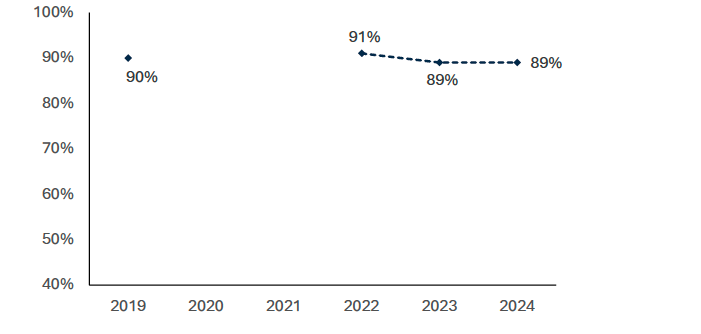
This indicator has remained broadly stable over time since 2019. Trend data is not yet available since the publication of SNAP3 in 2024. In 2024, 89% of adults in Scotland reported that they would offer support to people in their community during an emergency, such as a flood, who may not cope well.
While capturing intention, rather than action taken, this suggests a high level of community support for vulnerable people during severe weather events such as flooding.
C3.3 – Availability of flood insurance
Description: This indicator provides a measure of the proportion of householders with prior flood claims who can receive quotes from 5 or more insurers through Price Comparison websites (figures provided by FloodRe scheme)[38]
Data source: Flood Re
Ambition: Maintaining over time
Actual trend: Maintaining
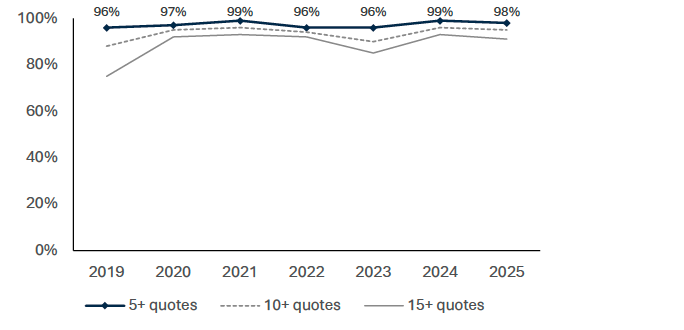
Flood Re is a re-insurance scheme that aims to make flood cover more widely available and affordable as part of home insurance. It supports people at the highest risk of flooding, including those with past flooding related claims. Availability of insurance is important in increasing a household’s resilience to flooding.
The proportion of high risk households able to access quotes from insurers has remained broadly stable since 2024. 98% of high-risk households with claims were able to obtain 5 or more quotes from insurers through the Flood Re scheme in 2025. This compares to 99% in 2024. In addition, high proportions of high risk households with flood claims were able to obtain quotes from 10 or more insurers (95%) and 15 or more insurers (91%). This represents an increase from 2019, when 75% of high-risk households with flood claims were able to obtain 15 or more quotes. In the same year 88% of high-risk households with flood claims could obtain 10 or more quotes and 96% could obtain 5 or more quotes.
In January 2016, prior to Flood Re’s existence, a baseline measurement showed that 38% of those with recent flood claims in could not obtain any insurance quotes, and for the 62% who could get a quote from 1 or more insurers, the average premium quote price was about £4,400. Only 9% could obtain quotes from 2 or more insurers, and no households could obtain 5 or more quotes.
C4.1 – Proportion of dwellings with urgent disrepair to critical elements
Description: This indicator shows the percentage of dwellings in Scotland with urgent disrepair to critical elements
Data source: Scottish House Condition Survey
Ambition: Decreasing over time
Actual trend: Too early to say
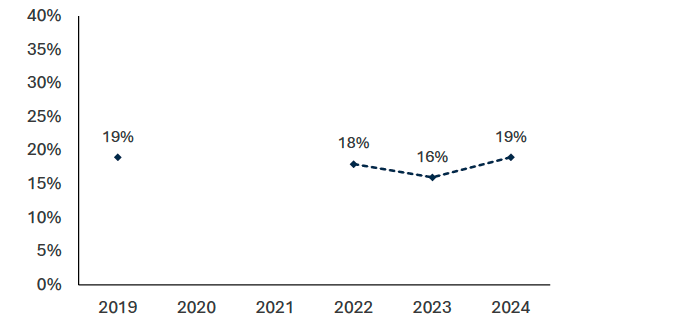
There proportion of dwellings with urgent disrepair to critical elements has remained broadly stable since 2019. Trend data is not yet available since the publication of SNAP3 in 2024. In 2019, an estimated 19% of dwellings had urgent disrepair to critical elements. The same proportion (19%) were found to have urgent disrepair to critical elements in 2024.
New buildings which are better designed or existing buildings which are better maintained should be less vulnerable to extreme weather events.
C5.1 – Historic Environment Scotland grant applications including adaptation measures
Description: This indicator shows the proportion of Historic Environment Scotland grant applications funded that include adaptation measures
Data source: Historic Environment Scotland
Ambition: Increasing over time
Actual trend: Too early to say
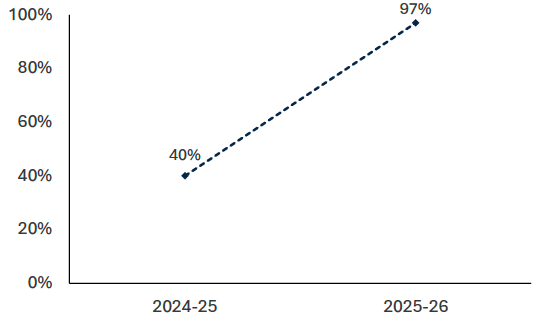
In 2024-25, 25 of 62 (40%) grant applications referenced climate change. In 2025-26, this figure increased to 88 of 91 (97%) grant applications.
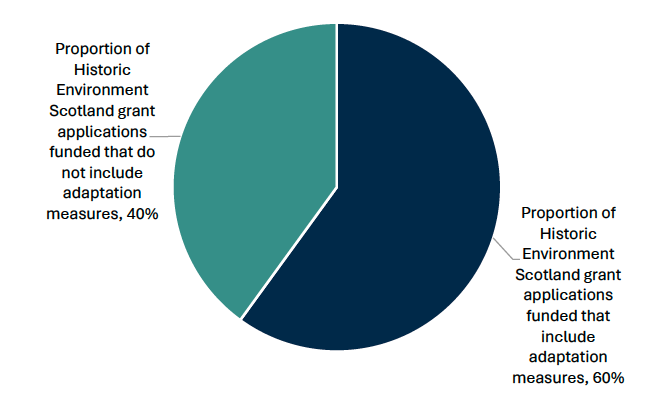
Across the four grant programmes (City Heritage Trusts; Historic Environment Grants; Partnership Fund; and Heritage and Place) in 2025-26, 60% of applications referenced adaptation. This figure will be monitored on an annual basis going forward, allowing an assessment of the trend being seen to be made from 2026-27 onwards.
Historic Environment Scotland Grants are one of the key funding sources for Scotland’s historic environment and assets. All capital repair projects have delivered at least one adaptation measure in the reporting financial year. Expanding HES reporting to include capital repair grants is helpful to illustrate the interventions delivered to physical assets. According to assessment criteria developed and applied by HES Climate Change and Grants Teams, 3 of 3 capital repair grants (100%) which completed technical development in 2025-26 demonstrated adaptation measures, with 11 of 11 capital repair grants (100%) in 2024-25.
For future reporting it is anticipated that the extent of benefit of the adaptation may be indicated, as the above data suggests most if not all repair projects will include some form of adaptation as a matter of course. This is because deterioration to buildings or monuments is often driven by the effects of weather and climate, increasingly felt through recent trends. The HES Grants Team will look to develop a methodology for assessing this consistently over the course of 2026-27.
C6.1 – Number of local authority Coastal Change Adaptation Plans published
Description: This indicator describes the number of local authority Coastal Change Adaptation Plans (CCAP) published
Data source: Scottish Government
Ambition: Increasing over time (until a plan is in place for all 24 local authorities with an erodible shoreline)
Actual trend: Increasing over time
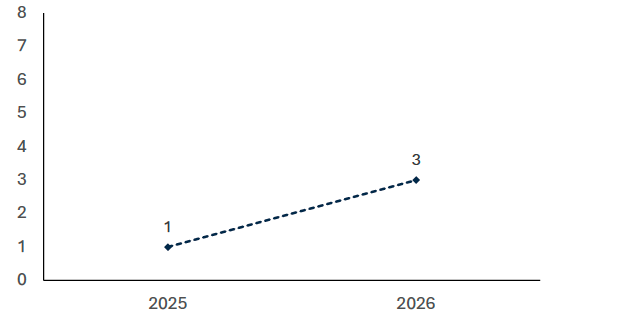
Coastal Change Adaptation Plan guidance was published in February 2023. Since then, three local authorities have published a CCAP. An additional fourteen local authorities are currently working on a CCAP.
24 local authorities have an erodible shoreline and have received funding for a Coastal Change Adaptation Plan. Coastal Change Adaptation Plans are a key mechanism for coastal resilience and adaptation actions across Scotland.