
Scotland's Climate Change Plan: 2026–2040
This Climate Change Plan (CCP) sets out the policies and proposals we will take forward to enable our carbon budgets to be met between 2026 and 2040.
Annex 2 – Sectoral Annexes
Contents
- Buildings (Residential and Public)
- Transport
- Waste
- Energy supply
- Business and Industrial Process
- Agriculture
- Land Use, Land Use Change and Forestry (LULUCF)
- Nature and Biodiversity
- Marine
Buildings (Residential and Public)
Introduction
A transformational change to the way in which we heat our residential and public buildings is essential to meet our net zero target – transitioning to clean heating by 2045 and reducing the energy required for heating.
Achieving this will depend on making the journey as smooth as possible by supporting consumers, especially those who need that support the most, and by helping people to understand and smoothly navigate the transition to clean heat.
We must do this while continuing to reduce fuel poverty and allowing for technological development. An approach which supports a range of clean heating technologies based on what is best for a particular home, location or set of circumstances will give property owners control over the decisions that affect their lives. It will also accommodate Scotland’s differences in geography as well as across our homes and buildings. Almost 20% of Scotland’s dwellings were constructed before 1919,[60] so special consideration will be given to retrofitting traditional buildings.
Meanwhile, the Fuel Poverty (Targets, Definition and Strategy) (Scotland) Act 2019 continues to commit the Scottish Government to reducing fuel poverty. The latest official 2024 figures at the time of this document’s publication estimate that 732,000 households in Scotland (29%) are living in fuel poverty and 357,000 (14%) are living in extreme fuel poverty.[61]
While the key levers for reducing fuel poverty such as energy pricing and market reform sit with the UK Government, the Scottish Government must find the right balance to both reach net zero by 2045 and reduce fuel poverty.
The heat transition will require around 1.9 million homes and 14,000 public buildings to move to clean heating systems such as heat pumps and heat networks by 2045. We must rapidly accelerate the number of heating systems converting to clean heat as we move towards and then into the next decade.
We also require important decisions and actions from the UK Government in key reserved policy areas which will be vital to Scotland’s progress. The UK Government’s Warm Homes Plan was published in January 2026; however, it did not fully address these issues and we continue to engage with the UK Government on these matters.
We are setting a target for decarbonising heating systems by 2045, so far as reasonably practicable – giving people long-term certainty and time to plan, adapt and adjust. We are also developing means to boost heat network development through the potential use of powers to require certain properties to change from fossil fuel heating systems when they have the opportunity to connect to a heat network. We set out these plans to the Scottish Parliament on 18 November 2025 and published a draft Buildings (Heating and Energy Performance) and Heat Networks (Scotland) Bill.[62] The intention is to formally introduce the Bill early in the next Parliament, but that will be subject to the outcome of the election.
We will prepare a new heat decarbonisation strategy and delivery plan, setting out the actions that Ministers intend or consider necessary to ensure that the decarbonisation target is met. This will provide further clarity on future expectations of how our buildings are heated and help to stimulate the clean heat market – progressing property owner demand and encouraging the clean heat supply chain.
Scottish Government investment and policies to increase energy efficiency can reduce emissions but also play an important part in reducing energy bills and fuel poverty. The change to clean heat is the primary driver for reducing and removing emissions, but measures to improve energy efficiency can make those clean heating systems more effective while using less energy.
That determination to reduce fuel poverty is why we are planning to create powers to set minimum energy efficiency standards for owner/occupier and non-domestic properties, subject to further consideration. We are also developing a minimum energy efficiency standard in the private rented sector, decisions upon which will follow after the Scottish election.
We will continue to provide advice and support for property owners (such as grants and other financial support) related to energy efficiency and clean heating. However, the Scottish Government cannot fund the clean heat transition alone. We will, therefore, continue to work with lenders to foster market conditions that support a wider range of private lending products.
Because we expect the cost of the clean heat transition to decrease over time as these technologies become more established, and as economies of scale are realised in Scotland and wider UK, we will continue to target support towards those who need it the most.
Our New Build Heat Standard is preventing future emissions at source and avoiding costly retrofitting later. We are reforming Energy Performance Certificate (EPC) regulations and the operational governance framework. These will give people better information on how to improve the energy efficiency of their buildings and reduce emissions from their heating systems. We have also published interim guidance for the social housing sector.
Helping people understand which measures are appropriate for their properties and giving them confidence in the quality of work remains important. That is why we continue to provide free advice to all through our Home Energy Scotland Advice Service (and Business Energy Scotland Advice Service). We will also continue our engagement, for example through roundtable events with installers and training providers, to ensure that the provision of skills support matches need as the number of clean heat installations increases.
Making the change to new and clean heating systems represents a major shift and many will feel apprehensive about what this means. That is why we will work hard to make the process as smooth as possible – to provide advice and support wherever it is needed and to help people feel confident about navigating the process.
We also believe that the transition can be achieved in a way that is consistent with our determination to reduce fuel poverty, and that clean heat – combined with further action that we believe the UK Government must take to reduce electricity prices – will enable people to heat their homes comfortably and affordably.
Context and Wider Alignment
A just transition to net zero will mean that we must decarbonise the heat in our residential and public buildings while also reducing fuel poverty. However, many households, families and businesses across Scotland continue to face difficult financial circumstances exacerbated by fuel prices.
We will draw on the Fuel Poverty Panel’s recommendations[63] in response to our Periodic Report on Tackling Fuel Poverty 2021-24[64] to ensure that a future strategy meets the ambitions and challenges of tackling fuel poverty, as we undertake our duties under the Fuel Poverty Act 2019.
Instead of prohibiting the use of gas and other fossil fuel heating systems by every homeowner, we are setting a target for decarbonising heating systems by 2045. This target will be set through legislation in the draft Heat in Buildings Bill.[65] This signals the importance of the transition to clean heat while being realistic and practical, allowing us to continue to support those for whom cost pressures remain a significant challenge.
Many of the enablers essential for a just and fair heat transition are reserved. The UK Government published its Warm Homes Plan earlier this year. This was a missed opportunity to set out how it intends to rebalance gas and electricity prices and reform the electricity market in ways which significantly reduce the running costs of clean heating systems. Progress in this area is critical and will be one of the most important factors in driving uptake and ensuring people can make the transition without exacerbating fuel poverty. We call strongly on the UK Government to make these important changes and we regret that the powers to do so do not lie in Scotland.
Multiple key stakeholders, including the Climate Change Committee (CCC), have underlined the vital importance of steps to make electricity more affordable. This will be essential to ensure that the heat transition also supports efforts to tackle fuel poverty, with several studies demonstrating the positive effects that clean heat could have on energy bills should steps be taken to make electricity more affordable.
The transition to clean heat also offers significant economic opportunities. A Scottish Enterprise study in 2024 estimated that the Scottish clean heat sector generated £1.66 billion of turnover annually in the previous financial year, contributing £0.69 billion of gross value added per annum to the Scottish economy. According to the definitions used in this study, the sector consists of over 470 companies, with 8,300 direct employees. The sector has experienced significant growth over the past three years, with employment increasing by 68%, turnover by 52% and GVA by 69%.[66]
We continue work to improve the evidence base for the built environment and construction sectors’ Just Transition Planning, including workforce analysis of the construction sector and work with the Construction Leadership Forum to develop a Construction Industry Net Zero Route Map.
The CCC’s 7th carbon budget[67] highlights the urgent need for the industry to develop a workforce with the skills to design, install, and service heat pumps at scale.
The Climate Emergency Skills Action Plan[68] identified retrofit and heat decarbonisation as key areas for green job growth. Building Skills for Net Zero in Scotland research[69] carried out in 2021 estimated Scotland will need an additional 22,500 workers by 2028 to meet the CCC's balanced pathway, particularly focused in retrofitting and heating.
The Green Jobs Taskforce report[70], published in 2021, identified the need for reskilling in sectors at risk, including fossil fuel heating, and a need for the majority of the current heating system installers to upskill to be able to install heat pumps. This requires significantly different skills, for example knowledge in heat loss calculations, hydraulic balancing, flow temperature calculations and heating system sizing.
We are addressing this need by piloting a new Heat Pump Skills Fund. Launched in 2025, and continuing in 2026, the Fund supports upskilling of existing heating engineers and plumbers in heat pump installation. The Fund is delivering across Scotland, including remote and rural communities via a mobile training van, and will help test industry interest so that the Fund can be further developed in line with increasing consumer demand for clean heat systems.
Our Vision
Our vision for 2040 is that, as a result of a shift to clean heating systems, our homes and buildings will be warmer, comfortable and more affordable to heat. We will have greatly reduced emissions and made a vital contribution to tackling climate change.
The transition will also help deliver against one of our key objectives, tackling and reducing fuel poverty. Our proposed minimum energy efficiency standards will have made significant progress in making it more affordable for Scotland’s homes to remain comfortably warm, reducing the number of households in fuel poverty.
Our economy will have experienced significant growth in jobs and turnover right across the country, ensuring that Scottish businesses throughout the supply chain and private lending sector benefit fully from Scotland’s development of a thriving market for installing clean heat and energy efficiency measures.
By 2040, our vision is for Scotland’s economy to have fully captured the significant opportunities of the clean heat transition. Through our efforts to build investor confidence and foster a supportive investment environment, businesses across Scotland — including those in the private lending sector and throughout the supply chain — will drive growth in jobs and turnover.
Heat networks will be a key part of the technology mix in the buildings sector and we will meet our statutory target for heat network deployment by 2035.
Progress since the Climate Change Plan update
The Scottish Government has made significant progress since the publication of the Climate Change Plan update (CCPu),[71],[72] working within a challenging budget settlement while tackling a cost-of-living crisis and related increase in fuel poverty rates.
Emissions for this sector have reduced by 39% since 1990 to 6.0 MtCO2e in 2023,[73] while an estimated 56% of homes are now rated EPC C or better – already an increase of 11 percentage points since 2019.[74] In order to meet our carbon budgets, emissions for this sector must be reduced to 28.8 MtCO2e for 2026-2030, 26.6 MtCO2e for 2031- 2035 and 18.0 MtCO2e for 2036-2040.
Our New Build Heat Standard, introduced in April 2024, will continue to ensure that new buildings are constructed with either zero or negligible direct emissions from the main heating systems. Scotland was the first nation in the UK to take this decisive step. This leadership demonstrates our determination to future-proof our building stock, provide certainty to industry, and align new development with our 2045 net zero target.
We are introducing revised Energy Performance Certificate (EPC) regulations and a new EPC operational governance framework to improve consumer confidence.
In conjunction with EPC reform, we are consulting on the development of a more detailed, bespoke Heat & Energy Efficiency Technical Suitability Assessment to help ensure people have access to the right information about which measures are technically suitable to install and which are not – particularly for more challenging buildings like tenements or historic buildings.
We have also consulted on proposals for a Social Housing Net Zero Standard and will continue to liaise with our partners in the social housing sector before confirming next steps. In the meantime, we have published interim guidance.
Key progress is summarised below:
- We introduced our New Build Heat Standard (NBHS) in 2024, ensuring that new homes and buildings have climate-friendly heating systems.
- We allocated £1.67 billion of funding through our Heat in Buildings schemes this parliamentary session. We have a broad range of delivery programmes, including our Home Energy Scotland Grant and Loan scheme, fuel poverty schemes and a range of funding support for public buildings, social housing and heat networks.
- Since the start of this parliamentary session, Heat in Buildings programmes have supported on average 15,000 households annually, including those in or at risk of fuel poverty.
- We set up the Green Heat Finance Taskforce to explore innovative financing solutions. The Taskforce has published two reports - Part 1 focused on solutions for individuals and Part 2 focused on place-based solutions, development of heat networks and financing social housing retrofit. We published our response to these recommendations last year.[75]
- We have funded the Green Heat Installer Engagement Programme, including the Low Carbon Skills Grant and a mobile heat pump training centre which helps ensure that remote and island communities have access to training opportunities.
- We established a Heat Network Support Unit (HNSU) in 2022[76] which has formally supported 55 pre-capital projects in 18 local authority areas, with the Scottish Government committing approximately £3.2 million of financial support.
- Scotland’s Heat Network Fund (SHNF) launched in 2022, has, to date, awarded approximately £14.5 million to seven heat network projects in Scotland.
- All 32 local authorities in Scotland have published Local Heat and Energy Efficiency Strategies (LHEES), providing evidence of the interventions needed to decarbonise Scotland’s buildings and where these buildings are located.
- Permitted development rights relating to renewable energy equipment installation were amended and expanded in 2024. We consulted on further amendments to PDR, and the consultation report has now published.[77] While the further amendments will not be taken forward this parliamentary term, this will be considered post-election.
Several policies first outlined in the CCPu continue to play a role in decarbonising heat – more detail can be found later in this chapter:
- Heat in Buildings Programme delivery schemes (including Area Based Schemes, Warmer Homes Scotland, Home Energy Scotland Advice Service, Home Energy Scotland Grant and Loan scheme),
- Heat in Buildings regulation, including mandatory minimum energy efficiency standards for the Private Rented Sector,
- Support for Heat Networks, and
- Urge the UK Government to rebalance levy costs on energy bills to make gas and electric systems more cost comparable.
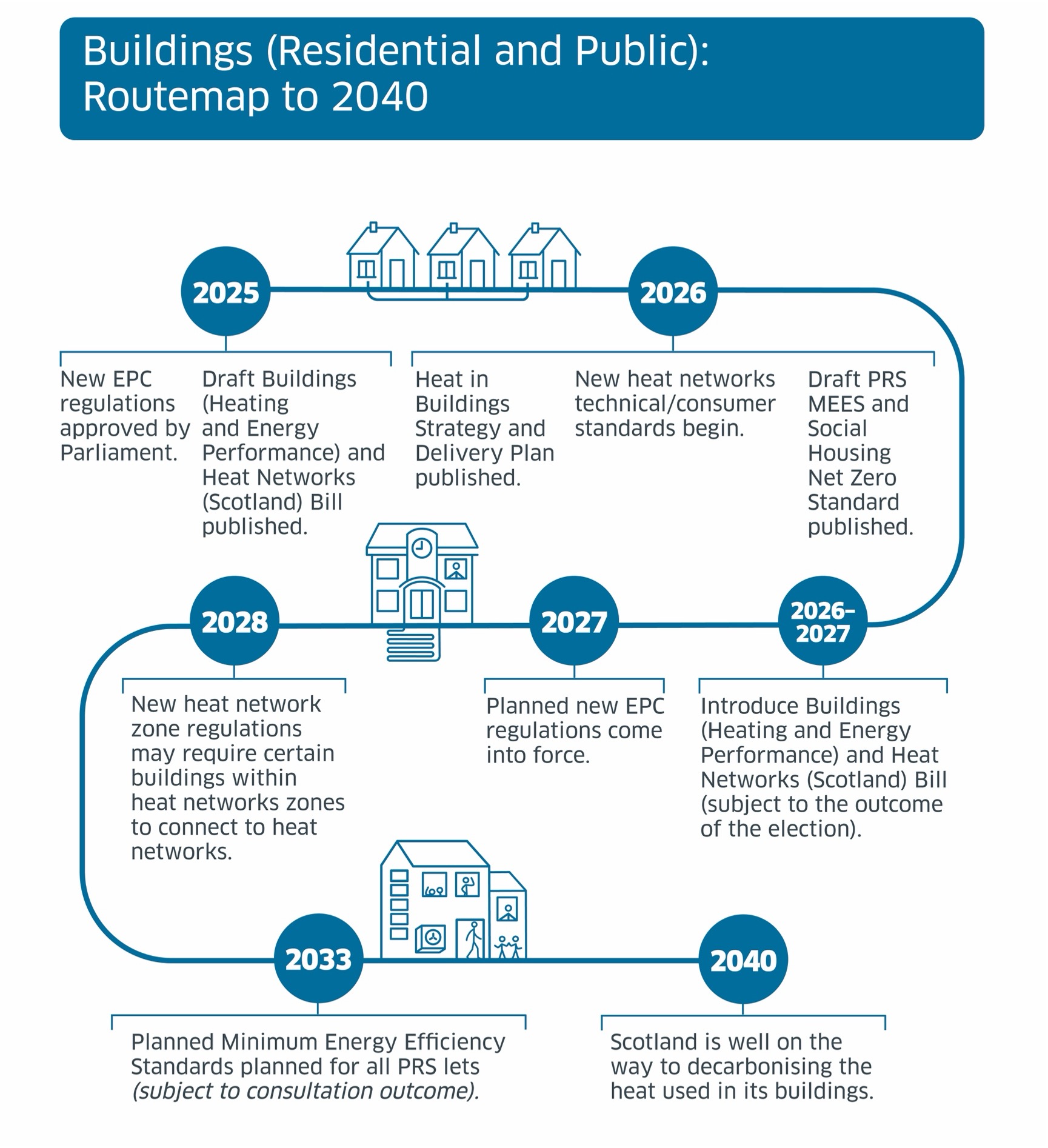
Buildings (Residential and Public): Routemap to 2040
- 2025
- New EPC regulations approved by Parliament
- Draft Buildings (Heating and Energy Performance) and Heat Networks (Scotland) Bill published.
- 2026
- Heat in Buildings Strategy and Plan published.
- New heat networks technical/consumer standards begin
- Draft MEES and Social Housing net Zero Standard published
- 206-2027
- Introduce Buildings (Heating and Energy Performance) and Heat Networks (Scotland) Bill (subject to the outcome of the election).
- 2027
- Planned new EPC regulations come into force.
- 2028
- New heat network zone regulations may require certain buildings within heat networks zones to connect to heat networks.
- 2033
- Planned Minimum Energy Efficiency Standard planned for all PRS lets (subject to consultation outcome).
- 2040
- Scotland is well on the way to decarbonising the heat used in its buildings.
Actions We Will Take to Achieve Our Vision
Below, we describe our policies and proposals which will deliver clean heat alongside our objectives of reducing fuel poverty. We also describe the approach (both legislative and enabling) on heat networks. Although many of these policies and proposals are relevant to multiple outcomes, they are listed under the most relevant outcome.
Outcome 1: The heat supply to our homes and non-domestic buildings is very substantially decarbonised, with high penetration rates of renewable and zero emissions heating.
A target for decarbonising heating systems
(Also relevant under Outcome 3)
We are setting a target to decarbonise buildings by 2045, consistent with the need to reduce emissions as set out in this Plan. By establishing and confirming a target for decarbonising heating systems by 2045, where reasonable and practicable to do so, we are sending a strong signal to homeowners, landlords and other building owners on the need to prepare for change. We published the Draft Buildings (Heating and Energy Performance) and Heat Networks (Scotland) Bill, and will also publish, by the end of 2026, a Heat in Buildings Strategy and Delivery Plan which sets out the actions on the part of the Scottish Government and others which will be designed to enable and achieve this target (see below).
Social Housing Net Zero Standard
(Also relevant under Outcomes 2 and 3)
We will review and complete work on our Social Housing Net Zero Standard in line with progress on the areas above – taking into account the standards and requirements established for other tenures through separate regulations.
Delivery schemes
(Also relevant under Outcomes 2 and 3)
We will continue to deliver a programme of support schemes and advice services which are designed to support a wide range of groups to decarbonise heat in our buildings.
Over the period of the Spending Review, we are allocating £1.3 billion to heat in buildings, further to the £1.67 billion allocated over this parliamentary session.
We recognise that the significant cost of moving to clean heating cannot be funded by the public purse alone. These support mechanisms will provide a platform for future progress, and will evolve alongside the role of private investment and finance.
These schemes include:
Home Energy Scotland (HES) Advice Service – a domestic advice service that acts as a single point of access for free, bespoke, impartial advice on energy efficiency, renewable heating and fuel poverty support in Scotland. The service supported 95,000 households from April 2024 to March 2025.
Home Energy Scotland Grant and Loan – support open to all owner-occupied domestic households in Scotland. It provides up to £7,500 as a grant and £7,500 as an interest free loan for the installation of a heat pump as well as funding for energy efficiency measures. An additional £1,500 is available for both the clean heating and energy efficiency grants for households eligible for the rural uplift. From April 2023 until December 2025, the scheme has funded the installation of over 6,500 heat pumps.
Area Based Schemes (ABS) – local schemes which are designed and delivered by councils, often with utility companies and other local partners such as Housing Associations. ABS funding helps property owners meet most or all of the costs of providing energy efficiency measures to households in or at risk of fuel poverty. This has helped over 125,000 households to make their homes warmer and more energy efficient since 2013.
Warmer Homes Scotland (WHS) – our national fuel poverty scheme, designed to help those living in fuel poverty or at risk of fuel poverty through installing insulation and heating measures into individual properties. Since the launch of the first Warmer Homes Scotland scheme in 2015, the scheme has invested around £440 million and helped over 50,000 households across Scotland to live in warmer, healthier homes which are more affordable to heat.
Private Rented Sector Landlord (PRS) Loan – a scheme that provides loan funding to private registered landlords to enable them to invest in improving the energy efficiency of their properties and install clean heating systems. The scheme has paid out over £1.9 million since its launch in 2020.
Business Energy Scotland (BES) – a non-domestic advice service that offers free specialist advice and support to small and medium sized enterprises, charities and non-for-profit organisations on implementing energy efficiency and heat decarbonisation measures with the aim of cutting carbon emissions and reducing energy costs.
SME Loan and Cashback Scheme – a scheme aimed at supporting small and medium sized enterprises, charities and not-for-profit organisations to implement energy efficiency or renewable measures. The scheme provides unsecured, interest free loans of up to £100,000, as well as cashback grants of up to £30,000.
Social Housing Net Zero Heat Fund – a Fund designed to accelerate the delivery of energy efficiency and clean heat to existing social housing. The Fund supports the social housing sector to achieve energy efficiency and clean heat standards in social housing projects across Scotland.
Public Sector Decarbonisation Support – the following support mechanisms are in place to help public bodies decarbonise heat and improve energy efficiency in existing public sector buildings:
- The Scottish Public Sector Energy Efficiency Loan Scheme is delivered by Salix Finance on behalf of the Scottish Government. The Loan Scheme offers zero-interest loans of up to 75% of the total project value to support local authorities, universities and arm’s length external organisations to undertake spend-to-save energy efficiency improvement projects that generate financial and emissions savings for public bodies.
- The Scotland Recycling Fund, as part of the Loan Scheme, is a ringfenced fund held by the eligible public body. It is created using capital provided by the Scottish Government via Salix and is equally matched by the public body. This scheme aims to increase long-term investment in energy efficient technologies by allowing financial savings achieved through completed projects to be reinvested in further eligible projects year on year, hence the term ‘Recycling Fund’.
- Scotland’s Public Sector Heat Decarbonisation Fund is also delivered by Salix Finance on behalf of the Scottish Government. The Fund offers capital grants to support public bodies in progressing ‘whole building’ approach projects that decarbonise heating systems and improve the energy performance of their buildings. Phase 3 of the Fund launched on 2 March 2026 and brings together previously separate grant offers into a single, streamlined Fund accessible to all public bodies in Scotland. Funding is offered at an intervention rate of up to 80% of eligible project costs for local authorities, universities and arm’s length external organisations and up to 100% for central government organisations who do not have access to borrowing funds for this type of work.
- The Scottish Public Sector Non-Domestic Energy Efficiency (NDEE) Framework was designed to support public and third sector organisations to procure energy efficiency retrofit work, and Project Support Unit (PSU) exists to support public bodies to call off from the NDEE Framework and assist the subsequent project through to completion. (The Scottish Government is currently redeveloping the NDEE and PSU Frameworks as the previous contracts came to an end in 2024).
Heat Networks
New heat network proposals
(Also relevant under Outcome 3)
Heat networks can help reduce greenhouse gas emissions and energy bills to help tackle fuel poverty. They are used extensively across Europe. Currently, heat networks supply only 1.5%[78] of heat in Scotland but are a key strategic technology for reducing emissions from heating our homes and buildings.
The Draft Buildings (Heating and Energy Performance) and Heat Networks (Scotland) Bill[79] sets out plans to boost heat network development. These include potentially requiring large, non-domestic premises to move away from fossil fuel heating systems when they have the opportunity to connect to a heat network. The draft Bill also includes plans to introduce powers to create a new licensing system for heat network operators across Scotland which, if an application is approved, will provide new rights and powers like access to the roads which will reduce the time and cost associated with constructing and maintaining heat network projects.
We will continue to support the development of these heat networks through funding and advice, such as our two existing schemes, Scotland’s Heat Network Fund and our Heat Network Support Unit. We are also exploring how we can support the key role that the private sector will play by investing in heat network opportunities.
Heat Network Support Unit (HNSU)
(Also relevant under Outcome 3)
The HNSU supports the development of heat network projects. It does this by offering grant funding and expert advice throughout the pre-capital stages of development. We are working on building a project pipeline to meet our targets and to build capacity within the public sector to lead on, invest in and deliver heat network projects.
The HNSU offers grant funding for feasibility studies, outline business cases and strategic heat network support for local authorities. Support is tailored to the project needs, focused on engagement and co-ordination. Projects supported by the HNSU can be found in the Heat Networks Quarterly Reports.[80] Following project development funding from the HNSU, a heat network project may be capital ready.
Scotland’s Heat Network Fund (SHNF)
(Also relevant under Outcome 3)
SHNF offers capital grants to businesses and organisations in the public, private and third sectors to develop heat network projects. It aims to support the roll-out of zero emission district heat networks and communal heating systems.
SHNF supports:
- new low or zero direct emissions district heat networks or communal heating systems,
- the expansion of existing district or communal heating systems where the heat demand of the extension as a minimum is supplied by a low or zero direct emissions heat source, and
- the decarbonisation of existing district heat networks or communal heating systems where a zero direct emissions heat source replaces an existing polluting heat source.
Due to the long development and construction periods required to deliver some heat networks, continued investment in heat networks will be needed for the remainder of this decade. We have, therefore, recently announced that the SHNF will remain open to new applications until March 2030. This will maintain momentum of the heat network project pipeline and provide confidence to private investors.
Heat in Buildings Strategy and Delivery Plan
(Also relevant under Outcomes 2 and 3)
We will publish a new Heat in Buildings Strategy and Delivery Plan by the end of 2026, establishing a clear and credible pathway for heat decarbonisation to meet net zero. The Plan will detail the actions within the Scottish Government’s control, identify key delivery dependencies across sectors and levels of governance – including asks of the UK Government and the impact of its policies and decisions in Scotland. The Plan will set out our approach to delivery in full, including how the policies here will be taken forward and monitored. It will set out timelines and priorities in areas including skills and supply chain growth. It will be co-developed with stakeholders, articulating how we will work collectively to achieve our vision – across Scottish, UK and local government as well as with the private sector and individuals.
Outcome 2: Our homes and buildings are highly energy efficient, with all buildings upgraded where it is appropriate to do so, and new buildings achieving ultra-high levels of fabric efficiency
Financial support for energy efficiency
(Also relevant under Outcomes 1 and 3)
We will enable progress towards our goal of decarbonisation, while reducing fuel poverty, by continuing to provide targeted advice and financial support for energy efficiency measures in homes through schemes such as Warmer Homes Scotland, our Area Based Schemes, the Social Housing Net Zero Heat Fund and our Home Energy Scotland Grant and Loan Scheme (see above).
This will support the transition while targeting measures at those most at risk of fuel poverty. These measures will help reduce the cost of living pressures still being faced by too many.
Minimum energy efficiency standards
(Also relevant under Outcome 3)
We have published plans to give Scottish Ministers a regulation-making power to set minimum energy performance standards for buildings with direct emission heating systems.[81]
Minimum energy efficiency standards for the Private Rented Sector (PRS)
(Also relevant under Outcome 3)
We are analysing the responses to our consultation on a minimum energy efficiency standard (MEES) in the domestic private rented sector (PRS), which our consultation proposed could apply to new tenancies from 2028 and all tenancies from 2033. Further to decisions on the consultation outcome, we intend to progress regulations to introduce this MEES early in the next parliamentary term, subject to the views of the next Scottish Government. Analysis has suggested that all PRS homes installing certain measures could reduce emissions in PRS dwellings, across the sector as a whole, by around 5% (although this is dependent on behaviour, as some tenants may choose a warmer home for the same cost, rather than the same temperature at lower cost).
Energy Performance Certificate (EPC) reform
(Also relevant under Outcomes 1 and 3)
We need to enhance EPCs so that they continue to be a valuable source of information for home buyers, owners, and tenants. The Scottish Government consulted on proposals in 2023 to reform EPCs, in line with the CCC’s advice. These reforms would address long-standing criticisms from the CCC and others that EPC ratings are not aligned with net zero. We published our response to this consultation in January 2025 and provided a further updated Government response in October 2025. We laid revised Energy Performance of Buildings Regulations in October 2025 which were approved by the Scottish Parliament in December 2025. These were due to come into force in October 2026, but are now likely to be delayed into 2027, subject to the agreement of Parliament. The delay is due to the UK Government slowing down its timeline for EPC reform from October 2026 to the second half of 2027 – meaning that technical infrastructure (including the Home Energy Model and assessor training) will not be ready to support reformed EPCs as planned.
Our reforms will mean that domestic EPCs are clearer about how well-insulated a home is by providing new information on the Heat Retention Rating of the home (a rating based on the annual heat demand (kWh/m2) of the building). They will also highlight clearly whether key insulation measures (such as cavity wall and loft insulation) have been installed.
The reformed domestic EPCs will provide new information about the home’s current heating system through a new Heating System Rating. They will also continue to provide information on potential improvements that could be made to make the home more energy efficient and information on alternative cleaner heating systems. They will continue to provide a standardised rating to reflect the cost of running the home (the Energy Cost Rating) and show how potential improvements could reduce this cost.
We will make similar reforms to non-domestic EPCs so that they provide a clearer indication of a building’s performance relative to other buildings of the same type, and information about the building’s direct emissions and energy demand.
We are also reducing the validity period of EPCs from ten to five years to ensure that current and prospective building owners and tenants have more up-to-date and accurate information on the building’s energy performance as it transitions to net zero.
We have reviewed the operation and governance of the EPC assessor market to ensure that consumers (home and business owners/tenants alike) have full confidence in their EPC rating. The revised EPC regulations will bring into force a new operational governance framework to strengthen quality assurance requirements, including introducing a new onsite audit and inspection regime to enhance existing checks to ensure EPCs are accurate and reliable. We are also working with the UK Government and other devolved administrations to review the National Occupational Standards, which set the skills, qualifications and training requirements for EPC assessors who are able to operate across the UK internal market.
We are also developing the new technical infrastructure required to underpin the revised EPC regulations. We are working with the UK Government to develop a new EPC Register and calculation methodology to enable EPCs in Scotland to be generated using the UK Government’s new Home Energy Model, which will replace the current Standard Assessment Procedure (SAP) methodology when the revised regulations come into force.
Outcome 3: The heat transition is fair, leaving no-one behind and stimulates employment opportunities as part of the green recovery
Future finance, including the Green Heat Finance Taskforce (GHFT)
(Also relevant under Outcomes 1 and 2)
The independent Green Heat Finance Taskforce reports identified key barriers to the scale up of private finance provision. These barriers included a lack of consumer demand, and a shortage of a delivery ready project pipeline for initiatives to upgrade groups of properties collectively. However, it expressed confidence that the supply of private lending would increase to match consumer and project demand.
We responded to the Taskforce last year,[82] setting out the early actions that we have already progressed to raise understanding of the current clean heat financing landscape amongst mortgage advisors who engage directly with consumers, as well as steps that we will take to explore the potential to create a market for innovative financing approaches. As we do this, we will work with lenders and the UK Government given the UK-wide nature of financing markets and regulation.
Local Heat and Energy Efficiency Strategies (LHEES)
(Also relevant under Outcome 1)
Local authorities have now published their first LHEES. The LHEES strategies and delivery plans have provided both local authorities and the Scottish Government with invaluable understanding of the local context across Scotland. These identified a range of opportunities. For example, over 300 potential large-scale heat networks were identified which could – if fully developed – supply over 15 TWh per year of low carbon heat. Many of these projects could represent good investment cases for the public and private sector alike. Local authorities are therefore prioritising their development in conjunction with their Local Development Plans and available support from the Scottish Government.
The LHEES process is iterative and cumulative, which is why work is already underway on the supporting framework for the next iteration in collaboration with a wide array of local stakeholders. Our aim is to build on the existing LHEES, standardise where possible and create a streamlined and investible delivery route to underpin our Heat in Buildings Programme.
Community And Renewable Energy Scheme (CARES)
(Also relevant under Outcomes 1 and 2)
Community And Renewable Energy Scheme (CARES) provides advice and funding to communities across Scotland looking to develop renewable energy, heat decarbonisation and energy efficiency projects. This includes support for community groups to develop their own renewable energy generation projects, including wind and solar PV projects, and for those looking to decarbonise their buildings through the installation of renewable technologies like heat pumps and solar PV. Since its inception, CARES has advised over 1,600 organisations and provided over £74 million in funding to communities throughout Scotland, supporting over 1,000 projects.
Baseline assumptions/UK Government Actions
The emissions trajectory for the sector explicitly incorporates the impact of F-gas regulation, which is jointly managed and developed by the Scottish, UK and Welsh Governments. Other UK Government policies, such as the Clean Heat Market Mechanism, are not individually quantified within the analysis but are treated as enablers. These policies are assumed to support the wider market and behavioural shifts necessary to deliver the emissions reductions outlined in the pathway.
Just Transition Principles and Adaptation
The Scottish Government is committed to planning for and delivering a just transition in the built environment and construction sectors. We published a discussion paper[83] in 2023 and used this to guide a series of events to get a better understanding of Just Transition issues for these sectors. This engagement forms an ongoing part of our approach to Just Transition planning for the sector.
Outcome 3 for this sector, ‘the heat transition is fair, leaving no-one behind and stimulates employment opportunities as part of the green recovery’ is based on just transition principles. In the preceding section we have described the policies and proposals that will deliver this outcome.
People and Communities
We know that the decarbonisation of our residential and public buildings has significant implications for people and communities across Scotland. The Programme for Government 2025 reiterated our commitment to decarbonise Scotland’s buildings in a way that does not penalise individuals but helps tackle the climate emergency, rising energy bills, and fuel poverty.
We will therefore continue to take action to support people and communities. As set out above, we already fund a range of delivery schemes to improve energy efficiency and support clean heating measures, targeted at those that need it most. In 2025/26 alone, our schemes are supporting 20,000 households, saving them up to £500 a year on their energy bills.
The heat transition will also create new opportunities for jobs and growth in clean heat and construction, bringing economic benefits to communities across Scotland.
Workforce
For the estimated 8,300[84] workers employed in Scotland’s clean heat and energy efficiency sectors, the heat transition will create new opportunities, but also potential risks. The wider reform of our post-school education and skills system, including our new SG-led approach to skills planning, aims to ensure that the education and skills system becomes more responsive to Scotland’s strategic skills needs, aligned with national ambitions such as achieving Net Zero.
Our ongoing engagement with industry emphasised the importance of investment to upskill the current workforce and attract new entrants to the sector. Many young people felt that there was little to no visibility of green jobs and asked for further information and accessible opportunities to support access to these careers. However, we are aware that installers, many of whom are Small and Medium Enterprises (SMEs), need confidence in local demand for clean heat systems before investing in upskilling their workforces.
It is, therefore, vital that the Scottish Government continues to work in partnership with the industry and training providers to ensure that the appropriate support and training provision are available, and in a way which is aligned with business needs and future local demands.
This will require a flexible approach which enables training provision to evolve quickly as consumer demand increases in different locations, adapted to different training needs. We will work closely with installers, industry and training providers to develop the future skills and training offering – building on existing support such as the Green Heat Installer Engagement Programme which, in 2024/25, supported 25 installers to achieve MCS certification.
This will also draw lessons from the piloting of new Heat Pump Skills Fund, launched during 2025/26, and research commissioned from ClimateXChange to better understand the skills and workforce implications of the clean heat transition for our construction sector overall.
Our future training offer will be summarised alongside delivery options in our new Heat in Buildings Strategy and Delivery Plan which will be published in 2026.
Employers
We recognise the importance of supporting employers with the heat transition. For example, Business Energy Scotland has provided over 108,000 businesses with support and advice since its relaunch in 2022, delivering over £248 million of lifetime cost savings in its first three years.
Our engagement with industry has underlined key issues, including the need for consistent standards across the sector. We are working to respond to the issues raised, including through our work with the Construction Leadership Forum (CLF) to develop a construction industry net zero route map. Our EPC reform programme also responds to industry concerns, through the development of a more accurate methodology and a clearer rating system to reflect wider aspects of buildings’ energy performance.
The target for decarbonising heating systems by 2045 gives the supply chain confidence to invest. The target and support schemes will build the scale of the clean heat market, delivering new jobs, skills and retraining opportunities. This will be directly through increased demand for installers, as well as indirectly through more demand for support services, such as building assessments to identify what is right for an individual property, or from lenders where additional financing such as green secured loans can offer a solution for to help some individuals fund the upfront installation costs.
Climate Adaptation
Climate-resilient means buildings need to be adaptable to our changing climate. Buildings constructed today need to be designed for the future climate. Many of Scotland’s existing buildings and wider built environment (such as streets and other urban spaces) will need to be adapted to projected increases in heavy rainfall, sea level rise and higher temperatures.
When an existing building is being maintained, improved or changed there is an important opportunity to consider ways to adapt to climate change. Retrofitting energy efficiency measures – such as loft and wall insulation – to our buildings will reduce health risks from cold weather and can help manage internal temperatures during hot weather. A number of our schemes, notably our Area Based Schemes and Warmer Homes Scotland, operate in line with PAS 2035 standards, which require consideration of ventilation needs, including extractor systems, trickle vents in glazing and airflow between rooms. Together, improved energy efficiency and ventilation can help reduce vulnerability to overheating. We will continue to explore how schemes can be adapted to better support both climate mitigation and adaptation.
Our new Heat in Buildings Strategy and Delivery Plan will consider climate adaptation issues such as exploring how passive cooling measures, for example ventilation and shading, could be applied to buildings during the course of improving their fabric efficiency. It will also consider the integration of climate adaptation measures for properties into public engagement on energy efficiency, and understanding the need for, and role of, clean heat systems that are capable of also providing cooling, such as reversible heat pumps.
Our Call to Others
Local Authorities
We are calling on Local Authorities to:
- build on LHEES to coordinate and sponsor development of place-based projects, seeking out opportunities to aggregate projects into programmes,
- explore opportunities for developing heat networks alongside industry partners, including providing anchor loads by committing to connect local authority buildings,
- collaborate across neighbouring authorities to join up on heat plans at an appropriate spatial level, while agreeing planning projects to prioritise,
- partner with community-focused organisations – such as Local Energy Scotland, and retrofit delivery providers such as Home Energy Scotland – to align efforts in reaching local goals and engaging effectively with communities, and
- continue to deliver energy efficiency and clean heat projects across the social housing stock under local authority ownership.
Industry and Business
We call on Scottish businesses to take measures to improve the energy efficiency of non-domestic and domestic buildings, and to replace existing heating systems with low carbon or renewable alternatives. We already provide enhanced advice and support to businesses, and the Heat in Buildings Strategy and Delivery Plan will articulate how we will work collectively to achieve our vision across the economy.
To meet anticipated demand, Scottish businesses currently involved in or with potential to pivot into the low carbon and energy efficiency supply chain will need to scale up the manufacture and deployment of energy efficiency measures and renewable or low carbon heating systems, as well as investing in the skills and workforce needed to maintain and operate these systems.
The UK Government
The CCC highlights ‘making electricity cheaper’ as its key priority recommendation to the UK Government,[85] and rebalancing electricity and gas prices is crucial to accelerating the decarbonisation of heat. By taking urgent action on energy markets to reduce the cost of electricity, the UK Government could significantly reduce the running costs of clean heating systems. We have consistently called on UK Government to accelerate the process of decoupling and recognise the importance of increased renewables rollout to achieve this process.
The UK Government published its Warm Homes Plan (WHP) at the end of 2025. This was a missed opportunity to accelerate the move to clean heat and bring down energy bills. The Plan did not set out how the UK Government plans to reduce electricity prices for the long term, leaving many key questions unanswered.
On the finance side, the Green Heat Finance Taskforce[86] (GHFT) called for the UK Government to:
- develop a regulatory framework that encourages innovative finance solutions to scaling home energy retrofits (e.g. aggregated demand models and scaled green loan markets),
- ensure blended financing funds, including the National Wealth Fund and Great British Energy, are fully accessible to Scotland, and
- establish the regulatory framework which enables institutional investors to invest in retrofit projects, without breaching capital buffer levels.
However, our ambitious climate change targets are to reach net zero five years before the rest of the UK, meaning that we must continue to make rapid progress alongside any action taken by the UK Government.
Individuals and Households
Property owners can act now to play their part in decarbonising heating for future generations. There are several key ‘moments of change’ when home and other property-owners should consider changing to clean heat – installing a heat pump, for example, or connecting to a heat network where available. These moments include when considering boiler replacement, during renovations, and when moving to a new property. At these times, we encourage people to consider the options available to them, using the support and resources provided by Home Energy Scotland. These options include ways to make a home or building more energy efficient.
We are continually working to improve the process that customers go through to install clean heating and/or energy efficiency upgrades in their homes. We are currently working to explore existing customer journeys and how these may be improved, with a focus on Home Energy Scotland. This will help us to shape and evolve future advice and support services and to ensure that they continue to meet the expectations of a growing customer base.
Transport
Introduction
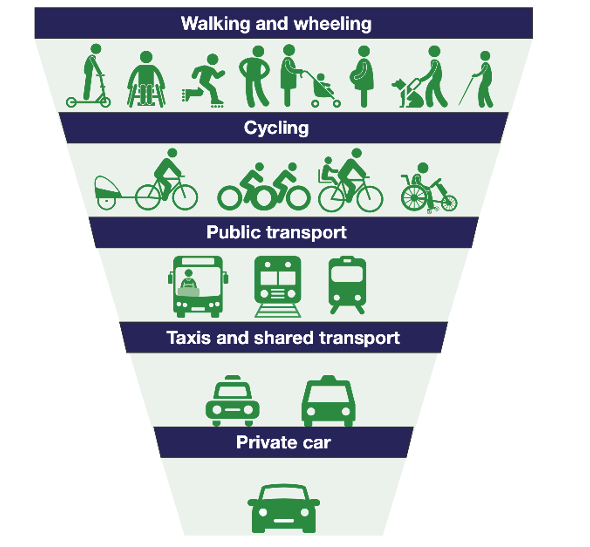
To achieve net zero by 2045, we need to transform how we travel in Scotland. Currently, transport accounts for the largest share of our greenhouse gas emissions. There will need to be a major shift in the vehicles and fuels we use in our transport and energy infrastructure, our travel choices, and in the transport skills that people learn and deploy. Transport and travel are a big part of everyday life and everyone will be affected by the transition that has to take place. In basic terms, we need to move away from the types of transport that contribute most to greenhouse gas emissions and instead use the types of transport that are less carbon intensive. Where possible, especially where public transport alternatives are available, this includes moving away from traditional private car use – the largest contributor to transport emissions.
Changes to the transport sector will not only lead to emissions reduction, but will also result in other significant benefits, including improved places and communities and improved health and well-being. These will come about, for example, through improved air quality, greater equality of access to transport services, and safer, more attractive spaces in which to work, relax and live.
The transport system is a fundamental part of how each of us lives. It influences the way we live, work and learn. It allows us to access goods and services, and the efficient movement of people and goods is crucial for the economy.
The current transport system drives inequalities and is centred around fossil fuel powered modes of transport. For this reason, transport is Scotland’s largest emitting sector, accounting for a third (33.2%) of Scottish emissions in 2023. We know that decarbonising the transport sector and reducing transport emissions requires fundamental system-wide change. We need to reduce the need to travel, encourage the use of sustainable forms of transport and transition from petrol and diesel vehicles to zero emission vehicles powered by renewable energy and sustainable fuels. This Climate Change Plan is fully aligned with the priorities of our National Transport Strategy.[87]
Technology shift is key to reducing transport emissions. Decarbonisation will require the replacement of vehicles which run on fossil fuels with those that are powered by renewable electricity or alternative, sustainable fuels. New charging and refuelling infrastructure across Scotland will also be required. Bringing about this transformation, across all transport modes, from fossil fuel to alternative propulsion technologies, will require action from across the private and public sector. It is likely to require a mix of different policies from Government, with a combination of regulation to phase out fossil fuelled technologies, alongside financial investment to enable uptake of zero emission alternatives.
That said, technology shift alone is not enough. We also need to change how and why we choose to travel and move goods to, from and across Scotland, or otherwise risk missing opportunities for better transport outcomes through this transition. This will mean reducing the demand for travel by unsustainable modes, whilst complementing plans for economic growth, Scotland’s Circular Economy[88] and the requirement for transport related energy infrastructure noted above.
A change in behaviour from consumers, individuals, communities and businesses is required. This societal shift in behaviour requires clear leadership from the government to create the conditions that enable people to change their behaviour and reduce their transport emissions. We want to help people make sustainable transport choices. Leadership from businesses and employers is also key to achieving this shift, both in terms of commuting and business travel. This could involve developing formal net zero transport commitments and incentivising sustainable transport options, providing individuals, households or businesses the capability, opportunity and motivation to adopt sustainable travel behaviours.
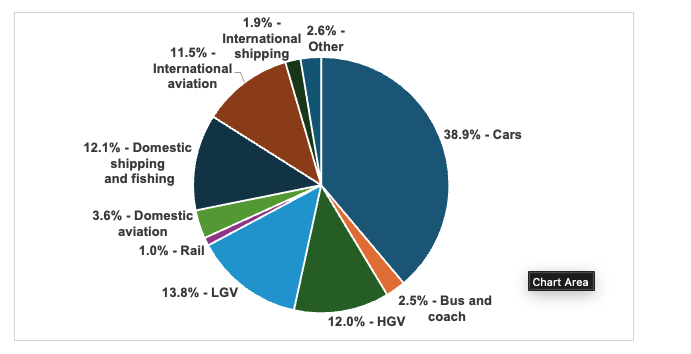
Emissions from the Scottish Transport sector, including international aviation and shipping (IAS), are currently around 13.1 million tonnes per year (2023). We aim to reduce these emissions to 9.8 million tonnes by 2030 and 4.2 million tonnes by 2040 and 3.0 million tonnes by 2045.
Context and Wider Alignment
The transport sector is broad and complex, encompassing different modes of travel, on land, water, and in the air. It employs an estimated 144,000 people, representing around 5% of the total Scottish workforce,[91] and with the largest proportion employed within road transport (65%).
Transport adds £8.3 billion in value to our economy,[92] and transport jobs in Scotland tend to be better paid than the economy average. The average median gross weekly pay in the transportation and storage sector was £656 in 2023, 12% higher than the Scottish average of £588, and it has stayed above the national average since 2018.[93]
The size of the transport workforce has been stable in recent times, and this trend is expected to continue as the sector transitions to net zero. The sector has an older workforce when compared to the Scottish average, with 40% of jobs held by people aged 50 or over, compared to 33% economy-wide.[94] Forecasts suggest around 31,000 new entrants will be needed by 2027 to replace those leaving the sector or retiring.[95]
Relative to other sectors and Scotland as a whole, transport also employs disproportionately more men than women. In 2023, 81% of the transport jobs were held by men and 19% by women, a split which has become even more unequal over recent years.[96] This is in comparison to the wider Scottish economy which was 50:50 in 2023. To achieve the rapid transformation required for net zero, the transport sector must become more attractive to a broader and more diverse talent pool. This is essential not only to ensure stable workforce numbers but also to bring in the range of skills, perspectives and innovation needed to solve complex decarbonisation challenges.
The Scottish Government’s approach to the Just Transition for transport has been set out in the Transport Just Transition Plan[97] published alongside this CCP. The Plan acknowledges the need to reduce greenhouse gas emissions from transport at pace while ensuring the continued movement of people and goods between Scotland’s industries and communities. It also recognises that the current personal transport system is not fair – the highest earners in our society are more likely to travel by car because they are better able to afford it, and, therefore, have better access to jobs, health, learning and social opportunities. This is in stark comparison to those in low-income households who are more likely to rely on bus travel or walking and are therefore more limited to opportunities in their local areas.
Our Vision
Our National Transport Strategy continues to be the foundation on which we build our vision for the future of Scotland’s transport system. Our vision is that, by 2040:
“We will have a sustainable, inclusive, safe and accessible transport system, helping deliver a healthier, fairer and more prosperous Scotland for communities, business and visitors”.
Our vision for 2040 is that our society will be less reliant on private car use and we will have communities which favour sustainable modes of transport – embracing walking, wheeling, cycling and public transport. Local living will be supported by ensuring people have access to local business and to the appropriate digital tools for access to services direct from their home. Our public transport system will be affordable and accessible to its users, and it will be increasingly inter-connected, with greater integration between modes and more integrated ticketing. Different modes of public transport, such as bus and rail, will be linked with high quality, well-maintained walking, wheeling and cycling routes, providing increased multi-modal sustainable travel options. This will make us less reliant on a single form of transport and will reduce the need to use a car. The freight sector will adapt to the increasing need to decarbonise through the use of new technologies and business models, as well as evolving to reflect the changing demands of consumers.
Our Draft Transport Just Transition Plan also sets out our ambition for workers seeing a net zero transition that supports new and existing well-paid jobs across Scotland, within transport services, supply chains and in the wider economy. It also envisages a transport sector that supports diversity in the workforce, advances equality of opportunities for all, and is underpinned by a commitment to fair work.
Our transport system must promote and enable travel choices that minimise the long-term impacts on our climate and improve the lives of current and future generations by reducing inequalities and improving health. At the same time, we need a transport system that is prepared for current and future impacts of climate change and is safe for all users, reliable for everyday journeys and resilient to weather-related disruption.
Progress since the Climate Change Plan Update
Since our previous Climate Change Plan Update (CCPu) in December 2020, the Scottish Government has achieved the following:
Car Use
The draft Route Map to reduce car use in Scotland[98] by 20% by 2030 was published in 2022 and an analysis of the consultation responses[99] has now been published. The majority of the policy interventions included in the draft Route Map have now been delivered. These interventions aimed to support behaviour change and included:
- Free bus travel for under-22s,
- Publication of the Fair Fares Review on issues relating to the cost and availability of public transport services,
- Removal of peak rail fares,
- Free cycles for school children,
- Investing £2 million to develop ‘Mobility as a Service’,
- Investment in bus priority measures,
- £500 million investment, for active travel infrastructure, access to bikes and behaviour change schemes,
- Implementation of Low Emission Zones in four major cities,
- Pavement parking ban enforcement legislation,
- Supporting local authorities in introducing Workplace Parking Licencing, and
- Publishing independent research on demand management measures to reduce car use equitably[100] and on parking measures to reduce car use[101].
We have since, as agreed with the Convention of Scottish Local Authorities (COSLA), moved away from the approach of publishing an updated route map to 20% reduction of car kms by 2030 in the same format. Instead, in June 2025 we published a renewed policy statement[102] which reiterates our commitment to reducing car use in Scotland and sets out where we are currently. It acknowledges the challenges in reducing car use and the enabling environment required, including both incentives, such as funding public transport and active travel, and disincentives, such as enabling the development of local or regional road user charging schemes using local road user charging powers. We have set out our new target relating to car use in the ‘Actions we will take to achieve our vision’ section.
Continued investment in incentives to encourage a shift away for car use is also important. We invested £20.2 million in bus priority through the Bus Partnership Fund to the end of March 2024 delivering bus gates, enforcement cameras, bus priority at traffic lights and making temporary improvements permanent in order to improve bus services. Through 2025-26, the Scottish Government provided £123 million, for sustainable and active travel, the majority of which supports delivery of high quality active travel and bus infrastructure.
We introduced new delivery models for active travel in 2024 across both infrastructure and behaviour change programmes. The first Active Travel Infrastructure Investment Report[103] was published in March 2025, revealing that in 2023-24 alone, over 115km of new and upgraded active travel infrastructure was delivered, and we continue to see significant year on year increases in the number of people using this infrastructure across Scotland.[104]
Electric Cars and Vans
Through the introduction of the Vehicle Emissions Trading Schemes (VETS) legislation, by 2030, 80% of new cars and 70% of new vans are mandated to be zero emission. When in force, VETS became the most significant measure for reducing transport emissions in Scotland. As a result of the original VETS Order (2023) it was initially anticipated that there would be a cumulative reduction in emissions of 40 Mt by 2045, approximately the sum total of all sectors’ Scottish emissions in 2022.
Following public consultation, VETS policy was amended in 2025 to provide additional flexibilities for the automotive industry while maintaining VETS headline targets. In parallel, the UK Government decided to delay the phase out of new hybrid cars until 2035. Petrol and diesel vans can also continue to be sold until 2035.
The amendments included three UK Government proposed amendments providing manufacturers with greater flexibilities whilst retaining overall headline targets. Vehicle manufacturers using the CO2 trading schemes and flexibilities, inherent in the policy design, can comply with VETS without meeting the headline ZEV sales percentages should their remaining non-ZEV sales be made up of sufficiently efficient vehicles and by trading with other manufacturers that have excess credits. The combined impact of these flexibilities is expected to reduce the emissions savings forecast to be delivered by VETS. To account for that change, officials are developing a package of costed policy interventions to address this gap and deliver a more rapid decarbonisation of cars and vans in line with CCC carbon budgets.
Carbon savings achieved by VETS are dependent upon the provision of sufficient public EV charging infrastructure and continued support for consumers to transition to EV ownership to ensure a just transition. That is why we have continued to engage with UK Government to encourage ongoing support for these areas, and why the Scottish Government has continued to invest in the public charging network.
Since 2011 the Scottish Government has provided over £65 million to support the development of public EV charging infrastructure across Scotland. As a direct result of this funding and increasing private sector investment Scotland now has over 7,400 public charge points, with the capacity to charge over 12,000 electric vehicles at any one time. Scotland has one of the most comprehensive public charging networks in the UK, with more rapid public EV charge points per person than any other part of the UK except the South East of England.
The Scottish Government’s Vision for public EV charging infrastructure in Scotland[105] was published in June 2023. And a draft Vision Implementation Plan[106] published in December 2024 sets out a route map to deliver on our vision and ambition to deliver a comprehensive and convenient network that meets the needs of users and is funded by private investment by 2030.[107] The Scottish Government is continuing to support the expansion of public EV charging through its £30 million EV Infrastructure Fund which is enabling local authorities to partner with each other and with the private sector to expand public charging across Scotland. The Scottish Government has also provided a further £4.5 million to enable the expansion of public EV charging in rural and island communities less likely to benefit from stand-alone private sector investment.
Since 2011 the Scottish Government has provided over £230 million in interest free loans to support individuals and businesses including the taxi sector across Scotland purchase over 8,700 zero and ultra-low emission vehicles saving an estimated 230,000 tCO2e. Since 2013 the Scottish Government has also provided over £19 million for the installation of over 23,000 lower powered charge points at homes and at workplaces, complementing the public charging network.
The Scottish Futures Trust estimates that the private sector invested approximately £25 million to £35 million in expanding public EV charging infrastructure in Scotland in 2023 and between £40 million and £55 million in Scotland in 2024 and between £50 million and £75 million in 2025. By the end of 2025 with private sector investment fuelling rapid growth in public EV charging, over two thirds of all public EV charging in Scotland was funded and operated by the private sector.
Road Freight
Scotland signed the Global Memorandum of Understanding on Zero Emission Medium and Heavy Duty Vehicles in 2021 alongside 15 other leading nations in order to build global confidence in the market for these vehicles. This MoU sets the aspiration that, as a minimum, 30% of sales of new passenger and freight vehicles over 3.5 tonnes will be zero emission by 2030 and all new sales will be zero emission by 2040.
In 2022, we set up the Zero Emission Truck Taskforce to work collaboratively across the logistics, energy, manufacturing, government and finance sectors to support Scotland’s hauliers in their ambitions for cleaner, greener road freight. The Taskforce published the HGV Decarbonisation Pathway for Scotland in May 2024. It contains actions for all members to deliver over the coming years covering: energy infrastructure challenges; financial models; confidence in technological and commercial change; and workforce skills.
On 19 March 2025, we delivered on our action in the HGV Decarbonisation Pathway to create a forum for operators and financiers to discuss practical steps the sector can take towards decarbonisation and the role private sector financing can play in unlocking the transition. The sector agreed to continue working collaboratively to support shared learning and to find solutions to bring the costs of decarbonising heavy road vehicles down. Following those discussions, we have continued to build and support collaborations between operators, financiers and the energy sector to develop investment opportunities and explore financial solutions for HGV decarbonisation. In July 2025 we launched an HGV Market Readiness Fund, making £2 million available to support consortia in developing proposals for fleet decarbonisation and infrastructure development, as well as helping SMEs conduct technical analysis for the switch to zero emission vehicles.
Since 2019 we have been supporting Scotland's colleges to move at pace to prepare for the transition to zero emission vehicles. This has evolved from supporting provision of training in EV repair and maintenance as a niche skill, to a college sector where EV skills are embedded in automotive training programmes. We are well on our way to doing the same with EV charge point skills. To date we have invested over £1.2 million and we continue to expand that support to also cover training in skills related to zero emission heavy duty vehicles (HDVs). In 2025-26, we launched a zero emission HDV skills training fund for projects across Scotland that support the skills needed for the transition and address some longstanding issues in the automotive workforce.
As a result of our work with the college sector we have upskilled all college automotive lecturers in electric vehicle maintenance – over 100 lecturers across 15 colleges, who have so far gone on to train around 5,000 learners. Colleges across Scotland now also benefit from EV training equipment, such as training vehicles, simulator units and VR headsets.
Bus
Between 2020 and 2022, the Bus Decarbonisation Taskforce co-designed a pathway to a future where bus operators exclusively run zero-emission battery-electric and hydrogen fuel-cell buses. The Taskforce brought together bus operators through the Confederation of Passenger Transport, the electricity distribution sector, the manufacturing, public sector and finance industry together to address the barriers to working together to decarbonise buses rapidly at-scale. The Taskforce helped with the design and implementation of funding support for the transition to zero emission buses. Since 2020, the Scottish Government has invested over £150 million capital, through two rounds of the Scottish Ultra Low Emission Bus Scheme (SULEBS) and two rounds of the Scottish Zero Emission Bus Challenge Fund (ScotZEB). This significant investment has resulted in 800 new, zero-emission buses and coaches on road or on order, servicing communities across Scotland.
On 1 April 2019 the Low Emission Vehicle (LEV) incentive was introduced under the Bus Service Operators Grant (BSOG) to encourage bus operators to purchase vehicles with the lowest emissions. The new BSOG low emission vehicle (LEV) incentive applied to all new claims to BSOG from April 2019 to 31 March 2022, which satisfied the qualifying criteria. There were variable rates applicable, dependent on the well to wheelhouse greenhouse gas emissions.
Aviation
The Scottish Government published its Aviation Statement in 2024, which describes the various actions we’ll take to increase our international connectivity while encouraging decarbonisation. There are limitations on Scottish Ministers’ powers to support greater progress, because aviation is largely a reserved matter, and Scotland is one part of what is a global and highly interconnected aviation network. Further, the UK Government’s Jet Zero strategy[108] for aviation decarbonisation applies throughout the UK and influences the policy choices the Scottish Government can make. However, the aviation sector itself is aware that it will need to fund the vast majority of costs associated with the transition to net-zero, with governments playing a supporting role.
Highlands and Islands Airports Limited (HIAL) is leading on our commitment to make the Highlands and Islands a zero-emission aviation region. Following the publication of its Sustainability Strategy and completion of a Net Zero Roadmap and energy audit at Inverness Airport, HIAL continues with its programme of activity to decarbonise airport operations and infrastructure.
The aviation sector in Scotland fully recognises the importance of sustainable aviation fuel (SAF) in helping to significantly reduce aviation emissions. Airports and airlines were represented on the Scottish Government’s SAF working group, which considered whether any policy changes could be made to encourage SAF production in Scotland from the feedstocks highlighted in the UK SAF mandate. Project Willow (an independent study exploring the options to secure a sustainable future for Grangemouth) includes two potential SAF projects that could be developed at Grangemouth. The SAF working group was paused to avoid potentially covering issues that may also have been considered by Project Willow, although the two pieces of work were distinct.
In 2025 Scottish Enterprise awarded £9 million funding to ZeroAvia – a company developing hydrogen-electric engines for commercial aircraft – to establish a hydrogen fuel cell manufacturing centre in the Advanced Manufacturing Innovation District Scotland near Glasgow. This followed the £20 million investment by the Scottish National Investment Bank in 2024.
Ferries
Our Vessels and Ports Plan published 2 May 2025 set out the investment programme recommended to maintain and safely operate Clyde & Hebrides and Northern Isles ferry services, in particular by:
- renewing the fleet and upgrading ports in response to asset age and condition;
- improving technical and weather reliability when investing in new vessels and port upgrades; and
- improving resilience through an expansion in the major vessel fleet and through increased interoperability of vessels and ports within the major and small vessel fleets.
The objective of the Vessels and Ports Plan for vessels is to bring the average fleet age down to around 15 years whilst making necessary improvements in reliability and resilience.
Our Small Vessels Replacement Programme (SVRP) in particular, is utilising low carbon technologies for our new vessels and is on track to reach the current target of 30% of ferries in Scottish Government ownership being low emission by 2032. The timescale and scope of SVRP is enabling an effective contribution to emissions reduction.
In relation to Phase 1 of SVRP: contracts have been signed to build seven new zero-emission and shore-powering-capable electric ferries for the Clyde & Hebrides Ferry Services (CHFS) fleet. As well as improving connectivity and resilience, their electric operation will reduce overall fleet carbon emissions and improve local air quality. The first vessel is expected to be delivered in 2027. Work is now underway on Phase 2 of the programme, where we aim to replace further vessels from the CHFS fleet, as well as collaborating with The Highland Council in its Corran Ferry replacement project.
Ports
The composition of Scottish ports comprises those owned: privately; by local authorities; by trusts; and by Caledonian Maritime Assets Ltd (CMAL). Our decarbonisation activity with ports recognises these ownership structures, roles and responsibilities, seeking to work with them to promote decarbonisation of port activity as well as the business opportunities afforded to ports from the wider decarbonisation agenda, such as offshore renewables development. Ports in Scotland are of varying sizes and low emission solutions need to be proportionate to the scale of an individual port. Many ports across Scotland have already published plans committing to decarbonising their operations, including the introduction of shore power. At the moment, shore power is being installed at a number of Scottish ports (e.g. Aberdeen, Forth Ports, Eyemouth, Fraserburgh, Montrose, plus some on the lifeline ferries network).
Rail Passenger Services
Three quarters of ScotRail passengers are benefitting from 896[109] kilometres of electrified railway. We are committed to ensuring more passengers can benefit from newer and more efficient trains. In December 2023, the first (in service) electric passenger train ran from Glasgow Central to Barrhead. The completion of this £63 million project, on programme and on budget, was a significant milestone in our rolling programme of electrification. In 2025 we delivered electrification of Glasgow - East Kilbride services, as part of an investment of over £143 million from the Scottish Government. Passengers on this line are benefitting from cleaner, greener, quieter and more efficient services along with a new station at East Kilbride and a relocated accessible station at Hairmyres. In September 2025, a £342 million investment in electrifying sections of the Fife and Borders routes was announced, alongside the commencement of a procurement exercise for 69 new (Battery-electric and electric) Suburban trains, as part of the next stage in modernising Scotland’s Railway.
Our previous Climate Change Plan contained a commitment to establishing an international rail cluster in Scotland to unlock supply chain opportunities. We have progressed this at pace and continue to fund the Rail Cluster Builder, supporting small and medium enterprises to access commercial opportunities within the rail industry. To date 709 individuals have registered with the rail cluster project, with 501 registered companies and 308 SMEs also registered.
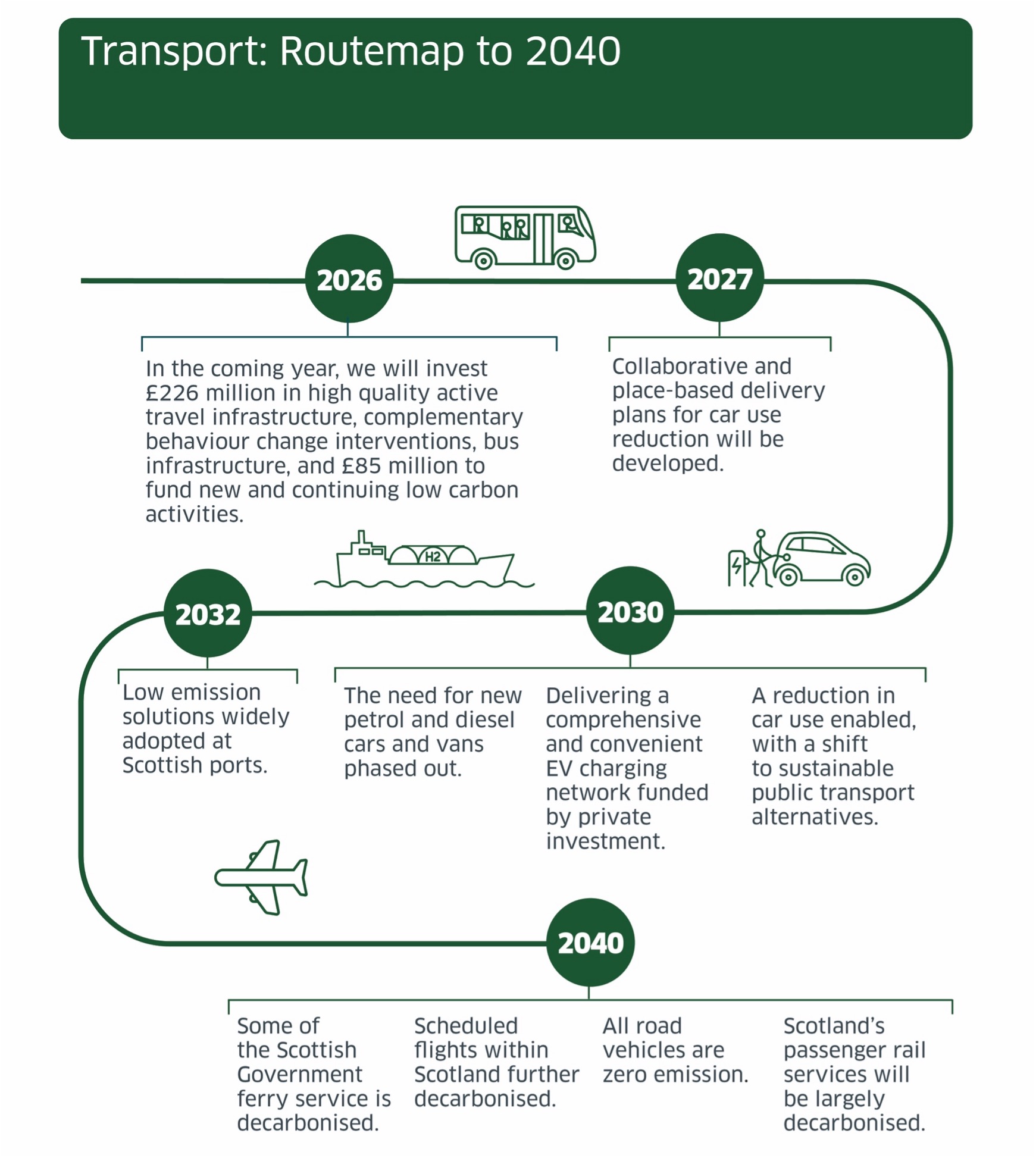
Transport: Routemap to 2040
- 2026
- In the coming year, we will invest £226 million in high quality active travel infrastructure, complimentary behaviour change interventions, bus infrastructure, and £85 million to fund new and continuing low carbon activities.
- 2027
- Collaborative and place-based delivery plans for car use reduction will be redeveloped.
- 2030
- Low emission solutions widely adopted at Scottish ports.
- 2032
- The need for new petrol and diesel cars and vans phased out.
- Delivering a comprehensive and convenient EV charging network funded by private investment.
- A reduction in car use enabled, with a shift to sustainable public transport alternatives.
- 2040
- Some of the Scottish Governent ferry service is decarbonised.
- Scheduled flights within Scotland further decarbonised.
- All road vehicles are zero emission.
- Scotland's passenger rail services will be largely decarbonisd.
Actions We Will Take to Achieve our Vision
We have outlined below the actions we will take to support the development of a sustainable, inclusive, safe and accessible transport system by 2040. These actions are set out under new ‘outcomes’, replacing the outcomes within the Climate Change Plan Update 2020. Reaching this vision for the transport system will also require substantial efforts by other actors; those are set out in Our Call to Others section.
Outcome 1: To address our overreliance on cars, we will create the enabling environment for reducing car use, incentivising behaviour change towards sustainable travel modes and disincentivising private car use, where these align with a just transition.
Key Policies: Successor Policy Car Use Reduction – Following a review of the car use reduction policy in 2025, a new target has been set out in alignment with the Climate Change Plan and supportive of our Net Zero targets. This is alongside supporting actions on legislation, collaborative delivery planning and communication and engagement.
The Scottish Government and COSLA are committed to reducing car dependency fairly across all communities, supporting the National Transport Strategy’s priorities and outcomes. Achieving car use reduction requires behaviour change. While encouraging mode shift, we recognise car use remains essential for some – such as carers, disabled people, shift workers, and rural residents. Therefore, phasing out petrol and diesel cars must go hand in hand with enabling sustainable alternatives.
Our Renewed Policy Statement[110] on car use reduction, published in June 2025, outlines four sustainable behaviours to reduce car use:
- Reduce travel need via online options
- Live locally to shorten travel distances
- Switch modes to walking, wheeling, cycling, or public transport
- Combine or share trips
The statement reaffirms our commitment, assesses current progress, and highlights the benefits and challenges of car use reduction. It also stresses the need for the enabling environment to manage car demand.
Key actions to support and drive behaviour change
Target Setting: A target has been set to reduce emissions from cars in the first carbon budget (2026-2030) by at least 16% from today’s levels (2023). Consistent with the CCC advice, we will need to reduce annual car mileage by at least 4% by 2030 (on a 2030 ‘business as usual’ forecast baseline) and at least 90% of all new car sales will need to be electric by the same year. This car use reduction target is based on the advice from the CCC on what is possible with only incentivisation measures for switching to sustainable transport modes. However, we wish to be more ambitious on car use reduction both due to its emissions reduction potential, and the co-benefits for health and well-being, tackling inequalities and improving places for people. Therefore, alongside incentivisation measures to switch mode (active travel and public transport interventions), other measures that discourage car use may also need to be considered. For example, this might include parking and speed limit interventions or whether local authorities choose to implement local road user charging. Delivery will be place-based, acknowledging diverse structural and individual barriers to change, and will be supported by a commitment to develop collaborative delivery plans by the end of 2027.
Legislation: A regulatory check of Transport (Scotland) Act 2001 powers began in August 2025 to enable local road user charging schemes should local authorities choose to implement them. Completion of this work is expected by early 2027.
Collaborative Delivery Planning: From September 2025, we have been working with stakeholders at national, regional, and local level to develop place-based delivery plans by end of 2027.
Communication and Engagement: Commenced in May 2025, along with a broad coalition of partners, we will develop a national communication and engagement campaign and set out a positive vision around how reducing car use can deliver outcomes for public health, air quality, and the environment.
Car/Bike Sharing and Travel Planning: Through the People and Place programme, we continue to promote car/bike share schemes, Mobility as a Service (MaaS), and multimodal hubs. We are advancing smart ticketing, digital travel data, and Bus Open Data provisions (Transport Act 2019), with the open data implementation due to commence in 2026.
Motoring Tax Reform: We continue to urge the UK Government to reform Fuel Duty and develop a four-nations approach to motoring taxation that supports EV uptake and car use reduction while addressing revenue loss.
Outcome 2: To support modal shift through more sustainable forms of travel, including incentivising public transport use and supporting more people to walk, wheel and cycle for everyday journeys
Highlighted Policies:
- Provide free bus travel for under 22s and older and disabled persons.
- Multi-year funding commitments to enable build-up of capacity and capability in the active and sustainable sector and confidence for planning and delivery of long-term, large-scale ambitious infrastructure programmes.
- Progress development of smart and digital national integrated fares, ticketing and payment systems and technology across public transport in Scotland
We recognise that it is important that people find public transport convenient and easy to use, particularly when using more than one mode of transport or more than one operator`s services in order to complete an end-to-end journey. Our focus is on improving the availability, affordability and accessibility of public transport.
We will support 20-minute neighbourhoods and low traffic neighbourhoods – connected, accessible places where people can meet their daily needs locally, enabling people to live, work and pursue opportunities to improve their learning and wellbeing in communities close to home.
Integration
We are taking an integrated approach to the shift to more sustainable forms of travel that incorporates long term investment in infrastructure as set out in the Strategic Transport Projects Review[111] (STPR2).
Our second STPR2 is a long-term framework for investment in transport infrastructure which drives Scottish Government capital investment decisions for our strategic transport system. The framework includes 45 recommendations for how we will deliver the National Transport Strategy 2 (NTS2) vision, priorities and outcomes. The recommendations are the result of robust, objective-led, and evidence-led review of the performance of the Scotland-wide strategic transport network across all modes.
We have an ambitious vision for an integrated public transport system which is more accessible, more available, and more affordable; a system which enables people to make positive and proactive choices to use public transport. We are taking forward a programme of medium to long-term work to consider options and develop the business case for introducing a national and/or regional integrated ticketing system and fare structure for public transport.
Improving the overall integration of public transport is crucial to support a shift to sustainable travel, and to provide viable alternatives to the private vehicle. This includes better integrating of services, infrastructure, ticketing and fares structures, alongside better travel information. Transport Scotland continues to take forward a number of policies and initiatives to advance our ambitious vision for an integrated public transport system.
Smart Ticketing
In 2026 we will seek to lay legislation that will bring into force the bus open data and associated smart ticketing measures created by the Transport (Scotland) Act 2019 (“the 2019 Act”). This will create a statutory duty on bus operators (and local authorities for associated bus stop information) to provide a broader range of information about services, including details on fares, timetabling, and for the first time, real-time vehicle location data. This will be used to inform the Traveline Scotland website and app, as well as being available as open data for all journey planners, enabling passengers and potential passengers to make more informed decisions about their travel plans. Better information is key to unlocking the benefits of public transport for both existing and potential passengers.
In 2023 we established the National Smart Ticketing Advisory Board, whose function is to advise Scottish Ministers on the future of smart ticketing and to set a national technical standard for ticketing schemes. The Board is currently working on its first suite of technical recommendations to Ministers, that was laid before Ministers in October 2025. The report was published in early 2026. The 2026 legislation will bring into force the necessary legal definitions around ticketing schemes and arrangements, clarify the inclusion of trams within a ticketing scheme and allow Scottish Ministers to set further guidance in response to the recommendations made by the Board.
Active Travel
Active Travel is a key enabler for reducing emissions through facilitating a modal shift away from less sustainable travel behaviours. Supporting more people to walk, wheel or cycle for those shorter, everyday journeys can make a noticeable contribution to emissions reductions. Figures from the Department for Transport [112] suggest that there are 30 fewer car and taxi trips for every 100 new cycle trips induced by new cycling infrastructure. Sustrans report that walking, wheeling and cycling in Scottish cities saves 90,000 tonnes of greenhouse gas emissions, and takes up to 440,000 off the road network.[113]
There is a growing body of evidence that demonstrates where high quality, safe and accessible infrastructure is delivered, people will use it and will be more inclined to switch to more active forms of travel. Over a two-day survey period on 24 and 25 September 2025, traffic surveys recorded 5,287 bikes on the South City Way cycle route on Victoria Road in the south of Glasgow. This was out of a total of 32,894 methods of travel recorded, meaning that 16.1% of people cycled their journey – a new record for the South City Way. In the same 48-hour period on the western-most portion of Edinburgh’s new City Centre West East Link (CCWEL), at West Coates in Roseburn, 2,798 bikes were recorded over the same 48-hour survey period. This was out of a total of 30,175 travel methods recorded on the street, equating to 9.3% of journeys being made by bike – a new record cycling modal share for this section of route.
The scope of our regional behaviour change programme will incorporate wider sustainable travel interventions, such as hubs, shared and demand responsive transport projects. Car share and demand responsive services can improve people’s opportunities to access key services and amenities without having to rely on ownership of a motor car, and in this way, can play a key role in reducing household car use or indeed enabling a choice not to purchase a motor car. We will also continue to provide direct funding to local authorities, regional transport partnerships and National Park Authorities through our Active Travel Infrastructure Fund to develop safe and convenient active travel routes to support communities to make active travel choices.
Bus
Bus is the most used form of public transport. Bus transport is not only sustainable, but also an important mode of transport which is used primarily by lower income households. Increasing the affordability, availability and reliability of buses is a Scottish Government priority.
Through the Under 22s Scheme and the Older and Disabled Persons Concessionary Travel Schemes over 3 million journeys are made every week. These schemes are helping people across Scotland cut costs for essential everyday and leisure travel.
In December 2025, the Scottish Government confirmed the Highlands and Islands Transport Partnership (HiTrans) and Shetland’s Transport Partnership (ZetTrans) as the pilot delivery partners for the £2 bus fare cap pilot. The pilot areas are Highland, Moray, Argyll and Bute, Western Isles and Shetland. The bus fare cap pilot is a 12-month Scottish Government initiative designed to make bus travel more affordable, improve access for low-income communities and support sustainable travel for people across the pilot areas. The pilot was launched on a phased basis commencing in Shetland on 30 January. The next phase of the pilot commenced in the Western Isles on 23 February and then in Orkney on 9 March. The pilot was then rolled out across the in Highlands, Moray, Argyll and Bute from 23 March. Under the pilot, single journey fares on participating local bus services will cost no more than £2.
The Bus Infrastructure Fund 2025-26 was introduced to deliver funding to local authorities and regional transport partnerships, working with bus operators and others, to build and upgrade local bus infrastructure to improve the attractiveness of buses to existing and new passengers. The fund supports delivery of a range of bus infrastructure including the transformation of key corridors into a number of Scotland’s towns and cities into sustainable transport corridors which will see bus lanes and active travel designed and delivered together for the benefit of those who live and travel along them.
We will develop and deliver trunk road bus priority which seeks to implement schemes targeted at delivering faster and more reliable journey times for bus passengers. As a first step to delivering this policy, Transport Scotland’s intention is to work with Glasgow City Council (GCC) to evolve the Glasgow Managed Motorways study (in line with STPR2 Recommendation 14: Provision of strategic bus priority measures), to holistically consider the reallocation of road space and to consider the M8 aspirations of GCC.
Rail
Rail in Scotland and across Great Britain remains a very low carbon mode of transport contributing only 1% of Scotland’s overall transport emissions. We, therefore, have a responsibility to generate modal shift from private cars by encouraging more people to choose rail more often.
We know that people are still struggling with cost-of-living pressures and don’t always see public transport as affordable or attractive. Therefore, the Scottish Government permanently abolished peak fares from 1 September 2025. This is helping existing peak time rail passengers manage the cost of living, while encouraging more people to travel by train and reducing car journeys which is essential for tackling Scotland’s transport emissions. Beyond this, the Scottish Government has announced that ScotRail fares will be frozen for 12 months from 1 April 2026, including Season Tickets and Flexipasses. This will maintain the attractiveness and affordability of rail.
Our commitment to investing in rail continues, and in 2025-26 we invested over £1.5 billion in Scotland’s railway, and this will support the provision of ScotRail and the Caledonian Sleeper passenger rail services. From 2024 to 2029, we are investing £4.2 billion to support Network Rail in maintaining, renewing and improving network infrastructure. Recognising that a high performing and reliable network is more attractive to passengers, Scottish Ministers have specified the need for track and train to work together in order to meet the performance target they have set for Scotland’s rail industry, whereby 92.5% of trains must arrive at their final destination within five minutes of the scheduled time.
From now until 2045 we are taking action to replace the trains that serve our InterCity, Suburban and Rural routes. Newer trains will cater to passengers needs and will be equipped with modern facilities while providing a faster, smoother and more reliable passenger service. This is important to attract more people onto the railway through modal shift. It is expected that the introduction of a battery-electric fleet will reduce Scotland’s rail emissions by 27% and we are committed to continue modernising our railway from now until 2045 to fully capitalise on these emissions reductions.
Ferries
The Islands Connectivity Plan (ICP) Strategic Approach sets out a vision of “integrated ferry services that enable sustainable and active travel choices which support our health and well-being, and make our island and other ferry-dependent communities great places to live, work and visit”. We are taking action to achieve better integration of our ferries with the wider transport system – especially public, shared and active modes. This will include measures in a range of areas, such as better information provision, improved infrastructure, and developing more integrated products and processes across operators to assist connectivity.
Outcome 3: To support modal shift through encouraging more freight to move by rail or water instead of road
Key Policies
• Providing support for modal shift of freight from road to rail or water
One freight train can remove up to 129 lorries from our roads. An average diesel-hauled freight service produces 76% less CO2 per tonne than road transport and it emits less than one tenth of the nitrogen oxide and fine particulates of road haulage. While lorries will transition to low and zero emission technology, this will take some time and emissions from rail transport are projected to remain lower for at least several years. We will continue to encourage rail freight growth with a regulatory target for rail freight growth of 8.7% for 2024 to 2029, with the expectation that a figure closer to 10% could be achievable by the rail industry.
The Scottish Government confirmed funding for Freight Facilities Grants (FFG) in 2025-26 to support private investment in new and updated rail and water freight facilities. These grants, which can help with the capital costs of providing the required freight handling facilities, have resulted in the removal of over 50 million lorry miles from the road. Awards made under FFG for 2025-26 total more than £3 million. Over a 10-year period this is estimated to remove over 26 million lorry miles from roads across Great Britain and save over 37 million KGs of carbon emissions.
There is also potential for further modal shift to rail to be unlocked through our rail electrification programme. This is because the considerably greater power capability of electric locomotives, which can be over twice that of a diesel locomotive, provides additional railway capacity and capability through superior acceleration, which reduces track occupancy to accommodate more freight and passenger trains on the same lines. The more powerful electric locomotives can also haul much heavier freight trains, enabling more goods to be carried in a single trainload.
Outcome 4: We will phase out the need for new petrol and diesel cars and vans by 2030
Key Policies
- Vehicle Emissions Trading Schemes (VETS) legislation/ Zero emission vehicle (ZEV) mandate. The four-nation Vehicle Emissions Trading Schemes (VETS) Order 2023 is the main policy instrument for phasing out the sale of new petrol and diesel cars and vans in Scotland. VETS operates UK-wide and is currently the single most effective policy measure for reducing transport emissions in Scotland, mandating an annual escalation in the proportion of sales of new zero emission cars and vans from 22% of cars and 10% of vans in 2024 to 80% cars and 70% vans by 2030. VETS also sets targets for new non-ZEV vehicles that limits their CO2e emissions beyond 2021 levels.
- Electric Vehicle Infrastructure Fund (public EV charging network). Supporting local authorities to work in partnership with the private sector to continue to expand public EV charging infrastructure across Scotland.
- Develop a range of new incentives that support consumers, sole traders and micro businesses to transition to electric vehicles.
- Additional support to enable the more rapid rollout of critical EV charging infrastructure including public EV charging in rural communities and charging at domestic properties, including cross pavement charging. properties.
This outcome is the source of one of the greatest emissions reductions from transport, and indeed the whole Scottish economy, over the first carbon budget period. Key to the reduction of emissions here is the uptake of zero emission cars and vans triggered by the Vehicle Emissions Trading Schemes (VETS) Order 2023, and a range of actions to support uptake beyond what is envisaged by these regulations.
VETS operates UK-wide and is currently the single most effective policy measure for reducing transport emissions in Scotland, mandating an annual escalation in the proportion of sales of new zero emission cars and vans from 22% of cars and 10% of vans in 2024 to 80% cars and 70% vans by 2030.
Since the introduction of the VETS legislation in January 2024, the UK saw a record 473,348 electric car registrations, a 23.9% increase on the preceding year.
Following a public consultation that closed on 18 February 2025, the UK Government has delayed the phase out of new hybrid petrol and hybrid diesel cars until 2035. Petrol and diesel vans can also continue to be sold until 2035. The consultation consisted of two parts. Part 1 was a technical consultation on reserved UKG policy regarding types of non-zero emission vehicles, including new hybrid, and plug-in hybrid petrol and petrol and diesel cars which could continue to be sold after 2030 until 2035. Part 2, following pressure from the automotive industry on the UK Government, contained the three UK Government proposed amendments for VETS. The combined impact of these flexibilities is expected to reduce the emissions savings forecast to be delivered by VETS. To account for these changes, we are developing a package of costed policy interventions to address this gap and deliver a more rapid decarbonisation of cars and vans in line with CCC carbon budgets.
However, this transition and the emissions reductions it can deliver will not be achieved without a significant expansion in public charging infrastructure and support for consumers to transition to zero emission vehicles. We are working with key stakeholders, including private companies investing in public EV charging infrastructure, to ensure that these enabling measures are in place to support a successful and just transition. This includes continuing to work with the Energy Skills Partnership to ensure the provision of appropriate training through the college network in the servicing and maintenance of zero emission vehicles.
Through our £30 million EV Infrastructure Fund, we are supporting local authorities to work in partnership with the private sector to continue to expand public EV charging infrastructure across Scotland, with a particular focus on those areas of Scotland less likely to benefit from private sector investment in public EV charging infrastructure, including rural and island communities. The full fund is one action identified in the draft Vision Implementation Plan to support the delivery of a comprehensive and convenient network that meets the needs of users and is funded by private investment as part of the expansion of public charging across Scotland by 2030.
Alongside the growth of the public charging network, it is essential that wherever possible drivers have access to charging at home and at their destinations. Three Scottish local authorities are currently trialling cross-pavement charging to enable EV drivers that live in properties without access to off-street parking to charge at home. The Scottish Government is also supporting the Scottish Collaboration of Transport Specialists (SCOTS), a network representing transport officers from Scotland’s local authorities and Regional Transport Partnerships, to develop guidance on cross-pavement charging which addresses legal and safety issues and to support all local authorities to enable cross-pavement charging. In combination, these measures will support improved access to electric vehicle charging for those living in tenements within the meaning of section 26 of the Tenements (Scotland) Act 2004.
Scottish Government also continues to support consumers and businesses to install EV charging and has provided over £19 million in grant funding to support EV charging infrastructure for individual businesses and consumers, complementing the public EV charging network by supporting the installation of over 23,000 home and business charge points across Scotland. This infrastructure plays a critical role in enabling consumers and businesses to switch to EVs.
Scotland is currently the only part of the UK offering financial support in the form of an interest free loan for consumers to purchase electric vehicles. To date, the Scottish Government’s interest-free loan scheme has provided over £233 million in interest-free loans to support the purchase of over 8,700 zero and ultra-low emission vehicles, saving an estimated 230k tCO2e.
However, to meet our Carbon Budgets it will be necessary to transition to EVs more quickly than will be enabled by VETS legislation. In the CCC Progress Report for Scotland, published on 25 February 2026, it identifies that “risks remain due to the potential use of ZEV mandate flexibilities and lower confidence in achieving the CCP pathway". The Scottish Government will take forward the development of potential contingency options to address the risk that could be implemented if required.
The Scottish Government will continue to provide support to ensure this transition to EVs can happen at the pace required, considering support to consumers relating to vehicles and charging.
It will also be necessary to significantly expand the provision of home charging, and for the provision of public EV charging in rural and island communities. There are particular challenges in delivering public EV charging at pace and at scale in rural and island communities due to the limited capacity of the supply chain to support the delivery of infrastructure at scale in these areas.
Public Sector Fleet
In 2019 the Scottish Government established stretching targets for the public sector to decarbonise its fleet in stages, focusing on vehicle types and aiming to remove petrol and diesel vehicles from the fleet starting with cars, followed by light vans then other heavy and specialist vehicles. These targets reflected the technology available and in development at the time. The 2020 Climate Change Plan update included an ambition that from 2025 no new petrol or diesel vans and from 2030 no new petrol or diesel vehicles would be brought into the public sector fleet, and over the past five years there has been positive progress towards decarbonising the public fleet, with 19% of the public fleet now being zero emission.
The Scottish Government has worked with the public sector to develop a draft Public Sector Fleet Decarbonisation Action Plan. We are now consulting key stakeholders across the public and private sector on the actions identified within that Plan and expect to publish a final version by the end of 2026. The draft Action Plan reflects the continued commitment of Scottish Government and the wider public sector to decarbonise its fleet, further support the public procurement of electric vehicles and ultra emission vehicles and identify actions that better align public spending with emissions reduction.
Outcome 5: We will work with the energy, finance and road transport sectors and related businesses to ensure all road vehicles are zero emission by 2040
Key Policies
- Investment in replacement of vehicles and deployment of charging infrastructure.
- Consider what regulatory options are available to encourage and ensure transition; implement as required.
- Support skills development and other aspects of economic development to support a Just Transition.
Road vehicles accounted for two thirds of transport emissions in 2023, largely because it is the most common form of powered transport. Cars and vans make up the largest share of road vehicles. Progress in the uptake of zero emission cars and vans has been encouraging – the purchase cost and operating cost of light vehicles has fallen in recent years, the charging network is growing, public awareness is increasing, and manufacturers are introducing more vehicle models to the market.
In terms of other types of vehicles, progress is more variable. For example, uptake of zero emission vehicles within the bus sector is strong. However, the uptake of zero emission heavy goods vehicles (HGVs) has so far been negligible in Scotland, with around 150 zero emission HGVs[114] registered across the UK out of a total of over 685,000[115] in 2025.
HGVs (which includes a wide range of heavy vehicles, including many that do not transport freight) are therefore a major area of focus. There are several strategic barriers to the speedy and effective transition of all of Scotland’s HGVs being zero-emission at the tailpipe:
- While costs of zero emission vehicles such as cars, vans and buses are reducing and nearing parity with internal combustion engine vehicles, the low numbers of zero emission HGVs currently in operation mean that the up-front purchase costs of many (but not all) HGVs remain comparatively high in the short to medium term.
- A high proportion of commercial fleets (including buses, coaches, HGVs and vans) are owned by SMEs and/or operate within very low-margin sectors, meaning that they may have limited management and financial capacity to invest in new vehicles and charging infrastructure. This may particularly be the case in the early stages of the transition before economies of scale begin to take effect.
- Charging infrastructure for zero-emission vehicles needs to be installed at depots and destinations, as well as at strategic points around Scotland’s road network.
- There are limited skills and know-how across fleet-owning organisations about emerging vehicle technology, charging infrastructure practicalities, and financial products. This includes limited available information about how well some zero-emission vehicles function in particular scenarios, maintenance requirements, life-span and residual value.
To remove these barriers, we will pursue the following areas:
Legislation
Our approach to legislation for cars and vans, including the Vehicle Emissions Trading Scheme (VETS), is described above under outcome 4. In January 2026 the UK Government published a consultation on a new HGV CO2 emissions regulatory framework for the UK. In the framework, the UK re-stated its policy intention to phase out the sale of new non-zero emission HGVs in 2035 (up to 26 tonnes) and 2040 (all HGVs). The dates set should be early enough to prompt market change towards zero emission technology, while recognising that existing diesel vehicles will remain on the road for some time after the sale of new vehicles ends. The Scottish Government has responded to the consultation to encourage the UK Government to adopt an ambitious framework that supports the adoption of zero emission HGVs at a scale and pace required to deliver meaningful emissions reductions, while ensuring security of supply of vehicles for operators across the country.
We believe that unified UK action on a common regulatory pathway would be the best outcome for our transport operators, but if, following the consultation, the UK Government does not move at the pace required then we will consider options for additional regulatory interventions in Scotland within devolved competence.
There is a need for clearer direction to industry on the decarbonisation of bus fleets as well as future demand for the manufacturing of zero emission buses. We have worked with the UK Government to make amendments to the Bus Services Act 2025, extending legislation to end the registration of new non-zero emission buses to Scotland. The Act provides new powers for Scottish Ministers to prohibit the registration of new non-zero emission buses (ZEBs) on local services in Scotland from a date no earlier than 2030. Scottish Ministers now have the ability to bring forward secondary legislation detailing the implementation of this measure in Scotland. This will reinforce the Scottish Government’s climate change ambitions by setting out the timeline in restricting the registration of new non ZEBs, which will provide more certainty to bus manufacturers and operators in Scotland.
Energy Infrastructure
The cost of electricity and the ability to access energy where it is required are crucial to the decarbonisation of road transport. Both matters are reserved to the UK Government who have substantial reforms underway.[116] As referred to elsewhere in this document, these issues are not specific to road transport decarbonisation but impact on many other Scottish devolved responsibilities.
We will work with the Scottish Futures Trust to undertake analysis of transport’s growing demand for energy across Scotland’s trunk road network and motorway service areas and we will work with the electricity sector to ensure that the demand for investment in the energy system generated by the electrification of road transport is well understood at a strategic level. This will draw on our developing mapping of en-route charging required for HGVs.[117]
We know that high-capacity charging in most HGV depots and en-route sites must be operational by the 2030s. We will work with fleets and charge point operators to maximise the installation and utilisation of this infrastructure. A Scottish network of around 20 locations offering charging to commercial fleets including HGVs will be open from the end of 2026 as a result of the ScotZEB bus decarbonisation funding programme. In addition, six HGV depots will open high powered charging to other fleets under funding from the UK Government’s Zero Emission HGV and Infrastructure Demonstrator (ZEHID) programme.
Energy infrastructure will be owned and operated by the private sector. If, as energy infrastructure develops, market failure becomes apparent (e.g. in remote or rural areas), the Scottish Government will consider intervening to support a just transition for the whole of Scotland.
Investment
The Scottish Government recognises that there will be a need for financial support across multiple years to enable the transition of the HGV sector to unlock the commercial investment required to make the transition sustainable in the long term. This can cease once commercial investors have adjusted to new business models and haulage operators (large or small) are able to transition to zero emission vehicles at scale. The CCC, in its 2025 Scottish Progress Report, has acknowledged the risk regarding efforts to encourage electric HGV adoption. We will work with the financing sector to understand how public and private investment can work together to unlock rapid and substantial transition to zero-emission alternatives in the HGV sector, keeping progress under review and developing contingency plans for additional interventions should these be required.
We will focus our support on battery-electric vehicles and charging infrastructure as it is clearly demonstrating both technical and commercial feasibility, while remaining open to potentially supporting other zero emission technologies in the future as they mature to a similar point.
We will continue to work collaboratively with the heavy duty vehicle sector, co-designing our approach with key stakeholders to maximise impact and taxpayer benefit. We will establish a network of financiers and hauliers to work in partnership to overcome challenges facing the sector, including costs associated with transition.
Skills
Delivering the transition across the road transport sectors presents a significant reskilling challenge, due to the size of the workforce relative to other modes. There are particular challenges for the HDV sector, which must be able to adapt to and support an acceleration of HDV decarbonisation if we are to take advantage of the economic opportunity for Scotland in this area.
We will continue to develop and take forward the actions outlined in the Just Transition Principles and Adaptation: Workforce section. These actions include building capacity within Scotland’s colleges to ensure that training programmes are available across all regions, working with industry to have a route map to allow greater awareness of the timing of reskilling that will be required to 2030 and supporting the sector to use the opportunity of the transition to tackle workforce issues such as lack of diversity.
Buses
Community Transport (CT) services are mainly provided by local voluntary organisations on a not-for-profit basis to fill a transport need in their community that is not met by commercial transport operators. As they operate on a non-profit basis they are unlikely to meet the eligibility criteria for leasing, leaving a gap in our bus decarbonisation policy. We will address this gap through the Plugged-in Communities fund, with £4 million allocated in 2025-26 to support Community Transport Organisations to make the switch to zero emission vehicles.
We are continuing support for the decarbonisation of bus fleets through extension of the Scottish Zero Emission Bus Challenge Fund (ScotZEB), with a third phase of the programme making £45 million available into 2028. ScotZEB has been successful in encouraging a collaborative approach to decarbonisation of bus fleets, expanding charging infrastructure for heavy vehicles and introducing new business models to stimulate private sector investment.
Biofuels
The Scottish Government is keeping the role of biofuels and other alternative combustion fuels under review. While they may offer short-term benefits for reducing net emissions from heavy duty road vehicles, analysis to date suggests that they should be prioritised for use in modes such as long-haul aviation and shipping where alternative methods of decarbonisation, such as electrification, may be less feasible. The Scottish Government's approach to the decarbonisation of HGVs will continue to evolve, taking into account the outcome of the current UK Government consultation on a new regulatory framework for HGV CO2 emissions.
Key Policies
- SAF & Project Willow. The Scottish Government is considering options for increasing sustainable aviation fuel (SAF) production and use in Scotland. SAF is one of the key technologies available to support the decarbonisation of the aviation sector. SAFs are drop-in fuels, meaning they can be blended into fossil-based aviation fuel without modifying existing aircraft and infrastructure. SAF will play a crucial role in reducing aviation emissions over the short and medium term. The UK Government is leading on SAF policy development, and the Scottish Government has noted that it is keen for this to progress.
- The recent work of Project Willow - the joint Scottish and UK Government study exploring the options to secure a sustainable future for Grangemouth - demonstrated that a long term, new industrial future is achievable at the site. The report included two potential SAF projects that could be developed at Grangemouth.
Aviation will only achieve its net zero ambition if meaningful action continues at the global, national and local levels. This will require significant collaboration throughout the sector and across governments. This fundamental transformation will, in general, require the reduction or replacement of fossil fuels by various means: the wider adoption of SAF; airspace modernisation; the development of new hydrogen, electric, and hybrid aircraft; and, making existing aircraft more fuel efficient.
The Scottish Government will continue to work closely with the UK Government to ensure that the Jet Zero Strategy benefits Scotland. Increasing SAF production and use is a prominent commitment in many net-zero strategies, from a global to a local level. The UK Government introduced a SAF mandate in January 2025, and has also introduced a SAF Bill, the purpose of which is to provide investors with greater confidence about investing in SAF. The Bill process is expected to conclude in 2026.
Scotland is particularly well suited to leading on zero emission flight, thanks to our strong aviation sector, our renewable skills and our well-developed island connectivity. As companies continue to develop electric and hydrogen aircraft, Ministers want to ensure that the infrastructure required to facilitate this zero-emission transformation has been carefully considered in advance.
HIAL is leading on our commitment to make the Highlands and Islands a zero-emission aviation region. Following the publication of its Sustainability Strategy, HIAL continues with its programme of activity to decarbonise airport operations and infrastructure.
The Scottish Government will introduce Air Departure Tax (ADT) as a devolved replacement for the UK-wide Air Passenger Duty (APD) from 1 April 2027. This is possible due to the development of a new Highland and Island exemption that protects crucial connectivity in the region while complying with the UK Government’s subsidy control regime.
ADT rates and bands will match those of the UK Government’s APD for 2027-28 to provide certainty for passengers and the aviation industry. From April 2028 onwards the Scottish Government intends to implement a Private Jet Supplement that will levy higher rates of ADT on private jet flights. Private jet flights are responsible for higher carbon emissions per passenger than commercial flights, and this measure will ensure that those who choose to travel by private jet pay their fair share.
We launched a consultation on 29 January 2026 on our ADT proposals – including the Private Jet Supplement. The consultation invites comment and evidence from interested parties and is open until 26 March 2026. The contributions received will then be analysed with a response published in due course.
Further ADT policy development will be shaped by the High-Level Principles of ADT, which were published alongside the Medium-Term Financial Strategy on 25 June 2025. These set out that ADT should:
- generate stable revenues to fund public services in Scotland,
- protect Highlands and Islands aviation connectivity,
- promote Scotland’s connectivity and growth objectives, and
- support our net zero ambitions.
As well as meeting our commitment in the April 2024 Climate Change Action: Policy Package, these principles provide the long-term foundation for industry, passengers, businesses and the Scottish Government to work together to realise the economic and wider opportunities arising from the implementation of ADT in Scotland.
Aviation is included within the UK Emissions Trading Scheme (ETS). Working with other governments in the UK as part of the ETS Authority, we have set a tighter limit on emissions including from short haul and domestic aviation emissions. This incentivises aircraft operators to cut their carbon footprint.
Further Opportunities for Decarbonisation Alongside Ongoing Asset Renewal
As part of asset maintenance and operations, we will continue to invest in cleaner ferries and rail. While our ongoing asset investments on ferries and rail are not included as policies or proposals for the purpose of the CCP, they do represent opportunities for further transport decarbonisation efforts. Our work on shipping relies in majority on actions from the UK Government. While there are no policies or proposals associated with shipping, we have outlined how we are engaging the UK Government on shipping decarbonisation.
Further detail on rail, ferries and shipping is set out below.
Rail
We will continue to progress our commitment to decarbonise Scotland’s railway. Our investment in electrification to date means that over three quarters of rail journeys are now made on electric traction. The Scottish Government will take the following actions which are not CCP policies nor proposals:
- We are working to ensure the resilience of Scotland’s railway through the delivery of new electric power Feeder Stations. Phase 1 of this programme is well underway, with two of the six Feeder Stations in this Phase, delivered already. This programme will provide the power to facilitate the electrification of the Fife and Border routes along with improving the resilience of the electrical power network of the Scottish rail network.
- In November 2025 we published Rail Recharged: Scotland’s Fleet Transition Strategy, which set out the considerable progress the Scottish Government has made towards electrifying and modernising Scotland’s railway.
- This Strategy has been developed in line with the commitment made within the Rail Services Decarbonisation Action Plan, to review the Scottish Government’s progress towards rail decarbonisation against the challenges and opportunities the Scottish Government, and wider rail industry, has faced since the original plan was first published in July 2020.
- The Strategy is closely aligned with the ongoing work to replace ScotRail trains that are reaching the end of their useable life. This action ensures that Scotland’s Railway will continue to provide reliable and resilient passenger services, which is essential for attracting more people away from their cars and onto their publicly owned rail services.
- At the core of the Strategy is the commitment to keep passenger services moving, investing strategically in light of ongoing budgetary pressures and supporting Scotland’s railway on its journey to net zero emissions by 2045.
- The plan outlines how trains will be replaced across three passenger markets: InterCity, Suburban and Rural.
- The diesel trains that currently operate on our InterCity routes are approaching the end of their life, and in December 2024 we announced formal commencement of a procurement exercise to replace the InterCity fleet.
- We will introduce new electric and battery-electric trains on parts of our Suburban network, namely the Borders, Fife and selected Strathclyde routes. In September 2025 the Cabinet Secretary for Transport announced the start of the procurement exercise to replace the trains operating on these routes. This will be the first time battery-electric trains have been used on the Scottish rail network and will be an important addition to ScotRail’s zero-emission fleet. On 8 December 2025, we completed the electrification and enhancement of the East Kilbride line delivered through £144 million of Scottish Government investment.
- To further support our decarbonisation ambitions, we are currently developing and appraising options for replacing the existing diesel trains on our Rural lines and we expect these to be with independently-powered trains.
Ferries
Limited – or sometimes no – alternative transport modes are available to fulfil many of our ferry service roles, reducing the scope for shift to lower carbon modes of travel. In addition, even small ferry vessels require significant energy (with associated carbon cost), to build and to operate. While low carbon solutions can be more costly than conventional technologies, particularly in the shorter term, electrified vessels are increasingly competitive for smaller vessels within the ferry fleet. In the case of lower carbon fuel options for larger vessels, there is currently a challenge with their availability. We have adopted the principle that all new ferries for CHFS (Clyde & Hebrides Ferry Services) and NIFS (Northern Isles Ferry Services) should be designed, where possible, with potential for retrofitting; this includes the upcoming replacements for the Northern Isles freight vessels. We intend to balance consideration of such additional costs with the stated first priority of the Islands Connectivity Plan[118] “maintaining reliable and resilient operations, supporting island population and human health”.
Scope for emissions reduction includes hybrid and low carbon energy sources for vessels; lowering emissions from vessels using conventional propulsion; improvements to port assets and associated operations; and operating our networks as efficiently as possible. Provision of shore power connections at ports has already commenced. Shore charging facilities at slipway locations will enable the roll-out of our all-electric new smaller vessel fleet. Other decarbonisation initiatives at ports include evaluation and site-specific adoption of appropriate low- and zero-carbon technologies, design standards, and materials.
In addition the Scottish Government will take the following actions alongside our CCP policies and proposals:
- We will continue to work toward maximising the proportion of ferries in Scottish Government ownership which are low emission, with a target to increase this to 48% by 2040.
- We will increase the ability of our ferries to utilise low-carbon renewable electricity for their battery charging requirements (where applicable), and/or providing electric shore-powering of auxiliary vessel energy requirements when in port.
- We will build on existing reporting from our CHFS and NIFS operators on emissions from our ferry operations to monitor a reduction in carbon emitted per passenger/tonne carried. We will aim to reduce this from a baseline figure to be set in 2026, to a target – also to be set in 2026 for 2040.
Shipping
We are working with the UK Government to support proposals at the International Maritime Organisation (IMO) to significantly lower shipping carbon emissions in the global sector, including the option of introducing a global levy on marine fuel to fund research in cleaner technologies and fuels. IMO negotiations culminated in the April 2025 agreement on a Net-Zero Framework, establishing legally binding measures to cut international shipping's greenhouse gas emissions by 2030, 2040, and achieving net-zero around 2050. Key components include mandatory reductions in fuel intensity, a global emissions pricing mechanism, and a dedicated Net-Zero Fund to support the transition to cleaner fuels and technologies. However, in October 2025, the IMO voted to delay the adoption of its Net-Zero Framework by one year. A further vote is expected in October 2026.
UK Government has also committed to aim for zero fuel lifecycle greenhouse gas (GHG) emissions in domestic UK maritime to by 2050, with at least a 30% reduction by 2030 and an 80% reduction by 2040, relative to 2008 levels.
We work with individual ports and the British Ports Association to consider a process for encouraging shared best practice initiatives for reducing emissions across the sector. Working with the ports sector and with its statutory consultees through the Harbour Order process to ensure future port developments are environmentally underpinned.
We are continuing to collaborate with the UK Government, the NESO and Ofgem to explore all options to accelerate network connection timelines for Scottish projects and provide more certainty on connection dates as early as possible. NESO put forward a ‘First Needed, First Ready, First Connected’ proposal to reform the grid connection process, which will raise barriers to receiving a grid connection offer and terminate projects that aren’t required or progressing.
We are working with UK Government to expand the UK Emissions Trading Scheme (ETS) to include the maritime sector for domestic journeys (i.e. from one UK port to another UK port). Including the maritime sector within the scheme could also strengthen the incentive to adopt low carbon fuels, and support deployment of fuel-efficient technologies and the introduction of fuel-efficient operating practices.
In addition the Scottish Government will take the following actions alongside the CCP policies and proposals:
- We will work with the UK Government to support proposals at the International Maritime Organisation (IMO) to significantly lower shipping carbon emissions in the global sector.
- We will work with individual ports and the British Ports Association to consider a process for encouraging shared best practice initiatives for reducing emissions across the sector.
- We will work with the ports sector and with its statutory consultees through the Harbour Order process to ensure future port developments are environmentally underpinned.
- We will further review proposed action on shipping emissions, such as stronger assumptions around technological advancements or incorporation of international commitments.
- We will advise on different shipping routes from Scotland, including consideration of the potential to contribute to reducing international emissions.
Just Transition Principles and Adaptation
Following the previous sections that set out what the transport sector will do to meet Net Zero this section will explain how it will do this, ensuring nobody is left behind and businesses can seize the economic opportunities of the transition.
People and Communities
The Scottish Government is committed to an approach that recognises the inequities that people already face when it comes to transport. This includes the place-based challenges facing those in smaller towns, rural communities and islands, and demographic as well as economic challenges for those with additional mobility needs and those on lower incomes who either don’t have access to cars or are in car dependency and rely more on public transport, mostly bus. We understand that many within these groups will often have fewer options to change their travel behaviours, so we are determined that they will not be disadvantaged by the changes that need to be made.
As Scotland’s transition continues, we will maintain our focus on fairness. A major part of this will be about continuing to ensure people and communities are supported in switching to EVs, and in accessing the necessary EV infrastructure through, for example, a final Vision Implementation Plan for the delivery of additional EV chargers by 2030, through the use of the EV Infrastructure Fund designed specifically with the needs of rural and island communities in mind (addressing the Just Transition Commission (JTC)’s recommendations of February 2026) and through the Vehicle Emissions Trading Scheme that supports uptake of new vehicles sold and reduces in turn the purchase price of ZEVs for individuals and communities (e.g. through car clubs). We will also consider how we can better support consumers transitioning to EVs, especially for rural and island areas and lower-income groups (as per latest JTC recommendation). Scottish Government continues to support consumers to install EV charging and has provided over £19 million in grant funding to support EV charging infrastructure for individual businesses and consumers.
We know, however, that simply expanding electric vehicle ownership will not, on its own, ensure greater fairness in transport. A central priority for the next stage of our transition will, therefore, be to deliver a better, fairer transport system for everybody, non-drivers and remaining drivers alike. This will include incentives for people to travel more sustainably by accessing more easily bus and train services, addressing one of the JTC recommendations. We have an ambitious vision for an integrated public transport system which improves people’s access to public transport. We are taking forward a programme of medium to long-term work to consider options and develop the business case for introducing a national and/or regional integrated ticketing system and fare structure for public transport.
Our approach also recognises that the negative impacts of car use fall disproportionately on those who are already more vulnerable and disadvantaged, including air quality and noise pollution. It also includes a commitment, working with partners, to taking a place-based approach to car use reduction as part of a just transition. The JTC has noted that a delivery strategy for reduced car use in Scotland will need to focus on urban areas to ensure that rural communities can remain connected. The Scottish Government currently spends over £2 billion annually to support public transport, including providing up to 2.3 million people in Scotland with access to free bus travel.. Through the 2026-27 budget, the Scottish Government is also providing £226 million, for sustainable and active travel, the majority of which will support delivery of high quality active travel and bus infrastructure.
Workforce
Scotland’s transport sector employs around 144,000 people, including supply chain roles and vehicle-related jobs. While the overall workforce size is expected to remain stable during the transition to net zero, the nature of jobs and required skills will shift significantly. Changes in vehicle technology and fuelling will impact roles in repair, maintenance, and fuel retail, while up to 15,000 new roles may emerge to support zero emission vehicle uptake, infrastructure installation, and growth in emerging industries like hydrogen and Sustainable Aviation.[119] This transition will require new and enhanced skills across transport and adjacent sectors. To support this and in line with the latest JTC recommendations, the Scottish Government will:
- Continue funding the Zero Emission Skills College Programme via the Energy Skills Partnership (ESP) to build training capacity in zero emission vehicle technologies, and
- Engage with workers and employers to map skills needs and pilot approaches to ensure workforce readiness in line with vehicle adoption.
Employers
Businesses across Scotland must be equipped to seize the opportunities of transport decarbonisation, despite challenges like upfront costs, technology uncertainty, and procurement disruption. With 52,000 HDVs in Scotland, many operated by SMEs, the Government will provide £1 million in 2025 to help small hauliers access expert advice on fleet transition, supporting a Just Transition.
Key economic opportunities include:
- Manufacturing decarbonised HDVs,
- Potential for producing SAF, and
- Installing and servicing charging/refuelling infrastructure.
Actions in support of realising these economic opportunities have been outlined earlier in this chapter.
Adaptation
The impacts of climate change are now unmistakably affecting how people, goods, and services move throughout Scotland with the effects of flooding, landslips, scour and storms already putting increased pressure on our Road, Rail, Aviation and Maritime Networks. As we respond to this new reality, a just transition presents an opportunity for us to both strengthen the resilience of our transport system and the surrounding natural environment. Transport Scotland’s Approach to Climate Change Adaptation and Resilience[120] (ACCAR) (published 2023) sets out an ambitious vision for “a transport system which is well adapted and prepared for current and future impacts of climate change, is safe for all users, reliable for everyday journeys, and resilient to weather related disruption.” By embedding adaptation and resilience across its functions through a dedicated internal governance structure and cross-directorate leadership board, Transport Scotland is ensuring the effective delivery of ACCAR outcomes.
In 2024, the ACCAR was integrated into wider Scottish National Adaptation Plan (SNAP3) which sets out over 200 actions to build Scotland’s resilience to climate change. Responding to the latest UK Climate Change Risk Assessment[121], this five-year plan details a clear objective and key actions to adapt Scotland’s transport system. In alignment with SNAP3 and the ACCAR, Transport Scotland will build the resilience of our Trunk Road Network to climate change through development of a Trunk Roads Adaptation Plan and a Biodiversity Strategy, collaboration with the Operating Companies on strategies for our most vulnerable locations and active management of high wind, flood and landslide risks. We will continue to support Network Rail to design and deliver Scotland’s Railway: Climate Ready Plan. While aviation remains mainly a reserved area, Transport Scotland will engage with our stakeholders at Highlands and Islands Airports Limited to support their decision making on climate risk management and adaptation actions. Across ferry and port infrastructure, we are committed to safeguarding lifeline ferry services from the impacts of climate change through the Islands Connectivity Plan, the development of ferry reliability performance measures, and supporting consideration of the latest climate modelling data in relation to port investment.We will also support Scottish Canals in their pursuit of a second Smart Canal, and in developing a climate resilience strategy by 2028.
Our Call To Others
In order to achieve our Net Zero targets in relation to the transport sector, action will be required to be taken by all members of society, from the general public, businesses, public sector organisations as well as all levels of government.
The UK Government
Decarbonising the transport sector will require substantial action by the UK Government in areas where key powers remain reserved. We call on the UK Government to implement policies, including fiscal instruments, to support our mutual ambition to tackle climate change while delivering a just transition.
UK Government action is particularly needed in the following areas:
- The UK Government reserved policy on 2030 phase out of the sale of new non-hybrid petrol cars and diesel cars, and the 2035 phase out of new petrol vans, new diesel vans and new hybrid cars.
- Commitment to utilise the devolved VETS legislation to achieve the headline targets on electric car and van sales.
- Strengthening incentives to purchase cleaner vehicles and drive private sector investment in charging infrastructure.
- Investing in electricity networks to enable charging in the locations and timescales required.
- Reducing electricity costs, for example by reducing VAT rate levied on public charge points used to charge EVs.
- Taking a four-nations approach to broader motoring tax reform covering fuel duty, vehicle excise duty and VAT.
- Legislating for ambitious phase out dates for non-zero emission HGVs.
- Consideration of vehicle taxation reform with reductions for zero emission vehicles.
- Greater clarity and ambition on aviation and shipping decarbonisation policies.
- Collaborative development of any policy affecting Scottish greenhouse gas emissions and Scottish transport operators.
UKG Action on road transport
The Scottish Government is working with the UK Government and other devolved governments to deliver stable and ambitious devolved VETS legislation containing the Zero Emission Vehicle Mandate. Alongside that, the UK Government has restored the 2030 phase‑out date for the sale of new petrol and diesel cars, while keeping 2035 as the point at which all new cars and vans must be zero‑emission.
We continue to call on the UK Government to take a comprehensive, four-nations approach towards reform of vehicle, road and EV charging taxation. This is urgently needed to replace dwindling revenues as the transport sector decarbonises, which the Office for Budget Responsibility identified as the “largest single cost” of the transition to net zero. If properly designed, a broader, coherent reform of the motoring tax regime that aligns with wider transport and net zero policy objectives can also help incentivise the transition to EVs and contribute to meeting our climate change ambitions. As the relevant tax powers are fully reserved, we need the UK Government to agree to urgent dialogue on structural reform of motoring taxation on a four-nation basis.
It is also widely recognised that electricity markets, strategy, investment and planning need to modernise at speed to enable transport electrification across all modes. We require substantial investment in electricity distribution and potentially also transmission networks around many transport sites. Electricity policy is reserved to the UK Government and only the UK Government can act on this.
We call on the UK Government to work with the devolved administrations to bring forward regulations as soon as possible following its consultation to phase out non-zero emission HGVs in such a way that no combustion engine vehicles remain on the road after 2045. We are also seeking clarity on the status of the Zero Emission HGV and Coach Energy Infrastructure Strategy.
We are calling on the UK Government to commit to strong Scottish involvement in decision making about design of calls under the £2 billion Auto 2030 programme. We need the UK Government to ensure that funding schemes are designed in a way that allows relevant companies across all parts of the UK to benefit from support for the supply chain.
We also ask that the UK Government implements policies, including fiscal instruments, to strengthen incentives to purchase zero emission cars, vans and heavy goods vehicles, including lease and loan schemes to help ensure a wholesale shift in the market for zero emissions.
The success of electric vehicle (EV) adoption is closely tied to strong government support and incentives. Norway, which is often considered a global benchmark, thanks to a combination of government policy, economic incentives, infrastructure, and public mindset has implemented some of the most generous EV incentives in the world, including:
- No purchase/import taxes on EVs (which are high for petrol/diesel cars).
- Exemption from VAT (25%) on new EV purchases.
- Reduced tolls and ferry fees.
- Free or discounted parking in many municipalities.
- Access to bus lanes in urban areas.
UKG Action on Aviation
Aviation is largely a reserved matter and the UK Government’s Jet Zero Strategy for aviation decarbonisation applies throughout the UK and influences the policy choices the Scottish Government can make. However, we will continue to work closely with the UK Government to understand the progress of the Jet Zero Strategy, in particular the targets set for UK domestic flights to reach net zero by 2040 and the aspiration for zero emission routes connecting different parts of the UK by 2030.
We also call on the UK Government to provide further information on its support for the production and use of SAF, which can significantly reduce emissions. In particular, following the introduction of a SAF revenue certainty mechanism through UK legislation, we would like to understand the further action required across relevant UK government departments to overcome other obstacles to further SAF production and use.
As aviation is a global industry, decarbonisation requires worldwide effort. The UK Government is the member of the United Nations body the International Civil Aviation Organisation (ICAO), which has an aspiration for net-zero carbon emissions by 2050. The UK Government must ensure that ICAO demonstrates commitment to this aspiration through a comprehensive and fully funded plan of action.
UKG Action on Shipping
The UK Government is supporting the decarbonisation of the UK maritime sector through investment from its UK Shipping Office for Reducing Emissions (UK SHORE). The Scottish Government has no similar scheme for Scottish specific projects. We are encouraging the renewal of the scheme.
We are supportive of the UK Governments implementation process for expanding the Emissions Trading Scheme (ETS) to initially include vessels over 5,000 gross tonnage (though with an initial derogation for our ferries). We also ask the UK Government to consider shipping levies on vessels to help fund the infrastructure required to accommodate future fuels at ports, these levies would be applied as a UK initiative.
We would encourage the UK Government to improve the processes which energy companies use to prioritise strengthening of electricity grid connections to ports for shore powering. Significant reform is needed to ensure adequate connection to the grid is not a blocker to our clean power goals, or wider economic growth.
In addition, clarity from the UK Government to wider industry stakeholders on future emissions regulation of the maritime sector will assist in bringing to the commercial market the low-carbon technologies and services that we will require in future vessel procurement to decarbonise the fleet.
UKG Action on Rail
Alignment between the Transport Scotland and the UK Government is essential for cross-border rail priorities especially in relation to planning for improved rail connectivity, planning for rail freight growth and other cross border rail passenger services – and all and any associated investment strategies. These investment strategies should include prioritising the electrification of links to key English ports and strengthening the power supply on cross border routes to ensure that it is sufficient for current passenger and freight services and can accommodate expected growth.
Scottish Regional Transport Partnerships and Local Authorities
The Scottish Government has already been working with local authorities and Regional Transport Partnerships on developing annual National Transport Strategy Delivery Plans. The Fourth Delivery Plan was published on 19 December 2024 and sets out the range of actions the Scottish Government will take until the end of 2025 to support the delivery of a sustainable, safe, inclusive, resilient transport system that meets the needs of individuals, businesses and visitors, and is accessible to all. Local authorities play an increasingly critical role in every aspect of transport including the provision of public EV charging infrastructure. Local EV Strategy and Expansion Plans set out forward plans for the provision of this infrastructure in local authority areas, and local authorities have a lead role to play in enabling this infrastructure.
The Scottish Government is supporting local authorities to procure EV charging infrastructure through the EV Infrastructure Fund, with public funding prioritising those areas of Scotland less likely to benefit from stand-alone private sector investment in public EV charging infrastructure, including rural and island communities. We are also the Scottish Collaboration of Transport Specialists (SCOTS), a network representing transport officers from Scotland’s local authorities and Regional Transport Partnerships, to develop guidance on cross-pavement charging which addresses legal and safety issues and support all local authorities to enable cross-pavement charging so that EV drivers without off-street parking can benefit from lower cost of home charging.
We recognise resource constraints faced by local authorities and will continue to work with all local transport authorities to support equitable measures which encourage active travel and accompany greater investment in public transport for a fairer and greener transport system. Our new active travel delivery models, introduced in 2024, are already showing the ambition and drive that can come from providing regional and local authorities with direct funding and control for behaviour change interventions and infrastructure projects.
Through our renewed policy statement on achieving car use reduction in Scotland, we have committed to undertaking a regulatory check of the existing and required regulation to operationalise local road user charging powers set out in the Transport (Scotland) Act 2001. It will be at the discretion of local authorities and regional transport partnerships to utilise this power once fully implemented.
Local authorities also have the discretionary power to introduce workplace parking licensing (WPL). It is for a local authority to determine whether they wish to use this power and to shape proposals to suit local circumstances.
We continue to work with Caledonian Maritime Assets Limited (CMAL), as the lifeline ferries and ports asset owner to ensure that at their ports, infrastructure upgrades deliver improvements and maximise operations, to help reduce any negative environmental impacts.
We will continue to work with Network Rail to ensure they deliver their enhancements programme in a way that maximises efficiency. We will work closely with them as they develop their Adaptation Pathways for Scotland’s Railway which will ensure we have a rail network that is robust and resilient to the impact of climate change and continues to deliver for passengers.
Scottish Businesses and Industry
The Scottish Government encourages businesses to consider how their employees commute, and to support and incentivise employees to choose walking, cycling and/or public transport for commuting, as well as for business journeys.
Businesses in Scotland import, manufacture, produce and then transport and export goods around the country and beyond, including key Scottish exports that are essential to our economy. Businesses must consider ways to reduce their transport emissions: where possible, businesses should use rail or water rather than road to transport goods to market over long distances.
Where moving goods by rail or water is not feasible, businesses should explore zero emission vehicles for the remaining journeys. Battery electric HGVs are already available for many urban and regional journeys and expected to be widely available for long distances by the 2030s. There has been considerable success seen in the bus sector where private sector led investment and collaboration amongst key sectoral stakeholders has resulted in rapid uptake of zero-emission alternatives. There is a significant interest from the private sector in HGV decarbonisation in Scotland. Financiers, fleets, energy providers and manufacturers should continue to discuss, collaborate and innovate new ways of working to overcome challenges faced by the sector.
There are opportunities around last mile deliveries to electrify van fleets, or to use e-cargo bikes to deliver more locally. Furthermore, we encourage businesses to welcome 20-minute neighbourhoods and set up businesses locally to encourage people to shop, live and work nearby.
Through the Bus Infrastructure Fund, we are seeking match in kind financial contributions or actions from bus operators where significant bus infrastructure investment is made which has the potential to reduce the running costs of operators.
As far as possible, businesses will need to prepare for the transition by training staff in the skills that will be required in a net zero transport system and by facilitating employees to make more sustainable travel choices to and from their places of work. We encourage businesses to take advantage of the courses currently available through the college network as they upskill for the transition. Further concerted effort will also be required from industry to address the lack of diversity in the sector and remove the barriers to attracting new workers for the future.
Local Communities
Through the regional delivery model, our new behaviour change programme (The People and Place Programme) enables Regional Transport Partnerships and Local Authorities to identify priority challenges to address and utilising their direct funding to put in place bespoke projects, services or interventions. Key examples include:
- The Bikery in Huntly, which NESTRANS have supported in 2024-25. This cycle hub provides free and low-cost new and recycled cycling equipment to the community in Huntly and wider Aberdeenshire.
- SESTRANS have engaged the Bike Station which has seen 581 bikes delivered from their Edinburgh branches in 2024-25, and 901 people on the waiting list for a bike.
Reducing transport emissions at a community level can have significant impacts on health and wellbeing by improving air quality and promoting physical activity in travelling to and from a bus stop. Public transport also provides opportunities for social interaction, which can reinforce a sense of community and reduce feelings of isolation and loneliness. We would encourage communities to use and support their local bus service where one is available, as without continued use these services may no longer be viable and may be reduced or withdrawn.
Individuals/households
Individuals have a significant contribution to make to help reduce emissions from transport. We, therefore, ask that individuals consider their transport choices holistically and consider their need to travel on a daily basis. When travelling to work, we encourage individuals to leave the car at home where possible, and use public transport, walk or cycle for those journeys. Similarly, when travelling to school or for leisure purposes, and especially for short journeys, where you can we ask that you take the bus, cycle or walk. Additionally, as we continue to incentivise and support the uptake of electric vehicles, for example through VETS legislation and support provided through the EV Infrastructure Fund, we encourage individuals to choose electric vehicles over unsustainable alternatives when buying a new vehicle.
We will continue to support interventions that encourage more people to walk for their daily journeys and strengthen the links with health policy, noting the increasing numbers of GPs now socially prescribing walking interventions as preventative measures for long-term health conditions. 43% of car journeys are less than 5 km, yet many of these journeys could be made by sustainable methods such as walking, wheeling and cycling. Increasing our walking, wheeling and cycling over shorter distances (5km or less) not only reduces emissions but improves people’s physical and mental health and wellbeing through increased physical activity and time spent outdoors.
Our regional active and sustainable travel behaviour change programme (the People and Place programme) is, through a range of interventions led by local, regional and national delivery partners, equipping people of all ages and abilities with the skills, confidence and means (e.g. access to bikes – see below) to make more of their daily journeys by more sustainable modes of transport. Bikeability continues to be supported as the national, accredited training programme for equipping children of school age with the skills, confidence and knowledge to ride a bike at an age that enables cycling to become a core feature of their long-term travel habits.
International Engagement
We recognise that the Scottish transport sector cannot be decarbonised without international engagement. Reducing emissions from aviation and shipping in particular will require an international approach. We will continue to engage through the UK Government with the ICAO and the International Maritime Organization to reduce the environmental impacts of aviation and shipping respectively. For other sectors we will seek to engage with countries and cities around the world to share good practice through mechanisms such as the Global MoU on Zero Emission Medium and Heavy Duty Vehicles.
Waste
Introduction
The Scottish Government is committed to building a circular economy, moving from a "take, make and dispose" model to one where we value our materials and keep them in use for as long as possible. This shift is essential to power Scotland's just transition to a fair, green and sustainable economy, and critical to meeting our obligations to tackle the twin climate and nature emergencies.
Over the past two decades Scotland has made strong progress in reducing emissions within the waste sector.[122] In 2023, the waste sector emissions stood at 1.7 MtCO2e, 73% lower than the 6.3 MtCO2e in 1990.[123] Progress has been driven by cutting the amount of waste we produce in Scotland, making recycling a part of everyday life for households and businesses, reducing the amount of waste that ends up in landfill, and improving landfill gas capture through progressive introduction of methane capture and oxidation systems.
This is reflected by the statistics: Scotland has cut the amount of waste it produces to the lowest level on record, surpassing our 2025 target to cut waste by 15%, with waste down by more than 20% from 2011 levels.[124] The amount of waste going to landfill in Scotland has dropped by 61% since 2011, now standing at an all-time low of 1.8 million tonnes (2024). We landfill less than 20% of all waste in Scotland (19% in 2023), and recycle over 62%.
Despite this, large-scale system change is required to drive a more rapid transition to net zero and a circular economy in Scotland. The policies and proposals in this chapter are designed to tackle the territorial emissions that result from the waste sector to 2040 and the wider carbon impact of Scotland’s waste, by changing how Scotland produces, consumes and manages its resources. To achieve this, it is vital that we continue to deliver actions cohesively across the waste hierarchy, prioritising actions towards the top of the hierarchy in line with circular economy principles. Only focusing on emissions produced here in Scotland would risk creating perverse policy incentives and disincentives, and risk “offshoring” emissions rather than abating them.[125]
The waste we produce comes from three key sources: (1) households, (2) commercial and industrial sectors, and (3) construction and demolition activity. The waste sector’s emissions are dominated by the decomposition of waste in landfills, which produces methane – a greenhouse gas that is around 28 times more potent in the atmosphere than carbon dioxide over a 100-year period.[126] Much of the emissions from landfill today comes from waste landfilled years earlier, and it continues to be important to efficiently collect methane from landfill sites. Other sources of emissions within the waste sector include waste water and sewage treatment, composting, anaerobic digestion and types of incineration in very limited circumstances (for example, clinical waste).
The way that material flows around the economy is complicated and influenced by everyone in the supply chain. Considering the whole system is vital, and we aim to take a targeted, coordinated approach to materials recognising that different materials will have different emission and environmental impacts. The package of measures looks strategically across the waste hierarchy at embedding positive behaviour change, and has been developed based on the Circular Economy & Waste Route Map to 2030’s system-based review of the diverse range of incentives and individual, social, and material factors that impact our decisions and behaviour.
Context and Wider Alignment
Everyone produces waste, and everyone has a part to play in managing our resources responsibly, while reducing waste and its associated emissions. The resources and waste sector makes a key contribution to Scotland’s society and economy. Overall the sector contributed over £750 million to the Scottish economy estimated gross value added (GVA) in 2021.[127] Estimates suggest 12,000 employees work within the resources and waste sector in Scotland.[128]
The Circular Economy (Scotland) Act 2024 (the Circular Economy Act) provides the legislative framework to support Scotland’s transition to a zero waste and circular economy. Scotland’s Circular Economy & Waste Route Map to 2030, published in 2024, sets out the priority actions we need to take to deliver more sustainable use of our resources, and tackle the emissions associated with resources and waste.
To strengthen the strategic approach to progressing Scotland’s circular economy, there is a requirement on Scottish Ministers to publish a circular economy strategy and revise and republish the strategy at least every five years, as set out in the Circular Economy Act. Circular economy targets will follow on from this in 2027.
Our Vision
By 2045 Scotland’s cultural, social and business norms will be driven by a focus on:
- Responsible production, where a circular economy is embraced by the businesses and organisations that supply products, ensuring the maximum life and value from the natural resources used to make them,
- Responsible consumption, where people and businesses are enabled to make sustainable choices and demand products and services in ways which respect the limits of our natural resources. Unnecessary waste, in particular food waste, will be unacceptable in Scotland, and
- Maximising value from waste and energy, where the environmental and economic value of wasted resources and energy is harnessed efficiently.
To achieve this, Scottish Government will support consumers and businesses to make sustainable choices, adapt business models, and enable and maintain positive behaviour changes. Underpinning this vision, Scotland's Circular Economy and Waste Route Map grouped measures under four strategic aims, which reflect the span of the waste hierarchy:
1. Strengthen Scotland’s Circular Economy
2. Reduce and Reuse
3. Modernise Recycling
4. Decarbonise Disposal
Progress since the Climate Change Plan update
The Scottish Government has continued to make progress in delivering CCPu waste sector policies since 2020 and waste sector emissions have stayed fairly constant at around 1.7 MtCO2e (2023). Aside from the Circular Economy Act and Route Map mentioned above, key updates include:
- The introduction of a ban on the manufacture and supply of certain single-use plastic items came into force in June 2022,
- In February 2026, the planned introduction of a ban on the sale and supply of wet wipes containing plastic in Scotland from August 2027 was confirmed,
- Since 2021, over £66 million has been allocated to 48 projects in 27 local authorities for recycling and reuse collection infrastructure from the Scottish Government’s Recycling Improvement Fund,
- In January 2025 legislation for UK-wide Extended Producer Responsibility (EPR) for packaging came into force (see details below),
- From June 2025 the sale and supply of single-use vapes has been banned,
- The National Planning Framework 4 (NPF4) was adopted in February 2023 and includes policy that supports a minimisation of lifecycle greenhouse gas emissions. Planning guidance has also been published to support the application of NPF4 policy 2 (climate mitigation and adaptation), referencing the emissions reduction opportunity of sustainable waste and material recovery, recycling and reuse measures in construction, operation and end of life stages of development,
- NHS Scotland Circular Economy Programme has been established to support the transition to more circular supply systems within NHS Scotland, and
- We published a review of progress against our 2019 Food Waste Reduction Action Plan and this helped inform the reset of our approach to tackling food waste.[129]
Several policies put forward in the CCPu will continue to play a role in decarbonising our waste sector and the journey to net zero, including:
- The ban on landfilling biodegradable municipal waste, has driven emission reductions over the past decade, and this longer-term downward trend is expected to continue,
- In March 2025 we published a Call for Evidence around the potential to extend the ban on biodegradable municipal waste to landfill to include biodegradable non-municipal wastes,
- We are co-designing a statutory Code of Practice to deliver better and more consistent household recycling and waste services across Scotland,
- We published a waste reprocessing infrastructure report in August 2025. This will help inform sector engagement and policy development to ensure Scotland has the capacity to manage more of its waste domestically,
- Support is being delivered through Zero Waste Scotland to help membership bodies and community groups promote reuse behaviour, including sharing libraries and repair cafes, and
- We will publish a Call for Evidence on increasing the adoption of reusable packaging, alongside England and Northern Ireland, to further understand the impacts of transitioning to reuse systems on the environment and society.
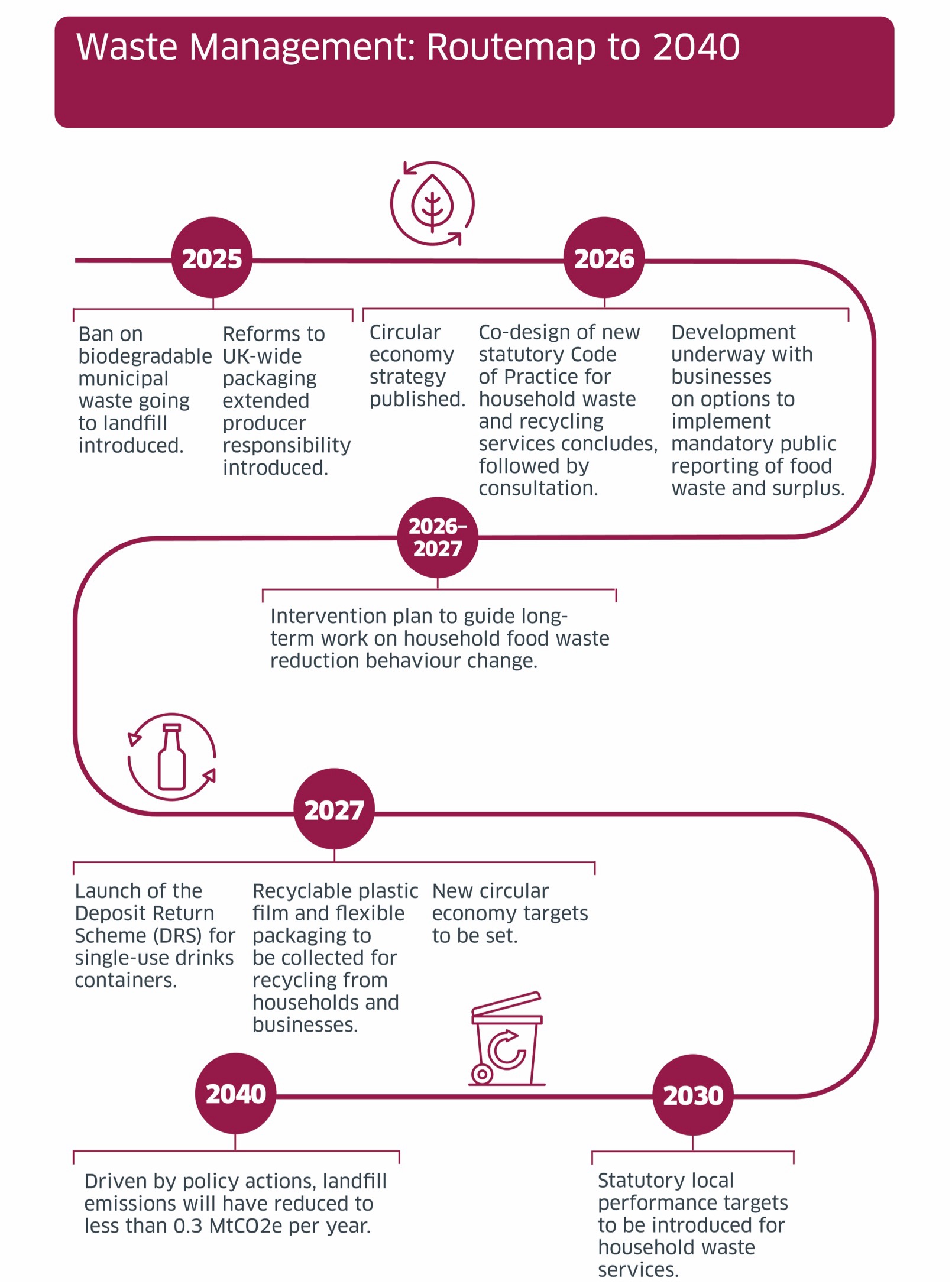
Waste Management: Routemap to 2040
- 2025
- Ban on biodegradable municiple waste going to landfill introduced.
- Reforms to UK-wide packaging extended producer responsibility introduced.
- 2026
- Circular economy strategy published.
- Co-design of new statuory Code of Practice for household waste and recycling services concludes, followed by consultation.
- Development underway with businesses on options to implement mandatory public reporting of food waste and surplus.
- 2026-2027
- Intervention plan to guide long-term work on household food waste reduction behaviour change.
- 2027
- Launch of the Deposit Return Scheme (DRS) for single-use drinks return drinks containers.
- Recyclable plastic film and flexible packaging to be collected for recycling from households and businesses.
- New circular economy targets to be set.
- 2030
- Statuory local performance targets to be introduced for household waste services.
- 2040
- Driven by policy actions, landfill emissions will have reduced to less than 0.3 MtCO2e per year.
Actions We Will Take to Achieve Our Vision
Measures here are organised by strategic aims in our Route Map in line with the waste hierarchy, which provides the basis for an effective policy package to reduce emissions across the sector and the wider carbon impact of Scotland’s waste. At a glance, the key policies that will continue to drive direct emission savings related to waste include:
- The ban on biodegradable municipal waste going to landfill,
- Maximising landfill gas capture opportunities,
- Reviewing and targeting materials currently landfilled to identify and drive alternative management routes – including biodegradable non-municipal wastes,
- Delivering the Deposit Return Scheme and reforms to extended producer responsibility schemes,
- Actions to cut the amount of food waste households and businesses produce,
- A new statutory Code of Practice and statutory local recycling and reuse performance targets for household waste and recycling services, and
- New circular economy targets to be set by 2027.
Strengthening Scotland’s Circular Economy
If we are to maximise the opportunities that a circular economy brings to Scotland, we must maintain a strategic approach to its delivery, ensuring the right structures and support are in place to enable action.
As outlined above, our first statutory circular economy strategy, a requirement of the Circular Economy Act, alongside an associated monitoring and indicator framework has now been published. We will develop new statutory circular economy targets by 2027.
The Scottish public sector spends more than £16 billion a year buying goods and services and this purchasing power has the potential to stimulate market development and innovation. We will work to embed circularity into public sector procurement processes, helping to reduce the environmental impact of public spending, shift markets and mindsets, and build long term value chains that prioritise reuse, repair, and reduced material consumption, alongside an ongoing focus on human rights. This includes considering new regulations to require purchasing goods with recycled content, recycled or reused products or future recyclable products informed by commissioned research. The circular economy strategy sets out more on our approach to procurement practices.
SEPA and the Scottish Government are working with the other three UK nations to develop a Digital Waste Tracking service. This service will bring a step change in transparency and accountability around the movement of Scottish waste across the UK from start to finish. The first phase of the new digital service will commence in April 2026 on a voluntary basis. Legislation requiring waste receiving sites to use the new service will come into force on January 2027.
Reduce and Reuse
Reducing waste and reusing materials are the first goals of the waste hierarchy and central to changing our relationship with materials and products. Building an economic system that moves away from items that are designed to be disposable will bring significant environmental benefits. Measures here are grouped under three objectives.
Objective 1: Drive responsible consumption, production and reuse
We will develop and publish a Product Stewardship Plan in 2026 that will set out the actions we propose to take on eight priority products that have significant potential to reduce carbon and support a more circular economy. Priority products were identified using an evidence-based framework that considers environmental and economic impact, alongside alignment with existing and future policies in Scotland, the UK and EU. The eight products to be covered by the plan are packaging, electronics, batteries, vehicles, end-of-life fishing gear, clothing and household textiles, mattresses and furniture.
We are committed to further reforming existing extended producer responsibility schemes, and will seek to implement a new extended producer responsibility programme for textiles in partnership with the other nations of the UK. We will consider wider product stewardship measures across the supply chain, including new collection and takeback routes, further action on single-use products, and alignment with EU Legislation. We will particularly consider how best to mainstream existing local authority, producer and waste management initiatives to expand reuse, repair and redistribution, reducing the impact of disposal and providing opportunities to address the cost of living.
Beginning in 2025, reforms to UK-wide packaging extended producer responsibility (EPR) are anticipated to increase recycling rates for packaging materials to at least 76% by 2030.[130] In-scope packaging producers are now required to cover the full net cost of managing their household packaging when it becomes waste: Scottish local authorities received an estimated £150 million from producers to fund efficient and effective collection and disposal systems for household packaging waste in the first year of the scheme (2025/26). We continue to work with other UK nations to implement further reforms to the scheme, including fee modulation for environmental sustainability and labelling requirements, alongside measures to incentivise the use of reusable packaging.
We remain committed to the delivery of a successful Deposit Return Scheme (DRS) from October 2027 to reduce litter and increase recycling rates for single-use drinks containers to at least 90%. We also continue to work with stakeholders to develop action to tackle the environmental impacts of single-use drinks cups. We will develop further measures to tackle consumption of problematic single-use items and promote and enable the uptake of reusable alternatives, including consideration of environmental charging where appropriate, and working with other UK nations and industry on reusable and refillable packaging targets and wider support.
Alongside other UK nations, we have committed to reforming the Waste Electrical and Electronic Equipment (WEEE) EPR Regulations,[131] and have introduced new obligations for online marketplaces and vapes. We remain committed to considering further reforms, including mandating producers to fund kerbside collection services for both small and large WEEE items and supporting retailer take-back schemes, making it more convenient for households to dispose of electronic waste responsibly. Alongside other UK nations, we remain committed to reforming battery EPR to account for changes to the batteries market, particularly electric vehicles, and to ensure comprehensive support for the collection, treatment, storage, recycling and disposal of waste batteries.
As part of the UK-wide EPR reform, we will work with the UK Government and other devolved governments to seek to place greater financial responsibility on vehicle producers for the environmental impact of their products at end-of-life. This will encourage improvements in vehicle design to facilitate dismantling, reuse, and recycling, taking into account the growth of electric vehicles in particular.
We are also committed to working with the fishing and aquaculture sectors to improve the collection and recycling of end-of-life gear and overall waste management in the sector whether offshore or onshore. This is a key deliverable of our Marine Litter Strategy.
In 2023[132] household textile waste made up only 4% of arisings but accounts for 19% of the carbon impacts associated with Scotland’s household waste. As well as confirming that textile products will be a key focus of our product stewardship plan, we have also set out proposed circular economy actions for the textiles sector in our Circular Economy Strategy. The Scottish Government recognises the value of a thriving circular fashion and sustainable textiles sector in Scotland and is committed to pursuing opportunities to strengthen support across the sector. We have been working with Defra as they develop their Circular Economy Growth Plan for England to understand where we can collaborate on measures, and where action must be taken by the UK Government. We have also been working with stakeholders across the supply chain, seeking to develop further policies and actions to accelerate sustainable economic growth that safeguards our resources and aligns with our transition to net zero.
Mainstreaming reuse and repair is key to addressing the current unsustainable approach to consumption and production. As well as influencing product design and manufacture, for example, through the producer responsibility measures set out above, we are working with Zero Waste Scotland to develop measures to improve the reuse experience for consumers, and support alternative business models so that leasing, repair and refurbishment, and reuse of products is easier and more attractive for businesses.[133]
Preventing either new or good as new products from being destroyed is another key focus for activity. Action to address the disposal of unsold consumer goods will be built on further research and co-design with stakeholders and businesses, and may include regulations using new powers to introduce restrictions on disposal of such goods in the Circular Economy Act. A proportionate approach will be taken, focusing on businesses and products that have the most significant environmental impact in Scotland and taking into account the availability of reuse and recycling as alternatives to disposal.
Objective 2: Reducing food waste
The Scottish food waste estimate indicates that over 1 million tonnes of food was wasted in Scotland during 2021, accounting for around 6% of Scotland's total carbon footprint that year.[134] Tackling food waste is one of the most important ways we can reduce the carbon impact of Scotland's waste. If food waste is sent to landfill, it releases methane– a greenhouse gas many times more potent than carbon dioxide. Some of these emissions can be avoided by recycling food waste, and we are actively exploring with innovators and companies ways of diverting more food waste as a feedstock for anaerobic digestion and biochemicals. However, cutting down on wasted food, particularly the waste of edible food, reduces the 'upstream' emissions, and costs, associated with growing, harvesting, processing, transporting, and buying food to begin with.
To drive food waste reduction, we will work with Zero Waste Scotland to develop an intervention plan by 2026/27 to guide long-term work on household food waste reduction behaviour change. This will gather evidence about and review interventions that have potential to reduce household food waste. It will help address gaps in food waste reduction behaviour change knowledge and inspire action at various decision-making stages, including when and how to purchase and store food.
To support business to cut food waste and save money, from 2025/26 we will develop with stakeholders effective options to implement mandatory public reporting of food waste and surplus by businesses. Utilising new powers from the Circular Economy Act, this will put in place more effective monitoring and management of food waste. We recognise that reporting will be an additional ask on businesses, and that many food businesses work across the UK. We will continue to work with key partners to ensure we are engaging at a Scottish and UK level to maximise potential impact and simplicity for the business sector.
Our focus on targeting the prevention of food waste in households and in businesses is crucial to driving Scotland’s efforts to reduce the amount of food waste generated and reverse the increase in food waste trends that was estimated between 2013 and 2021.[135] This will help us work towards the United Nations Sustainable Development Goal 12.3 to halve food waste and reduce food loss by 2030.[136]
In addition, NHS services operate throughout Scotland, and the NHS is a major buyer of food and related services. We are committed to support the development and implementation of an NHS Scotland national action plan on food waste. All Health Boards have been working towards a 33% reduction in food waste by 2025, with the majority of Boards, representing well over 60% of the population, already reporting compliance with this target. Food waste management and source segregation of food waste supporting the bio-circular economy is in place across virtually all of Scotland’s main hospital sites. The management of food waste and food as a resource will be further included in NHS Scotland’s forthcoming revision to its Climate Emergency and Sustainability Strategy, due in 2027, and the work of Health Boards in the preparation of local Good Food Nation Plans.
Objective 3: Embedding circular construction practices
Construction and demolition accounts for up to half of all waste produced in Scotland (45% in 2023) [137] and is a priority sector for us. This waste is largely soil excavations from housing and infrastructure projects, as well as bricks, tiles, and concrete from demolition. Scotland has met the EU target of 70% recycling and reuse of construction and demolition waste every year since 2011, with recycling and reuse rates currently at 90.1%. However, there is a need to focus further up the waste hierarchy, reducing waste and reusing resources.
Building on scoping and feasibility work undertaken since 2023, we are supporting the development of a model for regional Scottish hubs and networks for the reuse of construction materials and assets.[138] This measure involves the development of investment ready models from 2025 to 2027, supporting the development of regional platforms for storing and sourcing used construction materials, drawing on national and international best practices to address challenges like supply-demand mismatch, dispersed materials, and cost biases toward new, high-carbon products.
There is a need to move beyond management of waste materials to maximising the lifespan of carbon and material intensive structures in our built environment. Through our commitment to investigate and promote options to incentivise and build capacity for the refurbishment of buildings, we can support more refurbishment of existing buildings over new builds.
In the Route Map, we committed to developing new and promoting existing best practice standards in circular practices within the construction sector, and assess the options for both voluntary and mandatory compliance. This measure will support Scotland’s circular economy by promoting and developing best practice standards for material reuse in construction, reducing reliance on virgin materials and lowering associated emissions. The Circular Economy Strategy also identifies the built environment as a priority sector, as part of this a dedicated roadmap is being developed that will identify sector-specific conditions, barriers and opportunities to accelerate circularity in the sector.
The Scottish public sector construction procurement framework employs an Investment Hierarchy[139] that helps to address construction waste. The Investment Hierarchy aims to support better use of existing assets, including reuse and repurposing. Its leading principle is to reduce the need for new construction or demolition and therefore, where possible, avoid construction waste altogether.
These principles are being carried forward and strengthened in the draft Infrastructure Strategy, published for consultation on 13 January 2026.
The Scottish Aggregates Tax, a tax on the commercial exploitation of primary aggregates,[140] will be introduced from 1 April 2026. The new devolved tax will support our circular economy objectives by encouraging the minimum necessary use of primary aggregates, maximising the use of recycled and secondary alternatives, and incentivising innovation and the development of alternative material.
Waste Crime
Waste crime undercuts legitimate operators, and undermines the shift to a circular economy by creating leakage resulting in valuable resources being lost. The Circular Economy and Waste Route Map sets out a number of actions we are taking forward to address waste crime. This includes work to deliver our 2023 National Litter and Flytipping Strategy, which set out a six-year plan to focus on the prevention of litter and flytipping through education and awareness raising; ensuring that there is suitable infrastructure and services, including improving data that can help determine effective interventions; and enforcement that acts as a deterrent and punishment for those who fail to recognise the harm that litter and fly-tipped waste causes the environment.
Modernise Recycling
Recycling helps to conserve our natural resources, keep valuable materials flowing through our economy, and reduce the amount of waste sent to landfill and incineration. We want a high-performing recycling system that modernises recycling services for households and businesses across Scotland, optimises the performance of collection services, and can recycle most waste types to maximise diversion of waste from disposal.
Our final investments from the Recycling Improvement Fund are now being delivered. The five-year fund, developed in partnership with local government, has allocated more than £66 million to 48 projects in 27 local authorities to improve recycling infrastructure since 2021. Zero Waste Scotland estimate that projects will benefit more than two-thirds of Scottish households and reduce annual CO2e emissions by 62,741 tonnes.
To build on these investments, using powers from the Circular Economy Act, we are developing a statutory Code of Practice for household waste services to replace the existing voluntary Code. The development of the new code is based on a co-design with households, COSLA, local authorities, third sector organisations and service operators for high quality, high performing household recycling services for both kerbside and flatted properties. The co-design process will conclude by the end of 2026, followed by public consultation and parliamentary scrutiny. The Code of Practice will come into force after an implementation period to be agreed with local government.
Reflected in these new standards, recyclable plastic film and flexible packaging is to be collected for recycling from both households and businesses across the UK by 31 March 2027. Local authority costs of operating an efficient and effective household collection service for recyclable plastic film and flexible packaging will be covered by packaging EPR.
In line with current EU policy, in 2025 the Scottish Government consulted on the separate collection of textile waste from households, which explored whether kerbside collection of textiles or alternative means of collection by local authorities should be a mandatory service in Scotland. We have also committed to review current practices with respect to separate collection of bio-waste (e.g. garden waste). This will be complemented by a review of waste and recycling service charging, to ensure that we have the right incentives to reduce waste and maximise use of recycling and reuse services. In 2025 we also consulted on the current rural exemption for food waste recycling, and whether that should continue in its current form. All of these measures are currently being assessed through the co-design of the household recycling Code of Practice.
Alongside the new Code of Practice, we will develop, in partnership with COSLA, an action-focused improvement programme as a framework to enable local authorities to improve their household recycling and reuse rates. This programme will support the setting of ambitious and achievable statutory local recycling and reuse performance targets for household waste services from 2030 onwards, underpinned by funding sufficient to enable their delivery.
We are undertaking a targeted review of compliance with current commercial recycling requirements in Scotland. Led by SEPA, the review will conclude by the end of 2026, and will help improve our understanding of the barriers faced by Scottish businesses and other commercial sector premises to achieve greater waste reduction and improved recycling and reuse.
Working with Zero Waste Scotland, SEPA, and the commercial waste and resources sector, we will seek to conduct a national compositional study of waste from commercial premises before 2030. The study will examine how much recyclable material is in residual commercial waste, helping identify priority materials, products and sectors for further waste prevention, recycling and reuse interventions.
Following completion of the two actions above to improve understanding of the commercial waste and recycling landscape in Scotland, by 2030 we intend to commence a co-design process with stakeholders to improve commercial waste service provision. This will drive greater waste prevention and reuse, maximise recycling and reduce emissions associated with commercial waste.
Decarbonise Disposal
The policies in this section are focused on the emissions stemming from disposal to landfill.[141]
On 31 December 2025 the ban on biodegradable municipal waste (BMW) going to landfill came into force in Scotland. Local authorities and waste operators have made significant progress to prepare for the ban, and the overwhelming majority already have compliant solutions in place. However, due to a temporary shortfall of energy from waste capacity in Scotland, some parts of the waste sector identified challenges in fully complying with the ban. SEPA, as Scotland’s independent environmental regulator, set out its enforcement approach to the ban on biodegradable municipal waste going to landfill via a Temporary Regulatory Position Statement (published on 29 October 2025). As a result, relatively small amounts of biodegradable municipal waste are expected to be landfilled in 2026 and 2027 before the Temporary Regulatory Position Statement expires on 31 December 2027. The ban has been critical to the recent decline in waste sector emissions and is projected to continue to drive the sector’s emission savings over the next decade.
Building on this, and reflecting CCC advice, we will continue to support full compliance with the ban, and review and target materials currently landfilled to identify and drive alternative management routes. This includes the potential to extend the BMW landfill ban to include biodegradable non-municipal wastes, and work to provide assurance around some specific waste streams including mattresses. The Call for Evidence on reducing the landfilling of biodegradable and other wastes, which explored the potential to ban the landfilling of non-municipal biodegradable waste, was held in 2025. Responses to the Call for Evidence are currently being analysed, with the publication of the analysis planned for later in 2026.
We have committed to develop a Residual Waste Plan by 2027 to ensure the best environmental outcome for materials and set strategic direction for management of residual waste to 2045. The Plan will set the long-term vision for future disposal practices in Scotland to minimise the environmental and climate impacts of waste while ensuring that we have appropriate capacity in place to manage the expected, declining volumes of waste in the future as Scotland moves to a fully circular economy. To guide this, the Plan will be shaped in collaboration with a range of stakeholders to draw upon the expertise across sectors.
We will work with industry and the public sector to maximise landfill gas capture opportunities in Scotland. We recognise that industry has made strides to improve and optimise landfill gas capture. Maintaining the efficiency of landfill gas capture is critical to ensuring Scotland maximises the emission savings that accompany our rapid shift away from landfilling practices. We are reviewing the potential options to drive the pace and scale of decarbonisation, and will continue to engage with industry to understand the consequences of changes to landfill management financial incentives on decarbonisation.
This work will be considered alongside the development of the Residual Waste Plan, to ensure a strategic approach to decarbonisation of residual waste and its impacts, Scotland’s long-term infrastructure requirements, and management of legacy waste infrastructure.
Other Emission Sources
Other sources of emissions within the waste sector include waste water and sewage treatment, composting, anaerobic digestion, and certain types of incineration in very limited circumstances (for example, clinical waste).
We are working closely with Scottish Water, which has huge potential for renewable energy generation and energy efficiency, including in the waste water treatment network. Scottish Water’s ambitious Net Zero Route Map[142] includes a wide range of action to minimise emissions across all aspects of its activities to meet, and go beyond, its target of net zero emissions by 2040.
It is our intention to broadly align with Energy Neutrality and Resource Recovery requirements in the EU's Urban Waste Water Treatment Directive[143] (Article 11 and 20). This is likely to include energy audits, energy recovery and resource recovery.
As the CCC has set out, anaerobic digestion and composting play an important part in recycling food and garden waste, providing alternatives to disposal and helping to reduce emissions. We will continue to work with SEPA and the sector to ensure there is appropriate capacity in Scotland to manage these biodegradable materials, and optimise the efficiency of both anaerobic digestion and composting.
Just Transition Principles and Adaptation
A circular economy can bring tangible benefits to Scotland’s communities and businesses. Based on the Scottish average for 2021/22, food and drink waste cost £240 per person or £480 per household that year.[144] A more circular Scotland means cutting waste and its associated cost, opening up new market opportunities, improving productivity, self-sufficiency and resilience through reduced reliance on international supply chains and global shocks, and strengthening communities by providing local employment opportunities and lower cost options to access the goods Scotland needs.
People and Communities
Our products will be designed to last longer and can be more easily repaired, and the reuse of materials and products will be the norm. The building up of Scotland’s circular economy will help to improve people’s lives by ensuring lower-cost access to goods, as well as local employment opportunities – for example, through greater reuse, repair, remanufacturing, ‘servitisation’ (e.g. renting/leasing models) and other circular business models. Evidence suggests that there are likely tangible public health benefits associated with this shift. A recent report from Public Health Wales[145] outlined some of the probable and long-term health benefits associated with a circular economy through delivering waste reduction, reuse and recycling actions.
As with any systemic transition, there are risks that we need to mitigate to ensure these opportunities are seized and we address rather than exacerbate existing inequalities. For example, we know that more sustainable products may be more expensive at the outset, and that lower income households could be impacted by reduced access to cheaper, less durable products. This is why our support for a wider societal shift towards valuing second-hand or repaired products, together with increasing access to sharing libraries and repair cafes, is so important. By making this the norm, we can ensure the availability and affordability of these products to everyone in society. The range of impact assessments published alongside this CCP set out further Just Transition considerations that will be taken into account as measures are developed and implemented. These include:
- Impacts on the costs and availability of goods for people with protected characteristics and/or experiencing socio-economic disadvantage: by promoting reuse and repair, policies may lower household costs through access to affordable second-hand goods, for example, through better access to reuse hubs and community repair schemes.
- Household savings made by reducing food waste. Food and drink waste cost Scottish households an average of £480 per household in 2021/22.[146] By adopting behaviours like meal planning and proper storage the average Scottish family could make savings through reducing food waste. We will work with stakeholders to improve our understanding of key behaviours and barriers that different people in society may face in trying to reduce household food waste.
- Access and availability of high-quality reuse and recycling services. Measures to drive modernisation of recycling must take into account the different geographical and community needs that local authorities and residents across Scotland encounter, for example, the different considerations for an urban area with flatted properties, or delivering a service in a sparsely populated rural area. The co-design of a new household Code of Practice will account for this, placing households at the heart of how services are designed and delivered.
- Accessibility considerations for the introduction of the DRS on those experiencing socio-economic disadvantage. Through the DRS, consumers will pay a refundable deposit when purchasing eligible drinks with the deposit being refunded when the empty container is brought back to a designated return point. We are committed to ensuring the scheme supports a fair transition, with attention to regional equity, reuse and refill options and alignment with broader climate goals.
- Effective community engagement around residual waste treatment facilities. In response to a recommendation in the independent review of incineration,[147] we have committed to facilitate the co-production of meaningful and effective community engagement guidance, working with community groups, local authorities, and residual waste operators, seeking to significantly strengthen transparency, community engagement and trust as facilities are developed.
Workforce
An estimated 12,000 employees work directly within the resources and waste sector in Scotland.[148] The recent Circular Jobs Tracker Report found there were over 56,000 fulltime equivalent jobs attributable to circular economy activities in Scotland in 2021, representing 2.6% of total employment. These indicative headlines show the tremendous potential contribution of circular economy activities to the Scottish economy, including occupations in repairing and recycling our goods, engineering, building and decommissioning our infrastructure, managing our waste and resources, and enabling future progress through education and skills development. Delivering a circular economy provides opportunities to create new high quality and entry level jobs, including in areas with persistently high unemployment. A recent report found that putting circular approaches into action could generate nearly 60,000 new jobs, especially in labour-intensive sectors like repair, maintenance and waste management.[149]
We also know that the transition will have implications for the existing workforce. For example, as well as potentially creating new job opportunities, the introduction of interventions around repair, reuse and reprocessing may require training and skills development for the current workforce. As interventions are developed, we are actively taking into account re-skilling to ensure access to new jobs and access for disadvantaged groups to opportunities. This is particularly relevant for those within construction and demolition, business and commerce, and for consumption-related measures.
There are Just Transition challenges that we are working to address in policy design. As Scotland produces less waste and materials move up the waste hierarchy, our infrastructure requirements will change, particularly for residual waste. Those working within waste management, for example, at landfill sites or Energy from Waste incineration facilities, may be impacted as these capacity requirements change, with potentially fewer jobs in this part of the sector. The development of a Residual Waste Plan to 2045 in collaboration with the sector and other stakeholders is a key opportunity to consider these issues strategically as workers move from sectors that are attempting to decarbonise.
Employers
Reductions in waste and consumption of resources, alongside more effective and efficient waste management processes, will deliver benefits to business in terms of savings, greater resilience, and more stable supply chains. The transition should also support a shift in how we treat and manage materials, helping to create economic opportunities by valuing our materials: such as consideration of the available markets for collected materials to maximise higher value return and keep them in use, and opportunities to drive greater investment in domestic reprocessing here in Scotland.
The 'polluter pays' principle runs through waste and circular economy policies and legislation, and is one of the guiding principles on the environment set out in the Continuity Act.[150] It is the principle that those who cause pollution should bear the financial responsibility for any damage or remedial action required as a result. At a high-level, implementing the polluter pays principle may mean that there are some upfront costs as well as long-term cost savings (i.e. additional enforcement costs for public bodies, and administrative costs for businesses). It means that some employers may see higher or lower costs, as costs are transferred to those that are responsible for the costs associated with pollution, for example:
- Reforms to UK-wide packaging extended producer responsibility (EPR), mean that in-scope packaging producers are now required to cover the full net cost of managing their household packaging when it becomes waste.
- Mandatory reporting of food waste and surplus is expected to have cost implications for businesses, and SEPA as the regulator. The Scottish Government has been clear that it will develop effective options with stakeholders for how this reporting requirement can be fairly and effectively implemented. We want to learn from businesses' experience of existing voluntary reporting.
- Measures to modernise reuse and recycling may include some wider costs for local authorities in moving from a voluntary to a mandatory Code of Practice for household recycling services (e.g. they may need to make one-off capital investments such as bins, vehicles and storage facilities). These costs and the funding support required for local authorities form part of the co-design. Similarly, measures to improve commercial waste and recycling provisions may also entail some costs for businesses and local authorities. Co-design with stakeholders is key, ensuring the expertise of and evidence from local government and the business sector informs policy development.
- A strategic approach to residual waste management will benefit the sector but may involve some direct upfront costs, arising from the need for new physical infrastructure and machinery costs, staff training or IT changes. Collaboration with stakeholders, including the resources and waste sector and wider business community, is crucial.
We recognise that support for businesses to embed circular economy behaviours, models and practices is vital. However, it is also important to recognise that there will be very significant costs to employers and society as a whole if we do not take forward the actions in this chapter. The positive economic opportunities and environmental impacts from a circular economy will not be fully realised, and the cost of waste and its environmental externalities will continue to be borne by public bodies, businesses, and communities.
Adaptation
With regards to waste infrastructure, the changes in our climate will have a bearing on how we meet Scotland’s strategic waste infrastructure and capacity requirements for the coming decades. For example, the increased risk of flooding may bring additional risks in terms of environmental impacts at landfill sites due to leakage or run-off, and low-lying or coastal-based facilities may face additional risks. Increased temperatures may also put pressure on recycling services and reprocessing facilities, and lead to increased levels of waste decomposition (meaning more frequent collections or increased sorting or storage could be required for certain waste streams to maximise recycling and also protect public health).
With regards to waste water treatment, climate change will present major challenges to Scottish Water’s waste water treatment works that could impact environmental performance and impact river water quality. To adapt and to maintain current service to customers and protect the environment, Scottish Water will assess the capability of our waste water treatment works and networks to deal with the expected increase and variability of flows entering the system due to climate change and adapt assets to cope with the wider range of conditions they may expect. More information on the steps we are taking in this area is covered in the Scottish National Adaptation Plan 2024 – 2029.
With regards to adaptation and the role of the circular economy in climate resilience, our transition to a net-zero and climate-resilient economy will rely on the secure and adequate supply of critical raw materials (minerals and metals) and technologies which form the basis of many industrial supply chains. Insights from Scottish Enterprise[151] have shown that the materials Scotland requires to support our energy transition and economic growth are experiencing supply security risks, including from exposure to climate hazards and related supply chain disruption. For instance, copper and lithium, which are of high importance to wind energy, electric vehicles and battery storage, are vulnerable to water stress given their high water requirements. We will explore how best to build supply chain and overall economic resilience, including supporting remanufacturing, recovery, reuse and recycling, and mitigating risks associated with critical raw material and technology access.
Our Call to Others
Local Authorities
Local government are key partners in our efforts to decarbonise the waste sector and improve public services. This is reflected by ongoing collaboration between Scottish Government and Local Government on a range of actions in this chapter. Key asks for local government include:
- Continuing to play a critical role in moving materials up the waste hierarchy, by actively encouraging households and businesses to focus on waste prevention, reuse and repair. Examples include communications, delivery of key services to households and businesses, and investment in reuse services,
- Working with partners to progress the co-design of the new statutory Code of Practice for waste and recycling service standards, and looking for opportunities to go further than those minimum standards to drive further improvements in reuse and recycling,
- Continuing to bring local government expertise to the development of key policies and implementation of the system-wide approach set out in the Route Map, including implementation of packaging EPR, DRS, and actions to minimise the carbon impacts of Energy from Waste (see Energy Supply chapter), and
- Working with government and other partners to support strategic planning for future infrastructure requirements, including its role in unlocking domestic reprocessing opportunities and investment, the final investments from the Recycling Improvement Fund, the progression of strategic landfill gas capture projects, and in the development of the residual waste plan to 2045.
Industry and Business
Our approach has been and will continue to be guided by the New Deal for Business. This is reflected in many of the measures in this chapter. Our key asks for businesses and industry include:
- Continuing to move materials up the waste hierarchy, by actively increasing waste prevention, reuse and ability for repair by rethinking operations, diversifying businesses and supporting innovation, including through more sustainable product design,
- Reviewing and tackling the business-level barriers to maximising recycling, engaging with measures in this chapter, such as the review of commercial compliance with recycling requirements, commercial provision co-design, and improvements to our understanding of commercial waste composition,
- Continuing preparations, including putting in place alternative treatment solutions for residual waste, for full and timely compliance with the ban on biodegradable municipal waste to landfill, and
- Working with government to maximise Scotland’s landfill gas capture efforts and on the development of Scotland’s residual waste plan to 2045 to shape the long-term strategic direction for the management of residual waste; and taking a leading role in the development of a sector-led plan to minimise the Carbon Impacts of Energy from Waste (EfW) – see Energy Supply sector.
The UK Government
We recognise that certain matters relating to the circular economy are reserved to the UK Government, and separately that the production of our products, services and materials involve supply chains that go beyond Scotland, spanning the UK, European Union, and the rest of the world.
Although we already work constructively with the UK and other devolved governments on some common interests, to drive more rapid progress further collaborative action is required. Given the immense challenges we collectively face and significant economic and environmental opportunities a circular economy can bring, we need enhanced cooperation to deliver our shared ambitions, at pace, in a host of areas that would unlock circular economy and emission reduction progress across the UK's nations. These areas include matters reserved to the UK Government such as certain product standards, the role of VAT and tax to incentivise and encourage sustainable behaviours, and measures to influence global markets, reduce imported and exported emissions and incentivise investment in domestic reprocessing capacity.
Individuals and Households
Cutting food waste and maximising recycling: Reducing overall food waste is one of the most impactful steps we can take to tackle the climate impact of Scotland's waste, it is also one of the biggest challenges. Householders contribute around 60% of the food wasted in Scotland,[152] and – based on information from 2021-23 – Scottish households threw away 330,000 tonnes of food waste per annum in the residual waste bin.[153] Shifting this behaviour to value food more by wasting less and recycling any remaining food waste would make significant inroads into climate change impacts.
Supporting high quality recycling is everybody’s responsibility, and the interventions above are designed to put people at the centre of how services and future interventions are designed. This includes learning from people’s experiences, identifying behavioural barriers, co-designing measures with households, and ensuring effective communications to encourage and give people the tools to adopt more sustainable behaviours.
Choosing and demanding more sustainable products: We want to encourage people in Scotland to purchase products and services in ways which respect the limits of our natural resources, and to see unnecessary waste as unacceptable. Making reuse and repair more accessible is a key part of this, to keep materials and products in use for as long as possible, and build confidence in sustainable choices.
Our Route Map includes actions to address this, for example improving the reuse experience for consumers. The implementation of schemes like the Deposit Return Scheme is also likely to have a positive impact on public attitudes and behaviours around the waste we produce and the value of materials.
The Scottish Government will continue to work with the public, in line with the principles set out in our Net Zero Nation public engagement strategy. Public engagement has informed the development of measures throughout this chapter. This includes taking into account feedback from two public Route Map consultations in 2022 and 2024, showing consistently high levels of public support for its actions.
International Engagement
We retain a clear commitment to seek to maintain or enhance the environmental standards in place when we left the EU, and to maintain alignment with developing EU standards where possible and meaningful to do so. There are a number of areas outlined in the sections above that reflect this, including our approach for specific products like packaging, batteries and textiles.
No country has yet identified a long-term pathway to achieving zero waste and a circular economy, but we recognise there are some bold, ambitious examples of a circular economy in action across the world. We want to engage with and learn from the experiences of others, and share our own experiences as we deliver this economic transition.
Energy supply
Introduction
The sector covers two broad elements. The first is electricity generation and power stations where we have already made substantive progress, with current emissions just under 1 MtCO2e in 2023.[154] Remaining emissions arise from three main sources: Peterhead gas-fired power station (~0.6 MtCO2e, 2023); energy from waste sites (~0.3 MtCO2e, 2023), and island diesel generators (~0.05 MtCO2e 2023). There are additionally a small number of emissions from other fuels (~0.02 MtCO2e, 2023). The second element covers oil and gas supply emissions as a result of refining of crude oil into petroleum, the operation of terminals to manage the import and onshoring of oil and gas, leakage of gas from pipelines, and emissions associated with the onshore production of oil and gas.[155] Emissions from this sector were 2.85 MtCO2e in 2023.
Scotland is already at the forefront of the transition to renewables – a record 37.9 TWh of renewable electricity was generated in 2024. We have already seen substantial decreases in emissions from electricity generation as a result – the emissions from energy generation have reduced from 14.7 MtCO2e in 1990 to 1.0 MtCO2e in 2023 (93.4% reduction). It is essential that our renewables sector continues to grow in order to match growth in the demand for electricity that will arise as we decarbonise other sectors. To support a resilient energy system, grid and storage capacity will also need to grow substantially alongside this.
Electricity supply emissions are projected to decline further to 0.37 MtCO2e by 2040, due primarily to the closure of the existing Peterhead power station and its replacement by a modern gas fired plant (CCGT) utilising carbon capture and storage technology (CCS), and energy from waste sites installing CCS technology once the Scottish Carbon Capture Usage and Storage (CCUS) Cluster is online – both by 2032.
The closure of the Grangemouth refinery in April 2025 will support the reduction of emissions from the oil and gas supply sector to 0.47 MtCO2e by 2030 but has resulted in the loss of 400 jobs with a commensurate impact on Scotland’s economy and wider communities. The North Sea is a geologically mature oil and gas basin and the natural decline in production over the period of this Plan means we will also need to support Scotland’s highly skilled and valued workforce to transition into other parts of the economy. We have taken action to support the community and the workers directly impacted by the Grangemouth closure, and are working closely with the UK Government and Petroineos to develop potential alternative uses for the site.
Context and Wider Alignment
Scotland has a thriving energy sector – it has been at the heart of our economy, initially through the oil and gas industry and now through the growing renewables industry. The energy supply sector is now in a period of transition. To further reduce our emissions in the energy sector, we must address the remaining sources of emissions while maintaining secure and resilient supply.
Oil and gas currently account for around 77% of Scottish energy consumption[156]. The biggest users are the energy industry, road transport and domestic heating. This demand is currently met through a mixture of domestic production (i.e. from the North Sea, including West of Shetland) and imports. The geological maturity of the North Sea basin means that domestic production is forecast to decrease significantly over the next decade.[157],[158]
In contrast, our renewables sector continues to grow – with the amount of renewable electricity generated in 2024 representing an 13.2% increase compared to 2023. In 2024, 73.1% of electricity generated in Scotland was from renewable sources,[159] and Scotland is a net exporter of electricity to the rest of the UK: in 2024, there were 19.7 TWh of net electricity exports to other UK nations.[160]
Alignment with Key Strategies and Plans
The CCC has identified that the capacity of renewables in Scotland needs to more than triple by 2035 to meet the increase in demand for electricity arising from the decarbonisation of other sectors. Alongside this, there will need to be an unprecedented investment in grid infrastructure and the development of grid storage, while considering the potential impacts on local communities, on Scotland’s habitats, wildlife and landscapes under development as well as the impacts on this climate change plan.
- Planning is a critical enabler in the delivery of the increase in energy infrastructure that is needed. Our fourth National Planning Framework (NPF4), adopted in 2023, places climate and nature at the centre of our onshore planning system and makes clear our support for all forms of renewable, low-carbon and zero emission technologies, including transmission and distribution infrastructure. Potential impacts on communities, nature and cultural heritage, including the cumulative effects of developments, are important considerations in the decision-making process. All applications are subject to site-specific assessments.
- For offshore wind development, we consulted on the Draft Updated Sectoral Marine Plan for Offshore Wind Energy during the summer of 2025. This planning process brings together a strategic assessment of environmental, social and economic impacts and benefits of the offshore wind pipeline for the ScotWind and INTOG leasing rounds. All applications are subject to site-specific assessments.
- In September 2024, we published our Green Industrial Strategy. The strategy set out five opportunity areas for Scotland, building on our existing strengths, where we have the best opportunities to build internationally competitive sectors, creating highly skilled, well-paid jobs with economic and social value across the country.
- The key levers of energy policy and regulation that will be required to support delivering this growth in renewable generation are largely reserved to the UK Government. Achieving our joint ambitions therefore requires actions by the UK Government, NESO and Ofgem. We need to work closely together to reform the energy system to ensure the delivery of the energy infrastructure:
- The UK Government’s Clean Power Action Plan (CP2030),[161] published in December 2024, aims to decarbonise the GB power system by 2030.
- In October 2024, the UK, Scottish and Welsh governments jointly commissioned the newly created National Energy System Operator ‘NESO’ to produce a Strategic Spatial Energy Plan (SSEP) for Great Britain. This will set out a strategic blueprint for GB’s energy system for the period out to 2050.
Our Vision
By 2035, we will have expanded our renewable capacity significantly to meet the increasing demand as other sectors decarbonise. We already have an ambition to deliver 20GW of onshore wind by 2030 and in January 2026, we published the ‘Offshore Wind Policy Statement 2020 update: Scotland’s Offshore Wind Ambition’. This set out an increased offshore wind ambition for Scotland of up to 40GW of new offshore wind capacity by 2040, including all ScotWind and Innovation And Targeted Oil and Gas (INTOG) projects.
We will be less reliant on imported fuels and global fossil fuel markets; strengthen our energy independence and security; and produce the power we need to meet increasing demand for clean electricity as we decarbonise heat and transport.
As we transition to a net zero energy system and reduce our dependence on fossil fuel generation, energy storage will play a larger role in ensuring a secure and resilient electricity system by providing a reliable and flexible electricity supply.
The Scottish Government maintains the finalised position of no support for onshore unconventional oil and gas, including hydraulic fracturing (or fracking) which it confirmed in October 2019. Our finalised position of no support for onshore conventional oil and gas was confirmed in June 2025. At the same time, the Scottish Government confirmed its finalised position of no support for coal extraction in Scotland.
Energy density represents a continuing difficulty in decarbonising Non-Road Mobile machinery (NRMM) and aviation. The Scottish Government seeks to develop infrastructure to allow decarbonisation of these sectors through improved efficiencies, novel technologies and alternative fuels. In particular, the Scottish Government aims to decarbonise NRMM by at least 80% by 2040.
Whilst finished fuels continue to play an important part in our energy mix today, the declining demand for oil and gas means that we expect the emissions from oil and gas terminals and from refining will gradually drop over the coming years. The transition from fossil fuels to renewables represents a generational shift in our economy. The following principles are central to our vision:
- Communities hosting energy infrastructure must derive direct benefit from it and be meaningfully engaged and consulted at the right time about developments that impact them.
- We must continue to support Scotland’s existing valued and highly skilled oil and gas workforce to access opportunities across the energy sector.
- Individuals and businesses should feel the wider benefits of the changes to our energy supply through lower bills and secure energy supplies.
Progress since the Climate Change Plan update
As set out above, the contents of this chapter differ from the previous iteration of the Climate Change Plan (2018) and Climate Change Plan update (2020), which focused on electricity generation only. The 2023 annual emissions envelope published in the Climate Change Plan update (CCPu) for electricity was for 1.5 MtCO2e, whereas the Scottish greenhouse gas emission statistics for 2023 (published in June 2025) show a position of 1.0 MtCO2e. These figures show a more rapid decrease in electricity emissions than anticipated.
Since the CCPu, we have taken significant steps to progress our renewables ambition and reduce emissions in this sector. Many of the actions are ongoing as they represent long-term commitments. We have supported the development of a system that has an increasing volume of renewables through:
- Signing the Onshore Wind Sector Deal. This confirmed joint industry and Scottish Government commitments to deliver 20GW of onshore wind by 2030 and set out the actions to deliver this,
- Confirming our increased ambition of up to 40GW of new offshore wind capacity in Scotland by 2040,
- Consulting on a draft updated Sectoral Marine Plan for Offshore Wind Energy (SMP-OWE), which sets out an integrated planning framework for both the ScotWind and Innovation and Targeted Oil and Gas (INTOG) leasing rounds,
- Introducing a Scottish statutory instrument to reform how the Habitats Regulations apply to offshore wind, enabling a more flexible approach to environmental compensation for offshore wind projects,
- Consulting on a Scottish Marine Recovery Fund and progressing work to operationalise the Fund as soon as possible, which would support timely decision-making on offshore wind applications,
- Encouraging offshore wind developer engagement with the Scottish supply chain through implementation of the Supply Chain Development Statement process, led by Crown Estate Scotland,
- Continuing our commitment to help the Scottish hydrogen sector develop and grow and to establishing a hydrogen economy in which the benefits of our energy transition are shared, and which recognises the role of hydrogen in the energy system, harnesses the full potential of our skilled people, our worldclass industries, and our natural resources,
- Consulting on our draft Bioenergy Policy Statement – which sets out how we want to see the resources available to the bioenergy sector being used. This will be followed by our finalised Bioenergy Policy Statement,
- Continuing to improve our energy consenting process, including recently doubling the number of staff in our Energy Consenting Unit,
- Continuing to reform the consenting process through the powers enabled by the UK Government’s Planning and Infrastructure Act
- Commissioning the independent review of incineration and publishing our responses to both of Dr Church's reports, accepting all of the review's recommendations in principle or in full,[162]
- Working with the UK Government, Ofgem and network operators to ensure Scottish Government policy goals are considered in reserved policy and regulations relating to energy – including engaging with the UK Government on electricity market reforms and transmission charging,
- Pressing the UK Government to ensure the clean energy and storage capability of Scotland’s hydro resource can be realised by instituting appropriate market mechanisms,
- Committing to the publication of a call for evidence on battery energy storage Systems in 2026,
- Adopting National Planning Framework 4 (NPF4) on 13 February 2023. NPF4 places climate and nature at the centre of our planning system and makes clear our support for all forms of renewable, low carbon and zero emissions technologies. In response to incineration review recommendations, NPF4 sets out that the Scottish Government will not support new developments of energy from waste facilities, except under limited circumstances,
- Setting out a new rating exemption for prescribed plant and machinery used for onsite renewable energy generation and storage in the Scottish Budget 2023-2024. This is available now until 31 March 2035. This exemption is in addition to the most generous and comprehensive NDR relief package for renewable energy producers in the UK, which includes a number of policies aimed specifically at incentivising investment in low carbon technologies,
- Consulting on phase 3 of our Permitted Development Rights (PDR) review programme in Summer 2023, which was focussed on domestic and non-domestic renewables. The phase 3 consultation sought views on proposals to extend PDR for solar equipment. The final provisions were laid in the Scottish Parliament on 28 March 2024 and came into force on 24 May 2024,
- Carrying out a research project to help us map current and future workforce and skills requirements in Scotland’s solar industry to 2030. This research was published on 9 July 2024. We commissioned a further research project to build on these findings, and quantify and summarise the existing provision of skills development and training pertinent to the onshore wind and the solar industry sectors in Scotland. The final report was published on 3 February 2025, and included recommendations to enhance skills and training across Scotland, with a view to facilitating the supply of skilled workers that the two sectors will need,
- Continuing focus on effective action to reduce the energy demand of new buildings and are currently undertaking a review on ‘a Scottish equivalent to the Passivhaus standard’. This includes discussion on the ongoing role that effective use of on-site generation can play in offsetting energy demand.
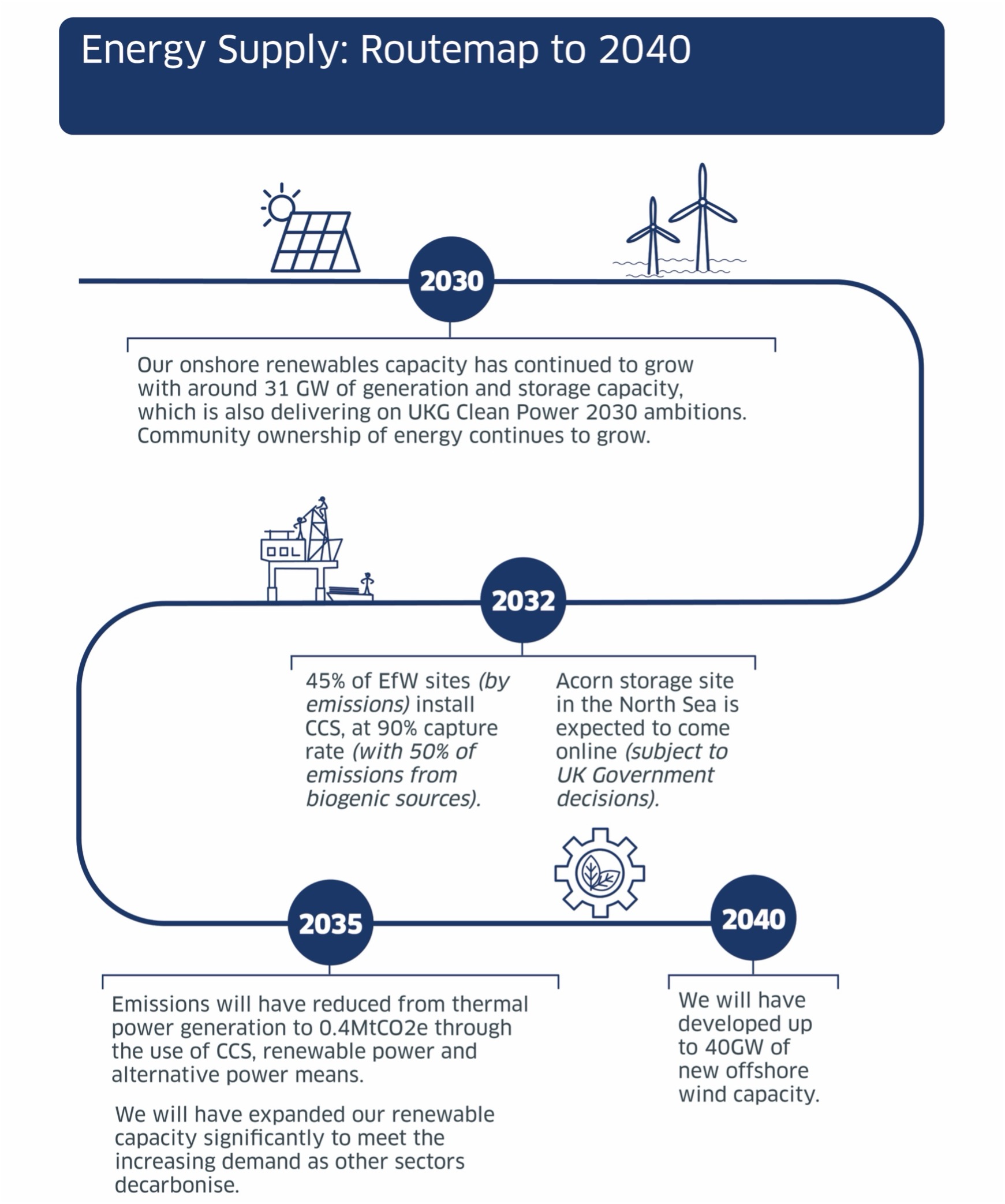
Energy Supply: Routemap to 2040
- 2030
- Our onshore renewables capacity has continued to gor with around 31 GW of generation and storage capacity, which is also delivering on UKG Clean Power 2030 ambitions. Community ownership continues to grow.
- 2032
- 45% of EfW sites (by emissions) install CCS, at 90% capture rate (with 50% of emissions from biogenic sources).
- Acorn storage site in the North Sea is expected to come online (subject to UK Government decisions).
- 2035
- Emissions will have reduced from thermal power generation to 0.4MtCO2 through the use of CCS, renewable power and alternative power means.
- We will have expanded our renewable capacity to significantly to meet the increasing demand as other sectores decarbonise.
- 2040
- We will have developed up to 40GW of new offshore wind capicity.
Actions We Will Take to Achieve Our Vision
Achieving emissions reduction for the energy generation sector means moving to an electricity system in which the residual amount of unabated gas is displaced by low carbon and renewable sources. To deliver this target, whilst ensuring a safe and secure supply, we must grow our renewables capacity, including from offshore and onshore wind, storage technologies and solar. Other nascent renewable technologies, such as marine and tidal energy, will also play a role in the longer term and we will continue to support the development of these sectors.
Peterhead Power Station
Peterhead is the largest power station of its kind in Scotland, playing a critical role in maintaining security of supply and providing flexibility to the grid. While the existing Peterhead station currently fulfils this role, the age of the equipment makes it unsuitable for conversion to low-carbon generation through, for example, installation of CCS.
The operator of Peterhead, SSE Thermal (SSET), has submitted plans to the Scottish Government and Scottish Environment Protection Agency (SEPA) to develop and operate a new, 910MW CCGT, including carbon capture capabilities, to replace the current power station. This power station (Peterhead 2) would connect to the shared infrastructure being developed by the Scottish Cluster to transport the captured CO2 and store it at the Acorn storage site in the North Sea. A Section 36 Planning Application is being considered by Scottish Ministers for both the new power station and carbon capture plant.
However, the fiscal, legislative and regulatory levers required to deliver CCS remain reserved to the UK Government. At the June 2025 Spending Review, the UK Government announced £200 million of development funding for the Acorn Transport and Storage (T&S) Project so that it can proceed towards a Final Investment Decision before the end of the current UK Parliament. It is now crucial that a firm timeline and path to the full funding package is progressed as a matter of urgency.
Energy from Waste
Energy from waste (EfW) emissions are reported under the Energy Supply Sector, and while the Waste chapter’s focus is primarily on the waste management sector, some of the policies and proposals outlined will have a positive impact on efforts to decarbonise the EfW subsector.
EfW is the process of recovering energy in the form of electricity and/or heat from the primary treatment of waste, or the processing of waste into a fuel source. The principal purpose of EfW plants is as a disposal route for residual waste, recovering energy as electricity, heat or fuel. 2023 GHG statistics for Scotland showed that EfW sites contributed an estimated annual 0.3 MtCO2e, representing 31.3% of electricity generation emissions, largely due to the reduced contribution of gas generation to the energy mix. While EfW emissions are expected to rise in the short-term as further waste is diverted from landfill, this is expected to be accompanied by a larger longer-term decrease in emissions from the waste sector as a whole due to lower landfill emissions.
The independent review of the role of incineration in Scotland’s waste hierarchy[163] found that incineration's current place within the waste hierarchy is correct. This means that it is preferable to other forms of residual waste treatment, such as landfill, but the review made clear recommendations around limiting future capacity and decarbonisation of energy from waste.
The focus of our efforts to tackle EfW emissions, in line with recommendations from the independent review of incineration[164] and the Net Zero, Energy and Transport Parliamentary Committee findings[165] is on continuing to reduce the amount of waste that Scotland produces and tackling high emitting materials further up the waste hierarchy, through sustainable resource and circular economy measures summarised in the Waste sector chapter.
This is also why we accepted the review’s recommendation for no new planning permission to be granted for new EfW developments, except in limited circumstances. Iin such circumstances, we require new EfW facilities to have an acceptable decarbonisation strategy aligned with Scottish Government decarbonisation goals e.g. installation of CCS technology, or connection to a heat network.
Reducing and Decarbonising Scotland’s Waste
In addition to the policies set out in the Waste chapter to drive decarbonisation of energy from waste through more sustainable resource use, the Scottish Government has set out its support in principle to the inclusion of EfW in the UK Emissions Trading Scheme (ETS). ETS is a carbon pricing mechanism that incentivises emitters to decarbonise. Following consultation, in 2023 the UK 4-nation ETS Authority confirmed plans to continue exploring inclusion of EfW in the UK ETS from 2028, with a two‑year monitoring, reporting and verification (MRV) transition period starting in 2026.[166]
As well as supporting the inclusion of EfW in the UK ETS, we will work to incentivise advanced sorting and separating technologies for residual waste (e.g. to separate key recyclable material streams before incineration) where feasible, as part of wider efforts to end the unnecessary incineration of high carbon-emitting materials, such as plastics.
Decarbonising Existing EfW Infrastructure
Scotland’s National Planning Framework 4 (NPF4) requires all new EfW facilities to have an acceptable decarbonisation strategy aligned with Scottish Government decarbonisation goals, such as installation of CCS technology, and to demonstrate that connection to a heat network is feasible (as per NPF4 Policy 12). Planning permission has not been granted for any new EfW facilities in Scotland since NPF4 came into force.
In addition, the Scottish Government intends to facilitate the development of a sector-led plan to minimise the carbon impacts of the energy from waste sector. This plan will form a specific strand of the Residual Waste Plan (see waste chapter), and ensure that actions across the EfW sector are aligned with net zero ambitions, and give consideration to CCC advice.
Retrofitting post combustion carbon capture technology on plants which are currently utilising biomass feedstock would help reduce emissions, while still being able to benefit from utilisation of available biomass resources. BECCS EfW operates in a similar way to BECCS power plants, producing either power and/or heat, but using waste as a feedstock rather than pure biomass. Information on BECCS is set out in further detail in our chapter on Negative Emissions Technologies, and in our draft Bioenergy Policy Statement, published last year.[167] Our analysis is that if 45% of EfW sites (by emissions) install CCS by 2032, at a 90% capture rate (with 50% of emissions from biogenic sources), this would lead to a significant reduction in emissions from around 0.4MtCO2e until 2031 to just under 0.1MtCO2e in 2032.
Islands’ Diesel Power Stations
Diesel power stations on islands make up a residual and relatively negligible source of emissions in Scotland. However, they play a crucial role in ensuring security of supply for Scottish islands in the event of grid (e.g. subsea cable) faults. Current island generator sites are all owned by SSEN plc. and include power stations on Shetland, Orkney, Lewis, South Uist, Barra and Islay.
Annual emissions of these generators vary depending on power outages, their cause and how long they take to fix. Diesel generation is carbon intensive, but sometimes used for long periods while islands are disconnected from the mainland. For example, Battery Point was used extensively between 2020 and 2021 following a fault on the subsea cable between Skye and Harris, which ultimately required replacement. In situations such as these, local renewables may also need to be constrained to ensure the network operates within safety parameters. We continue to engage with network companies as they explore how best to reduce reliance on fossil fuels for back up.
The removal of unabated diesel and heavy oil fuelled generators from islands is an ambition of the network operator (SSEN) and is supported by Ofgem. Due to their essential role in maintenance of supply, these generators are currently exempted from environmental legislation designed to protect air quality; Scottish Ministers must review these exemptions before they run out in 2033 (in the case of generator use for planned power outage), and 2039 (in the case of unplanned power outage use). In time, it is anticipated that these generators will be replaced either with additional connections to the mainland national grid (making emergency supply use less frequent) or renewable and storage technology, i.e. batteries combined with solar/wind. In many cases, renewables generation already successfully provides additional power to supplement the main power supply during periods of high electricity demand.
We will continue to work with SSEN and Ofgem to drive forward progress in these areas over the next decade.
Just Transition Principles and Adaptation
Scotland’s net zero energy transition will create considerable economic opportunities that can support a just transition for energy consumers, workers and businesses across Scotland as we adapt to our changing climate.
Scotland’s offshore oil and gas sector supported c 53,000 jobs as of 2022, comprising 23,000 direct jobs (with operators) and 30,000 indirect jobs (with associated supply chain companies).[168] A large proportion of these jobs are in the North East of Scotland.[169] In the renewables sector, analysis from the Fraser of Allander Institute shows that this supported more than 47,000 full time equivalent jobs across the Scottish economy in 2022.[170]
To achieve our vision, we need to ensure the energy sector’s transition is shaped and driven by the people, communities and businesses that will be affected the most. At the heart of our approach is a commitment to continued engagement and collaboration with people, workforce, businesses, communities and other governments, recognising we all have a role to play in delivering a just transition.
People and Communities
Individuals and communities across Scotland will be affected by the changes in our energy supply sector, as the transition to a clean energy system will impact the way we work, travel, shop and live. Our policies and proposals aimed at reducing the amount of waste that Scotland produces, while decarbonising its residual waste, are likely to have a particular benefit for communities in which an EfW incinerator is based – such as Dunbar, Shetland and Polmadie.
In 2024, 71.5% of the electricity consumed in Scotland came from renewable sources [171] but households and businesses are not benefiting from this through cheaper bills. Energy bills remain high, and as a result 28.7% of households in Scotland are currently in fuel poverty.[172] In particular, rural areas and islands experience high fuel poverty rates, but they can also be the areas with the highest concentration of renewables.
Phasing out diesel power stations and transitioning to cleaner fuels or technologies to provide backup supply in the event of cable outages is likely to improve air quality and reduce noise pollution on island sites which use diesel-powered engines.
The shift to renewable energy will require building of new energy infrastructure and new transmission grid infrastructure. The Scottish Government continues to encourage developers to offer community benefit and shared ownership opportunities as standard on all renewable energy projects. Despite the powers to mandate community benefits being reserved to UK Government, we have made good progress through our voluntary approach, with around £30 million of community benefits offered to communities across Scotland in the year to February 2025, supported by our Good Practice Principles and Community Benefits Register. We are currently reviewing the Principles, guided by a public consultation, so that our community benefits arrangements deliver sustainable, meaningful impacts and support our just and fair transition to net zero.
We will also continue to support communities in developing, and benefitting from, their own energy projects. We will continue to invest in our Community and Renewable Energy Scheme (CARES), which provides advice and funding to communities across Scotland looking to develop renewable energy, heat decarbonisation and energy efficiency projects.
In addition, we are piloting enhancements to the Community Asset Transfer Scheme, which will ensure communities receive early notification of in scope public land sites due for repowering and a dedicated 12-month window to apply before a commercial strategy is pursued.
Case Study: One of the largest examples of a community owned project is the Orkney Community Wind Farms project by Orkney Islands Council. Once in operation, the wind farms would generate significant income and community benefit, empowering communities across Orkney. It is estimated that the projects could make up to £5.5 million profit per year. As Council owned, all profit would stay in the islands, enabling the council to preserve and enhance key services that local people value and depend upon. In addition, the projects would bring in £432,000 per year for a ‘location-specific Community Benefit Fund’ for communities to drive transformational projects of their own.
Supporting People and Communities Through the Energy Transition
The geological maturity of the North Sea as an oil and gas basin, the closure of oil refineries and the closure of traditional power stations will have a legacy in the communities in which these industries are located. These may not be the same locations that will benefit from the potential for growth in other sectors set out in the Green Industrial Strategy. It is essential that we continue to target support to communities likely to be most impacted by the transition.
For example, in February 2025, we announced the creation of a £25 million Just Transition Fund for Grangemouth, which underpins the delivery of our Grangemouth Industrial Just Transition Plan (published in June 2025). As well as outlining our vision for the future of the industrial cluster and its workforce (see sections below), the Plan sets out our approach to ensuring that the town and communities of Grangemouth are supported through the transition and see the benefits of new economic opportunities.
Case Study: In 2024, Scottish Southern Electricity (SSE) Thermal launched a Community Investment Fund, including a dedicated £25,000 per year Peterhead Community Fund to support community projects in the local area. The Community Investment Fund is part of a wider Community Investment Package of commitments, plans and activities through which SSE Thermal aims to enhance the lives of local residents, school children, young people, businesses and the environment.
Workforce
For workers in the energy supply sector, the transition will mean varying levels of change, depending on the specific industry they work in. The Scottish Government is determined to do all we can, within our own powers, to support the current energy workforce in adapting to these changes. Ensuring that our valued and highly skilled workers can transfer their existing skills or gain new ones, to seize the benefits of net zero is central to our approach. We are also committed to collaborating with industry and education institutions to grow a pipeline of new talent into renewables and other sustainable sectors. EY analysis commissioned by the Scottish Government estimates that the low carbon energy sector could support 45,000 direct and indirect jobs in 2030, rising to 70,000 in 2045.[173]
The North East and Moray have benefitted from employment created by Scotland’s world class energy sector. Workers in these areas will be particularly impacted by the reduction in fossil fuel production as the basin matures. We are targeting support to this area. This includes the Just Transition Fund for North East and Moray (see the case study below) and the Oil and Gas Transition Training Fund which launched in July 2025. The Transition Training Fund, which has been designed and developed by the Scottish Government, working in partnership with UK Government, is supporting eligible oil and gas workers with careers advice and funded training.
We have also put in place targeted support for workers at Grangemouth. In March 2025 the outputs of the Project Willow cross-site study were published, identifying nine potential alternative technologies that could be developed at the site including plastics recycling, bio-refining and low carbon hydrogen production. These projects could support 800 direct jobs at Grangemouth and many more indirect roles across supply chains and construction. The Grangemouth Just Transition Plan has ambitious outcomes for workers and 21 actions across a range of critical themes, including jobs and skills support and development.
Case Study: Through our pioneering Just Transition Fund, the Scottish Government has been supporting upskilling, reskilling and the transferability of workforce in the North East and Moray to meet the needs of the net zero transition - both now and in the future. Examples of skills projects supported by the Fund include:
- Energy Skills Passport – £3.7 million was provided to support the development of the industry-led Energy Skills Passport – a free-to-use tool allowing offshore oil and gas workers to see the extent to which existing training and qualifications could support transition to key roles in offshore wind. An initial version of the Passport was launched by industry partners in January 2025.
- Energy Skills Transition Hub and Net Zero Outreach Vehicle – £4.5 million was provided to the Energy Transition Skills Hub to support 1,000 people into energy transition roles across five years and delivery of Net Zero Outreach Vehicle. The Hub will enable North East Scotland College (NESCol) to offer a wider range of courses, supporting individuals to obtain the skills required to meet energy industry needs, and secure good quality, sustainable jobs. The Outreach Vehicle will visit local schools to inspire the next generation about the energy transition and provide flexible training opportunities to the wider community.
- National Energy Skills Accelerator pilot scheme – £1 million was provided to support a National Energy Skills Accelerator pilot scheme, to assess the energy transition skills landscape to 2030, identifying demand and gaps, and design and deliver training to support the transition.
The Scottish Government has made £25 million available to establish the Grangemouth Just Transition Fund. This will support the development of propositions within the Project Willow study and other viable opportunities which would support decarbonisation and employment across the industrial cluster. Under the Grangemouth Jobs Prioritisation Scheme, workers made redundant following the refinery closure are being prioritised for new roles created as a result of the Grangemouth Just Transition Fund. Former refinery workers who apply for eligible roles and meet the minimum job criteria will be guaranteed an interview, excepting in cases of excessively high number of applications. This is a first-of-its-kind scheme developed in collaboration with Unite the Union, designed to ensure that affected workers are given priority access to the new opportunities arising from Grangemouth’s Just Transition.
Further initiatives include developing a Grangemouth Industrial Cluster skills pilot that will support the industrial transition in the region. This work will be developed in collaboration with local industry and will centre around developing in-demand skills in local communities, including amongst those facing additional barriers to employment, such as early school leavers. The aim is to meet industry skills needs while also ensuring the opportunities provided through Grangemouth’s just transition are accessible to all in Grangemouth.
Additionally, and in partnership with the UK Government’s Office for Clean Energy Jobs, the Scottish Government is funding a programme to support the transition of those impacted by the closure of the refinery into jobs in industries with high workforce demand. Forth Valley College are the delivery provider for this work, in collaboration with Unite the Union and Skills Development Scotland. The majority of redundant refinery workers have enrolled in the reskilling programme. It is successfully transitioning workers, many of whom are highly skilled, into in-demand industries, including at Scottish Power, Forth Ports and Syngenta.
The renewable energy sector is already delivering jobs at scale with the expansion of the offshore wind sector presenting a once-in-a-generation opportunity. According to the most recent OWIC Wind Industry Skills Intelligence Model, at its peak, the offshore wind sector in Scotland could support up to 49,000 jobs in 2031, based on total UK sector outputs of 47GW. The sector offers opportunities for those entering the job market for the first time, as well as those who want or need to change careers as part of a just transition.
It is vital that Scotland has the skilled workforce needed to deliver our world leading potential pipeline of offshore wind projects. More than 450 learners and industry professionals are benefitting this year from new or enhanced offshore wind training being delivered by the college sector, helping to grow the skilled workforce required as the sector continues to develop. Scotland’s Offshore Wind Skills Priorities and Action Plan published in November 2025, developed with industry and key public sector partners, sets out initial actions to be taken over the next two years in supporting the pipeline of skilled workers which will be needed. The Scottish Government is investing £3.85 million in 2026/27 to deliver a targeted Offshore Wind Skills Programme. This new funding will enable us to deliver the most critical priorities in our action plan, while keeping the programme scalable as future funding decisions are taken.
In addition, the Scottish Government supports several initiatives to build skills capacity around planning for the energy transition, such as:
- National Planning Hub – Our Programme for Government 2024/25 committed to the establishment of Scotland’s first Planning Hub. Its aim will be to build capacity and resilience, and improve consistency and efficiency in decision making, with a key focus on supporting the transition to the fair, green-growing economy. A key focus has been providing direct and immediate additional support to planning authorities, with housing, renewable energy and local development plan delivery as priorities. The National Planning Hub has provided over £1 million of support to planning authorities this year. This represents a significant package to the planning system, with 50 projects across 20 planning authorities, alongside a cross-cutting programme by the Improvement Service and direct Scottish Government brokerage for stalled housing sites.
- Future Planners Programme – Our Programme for Government 2025/26 committed to boosting planning capacity and reducing barriers to delivery by supporting the reverse in decline in the planning profession. 17 Student Planners started the Future Planners Programme in August 2025, working on three placements in planning and consenting in the Scottish Government over 23 months across the Planning, Architecture and Regeneration Directorate, the Energy Consents Unit and the Planning and Environmental Appeals Division. The Student Planners will complete three placements over the course of the programme to gain invaluable experience in planning and renewable energy consenting, whilst undertaking a funded planning post-graduate degree. They will also be supported by a comprehensive learning and development programme.
Employers
There is already a thriving energy sector in Scotland and the transition will mean new priorities and new opportunities. The growth in renewable energy will require significant investment in the transmission and distribution networks to transport energy to where it is required. This will be supported by the growth in storage technologies – including battery and pumped storage hydro, and green hydrogen in the future – which will provide resilience to the energy system.
Our Green Industrial Strategy (GIS) sets out how we are maximising the opportunities for businesses to innovate and grow across the green economy – building and growing export markets for their skills and products, and attracting international investment and overseas firms who are seeking to invest in net zero.
We are investing in the infrastructure and manufacturing facilities critical to growing the offshore wind sector. To date, we have unlocked almost £900 million of investment – our own investment of almost £150 million is crowding in a further £70 million from UK public finance institutions and leveraging up to £670 million in private investment. Once fully completed, activity across these projects is expected to support up to 5,000 jobs.
Rural and coastal areas will also be affected by the unprecedented investment required in the electricity network over coming years, which will have a substantial impact on businesses, both directly and through the supply chain. This includes investment required to support the reduction in use of island diesel generators required to deliver the emissions reduction targets. For example, the cables for the new Shetland 2 HVDC link are set to be built at a new £350 million subsea cable manufacturing plant at the Port of Nigg. This is an investment by a global manufacturing company in the North of Scotland, creating hundreds of sustainable jobs.
The GIS also sets out how developing the CCUS and hydrogen sectors will bring long term opportunities to grow Scottish businesses and create jobs. We are continuing to support the development of these less mature energy sectors. For example, we have provided over £35 million since 2022 to help accelerate and maximise the production of renewable hydrogen in Scotland. In addition, we have provided funding to support strategically important hydrogen production projects to progress and complete their early technical stages – which is key to their chances of securing UK Government revenue support via highly competitive allocation rounds.
Our Call to Others
To maximise the benefit from our energy wealth and deliver the CCP policies and proposals, we must work collectively with governments and agencies, industry, the research and innovation sector, trade unions, our communities and civil society.
Local Authorities
We will continue to work with local authorities, public sector organisations and COSLA to achieve a decarbonised energy supply system. Applications for onshore electricity generating stations with capacities of 50 MW or less are largely decided by local authorities under the Town and Country Planning (Scotland) Act 1997, as amended.
The UK Government
We will continue to work with the UK Government and the National Energy Systems Operator on Clean Power 2030, the Strategic Spatial Energy Plan (SSEP), and Connections Reform to represent Scotland’s interests in reducing power sector emissions. We particularly call on UK Government to act on the following areas:
- Ensure that the SSEP aligns with Scottish climate change targets and priorities, including the inclusion of the full offshore wind pipeline, supporting the development of a long term, thriving green jobs sector,
- Provide clarity on the long term direction of reforms to the electricity market, including proposals to reduce the current high price of electricity relative to gas. Reforms must support our ambition to achieve net zero, and deliver a fair and just transition to net zero,
- Set out the long term direction of transmission charging reforms, as well as short to medium term measures to address the impact of unfair bill charges on Scottish generators,
- Ensure that reforms to speed up the building of new network infrastructure and the grid connections process reflect Scotland’s thriving renewables industry (including the pipeline of Scottish renewables projects) maximises economic value to Scotland and embeds community engagement principles,
- Accelerate the delivery of Hydrogen Allocation Rounds (HAR) including confirmation of HAR2 Invitation to Offer stage as soon as is possible,
- Publish the refreshed UK Hydrogen Strategy,
- Provide clarity on the timescale for final decisions on the blending of hydrogen into the UK gas grid in order to support hydrogen deployment in Scotland,
- Provide clarity on UKG’s current and planned engagement with EU partners on a potential North Sea hydrogen pipeline, including any formal or exploratory discussions on future hydrogen corridors, shared infrastructure, or wider North Sea system integration,
- Ensure that future Contracts for Difference auctions take into account Scottish specific considerations in their design including the unfair transmission charges which Scottish projects are subject to making them less competitive,
- Provide a firm timeline and path to the full funding package for the Acorn T&S Project as a matter of urgency,
- Support and enable the commercialisation of negative emissions technologies, CCS and hydrogen in the electricity sector as well as others, through appropriate business models,
- Develop a policy and funding framework to retrofit existing EfW plants with CCS from the early 2030’s,
- Implement proposals on mandating community benefits and shared ownership in a way that delivers lasting, meaningful outcomes for communities and consumers,
- Deliver a social tariff, so that those in fuel poverty receive an immediate reduction in their bills, and continue to take action to reform the system so that those least able to pay are not disproportionately impacted by the energy transition, and
- Continue to progress ambitious reforms under the Energy Act 2023 to support a wider range of compensatory measures for offshore wind development.
The Scottish Government also recognises the important role smart grid capabilities will play in enabling a more flexible and resilient decarbonised energy system. As Scotland continues to increase deployment of renewable generation, better use of data, digitalisation and system flexibility will be essential to maximise the value of our renewable resources, reducing curtailment and ultimately lowering bills for consumers.
While responsibility for electricity networks is largely reserved, we will continue to work constructively with the UK Government, NESO and Ofgem wherever collaboration can help ensure that network investment and system planning keeps pace with our ambitions.
The UK Government must also use its reserved policy levers for offshore oil and gas (including licensing, consenting and the associated fiscal regime) to ensure a just transition for the North Sea. We continue to call on UK Government to approach decisions for North Sea oil and gas projects on a rigorously evidence-led, case by case, basis – with climate compatibility and energy security key considerations.
Many of the proposals set out above require the active engagement of electricity generators or network operators. The Scottish Energy Advisory Board (SEAB) will continue to play a vital leadership role, alongside the New Deal for Business Group. To unlock investment into offshore wind critical infrastructure and supply chains, we will continue to work in partnership with industry, including through the Scottish Offshore Wind Energy Council (SOWEC) and seek every opportunity to maximise the level of private investment into offshore wind.
International Engagement
We will continue to prioritise activity and collaborations that promote learning and policy exchange, build upon Scotland’s reputation and increase our attractiveness to international partners to ensure a flow of new investment.
Scotland is a global leader in offshore wind and our proactive, innovative and targeted approach to collaborating with other countries has already resulted in delivery of significant inward investment into Scotland. For example, Japanese companies are investing hundreds of millions of pounds into Scotland's renewable energy sector, including Sumitomo, which is investing £350 million in a subsea cable factory - projected to support around 330 jobs over 10 years.
We will continue to enhance our international collaboration with Ireland and across the North Sea in particular, to progress a number of mutually beneficial actions across skills, supply chain, marine planning, data sharing and ports. We will continue to work closely with the Scottish Government’s international office network, Scottish Development International (SDI) and others to explore opportunities to showcase Scotland’s offshore wind sector and to engage with potential inward investors.
Business and Industrial Process
Introduction
Decarbonising our industrial sector is critical to delivering net zero by 2045 and to help Scotland realise the economic benefits and key opportunities of the global transition to net zero. In 2023, 17.6% of total emissions came from Scotland’s business and industrial sector, emitting the equivalent of 7.0 MtCO2e per year (2023) of carbon dioxide.[174] We aim to see this reduce from 27.6 MtCO2e in the first carbon budget period (2026-2030), to 14 MtCO2e in the third carbon budget period (2036-2040).
The Climate Change (Emissions Reduction Targets) (Scotland) Act 2019 requires a “business and industrial process” sector which differs slightly from the sector definitions in the previous Climate Change Plan, which followed the layout set by the Climate Change (Scotland) Act 2009. As a result, this chapter now includes emissions from non-domestic buildings as well as industry and industrial processes (i.e. processes to create industrial products). The chapter does not cover emissions or processes from oil, gas, nuclear or charcoal as these are now captured within the ‘Energy Supply’ chapter.
Context and Wider Alignment
Industrial emissions stem primarily from fuel combustion, and manufacturing and production processes. In 2023, our industrial sector contributed £13.8 billion[175] to the Scottish economy and employed over 166,000 people.[176] Scotland’s industrial activity is widely distributed, reflecting the country’s historic strengths in chemicals, including at Grangemouth,[177] and industrial manufacturing.
Our Vision
During the 2030’s, Scotland’s industrial sites will continue on a sustainable growth trajectory, having benefitted from decarbonisation pathways like electrification, fuel switching (hydrogen and bioenergy), energy efficiency, carbon capture utilisation and storage (CCUS), and a supportive public and private investment framework. By 2040, the industrial sector in Scotland will be significantly decarbonised through fuel switching to electricity and hydrogen, with harder-to-abate emissions being permanently stored through CCUS, including through the Acorn Transport and Storage (T&S) Project. In accordance with our Green Industrial Strategy (GIS), we will have created an enabling environment for green investment and growth, focused on supporting the economic sectors and industries which represent our greatest strengths and opportunities to compete in global markets. We will realise the opportunities our natural and human capital have afforded us by maximising Scotland’s wind economy, developing and scaling up the CCUS and hydrogen sectors.
Increased demand for lower carbon industrial products, including bio-feedstocks to replace fossil fuels in chemical and sustainable aviation fuel manufacturing, will drive innovation across Scotland’s manufacturing sectors. Manufacturing innovation, for example making products easier to recycle, will also support the transition to a circular economy; a system based on the reuse and recycling of materials.
Progress since the Climate Change Plan update
Since the finalisation of the CCPu in 2020, emissions in Business and Industrial Process have fallen by around 1.0 MtCO2e, from 7.9 MtCO2e in 2020 to 7.0 MtCO2e in 2023.[178] We have since taken the following actions to support the industrial and business process sector’s transition to net zero:
- Published our Hydrogen Action Plan,
- Launched the Scottish Industrial Energy Transformation Fund (SIETF), the Hydrogen Innovation Scheme (HIS), the Emerging Energy Technologies Fund (EETF) and the Low Carbon Manufacturing Challenge Fund,
- Established a new National Planning Improvement Hub,
- Commissioned the Industrial Decarbonisation Research and Innovation Centre (IDRIC) to publish a Policy Synthesis Report for Industrial Decarbonisation in Scotland,[179]
- Supported the Acorn T&S Project related National Gas SCO2T Connect project with a £2 million grant from the EETF,
- Published a detailed feasibility study of opportunities for developing Negative Emissions Technologies (NETs),
- Published a draft Bioenergy Policy Statement,
- Launched Making Scotland’s Future,
- Provided £1.5 million in funding to support the development of a Masterplan for Glasgow City Region (GCR) as part of the Clyde Mission,
- Published the Green Industrial Strategy (GIS),
- Launched the Grangemouth Future Industry Board (GFIB), and
- Published the results of Project Willow.
Despite these achievements, in some areas, progress has not happened at the pace and scale originally envisioned in the CCPu:
- The Acorn T&S Project had originally aimed to be operational by 2026; however, this was dependent on the UK Government confirming Track-1 status and providing a full funding package and timeline. A full funding package for the Acorn T&S Project has still not been confirmed by the UK Government which has resulted in project deployment being delayed.
- The Carbon Capture and Utilisation (CCU) Challenge Fund, made available through the CO2 Utilisation Challenge Fund, was progressed and launched. However, no awards were made due to a lack of applications resulting in the fund being withdrawn.
- Development of the Scottish Industrial Decarbonisation Partnership (SIDP) ceased, and the policy was withdrawn as many of the proposed co-ordination or convening functions began to be carried out by other groups.
- Delivery of a Net Zero Transition Managers Programme was stopped following engagement with industry partners which identified that many of the skills required for industrial decarbonisation matched transferrable skills currently prevalent in the oil and gas sector.
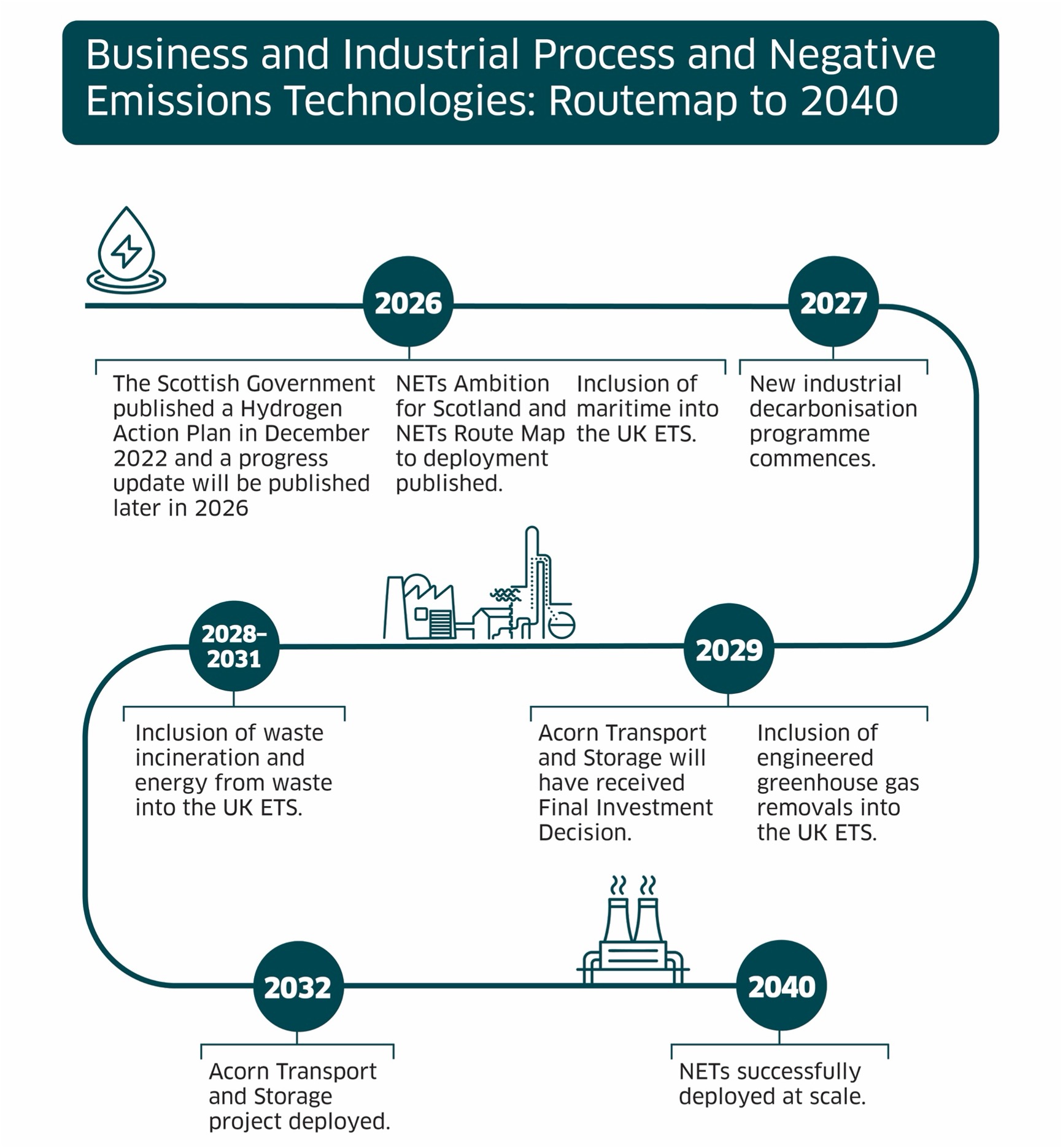
Business and Industrial Process and Negative Emissions Technologies: Routemap to 2040
- 2026
- The Scottish Government published a Hydrogen Action Plan in December 2022 and a progress update will be published later in 2026
- Nets Ambition for Scotland and Nets Route Map to deployment published.
- Inclusion of maritime into the UK ETS
- 2027
- New industrial decarbonisation programme commences.
- 2029
- Acorn Transport and Storage will have reached Final Investment Decision.
- Inclusion of engineered greenhouse gas removals into the UK ETS.
- 2028-2031
- Inclusion of waste incineration and energy from waste into the UK ETS.
- 2032
- Acorn Transport and Storage project deployed.
- 2040
- NETs successfully deployed at scale.
Actions We Will Take to Achieve Our Vision
Our Green Industrial Strategy sets out our strategic approach to green growth, offering a clear view of the economic sectors and industries in which we have the greatest strengths and opportunities. We will be guided by an efficiency-first approach, using a hierarchy of industrial decarbonisation to shape our policies:
- firstly, reducing energy demand where possible, optimising industrial energy use and/or material efficiency,
- then, electrifying industrial processes where feasible or, enabling switching to renewable or low carbon fuel supplies including hydrogen and hydrogen derivatives where appropriate, and
- incentivising a supportive investment, policy and regulatory landscape for installations to capture industrial CO2 emissions.
The policies and proposals in the section below will deliver on two main outcomes which will collectively support the Business and Industrial Process sector to reduce emissions in line with our net zero target.
Outcome 1: Scotland’s industrial sector will be on a managed pathway to decarbonisation, whilst remaining highly competitive and on a sustainable growth trajectory
UK Emissions Trading Scheme (ETS)
The UK ETS was established in 2020 as a UK-wide greenhouse gas emissions trading scheme, to encourage cost-effective emissions reductions in sectors including power generation, industry, and aviation. The Scheme is designed and operated jointly by the governments of Wales, UK and Scotland, and the Northern Ireland Executive (as the ‘UK ETS Authority’). The Scheme works to reduce greenhouse gas emissions by putting a market-determined price on carbon emitted. It operates on a cap-and-trade principle, capping the total number of ETS allowances and, therefore, emissions over a set period of time. Businesses operating in sectors covered by the system must buy UK ETS allowances to cover their yearly emissions.[180]
The UK ETS is currently the key policy mechanism to decarbonise the industrial sector, covering 16.3% of total territorial Scottish emissions in 2023. Scotland’s ETS emissions accounted for around 6.7% of all UK ETS emissions in 2023. Within Scotland, the vast majority of ETS emissions come from industry, with 75% of the 6.5 MtCO2e total (2023 figures), followed by power generation at 23%.[181]
The UK ETS cap is set to decline over time, which will reduce total UK ETS emissions.[182] It is expected that as the total number of allowances available declines, upward pressure will be placed on the UK ETS price, encouraging investment in decarbonisation technologies. The UK ETS cap has currently been set to align with net zero targets.[183]
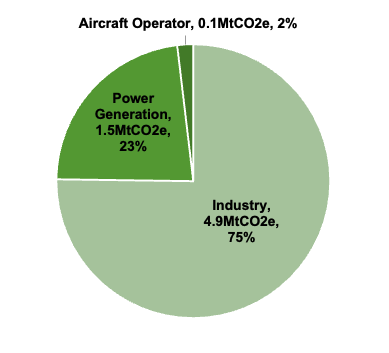
The Scottish Government supports measures to reduce the risk of carbon leakage. This is where climate policies reduce greenhouse gas emissions in one region, but are offset by increased emissions in another region with less stringent regulation. From 2027, the UK Carbon Border Adjustment Mechanism (CBAM) will apply to emissions on imported aluminium, cement, fertilisers, hydrogen, steel, and iron, aiming to ensure that carbon-intensive goods pay the same cost for emissions no matter where they have been produced. The UK CBAM will provide a global incentive to decarbonise industries and discourage businesses from relocating production to countries with weaker climate policies to avoid carbon costs. The Scottish Government recognises that the UK CBAM presents some challenges for businesses, particularly those which import products in scope. We continue to engage with the UK Government to ensure that Scottish businesses’ priorities and interests are considered as the development of the UK CBAM and its interaction with the EU CBAM progresses.
Increasing Demand for Low Carbon Industrial Products
Increasing market demand for lower-carbon versions of industrial products, for example cement used in the construction sector, would incentivise industrial producers to decarbonise manufacturing processes. However, it can be challenging for buyers or consumers to identify products with lower levels of embodied carbon relative to competitors. The UK Government is considering a range of policy interventions to increase demand for low-carbon industrial products, including establishing product classifications and developing an embodied emissions reporting framework[184] to address the knowledge gap currently faced by consumers and manufacturers. We will continue to work with the UK Government in the development of these proposals and ensure that Scotland’s interests are represented.
Energy Efficiency Measures
Analysis indicates that energy efficiency measures could deliver emissions reductions of between 5% and 35%, depending on the sector.[185] Alongside the Scottish Environment Protection Agency (SEPA), we support an outcomes-based approach recognising the importance of site-level needs, proportionality and enabling regulation to guide actions. SEPA has committed to prioritising energy efficiency improvements at key sites through its Corporate Plan.[186] Fully realising the abatement potential of energy efficiency will require a combination of regulatory measures and sustained access to capital funding, with the majority expected to come from private investment.
Scottish Industrial Energy Transformation Fund (SIETF) and Future Industrial Decarbonisation Investment
The SIETF was launched in 2020 to provide match-funding for industrial decarbonisation projects at sites across Scotland. It is a keystone policy to lever industry investment and support existing manufacturers. Building on the delivery of the SIETF, we are exploring a new incentivised investment programme at a significantly greater scale to accelerate the pace of transformation.
We are working on several actions – including issues of planning, permitting, skills and supply chains – to support and accelerate a wider range of projects to deploy. However, to deliver the required volumes of additional carbon abatement at pace, actions will also be required from the UK Government. These include:
- confirming the full funding package and deployment timeline for the Acorn T&S Project and the Scottish Cluster,
- confirming and providing support to help industry overcome the high cost of electricity, which remains a significant barrier to electrification, and
- considering alternative support mechanisms for industry following the closure of the Industrial Energy Transformation Fund.
Non-domestic Buildings
In this CCP, emissions from buildings are split across two sectors and, therefore, two chapters: non-domestic buildings (for example factories, shops and office blocks, but excluding public buildings) within this Business and Industrial Process sector, and domestic and public buildings covered in the Buildings (Residential and Public) sector. Many of the policies and proposals referenced in the Buildings (Residential and Public) chapter also apply to non-domestic buildings.
The majority of emissions reductions from non-domestic buildings will be driven by our target for decarbonising heating systems by 2045 and by the current and future support, incentives and advice in place to help building owners to make those changes. We are also developing means to boost heat network development through the potential use of powers to require certain properties to change from fossil fuel heating systems, when they have the opportunity to connect to a heat network.
We set out these plans to the Scottish Parliament on 18 November 2025 and published a draft Buildings (Heating and Energy Performance) and Heat Networks (Scotland) Bill.[187] The intention is to formally introduce the Bill early in the next Parliament, but that will be subject to the outcome of the election.
We are also planning to create powers to set minimum energy efficiency standards for non-domestic properties, subject to further consideration. These plans are also set out in our draft Bill, which proposes a regulation-making power to set minimum energy performance standards for buildings in which direct emission heating systems are used.
We are also introducing revised Energy Performance Certificate (EPC) regulations. These will give businesses better information on how to improve the energy efficiency of their buildings and reduce emissions from their heating systems. We will also introduce strengthened EPC operational governance through our new Scottish EPC Accreditation Scheme, which will improve consumer confidence.
Currently, it is estimated that more than half of non-domestic buildings use clean heat. We call on Scottish businesses to take measures to improve the energy efficiency of their non-domestic and domestic buildings, and to replace existing heating systems with clean heat alternatives. We will provide enhanced advice and support to businesses through existing programmes such the Business Energy Scotland advice service, and the SME Loan and Cashback Scheme.
To meet anticipated demand, Scottish businesses involved in the clean heat and energy efficiency supply chain will need to scale up the manufacture and deployment of energy efficiency measures and clean heating systems, as well as investing in the skills and workforce needed to maintain and operate these systems.
De-fossilising Chemicals
Many everyday products – such as plastics, pharmaceuticals, cosmetics, and synthetic fabrics – depend on carbon-embedded chemicals for their structure and performance. Research indicates that global demand for carbon-embedded chemicals, the amount of carbon contained within everyday products like plastics, textiles, and pharmaceuticals, is set to double by 2050.[188] At present, around 90% of feedstocks used in the global manufacturing of chemicals derive from fossil fuels, including oil, natural gas, and coal.[189]
Achieving a shift to de-fossilised feedstocks will require coordinated action across multiple domains, including:
- Circular initiatives: such as increasing the use of recycled carbon, supporting industrial symbiosis and the utilisation of captured carbon,
- Wider resource efficiency measures: this includes designing products for increased recyclability, reducing excessive or single-use packaging, minimising material used through smart design and improving the longevity of manufactured goods, and
- Biotechnology and bio-based manufacturing: these use renewable sources of carbon and can substitute fossil-derived inputs in industrial processes while strengthening domestic supply chains and manufacturing resilience.
To support the decarbonisation of Scotland’s chemical and manufacturing sectors, we will support research and innovation in sustainable feedstock development, support bio-based and circular economy infrastructure, and consider how procurement and regulatory levers can help to stimulate market capacity.
Outcome 2: Technologies critical to further industrial emissions reduction (such as carbon capture and storage, and production and blending of hydrogen into the gas grid) are operating at commercial scale in the 2030s
Electrification
One of the key routes for industry to decarbonise is through switching to lower carbon fuels, including electricity. The CCC advise that electrification is the most likely approach by which most industrial processes will be decarbonised.[190]
Many of the policy, fiscal or regulatory levers for industrial electrification lie with the UK Government,[191] which acknowledges that delays to upgrading national grid infrastructure and the high cost of electricity relative to gas, constrain industry’s ability to electrify. To progress this, we will continue to work with the UK Government, Ofgem, the National Energy System Operator (NESO) and network companies on reform of electricity market arrangements and accelerating electricity network infrastructure development. The UK Government proposes a British Industrial Competitiveness Scheme to reduce the cost of electricity from 2027 for many energy-intensive industries, but it must do more to address barriers to investment in industrial electrification.
Expansion of Hydrogen
Hydrogen is globally recognised as a key part of the energy transition and is seen as playing a role in applications ranging from power generation, hard to electrify transport, shipping, aviation, hard to electrify industry, chemical manufacture, and some heating and energy storage. The Scottish Government published a Hydrogen Action Plan in December 2022. We have provided over £35 million of funding to help develop Scotland's hydrogen sector to date.
Deployment of hydrogen projects and the supporting supply chain is moving forward in Scotland with the H100 project in Fife now constructed and undergoing its commissioning process. The UKG’s first Hydrogen Allocation Round (HAR) funding programme selected two projects in Scotland and an additional eight projects across Scotland have been shortlisted in the UKG Hydrogen Allocation Round 2.
Funding to support strategically important green hydrogen production projects, and to help develop the supply chain, and transport and storage infrastructure, is being delivered in partnership with our Enterprise Agencies.
We published ‘A Trading Nation – Realising Scotland’s Hydrogen Potential: plan for exports’ with the hydrogen sector in November 2024.[192] This plan was produced in alignment with our Hydrogen Action Plan and the GIS, and details the export opportunities hydrogen presents; as a commodity and in the supply chain.
Other policies include the Scottish Enterprise ‘Scotland’s Hydrogen Innovation Network’ (SHINe) initiative launched in 2024, which is a ‘super-network’ developed to connect partners across the Scottish hydrogen innovation ecosystem and raise the visibility of ongoing projects and opportunities to partners and investors in Scotland and beyond, including European companies.
The Scottish Hydrogen Industry Forum (SHIF) is composed of senior industry stakeholders, and is attended by Scottish Ministers. The SHIF provides a forum for discussion, insight and understanding of the challenges and opportunities facing this emerging sector, informing policy, and helping the realisation of the Scottish Government’s hydrogen ambitions.
Carbon Capture, Utilisation and Storage (CCUS)
CCUS refers to the methods and technologies required to capture carbon dioxide (CO2) from large emitters, such as biomass or fossil fuel power plants and industrial processes, and either convert this into new commodities (utilisation) or transport it for safe and permanent storage deep underground in a geological formation. To achieve net zero emissions, CCUS will be vital for industrial decarbonisation. The CCC has reiterated this point, stating that it “cannot see a route to Net Zero that does not include CCS”[193] and that it “must be progressed urgently”.[194]
We have provided £2 million through the Emerging Energy Technologies Fund to support and accelerate the National Gas SCO2T Connect project. This project aims to repurpose existing gas pipeline infrastructure for the transportation of captured carbon dioxide from industrial sites in the central belt to the Acorn T&S Project for permanent storage.
The Scottish Government continues to be supportive of the Acorn T&S Project, which now aims to be operational by the early 2030s and is estimated by the project to store 5-10 MtCO2e per year. The project is dependent upon the UK Government confirming a final decision and full funding package, as well as ensuring appropriate legislative and regulatory frameworks are in place.
CCUS is a key opportunity area for Scotland due to comparative advantages with existing oil and gas, and port infrastructure, along with significant geological storage potential and we have a highly skilled workforce in relevant adjacent sectors. These factors will help position Scotland at the centre of the European carbon capture and storage sector.
Case Study: Project Willow
Following Petroineos’ announcement that it would convert the refinery into a fuel import and distribution terminal; Project Willow was initiated to evaluate and assess the most feasible low-carbon technologies for Grangemouth. The project considered factors such as technological readiness, feedstock viability, local skills and supply chains, and overall economic contributions.
Project Willow identified nine projects as the most viable low carbon alternatives for the site. These include plastics recycling technologies, projects that seek to utilise bio feedstocks and projects which can act as a conduit for offshore wind, such as hydrogen fuel switching that would seek to decarbonise some of the high temperature processes across Grangemouth by displacing combustion of natural gas. The report also underscores the challenges of this transformation as low-carbon fuels and chemicals are currently more expensive to produce than fossil alternatives.
The investment required in the base case projects is substantial (~£3.5 billion[195] capex) and many of the projects require the development of new supply chains. We have made £25 million available to support immediate opportunities arising from Project Willow; the UK Government has also allocated £200 million from the National Wealth fund to support projects aligned with Project Willow. Together these funds will attract investment to the site and act as an incentive to project developers to locate their projects at Grangemouth.
Negative Emissions Technologies (NETs)
NETs are a range of technologies that capture and remove CO2 from the atmosphere. Most large-scale NETs require carbon capture and storage for permanent sequestration, with some (for example, biochar) relying on other methods. NETs offer a means to support the offsetting of carbon emissions.
Scotland has many advantages when it comes to NETs, including the availability of biological feed stock from existing industry, for example, spent grain from whisky distillation. This can be utilised in Anaerobic Digestion with CCS which breaks down organic matter without oxygen. This process produces biogas which can be upgraded to biomethane for gas grid injection by separating out and capturing the CO2.
Bioenergy with Carbon Capture and Storage (BECCS) also has potential in Scotland, where biomass, biogas or biogenic wastes are converted into energy (power, heat, hydrogen, fuels or methane), while at the same time capturing 90%+ of the biogenic CO2 produced and sending it for utilisation (CCU) or geological sequestration (NETs). This can be achieved on existing Energy from Waste facilities (where the waste on average contains 50% biomass) and existing woodburning power stations.
Direct Air Capture with Carbon Storage (DACCS) is where CO2 is extracted directly from the air, with the use of a liquid solvent or solid sorbent, which is then re-heated to produce a CO2 stream for utilisation or sequestration. DACCS is less commercially viable at this stage.
NETs are required to achieve our net zero targets; therefore, we must provide a supportive policy environment for the deployment of NETs technologies. Based on the outcomes of the NETs feasibility study,[196] we are committed to:
- Determine the scale of support needed and consider how best to work with commercial organisations in Scotland to develop NETS proposals,
- By the end of 2026, create a routemap to deployment of NETs at scale by 2040,
- Develop a new NETs ambition, timeline and costs estimate to provide industry with certainty,
- Continue to work with the UK Government to establish clear, technology-specific NETs ambitions, targeting 3 MtCO2e removals by 2040, and
- Encourage, promote and facilitate NETs developments through planning and consenting policy, as set out in National Planning Framework 4 (NPF4).
Just Transition Principles and Adaptation
People and Communities
Scotland’s energy-intensive industrial (EII) sites are deeply embedded in local communities and are widely distributed across Scotland, with major concentrations in Grangemouth, the Central Belt, and the North East. These sites, due to a number of factors, face increasing economic pressure if they fail to decarbonise. Rising carbon costs increase the risk of deindustrialisation, which could lead to job losses and economic disruption.
However, decarbonisation also presents transformative opportunities. Deploying technologies such as CCUS and NETs can create both short- and long-term employment, especially near EII sites. Fuel-switching to renewable energy can reduce costs for businesses and consumers and improve public health by lowering pollution. Expanding low-carbon markets will drive innovation and offer sustainable products, particularly in sectors like food and drink.
We are committed to supporting communities through ongoing engagement and participation. The Grangemouth Industrial Just Transition Plan is a key example, co-developed with the community to shape the site’s future. The Grangemouth Future Industries Board will continue to facilitate collaboration between public sector partners and local stakeholders. We will also work closely with workforces, employers, trade unions, and other organisations to maximise the opportunities of a just transition. The actions outlined in the following sections are central to supporting communities and their people.
Workforce
A core element of a just transition is protecting and creating employment as industries decarbonise. Without action, deindustrialisation could significantly impact jobs in local communities. Sectors identified by the EU as at risk of relocation – primarily manufacturing – employ over 95,000 people in Scotland and generate around £23 billion in annual turnover.
Scotland’s EII sites and skilled workforce are valuable assets. Leveraging them to drive the transition to net zero will enhance industrial competitiveness and development. Key pathways such as CCUS, electrification, and hydrogen will safeguard existing jobs and create new ones. However, a shortage of skilled workers could hinder the rollout of low-carbon technologies and deter investment. We are committed to helping the workforce seize these opportunities.
New sustainable jobs will emerge, requiring both new and transferable skills. Many of these already exist within Scotland’s workforce and can be adapted with the right support and investment.
To address these challenges, we are strengthening regional approaches to skills planning. For example, the Grangemouth Industrial Just Transition Plan sets a clear strategic direction, with skills as a central focus. The Scottish and UK Governments are jointly funding a Skills Intervention for Petroineos workers facing redundancy, providing targeted support for high-quality employment. A Grangemouth Industrial Skills pilot is also being developed via the Just Transition Plan to meet current and future workforce needs.
Employers
Employers have a critical role to play in delivering a just transition and supporting the decarbonisation of Scottish industry. Businesses must start to view carbon dioxide not only as a waste product, but as a potential asset. Whisky production is one example where captured biogenic CO2 could become a commodity, but the transition will require a fundamental shift in both operations and in mindset. This is a significant departure from traditional practices and opens up new opportunities for innovation and growth. To remain competitive and resilient, employers must anticipate future skills needs, invest in workforce development, and embed sustainability into their business models. Those who fail to adapt could lose competitiveness in emerging markets.
The policies and proposals outlined will support Scottish employers to take advantage of the transition. For example, the development of strategically located CCUS infrastructure in industrial clusters like Grangemouth and the North East will unlock economic opportunities, protect jobs, and leverage existing skills in local communities. The SIETF will continue to support industrial sites to implement energy efficiency measures across Scotland, with the potential of this to continue and grow with any new incentivised investment programme. The £25 million investment to support immediate opportunities arising from Project Willow will attract further investment and incentivisation for Grangemouth, creating additional economic opportunities and job creation. Similarly, our continued support for the development of Scotland’s hydrogen sector will also unlock further opportunities.
We will continue to work with organisations, like we have recently with IDRIC, SCCS and others, to gain strategic policy insights and foster collaboration across industry and academia, ensuring employers are supported in the net zero transition. The Scottish Government also incentivises improved workplace conditions through the Fair Work First policy. Businesses receiving direct grant support must meet criteria such as paying the Real Living Wage and recognising trade unions. Employers also have a responsibility to engage transparently with employees and communities.
Our Call to Others
Industry and Business
Businesses, regardless of size or sector, are key enablers of change. We call on them to lead by example – by investing in low-carbon technologies, adopting fair work practices and supporting workforce development. In return, the Scottish Government will continue to provide support through clear policy direction to help businesses thrive in the net zero economy.
The UK Government
We welcome the UK Government’s ambition to link the UK and EU ETS. There are clear benefits to doing so, particularly in terms of access to a larger carbon market, increased market liquidity and a more stable carbon price. In May 2025,[197] the EU and the UK published a Common Understanding which would form the basis of an agreement to work towards a link between the schemes and so, we ask both the UK and the EU to continue these discussions at pace.
We urge the UK Government to ensure that Scottish business and trade interests are considered in the development of the UK CBAM and its interaction with the EU CBAM.
To unlock the full potential of electrification, we call on the UK Government to accelerate reform of market arrangements and reduce the price of electricity relative to gas by the British Industrial Competitiveness Scheme, or other targeted operational support. Expanding the electricity grid is also critical to delivering our energy ambitions. We ask the UK Government, Ofgem, NESO, and network companies to work with us to deliver this transformational infrastructure.
We welcome the UK Government’s commitment to consult on an embodied emissions reporting framework and product classification system for industrial products. We ask that this work is undertaken in close collaboration with the Scottish Government to ensure the needs of Scotland’s industry are fully reflected.
We urgently need the UK Government to confirm the Acorn T&S Project and the Scottish Cluster, including the full funding package and timeline for deployment. Doing so will unlock billions in private investment, protect existing jobs and create thousands of new ones, and support the decarbonisation of key industries – not just in Scotland, but across the UK. To further support the CCUS sector, we call for the timely introduction of secondary legislation under the Energy Act 2023 to provide regulatory clarity and certainty for investors and developers.
To accelerate the deployment of NETs, we ask the UK Government to provide greater assistance to develop a stable policy environment including incentives and financial frameworks to build confidence with the private sector. We also need mechanisms to support the development of NETs in Scotland across various sectors via suitable Greenhouse Gas Removal (GGR) business models which allow for revenue stacking, and to adopt a clear UK-wide NETs ambition to give industry and investors certainty about the role of NETs in the future decarbonised energy system.
Industrial projects require a consistent policy and investment environment, that is why it is important that following the end of the Industrial Energy Transformation Fund (IETF), the UK Government must move at pace and with ambition and confirm the successor programme to IETF.
Individuals and Households
We encourage community groups to engage with local planning and transition efforts, helping to shape outcomes that reflect local priorities and deliver shared benefits. We will continue to ensure there is opportunity for members of the public to engage with us on such matters via consultations and other engagement opportunities.
International Engagement
Currently, the London Protocol[198] restricts the cross-border transportation of CO2 for permanent storage as it is classified as a waste product. While the UK has taken steps to amend this restriction, we urge the UK Government to pursue permanent amendments and bilateral agreements to enable international CO2 transport.
We will engage with the EU to promote close alignment between its carbon border policy and the UK CBAM. We propose flexibility and foresight to enable these mechanisms to work as platforms for international climate cooperation and leadership.
We also call on the UK Government to commit to matching the EU ‘Clean Industrial Deal’[199] to ensure that Scottish industrial sectors benefit from similar interventions on affordable energy for industry, integrating circularity in decarbonisation, and financing the clean transition.
Agriculture
Introduction
The Scottish Government wants our world leading agriculture sector to continue to produce high quality food, reduce its greenhouse gas emissions, adapt to climate change and restore nature. We firmly believe that there is no contradiction between these goals, and that our farmers and crofters are part of the solution to climate change. We know these goals are interlinked and that delivering emissions reductions in the agriculture sector can and should go hand in hand with building climate resilience, improving biodiversity and delivering business productivity. In fact, many of the most important actions farmers and crofters can take to reduce their emissions, and the policies and proposals in this plan, will deliver those vital, interlinked benefits.
As we decarbonise the sector, our commitment to a just transition will guide our approach, protecting rural livelihoods, sustaining food production, and delivering a thriving, resilient agriculture sector. Since 1990, emissions in agriculture have reduced by 13% from 8.6 MtCO2e to 7.5 MtCO2e in 2023. Our pathway to net zero will see agricultural emissions reduce to 5.8 MtCO2e by 2040.
As such, our pathway to 2045 will focus on decarbonising the agriculture industry while ensuring that we do not offshore emissions. Our policies are already empowering our farmers and crofters to make informed changes that reduce emissions. Many are already delivering towards our climate change and nature ambitions by seeking efficiencies, improving the way they farm and sequestering carbon and increasing climate resilience through tree planting or peatland restoration. Our programme of ongoing reforms to direct support including changes to enhanced greening are driving positive outcomes for climate and nature. We want to see these efforts expanded across the sector as we work towards our Vision of becoming a global leader in sustainable and regenerative agriculture.
Farmers and crofters will continue to be supported to produce food and be rewarded for contributing to our climate efforts. New conditions on agricultural support such as the Whole Farm Plan will help farmers understand and make informed decisions to improve their performance. Alongside this, we will provide tailored guidance, advice, training and engagement opportunities to ensure that farmers and crofters have the skills, knowledge and expertise that they need to adopt new low carbon farming practices. We will support the uptake of new technologies, recognising the range of emerging climate smart technologies which can support our farmers and crofters continue to be at the cutting edge of the industry globally.
Good soil management – including by using cover crops, reducing tillage and grazing livestock – is vital for productivity, climate resilience and for minimising emissions. It is important that we equip our farmers and crofters with the knowledge, skills and tools to understand, improve and maintain their soil health, based on the latest scientific developments.
Livestock are a central part of our Vision for sustainable and regenerative agriculture, and we recognise that Scotland’s landscape and climate is suited to the production of high quality meat and dairy products, and the range of benefits which the sector provides through the provision of sustainable food, the contribution to rural economies and its role in supporting biodiversity. We will continue to support the sector to become more productive, efficient and resilient so that it can continue to produce high quality meat and dairy with reduced emissions intensity.
Our farmers and crofters know their land and their business better than anyone, and we aim to give them the skills, knowledge and opportunities they need to find the most appropriate and effective way for them to reduce their emissions, increase carbon sequestration and support biodiversity, in a way that works for that land and business.
We expect that every agricultural business will and should have their own unique journey to reducing emissions, tailored to and reflecting the individual nature of the particular farm or croft. We believe that the best way to mitigate emissions from agriculture is by demonstrating to farmers the benefits that can be gained from reducing their emissions, inspiring and incentivising them to make those changes, and providing them with the tools to do so.
Context and Wider Alignment
Our agriculture industry provides high quality food and drink to Scotland and across the world. It employs just under 67,000 people, with a total income from farming of £1.3 billion in 2024.[200] Scottish agriculture also underpins £18.9 billion of turnover for our world-renowned food and drink industry which employs 115,000 people[201] as well as the wider agricultural supply chain for example, seed and equipment suppliers.
Our agriculture industry must be viewed in an international context: food and drink are international commodities and climate change is a global issue. Following the invasion of Ukraine and its impact of global food supply, we have increasingly recognised the importance of our agriculture sector in supporting food production. Sustaining Scotland’s food production will become increasingly important for our national resilience as climate change impacts agricultural production at a global level. Maintaining Scottish agricultural production will help to minimise the risks to the public from disruptions to global food supply and associated inflationary pressures. It is also important that our approach to reducing emissions from agriculture must make sure that we do not offshore our emissions to other countries, where production standards may be lower. Farmers and crofters often have diversified businesses and are using the land for multiple outcomes alongside food production, which is good for business resilience and rural population retention, key aims for this Government. They are land managers and deliver many climate mitigation, adaptation and biodiversity benefits through activities such as tree planting, peatland restoration and flood management.
Case Study: Cora and David Cooper, Tardoes Farm
On their 2,030 ha sheep farm in the Muirkirk Uplands, Cora and David Cooper’s sustainable and regenerative approach to farming has built a profitable farming business which is delivering for the climate and nature. At Tardoes farm, the Coopers use a low input, low maintenance adaptive mob rotational grazing system to produce high quality lamb while also restoring the peatland on their land.
Deep peat makes up around half of the landholding at Tardoes farm, much of which had been eroded due to historic drains, leading to a loss of good grazing and deep gouges in the land, and high mortality rates as a result. Working with RSPB Scotland and Peatland Action (NatureScot), Cora and David have restored 800ha of peatlands and realised the benefits that this has delivered for their farming business by removing those deep gulleys and improving moisture retention – a win-win for drought resilience of their grazing land and reducing downstream flood risk. The restored peatland not only stores and sequesters carbon but also offers an important habitat for upland birds and invertebrates.
By working with the land and applying holistic management as their sheep farming business developed, David and Cora have built a thriving and profitable sheep farming enterprise while delivering for the climate and nature.
The policies and proposals for agriculture in this Plan align with and will deliver towards other important government priorities, in particular the Scottish Biodiversity Strategy to 2045, the third Scottish National Adaptation Plan, the Good Food Nation Plan, the Cleaner Air for Scotland 2 Strategy, the fourth Land Use Strategy and the upcoming Land Use and Agriculture Just Transition Plan.
Our Vision
We have a clear Vision for Agriculture, published in March 2022. The Vision sets out our ambition for Scotland to become a global leader in sustainable and regenerative agriculture.
We will reform support for farming and food production, and our policies and proposals in this Plan will contribute to that Vision. We want our agriculture sector to produce food, reduce its emissions, support increased biodiversity, be resilient and productive into the future and support thriving rural communities.
By 2040, Scottish agriculture will have minimised its emissions, helping to deliver towards our net zero national target, while continuing to produce high quality, sustainable food. Farming will support increasing biodiversity, and our farmers and crofters will have incorporated climate measures in a way that supports their business objectives, enabling business resilience into the future.
Our farmers and crofters have and continue to make changes to improve the climate performance of their businesses, informed by the Whole Farm Plan which helps them identify new ways to do things to reduce their emissions and improve their productivity. Productivity and efficiency measures such as precision farming and optimised slurry storage and use are standardised practice across the sector.
The agriculture sector is doing more to support the climate and biodiversity and are being rewarded for it through the agricultural support schemes and informed by the Code of Practice for Sustainable and Regenerative Agriculture. Best practice methods and techniques are adopted across agriculture, and funding and equipment is available.
Research and innovation will continue to inform our knowledge base and new technologies and innovations will be tested, mainstreamed and used by farmers and crofters to reduce their emissions. This will impact across the farm business, including soil health, machinery, fertilisers and animal health. Our advisory services and knowledge transfer initiatives will ensure that our farmers and crofters have access to the most up to date information and techniques to continually improve and refine their skills and knowledge on low carbon farming, keeping Scotland at the leading edge of the global shift to low carbon farming.
Our livestock industry continues to be world leading while becoming more productive and efficient. Farmers and crofters have the information they need and are utilising new technologies and approaches to maintain the health and reduce the emissions intensity of their livestock.
Scottish agricultural soils will be under good management, supporting agricultural production and continued sustainable food production as well as acting as an important carbon store and tool for improved climate resilience. Research and development will have identified new, innovative ways to reduce nitrogen emissions from soil and our findings will have been translated to practical, real-world solutions. Our farmers and crofters will understand the status of their soil and be equipped with the knowledge and skills to improve and maintain their soil health to help manage climate risks from hazards like floods and drought, while minimising emissions.
In 2040, farmers and crofters continue to produce food sustainably, be recognised and rewarded for supporting the delivery of our carbon sequestration and nature objectives and integrated land management approaches are mainstreamed across the sector. They continue to be part of and play an important role in our thriving rural and island communities.
Progress since the Climate Change Plan update
Annual emissions since the finalisation of the Climate Change Plan (Update) (CCPu) in December 2020 have fallen by 0.2 MtCO2e, from 7.7 MtCO2e to 7.5 MtCO2e.[202] Our key achievements in agriculture since the publication of the CCPu include:
- Our Vision for Agriculture was published in March 2022 setting out our ambition for Scotland to become a global leader in sustainable and regenerative agriculture.
- We established our Agriculture Reform Programme to deliver that Vision. The Agriculture and Rural Communities (Scotland) Act 2024 (the Act) provides the powers required to deliver that Programme and includes facilitation of climate mitigation as an overarching objective of Scottish agricultural policy.
- As required by the Act, we have published:
- a Rural Support Plan which gives information about the expected use during the plan period of the powers in the Act, and Ministers must have regard to that Plan when exercising those powers, and
- a “Code of Practice for Sustainable and Regenerative Agriculture,” which provides guidance and practical examples on the types of sustainable and regenerative activities that can be adopted on farms or crofts.[203]
- We published and have regularly updated the Agricultural Reform route map, setting out key dates for farmers and crofters.
- The Whole Farm Plan was introduced from 2025, requiring claimants of basic payments to have started carrying out plans and audits that are relevant to their business. All businesses will be expected to have all of the plans and audits relevant to their business activities in place by 2028 at the latest.
- New conditions were introduced to the Scottish Suckler Beef Support Scheme in 2025, linked to calving interval performance, which aims to encourage beef farmers to undertake steps that will help to reduce the emissions' intensity of their cattle production systems and make them more financially efficient.
- MyHerdStats is available to cattle keepers to identify recommendations that can lower greenhouse gas emissions and increase efficiencies.
- Preparing for Sustainable Farming provided funding for farmers and crofters to conduct Carbon Audits and Soil Sampling.
- Funding has continued to be provided for farmers and crofters to take forward climate and nature measures on their land through Agri-Environment Climate Scheme. We expect this scheme to run until at least 2030.
- The Agricultural Modernisation Fund (AMF) has been used to deliver around £20 million support since 2020 on a diverse range of equipment such as UV water treatment systems, hand held devices for measuring nitrogen levels in crops and GPS guidance systems; and more recently has been targeted towards low emission slurry spreading equipment, slurry covers and new slurry stores.
- In 2025/26 the AMF delivered the Future Farming Investment Scheme (FFIS), providing £21.4 million flexible support for capital items that can be used to improve efficiency or support nature and climate-friendly farming, for example, livestock handling and weighing equipment and precision farming equipment
- The Knowledge Transfer Innovation Fund (KTIF) has continued to support projects in agricultural competitiveness, resource efficiency, environmental performance and sustainability, including through the Monitor Farm Programme.
- The Farm Advisory Service has continued to provide extensive guidance, advice and knowledge transfer for the sector with increasing focus on climate mitigation, adaptation and biodiversity.
- The Climate Change Mitigation Training Fund provided farmers and crofters with £500 or more for the cost of a “climate change badge” practical or technical training course.
- The Integrating Trees Network was launched and hosts events for farmers and crofters who are interested in the integration of trees on farms. The network won the Chartered Institute of Ecology and Environmental Management award for Best Practice Knowledge Sharing in 2024.
- The Land Reform (Scotland) Act 2025 includes several measures to make tenant farming and small landholding fit for the future, and in particular to help tenant farmers deliver the improvements to the land that will make farming more sustainable and productive, support biodiversity, and mitigate the effects of climate change.
- Small Producers Info Hub launched in 2024 and provides advice and information to small farms and small producers on range of activities including climate change mitigation and adaptation.
- The Women in Agriculture and Small Producers Practical Training funds provide hands-on training and support to women and girls, and small producers to enhance their skills, strengthen their businesses, and help them adopt climate change mitigation and adaptation.
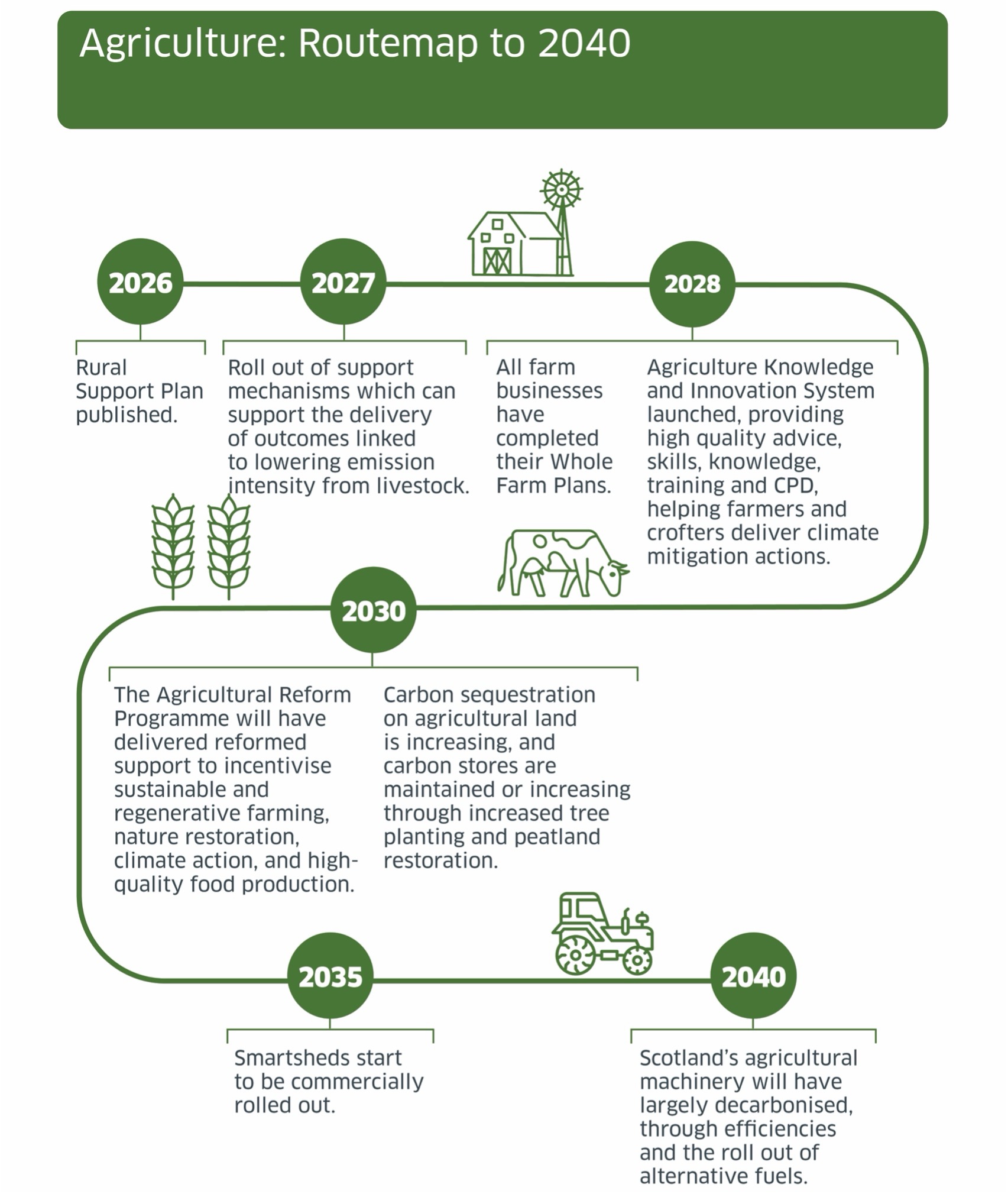
Agriculture: Routemap to 2040
- 2026
- Rural Support Plan published
- 2027
- Roll out of support mechanisms which can support the delivery of outcomes linked to lowering emission intensity from livestock.
- 2028
- All farm businesses have completed their Whole Farm Plans.
- Agriculture Knowledge and innovation System launched, providing high quality advice, skills, knowledge, training and CPD helping farmers and crofters deliver climate mitigation actions.
- 2030
- The Agriculture Reform Programme will have delivered reformed support to incentivise sustainable and regenerative farming, nature restoration, climate action, and high-quality food production.
- Carbon sequestration on agricultural land is increasing, and carbon stores are maintained or increasing through increased tree planting and peatland restoration.
- 2035
- Smartsheds start to be commercially rolled out.
- 2040
- Scotland's agricultural machinary will have largely decarbonised, through efficiencies and the roll out of alternative fuels.
Actions We Will Take to Achieve Our Vision
Our policies and proposals will support all of our farmers and crofters to reduce their emissions towards our national net zero goal while continuing to produce high quality food and improve biodiversity and climate resilience. Our five overarching outcomes, delivered through 22 policies and proposals, collectively offer a comprehensive approach to enable and support agriculture to reduce its emissions.
Outcome 1: A more sustainable and regenerative Scottish agriculture sector that contributes to delivering Scotland's climate change targets, and wider environmental outcomes, while continuing to produce high quality, nutritious food
This outcome reflects our overarching ambition for the sector and, aligned with the Vision for Agriculture, we will reform how we support the sector through the Agricultural Reform Programme, to become a global leader in sustainable and regenerative agriculture. We expect these policies to transform our agricultural support systems: we will continue to offer the certainty that direct payments provide but we are also asking farmers and crofters to do more for climate and nature in return.
Our first Rural Support Plan was published in March 2026 and sets out how we will deliver agricultural support and our strategic priorities for that support. We will continue to publish plans at least every five years.
As set out in our Agricultural Reform Route Map and co-developed with the agricultural industry, we will continue delivering the Agricultural Reform Programme and our new four tier framework throughout the lifetime of the CCP and beyond. This will support our farmers and crofters to reduce their emissions, as well as delivering high-quality food production, climate adaptation, and nature restoration, supporting thriving rural communities.
New technologies, developments and efficiencies in non-road mobile machinery will offer significant opportunities to minimise agricultural machinery emissions by reducing and replacing fossil fuel usage. Over the lifetime of the plan, we will seek opportunities to enable their uptake on farm, including through promotion of efficiencies and the provision of guidance and advice to farmers and crofters.
There are cross-sectoral challenges to decarbonising non-road mobile machinery which must also be addressed to minimise agricultural machinery emissions. Energy Supply Outcome 2, Proposal 1 will support machinery emissions reductions across relevant sectors.
To support efficiencies and reduce emissions from slurry and manure, from 2027, all Scottish livestock farmers producing slurry must use precision equipment for the application of slurry.
We recognise the importance of capital funding in the transition to low carbon farming, and that every farm will have unique needs. That is why we offered flexible support in 2025/26 through the FFIS for capital items that can be used to improve efficiency or support nature and climate-friendly farming. We are reviewing the scheme to better understand where and how improvements can be made for a second round of the FFIS. This will ensure more farms and crofts can access the support and become more resilient and sustainable.
Innovation and the development of new and emerging low carbon farming technologies can offer significant opportunities for efficiencies and emissions reductions. We will enable the sector to access and utilise those new technologies by, as appropriate, supporting their commercialisation and enabling knowledge transfer.
Outcome 2: More farmers and crofters have the skills, knowledge and opportunity to implement climate change measures, continuing to produce high quality, nutritious food
We want to make sure that our farmers and crofters have the skills, knowledge and expertise to identify and implement measures to reduce their emissions in a way that supports their overall business objectives. These policies will deliver a comprehensive package to enable farmers and crofters to build their skills and knowledge on low carbon farming and make informed decisions on how best to minimise their emissions and sequester carbon on their land.
The Farm Advisory Service, and from 2028 the Agricultural Knowledge and Innovation System, will offer extensive learning on low emission farming approaches.
Through the Land Reform (Scotland) Act 2025, and through ongoing work with the Tenant Farming Advisory Forum and Tenant Farming Commissioner through the lifetime of the CCP Plan and beyond, we will promote and support the uptake of sustainable and regenerative practices for tenant farmers, recognising that they must be part of the transition to net zero.
The Whole Farm Plan is already helping farmers and crofters measure their businesses’ impact and find ways to become more efficient. It supports the baselining of biodiversity on farm and emissions reductions and, from 2025, producing whole farm plans and reports is a condition of agricultural support.
Outcome 3: Soil health is improved and nitrogen emissions, including from nitrogen fertiliser, have fallen
Soils are an important carbon store that underpins all of our ecosystems. They are also a non-renewable resource and so maintaining and improving soil health is essential for long-term productive agriculture. We will support our farmers and crofters to maintain and improve their soil for agricultural productivity as well as emissions reductions. Alongside the provision of guidance and advice throughout the lifetime of the plan, from 2028 agricultural businesses will need to complete soil analysis and produce a nutrient management plan as part of the Whole Farm Plan.
The use of fertilisers represents 11% of our agricultural emissions. We recognise that fertilisers are important for maintaining our agricultural productivity, however, there are many opportunities to improve their efficiency and reduce how much fertiliser we use while continuing to produce high quality food. Our policies and proposals seek to identify opportunities to reduce the emissions associated with them. We are also considering the viability of using urease and nitrification inhibitors in a Scottish context.
We will continue to work with the other governments of the UK on the review and reform of the existing fertilisers regulatory framework. Proposals, which will be developed and consulted on with stakeholders, would enable a broader range of fertilising products to be regulated, including materials which have potential to be used as less harmful alternatives to traditional mineral fertilisers.
Plant breeding can play an important role by producing varieties which require fewer inputs. Research is taking place to producing varieties with increased nitrogen use efficiency and explore the market potential of such varieties in Scotland.
Outcome 4: Reduced emissions from red meat and dairy through the implementation of measures, including improved efficiencies, new technologies and improved animal health
Scotland is world-renowned for its high-quality red meat and dairy products, and we want to see the livestock sector thrive. Our policies and proposals will support the sector to improve its efficiency and adopt new technologies.
Management practices that impact on emissions intensity can be improved with access to relevant data. The MyHerdStats dashboard supports improved practices by providing information to all cattle keepers on herd fertility and animal mortality and we will continue to work with the industry to develop the dashboard.
Throughout the lifetime of the plan and beyond, we will co-design initiatives and projects at farm, regional and national level with the livestock industry for continuous animal health and welfare improvement. We will continue to explore how new technologies and approaches can support efficiencies and emissions reductions in livestock, including exploring selective breeding for low methane genetics, working in collaboration with the sector. We will also work with the industry to identify barriers, and support the development of any potential pathway for industry-wide uptake of methane inhibitors.
In the livestock sector, voluntary coupled support payments will continue until at least 2028. This policy recognises the importance of grazing animals in managing Scotland’s landscape and their contribution to biodiversity particularly in rural landscapes where farming is economically challenging. Continued support for livestock will be linked to the need to increase efficiency such as through the calving interval performance condition from 2025, starting at 410 days.
Outcome 5: Carbon sequestration on agricultural land is increased, and carbon stores are maintained or increased
We recognise that our farmers and crofters are pivotal to delivering carbon sequestration while reducing the emissions associated with the agricultural production. Aligned with the policies in the LULUCF chapter, our policies offer financial support, guidance and advice tailored to farmers and crofters which will support them through the integration of tree planting, peatland restoration and nature restoration into their farm businesses, complementing existing farm enterprises.
We want to see further integration of trees on farms and crofts, and for that integration to deliver “the right tree, in the right place”. We will continue to offer knowledge transfer and skills development opportunities around tree planting and management and the multiple benefits such as water management and shelter and shade that trees offer at a farm, regional and national scale. New and updated funding mechanisms for tree planting will be tailored to the needs of our farmers and crofters, supporting that integration of trees on farms
Aligning with the LULUCF chapter and through the fourth Land Use Strategy we will seek options for more integrated land use.
Importantly, for tenant farmers and small landholders we have modernised elements of the agricultural and small landholding legislation through the Land Reform (Scotland) Act 2025, in order to make it easier for them to implement climate change mitigation and adaption measures. The Land Reform (Scotland) Act 2025 also introduces a duty on Scottish Ministers to publish a model lease for environmental purposes to enable land managers, community groups, businesses and landlords to undertake hybrid land management to support our environmental and climate objectives.
Just Transition Principles and Adaptation
As we design and deliver our policies, co-development and co-design with rural partners is a foundational approach, aligning with the just transition principle to develop and maintain social consensus through engagement and partnership working.
People and Communities
This Plan will benefit the communities that support and depend on the agriculture sector, by ensuring its continued strength and sustainability. As our policies and proposals are targeted at reducing emissions from agricultural businesses, any impacts for people and communities will be indirect. However, they include benefits for people and communities across Scotland – for example, the contributions that our farmers and crofters make to reducing emissions and improving biodiversity will ensure our people have more opportunities to enjoy a more biodiverse countryside, and the multiple benefits that offers, including for public health. As the climate changes, actions like flood risk management will minimise the risks of climate impacts, and the damage that climate change can cause.
Our transformation of the agricultural sector, supported by our policies such as the Whole Farm Plan and the MyHerdsStats dashboard, will also lead to lower carbon food supply chains.
Workforce
There are over 67,000 people employed in Scottish agriculture. The policies and proposals in this Plan are focused on evolving the way existing farming and crofting businesses operate and maintaining high quality rural and agricultural jobs for the long term. Sustainable and regenerative practices will ensure the sector is sustainable, climate adapted and financially resilient into the future while continuing to produce high quality food.
As we transition to net zero, agricultural work will evolve. As low carbon farming measures become the norm across the sector and integrated land management approaches are more widely used, existing farming jobs may offer more variety and be more diverse. The policies and proposals in this Plan may also support new job opportunities and growth in employment in allied sectors for example in new agri-tech.
Importantly, as the sector changes, workers will need support and advice to develop the skills and knowledge to make the most of these new opportunities. Our policies offer extensive provision of guidance and advice through the Farm Advisory Service and the upcoming Agricultural Knowledge and Innovation System which has continuing professional development at its core. It will ensure that farmers and crofters can access the latest up to date information on how to apply low carbon measures on farm. Through initiatives like the Integrating Trees Network, we are also supporting farmers and crofters to develop the skills they need to take forward land-based activities such as peatland restoration and tree planting and management.
The majority of the agricultural workforce are owner-occupiers, meaning they own the farm and work on it. 85% working occupiers are aged 45 or older and the gender split is 65% male and 35% female.[204] We do not expect these policies to alter the demography of the sector, however, we have other important initiatives in place to support young and women farmers such as the Farming Opportunities for New Entrants group and the Women in Agriculture Practical Training Fund.
Employers
Thriving agricultural businesses are key to our net zero and economic ambitions and our policy approach acknowledges the importance of continuing to support agricultural production in Scotland and avoiding offshoring our emissions. That is why many of our policies and proposals focus on enhancing the efficiency, productivity and therefore the profitability of agricultural production.
Significantly, the Agricultural Reform Programme will ensure that our farm businesses continue to receive funding to produce high quality food while reducing their emissions and improving biodiversity. The Whole Farm Plan offers important insight to understand the current performance of the farm business and identify ways to improve that performance in a way that works best for that business.
Support, skills and knowledge are key to our approach, recognising that every farm and croft is unique and the path to reducing emissions will look different for every farm business. Most agricultural businesses are small and medium sized enterprises and are usually family businesses. As such, the development of skills and knowledge is vital for farm business owners. It will enable them to effectively apply new low carbon measures and integrated land management approaches to their businesses to ensure long-term business resilience.
Through our policies and proposals under Outcome 5 on carbon sequestration and carbon stores, we will support wider land-based industries including forestry and peatlands, maintaining those environmentally sustainable jobs as part of local, rural economies. Our policies and proposals may also benefit the wider supply chain: as farming businesses evolve how they operate, new opportunities will become available to support and drive innovation and the uptake of new technologies.
Adaptation
Scotland’s agriculture sector is highly exposed to climate hazards including increased rainfall, drought, water scarcity, heat stress, and rising prevalence of pests and diseases. Actions such as riparian planting, hedgerow creation and improved land stewardship can strengthen farm resilience, reduce downstream flooding and enhance national food security.
That is why climate adaptation is also a core pillar of Scottish agricultural policy. The Vision for Agriculture commits to transforming the sector into a global leader in sustainable and regenerative farming, while the Agriculture and Rural Communities (Scotland) Act reforms support systems to create a fairer, greener rural economy. Together, these frameworks aim to enable Scotland to produce more of its own food sustainably while equipping farmers and crofters to adapt at farm, landscape and national levels.
We know that actions on land that reduce emissions and sequester carbon are often the same vital actions that support biodiversity and deliver climate adaptation. That is why so many of our policies and proposals are designed to deliver these interlinked goals hand in hand.
Agriculture is uniquely placed as one of the sectors most vulnerable to the impacts of climate change yet also most able to adapt and build resilience. The actions of Scotland’s farmers and crofters will build climate resilience not only on farm but at a regional and national level. Integrated land management approaches in particular, can contribute to key climate adaptation goals including supporting our national flood resilience, increasing biodiversity and preventing soil erosion. Our policies and proposals in this Plan as well as across other government policies, chiefly the third Scottish National Adaptation Plan (SNAP3) will seek to encourage and reward farmers and crofters to take those adaptation actions.
We also know that climate change is driving more frequent flooding and growing water scarcity risks for farmers and crofters. Flooding damages crops, livestock and soils, while drier summers, especially in the east, are increasing pressure on irrigation and livestock feed. SEPA is working directly with farmers through the National Water Scarcity Plan to manage prolonged dry periods, and researchers are improving forecasting, refining water‑scarcity monitoring and developing lower‑water, more resilient crop varieties. RESAS funded research is also exploring how natural flood management, including through activities like “the right tree, in the right place” can help store more water in the landscape, supporting both drought and flood resilience.
Our Call to Others
The UK Government
We continue to call on the UK Government to engage meaningfully with the Scottish Government, and other devolved nations, to ensure funding reflects the potential for Scotland’s land to deliver for food production, nature and climate. Scotland’s greater share of UK land mass means we can contribute significantly to the UK’s climate and nature restoration targets. The UK Government’s application of a population-based formula is consequently inappropriate.
The UK Government has imposed a short-term Barnett settlement[205], contrary to the Bew Review[206] recommendation for collective four nation engagement to agree the principles of future funding allocations. It fails to provide the uplift called for by stakeholders, to reverse the real terms cuts of previous years, or to provide the multi-year certainty required. We call on the UK Government to provide sufficient, ring-fenced multi-annual funding support to the agriculture sector and provide them with long-term clarity. That funding should be flexible and offer at minimum five years of certainty to allow for long-term planning.
We recognise that some of the levers for reducing machinery emissions are reserved to the UK Government, including regulations on machinery standards, energy and tax as well as the development of international standards. We understand that the UK Government are developing a Non-Road Mobile Machinery Strategy and call on them to engage in meaningful dialogue with the Scottish Government to ensure Scotland’s agricultural interests are fully represented and for the timely publication of that strategy.
Recent UK trade deals risk seriously undermining Scottish producers by allowing imports of food produced to different environmental, animal welfare and food safety standards. These agreements threaten to undercut our farmers and increase the consumption of products with a higher carbon footprint. Scotland’s agriculture sector faces unique challenges and must be fully considered when trade deals are negotiated. We urge the UK Government to properly consider the needs of Scottish agriculture and to protect the high standards our farmers and consumers expect.
Individuals and Households
We call on the Scottish public to continue to incorporate Scottish produce into their diets, recognising the value that healthy, sustainable, high-quality food produced locally can offer their diet, their economy and the environment. By buying local produce Scottish people can ensure they are eating sustainable food and avoid offshoring their emissions to other countries. This also supports job and the economy across rural Scotland as well as supporting our world famous food and drink sectors, keeping Scotland globally recognised and a must visit tourist destination for years to come.
Section 35(13)(b) on reduction of Scottish Whole Farm Greenhouse Gas Emissions
Paragraph (b) of section 35(13) of the Climate Change (Scotland) Act has the effect that the Climate Change Plan must set out policies and proposals regarding the reduction of Scottish whole farm greenhouse gas emissions through the use of the matters specified in that paragraph.
Section 35(13) requirements
Research
We considered the evidence available and identified key gaps in developing our policies and that is reflected in the inclusion of research as part of our approach to delivering a number of our agricultural policies and proposals. Outcome 3, Proposals 1 and 2 will deliver research to support soil health and reduce nitrogen emissions. Outcome 4, Policy 2 includes research on animal health and welfare. The Environment, Natural Resources and Agriculture Strategic Research Programme (2022 to 2027) supports research that is relevant, respected and responsive to Scotland’s environment, communities, its people and to the rural economy. The Scottish Environment, Food and Agriculture Research Institutions (SEFARI) collective, which includes Scotland’s Rural College and the Moredun Research Institute, receives support from the Scottish Government as part of the programmes of research funded through the Rural Affairs and Islands portfolio on genetic improvement.
Knowledge transfer and advice
Guidance, advice and knowledge transfer are woven throughout our approach to mitigating agricultural emissions, recognising the value of empowering and informing our farmers and crofters so that they can take on new low carbon farming approaches with skill and confidence. Outcome 2, Policy 1 on the Farm Advisory Service and future AKIS will provide comprehensive knowledge transfer and advice to farmers and crofters. Outcome 1, Proposals 1 and 2, Outcome 3, Policy and Proposals 1 and 2, Outcome 4, Policies 1 and 2 and Outcome 5, Policy 2 include knowledge transfer and advice as key elements of those policies.
Land management accreditation, including organic farming
Land management accreditations, for example Organic Certification, can support farmers and crofters to identify and put into practice measures to minimise their emissions and improve biodiversity. The Agri-Environment Climate Scheme (AECS) has awarded over £41 million to support 703 organics contracts[207]. The area of converted and maintained organic land has increased by over 62,000 Ha between 2021 and 2025 equating to roughly 88% since 2021. The AECS scheme is expected to continue to 2030, and to deliver elements of Tier 3 until new Elective Support is implemented.
Nutrient resource budgeting
Nutrient management will support our farmers to improve their nitrogen use efficiency, increase their profitability and reduce their nitrogen emissions. Outcome 3, Policy 1 focuses on supporting farmers to improve their soil health, including the requirement from 2028 for all farms to complete soil analysis and produce a nutrient management plan as part of the Whole Farm Plan.
Circular economy initiatives
Scotland is transitioning to a zero waste and a circular economy, and agriculture must be a part of that transition. Circular economy actions on farm have the potential to mitigate emissions and enable greater resource efficiency, with potential financial savings for farmers. We have commissioned research through the ClimateXChange to explore circular economy opportunities for the agriculture sector. We expect that will support us to develop policies to improve agriculture’s circularity, and contribute to the Circular Economy Strategy, as required by the Circular Economy Act (Scotland) 2024.
Energy generation and efficiency
Farmers and crofters are well placed to seize opportunities in renewable energy through for example growing bioenergy crops or small-scale renewable production. The forthcoming Bioenergy Policy Statement will take into account the potential to scale up domestic production of biomass via planting of perennial energy crops, while recognising the potential synergies and trade-offs between bioenergy, biodiversity, and food production. Funding and advice on energy efficiency measures is available for small and medium-sized enterprise, including farms, through Business Energy Scotland. Outcome 2, Policy 1 on guidance and advice through FAS and the future AKIS encompasses support provided to farmers and crofters in areas such as renewable energy, reducing energy bills on-farms, energy use and fuel management, energy improvements, and future energy solutions.
Any land use strategy prepared under section 57
The important linkages between the agriculture and LULUCF chapters of this plan reflect that our farmers and crofters will be essential in delivering towards net zero through both reducing their emissions and increasing carbon sequestration on their land. We want to see more farmers and crofters taking an integrating land management approach, and Outcome 5, Policy 3 highlights the fourth iteration of Scotland’s Land Use Strategy as an important element of how we will explore options for more integrated land use.
Agroecology
Through ClimateXChange, we commissioned research on “The potential for an agroecological approach in Scotland”, which was published in 2021 and considered agroecology as a holistic approach to farming which encompasses food security, environmental and social goals. Our Vision for Agriculture is for Scotland to become a global leader in sustainable and regenerative agriculture by delivering for nature and climate and supporting a productive, diverse and flourishing agricultural industry. All of our policies will contribute towards that Vision, with Outcome 1, Policies 1 and 2 on Agricultural reform are of significant importance.
Carbon sequestration
Our farmers and crofters have an important role to play in increasing and maintaining carbon stores on their land. The policies and proposals in the LULUCF chapter which provide for landowners and managers (e.g. Peatland Outcome 2) as well as Outcome 5 in this chapter will support increased carbon sequestration and storage on our agricultural land through peatland restoration, tree planting and soil management.
Agroforestry
We know that integrating trees on farms and crofts can benefit the farm business as well as delivering climate mitigation and adaptation and improving biodiversity. We want to support our farmers and crofters to plant more trees on their land in a way that works for their business. Outcome 5, Proposals 1 and 2 are focused on how we will improve our support for tree planting through new or updated financial support as well as the provision of guidance and advice.
Land Use, Land Use Change and Forestry (LULUCF)
Introduction
The value and potential of Scotland’s land assets have been highlighted by the Committee on Climate Change. They have made it clear that one of the main reasons Scotland can seek to achieve a 2045 net-zero target is because of “the excellent opportunities to remove CO2 from the atmosphere through the likes of peatland restoration or afforestation and carbon capture and storage in Scotland”.[208]
Land supports a wide array of needs. Land used for food production also helps provide the clean air and fresh water we need to live. Consequently, we must ensure we take our nation’s food production and security into consideration, and take an approach that allows us to integrate the various demands on land use to ensure the fine balance needed for success and not simply offshore emissions.
The Land Use, Land Use Change and Forestry sector (LULUCF) is a category used in greenhouse gas inventories to account for emissions and removals of greenhouse gases associated with the way we use and manage our land. It includes activity such as forestry, cropland and grassland management and peatland degradation and restoration. It also includes emissions and removals associated with changing the main land use from one form to another, for example when we convert land to grow crops or build settlements on sites that were previously grass. LULUCF is the only sector that currently generates net removals from the atmosphere. There are two key pillars within LULUCF: forestry and peatland.
The categorisation used in the greenhouse gas inventory results in separate reporting of the greenhouse gas impacts of the LULUCF and agriculture sectors. Woodland creation on farms is therefore reported in the LULUCF rather than the agriculture part of the inventory. However, a more integrated approach is possible at a local level whereby greenhouse gas removals from woodlands on farms are reported within farm level carbon audits, and the role of land managers in storing and maintaining soil carbon is communicated more clearly.
The UK Greenhouse Gas Inventory undergoes continual refinement to improve the accuracy of emissions reporting, particularly within the LULUCF sector. Scotland maintains active engagement in this process to ensure that its unique soil types and climatic conditions are appropriately reflected in methodological updates and mitigation accounting.
Forestry
Scotland has created about 70% of all new woodland across the UK in the past five years. Scotland's total forest and woodland cover is estimated to be approximately 1,518,470 hectares, with 442,611 hectares classified as native woodland. In the past five years, Scotland has delivered 52,900 hectares of new woodland.[209]
Scotland is the most wooded of the UK countries with 19% woodland cover. In 2023, forestry was the only sub-sector in Scotland with a net emissions reduction, absorbing 7.6 MtCO2e annually (or 9.2 MtCO2e if storage in harvested wood products is included) which is equivalent to 14% of Scotland’s gross emissions. Increasing woodland cover in the future and making sure that existing woodlands are well managed offers an opportunity to make a significant contribution towards Scotland’s Net Zero targets.[210] The new Climate Change Plan will build on this through annual woodland creation targets that rise steadily to 18,000 hectares and which would increase woodland cover to 23% by 2040.
This annual woodland creation target is key to maintaining this level of cover and capacity for carbon sequestration over time. The uneven age profile of Scotland’s forests (a mixture of new planting with younger trees, older trees reaching their sequestration capacity and timber harvest removal) means the level of carbon removal by Scotland’s forests will fluctuate. Indeed, this forest carbon sink is predicted to contract by an estimated 42% (3.3 MtCO2e) from 2025 to 2040 before rising again. Creating new woodlands now is the main forestry measure to mitigate this decline and rebuild the rate of sequestration capacity. Under our policies and plans, by 2040 the carbon sink will sequester an additional 0.3 MtCO2e annually and at an increasing rate beyond this point.
Scotland’s forests provide a wide range of ecosystem services and benefits for people and the economy. These benefits tend to increase as the forest area expands. Aside from benefits for rural and regional economies, more trees in the landscape: improve physical and psychological health and well-being; protect the environment and increase biodiversity; enhance air quality and provide flooding regulation; create opportunities for, tourism, leisure and recreation; and preserve cultural and social meanings and sense of place for individuals and communities. These social and environmental benefits are estimated to have an annual value of at least £2 billion per year.[211]
Peatland
Scotland has around 2 million hectares of peatlands.[212] This represents around a quarter of Scotland’s land surface, and around two-thirds of the total peatland area across the UK. It is mostly in upland blanket bogs where Scotland has 10% of the global total, but there are also important areas of lowland raised bog and fen.
In good condition, peatlands provide a wide range of ecosystem services and benefits. As well as their role in mitigating climate change through the capture and storage of atmospheric carbon, healthy peatlands are also essential in helping us adapt to a changing climate.
Naturally wet peatlands give their unique ecosystems better resilience to a changing climate. They act as a natural sponge, regulating flows in watercourses during storms and droughts which benefits river fisheries and biodiversity and can play a part in reducing flood risk in downstream communities. They act as natural filters, reducing the amount of sediment and other pollutants reaching our rivers, burns and lochs and can help reduce water treatment costs. As wet habitats, they can play a role in reducing the intensity, depth and duration of wildfires with benefits for communities and nature. And they can have health benefits in terms of access to greenspace supporting physical and mental well-being.
However, peatlands are fragile systems and can easily be damaged or degraded by drainage, intensive use, management or development, and by climate change itself where the warmer, drier conditions expected increasingly put these wet habitats under stress. Around 70% (1.4 million hectares) of Scotland’s peatlands are degraded and in this condition they offer fewer benefits and ecosystem services, and release rather than store carbon.
Peatland degradation can be reversed through restoration which uses a number of techniques to return them to a more natural condition and reinstate the natural ecosystem functions and benefits they can provide. Peatland restoration is therefore essential for increasing peatland resilience and is an important component of mitigating and adapting to the linked climate and nature emergencies.
Our current ambition (which will be overtaken by the new 2040 target in this Plan) is to restore 250,000 hectares of degraded peat by 2030, and we are making good progress towards that goal. Through Peatland ACTION[213] – our world-class peatland restoration programme – we have restored around 90,000 hectares to date including 14,860 hectares in 2024/25 (the highest level ever in a single year and an increase of 42% on the 10,360 hectares restored during 2023/24).
This has reduced peatland emissions by 2.3 MtCO2e/yr: from 8.5 MtCO2e in 1990 to 6.16 MtCO2e in 2023. Although very welcome and important, this still represents 16% of Scotland’s total emissions and remains the largest source of emissions in the LULUCF sector.
In general, broad estimates suggest that the economic value of restored peatlands could be deemed to range from £130 to £415 per hectare per year when considering a broad range of ecosystem services, and £90 to £210 per hectare per year for climate benefits alone.[214] Such studies estimate the value that people place on the benefits of peatland restoration, such as carbon capture, habitat provision and regulation of water quality. These figures provide the general context to illustrate the socio-economic importance of peatlands to Scotland.
Context and Wider Alignment
In 2022, Scotland’s ecosystem services were estimated to be worth £5.9 billion (excluding oil and gas).[215] Industries based on natural capital support around £40 billion of economic output annually,[216] or around 14% of Scotland’s economy, and at the minimum around 260,000 jobs, directly and indirectly.[217] The top industries reliant on natural capital include: agriculture; fishing and aquaculture; forestry and timber; water and sewage; the spirits, wine and beer sectors; and renewable energy.
Beyond its economic value, land supports vital habitats and ecosystems such as peatlands and forestry that supply clean air and water, contributing to improvements in people’s well-being and quality of life, making it a critical component of our natural capital and a cornerstone of the emerging nature-based, green economy.
We need to take an integrated, natural capital approach to the linked climate and nature emergencies and the role of land use within this. Our Environment Strategy, Strategic Framework for Biodiversity and National Strategy for Economic Transformation set out our ambition for the restoration of biodiversity and ecosystem recovery, and global leadership in the rebuilding of our natural capital.
Alignment with Other Policies and Strategies
Our landscape and natural environment is one of our greatest national assets, contributing significantly to our economy and society. How we use our land matters to our collective health and wellbeing and will play an important role in achieving our wider net zero ambitions. Taking a whole system integrated approach is key to resilient landscapes and securing multiple benefits from the land.
Scotland’s forthcoming fourth Land Use Strategy (LUS) has a vital role to play in furthering our understanding of, and setting the direction for, integrated land use at a national scale as we seek to meet the many challenges we collectively face. Publication of the Strategy is due by the end of March 2026.
In order to deliver on our commitments to a Just Transition to net zero we need to work in partnership with rural communities to understand, recognise and act upon the knowledge and expertise of those that live and work on our land. Through the development of Scotland's forthcoming Land Use and Agriculture Just Transition Plan (LAJTP) the Scottish Government has spoken with farmers, crofters, fishermen, land managers, foresters, teachers, environmental stakeholders, care professionals and many more within rural communities about the barriers and opportunities they face in day-to-day life. Its focus will be on the livelihoods, skills, health and wellbeing of those who live in and rely on Scotland’s land and agricultural sector, and on maintaining and supporting thriving rural and island communities.
Moving away from the strategic national setting to a more localised focus, Scotland’s Regional Land Use Partnerships (RLUPs) pilot programme concluded in the spring of 2024 having established locally appropriate partnerships and frameworks, for example the excellent work of the community led Highland region[218] and the inclusive and comprehensive South of Scotland Land Use Framework.[219] RLUPs provide a unique mechanism to consider land use strategically at meaningful scales, whilst promoting collaboration, innovation and community engagement in local land use discussions. Building on the successes of the pilots, the Scottish Government is committed to continue working with the partnerships to transition into a long-term Scottish Government-backed initiative. In support of this around £320,000 was made available in 2024/25 and around £340,000 in 2025/26.
Forestry
Scotland’s forests and woods deliver against a range of other policy objectives which will help to secure a just transition to a low carbon economy. Within the natural capital framework, they make a significant contribution to Scotland’s economy, generating £1.1 billion gross value added (GVA) annually[220] and supporting an estimated 34,000 jobs.[221] Woodlands are integral to other rural activities, providing benefits to farm businesses through improved amenity, animal health and productivity, and offering opportunities for recreation and tourism. These impacts are felt in many remote and rural communities, helping to address rural depopulation and providing social benefits to communities across Scotland.
Scotland produces 60% of the UK timber harvest[222] and supports a vibrant timber processing sector – vital for locking up carbon in wood products. Timber is a highly sustainable material that can substitute for energy-intensive products, and has many uses including for construction and housebuilding. Demand for timber is rising globally and the UK relies heavily on imports. Domestic timber production is forecast to increase by over a third during the next 10 years. Continued investment in tree nursery production and in woodland expansion will help to reduce dependence on timber and tree stock imports and create opportunities for high quality green jobs.
Informed by our previous Climate Change Plan, Scottish Government’s Forestry Strategy 2019-2029[223] includes climate change as a key strategic driver. It sets outs how the sector will help deliver additional greenhouse gas removals through woodland creation, sustainably manage the existing resource to preserve Scotland’s carbon sink and support the delivery of an efficient low-carbon economy.
Forests and woodlands support climate adaptation and resilience through functions such as flood mitigation, reductions in soil erosion and the provision of shade and shelter against temperature extremes. Sustainable management of our woodlands helps Scotland’s forests to adapt, respond and recover as a natural capital resource from disturbances related to climate change. Actions on forests and woodlands are an important element of our Routemap to Resilience for Scotland's Forests and Woodlands,[224] as well as within Scotland’s National Adaptation Plan[225] and the National Flood Resilience Strategy [226].
Scotland’s forests and woodlands are a vital store of biodiversity. Active management of native woodland supports the greatest level of biodiversity. We will continue to enhance biodiversity in our woodlands through delivery of the Scottish Biodiversity Strategy, the Scottish Soil Framework and River Basin Management Planning.
Forests and woodlands, in both rural and urban settings, are important for the health and well-being of people in Scotland. The Fourth National Planning Framework recognises the value of forests, woodlands and trees and other greenspaces for improving the quality of urban environments and helping mitigate the impacts of development. The expansion of woodlands requires careful design and management, integrated with other land uses and with the meaningful engagement of local communities. For woodland creation proposals, the UK Forestry Standard (UKFS) requires that “people with a recognisable interest in a forestry proposal or its outcomes should be given the opportunity to be involved in its development” and work is ongoing to strengthen alignment of the process with the principles set out in the Land Rights and Responsibilities Statement.[227]
Peatland
Peatland restoration offers a range of job opportunities across the public, private and third sectors within government agencies, environmental organisations, and private contractors and consultancies. Since peatlands are mostly located in remote and rural locations, many of these jobs are similarly located where they can be locally significant, stimulating rural economic development, supporting good green jobs for communities, workers and employers, thereby contributing to Scotland’s Just Transition.
Compared to other land-based industries such as forestry, the peatland restoration sector is relatively new, small and is still building capacity. Although precise evidence regarding the current size of the sector is limited, the Peatland ACTION partnership has estimated that the current workforce is around 400 Full Time Equivalent (FTE) workers. Other evidence suggests up to 750 FTE employment in the wider peatland restoration sector if restoration increases to 20,000 per annum.[228]
The commercial peat extraction industry also supports a number of jobs. Current data is very limited, but the most recent estimates (from 2014) identified 127 employees in peat extraction in Scotland, 85 of which were directly employed. These are mostly located in the central belt and north-east regions of Scotland. Additionally, upwards of 2,000 jobs are supported across Scotland in the wider horticulture industry within sectors which currently rely on peat to varying degrees. This includes those working in growing media production and retail, rhododendron nurseries and potato and mushroom production.
The wide distribution of peatlands across Scotland means a similarly wide overlap with other uses of the land including for nature and biodiversity, farming and crofting, forestry, onshore renewables and other development, domestic and commercial cutting for horticulture, fuel and whisky production, and management for deer and grouse. This in turn requires that peatland policy is aligned and integrated with a range of linked policies, plans and strategies that influence land use and management at national, regional and local scales.
As described above, healthy peatlands can provide multiple benefits for climate, nature and people, and play an important role in mitigating and adapting to the climate and nature emergencies. Given this, actions on peatlands are also an important element of Scotland’s National Adaptation Plan and our National Flood Resilience Strategy.167 We recognise the importance of healthy peatlands for terrestrial and aquatic biodiversity, and the contribution that peatland restoration makes to the development of nature networks, Nature 30 sites, and of our ambition to protect 30% of Scotland for nature by 2030. Actions on peatlands therefore also feature in our Scottish Biodiversity Strategy and Delivery Plan 2024-2030.
Scotland’s islands support significant areas of peatlands. Our National Islands Plan[229] includes actions relating to peatland restoration on islands, recognising some of the specific and unique opportunities and challenges often associated with undertaking this type of work in such locations.
Our Vision
By 2040, Scotland will be internationally recognised for its woodland and peatland restoration achievements and potential. Our landscapes will be a mosaic of integrated land uses featuring a range of nature-based solutions to produce high quality food sustainably, to deliver a vibrant and enriched natural environment and to help Scotland be a prosperous, healthy, fair and inclusive nation with a thriving natural economy and thriving rural communities.
To 2045, our consultation for the Fourth Land Use Strategy, published in August 2025, proposes a refreshed vision of integrated land use: “Scotland’s national landscape is integrated and resilient – supporting the diverse needs of a Net Zero, nature-positive, wellbeing economy.”
While this proposed vision has not yet been finalised, it is certain that forestry and peatland will have a vital role to play in ensuring that the strategy achieves its aims.
Forestry
Our vision for Scotland’s forests and woodlands is set out in Scotland’s Forestry Strategy 2019-2029:[230]
“By 2070, Scotland will have more forests and woodlands, sustainably managed and better integrated with other land uses. These will provide a more resilient, adaptable resource, with greater natural capital value, that supports a strong economy, a thriving environment, and healthy and flourishing communities.”
To support our net zero targets and ensure our land is used and managed even more sustainably, it is vital that greater restoration and expansion of Scottish woodlands is continued, and wider changes in management practices are implemented.
In the coming years, we will have raised awareness of the importance of our land and be firmly on the road to fully recognising and better understanding and valuing the resources it offers. People and communities will have been able to engage with these changes and see the benefits, businesses will welcome the opportunities land use change has created, and our rural communities will be recognised as providing good employment opportunities and high-quality housing.
Peatland
Our vision for peatlands was first articulated in our 2015 National Peatland Plan[231] and revisited in our 2020 Climate Change Plan update. Our vision is that by 2030 Scotland’s peatlands are celebrated, valued and prized for the many benefits they can provide. More peatlands are revived, healthy and resilient, integrated into rural land management and communities within multifunctional landscapes, supporting good green jobs in the rural economy, and delivering positive outcomes for the climate, nature and people. There will be global recognition of the multiple benefits of peatlands to society, reflected in the level of support directed at ensuring their management as healthy ecosystems. Public funding for stewardship will be increasingly blended with responsible private investment, with appropriate rewards for the benefits derived from the peatlands’ natural capital and the services flowing from their healthy ecosystem functions. By now, peatlands are viewed as essential to the nation’s wellbeing and natural capital. Horticulture will be transitioning away from using peat, and decisions about development on peat will be informed by stronger assessment of their impacts on climate and nature.
Progress since the Climate Change Plan update
Forestry
Since the 2020 Climate Change Plan update (CCPu), the forest carbon sink (including storage in harvested wood products) increased by 0.6 MtCO2e/yr from -8.4 MtCO2e in 2020 to -9.2 MtCO2e in 2023. As reported in annual progress reports (most recently in May 2025),[232] since 2020 we have achieved the following:
- Woodland creation: Over 50,000 hectares of new planting in the past five years, including over 15,000 hectares in 2023/24. This was the highest level of annual new planting for 34 years and included 7,700 hectares of native woodland;
- Scottish Forestry has introduced four new measures to its Forestry Grant Scheme aimed at boosting agroforestry planting in Scotland and more than tripled the grant rate for the manual and mechanical control of bracken;
- Woodland creation has been significantly boosted through private finance attracted under the Woodland Carbon Code. The woodland carbon market has expanded approximately five-fold, far above the 50% target set in 2020. As of 31 March 2025, validated projects in Scotland are projected to remove 10.8 MtCO2e over their lifetimes;
- Scottish Forestry has published a woodland creation routemap to bring together actions to boost woodland creation levels over the next 5 years. These include enhancements to the Forestry Grant Scheme and the ongoing development of the Woodland Carbon Code to maximise the resources available to support woodland creation. Scottish Forestry will also produce a Woodland Creation Delivery Plan to set out the specific actions needed to scale up woodland creation in line with the CCP trajectory. Scottish Forestry has been investing up to £1 million in a comprehensive skills training programme for its frontline staff;
- Increasing the use of sustainably sourced wood-fibre or harvested wood products: There has been £4 million of funding since 2022 for 17 new projects to help improve Scotland’s timber transport infrastructure, decarbonise the forestry sector and take pressure off rural roads used by communities; and
- Scottish Forestry has implemented a new edition of the UK Forestry Standard with strengthened requirements to support diversity and resilience in our forests and woodlands. Scottish Forestry has published a Routemap to Resilience for Scotland’s Forests and Woodlands. This sets out how we can achieve more resilient forests and woodlands in Scotland through a set of priorities for action over the next ten years.
Peatland
Since the 2020 Climate Change Plan update (CCPu), peatland emissions have fallen by 0.12 MtCO2e/yr, from 6.28 MtCO2e in 2020 to 6.16 MtCO2e in 2023. As reported in annual progress reports (most recently in May 2025),[233] since 2020 we have:
- consulted on ending the sale of peat in Scotland,[234] organised stakeholder workshops and commissioned research on industry readiness and requirements for transitioning away from peat;
- adopted National Planning Framework 4 (NPF4) to support development that helps to meet climate targets and secure positive effects for biodiversity, and published planning guidance on climate mitigation and adaptation[235];
- established a Peatland Expert Advisory Group to advise Ministers on managing the impacts of developing windfarms on peat;
- introduced the Wildlife Management and Muirburn (Scotland) Act 2024 which introduces new controls on carrying out muirburn;
- introduced the Natural Environment Bill which contains provisions to establish more effective deer management in Scotland to help protect peatlands, and published guidance[236] on managing herbivore grazing on peatlands;
- established new measures under Good Agricultural and Environmental Conditions which came into effect in 2025 and will help protect peatlands and wetlands on agricultural land;
- initiated work with partners and stakeholders to integrate measures to support and incentivise peatland management and restoration into the new agricultural support framework;
- through the Farm Advisory Service, continued to support for landowners, farmers and crofters to understand the options and opportunities for their peatland;
- invested over £90 million on the restoration of almost 45,000 hectares of degraded peatland;
- through Peatland ACTION, progressed development of a Peatland Restoration Standard to ensure consistency and quality in restoration;
- through Peatland ACTION, developed a Peatland Skills Action Plan, provided enhanced training and established a New Entrants Scheme;
- launched the Land-Based Learning Review and Implementation Plan,[237] the most recent progress report (June 2025)[238] charts progress on implementing the Plan’s recommendations from April 2024-March 2025;
- launched our Natural Capital Markets Framework[239] which includes a commitment to explore approaches to blending public and responsible private funding for peatland restoration[240], with a carbon contract model to be piloted this year;[241]
- published a map of publicly-owned land,[242] as well as land managed by Scottish Crown Estate, which will enable anyone to view the location of much of the public land in Scotland and identify opportunities for collaboration between estates;
- commenced work to identify and assess options for a carbon land tax or other fiscal measures to further incentivise peatland restoration; and
- commissioned and published a range of research and analysis on peatland distribution, condition, emissions and costs and benefits.
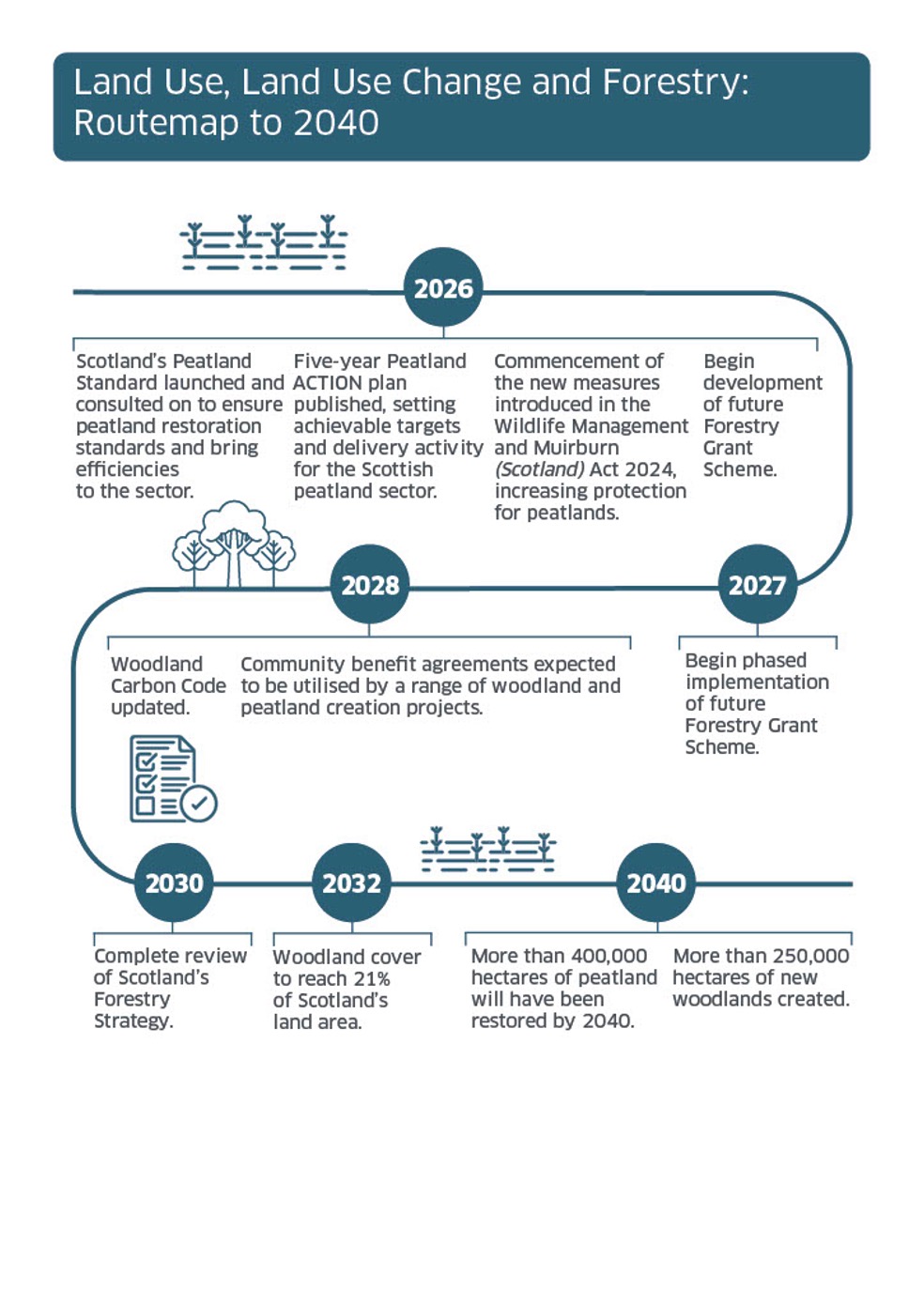
Land Use, Land Use Change and Forestry: Routemap to 2040
- 2026
- Scotland's Peatland Standard launched and consulted on to ensure peatland restoration standards and bring efficiencies to the sector.
- Five-year Peatland ACTION plan published, settings achievable targets and delivery activity for the Scottish peatland sector.
- Commencement of the new measures introduced in the Wildlife Management and Muirburn (Scotland) Act 2024, increasing protection for peatlands.
- Begin development of future Forestry Grant Scheme.
- 2027
- Begin phased implementation of future Forestry Grant Scheme
- 2028
- Community benefit agreements exected to be utilised by a range of woodland and peatland creation projects.
- Woodland Carbon Code updated.
- 2030
- Complete review of Scotland's Forestry Strategy.
- 2032
- Woodland cover to reach 21% of Scotland's land area
- 2040
- More than 400,00 hectares of peatland will have been restored by 2040.
- More than 250,000 hectares of new woodlands created.
Actions We Will Take to Achieve Our Vision
The Scottish Government is committed to:
- publishing Scotland’s Fourth Land Use Strategy by end of March 2026, and
- supporting the four successful RLUPs to transition from pilots to Scottish Government-backed initiatives, and using the learning from these Partnerships, seek opportunities to expand land use partnership working over the longer term.
Forestry
Scotland’s forests currently remove 7.6 MtCO2e annually, equivalent to 14% of Scotland’s gross GHG emissions. The proposed trajectory for woodland creation will be vital to sustain forestry’s contribution to reducing Scotland’s net emissions. Forestry also contributes £1.1 billion GVA and over 34,000 jobs to Scottish economy. Therefore, the key ambition is to expand the area of Scotland’s forests and woodlands to increase sequestration of greenhouse gas emissions and support wider objectives to generate income and employment, improve biodiversity, provide recreational benefits and support well-being in communities across Scotland. We have two forestry-related actions, outlined in the current Climate Change Plan Update 2020:
Outcome 1: Woodland Creation. We will continue with a stepped increase in the annual woodland creation rates from 2025/26 to enhance the contribution that trees make to removing emissions through sequestering carbon.
Delivery of the proposed levels of woodland creation will depend on sector confidence and on adequate funding for the Forestry Grant Scheme (FGS) over the next 15 years. Recent cuts to funding undermined forest sector confidence about investing in woodland creation in future and could best be addressed through a multi-annual agreement on funding for the FGS.
| Year | Proposed annual woodland creation target (hectares) |
|---|---|
| 2025-26 | 10,000 |
| 2026-27 | 12,000 |
| 2027-28 | 14,000 |
| 2028-29 | 16,000 |
| 2029-30 | 18,000 |
Delivery of this outcome will be supported by the following action:
- The annual woodland creation target will rise to 18,000 hectares by the end of this decade, achieving 21% woodland cover in Scotland by 2032. Approximately 250,000 hectares of new woodland would be created by 2040. The woodland creation targets include grant funded woodland creation and new planting undertaken on the public forest estate by Forestry and Land Scotland, creating new sustainable woodland on Scotland’s national forests and land, including through partnerships with external organisations to scale carbon capture opportunities.
- Forestry grants will continue to be developed in a targeted way and used to support landowners to establish sustainably designed and managed woodlands.
- Scottish Forestry will continue to work with market intermediaries to increase the accessibility and efficiency in the buying and selling of carbon credits to achieve greater scale and maturity in the market. This work will seek to support a further 50% expansion in the woodland carbon market by 2030. Building on the 10.8 million validated credits (each equivalent to one tonne of CO2) in the UK Land Carbon Registry in March 2025, this will require the validation of approximately one million credits a year between 2025 and 2030.
- We will continue to work with the farming sector through initiatives such as the Integrating Trees Network. The Forestry Grant Scheme includes a funding option aimed at creating small-scale mixed broadleaved and conifer woodlands on farms. This work will develop models to increase tree planting and woodland creation in ways that strengthen existing agricultural businesses on both tenanted and owner-occupied farms.
- The Scottish Government will continue to work with the other UK Governments to maintain a technical UK Forestry Standard that defines the requirements and provides guidance for foresters on how to practise sustainable forest management when creating new woodland or managing existing forest.
- Through the Scottish Forestry Improvement Programme, we will continue to invest in streamlining, digitising and increasing the transparency of our regulatory processes, ensuring that they are as efficient and simple as possible.
Outcome 2: Increase the use of sustainably sourced wood fibre to reduce emissions by encouraging the construction industry to increase its use of wood products where appropriate
Delivery of this outcome will be supported by the following action:
- In collaboration with the private forest sector and other public sector bodies, we will continue to implement a timber development programme through an annual programme of projects that support the promotion and development of wood products for use in construction.
- Funding to support forest nurseries will help them invest in a programme of technical innovation to develop and adapt modern horticultural practices.
- We will continue to work closely with the sector through the Scottish Forestry and Wood Based Industries Industry Leadership group. We have supported the development of a skills action plan (and will continue to do so) to encourage new entrants into forestry and to increase the skill sets of those already working in the sector.
Peatland
The peatland policies and proposals set out below are designed to continue steady progress towards meeting our vision, and to improve peatland condition and stewardship across Scotland in order to maintain or reinstate their natural function for the benefit of the climate, nature and people. They are gathered into three outcomes – protect, manage and restore – supported by world-class evidence and research.
Outcome 1: Protect. Protect and support the natural function of areas of peatland that are already in good condition, and prevent areas already degraded from deteriorating further.
Delivery of this outcome will be supported by the following action:
- We will continue our work alongside other UK nations to ban the sale of peat for horticulture in Scotland. We will draw on the outputs of our consultation, stakeholder engagement and commissioned research to ensure that the timing and scope of the ban are right for Scotland.
- We will continue work started by the Peatland Expert Advisory Group to improve the tools, guidance and monitoring relating to the design and construction of windfarms on peat.
- Informed by the local pilot projects announced in our 2025-26 Programme for Government, we will ensure that future deer management arrangements in Scotland support our peatland and wider soils ambitions to 2040. This will include requiring and, where appropriate, incentivising activity to control deer numbers in areas where priority work to improve nature is underway, such as peatland restoration.
- In 2026, we will aim to commence the new measures introduced in the Wildlife Management and Muirburn (Scotland) Act 2024 that increase protection for peatlands by establishing a licensing scheme which only permits muirburn on peatland for certain purposes such as for the creation of firebreaks to help prevent wildfires.
Outcome 2: Manage. Support positive measures by landowners and managers to manage and improve degraded peatlands.
Delivery of this outcome will be supported by the following action:
- We will continue our work with partners and stakeholders to develop incentives, guidance, advice and support on peatlands within the new agricultural support framework for land-owners and managers looking to integrate peatland protection, management and restoration with existing land use on their farm or croft.[243]
- We will continue our work with Peatland ACTION to support crofters wishing to progress peatland protection, management and restoration, and ensure we learn from the experience of initiatives working to bring private finance into this sector[244]. The new Crofting and Scottish Land Court Bill aims to bolster and strengthen the role of grazing committees, giving them, and individual shareholders, more options for proposing a range of environmental initiatives on common grazings.
- NatureScot will progress a holistic ‘Developing Healthy Ecosystems’ approach to strengthen monitoring of peatland condition within all designated sites even where it is not a listed feature.
- Through the Land Reform (Scotland) Act 2025 we have:
- legislated to adjust tenancy arrangements allowing tenant farmers and small landholders to deliver multiple eligible land use activities including peatland restoration and rewetting;
- proposed a new model lease for environmental purposes to assist individuals, communities and landlords to undertake hybrid land management actions including peatland restoration and rewetting; and
- introduced Ministerial powers to make regulations for Land Management Plans; these will require landowners who own land over 1,000 hectares to set out how they are managing or intend to manage the land in a way that contributes towards achieving Net Zero emissions targets, adapting to climate change and increasing biodiversity.
Outcome 3: Restore. Support focused interventions to return degraded peat to a more natural condition and reinstate the natural ecosystem functions and benefits they can provide.
Delivery of this outcome will be supported by the following action:
- We will increase peatland restoration by 10% each year to 2030 and maintain levels after that leading to the restoration of more than 400,000 hectares by 2040. Within this, we will look to increase the proportion of the most highly degraded and emitting peat that is restored.
- To bring focus, stability and certainty to the sector going forward, and to take us towards our 2040 ambitions, we published our first Peatland ACTION Partnership Plan on 15 December 2025.[245] This details the realistic and achievable actions needed over the next five years reflecting the current capacity, skills and capabilities of the sector. It also seeks to ensure that our investment maximises the multiple benefits of peatlands for climate, nature and people.
- In 2026, we will consult on and launch Scotland’s Peatland Standard which will ensure quality and consistent peatland restoration standards and bring efficiencies to the sector for training, project development, delivery techniques and monitoring and verification.
- We will continue to deliver the Scottish Government’s Implementation Plan in response to the recommendations of the Land-Based Learning Review to contribute to attracting and equipping more people with the skills and knowledge needed to work in land-based and aquaculture sectors.
- In addition to our multi-year investment plans for peatland restoration set out in our 2026 spending review over the next four years, we will also continue our work to leverage and blend responsible private investment into peatland protection, management and restoration through our Private Investment in Natural Capital Programme.
- Informed by new approaches to monitoring, we will continue work to restore and improve the condition of degraded peat on land that is publicly owned, managed by Crown Estate Scotland and within formally designated nature conservation sites.
- As announced in the budget 2025/26[246] we will continue working with the Scottish Land Commission to develop the evidence necessary to identify and assess options for a carbon land tax.
Outcome 4: Research and evidence. Continue to invest in world-class peatland research to inform the development of policy and practice.
Delivery of this outcome will be supported by the following action:
- Through our forthcoming Strategic Research Programme and other routes, we will continue to invest in research on: the distribution and condition of Scotland’s peatland resource; businesses in the supply-chain and any impacts arising from our actions; building the restoration pipeline and driving efficiencies; and understanding the complex relationship between herbivore grazing, peatland condition and emissions.
- Scotland’s new LiDAR data will contribute to the identification and monitoring of peatland restoration sites and contribute to transparency and cost effectiveness of some surveys.
Just Transition Principles and Adaptation
As highlighted above Scotland's forthcoming Land Use and Agriculture Just Transition Plan (LAJTP) will focus on the livelihoods, skills and health and wellbeing of those who live in and rely on Scotland’s land and agricultural sector, as well as focusing on maintaining and supporting thriving rural and island communities. It is anticipated the formal Land use and Agriculture Just Transition Plan will be published later in 2026.
People and Communities
Forestry
The expansion of woodland offers significant benefits for people and communities across Scotland. It will also offer opportunities for the development of woodland-based community enterprises. We know that community ownership and participation in woodland creation and management can foster community cohesion and promote community empowerment, helping people feel they have more control over the decisions that shape their lives and the environment in which they live. Scottish Forestry and Forestry and Land Scotland are developing and enhancing opportunities for individuals, families and communities to: make use of woodlands on public and private land, leading to benefits in health, recreation and wellbeing; and engage with proposals for woodland creation and management of existing forests.
Ongoing initiatives such as the Integrating Trees Network are helping to demonstrate the benefits that woodlands can bring to farm businesses through improvements in shade, animal welfare and productivity. Communities have valuable local knowledge and insights and their aspirations and concerns must be considered when decisions are being made about the places they live in and care about. The opportunities for communities to engage in the development of woodland creation proposals, and how these views are considered, are set out in Scottish Forestry’s forestry engagement and consultation processes.
To support communities in realising these benefits, we continue to ensure that forestry grants are available to communities that would like to create and manage woodlands. Targeted funding for communities is also available through the Scottish Forestry Community Fund, which supports community involvement in woodland management and ownership, as well as helping to promote community use of woodlands, delivery of community benefits and community wealth building.
Scottish Forestry continues to take action to support appropriate design and management of new woodlands.
It is supporting the Confederation of Forest Industries (Confor) to run training events across Scotland to promote good practice in stakeholder engagement. It has also funded Confor, in collaboration with community representatives, to develop good practice guidance on Engagement with Local People and Communities[247]. In addition, Scottish Forestry funds the Community Woodlands Association to provide advice and support to community woodland groups on issues such as woodland acquisition, woodland creation and management, and governance and funding.
To date, measures have included publishing guidance for communities to improve clarity and understanding of the woodland creation process and the engagement opportunities within it. We have also supported the forestry industry to work with community representatives to produce good practice engagement guidance, and to develop and run stakeholder engagement training. Scottish Forestry is also a partner in a project led by Community Land Scotland which focusses on developing and piloting a network of advisors across Scotland. These advisors will act as intermediaries and facilitate collaboration between local communities, landowners and natural capital investors to deliver more benefits to communities.
Looking forward, we plan to introduce a number of changes to further support this ambition, including:
- clearer, more robust community engagement requirements within the woodland creation application process, and
- improvements to our public consultation system (the Public Registers) to improve transparency and enable the digital sharing of a wider range of information.
Peatland
The peatland policies and proposals in this Plan, including continued expansion of peatland restoration, will bring benefits for people and communities across Scotland.
The most immediate direct benefits are linked to the employment and business opportunities created and maintained by a combination of our own public funding blended with increased private investment in the sector in future which will help support strong local economies and rural livelihoods.
However, as described above, healthy peatlands can provide multiple benefits for climate, nature and people, and play an important role in mitigating and adapting to the climate and nature emergencies. In time, these benefits may be experienced by communities through, for example, reduced water treatment costs and lower risks of flooding in rural and urban settlements.
Healthy peatlands, where the water table is at or close to the surface, may also play a role in reducing the intensity, depth and duration of wildfires. This benefits rural communities not only by improving the safety of residents but additionally by reducing smoke and avoiding impacts on respiratory health. Our new Strategic Action Plan on Wildfires recognises the importance of having landscapes that are resilient to wildfire in helping to control the risk and impacts of wildfires, and we will continue to work with land managers and local communities to reduce the risk of wildfire.
Workforce
Forestry
The forestry sector currently employs an estimated 34,000 FTE workers. Our policies and proposals for woodland creation and the use of sustainably sourced wood fibre in construction and manufacturing industries, will support the creation and maintenance of future jobs, as well as further training and skills development at manual, technical and managerial levels. The 2019 Future Forestry Workforce in Scotland review predicts that six sub-sectors of the industry will need to recruit up to 70% of their existing workforce over the next ten years.[248]
The long-term increase in woodland creation set out in this Plan will underpin future public and private investment in the workforce by reducing risk and uncertainty about future growth in the sector. This growth will offer opportunities to enhance training and diversity in the workforce through appropriate and accessible entrance routes. Our approach has the potential to unlock new direct and indirect economic opportunities across the country and stimulate the creation of sustained employment for rural areas. It is estimated that Scotland’s targets will support 1,700 FTE jobs directly in woodland creation, generating an estimated average annual GVA of £120 million.[249] Creating an extra 50 hectares of new woodland can support around five FTEs.[250] There will be an increased demand in managerial and professional roles, such as in forest and nursery management, professional forestry support services, wildlife and biodiversity management and recreation and tourism.
Increasing sustainably sourced wood products from our forests will create further employment in primary and secondary wood processing activities. Future increased harvesting and processing of timber from expanding forests offers economic improvement: it would reduce dependence on imports, increase value of domestic consumption and offer opportunities to maximise the added value of the sector to the Scottish economy.
To support the workforce in adapting to the transition and seizing these opportunities, we will continue to implement actions outlined in Scotland’s Forestry Strategy Implementation Plan[251] and support delivery of the forestry sector’s Industry Leadership Group’s Skills Action Plan.[252] The Action Plan looks to support and attract talent, encourage new entrants, develop the workforce and support wider outdoor learning networks.
Peatland
As noted above, the current peatland restoration workforce is estimated to be around 400 FTE, spread across a number of roles, sectors and locations. The actions set out in this Plan, including our continued long-term investment in peatland restoration, will support the creation and maintenance of additional and sustained direct and indirect jobs in the sector in future. Recent evidence[253] estimates that employment levels in the wider peatland restoration sector based on annual restoration rates between 10,000 and 20,000 hectares could range from 383 FTE to 749 FTE, and if restoration was to be 35,000 ha per year then even up to 1,258 FTE.
While some of the skills and expertise needed to support this growth will come from those already engaged in other land-based industries[254], it will also generate a demand for increased bespoke training in many of the skills specific to peatland work.
Our Peatland ACTION Partnership Plan sets out in more detail the specific actions we will take across the partnership to attract new entrants and support the workforce in developing the skills and expertise needed to support growth in the sector across Scotland.
Our commitment to establishing a ban on the sale of peat for horticulture, however, may lead to some contraction or displacement of the workforce employed in the peat extraction, horticulture and growing media industries. However, it is not possible to accurately predict the scale of any such impacts until the scope and timing of any ban and any associated exemptions is established which will influence how these sectors of the industry respond.
Employers
Forestry
The Scottish Government’s Forestry Strategy 2019-29 identified priority areas for action to help businesses engage in and benefit from woodland creation. The actions set out in this Plan will support additional income opportunities for farmers and other land managers, and for businesses in the wider supply chain. Our advisory schemes will support farmers and crofters in integrating woodlands into individual holdings.
Our plans and policies for investment in woodland creation will stimulate growth and confidence in the sector and encourage employers and businesses to make investments that improve their productivity and competitiveness. For example, sustained woodland creation provides the conditions for a predictable future timber supply, lowering the risk of investment in innovation. Increased throughput encourages processors to invest in technology, such as 3D scanners and larger robotic production lines. In turn, this allows a business to widen its timber procurement activities, increasing productivity and expanding the market.
Scotland is a dominant force in UK domestic timber production. In 2022, an estimated 72% of all softwood removals from private sector woodlands were harvested in Scotland.[255] The UK imports the vast majority of its timber, with demand expected to remain high, over this decade and beyond, to meet housebuilding and Net Zero ambitions.[256] This environment provides a strong, long-term economic platform for Scotland’s timber industry to increase revenue, investment and job security through increased domestic activity.
Our plans and policies provide landowners land managers and rural businesses with opportunities to diversify their operations and create additional revenue streams. In addition to benefits for farm businesses, woodlands support recreation, education and tourism opportunities in the local economy. This includes investing in facilities that enhance visitor experience and promote sustainable nature tourism, such as cycle trails and footpaths, forest kindergartens and other visitor facilities. Such developments support wider growth in tourism in local communities.
Peatland
The actions set out in this Plan, including our investment in peatland restoration, will support additional income opportunities for rural businesses, land-owners and managers across rural Scotland. Our Peatland ACTION programme provides advice to those looking to enrol in the restoration of degraded peat on their land and support their access to both public and responsible private funding. This will help build resilience across the farming, crofting and land use sectors and communities, supporting the viability and resilience of their businesses.
In addition, the peatland restoration sector that helps deliver projects on the ground will also benefit. These include businesses offering consultancy and services in surveying, project design and management, technical expertise in ecology and hydrology, civil engineering, research and monitoring, policy and advocacy, and in public and private finance. Compared to forestry, peatland restoration is a relatively young sector in Scotland with rather limited delivery capacity, but has been supported to grow by our investment through the flagship Peatland ACTION programme which has a specific focus on jobs, skills and business development. Further investment will be required to reach our long-term targets, and we will continue to work with and support the sector to build skills and delivery capacity going forward.
Through our Natural Capital Market Framework, our investment seeks to catalyse opportunities for ethical and values-led private investment in nature-based solutions. The Market Framework embeds Scotland’s six principles for responsible investment, including integrated land use, engagement and collaboration, community benefit, and high environmental integrity. Well-designed natural capital projects can deliver significant economic outcomes such as enhanced local employment opportunities, particularly in rural areas where sectors of the economy are heavily reliant on natural capital.
As outlined above, a ban on the sale of peat for horticulture in Scotland may lead to some contraction or displacement of businesses and jobs within that sector. However, it is likely that the knowledge and skills of those working in these businesses would be highly transferable to other land-based industries where there are increasing opportunities for investment, employment and business diversification.
Adaptation
Scotland’s woods and forests have a vital role to play in helping us to adapt to the impacts of climate change by, for example, supporting biodiversity, providing natural flood management and shelter for livestock. Our approach recognises that Scotland’s woods and forests also need to adapt to a changing climate and become more resilient to the growing threats they face, including from extreme weather events, wildfire, pests and diseases and herbivore browsing.
As noted above, healthy and resilient peatlands are also important in helping nature and society adapt to climate change. Natural and rewetted peatlands increase ecological diversity and resilience to a changing climate. They may also play a role in reducing the intensity, depth and duration of wildfires and flooding in Scotland’s communities. And they help improve water quality in lochs, burns and rivers which benefits nature and people.
Our Call to Others
Industry and Business
To ensure that we continue our woodland creation work it is vital that the forestry sector, supply chain businesses including nurseries, contractors and land managers are scaled up to ensure sufficient capacity to deliver woodland creation targets. To support this, we will work with the Scottish Forestry and Wood Based Industries Leadership Group to refresh their strategy and support the action plan.
Similarly for peatlands, as discussed above we urge businesses active in the land-based and peatland sectors (including feasibility, design, engineering, monitoring and private investment) to respond to the opportunities presented by our record levels of funding in the years ahead and invest in the people and machines needed to continue growing delivery capacity across Scotland towards the levels we want to reach going forward.
The UK Government
Scotland makes a significant contribution to the UK achieving its climate and nature targets. Scotland has created about 70% of all new woodland across the UK in the past five years, playing a vital role as a large carbon sink that reduces net emissions for communities and organisations not just in Scotland but across the UK. Similarly, restoring degraded peatlands in Scotland is vital to UK emissions reductions, and with two thirds of UK peatlands located in Scotland, much greater investment is needed by Scotland than by other nations.
However, the funding Scotland receives from the UK Government for rural and land-based action on forestry, peatland restoration and agriculture is based not on area but on annual population-based Barnett formula settlements which fail to deliver the funding Scotland needs to help deliver our shared outcomes.
The UK Government should make a more proportionate and multi-year financial contribution to woodland creation and peatland restoration in Scotland that reflects the full contribution we can and do make towards reducing UK-wide emissions. Scotland should not have to direct funding away from other needs to fund the majority of forestry or peatland restoration on behalf of the UK as a whole.
We also call on the UK Government to bring forward joint UK legislation to ban the sale of peat in horticulture in order to avoid the effect of the UK Internal Market Act undermining effective devolved policy in Scotland.
Individuals and Households
There is an opportunity for land managers to capture the long-term economic and biodiversity benefits of converting land or other open ground to woodland and restoring degraded peat. The availability of enhanced and targeted grant aid can help to successfully implement land-use change and we encourage individuals and groups to take up this support. Scottish Forestry advice, expertise and guidance are available through the Scottish Forestry Conservancies, sector-wide guidance and training, and peer-support opportunities such as the Integrating Trees Network.
We call on land-owners managers to understand the condition of peatland on their land, the opportunities and potential and for restoration, and to engage with Peatland ACTION to enrol their land in this important work. We also call on members of the wider public to find out more about initiatives to restore degraded peat, and avoid buying peat-based gardening products to support the transition of horticulture and gardening away from peat.
Nature and Biodiversity
Introduction
Climate regulates nature and nature regulates climate. The two are both inseparable and symbiotic.
In Scotland, and around the world, we are facing twin crises of climate change and biodiversity loss. There is abundant evidence that these crises are linked and mutually reinforcing. Climate change, caused by greenhouse gases arising from human activity, is a leading driver of global biodiversity loss. Biodiversity loss, in turn, reduces the capacity of our natural environment to absorb greenhouse gases, exacerbating the climate crisis. This is because healthy ocean and land ecosystems play a fundamental role in sequestering carbon, as well as helping us adapt to the locked in effects of climate change.
It is not possible to successfully address these crises by prioritising one over another: they must be tackled together. Our efforts to reduce emissions and reach net zero must be supported and reinforced by actions designed to protect and restore nature. This means focusing on opportunities to deliver joint nature and climate benefits, including nature-based solutions. It also means carefully managing potential tensions that can arise between net zero interventions and biodiversity, to ensure that our actions for climate and nature are mutually supportive and do not work against each other.
The Nature Emergency
The Scale of Biodiversity Loss
The evidence is clear that health of the planet’s ecosystems is deteriorating faster than at any point in human history. A million species around the world are estimated to be at risk of extinction and wildlife populations have, on average, declined by 73% since 1970.
These global trends of biodiversity loss are mirrored here in Scotland. We rank amongst those countries where habitats and species have been most depleted by human impacts through history, in the bottom 25% of nations for our ‘nature intactness’. The latest State of Nature report for Scotland highlights the scale of biodiversity loss, with 11% of Scottish species now threatened with extinction from Great Britain.
Risks to our Wellbeing and Prosperity from Biodiversity Loss
There is increasing awareness of the risks that nature-loss poses for countries around the world. After extreme weather events, the World Economic Forum identifies biodiversity loss and ecosystem collapse as the second greatest risk facing humanity over the next decade, followed by critical change to Earth systems and natural resource shortages. Environmental risks are among those expected to increase the most in severity and dominate the longer-term global risks landscape over the next decade.
People are part of nature, and we rely on a healthy natural environment for the essentials we need to survive. It provides us with food, water and shelter; regulates our climate and disease risk; maintains nutrient cycles and oxygen production; and enhances our health and well-being. It provides a safe operating space for humanity. As well as being a moral duty, addressing the biodiversity crisis is therefore essential for the wellbeing of current and future generations.
It is also fundamental to our economic success. Our economy is embedded in the natural environment, meaning that it is reliant on the resources and services nature provides and its capacity to absorb our wastes, including greenhouse gases and pollution. Although our economy is ultimately entirely dependent on nature, over half the world’s GDP is currently estimated to be moderately or highly at risk from nature loss. In Scotland, industries directly reliant on natural capital[257] support £40 billion of economic output and more than 260,000 jobs. Our economy is also dependent on global environmental health, given the integrated nature of supply chains and the wider geopolitical volatility that environmental degradation can lead to. Even if we address domestic environmental challenges, the international dimension presents huge risks, for example, to our economy and food security. The scale and urgency of these risks is highlighted in the UK Government’s 2026 National Security Assessment on biodiversity loss, ecosystem collapse and national security.
Key Drivers of Biodiversity Loss
The drivers of global biodiversity loss are outlined in the IPBES Global Assessment Report on Biodiversity and Ecosystem Services. Climate change is one of the five ‘direct’ drivers, alongside land and sea use change, exploitation of organisms, pollution and invasive alien species. Climate change has a significant negative impact on most ecological processes, for example by causing species to respond in ways that disrupt food webs. It poses a growing risk, owing to the accelerating pace of change and interactions with other direct drivers. The warmer the planet gets, the more stress is placed on ecosystems, triggering feedback loops that will accelerate warming and extreme weather events.
Importantly, these direct drivers of biodiversity loss are the result of human activities, underpinned by societal values and behaviours. These ‘indirect drivers’ include production and consumption patterns, human population dynamics, trade and technological innovations, which have led to overconsumption of natural assets.
Underlying these drivers, the 2024 IPBES Transformative Change Assessment identifies three fundamental causes of biodiversity loss:
- disconnection from and dominance over nature and people,
- concentration of power and wealth, and
- prioritisation of short-term, individual and material gain.
These apply to climate change too. In essence, we are demanding more goods and services than nature can supply into the future. At the root of this is a failure to recognise that society is part of nature and to account for the true value of nature in our economic activities.
Scotland’s Response to the Nature Emergency
Scotland’s Strategic Framework for Biodiversity sets out our response to tackling the nature emergency in Scotland. It includes:
- The 2024 Biodiversity Strategy, which describes a strategic vision and outcomes for restoring and regenerating Scotland’s biodiversity. The strategy sets targets for halting biodiversity loss by 2030 and restoring and regenerating Scotland’s biodiversity by 2045,
- A series of rolling Delivery Plans, to be reviewed every six years, with cross-sectoral actions for delivering these outcomes, and
- Statutory nature restoration targets, to be set out in the Natural Environment Bill, which will drive action and increase accountability for achieving the vision and outcomes.
Complementing this, the Environment Strategy also sets out our approach for improving our impact of Scotland’s consumption and production on the natural environment in other countries around the world.
A Joined-up Approach to Tackling the Climate and Nature Crises
Looking ahead, the climate and nature crises must be addressed at the same time through climate solutions that improve the state of nature, rather than compounding past damage; and interventions for nature that enhance climate resilience.
To support this joined up approach, we are focusing action in the following areas:
Nature-based Solutions to Climate Change
Nature-based solutions, such as street trees, raingardens, green roofs and improved water ways, can play a significant role in helping us to mitigate and adapt to climate change while also improving habitats for biodiversity. They also provide a range of benefits for people’s health and well-being by helping to create more resilient and enjoyable places to live, work and play.
We are taking significant action to support nature-based solutions to climate change. For example, Scotland planted nearly 75% of all new forests in the UK in 2023. We have also pledged £250 million to restore damaged peatlands, which currently contribute around 16% of Scotland's emissions, and have supported the restoration of 90,000 hectares to date. In the marine environment, we are working to increase our understanding of the contribution of Scotland’s blue carbon habitats, including saltmarsh and seagrass, as nature-based solutions and published a Blue Carbon Action Plan in September 2025. We are also seeking opportunities for scaling up use of blue-green infrastructure in urban areas to help sequester more carbon and improve biodiversity in our town and cities.
More broadly, actions to protect and restore Scotland’s natural habitats will support their ability to store carbon, including measures in the Natural Environment (Scotland) Act 2026 to improve the management of wild deer. Achieving sustainable deer populations is fundamental to Scotland’s ability to meet its climate and biodiversity goals.
Management of Potential Trade-offs between Net Zero and Nature Goals
It is essential to ensure that our policy actions to achieve goals for net zero and nature are designed to support, rather than work against, each other. This means understanding and carefully managing potential trade-offs.
For example, the Environment Strategy highlights the importance of ensuring that delivery of our ambitions for expanding our renewable energy capacity also supports targets for reversing biodiversity loss in Scotland. Tensions with biodiversity goals can arise due to pressures on land use or on the marine environment from renewable energy developments – both in terms of the space needed for development, and the potential direct impacts on Scotland’s unique biodiversity.
The Environment Strategy outlines our policy approach for managing these tensions - signposting to relevant measures, for example, in the National Planning Framework and the Bioenergy Policy Statement. It also commits to exploring options for strengthening our evidence base on the cumulative impacts of renewable energy and grid infrastructure on biodiversity. Our updated national marine plan for Scotland’s seas will help get the right planning framework in place to address the increased competition for marine space, whilst balancing the need for protection and enhancement of the marine environment, and sustainable development of existing and emerging sectors, including marine renewables.
As well as addressing impacts on biodiversity in Scotland, it is also important to minimise overseas environmental and human rights impacts from our energy transition – including from mining transition minerals used in batteries, turbines and power lines and from any imported bioenergy feedstocks. The Environment Strategy commits to exploring opportunities for improving the sustainability of the overseas environmental impacts of our energy transition in Scotland. More broadly, it commits to continuing to strengthen our evidence base on the interactions between energy policies and biodiversity to support our joined-up approach to tackling the climate and nature emergencies.
Reducing overall demand for energy is an important part of managing these tensions, for example by promoting use of public transport and energy-efficient homes. This can also help to cut energy and infrastructure costs and limit our exposure to fluctuating energy prices, while also reducing fuel and transport poverty. As set out in the Environment Strategy, we will continue to work with stakeholders to support energy demand reduction across sectors.
Supporting the Economic and Societal Changes Needed to Achieve Climate and Nature Goals
There is growing international evidence that tackling the climate and nature crises will rely on economic and societal change, particularly in high income countries like Scotland. This will help to ensure that we thrive within the planet’s sustainable limits and do not take from nature faster than it can regenerate itself. The Environment Strategy sets out a wide range of policy priorities for supporting and enabling these changes in ways that will help to transform our country for the better, improving the lives of people across Scotland. It sets out steps for supporting the just transition to a net zero, nature positive, circular economy and improving the sustainability of our lifestyles. Crucially, it focuses on approaches that will benefit Scotland’s prosperity and wellbeing – boosting green jobs and industries, improving people’s health, tackling poverty and promoting social justice.
Reconnecting people with nature can be a deep lever for enabling and supporting these societal changes, by inspiring care for the natural world. Evidence suggests that this can be a powerful motivator for people to adopt low carbon behaviours, such as using active travel and public transport, shifting towards sustainable, healthy diets, avoiding food waste and changing the way we purchase products. These societal and behavioural shifts are key to supporting our transition to a sustainable and fairer future. However, we also know that people’s knowledge and awareness of Scotland’s biodiversity crisis is low, and that significant barriers remain for people to engage with nature.[258] The Environment Strategy identifies policy priorities to help strengthen people’s connection with nature, including creating nature-rich urban spaces, supporting nature-based education and health, enhancing animal welfare and harnessing the role of the arts and rights-based approaches. These changes can also benefit the health and wellbeing of people and communities across Scotland.
Interventions for Nature that Enhance Climate Resilience
The Scottish National Adaptation Plan 2024-29 recognises the crucial importance of a healthy natural environment in supporting Scotland’s resilience to climate change.
A key priority is to build resilience against multiple and cascading risks by managing water and soil health as our primary natural assets. Not all climate risks are equal: those to food, infrastructure, health, economy and finance ‘flow’ through ecosystems and water. That is why the way we use our land and seas must be sustainably managed in order to provide multiple benefits and address multiple risks simultaneously. In addition to building resilience to climate risks, by prioritising diversity and connectivity, these actions help to restore nature’s functions of regulating climate through improved soil health and water flows.
Climate risks include temperature extremes, floods, fires, drought, storms, pests, pathogens and disease. These interact with each other as well as with non-climate risks to create vulnerabilities to events. The frequency and intensity of these events arise through both the average and chaotic nature of climate change. As climate warms it becomes more unpredictable, characterised by extreme events and ‘unusual’ patterns of weather. It is the unpredictable nature of change that makes it difficult to deal with: events are outside our experience, and if we do not know where and when something is going to happen, how big it will be or how long it will last, our best response is to build resilience. Investing in the health, diversity and connectivity of our natural environment is our most effective insurance against these risks.
Marine
Introduction
The world’s ocean has a crucial role in reducing global greenhouse gas emissions and regulating the Earth’s climate. It is estimated that every year the ocean absorbs about a quarter of the carbon dioxide emissions released by human activities and since the 1970s has absorbed around 90% of the excess heat generated by greenhouse gases.[259][260] [261] Ocean climate also impacts on prevailing weather patterns and the ocean’s productivity from the smallest single-celled plants and animals to fish and fisheries.
A healthy ocean with thriving ecosystems is an active part of the global carbon cycle. It is our planet’s second largest carbon sink, after the earth’s rocks, and is estimated to contain around 50 times more carbon than the atmosphere. Changes to the global carbon cycle can change the amount of greenhouse gases in the atmosphere and have impacts on our climate.[262]
Scotland, as other nations, is experiencing the impacts of climate change on its seas and coasts. For example, the sea is getting more acidic and warmer, and rising sea levels are resulting in increases in coastal erosion and flooding, especially compounded by combined effects with extreme weather. The scale of these impacts varies across Scotland, but they are directly affecting people who live and work in coastal communities and marine sectors, as well as the life in the sea.[263] [264] These impacts also directly influence the ability of our seas to regulate our climate, as warmer, more acidic oceans may affect how they absorb and store carbon dioxide.
Marine ecosystems that play a part in the global carbon cycle are under pressure from multiple stressors, including climate change. Human activities, including those that produce emissions as well as those that damage ecosystems, continue to impact on marine life and will reduce the ability of the ocean to regulate our climate.
In order for our seas to remain a source of prosperity for the nation, especially in our coastal and island communities, the ocean must be safeguarded. This will ensure that, amongst the many benefits it brings, it can continue its role in regulating our climate and reducing global warming as well as providing healthy nutritious food. This means we must drive down emissions in all sectors, including the blue economy, to reduce the impacts of climate change on the ocean, as well as protecting and enhancing the biodiversity of Scotland’s seas to support ocean resilience. We must manage this transformation in a way that is fair and just for businesses, people and nature, particularly in rural and coastal communities that depend on the sea, by empowering communities and sharing in the benefits of a green economy.
Emissions from Marine Sectors and Habitats
To protect the future of Scotland’s seas, action must be taken to reduce whole economy emissions, to increase resilience of the seas and to adapt to climate change, as well as improve biodiversity and the health of our seas in a way that is fair and just for those who depend on it.
Scotland’s marine environment holds an abundance of renewable energy resources, and offshore wind and marine renewables (e.g. wave and tidal) have a major role to play in reaching net zero, as renewable energy generation will displace GHG emissions from other energy sources (e.g. coal, gas). The scale of infrastructure development needed comes with the risk of significant impacts on nature and biodiversity, which is why it is important that adverse impacts are mitigated and, where appropriate, compensated for. For offshore wind specifically, we are working to identify and develop strategic compensatory measures, which have the potential to deliver innovative large-scale benefits to the environment. This could support efforts to address the global climate emergency and the nature emergency in tandem.
We have an improving understanding of emissions in the blue economy and the opportunities for the fishing and aquaculture sector to decarbonise and for marine habitats to support mitigation. Our blue economy sectors are reported across a range of the GHG inventory’s sectors, such as fuel emissions from fishing vessels in Transport and emissions from aquaculture operations in Industry. This means uncertainties remain on the estimates of GHG emissions from marine sectors, and we are considering how best to translate the current reporting mechanisms to support decarbonising the blue economy.
Fisheries
The Fisheries Management Strategy[265] sets out our activities to support the sector to tackle the climate emergency. We have a developing understanding of the GHG emissions of Scotland’s fishing fleet and the variables which contribute to vessel emissions, including the size of vessel, gear type used, time at sea and distance covered within a trip.
GHG emissions from fishing vessels represent a very small proportion of Scotland’s emissions – equal to about 0.7% of Scotland’s total emissions and about 2.4% of total emissions from Scotland’s domestic transport sector. Initial studies suggest that the highest proportion of the sectors’ GHG emissions are from a few, very large vessels which spend long periods of time at sea. Smaller vessels that spend less than one day at sea per trip and use static or mobile fishing gears represent a large proportion of the total Scottish fishing vessel fleet, however they represent a small proportion of the annual GHG emissions of the sector.
The direct emissions from Scottish fishing vessels were estimated at 0.271 MtCO2e in 2022.[266] However, there are limitations to this methodology, including the exclusion of smaller (under 10m length) vessels and underlying assumptions on the fuel efficiency of vessels. We are continuing to refine these estimates as new and updated methodologies become available.
A number of improvements have been proven to reduce emissions from fishing vessels of all sizes, including adding various additives to traditional fuels for improved engine performance, modifying fishing gear, improving poor vessel balance or reducing the size and areas of ahull appendages. The fuel savings from most of these improvements are small, but can be important when combined with other measures. Further technological developments are needed to enable larger scale transformation of the sector to net zero – currently there are few cost-effective options available for larger vessels within the Scottish fleet, which represent the highest proportion of emissions.
Aquaculture
Studies to understand the emissions from aquaculture have conducted Life Cycle Assessments to profile GHG emissions across production and the supply chain.
A review of published literature estimates that emissions from salmon aquaculture were around 0.436 MtCO2e in 2020.[267] However, we know that 95% of those GHG emissions (roughly 0.4142 MtCO2e) are from feed production, the majority of which is imported from outside of Scotland and the UK and therefore not captured in Scotland’s territorial emissions. The remaining 5% represents minor contributions from fuel use (diesel) and transport and negligible contributions from electricity and chemicals.
The Vision for Sustainable Aquaculture[268] supports adaptations in the sector through reductions in marine pressures, including to deliver emissions reductions to support net zero.
We are working in collaboration with marine stakeholders, across the UK and internationally, to support wild capture fisheries and aquaculture to transition to net zero in a way that is fair and just. Many of the actions need to be developed and initiated by the fishing and aquaculture industry and others in the private sector (e.g. net or vessel designers). Government also has a role to play in driving forwards innovation and identifying and removing barriers, where possible.
This transition needs to be balanced with the outputs of the sector in relation to the production of low-carbon, healthy food and the positive role that the fishing and aquaculture industry plays in the socio-economic and cultural fabric of Scotland’s coastal communities.
Blue Carbon
Looking after Scotland's natural marine organic carbon stores, referred to as blue carbon, is part of our approach to climate change mitigation, as well as adaptation and improving biodiversity. Scotland’s blue carbon habitats include saltmarsh, seagrass beds, sedimentary beds, and kelp and other seaweeds.
Collectively, these habitats represent significant long-term stores of organic carbon, which have accumulated over thousands of years. To support climate change mitigation, it’s important to protect existing stores of carbon, particularly where they are identified as vulnerable to disturbance, as such disturbance may result in loss of CO2 to the atmosphere.
It is also possible to add to some existing stores of organic carbon by restoring or creating new natural habitats that sequester as well as store carbon or through removal of pressures to facilitate passive restoration. In Scotland, this applies to saltmarsh and seagrass, though their potential to contribute to climate change mitigation is small because of the limited extent of these habitats and the specific geomorphological site conditions they require.
Our understanding of Scotland’s blue carbon habitats is improving, supported by research by the Scottish Blue Carbon Forum (SBCF) and the wider community of experts. However, evidence gaps currently prevent the inclusion of blue carbon habitats in the UK GHG inventory. The Scottish Government supports inclusion of coastal habitats in the inventory where appropriate based on the latest available evidence. We are working with the UK Government and other Devolved Governments, through the UK Blue Carbon Evidence Partnership, towards their inclusion.
Scotland’s Blue Carbon Action Plan[269] sets out how we are addressing evidence gaps across each of the blue carbon habitats and integrating consideration of blue carbon into wider marine policies. Marine policies like the National Marine Plan and the Marine Protected Area (MPA) network help to manage pressures on existing habitats, contributing to passive restoration, and upcoming work towards Nature Positive will help to restore habitats that can contribute to achieving net zero.
Blue Carbon in the MPA Network
The MPA network has developed over many years with the majority of sites designated by the early 2010s. At that point, understanding of the contribution of marine habitats to climate change mitigation, separate to their more widely recognised biodiversity benefits, was limited. Our understanding has improved since, particularly supported in Scotland by the creation of the SBCF in 2018.
Many habitats that have since been recognised as natural carbon stores were already included in the MPA designation process as protected features due to their well-recognised biodiversity benefits. Since then, we have been working with NatureScot to assess how the MPA network protects blue carbon stores in seagrass beds and seabed sediments.
Further, the Scottish Government will review and update the MPA designation guidelines as soon as practicable to give regard to climate change mitigation and adaptation, and consideration of the potential for carbon storage and sequestration, in any future designations.
Policies to Protect the Health of Scotland’s Seas
Protecting and restoring the health of Scotland’s seas is vitally important to ensure it continues to support the global carbon cycle, regulate our climate, store carbon and is resilient to, and reduces, the impacts of climate change.
The Scottish Government has a large number of policies and actions to support and improve the health of Scotland’s seas. The Scottish Biodiversity Strategy Delivery Plan 2024-2030 (SBS DP), Scotland’s National Adaptation Plan 3 (SNAP3), and the UK Marine Strategy are overarching strategies which help govern our collective action for Scotland’s biodiversity and climate, including to monitor and protect our seas and ensure Good Environmental Status (GES) is achieved or maintained.[270] They set out actions and commitments to achieve our statutory and non-statutory obligations across marine protection, fisheries management, spatial measures such as the National Marine Plan, monitoring of ocean health and invasive non-native species, measures to support public and private investment into marine and coastal restoration, species protection, and blue carbon.
The following links provide further information on key policies currently in place or under development. We are embedding a just transition approach in the development of these policies, to ensure that the transition they will support is fair and just for people, businesses and those who work in Scotland’s rural and coastal communities where the sea plays a significant economic, social and cultural role:
Contact
Email: ClimateChangePlan@Gov.Scot