
Scotland's Climate Change Plan: 2026–2040
This Climate Change Plan (CCP) sets out the policies and proposals we will take forward to enable our carbon budgets to be met between 2026 and 2040.
Introduction
The Scottish Government’s commitment to ending our contribution to global emissions by 2045, as agreed by Parliament on a cross-party basis, remains unwavering.
Scotland is over halfway to achieving our target of net zero emissions by 2045. The latest official statistics for Scotland showed that our greenhouse gas emissions had fallen by 51.3% between 1990 and 2023 – the largest reduction in the whole of the UK. Nearly every sector of the Scottish economy has seen substantial emissions reductions over that time.
This includes a 93.4% reduction in electricity supply emissions, from sources such as power stations; a 73.1% reduction in waste management emissions, such as landfill, and a 59.5% reduction in industrial emissions, including manufacturing and construction.
The key driver of the transition to date has been the transformation of the way we generate energy - from coal and gas to today’s thriving renewables sector. In 2024, 73.1% of electricity generated in Scotland was from renewable sources, and Scotland is a net exporter of electricity to the rest of the UK: in 2024, there were 19.7 TWh of net electricity exports to other UK nations. Looking forward, Scotland’s renewable energy capacity continues to grow, with a strong pipeline of future projects that will play a key role in decarbonising the GB power system.
In the energy sector and beyond, this transition can also support significant economic opportunities for Scotland if done correctly. The latest PwC Green Jobs Barometer showed that 5.6% of all job adverts in Scotland in 2024 were for jobs that have a positive impact on the environment, up from 4.0% in 2023, and the highest among 12 nations and regions of the UK. Our already thriving green jobs sector can continue to grow in regions across Scotland, while collaborative working with the private sector can boost investment in the net zero economy.
Delivering the climate mitigation policies and proposals[1] in this plan will put us firmly on track to deliver net zero by 2045 and reflects our continued ambition in ensuring climate resilience. Markets for new technologies are already bringing benefits, as can be seen in the falling price of EVs, and, over time, this will result in households also seeing and realising the real advantages of these actions. It will bring warmer homes and lower heating costs. These plans will also bring lower running costs for road vehicles, while greater energy security will help shield us from international instability in energy supplies.
Health benefits will come from cleaner air, warmer homes, healthier food, health-promoting natural and built environments, and high quality public services - these can prevent many of the anticipated health impacts of climate change, such as respiratory and cardiovascular diseases. The CCP also supports delivery of Scotland’s prevention-focused Population Health Framework, wider public service reform agenda and the ambitions of the Scottish Government to build a fairer, greener and healthier Scotland.
The Contents of This Climate Change Plan
The carbon budget levels approved by the Scottish Parliament last year represent an ambitious delivery pathway towards achieving net zero by 2045. The Climate Change (Scotland) Act 2009 requires that a plan is produced which sets out the policies and proposals for meeting our carbon budget targets during the plan period.
The actions we will take to deliver the carbon budgets in each sector are set out in the main part of this document in a summary form, with further detail provided in Sectoral Annexes. These outline our priorities for emissions reduction over the course of this plan.
The policies and proposals included set a credible pathway to achieving Scotland’s first three carbon budgets. However, we know there are a range of uncertainties inherent in a society-wide plan covering 15 years, from rapid technological change, the pace of market development and action from the UK Government. The augmented Monitoring and Evaluation annex, laid out in this plan, will allow us to assess ongoing implementation of climate action, alongside opportunities and risks in the wider world. In this way, delivery of climate mitigation will be more agile, allowing us to pivot towards areas of opportunity and take advantage of new technologies as they become available.
The CCP also sets out how these targets will be met fairly, in a way that continues to maximise the opportunities of the transition – for example, to improve wellbeing and tackle poverty, including child poverty – while reducing impacts to a minimum, wherever possible. This approach is what is known as the ‘just transition’ and we are clear that it is an absolute necessity. These annexes also provide an update on progress from the previous update.[2]
The importance we place on achieving the economic, social and wellbeing opportunities of the transition informs this plan, and the actions we will take to ensure it is delivered in a just and fair way. The plan also recognises the important role for adaptation to the changing climate and addressing nature and biodiversity loss in tandem.
Further detail is set out on a range of issues in the annexes, including where the Climate Change (Scotland) Act specifies factors that must be taken into account when setting this plan, including:
- Just Transition Principles: how the policies and proposals will affect sectors, regions and jobs (Annex 1A, with specific references in each sectoral annex) as required by Section 35(20),
- Consumption and Lifestyle: how our action will affect emissions associated with what we consume (Annex 1B) as required by Section 35(18), and
- International: how our action supports developing countries to reduce emissions and adapt to climate change, and how it contributes to the UN Sustainable Development Goals (Annex 1C) as required by Section 35(19) and (24)(b).
Alongside the plan documentation, there are a number of impact assessments - which are linked below - which consider the wider impacts of this plan and its proposals, alongside Children’s and Easy-read versions in English and Gaelic.
- Equality Impact Assessment
- Fairer Scotland Duty Assessment
- Children Rights and Wellbeing Impact Assessment
- Island Communities Impact Assessment
- Business and Regulatory Impact Assessment
- Scotland's Draft Climate Change Plan: 2026-2040 - Strategic Environmental Assessment Environmental Report - gov.scot
Achieving Carbon Budgets
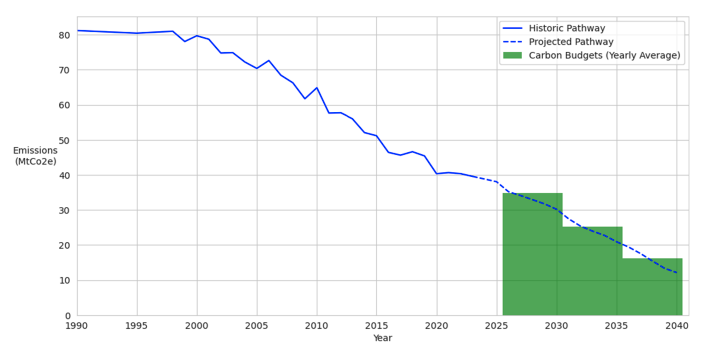
In 2025, the Scottish Government introduced a new set of five-yearly carbon budget targets as our pathway to net zero in 2045. Carbon budgets provide a more reliable and consistent framework to measure progress to net zero and are used by other countries including Japan, France, the UK, Northern Ireland and Wales. This means reporting on progress is less prone to fluctuations than the Scottish Government’s previous approach of interim and annual targets, which could be affected by annual variations outwith our control such as extreme weather or a global pandemic.
The carbon budgets set targets for an average level of emissions reduction for Scotland over each five-year period:
- 57% lower than baseline levels for 2026-2030,
- 69% lower than baseline levels for 2031-2035,
- 80% lower than baseline levels for 2036-2040, and
- 94% lower than baseline levels for 2041-2045
Each carbon budget level refers to an average reduction in emissions over a five-year period from the 1990 baseline[3] and run in parallel with Scotland’s target of net zero emissions by 2045.
Our approach to delivering these emissions reductions is broken down by the sector of the economy within which the action will be taken forward. The sectors referenced by this plan are specified by legislation:[4]
- energy supply,
- transport (including international aviation and shipping),
- business and industrial process,
- residential and public (in relation to buildings in those sectors),
- waste management,
- land use, land use change and forestry (LULUCF), and
- agriculture.
This document sets out the key actions each sector will be taking forward to deliver our carbon budgets to 2040. The sectoral annexes provide further detail on the range of policies and proposals each area will be taking forward, how these integrate with the Scottish Government’s wider vision for the sector and actions we will take forward to secure a just transition in each sector.
There are significant uncertainties with planning actions to deliver carbon budgets over a 15-year time span – technological change, action from UK government in reserved areas given the constraints of devolution, wider European and global developments and other factors will impact the policies and proposals set out in this document and result in other options becoming available.
Recognising these uncertainties, the actions set out in this CCP set out a credible and deliverable pathway to meeting carbon budgets based on the information which is currently available. Over time, the output of any contextual changes will be consistently monitored to ensure that plans for delivery remain aligned with emerging evidence and changes to technology, markets and UK Government action. It will also be important to understand any unintended consequences for people and businesses, such as costs that may risk exacerbating inequalities, disadvantaging rural or island communities, or disproportionately impacting small businesses. In order to verify that climate mitigation measures are as effective as possible, delivery of actions within the plan will be reviewed regularly, and amended as appropriate, while ensuring they remain sufficient to meet carbon budgets.
Updates since the Draft Climate Change Plan
Since publication of the draft CCP, the Scottish Government has sought a range of views from communities and stakeholders across Scotland on the detail of the plan to ensure it is deliverable.
We have held a large-scale public consultation, which received over 500 responses across Local Authorities, businesses, the third sector, Community Climate Groups and members of the public. To make the public consultation as active and inclusive as possible, we supported five third sector organisations who are ‘trusted messengers’ within their communities to deliver 112 engagement events. This public engagement programme reached over 1,800 people to gather their views on the actions within the draft CCP and increase understanding of key climate issues.
These events were also designed to target groups who are likely to be most impacted by the transition and hear from those who are often under-represented in discussions about climate change and climate mitigation, including trade unions, disability-rights groups and children and young people, among others.
Further to this the Scottish Government directly engaged with over 100 stakeholders to gain feedback on the plan, including groups such as Community Climate Action Hubs and Local Authority representatives to discuss local and regional perspectives on the draft plan. The plan has also benefited from expert input, including through the Climate Change Plan Advisory Group, covering individuals and groups with technical and scientific knowledge of climate change, representatives from business and finance, as well as those with knowledge of international law and policy related to climate change. The draft Climate Change Plan was also reviewed by the Scottish Science Advisory Council which includes membership from a wide range of scientific disciplines within Scotland’s science base.
The Net Zero, Environment and Transport Committee led Parliamentary scrutiny of the draft plan, supported by evidence sessions across nine further committees. Ministers also requested the CCC’s views on the draft plan as our independent statutory advisers, which were published as part of their Progress Report for Scotland in February 2026. Taken together, the actions set out in the draft plan have been the subject of significant scrutiny from a range of viewpoints ahead of finalisation, and these contributions have strengthened the CCP.
Importantly, this CCP provides further detail on the approach to delivery of the policies and proposals that sit within it, and clarifies how these will be monitored and assessed. Implementation will be underpinned by a bolstered monitoring and evaluation approach to track delivery, set out at Annex 3.
The strengthened annex sets out a range of new indicators aligned to the policy package to make sure delivery of carbon budgets remain on track. Outputs will be reviewed regularly and published annually as part of the CCP monitoring report. The approach has been designed to provide early warning on progress to allow for agile corrective action, ensuring we meet our carbon budgets. In addition to the annual Progress Report received from the CCC, this will allow scrutiny of whether our pathway to meeting our carbon budgets is being achieved, and whether Scotland’s net zero transition is fair and just.
Where appropriate, sector policy packages have been updated to incorporate feedback on how they can be improved or implemented more effectively, which have fed through to whole plan assessments of costs, benefits and emissions. The feedback we have received indicates that this level of detail – more than is required in any other climate plan in the UK – has given readers a clearer view of the trade-offs inherent in policy design and strengthened transparency in our decision making. Work for the final plan has strengthened our understanding of the finances and benefits associated with the policy package – including more detail on the wider health and wellbeing impacts of our approach.
Information on the benefits of decarbonising has also been strengthened through the work of the Edinburgh Climate Change Institute, who have used their Co-Benefits Atlas model to quantify the wider benefits associated with delivery of this plan. Further contextual updates have been made across the plan where there have been updates to the available information – for example, following the publication of the UK Government Budget and Warm Homes Plan over the winter.
A new Consultation and Scrutiny Annex (Annex 4), provides further detail on the range of updates made to the plan following this feedback.
Contact
Email: ClimateChangePlan@Gov.Scot