
Investigation into the long-finned pilot whale (Globicephala melas) mass stranding event, Tolsta, na h-Eileanan Siar, July 2023
This report details the comprehensive analysis into the mass stranding event (MSE) of long-finned pilot whales that occurred in Tolsta Bay, Isle of Lewis, Scotland, on 16 July 2023.
Section 6: Pilot Whale MSE Summary and Trends
Rachel Lennon; SMASS and University of Glasgow.
Understanding trends and patterns in previous strandings is essential for contextualising the significance of mass stranding events such as this. Data collected by SMASS over the three decades of the scheme's operation was analysed. Incidence data for reports to SMASS were examined to assess temporal and spatial trends and patterns, providing a framework for evaluating whether this stranding event was anomalous in scale, timing, or location.
6.1 Summary Statistics
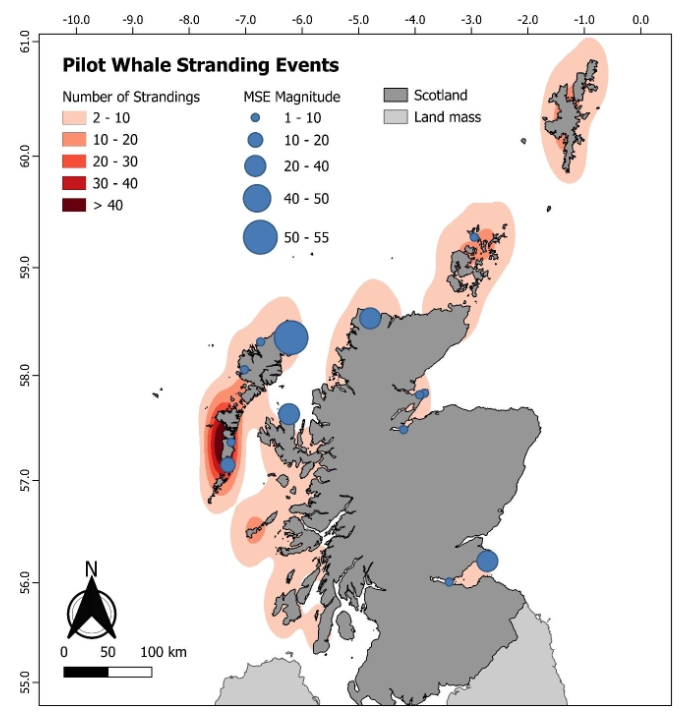
Between 1992 and 2023, a total of 480 long-finned pilot whales were reported stranded. Of those, 180 were part of mass stranding events (MSEs), of which there have been a total of 13. A map showing both density of long-finned pilot whales single strandings and MSE’s is given in Figure 9.
6.2 Temporal Trends
To test for annual trends, generalised linear models (GLMs) were fitted to counts of stranding events as a function of year with an interaction of event type. The model was fit with a Poisson error distribution and log-link function.
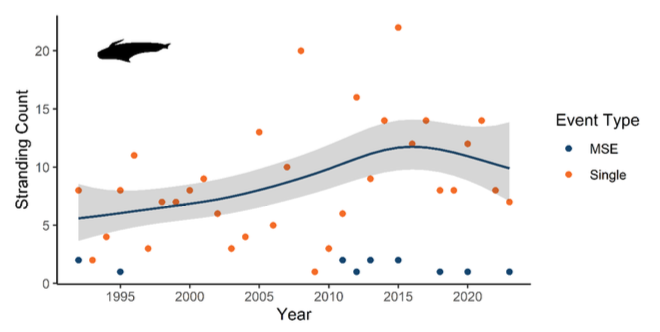
Both single stranding events (z = 3.70, p < 0.001) and MSEs (z = 10.53, p < 0.001) have increased over time (Figure 6). The magnitude of MSEs has also increased, with more individuals being involved in events in more recent years (z = 6.89, p < 0.001). The Tolsta beach mass stranding was the largest UK based stranding event on record, in terms of individuals involved, until the Sanday MSE in July 2024 (n = 77 animals).
To test for seasonal trends, GAMs were fitted to counts of strandings with covariate smooths of month with a cyclic cubic spline and year with a thin plate regression spline. Event type was fitted as an interaction term for both smooths. Models had a Poisson error distribution and log-link function.
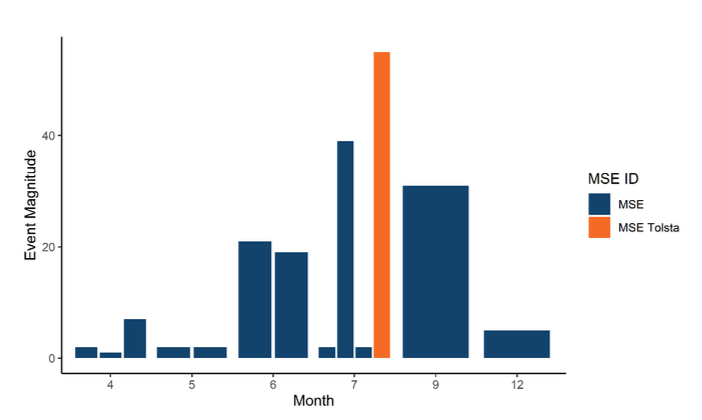
For single stranding events, long-finned pilot whales display no seasonality with strandings occurring all year round (edf = 0, p > 0.05). This contrasts to MSEs, which display a clear peak in the summer months around June and July, though there are events recorded in every season (edf = 2.04, p < 0.05). The largest magnitude events also occur in the summer months (z = 4.16, p < 0.001). July has the highest magnitude of MSEs including the Tolsta MSE. The 2024 Sanday MSE also occurred in July.
It is important to note here that reporting effort has increased over time with wider mobile phone use and growing citizen science and public engagement, improving detection of single strandings. Although robust effort metrics are not yet available for Scottish strandings, mass strandings are so conspicuous that they were likely reported even historically, making them less sensitive to changes in effort. Thus, rising MSE frequency likely reflects a real trend.
6.3 Body Condition Trends
Body condition assessment provides a useful metric for evaluating the health status of stranded cetaceans, as chronic disease, injury, or insufficient feeding all negatively impact energy reserves and tissue deposition. Animals in good body condition are therefore assumed to have been in generally better health prior to stranding, making body condition indices valuable for identifying animals potentially compromised by underlying health issues. For this mass stranding event, assessing body condition across the group helps determine whether these animals were healthy individuals subject to a relatively acute process, or whether poor health may have contributed to the stranding.
Body condition index (BCI) scores were used as a proxy for health by indicating available energetic reserves. A BCI for long-finned pilot whales was generated from the residuals of a generalized additive model (GAM) fitted to girth as a function of body length. The GAM accounted for non-linear relationships between body size and length, whilst residuals quantified relative BCI. A linear model was then fitted to BCI with event type as a covariate to test for differences between stranding events.
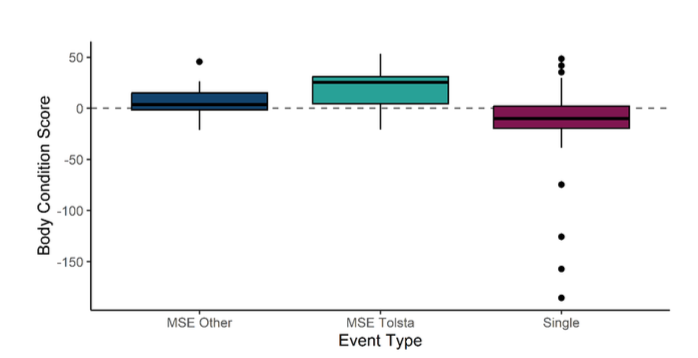
The modelling found that mass stranding events had a better BCI than single stranding events (t = 2.84, p < 0.01), whilst individuals from the Tolsta MSE had higher body scores than other mass stranding events (t= 2.05, p < 0.05) (Figure 8). This supports the hypothesis that mass stranding events predominantly comprise healthy animals, which, aside from the acute impacts of the stranding event, are physiologically normal.
6.4 Spatial Trends
To conduct spatial analysis of recent mass stranding events, the latitude and longitudes of each event was used to generate point data. A heatmap was created using a kernel density estimation in QGIS across a 50km search radius.
Long-finned pilot whale strandings occur across Scotland but exhibit a clear hotspot on the west coast, particularly in the Outer Hebrides, where both the frequency and magnitude of mass stranding events are highest (Figure 9). This spatial pattern is consistent with the known offshore distribution of long-finned pilot whales in the northeast Atlantic, with animals occurring in oceanic waters west of Scotland. The concentration of strandings around the Western Isles likely reflects both the proximity of suitable pilot whale habitat and the complex bathymetry and hydrography of this coastline, which may increase stranding risk for highly social, deep-diving species navigating these waters.
Contact
Email: marine_species@gov.scot