
Investigation into the long-finned pilot whale (Globicephala melas) mass stranding event, Tolsta, na h-Eileanan Siar, July 2023
This report details the comprehensive analysis into the mass stranding event (MSE) of long-finned pilot whales that occurred in Tolsta Bay, Isle of Lewis, Scotland, on 16 July 2023.
Section 12: Impacts of Underwater Noise and Hearing
As light attenuates rapidly underwater, cetaceans inhabit an environment where sound is the primary sensory modality. Hearing is thus essential to the survival and ecological fitness of these deep-diving species, which depend upon acoustic cues for vital biological functions including prey detection, orientation, predator evasion, and communication. Consequently, any degree of hearing loss or impairment can have consequences, disrupting essential behaviours and potentially compromising individual fitness and population viability.
12.1 Cochlear (ear) analysis
Maria Morell; University of Hannover
Hearing impairment can be caused by several factors, such as noise exposure, age, ototoxic drugs exposure, pollutants, infections, and congenital disorders (Southall et al., 2019; Morell et al., 2020; Rohner et al., 2022; Siebert et al., 2022). Similar to documented hearing loss in humans and terrestrial mammals, repeated exposure to loud noises of specific intensity and frequency can cause temporary or permanent hearing loss in cetaceans. Permanent hearing loss is associated with structural alterations within the organ of Corti (Figure 19), including damage to hair cell stereocilia and degeneration/loss of sensory cells. Unlike some organisms, mammalian hair cells lack regenerative capacity, with neighbouring cells actively participating in scar formation upon cell death. Additionally, loud noise exposure can induce morphological changes on the tectorial membrane, altering the imprints left by healthy hair cells. These imprints can remain even after hair cell disappearance and can be assessed through electron microscopy. High-intensity sources like active sonar and underwater noise from shipping, gas exploration, or seismic surveys could potentially cause such severe lesions that they become directly or indirectly lethal, e.g. gas embolism (Epson et al., 2005), hearing compromise (Southall et al., 2007) or displacement.
Examining the cochlea for scarring patterns and stereocilia imprints can be a valuable tool for identifying past acoustic trauma in whales, despite potential artefacts arising from tissue decomposition. Furthermore, the location of damage within the cochlea can provide clues about the frequency range of the sound that caused the injury. However, obtaining reliable data requires rapid cochlea fixation (ideally within 15 hours postmortem) to minimise postmortem changes that can obscure these vital indicators of noise exposure.
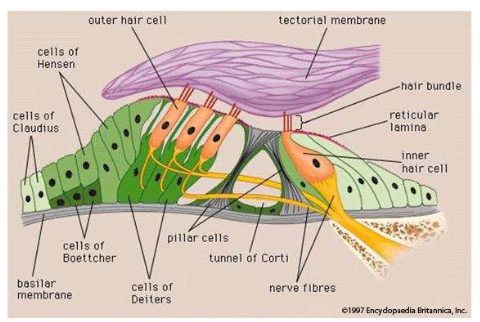
Due to the time required to recover the stranded animals, only the freshest carcasses (≤40 hours post-mortem) had their ears preserved for examination. While autolysis may hinder definitive diagnostics, ultrastructural assessment can still provide valuable insights into potential noise-related pathology and inner ear condition. However, the delay in preservation may limit the ability of analyses to determine whether noise exposure contributed to this stranding event (Morell et al., 2017).
Results: Necropsy examination did not reveal evidence of direct blast trauma. Several animals did appear to have haemorrhage in one or both ears, however, this may have been caused by agonal congestion which can occur during stranding. The analysis of cochlea by scanning electron microscopy takes several months due to lengthy decalcification processes. Initial results did not detect overt pathology consistent with acoustic trauma although substantial autolysis precluded assessment of fine structural detail. More specialist diagnostics are currently underway and if applicable will be published in due course.
12.2 Underwater Noise Assessment
Underwater sounds have been shown to injure or disturb cetaceans, and around the world, cases have been documented of cetacean mass strandings that have been linked to underwater noise, across many species.
The Scottish Government’s Marine Directorate-Science, Evidence, Data and Digital (MD-SEDD) Portfolio has reviewed several acoustic information sources available around the time of the pilot whale mass stranding at Tolsta on the east of the Isle of Lewis in July 2023. This includes analysis of passive acoustic data collected through existing co-deployed broadband and click detector recorders at two different locations, one at a site approximately 12.5 km offshore of the beach where the stranding occurred (Tolsta site), and another one at a site on the west of the Lewis (Garenin site). Data from the week prior to, and the day of the stranding were analysed. Both broadband acoustic data and cetacean click detections were available around the time of the stranding event and the report seeks to provide an account of (1) the presence of cetaceans around the time of the stranding, and (2) the presence of any identified sounds from presumed anthropogenic sources, acknowledging the limitations of inferring any conclusions from single underwater recorders. It also summarises activities that were taking place in the region at the time, that may have generated underwater noise.
At the Tolsta site, cetaceans were detected regularly throughout the analysis period on both the broadband and click detector recorders. However, these detections could not be attributed to specific cetacean species, except to delphinids or porpoises. A total of 1,330 unique cetacean detection events were identified throughout the analysis period in the broadband data. Shipping noise was commonly encountered at the Tolsta site, and impulsive sounds were found in the recordings at around 01:00 UTC and 05:00 UTC (02:00 and 06:00 British Summer Time) on 16 July. Impulsive sounds were not found at other times. Given the frequencies and pulse patterns of these sounds, and that they decreased in amplitude over the duration of the recording, the sounds appear to be consistent with echosounders which are commonly found on vessels throughout Scottish waters, which would decrease in amplitude if the vessel was moving away from the acoustic recorder. However, the source of the detected sounds cannot be verified given the lack of vessel presence at the time in the Automatic Identification System (AIS) and Vessel Monitoring System (VMS) evidence. The area of the sea in which the sounds detected by the recorders were audible is also unknown. From the data gathered, combined with the uncertainty around the time of the stranding, it is not possible to determine whether the pilot whales were in the area to hear these sounds, or what effect they may have had on their behaviour if they were. However, echosounders are widely used by vessels, and would not be unusual sounds in the marine environment.
The recordings from the Garenin site on the west of Lewis included high levels of shipping noise and cetacean detections, but at much lower levels than those seen at the Tolsta site. Other biological sounds were also recorded, including sounds that are considered likely to have been from fish such as haddock.
In reviewing activities that could have produced underwater noise, MD-SEDD approached the Ministry of Defence (MOD), which reported activity in the area. However, the information provided by the MOD does not suggest any obvious activity that may have been a factor in the strandings, such as the use of active sonar or explosives, which have previously been linked with cetacean strandings around the world. Activities taking place under licence included a geophysical survey at a wind farm lease area on the west of Lewis. Much of that activity was carried out at very high frequencies, well outside of pilot whale hearing ranges. Sounds from the geophysical survey were not detected in the acoustic data collected by MD-SEDD at the Garenin site.
The results of this work are presented in the publication: “Report on Passive Acoustic Underwater Monitoring Data and Potential Sources of Noise in Relation to a Mass Stranding of Long-Finned Pilot Whales (Globicephala melas) on Isle of Lewis, July 2023.
Contact
Email: marine_species@gov.scot