
Investigation into the long-finned pilot whale (Globicephala melas) mass stranding event, Tolsta, na h-Eileanan Siar, July 2023
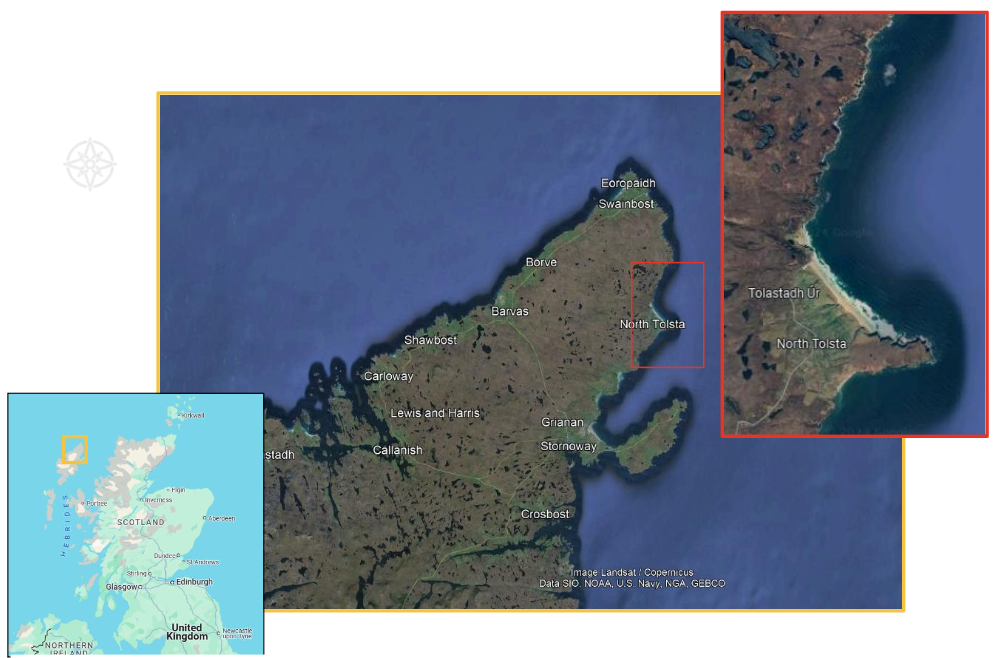
This report details the comprehensive analysis into the mass stranding event (MSE) of long-finned pilot whales that occurred in Tolsta Bay, Isle of Lewis, Scotland, on 16 July 2023.
Section 2: Investigation outline
With 54 deceased animals, this MSE was the third largest recorded mass stranding event in the UK behind a subsequent long finned pilot whale MSE in Sanday, Orkney in July 2024 involving 77 animals and a false killer whale stranding event involving 130+ animals almost a century earlier in 1927 in the Dornoch Firth[1].
The reasons as to why cetaceans mass strand are complex, multifactorial and species- and location-specific. Any investigation into possible causal factors that, in isolation or in combination, led to the stranding therefore needs to cover several key components. In this situation, the investigation aimed to address the following questions: why was this typically pelagic species found close to shore, what factors might have led them to strand, and what can be inferred about their ecology and life prior to the stranding? This investigation sought to assess the disease status of the stranded animals and attempt to identify any processes that may have contributed to this specific stranding. The necropsies undertaken have helped identify potential underlying health issues and external injuries, and information derived from gross necropsy has been supported by diagnostic testing to identify or exclude known pathogens and disease processes known to impact these species.
The analysis encompassed a comprehensive suite of techniques; diagnostic necropsies supported by histopathological, toxicological, and microbiological analysis; environmental data analysis (sea currents, weather, geomorphology); dietary analysis (stomach contents, fatty acid and stable isotope studies) and genetic analysis.
Comprehensive sampling of all stranded individuals, including maternal and foetal tissues, enabled population level analyses of health parameters, contaminant loads, dietary ecology, and metabolic profiles that would be otherwise impossible to obtain from free-ranging animals. These data represent a baseline for understanding both the proximate causes of this mass stranding event and the broader physiological status of a species that remains largely inaccessible to sampling due to its offshore distribution.
Long-finned pilot whales rely on complex vocalisations, utilising clicks and whistles for communication, echolocation, and social cohesion. The potential for anthropogenic noise to disrupt, disorient, or injure cetaceans is well-documented (Harding and Cousins 2022; Weilgart 2007; Richardson et al., (1998) 2013; B. L. Southall et al., 2007). A separate report on analysis into continuous and impulsive noise sources in the area has been published.
Contact
Email: marine_species@gov.scot