
Investigation into the long-finned pilot whale (Globicephala melas) mass stranding event, Tolsta, na h-Eileanan Siar, July 2023
This report details the comprehensive analysis into the mass stranding event (MSE) of long-finned pilot whales that occurred in Tolsta Bay, Isle of Lewis, Scotland, on 16 July 2023.
Section 3: Overview of stranding event
On 16 July 2023, a mass stranding of long-finned pilot whales occurred at Tolsta beach on the Isle of Lewis (Fig 1 & 2). The incident was first reported to BDMLR as "a pod of several dolphins," but when the first medic arrived, they discovered a group of pilot whales with only 15 still alive among a larger number of dead animals. The stranding presented numerous challenges including poor weather conditions with heavy surf, a receding tide, difficult vehicle access, limited mobile coverage, and soft sand that made logistics difficult.
Cetacean mass stranding events (MSEs) represent extreme, time-critical situations where public safety, animal welfare, and scientific research priorities must be clearly defined and managed under a constant pressure of emergency.
Rescue teams arrived around 08:40 to find animals scattered along the shoreline. BDMLR medics supported by Stornoway Coastguard, Fire and Rescue Services, Police, SMASS staff and local volunteers began the task of triaging live animals and implementing emergency care protocols. This involved, where possible, putting animals in mid sternal recumbency (upright), and utilising wet, pale coloured towels and sheets to cover the skin to prevent dehydration and overheating. This was possible for all but one animal (M371.44/23) which was too large and heavy to move.
Refloating attempts were considered for two male pilot whales (M371.55/23 and M371.54/23) based on size and the assumption that juvenile males have a higher likelihood of rejoining other groups at sea. One animal (M371.55/23) was successfully refloated, swimming strongly seaward and surfacing multiple times at increasing distances from shore. However, the second animal (M371.54/23) immediately re-stranded despite rescue efforts. Attempts to refloat additional animals were abandoned due to their size and the limited personnel available under increasingly dangerous sea conditions.
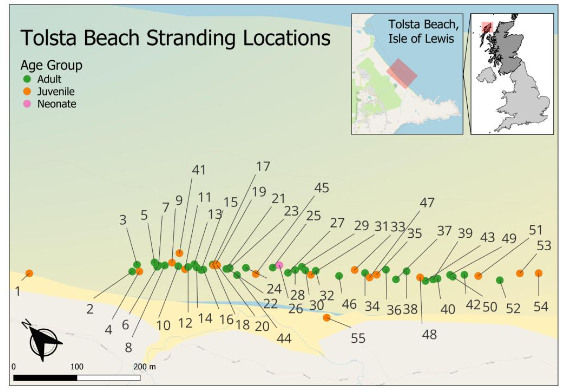
By 11:00 the coastguard terminated all refloat attempts due to worsening weather and unsafe water conditions for rescue personnel. The decision to euthanise the remaining live animals was reached through multi-agency consultation at 13:00, involving the local veterinarian, SMASS team, coastguard, BDMLR volunteers, and fire brigade. This decision was based on the impossibility of further rescue attempts given the deteriorating environmental conditions, the animals' compromised condition after prolonged stranding, and human safety. The veterinarian arrived at 14:15 to carry out the euthanasia procedures, with protocols established for volunteer safety and immediate postmortem sampling. The 12 whales that were still alive were euthanised by a local veterinarian using a modified .308 calibre rifle.
All euthanised animals were measured and sampled for skin, blubber, and muscle the same day of stranding, and arrangements made with Western Isles Environmental Health teams to have all carcasses recovered the following day to the Stornoway landfill site for examination and disposal. Data and tissue samples were collected from all animals and between 17 and 21 July, the SMASS team and collaborators examined all cases and undertook a complete diagnostic necropsy on a subset of 23 cases.
Contact
Email: marine_species@gov.scot