
Investigation into the long-finned pilot whale (Globicephala melas) mass stranding event, Tolsta, na h-Eileanan Siar, July 2023
This report details the comprehensive analysis into the mass stranding event (MSE) of long-finned pilot whales that occurred in Tolsta Bay, Isle of Lewis, Scotland, on 16 July 2023.
Section 5: Sightings data for long-finned pilot whales in the Northern Minch
Alice Walters, Whale and Dolphin Conservation.
Dr Lauren Hartny-Mills, Hebridean Whale and Dolphin Trust.
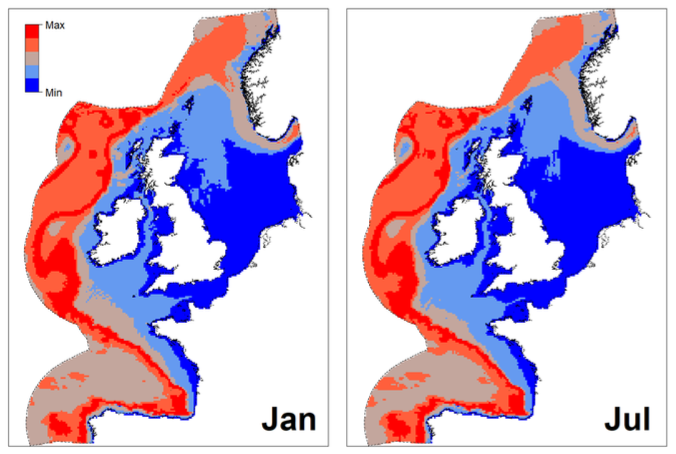
Long-finned pilot whales are primarily offshore cetaceans, and their sightings in nearshore waters outside of stranding events are uncommon but not necessarily abnormal or indicative the animals are out-of-habitat (Waggitt et al., 2020) (Figure 4). To investigate the observed incidence of this species in the Northern Minch, their regular habitat use patterns in the area was assessed. Disorientation or navigational errors are potential causes, but it is important to understand their usual behaviour, particularly the use of nearshore waters.
5.1 Hebridean Whale and Dolphin Trust Surveys
Since 2002, HWDT has conducted more than 100,000 km of dedicated acoustic and visual surveys for marine mammals off the west coast of Scotland from their research vessel, Silurian. Despite this extensive survey effort, there has only been one confirmed sighting of long-finned pilot whales. This sighting was of a group of 25 individuals recorded on 1 October 2018, to the northwest of the Summer Isles in The Minch.
Analysis of data from Whale Track recorded between 2017 and 2023, showed there had been no sightings of long-finned pilot whales recorded during 3,400 at-sea excursions and 265 land-based watches. During this time, 23,962 casual sightings were recorded and only 22 sightings were identified as long-finned pilot whales.
5.2 WDC Shorewatch
Between 2010 and 2023, WDC recorded over 14,000 Shorewatch efforts from specific land-based survey locations along the west coast and Western Isles, equating to approximately 2,349 hours of dedicated observation across 2,677 days surveyed during this period. These consistent, long-term shore-based surveys resulted in very few sightings of long-finned pilot whales across the survey period. Sightings occurred only on a single day in each of 2011, 2013, 2015, and 2019 – demonstrating the rarity of encounters despite sustained monitoring efforts.
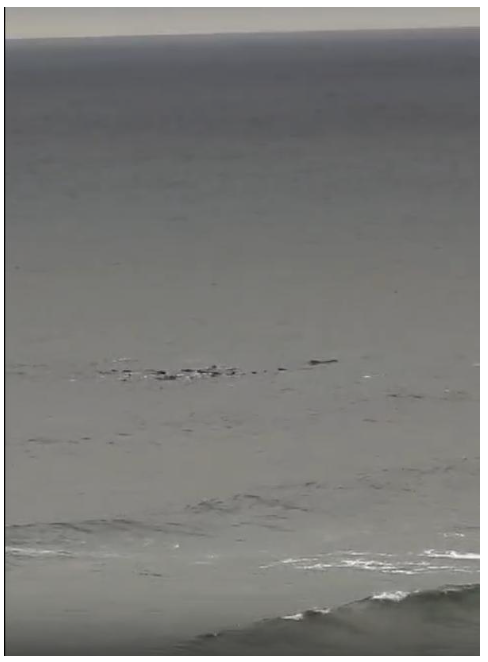
A sighting of approximately 30 long-finned pilot whales was observed at 19:06 on 15 July 2023, the day prior to the stranding. The whales sighted off Tolsta may represent the same group that subsequently stranded. The animals were observed milling in close formation and were reported to BDMLR by a local surfer (Figure 5). No additional reports were received from that area either before or after this observation.
The data presented above from HWDT and WDC demonstrates that the west coast is not often frequented by long-finned pilot whales. These findings support previous abundance and distribution studies which highlight the rarity of long-finned pilot whales in inshore Scottish waters, particularly in the Northern Minch where the mass stranding event occurred.
Contact
Email: marine_species@gov.scot