
Investigation into the long-finned pilot whale (Globicephala melas) mass stranding event, Tolsta, na h-Eileanan Siar, July 2023
This report details the comprehensive analysis into the mass stranding event (MSE) of long-finned pilot whales that occurred in Tolsta Bay, Isle of Lewis, Scotland, on 16 July 2023.
Section 10: Metabolic Stress and Proteomic Analysis
Dr Davina Derous1, Alexandra Tranganida1, Dr Joanna Kershaw2.
1School of Biological Sciences, University of Aberdeen.
2Sea Mammal Research Unit, Scottish Oceans Institute, University of St Andrews, St Andrews, Fife KY16 8LB, UK.
Cetaceans can become stressed by a range of factors which may impact individual and population resilience and predispose them to illness or stranding. Assessment of stress indicators is challenging but initial work into cetacean proteomics has been recently piloted by the University of Aberdeen. Proteomics is emerging as a powerful tool for understanding cetacean health, offering insights into antemortem metabolic processes and overall well-being and these signals can persist after death and exhibit low between sample variability in subsampling from the same tissue. Part of this investigation looked at the proteomic profiles of different blubber layers in a subset of animals from this MSE to gain a better understanding of their metabolic profile and identify health markers.
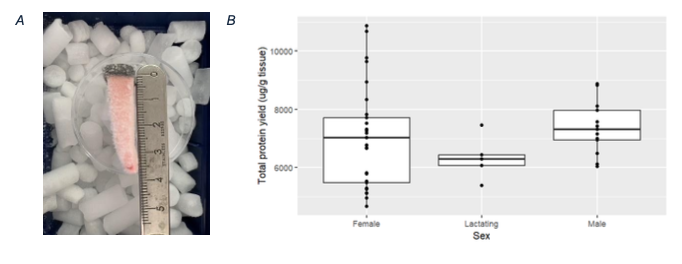
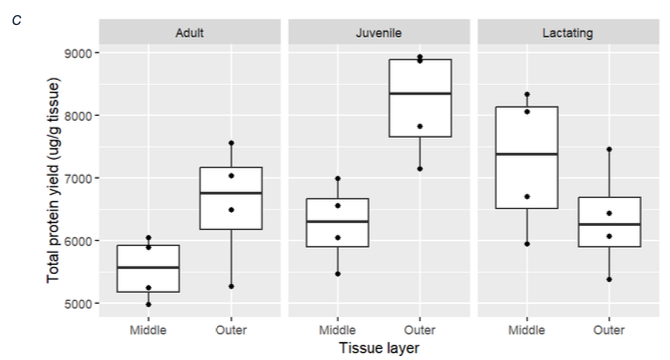
The primary objective was to identify protein-based biomarkers that could be used to assess health in free-ranging cetaceans. Blubber samples were collected from various groups (lactating females vs. non-lactating females, males, foetuses, juveniles, adults) and layers (outer, middle) to evaluate metabolic stress and blubber development. Initial analyses revealed no significant difference in total protein content between the outer blubber of females and males, while juveniles displayed a higher total protein content in the outer compared to middle blubber layer.
Results: Proteomic profiling of outer blubber in cetaceans revealed high inter-individual variability in total protein content and abundance, even within sex- and age-matched groups (Figure 18). Juvenile males displayed distinct proteomic signatures compared to adult males, reflecting blubber tissue expansion and developmental processes. In contrast, juvenile and adult females showed minimal proteomic differences attributable to growth, though adult females exhibited markers suggestive of tissue damage, potentially linked to hyperthermia at the time of sampling. Reproductive state had little influence on the blubber proteome of adult females, and euthanasia was not associated with proteomic changes. Overall, age emerged as the primary driver of proteomic variation, with signatures indicating tissue remodelling, inflammation, and coagulation processes.
This proteomic analysis offers novel insights into physiological processes in cetaceans, specifically age related and strandings related (e.g. hyperthermia) changes. At scale, this has potential to improve interpretation of blubber condition in stranded individuals, enhancing assessments of health status and identification of the physiological impact of stressors.
Contact
Email: marine_species@gov.scot