
Investigation into the long-finned pilot whale (Globicephala melas) mass stranding event, Tolsta, na h-Eileanan Siar, July 2023
This report details the comprehensive analysis into the mass stranding event (MSE) of long-finned pilot whales that occurred in Tolsta Bay, Isle of Lewis, Scotland, on 16 July 2023.
Section 9: Contaminants and Toxins
There are several natural and anthropogenic toxins and contaminants that are known, or suspected, to have impacts on cetacean health, immune status or reproduction. These include, polychlorinated biphenyls PCBs and polycyclic aromatic hydrocarbons (PAHs) and other persistent organic pollutants (POPs), toxins from harmful algal blooms (HABs), sewage, radionuclides, toxic elements and tri-butyl tin (TBT).
Previous investigations have shown that long-finned pilot whales tend to have lower levels of POPs than some odontocete species (Jepson et al., 2016; Brownlow et al., 2011; Weihe et al.,1996) likely due to their predominantly pelagic habitat and feeding at relatively low trophic levels. Samples for POPs have been archived for future screening, however based on previous analysis and the understood feeding ecology of this species, it is not expected that the levels of POPs will be particularly elevated (Weihe et al., 1996; Dam and Bloch 2000). The results for two contaminants of potential significance (harmful algal blooms and heavy metals) are summarised below. These data are part of wider ecotoxicological studies which will be published separately.
9.1 Contaminants: Biotoxin Screening
Dr. Jo Kershaw and Dr. Holly Armstrong; Sea Mammal Research Unit, University of St Andrews.
Harmful algal bloom (HAB) toxins consumed by marine predators through fish prey can pose significant health threats, impact behaviour and acute high exposure levels can be lethal. Mass mortalities and strandings among marine mammals due to biotoxin exposure resulting in HAB toxicosis have been regularly reported since the late 1990s worldwide. The two major HAB toxins found in fish around Scotland are domoic acid (DA, produced by Pseudo-nitzschiia species), and saxitoxins (STX), produced by Alexandrium species) (Kershaw et al., 2021). These can be detected in the urine and faeces of marine mammals following consumption of contaminated prey (Hall et al., 2024; Jensen et al., 2015). Concentrations of these two toxins were quantified in the urine of the pilot whales to investigate potential exposure in these animals.
Results: In the week leading up to the mass stranding (10 to 16 July 2023), Alexandrium species were present at high levels (> 20,000 cells/L) in the Outer Hebrides, while Pseudo-nitzschiia species were also present but at much lower levels (Habreports . Figure 17). Commercially available ELISAs previously validated for use with marine mammal samples were used for urine analysis (Jensen et al., 2015). Small urine volumes resulted in 15 samples assayed to determine STX concentrations, and 22 samples assayed to determine DA concentrations. All samples were below the assay limit of detection for both toxins.
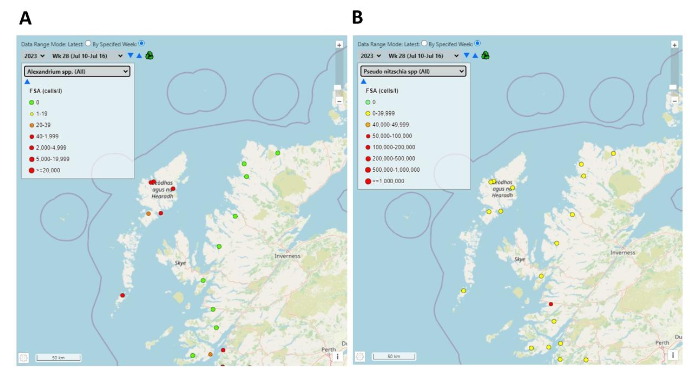
These data suggest that the pilot whales were likely not exposed to high levels of STX or DA through their diet immediately before the stranding event, even though cell counts of Alexandrium species were high, and Pseudo-nitzschia were present in the inshore waters around the Isle of Lewis over this period.
9.2 Contaminants: Heavy Metals
Ryan McCarthy, Dr Christoph Gade, Dr Rebecca von Hellfeld; University of Aberdeen.
In marine ecotoxicology, mercury (Hg) exists in various forms, of which methylmercury (MeHg) is the most toxic and bioavailable. MeHg is a neurotoxic organic mercury compound formed primarily through microbial methylation of inorganic Hg in aquatic sediments. It biomagnifies through marine food webs, leading to high concentrations in top predators, including cetaceans (Dietz et al., 2022).
In long-finned pilot whales mercury exposure is particularly well-documented due to their position as long-lived, high trophic level predators. Studies from the Faroe Islands have shown total Hg concentrations in liver tissue exceeding 100 µg/g wet weight, with MeHg comprising the majority of Hg in muscle (>90%) (Weihe et al. 1996; Hoydal, Erenbjerg, and Dam 2024). Due to their feeding ecology, long-finned pilot whales can exhibit physiologically elevated levels of heavy metals (mercury, Hg and cadmium, Cd). Interpreting metal burden is complex as these species have well-developed detoxification mechanisms to deal with naturally high exposure to these metals.
Results: Mercury concentrations varied markedly among tissues, with the highest levels detected in the liver, consistent with hepatic detoxification processes. Significant positive correlations were observed between skin, liver, and muscle concentrations. Adults exhibited higher burdens than juveniles, reflecting cumulative exposure, and females consistently exceeded males. Measured concentrations were within global ranges reported for long-finned pilot whales indicating similar contaminant loads across populations. While some individuals approached thresholds thought to induce mercury-induced liver damage, it is unlikely that the observed burdens were sufficiently elevated to contribute to the stranding event.
More details on this work are available in McCarthy et al (in prep). Future work will integrate δ¹³C, δ¹⁵N, and δ³⁴S isotope analyses from skin, muscle, and liver tissues of stranded adult Globicephala melas (See section 11.2) with mercury (Hg) concentration data to elucidate ecological drivers of contaminant variability across populations. This will involve assessing differences in isotopic niche space and trophic position among Northeast Atlantic populations to determine whether variations in feeding ecology and habitat use explain Hg burden disparities.
Contact
Email: marine_species@gov.scot