
Learning estate strategy: Connecting People, Places and Learning
The Learning Estate Strategy and its guiding principles provide a platform for investment in the learning estate across Scotland and set out our strategic approach for managing the learning estate.
Strategic Context
4.1 National Performance Framework
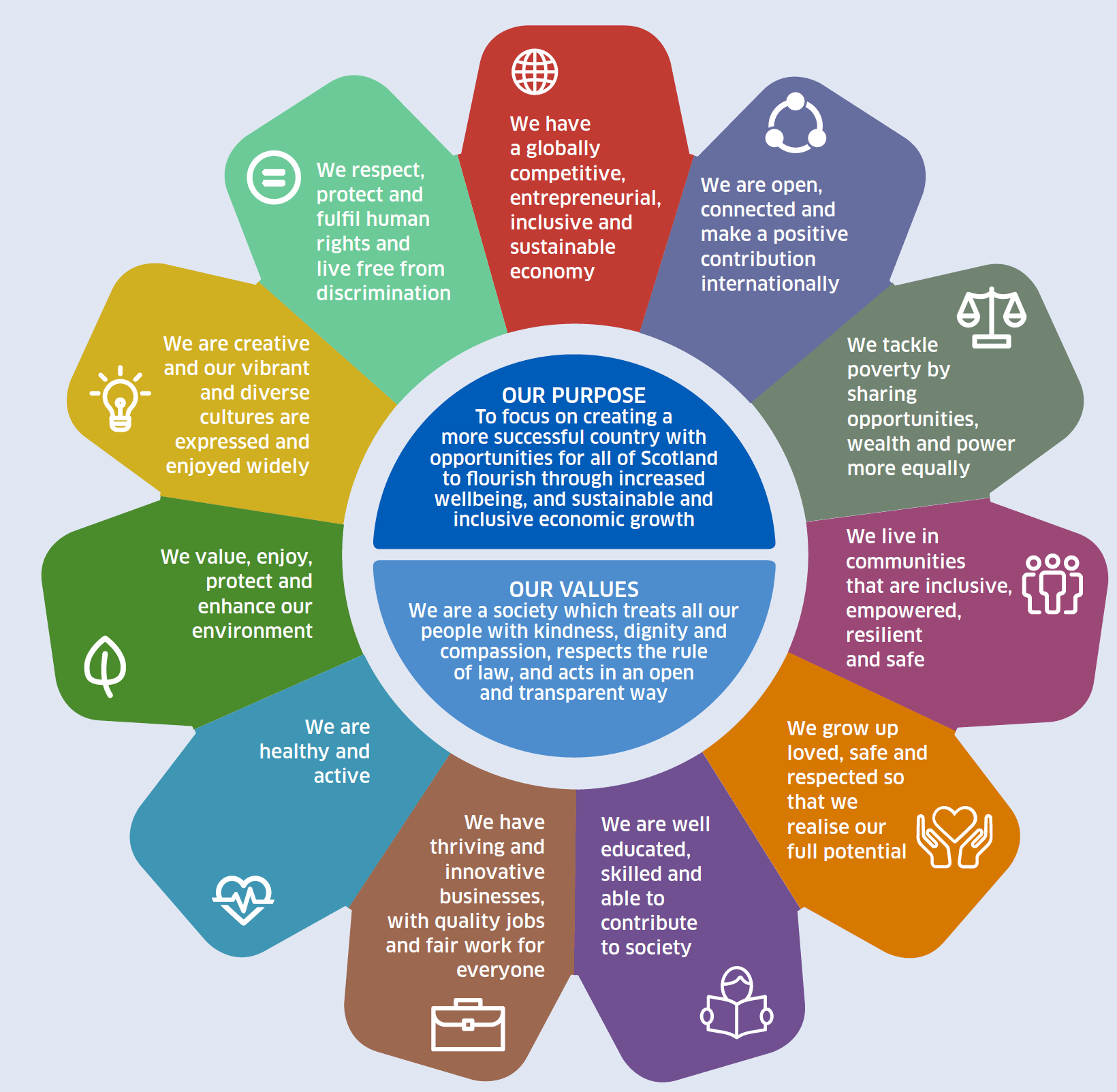
Graphic text below:
Centre Circle:
Our Purpose: To focus on creating a more successful country with opportunities for all of Scotland to flourish through increased wellbeing, and sustainable and inclusive economic growth.
Our Values: We are a society which treats all our people with kindness, dignity and compassion, respects the rule of law, and acts in an open and transparent way.
Surrounding Petals (10 statements):
1. We respect, protect and fulfil human rights and live free from discrimination.
2. We have a globally competitive, entrepreneurial, inclusive and sustainable economy.
3. We are open, connected and make a positive contribution internationally.
4. We tackle poverty by sharing opportunities, wealth and power more equally.
5. We live in communities that are inclusive, empowered, resilient and safe.
6. We grow up loved, safe and respected so that we realise our full potential.
7. We are well educated, skilled and able to contribute to society.
8. We have thriving and innovative businesses, with quality jobs and fair work for everyone.
9. We are healthy and active.
10. We value, enjoy, protect and enhance our environment.
11. We are creative and our vibrant and diverse cultures are expressed and enjoyed widely.
4.1.1 The National Performance Framework (NPF) focuses on creating a more successful country with opportunities for all of Scotland to flourish and thrive, through increased wellbeing and sustainable and inclusive economic growth.
4.1.2 Education and associated infrastructure are integral to many of the national outcomes and their indicators and development goals. The specific national outcomes which most relate to this Learning Estate Strategy are:
- We grow up loved, safe and respected so that we realise our full potential
- We are well educated, skilled and able to contribute to society
- We are healthy and active
- We live in communities that are inclusive, empowered, resilient and safe
- We have thriving and innovative businesses, with quality jobs and fair work for everyone
- We have a globally competitive, entrepreneurial, inclusive and sustainable economy
4.2 Learning Estate Efficiency
4.2.1 Long term planning for the future of the learning estate needs to be strategic and provide the best use of resources. Any decision in relation to the learning estate should first be considered through the lens of the Scottish Government’s Infrastructure Investment Plan hierarchy:
1) Determine future need
2) Maximise the useful life of existing assets
3) Repurpose or co-locate where possible
4) Replace, create or build a new asset
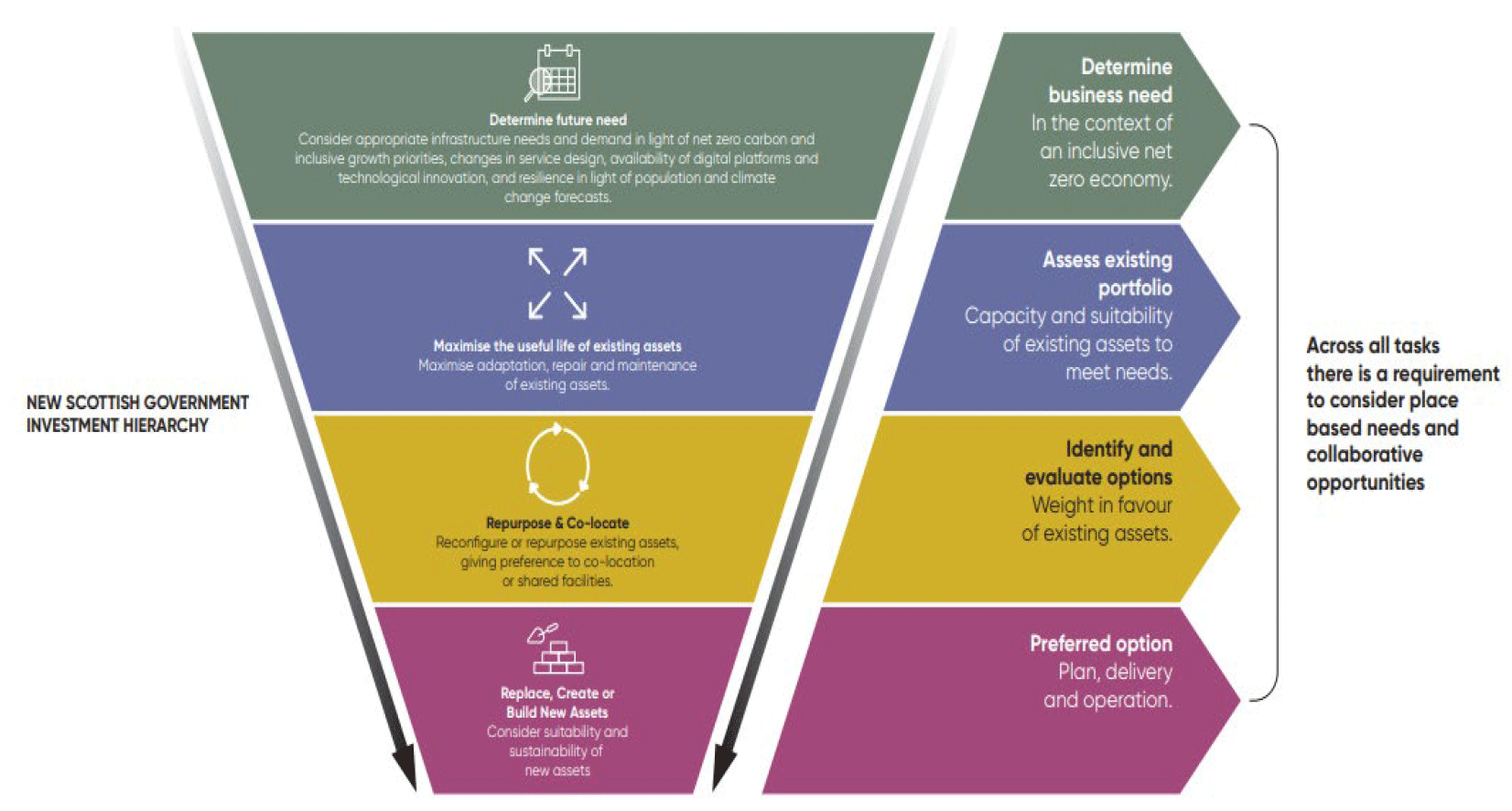
Graphic text below:
New Scottish Government Investment Hierarchy (Left Funnel):
1. Determine future need
- Consider appropriate infrastructure needs and demand in light of net zero carbon and inclusive growth priorities, changes in service design, availability of digital platforms and technological innovation, and resilience in light of population and climate change forecasts.
2. Maximise the useful life of existing assets
- Maximise adaptation, repair and maintenance of existing assets.
3. Repurpose & Co-locate
- Reconfigure or repurpose existing assets, giving preference to co-location or shared facilities.
4. Replace, Create or Build New Assets
- Consider suitability and sustainability of new assets.
Right Funnel (Decision Process):
1. Determine business need
- In the context of an inclusive net zero economy.
2. Assess existing portfolio
- Capacity and suitability of existing assets to meet needs.
3. Identify and evaluate options
- Weight in favour of existing assets.
4. Preferred option
- Plan, delivery and operation.
Note: Across all tasks there is a requirement to consider place-based needs and collaborative opportunities.
4.3 Public Service Reform
4.3.1 Scottish Government’s vision is of a Scotland where everyone has access to services that are efficient, good quality and effective. This vision and the approach to achieving it is detailed in the Public Service Reform Strategy. The Learning Estate offers the opportunity to support this improvement of outcomes to deliver public sector services that are joined-up, in the right place and achieve better outcomes for people and their communities. All public sector partners should seek to remove barriers to the more effective delivery of public services through collaborative assessment of needs, joined-up governance, coordinated funding, imaginative development and maximising utilisation of the learning estate.
4.4 Digital
4.4.1 There are a number of drivers for developing our digital ambitions to support learning and teaching, including:
- access to new and diverse skills
- agile and integrated learning experiences
- increasing digital content through free access to a range of industry leading tools and services
- developing opportunities for remote learning
- widen access for learners in rural areas
- improved links to business and enterprise
4.4.2 To support these digital ambitions, planning for the learning estate should consider both services infrastructure and spatial requirements, while also ensuring safety of learners and confidentiality of data.
4.5 Outdoor
4.5.1 Outdoor environments offer wider benefits, opportunities and experiences for all learners. Outdoor spaces and access to nature can enhance mental health, physical wellbeing and concentration. Outdoor spaces in the learning estate can also contribute to Scotland’s National Adaptation Plan 3 whilst educating learners on adaptation to the changing climate through water management, planting for carbon absorption, planting for growing food and biodiversity improvements.
4.5.2 The learning estate, therefore, needs to support this by providing enhanced and diverse outdoor areas for learning, teaching, play, physical activity and social interactions. This approach is embedded in early learning and childcare and is encouraged throughout primary and secondary education, for example by the Learning Estate Investment Programme requiring enhanced and sheltered outdoor areas. Lessons should be learned from all sector examples and applied throughout the learner journey.
4.6 Social Justice
4.6.1 The learning estate plays a vital role in advancing social justice in education by creating environments that are inclusive, equitable and responsive to the diverse needs of learners. By ensuring that facilities are accessible, safe and designed to support wellbeing and participation, the estate helps to remove structural barriers that disproportionately affect disadvantaged and marginalised groups. A socially just learning estate reflects the values of fairness and dignity, enabling every child and young person to engage meaningfully in their education and reach their full potential.
4.7 Policy Priorities
4.7.1 Our learning estate should support all relevant strategies and policy ambitions, such as:
- National Improvement Framework (NIF)
- Getting it Right for Every Child (GIRFEC)
- Curriculum for Excellence (CfE)
- Developing the Young Workforce (DYW)
- United Nations Convention of the Rights of the Child (UNCRC)
- Learner Participation in Education Settings
- Scottish Attainment Challenge
- STEM strategy
- Digital Learning and Teaching Strategy for Scotland
- College Infrastructure Strategy – Scottish Funding Council
- Parity of Esteem between Learner Pathways
- School Leaver Destinations
- Learning for Sustainability and associated “Target 2030” Learning for Sustainability Action Plan
- Outdoor Learning in CfE
- Realising the Ambition National Practice Guidance / play pedagogy in the early level of CfE
- School Libraries Strategy
- Gaelic Education Development
- Out of School Care development
- Community Learning and Development
- Learning Together
- The physical activity for health framework
- The National Walking Strategy, Cycling Action Plan for Scotland (CAPS) and the Long-Term Vision for Active Travel in Scotland
- A Connected Scotland
- The Anti-Racism in Education Programme
- Equally Safe Strategy
- The Gender Equality Taskforce in Education and Learning
- LGBT Inclusive Education
- Climate change: Scottish National Adaptation Plan 2024-2029
Contact
Email: matthew.rennie@gov.scot