
Learning estate strategy: Connecting People, Places and Learning
The Learning Estate Strategy and its guiding principles provide a platform for investment in the learning estate across Scotland and set out our strategic approach for managing the learning estate.
Introduction
2.1 The Learning Estate
2.1.1 The Learning Estate is an integral part of Scotland’s overall public sector estate, spanning everything from early learning and childcare settings, primary and secondary schools to residential education facilities, colleges and universities.
2.1.2 The learning estate, not including Universities who are autonomous institutions, accounts for around 20% of all public buildings. The estate is varied in size, design and location. It extends from small island or rural early learning and childcare settings which cater for less than ten children to complex, inner city universities accommodating thousands of students from across the world. The estate varies in age from historic, listed buildings to modern facilities. Therefore, the opportunities for different learning experiences will inevitably vary.
2.1.3 Regardless of their scale, the number of users or the function they serve, these buildings are often civic anchors at the heart of communities. While this can vary significantly depending on the needs of the place, there is a need to provide an all-encompassing vision and set of principles that can be applied across the learning estate when considering what we want it to be in the future. This vision must uphold the principles of equality of access to education, as enshrined in the Public Sector Equality Duty under the Equality Act 2010, ensuring that all learners regardless of background or circumstance can benefit from an inclusive learning environment.
Early Learning & Childcare
Number of Buildings - Circa 2,500 settings offering funded places (not all of these are public sector)
Schools
Number of Buildings - Circa 2,500 schools across primary, secondary, special and residential schools
Colleges
Number of Buildings - 24 Colleges with 270 blocks across 97 campuses,
Universities
Number of Buildings - 19 Universities, with many buildings making up each university
2.2 The Learning Estate Strategy
2.2.1 The Learning Estate Strategy, originally jointly published by Scottish Government and COSLA in 2019, reflects the shared vision of Scottish Government, local authorities, colleges and universities to inspire indoor and outdoor environments which enhance experiences for learners, staff, parents and the wider community.
2.2.2 This refreshed Strategy sets the aspirations of Scottish Government for the whole country across ELC, schools, colleges and universities. This strategy should be used to help shape all future decision making in reference to learning estates. It is anticipated that each organisation (e.g. Local Authorities, Colleges and Universities) will have their own learning estate strategies which are aligned to the vision and guiding principles of this document.
2.2.3 This should be considered alongside the published Asset Strategy guidance.
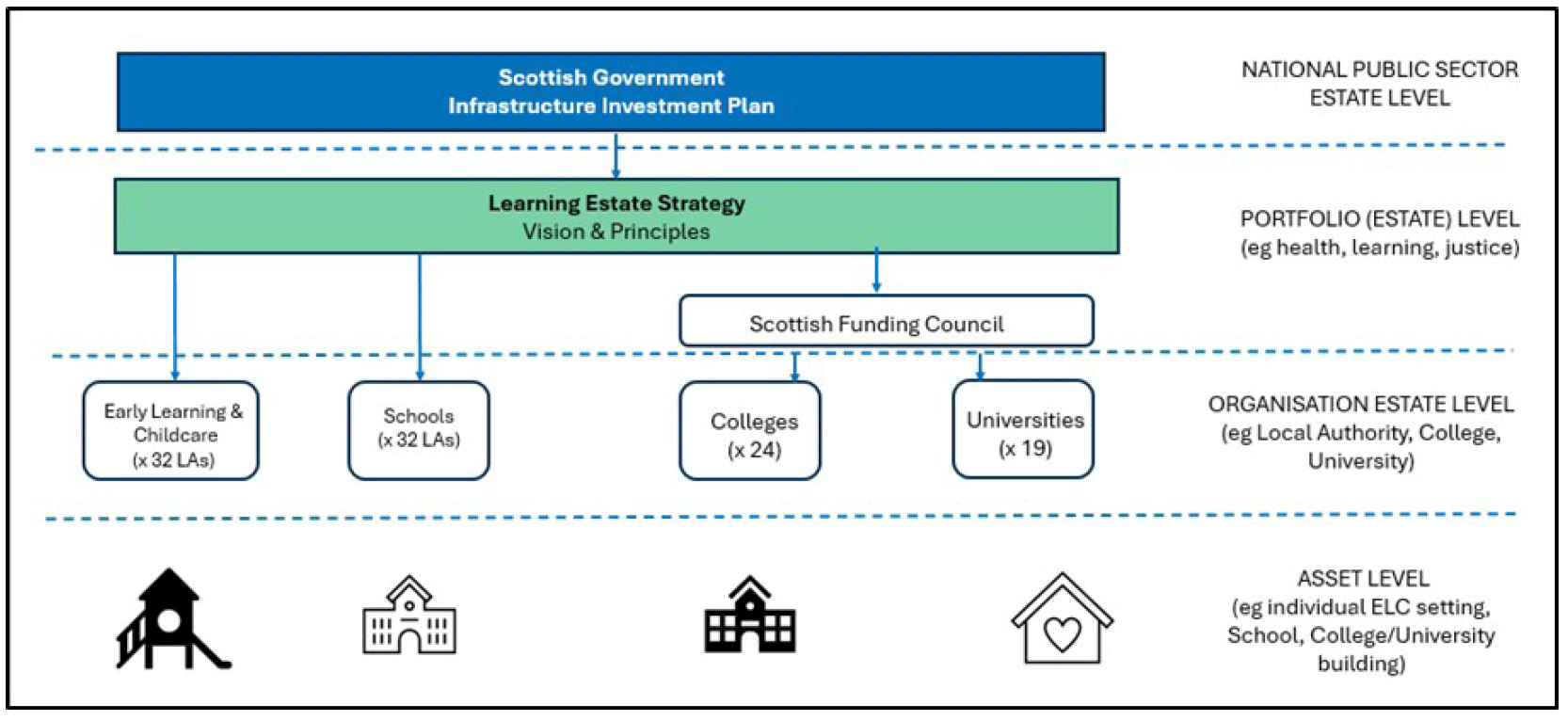
Graphic text below:
Scottish Government Infrastructure Investment Plan
Learning Estate Strategy – Vision & Principles
Scottish Funding Council
Underneath this, four categories are shown:
- Early Learning & Childcare (x 32 Local Authorities)
- Schools (x 32 Local Authorities)
- Colleges (x 24)
- Universities (x 19)
On the right side, four levels are indicated:
- National Public Sector Estate Level
- Portfolio (Estate) Level (e.g., health, learning, justice)
- Organisation Estate Level (e.g., Local Authority, College, University)
- Asset Level (e.g., individual ELC setting, School, College/University building)
Icons represent each category:
- A playhouse for Early Learning & Childcare
- A school building for Schools
- A college building for Colleges
- A house with a heart for Universities
2.3 Learning from previous Learning Estate improvements
2.3.1 The future of the learning estate should continue to be informed by previous experience. There are many excellent examples of effective delivery of high quality, sustainable learning environments that enhance the experience for all users. However, lessons could also be learned from challenges with multi-stakeholder engagement and integration of governance processes.
2.3.2 Examples to learn from include the following:
- Campus incorporating a college and two schools and community facilities to maximise opportunities for staff and learner collaboration
- Campus next to university research centre including high school, ASN school and community leisure to facilitate improved collaboration
- Agricultural college involved in development of a high school campus to determine the best fit for the skills need within the area. Campus now incorporates outdoor planting areas, polytunnels, glasshouses and workshops capable of accommodating tractors for maintenance
- High school working in partnership with neighbouring technology innovation park
- Campus incorporating – ELC, primary, secondary, Police Scotland and community leisure to improve collaboration and enhance service delivery to the community
- Secondary school with integrated NHS medical centre
- Largest Passivhaus education project in the world minimising whole life energy consumption
- First EnerPHit school refurbishment in UK
2.3.3 Projects should undertake evaluation to understand what went well and what could be improved upon, to build on previous successes. Many of these lessons are transferable across projects and sectors and should be shared as widely as possible, such as through the joint SFT/A+DS Shared Learning Events.
Contact
Email: matthew.rennie@gov.scot