
Learning estate strategy: Connecting People, Places and Learning
The Learning Estate Strategy and its guiding principles provide a platform for investment in the learning estate across Scotland and set out our strategic approach for managing the learning estate.
Drivers for Change
3.1.1 The previous Learning Estate Strategy was launched in 2019 with a vision of “Connecting People, Places and Learning” The key aims which will still be maintained are:
- To place the learner at the heart of decision making
- Encourage connections across all stages of the learner journey
- Taking a place-based approach, using the wider public sector estate
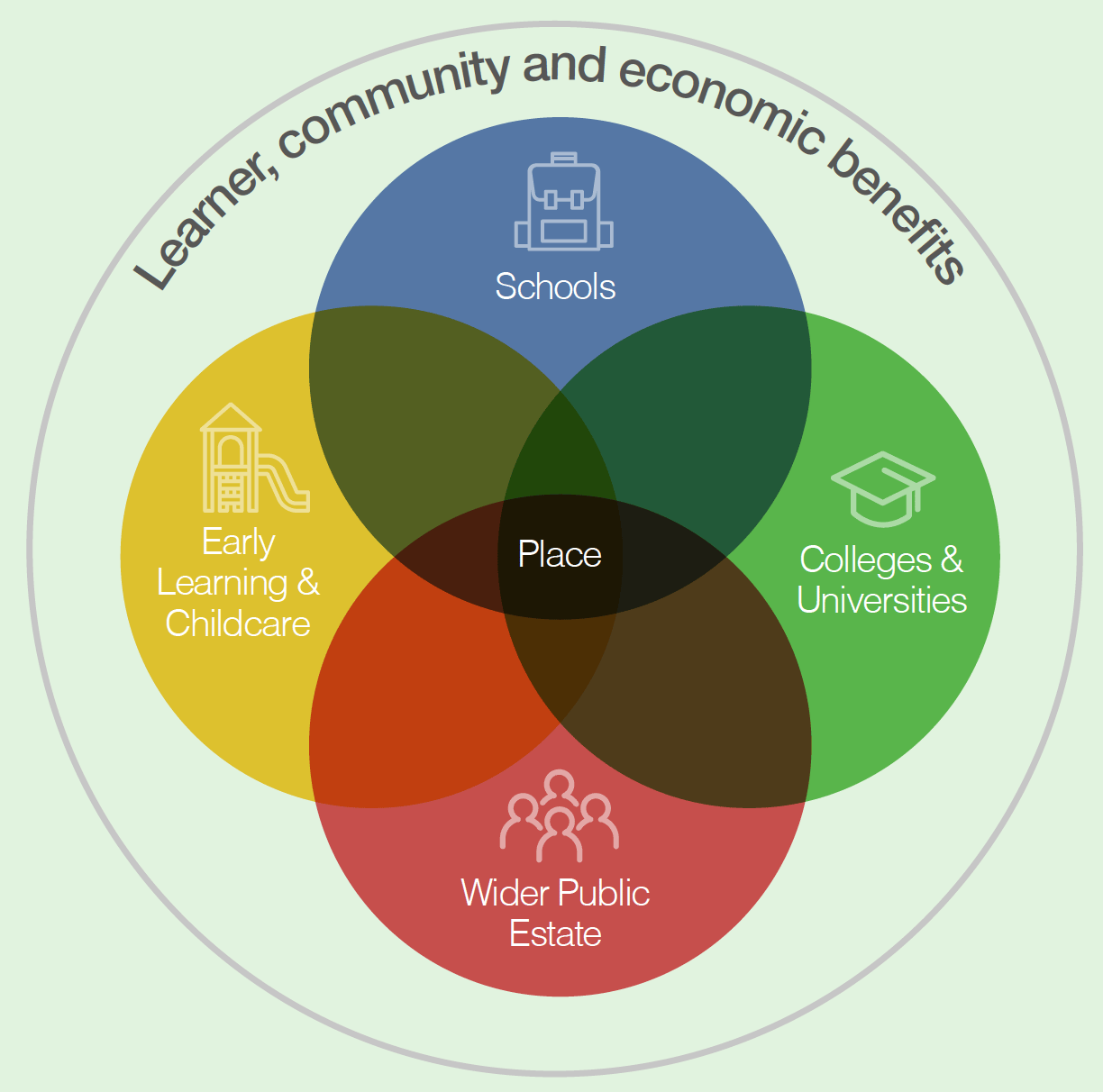
Graphic text below:
Learner, community and economic benefits
(Circular diagram with four overlapping sections and a central point labelled “Place”)
- Schools (blue section)
- Colleges & Universities (green section)
- Early Learning & Childcare (yellow section)
- Wider Public Estate (red section)
At the centre where all four overlap: Place
3.1.2 Since the launch of the Learning Estate Strategy in 2019, there has been significant change at a national and worldwide level, and it is now considered pertinent to review the strategy in light of these considerations:
- Wellbeing – COVID-19 in 2020 saw the closure of the majority of the learning estate across Scotland. There are many lessons to be learned across the current estate, e.g. digital capability, outdoor learning, welcoming spaces, healthier learning environments and user wellbeing.
- Sustainability – It is critical that public sector resources are used effectively and efficiently to ensure financial sustainability and viability for the future. There is therefore the need to think strategically about our estate and how it can best deliver efficient use of resources whilst still ensuring user experience and improved outcomes are at its core, e.g. clear assessment of needs, sharing facilities, re-using existing buildings.
- Additional Support Needs – There has been an increase in the number of school age pupils with Additional Support Needs from 30.8% in 2019 to 40.5% in 2024 and, therefore, a need to understand how best to accommodate these needs. In November 2023, the Education, Children and Young People Committee undertook an Additional Support for Learning Inquiry in which the physical environment played a key role in the responses and recommendations. This should inform how the learning estate could best support a diverse range of user needs, both in terms of capacity and user experience.
- Skills Development – In 2023-24 colleges delivered 116,602 FTE places and almost one in five of 18/19 year olds in the population attended college on a full-time basis. The demand for new and different skills and the introduction and adoption of new technologies and industries, are always changing. Planning for the learning estate needs to be cognisant of current and future trends, enabling learning and teaching that develops the skills needed for the world of work. The economy drives a need for skills planning to train the workforce, with flexibility and responsiveness to constantly adapt to the skills required most by industry. Approaches to education and learning, and technical requirements for buildings are constantly evolving and there is a need to continuously reflect this when developing the learning estate. Curriculum, pedagogy and physical environments (indoor and outdoor) are intrinsically linked and it is, therefore, important that any changes are holistically considered.
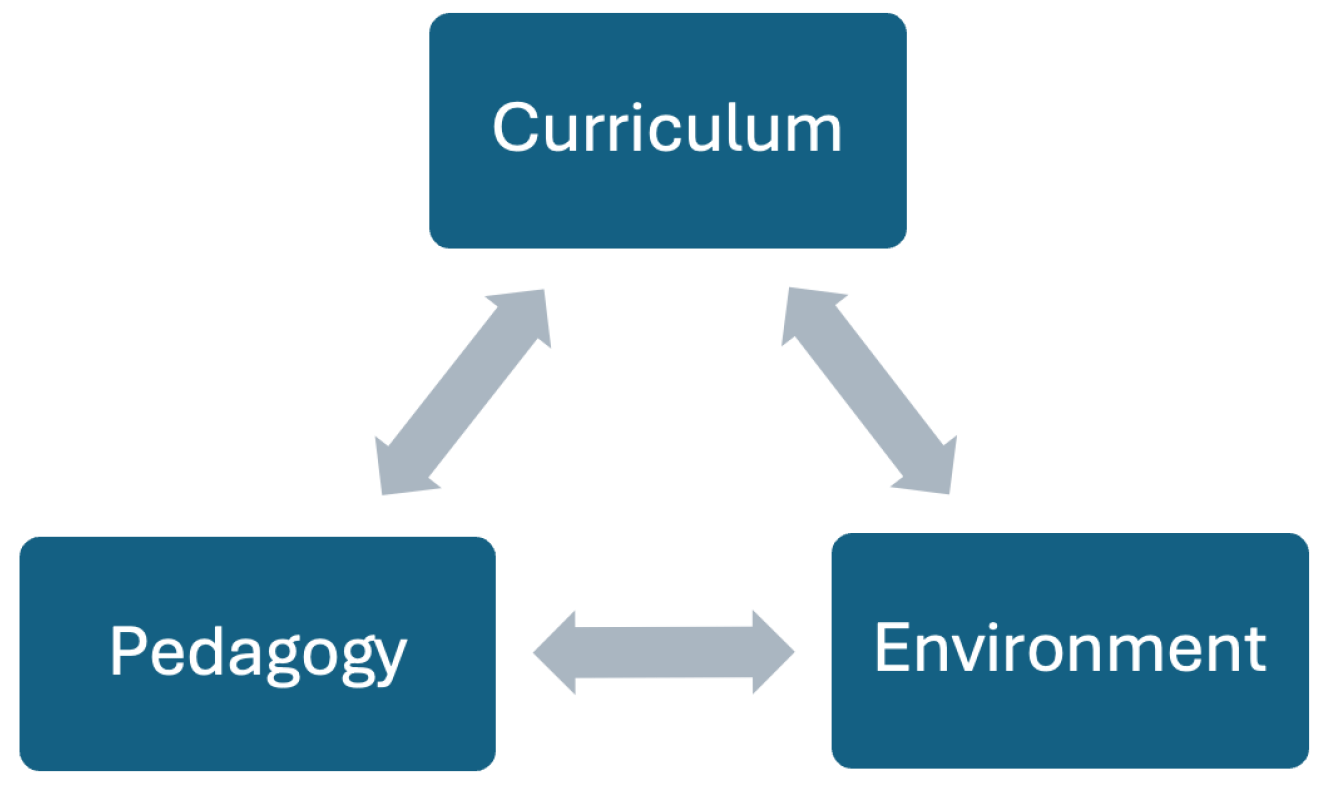
Graphic text below:
Curriculum
Pedagogy
Environment
(Three boxes connected by arrows forming a triangle, showing the interrelationship between Curriculum, Pedagogy, and Environment.)
- Key Priorities – This strategy aligns with and takes direction from wider strategic ambitions and policies of Scottish Government. This will enable an estate that can deliver excellence and equity across the learning estate in line with Scottish Government’s key priorities set out below:
Key Priorities:
Eradicating Child Poverty
Impact on Learning Estate:
Ensuring the learning estate provides a welcoming, safe, nurturing, healthy environment to meet the needs of every learner.
Key Priorities:
Growing the Economy
Impact on Learning Estate:
Planning for the learning estate should facilitate innovation, research, entrepreneurship and skills development. Working in partnership with industry, planning should reflect SG’s ‘Place Principle’ supporting inclusive growth and the creation of sustainable communities.
Key Priorities:
Tackling the Climate Emergency
Impact on Learning Estate:
The learning estate needs to reflect the Scottish Government ambitions of reducing energy and material consumption, developing a circular economy, minimising emissions and increasing adaptability to climate change.
Key Priorities:
Ensuring High Quality and Sustainable Public Services
Impact on Learning Estate:
The Learning Estate should support and enable high quality learning and teaching. The learning estate is often at the heart of the community and therefore has the potential to provide places where wider public services and support could be accessed.
- Changing Demographics - The overall population trend in Scotland is one that is ageing and declining. There are, however, areas that do not follow this trend and there are some capacity challenges with the learning estate aligning with the needs of its users in that locality. There can also be issues with rapid increases or decreases in transient populations such as migrants, refugees and international learners. These demographic shifts can present a challenge with regard to suitability and sustainability of the learning estate at all stages. All planning for the future learning estate should be agile enough that the buildings could be easily adapted to a different use regardless of the continuing demographic changes.
- Diversity and Inclusion – The increasingly diverse nature of Scotland’s population as per the 2022 census and the increase in instances of discrimination and inequality, including racist incidents, gender-based violence and anti-LGBT+ discrimination. The learning estate must be able to provide inclusive, supportive learning environments where all learners can thrive safely and with dignity.
Contact
Email: matthew.rennie@gov.scot