
Scotland House London Evaluation
The evaluation found that Scotland House London is widely considered to be a valuable strategic asset supporting Scotland’s interests in the UK and internationally, while suggesting practical improvements to increase use and refine the offering of SHL
6. Does investment in SHL offer value for money?
Key findings
- There was agreement thatinvestment in SHL offers strong value in terms of avoided costs and efficiencies. However, as is often the case with platforms such as SHL, interviewees highlighted that assessing return on investment is challenging. Much of SHL’s value relates to indirect and intangible outcomes or activities that may take time to generate impact, making it difficult to attribute specific results or quantify economic impact.
- Survey results indicate that there would be a significant negative impact on users if SHL was no longer available to users. Such a change was felt likely to lead to increased costs for seeking out and using alternatives, and have a detrimental impact on users’ business connections and capabilities.
Benefits of SHL spaces and facilities
The positive impact of an affordable physical space in London was highlighted by both survey audiences and interviewees. For some, the only way to have a presence in London is through SHL, due to other venues either being unsuitable or cost-prohibitive.
A key point raised by several interviewees was that their investment in SHL offers strong value in terms of avoided costs and efficiencies. They felt this could be evidenced by saving time and resources from not having to travel between Scotland and London; for example, the SHL team can support a ministerial visit, rather than several Scottish Government staff travelling to London with the Minister. Similarly, without meeting and event space in SHL, it was felt that significant time and resources would be spent scoping and booking alternative venues, which could also be more expensive.
Other positive impacts included that SHL can:
- Enable regular face-to-face meetings with internal teams and external partners or clients, with meeting in person being seen as important for enhancing relationships.
- Offer more space and privacy compared to other co-working spaces.
- Have a positive effect on wellbeing due to a warm and welcoming environment.
Views on whether investment in SHL is delivering value for money
Beyond considering the cost savings that could be attributed to being able to access SHL, stakeholders and partners were also asked to consider whether their organisation’s investment in SHL offers value for money. Several interviewees highlighted SHL’s strategic value as a platform for diplomatic engagement, trade and investment, and enhancing Scotland’s international presence. Data in the annual reporting on Scotland’s International Network also outlines the positive economic impact arising from SHL activity. For example, the 2023-24 Annual Report highlights SHL supporting the creation of 3,301 jobs and almost £1.3bn in planned capital investment, with SDI support landing 26 inward investment projects. In 2024-25, 1,363 jobs were planned, with £45m in planned capital investment and 38 inward investment projects.
“No one's ever suggested it's not great value… At the end of the day, if we didn't have Scotland House London, we'd almost certainly be having to do the same thing at significantly greater cost. But not just that… Scotland House as a quasi-ambassadorial presence is pretty priceless, and I would strongly encourage the Scottish Government not only to continue it but to invest more and grow it and do more with it because I'm sure more Scottish businesses could use it.” – Partner
However, a common theme across interviews was that, while stakeholders feel confident that SHL delivers meaningful value, value for money is difficult to accurately measure in terms of a return-on-investment basis. There was recognition that this value is often indirect and difficult to quantify. Some reflected on the challenges associated with evaluating intangible or ‘soft’ outcomes such as relationship-building, reputation and influence. Others highlighted difficulties in attributing specific outcomes, such as investment deals or partnerships, directly to SHL activity.
“I think you can quantify what would be the direct loss of not having it. If the First Minister was going to London for an event and we didn't have Scotland House, we'd be sending a lot more people down with him. We need to have more teams here working on preparing the programme. That would be harder for them to do. So the programme would potentially be less good. Now, even if you precisely measure all of that, I don't think it measures the whole benefit because there's also the intangible thing.” – SG Stakeholder
A few interviewees, while broadly positive about SHL, raised concerns about the ongoing affordability of investment in SHL in a constrained public spending context, and questioned whether current resource levels, particularly in relation to the size and use of the physical space, are proportionate to need. This issue was sometimes linked with changing working trends, for example, higher rates of hybrid or remote working.
“One of the learnings that we got is that when Scottish entrepreneurs, Scottish businesses are down in London, they don't want a hot desk for three days at SHL. They're coming down for a reason: attend an event, see a customer, see a partner, or go and knock on a few doors. So, therefore, we misunderstood what the level of demand might be for asking space. That has an impact on our ability to then charge for that space. And whilst there's an OK level of usage for the event space, I think just rethinking the purpose of the front office and therefore what the opportunities are to generate more revenues from it probably requires a little bit more focus, as we move into year 10 and beyond.” - Partner
“The team are always very nice and very helpful and very supportive. So, at a personal level, very, very grateful for what they do… I think the harder questions are about the sort of function and whether we can afford it… I'm just not sure we can afford it, given the sort of really hard choices we're making across government. So I think… that needs to be proven and evidenced.” – SG Stakeholder
Impact if SHL is no longer available
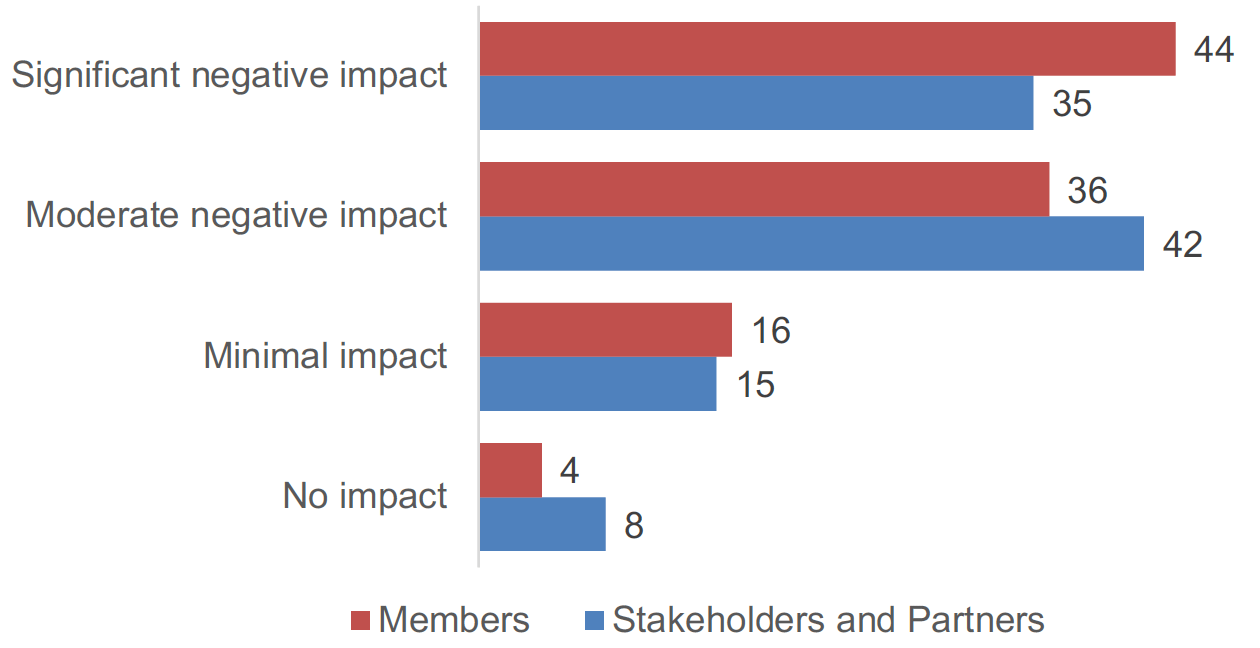
Both members and stakeholders were asked in the online surveys how they might be impacted if SHL’s facilities or services were no longer available (Figure 4). Many stated that not only would it create a negative impact (80% of members and 77% of stakeholders), but a significant negative impact (44% members and 35% of stakeholders).
Open survey comments explained why there would be a significant negative impact if SHL’s facilities or services were no longer available. Both audiences commented that opportunities to work in London and engage with various sectors would be significantly less, if not completely unviable, without SHL, highlighting the vital role it plays.
There was recognition among evaluation participants that while alternative venues could achieve some similar functions as SHL, these would involve compromise in terms of quality and efficiency. For example, members and stakeholders could hire ad hoc meeting or event space, or use of other institutional venues in London; however, these were generally seen as less convenient, more administratively burdensome, and potentially less effective in attracting stakeholders.
“I'm not sure another organisation could play a role. Certainly not at the moment. Given the range of stakeholders that the Scottish Government has to meet in London, and that's political stakeholders, different sectors, diplomatic stakeholders, etc. I just don't see how you can do that without some sort of facility that wouldn't lead you down the route of constantly having to do a case-by-case basis location finding exercise.” – SG Stakeholder
“If it had to be abolished on cost grounds, I think it would be more difficult for the Scottish Government to both engage directly with stakeholders, but also convene other stakeholders.” – SG Stakeholder
Some survey respondents noted they would immediately lose some of their business connections and capabilities, such as accessing and engaging certain markets and sectors. They also highlighted the potential limitations of not having access to the facilities and services, such as loss of business, lack of visibility, and a reduced profile, as well as the potential additional costs to their organisation if alternative venues needed to be used.
“They probably see it as a cost on the balance sheet and just a room in a building in the centre of London. But for companies like us, which are small, growing and particularly in what's a very tough economic environment, it's an absolute lifeline. So it's much more important than it probably looks from the outside for businesses like ours. And I imagine lots of businesses of a similar size.” – Member
“The impact would be significant because Scotland House London provides a unique platform that we could not easily replace.” – Survey respondent
“Being able to bring, whether it's meeting the buyers, bringing customers in, bringing businesses in to talk about how we can support them, that would be a huge miss… It's a great space to be able to bring people, so we can't lose it.” – Partner
This view was not universal, however. One stakeholder, whose engagement with SHL was more limited than that of other interviewees, expressed the view that losing SHL would not be problematic for them.
“Would I lose much in terms of the way I work and what I do when I go to London? I wouldn't lose much. It's nice to have, but not essential. I think that would probably sum it up.” – SG Stakeholder
Contact
Email: socialresearch@gov.scot