
Scotland House London Evaluation
The evaluation found that Scotland House London is widely considered to be a valuable strategic asset supporting Scotland’s interests in the UK and internationally, while suggesting practical improvements to increase use and refine the offering of SHL
5. How effectively does SHL deliver on its objectives and contribute to SG’s international priorities?
Key findings
- SHL reporting evidences a range of activities that align with its long-term priorities and support Scotland’s interests in the UK and internationally. This volume and variety of work has taken place despite reductions in staffing, working practices and membership numbers during and post-pandemic, and changes to the SHL partners and their financial contributions.
- The most commonly identified benefit of SHL relates to positive economic impact. Participants highlighted SHL’s role in supporting economic diplomacy, acting as a base to attract inward investment, and providing soft power or influence in promoting Scotland’s profile. SHL also has significant convening power, building connections between the Scottish and UK Governments, as well as supporting Scottish businesses and SHL members to meet their own objectives by facilitating engagement with relevant stakeholders.
- A consistent theme was the value of the well-located, modern, visibly Scottish space. SHL was viewed as convenient and accessible, and its facilities were felt to create a positive impression for visitors and enhance Scotland’s reputation.
- SHL is widely seen by evaluation participants as an important strategic asset. While SHL’s annual reporting highlights a range of work undertaken and its impact, several interviewees alluded to difficulties in articulating tangible impacts or giving concrete examples of added value from SHL activity.
Examples of Scotland House London activities
The evaluation reviewed SHL reporting from 2019, when the Scottish Government took on ownership of SHL. The reporting contains ample evidence that SHL has proved a useful hub for promoting Scotland’s interests, culture and economy, delivered through a wide programme of activity over that period. As noted in Chapter 2, in 2023-24, SHL hosted 98 events, facilitated 11 ministerial visits, and supported 94 members.
As highlighted throughout this report, key features of SHL activity include events management, diplomatic engagement, ministerial meetings and business meetings, and this work has been influential in promoting Scotland’s interests in the UK and internationally. SHL has been a useful resource to help leverage support for Scotland’s businesses, promote Scotland as a tourist destination, facilitate a platform for political and diplomatic work and generate inward investment.
The Annual Report for 2023-24 highlights a growth in reach, as evidenced by increased social media interactions and comments that this reporting period was particularly successful in terms of promoting Scottish culture and identity. Increased momentum was apparent, too, in this review, with activity post-COVID found to be at its most productive level in this financial year. This appeared to be replicated for 2024-25 based on the Business Plan, though summary quantitative data was not available.
Examples of areas with considerable activity between 2019 and 2024 include:
Economy, trade and investment
Attracting inward and capital investment and creating new jobs - SDI has secured significant inward investment projects, securing hundreds of high value jobs from the platform, including Tachmed Healthcare Ltd, a fast-scaling life sciences company, who in 2025 committed to open a new hub in Glasgow, creating up to 40 high-value jobs. The platform is also key vehicle to pursue Scotland’s capital investment ambitions, delivering multiple investor showcase events to engage the global investors across priority asset classes including in Offshore Wind, Infrastructure and Housing
Promoting international trade opportunities, such as for Scotland’s food and drink businesses, through work undertaken by an in-house specialist, holding an evening reception themed ‘Scotland’s Vision for Trade’ and working with the Scottish AI Alliance to host a fringe event during CogX Festival 2023.
Supporting research and innovation, for example by encouraging university and innovation centre membership with SHL, working with the Converge Challenge to showcase achievements and innovations of Scotland’s universities, holding events such as Climate Tech and AI Accelerator and brokering a partnership with NESTA.
Reputation, influence and relationships
Expanding Scotland’s international reach through ongoing diplomatic engagement with economic and financial attachés from priority countries in London and maintaining ties with the Association of Economic Representatives.
Promotion of Scotland’s culture and festivals, such as work with the EU National Institutes of Culture network, annual Burns supper and St Andrew’s Day events, partnering with the Royal Conservatoire of Scotland, collaboration with the Edinburgh Fringe, a Scottish Ballet briefing, and showcasing emerging artists, filmmakers, authors and poets.
Hosting First Minister and Ministerial visits, supporting multiple meetings per visit and ranging across policy areas, such as a First Minister / Lord Mayor Financial Services Burns Supper, inputs at COP events, meetings between Ministers and Ambassadors in London and convening the First Minister’s public address at the London School of Economics.
Climate change, biodiversity and renewable energy
Maximising Scotland’s involvement in climate conferences such as COP26 and COP28, including engagement across the Embassy network, an inaugural Scottish COP business delegation and an Islands Showcase Day and Policy Dialogue session with over 50 diplomatic representatives and academics in attendance.
Impact of Scotland House London
A majority of evaluation participants believe that SHL is a strategic asset for the Scottish Government. For example, in a stakeholder survey question, almost all (94%) believed that having an official Scottish Government and agency representation in London is important for promoting Scotland’s interests.
Many interviewees considered Scotland House to have strategic value and could describe some of the activity undertaken at or by SHL. However, when asked directly, they found it more challenging to identify the impact of SHL, for two reasons. Firstly, as noted earlier, interviewees' knowledge of SHL often related to their specific area of focus, so they were less aware or able to comment on the impact of the broader range of SHL activity. Secondly, while interviewees could often describe or give examples of specific activities, such as meetings or events, they found it difficult to attribute a tangible impact or explain the added value that had resulted from that activity. This is part of a bigger issue around identifying and attributing impact to SHL, which is explored more in Chapters 5 and 9.
Economic impact
Participants’ comments on the positive impact of SHL centred on its effectiveness at engaging in and supporting economic diplomacy. Interviewees felt that SHL made it easier for the Scottish Government and other stakeholders to engage with other countries via their embassies and with international businesses, showcase different sectors and industries, create a platform and opportunities for supply chains, and attract foreign investment. For instance, one interviewee highlighted a Scottish Government Minister's pre-election event with investors at SHL on bond issuance.
Another key value of SHL was its role as a base to attract inward investment, with examples given during interviews of how this is achieved. A range of approaches was described, from strategic planning to speculative business encounters. For example, one stakeholder highlighted how a chance encounter with a foreign business owner led to an invitation to SHL. This resulted in the business owner visiting Scotland and subsequently buying and investing in tourist infrastructure.
More strategically, interviewees described how they worked alongside SHL staff to achieve mutual objectives:
“We drive lead generation activity through the office. So, we'll hold events, bring people here, we'll pitch to them, and we can definitely point to companies that have invested in creative jobs in Scotland, where the initial contact came from, delivered through Scotland House colleagues whose job is to help bring money to Scotland. And again, they can point to projects which are now happening in Scotland as a result of money that they secured from investors in London and where that initial contact or a pitch around the process was made in Scotland House.” – Partner
“We're increasingly trying to work with the team at Scotland House London to say, how do we make the most of and leverage the asset that we do have in London and to understand their programme that they want to achieve during the course of the year, much of which is aligned to what we're doing to increase kind of the economic impact, the creation of jobs and bringing investment to Scotland… That proactive approach [has been] developed over the last couple of years, and that's been terrific to be able to do. I think the team have been very helpful and open.” – Non-SG Stakeholder
Interviewees explained that having SHL available as a base in London meant they could be more productive during their visits. For example, facilitating work between meetings, having secure conversations, or being able to conduct multiple meetings from one premises. As one interviewee noted, London is a ‘cluttered landscape’; in their view, having SHL made it easier for Scotland to stand out and make a positive impression.
“The range of meetings that could take place there or the range of meetings that the First Minister could take while being based there was helpful. I went down with the First Minister, and he was able to do a range of engagements in London, which included economic engagement with the Lord Mayor of London. And although that was not on site, being based at Scotland House London just helped facilitate those meetings.” - SG Stakeholder
Example 14: SHL coordinated a Ministerial evening reception themed ‘Scotland’s Vision for Trade’. This allowed the Minister to meet with foreign diplomats from over 30 countries, reinforcing Scotland’s trade ideals and principles.
Example 15: SHL engaged with KultraLab – an innovative behavioural science and technology company – to pitch the benefits of locating in Scotland to tap into the country’s supportive tech eco-system and Scotland’s leading research expertise in data and digital. In May 2022, the company announced its decision to establish a new hub in Edinburgh after it received more than £2 million in investment from Scottish investment syndicate, Kelvin Capital, and Scottish Enterprise, creating up to 25 high-value jobs in Scotland.
Example 16: SDI has worked with ITZA Media Limited to maximise economic opportunity for Scotland, introducing the company to partnership opportunities with Scottish universities and supporting ITZA’s plans to scale up an R&D intensive business that could complement Scotland’s existing digital gaming, AI and data analytics cluster. In 2024, the company announced its decision to establish a digital learning, production and AI analytics hub in Edinburgh, planning to create up to 50 jobs within three years.
Convening power
Most interviewees felt that collaborating with SHL helps them meet their organisations’ objectives. Interviewees commented that SHL enables them to access new networks, and to reach a wider audience. They reflected that SHL provides a platform to raise awareness and the profiles of specific businesses and Scotland’s wider offer, through engaging with stakeholders and partners, present and future, on a national and international scale. They felt this range of networking opportunities helps build and strengthen relationships and reputation and provides access to other markets.
The participation of staff from the Scottish Government and partner agencies in London to participate in local events and networking was valued by some interviewees. For instance, one noted that SHL staff have their own contact lists and could curate relevant audiences for events as well as undertake the logistics of event planning. This was seen as the main value of SHL for their organisation. Another stated:
“There's just a real value to having people who know the landscape and know their way around… And the venue was great, but more importantly, the team in Scotland House, as soon as we said we would like to do this, they worked really closely with the team to make sure it was a success and that we'd get the most value out of it.” – SG Stakeholder
A further benefit was that SHL could provide soft power or influence in promoting the profile of Scotland with other governments and enable information exchange to Scotland about what is happening in other countries.
“We combine well with our economic development agencies to use those diplomatic relationships to promote our global trade and investment strategies. So that’s in a good place.” - SG Stakeholder
Some survey respondents suggested that SHL’s facilities and services strengthen the connection between the UK Government and its agencies and their Scottish equivalents. Expression of this benefit was more muted during interviews, however, and more challenges with this form of networking were identified. Interviewees’ perceptions of how visible SHL is varied, with a prevailing view that it is either not well understood or that it is known about within the Scottish Government but not beyond it. For example, one stakeholder expressed some concern that Scottish Government staff in Scotland lacked visibility over what the team in SHL do, meaning they do not understand their contribution.
While some interviewees valued the opportunity presented by SHL to meet people face-to-face, they noted that limited budgets in public sector organisations negatively impact the ability of those staff to visit London in person. This, coupled with the rise in remote working, led another stakeholder to note that Scottish Government staff visit London less, and as a result have a more limited understanding of the role or potential of SHL.
A small number of interviewees also reflected on the nature of intergovernmental relations, noting that when relationships between the Scottish and UK governments are strained, the impact of SHL work could be limited. For instance, this could make it more challenging to work with foreign diplomats who may not want to engage with Scottish representation in case it could have a negative impact on their relations with the UK government.
Example 17: SHL officials facilitated the London Diplomatic Scientific Club, a grouping of around 40 Science Officers and Cultural, Economic and Higher Education attaches, to take a field trip to Scotland. This involved connecting with key Scottish stakeholders, spanning Scotland’s universities, research and innovation institutions and industry bodies and a two-day programme of engagements.
Example 18: In advance of COP26 being held in Glasgow, SHL held a Green Investment Showcase to promote the Scottish Government’s commitment to Net Zero and showcase Scotland’s green investment opportunities. There were over 80 attendees, including Economic Leads from various embassies in London, seven City Leaders from Scotland and representatives from the UK Sustainable Investment and Finance Association.
Example 19: As associate members of the EU National Institutes of Culture London Group (EUNIC), SHL influenced the group and EU Delegation to hold an edition of the ‘In Short, Europe' film festival in Glasgow. SHL brokered a relationship between EUNIC London, the EU Delegation and the eventual hosts, Glasgow Film and convened partner meetings, fed into budgetary processes and enhanced the festival’s promotion. The festival showed 28 award-winning films from 23 European countries over three days in Glasgow. This attracted approximately £28,000 in funding for Scotland’s cultural sector.
Positive impact on members
The survey asked members about the impact of their SHL membership on their work in London. As outlined in Figure 3, a majority of respondents agreed with most statements, including that membership has improved their ability to engage with London-based opportunities and events (84%), membership has helped improve their connections with London-based partners or stakeholders (72%), and that their membership has supported progress toward my professional goals with the London market (68%).
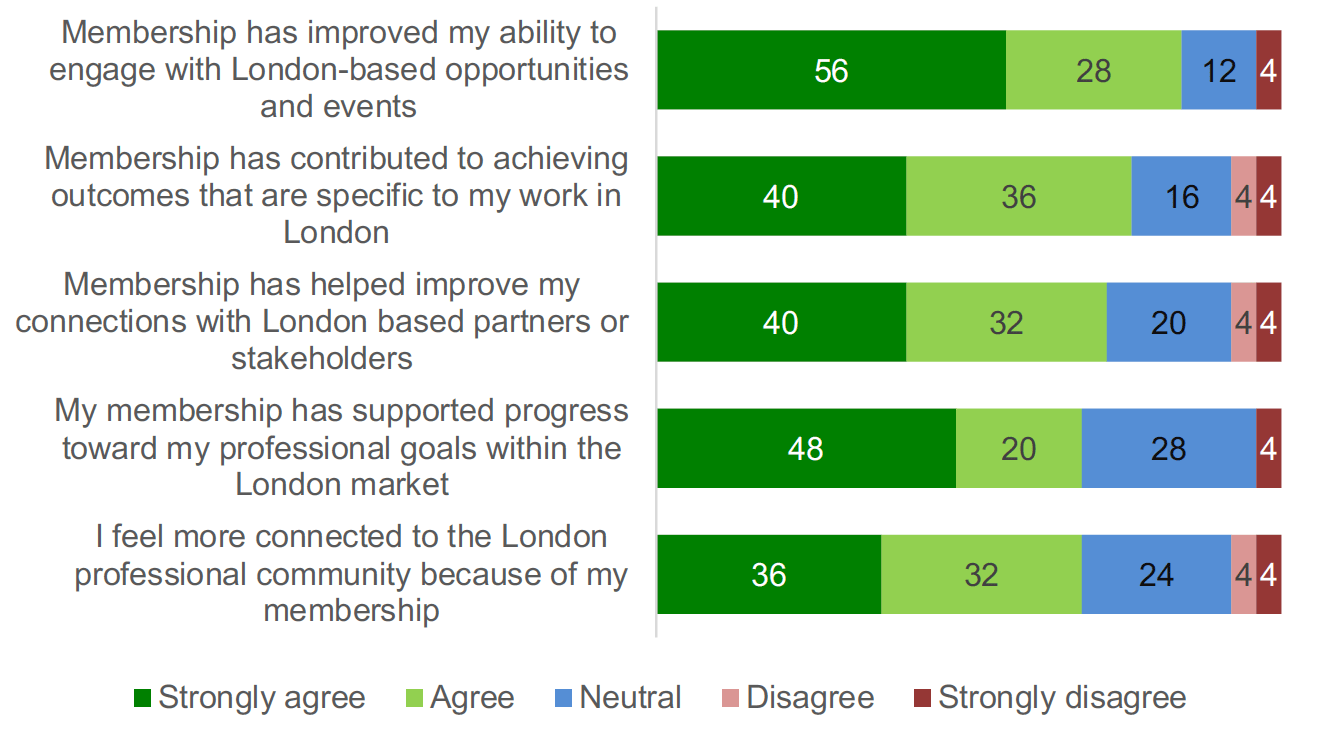
One quarter (24%) responded neutrally to the statement ‘I feel more connected to the London professional community because of my membership’, potentially highlighting the desire for SHL to offer members more support in making and maintaining connections. To illustrate this, one member presented their perception that SHL had not had a direct impact on their work:
“No direct impact, in terms of their direct impact on us. I've certainly not had any inquiries. I've not been introduced to anyone. I've not had a business come up to me and say, ‘Oh, we know you, we see you're also members of Scotland House’. There's not been anything like that ever at all..” – Member
The positive impact of a well-located, modern, visibly Scottish space
A consistent theme across survey responses and interviews was the positive impact of the location and physical environment of SHL. Several respondents highlighted two key benefits of SHL’s location. It was generally felt that the central location is accessible, and its proximity to central train and underground stations makes it easy to connect to airports and domestic and Eurostar services at King’s Cross. This was seen as beneficial in allowing people from Scotland or Europe to easily ‘commute’ to SHL and maximise the time they have available for meetings, rather than travelling.
SHL’s location was chosen to be between Westminster and the City of London, and most interviewees appreciate this location. The specific setting of the office space, beside and looking onto the Thames, was also considered to be very appealing. A very small number of interviewees suggested other locations may be closer to the key stakeholders in their sectors, such as the creative industries.
A small number of interviewees also noted that, in addition to the convenient location, SHL provides a recognisable, familiar space to meet others. They highlighted its value as a venue for organisations that may not have their own meeting space, and as a central location where colleagues from disparate teams can come together.
Scotland House London’s interior was also felt to have a positive impact. Interviewees spoke of the quality of the physical environment, describing the interior as well presented, well organised and with a sense of intimacy. Interviewees noted the good impression this makes on those they bring to SHL. Members also felt the quality of the facilities enhanced the standing of their organisation, with audiovisual equipment and technology and the modern aesthetic felt to deliver a credible, professional impression. In open comments, survey respondents similarly outlined how SHL provides physical representation and a space to showcase Scotland in a professional setting. The events hosted at SHL attracted positive praise and were frequently mentioned by interviewees, and were described by one as a ‘slick operation’.
“When people come to see us, they feel that - even though we obviously say, this isn't our office, we're using Scotland House London - effectively they see it as our office. And that rubs off on the prestige of that name. So, they feel they're dealing with a very professional, aspirational business. So, that's very important.” – Member
“I've never heard anyone have negative feedback about Scotland House London, either the physical facilities or the staff there. I think the staff are friendly and helpful. And it's a place that you can bring stakeholders and be proud rather than embarrassed of where you're hosting them. You're not just meeting in a Starbucks, you're meeting them in a high-quality environment.” – SG Stakeholder
“It's got that really nice central feel to it. And I think people sort of feel that it's got a bit of a ‘wow’ factor, so it's quite nice to be able to bring guests in there. It sort of helps the discussion, and it's a bit of a talking point as well.” - Member
“After we opened, we had a constant procession of diplomatic staff coming to visit Scotland House London, who viewed their own premises as slightly old-fashioned and not the sort of modern image that they were trying to portray, particularly for potential investors. We then had lots of diplomats coming to Scotland House, London, to see how they could use that potentially as a model to modernise their own places.” – SG Stakeholder
Interviewees spoke positively about SHL being visibly Scottish, such as through the way in which it is decorated, the food provided, and the music being played. As such, it was suggested that SHL works well in promoting and supporting Scotland’s interests.
“I'd say as a venue, it's really, really good location. It's full of Scottish things. It has a good ambience about it. So I was quite impressed with it, to be honest.” – Non-SG Stakeholder
However, one member cautioned against over-emphasising Scotland’s culture, feeling this could have a negative impact. They suggested the emphasis should be more on Scotland having a distinct voice in topical debates, offering its take on AI ethics as an example:
“I think it is over-branded as Scotland… I think it's overdone, to be honest. And I think that something that is more about Scotland taking its place among the grown-ups about the discussions that really matter would be a really good use of this space.” - Member
Challenges and limitations on impact
Some challenges which have limited the ability of SHL to have a positive impact over time were evident in the review of SHL reporting. The most significant of these were the COVID-19 pandemic and resource issues.
The pandemic negatively impacted both membership and visitor numbers; visitors fell from 4,193 in 2019/20 to around 580 in 2021/22, while events fell from 57 in 2019/20 to 28 in 2020/21. Visitor numbers to SHL did not return to pre-pandemic levels until 2024/25, when they reached the highest levels recorded in the documents reviewed, with 5,241 visitors. Events followed a similar trajectory; in 2024/25, a total of 98 events were held at SHL.
However, membership of SHL has not yet recovered to its pre-pandemic levels. From 168 members in 2019-20, membership fell to 68 in 2021/22. The latest available data for membership was 2023/24, at which time membership was 94, which was similar to the previous year. While increasing membership is a stated objective of SHL, the documents reviewed to date do not clearly set out what actions have been taken to support growth.
The pandemic also triggered the redeployment of most staff to other parts of the Scottish Government, the closure of SHL’s facilities, and events that were either cancelled or needed to transition from in-person to online. The SDI team also saw significant staff changes during the year as they pivoted to support Scottish companies through processing recovery grants. Redeployment of all but five SHL staff meant that many activities usually undertaken by SHL were suspended or severely impacted, such as its work on research and innovation, building relationships with embassies and wider networks and work to grow the Global Scots community.
Another major challenge reported across the years under review was resourcing. For SHL, the following resourcing issues were noted:
- Staff numbers have declined since the pandemic, leading to pressure on staff and delivery. In 2021-22, there were 16 full-time Scottish Government staff based in SHL, which fell to 14 in 2023-24 and 13 in 2024-25.
- Highlands and Islands Enterprise (HIE) withdrew from the Collaboration Agreement at the end of 2023-24.
- Loss of membership and room hire income.
- SDI reducing its financial contribution from 1 April 2023.
- Planned post-pandemic Communications Manager post not recruited due to unforeseen circumstances.
- Similar issues were raised during interviews. Reductions in resourcing led one stakeholder to note that finding ways SHL could achieve a sustainable source of revenue was a key challenge. Another highlighted SHL needed to be careful not to ‘overpromise’, given its staff team was relatively small and could be overwhelmed, for instance, should marketing activity increase.
“I think probably the main challenge is around how you get a sustainable source of revenue so that [SHL] helps to pay for itself. Interestingly, we haven't encountered the same sort of challenges we have for some of our overseas posts. We have posts in Paris, Berlin, Copenhagen, etc, and that has been a matter of some political controversy here in Scotland, as people don't think that is a good use of public money. But that hasn't really been an issue in the same way for our presence in London. So, I think the main challenge really is that revenue one.” – SG Stakeholder
Attempts to address resourcing challenges at SHL have included using resources creatively to improve value for money, e.g. seeking sponsorships and partnerships for events, bringing together various elements of SHL’s activity to maximise impact, and undertaking a review of structures, which led to an agreement to merge the two teams under a single External Engagement Team with thematic responsibilities.
The other key challenge that could affect SHL’s impact which emerged during interviews was a lack of visibility; this is explored more in Chapter 8.
Contact
Email: socialresearch@gov.scot