
Scottish Household Survey 2024 findings: neighbourhoods and communities report
This report provides insights into neighbourhoods and communities in Scotland. It draws on key data from the Scottish Household Survey (2024) to explore neighbourhoods and communities both at a national level in Scotland and for different subgroups and different places.
Changes over the longer term – COVID-19
Between 2018/2019 and 2022 there were national-level improvements in neighbourhood connections following the COVID-19 pandemic.[16][17] More agreed that people from different backgrounds get on well together and there was an increase in sense of belonging to the community. Trust in the neighbourhood and perceptions of kindness also rose. The proportion of people who felt they can turn to their neighbours for advice increased. There were also improvements in agreement that local people take action to improve their neighbourhoods.
The 2024 figures suggest that the improvements on these measures in 2022 have not sustained, with many of these measures now similar to their pre-pandemic (2018 or 2019) levels (Figure 8, see Table 2 in Annex C for detail of all measures).
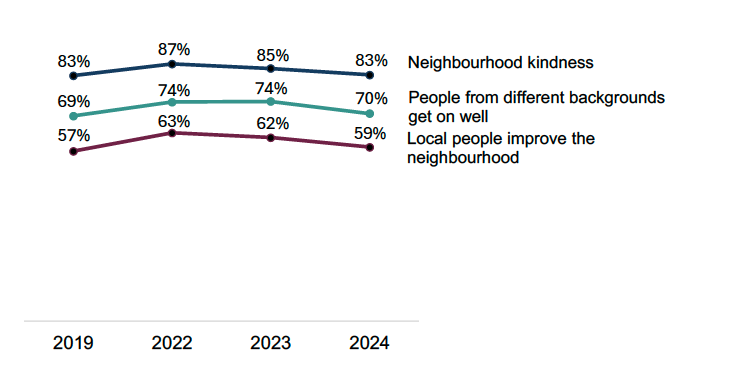
Percentage of adults who agree local people take action to improve the neighbourhood, that people from different backgrounds get on well together, and that people are kind to each other, 2019 to 2024, Scotland[18]
Since 2019, more agree that there are places where people can meet and socialise, and welcoming places and opportunities to meet new people. Sixty percent in 2024 agreed that “there are places where people can meet up and socialise”, an increase from 57% in 2019. Fifty-six percent agreed “there are welcoming places and opportunities to meet new people”, an increase from 52% in 2019.
However, perceptions of neighbourhood safety have worsened since 2019, falling from 83% in 2019 feeling very/fairly safe walking along in the neighbourhood after dark, to 78% in 2024. The percentage who agreed that “I feel I could turn to someone in this neighbourhood for advice or support” has fallen, from 78% in 2019 to 75% in 2024.
The percentage who meet others socially weekly has not changed back to pre-pandemic levels, with 68% meeting socially with friends, relatives, neighbours or work colleagues at least once a week, lower than 73% in 2018. This suggests a possible longer term change in how frequently people meet and socialise with others.
Between 2018[19] and 2022, loneliness in Scotland increased, and fewer people were meeting others socially at least once a week. In 2024, loneliness has improved, with figures now stable with their 2018 levels. Twenty percent of adults in 2024 reported feeling lonely at least some of the time in the past week, stable from 21% in 2018.
Neighbourhood trust and kindness are now stable with their 2019 levels. In 2024, 70% of adults agreed “this is a neighbourhood where people from different backgrounds get on well together”, stable from 69% in 2019. Seventy-nine percent feel a ‘very strong’ or ‘fairly strong’ sense of belonging, stable from 78% in 2019, alongside agreement that “this is a neighbourhood where local people take action to help improve their neighbourhood”.
Contact
Email: socialresearch@gov.scot