
Scottish Household Survey 2024 findings: neighbourhoods and communities report
This report provides insights into neighbourhoods and communities in Scotland. It draws on key data from the Scottish Household Survey (2024) to explore neighbourhoods and communities both at a national level in Scotland and for different subgroups and different places.
Social isolation and loneliness
In 2024, 68% of adults in Scotland “meet socially with friends, relatives, neighbours or work colleagues” at least once a week (Table 2.35 in the supporting Excel workbook). This is stable from 69% in 2022.[12]
Some groups are more likely to meet socially at least once a week. Eighty-one percent of 16 to 24 year olds meet socially at least once a week, compared to 59% of 35 to 44 year olds (Table 2.35 in the supporting Excel workbook). Seventy percent of women meet socially once a week, compared to 65% of men (Table 2.35 in the supporting Excel workbook). Disabled people were less likely (64%) than non-disabled people (69%) to meet socially once a week (Table 2.36 in the supporting Excel workbook).
Twenty percent of adults living in Scotland experienced feelings of loneliness in the last week (Table 2.37 in the supporting Excel workbook). This is a decrease from 23% in 2022.
Loneliness varies by Local Authority (Figure 6, Table 2.37 in the supporting Excel workbook). Fourteen percent of adults in Inverclyde, Argyll and Bute and East Dunbartonshire experienced loneliness at least some of the time in the past week. This compares to 30% of adults in Stirling and 33% of adults in North Ayrshire.
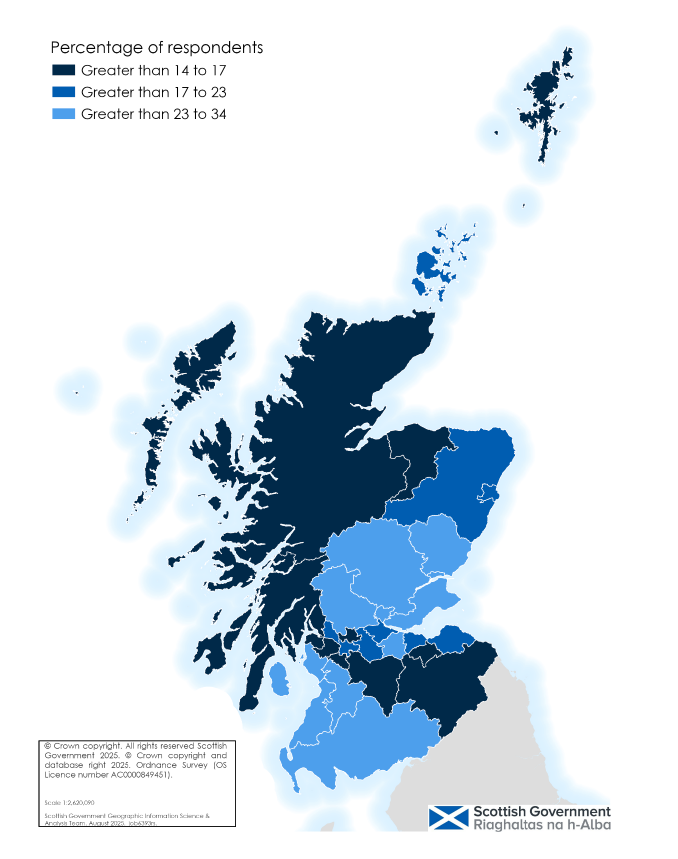
Percentage of adults who experienced loneliness in the last week ‘all or almost all of the time’, ‘some of the time’, ‘most of the time’ 2024, Local Authority Areas in Scotland[13]
The oldest and youngest age groups report the highest levels of loneliness. A quarter (25%) of those aged 75 and over, and 23% of 16 to 24 year olds, experienced loneliness over the last week (Table 2.37 in the supporting Excel workbook and Figure 7). People from these age groups are also more likely to meet others socially at least once a week. This suggests that factors other than the quantity of social interaction are involved in the higher reported levels of loneliness.
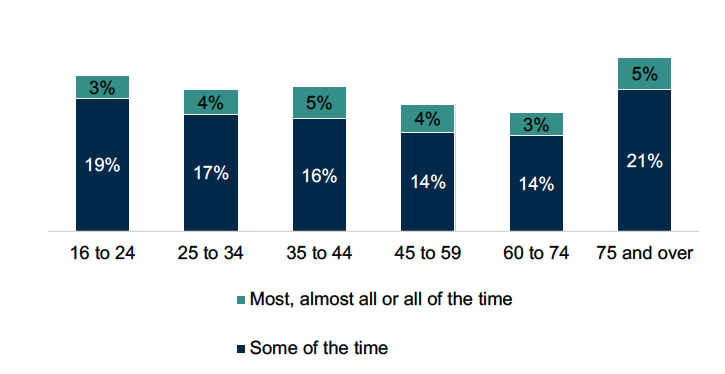
Percentage of adults who report feeling lonely 'some of the time', or 'most, almost all or all of the time', by age, 2024, Scotland[14]
Those living in the 20% most deprived areas were over twice as likely to experience feelings of loneliness (28%) as those living in the 20% least deprived areas (13%). Disabled people were over twice as likely (38%) to experience loneliness as non-disabled people (15%) (Table 2.37 in the supporting Excel workbook).
Single pensioners, single adults and single parents were also much more likely to experience loneliness in the last week compared to adults from other household types. Thirty-seven percent of single adults, 40% of single parents, and 41% of single pensioners, experienced loneliness in the past week. This compares to 10% of older smaller households and 14% of adults from large families (Table 2.38 in the supporting Excel workbook).
Contact
Email: socialresearch@gov.scot