
Good Food Nation plan: initial monitoring framework
The first monitoring framework for the national Good Food Nation Plan establishes a baseline for evaluating Scotland’s food system. It sets out 51 high-level indicators used to monitor progress towards the six overarching outcomes outlined in the national Good Food Nation Plan.
8. Outcome 6: Global impact
Outcome 6: Decisions we make in Scotland contribute positively to local and global food systems transformation. Scotland actively engages in learning and exchanging knowledge and best practice internationally.
Summary of Outcome 6 Indicators
The indicators included in the Good Food Nation Plan for monitoring Outcome 6 have been structured around two sub-outcomes for the purposes of the indicator framework.
Identifying appropriate data indicators that align with outcome 6 of the plan has been challenging. Indicators which measure and reflect the global reputation of Scottish food and drink products are brought together under sub-outcome 6A. This includes data on the number of food products which are recognised under EU Geographical Indication Schemes, the value of Scottish food and drink exports internationally (in real terms) and the importance of Scotland’s food and drink sector as a driver of tourism and motivating visitors to choose to come to Scotland. Under sub-outcome 6B, while quantitative indicators for global food system transformation are not available, the section highlights examples of Scotland’s leadership in research, innovation and sustainable practices that contribute to international progress on food system transformation.
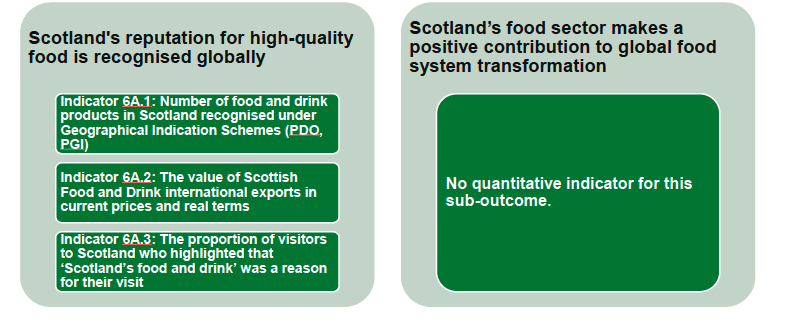
Scotland's reputation for high-quality food is recognised globally
- Indicator 6A.1: Number of food and drink products in Scotland recognised under Geographical Indication Schemes (PDO, PGI)
- Indicator 6A.2: The value of Scottish Food and Drink international exports in current prices and real terms
- Indicator 6A.3: The proportion of visitors to Scotland who highlighted that ‘Scotland’s food and drink’ was a reason for their visit
Scotland’s food sector makes a positive contribution to global food system transformation
- No quantitative indicator for this sub-outcome.
Sub-outcome 6A: Scotland's reputation for high-quality food products is recognised globally
As set out in the Good Food Nation Plan, Scotland’s food and drink sector has an established reputation, domestically and globally, with a recognised brand focused on quality and provenance.
This sub-outcome captures indicators which align with the reputation of Scottish food products: the number of products that have protected status under Protected Geographical Indication (PGI) and Protected Designation of Origin (PDO) schemes; the real value of our food and drink exports to global markets, and the importance of food and drink as a motivation for visitors to choose to come to Scotland.
Indicator 6A.1: Number of food and drink products in Scotland recognised under Geographical Indication Schemes (PDO, PGI)
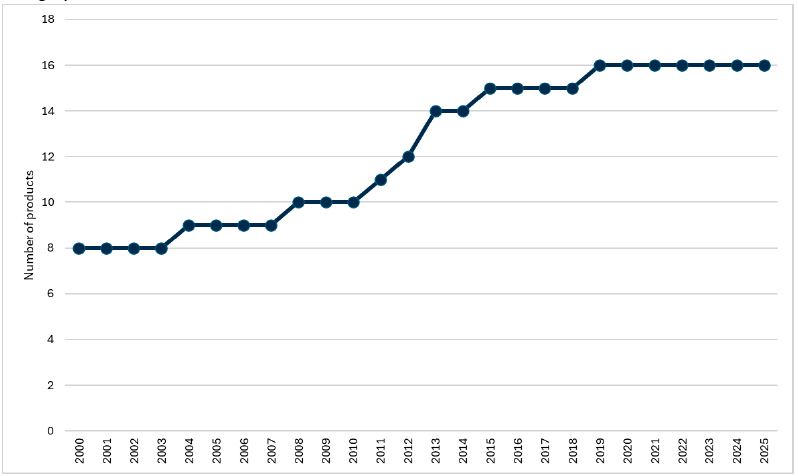
Headline 6A.1: Food and drink products recognised under Geographical Indication (GI) schemes has increased from 6 in 1996, to 16 currently (this includes Native Shetland Wool). There have been no new food products designated under GI schemes since 2020.
Source: Department for Environment, Food and Rural Affairs, Protected geographical food and drink names
Baseline 6A.1: 16 food and drink products (including Native Shetland Wool) had either a PGI or PDO designation under UK and EU geographical indication schemes which were sourced entirely (or in part) from Scotland.
Food produced in Scotland is known globally for its quality produce. A Geographical Indication is a designation for products that have a specific geographical origin and qualities inherent to that location and method of production. Protected Geographical Indication (PGI) and Protected Designation of Origin (PDO) schemes[186] help to maintain the authenticity and value of many food products. There are currently 16 food and drink products produced entirely (or partly) in Scotland with a protected food name with PGI or PDO.
After 1 January 2021, the UK is outside the EU GI (Geographical Indication) system. New Scottish food producers seeking EU PDO/PGI protection (for new product names) now must apply as third country producers. This introduces extra administrative requirements. All Scottish food/drink names protected under the EU GI system by 31 December 2020 (“stock”) were “grandfathered” — meaning those names still enjoy protection in the EU and in the UK under the UK’s own scheme. If a UK producer (outside of Northern Ireland) wants a new GI, they must apply to the new UK scheme and if they want EU recognition, apply to the EU scheme separately, fulfilling EU requirements for third country applicants. There has been no successful applications for new Scottish products under these schemes since 2019 (Ayrshire New Potatoes).[187]
Indicator 6A.2: The value of Scottish food and drink international exports in current prices and real terms
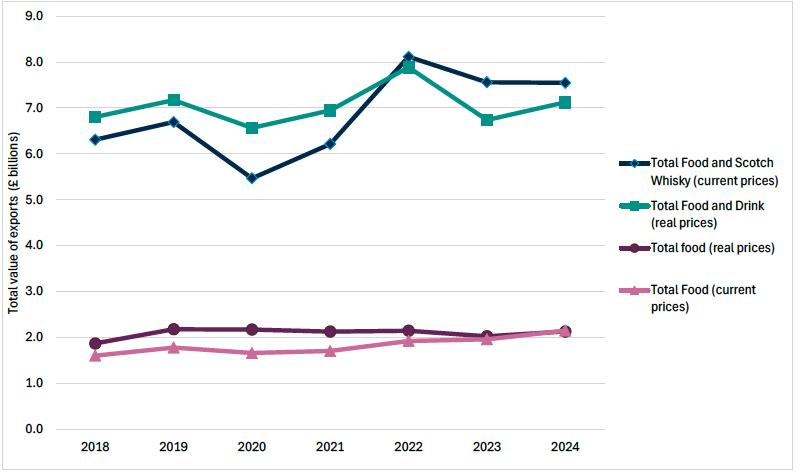
Headline 6A.2: Scotland’s food and drink international exports have been relatively stable over time as seen in both current and real terms.
Source: Scottish Government, Inflation Adjusted HMRC Regional Trade Statistics for Scotland
Baseline 6A.2: The latest data for this indicator is £7.12 billion of food and drink international exports in the year ending Q4 2024[188], according to inflation-adjusted HMRC Regional Trade Statistics. A baseline will be set when Q4 2025 data is available.
The international reputation of Scottish products is reflected in the disproportionate importance of Scotland’s exports of food and drink products. Scotland accounts for around 30% of the UK’s total food and drink exports. Whilst exports of Scotch Whisky drive a large share of this trade (72% of value in 2024), other food products play an important role. For example, Atlantic salmon produced in Scotland is not only Scotland’s top food export, but the UK’s top food export in terms of value.
From 2024, the Scottish Government have published trade value estimates presented in ‘real terms’, which refers to figures adjusted for inflation using Chained Volume Measures (CVM).[189] CVMs of export quantity have been introduced to illustrate how exports (and imports) have been changing over recent years when high price inflation has been the driving factor in changes in the value of trade. Changes in this ‘real terms’ trade data are a more meaningful indicator of showing true increases/decreases in the magnitude of Scottish food and drink exports.
Food and drink are key exports for the Scottish economy, in current prices the total value of Scottish exports was £7.55 billion in 2024. Taking into account inflation, the value of food and drink exports increased by 4.9% in the year ending Q4 2024 when compared to the year ending Q4 2018.
Indicator 6A.3: The proportion of visitors to Scotland who highlighted that ‘Scotland’s food and drink’ was a reason for their visit
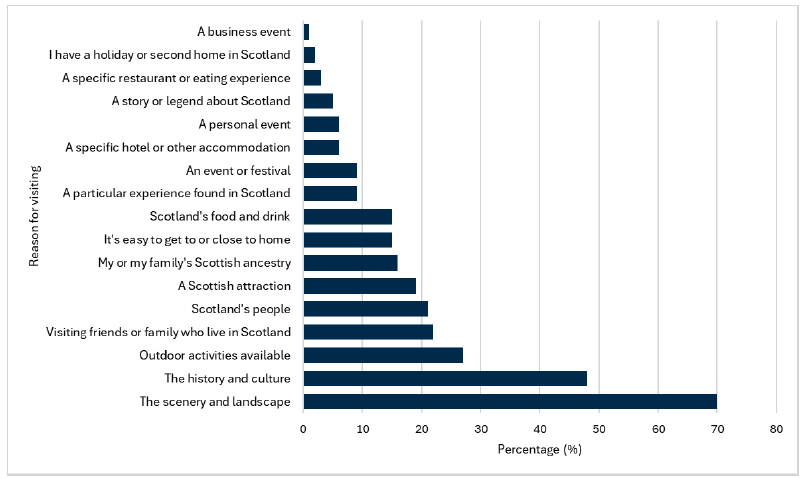
Headline 6A.3: 15% of visitors to Scotland were motivated to visit due to Scotland’s food and drink.
Source: Visit Scotland, Scotland Visitor Survey
Baseline 6A.3: In 2023, 15% of visitors to Scotland highlight food and drink as a reason for choosing to visit Scotland. This is the baseline for indicator 6A.3. Future updates are expected to be available every 3-4 years.
According to the latest visitor survey, 15% were motivated by Scotland's food and drink. Other drivers such as scenery and landscape (70%), history and culture (48%) and outdoor activities available (22%) were found to be more common reasons for choosing to visit Scotland. The survey includes visitors to Scotland from within the UK, as well as international visitors.
Visitors to Scotland are motivated to visit Scotland for a wide variety of reasons, including Scotland’s food and drink offering.
Sub-outcome 6B. Scotland food sector makes a positive contribution to global food system transformation
Headline 6B: Scotland’s food sector makes many positive contributions to global food system transformation. However, a suitable indicator to assess and monitor this has not been identified at this stage, with further work required to develop indicators.
We have not identified any quantitative data indicators for this sub-outcome. The Scottish Government continues to support research and innovation in low-carbon food solutions to enhance the resilience of our future food system to climate change and contribute positively to global food transformation. For example, the Scottish Government has:
- Supported vertical farm technology in Scotland: SRUC Vertical Farming Innovation Centre[190] – which has received funding from the Scottish Government – is an example of the kind of solution required to overcome challenges around food production and security in the future.
- Funded research into alternative crops or climate-resilient varieties of staple crops: research conducted on hemp has demonstrated that this valuable environmental crop can not only contribute to meeting climate and biodiversity targets, but can also deliver high-quality alternative protein and other health benefits.[191]
- Supported organic farming practices - such as the use of cover crops and intercropping that can support resilience of agricultural systems - in line with existing evidence.[192]
SEFARI Gateway[193], Scotland’s Centre of Expertise for Knowledge Exchange and Innovation, funded by the Scottish Government - provides bespoke access to a range of research, expertise and analysis across the Scottish Government’s Environment, Natural Resources and Agriculture (ENRA) Research Portfolio - including sustainable food system and supply chains. The global impact of work undertaken in Scottish institutions was recently displayed at Scotland’s Global Food Security Conference (November 2025), hosted by the Cabinet Secretary for Rural Affairs, Land Reform and Islands.[194]
Contact
Email: resasfoodresearch@gov.scot