
Good Food Nation plan: initial monitoring framework
The first monitoring framework for the national Good Food Nation Plan establishes a baseline for evaluating Scotland’s food system. It sets out 51 high-level indicators used to monitor progress towards the six overarching outcomes outlined in the national Good Food Nation Plan.
7. Outcome 5: A thriving food culture
Outcome 5: People and communities are empowered to participate in, and shape, their food system. Scotland has a thriving food culture with a population who are educated about good and sustainable food.
Summary of Outcome 5 Indicators
As set out in the national Good Food Nation Plan, this Outcome captures the aspiration for the people of Scotland to be active participants in shaping Scotland’s future food system. Dennis Overton, chair of the Independent Scottish Food Commission, recently described the Good Food Nation Plan as a “whole Scotland project” and an opportunity to “involve all of Scottish society coming together.”[166]
Transforming Scotland’s food system also means more of Scotland’s people are enabled and empowered to participate in this transformation. This includes making changes in their everyday lives and making changes within their communities which help to transform our food system in line with the ambitions of the national Good Food Nation Plan, and that people feel this change is supported by government policy at all levels. This change will include more people engaging with positive behaviours through choosing to consume healthier and more sustainable foods.[167] It could also involve more active citizen participation in shaping how our food system can work better for people in Scotland (see below).
The national Good Food Nation Plan also recognises that our food system should be more than just a system that delivers calories and nutrients, a system that grows the plants and rears the animals that underpin our domestic food supply or the employment and economic activity within the supply chain. Food can also be understood as being tied to our sense of identity and belonging. It is intrinsically linked to our understanding of ourselves, the communities we inhabit, and our history, as expressed through traditions associated with preparation of national dishes or dishes associated with notable celebrations or festivals. Scotland’s ‘food culture’ can often be framed or perceived negatively[168] - however the reality is that the food we eat, can be richly diverse, multicultural, and rooted in longstanding traditions.[169]
Food education has a role to play in forming a comprehensive understanding of the challenges associated with food production and consumption, that will enable people to engage critically with the food system.
The indicators under this outcome are less well developed compared to other Outcomes in the national Good Food Nation Plan. Where data exists, we have drawn upon this to explore certain measurable aspects - such as the data related to the number of people growing their own produce and programmes backed by Scottish Government funding which promote food education or more sustainable, local food to be served in particular settings - such as schools. We also include some evidence relating to sustainable food actions of households as an indicator. Capturing Scotland’s ‘food culture’ within a quantitative measure is more challenging and there is no data indicator included for this in the Plan.
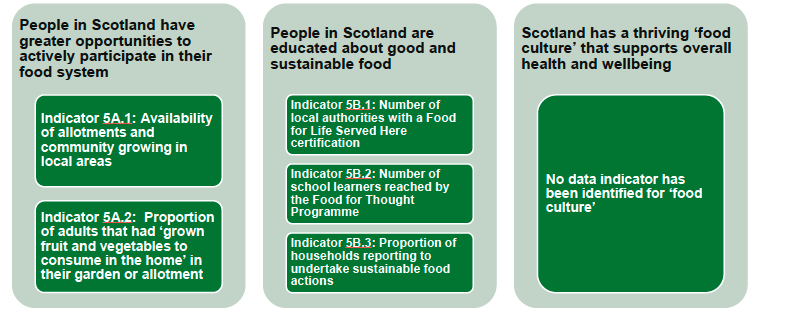
People in Scotland have greater opportunities to actively participate in their food system
- Indicator 5A.1: Availability of allotments and community growing in local areas
- Indicator 5A.2: Proportion of adults that had ‘grown fruit and vegetables to consume in the home’ in their garden or allotment
People in Scotland are educated about good and sustainable food
- Indicator 5B.1: Number of local authorities with a Food for Life Served Here certification
- Indicator 5B.2: Number of school learners reached by the Food for Thought Programme
- Indicator 5B.3: Proportion of households reporting to undertake sustainable food actions
Scotland has a thriving ‘food culture’ that supports overall health and wellbeing
- No data indicator has been identified for ‘food culture’
Sub-outcome 5A: People in Scotland have greater opportunities to actively participate in their food system
In practice, active participation in shaping our food system could encompass many different activities. For example, it could include encouraging individuals to connect to primary food production through growing their own produce in gardens, allotments or community gardens - and perhaps an expansion of food production into our urban spaces in a more formal model under urban or peri-urban agriculture.[170] It could include people increasingly supporting and/or volunteering in food initiatives that promote positive wellbeing outcomes for disadvantaged individuals, such as food re-distribution initiatives, community food networks, food pantries and local food hubs which already operate across many parts of Scotland.[171]
It is worth noting that formal volunteering in Scotland has been in decline over the long-term as recorded in the Scottish Household Survey. Formal volunteer participation rates were 31% in 2010 and have fallen to 18% in 2023.[172] The two biggest challenges identified by Third Sector Organisations in recruiting new volunteers are ‘fewer people coming forward to volunteer’ and 'people have less time to volunteer’. This broader trend is likely to present potential headwinds in realising the ambitions of growing citizen participation in food system transformation.
There are many examples across the country of local food initiatives.[173] Other ways of participating could include participation in events that celebrate and promote local Scottish food such as local food festivals, seeing more up-take of initiatives that seek to promote cooking skills and knowledge that use healthy and local foods, and projects which seek to increase and develop local food supply chains. Others may view participation as something led from the community. Community-led food conversations, held as part of The Food Conversation across the UK for example, have helped paint a picture of what a more joined-up food system, with active participation by citizens at its heart, could look like.[174]
Citizen participation is also related to the wider concept of Scotland’s ‘food culture’ (see sub-outcome 5C).
There are also 19 regional food groups[175] operating throughout Scotland which bring together a wide variety of stakeholders interested in the local food and drink sector. They include producers, hospitality and tourism businesses, independent retailers and markets. Each group works “in its own way but they are all looking to put local food, drink and businesses on the map drive growth” through a range of activities. These groups have been coordinated by Scotland Food and Drink experts (since 2020) and receive Scottish Government support - although many of the groups have been operational for many years.
Indicator 5A.1: Availability of allotments and community growing in local areas
Headline 5A.1: There are wide-ranging benefits for people associated with growing their own food in allotments and other community growing sites. Data on allotment availability and waiting lists are held at a local authority level.
Growing your own food can have many benefits for individuals.[176] Growing food involves physical exercise and has also been associated with improved mental health outcomes[177],[178]. The contribution of food growing to the personal independence and cognitive ability of older or vulnerable people has also been recognised.[179] There is also the potential for education and skill development through the activity of food growing, particularly among children. Community gardens have also been associated with promotion of social health benefits and social connections.[180] Substituting garden-grown produce for store-bought foods may also have an impact on lower food costs and improving access to healthy and nutritious fruit and vegetables. A study found that UK households growing their own fruits and vegetables produced approximately half of their annual vegetable supply and 20% of their fruit supply. These households consumed 70% more fruits and vegetables than the UK national average and generated 95% less food waste.[181]
Further, SCAF[182] have suggested that allotments also have a role in preserving and evolving Scottish food culture and heritage and that they play an important role in intergenerational knowledge transfer, with community growing spaces being sites for sharing traditional Scottish food practices between generations and diverse communities.
The national Good Food Nation Plan encourages people to discover and take advantage of the wide-ranging benefits which can come from growing their own food in allotments and other community growing sites. Under the Community Empowerment (Scotland) Act 2015, local authorities have several duties relating to provision of allotments.
Most local authorities have published information on allotment availability, including current provision and length of waiting lists, through the annual reports required under allotment legislation. Whilst there is a requirement for the information to be published annually, there is neither a requirement on local authorities to update Scottish Ministers on when this information is published, nor for Scottish Ministers to collate it. Therefore, at this time, the data is not held in a consistent format to allow for monitoring at a national level. However, following a review by the Scottish Parliament,[183] the Scottish Government are considering what non-legislative actions can be taken to support local authorities to improve the quality and consistency of data reported.
Indicator 5A.2: Proportion of adults that had ‘grown fruit and vegetables to consume in the home’ in their garden or allotment
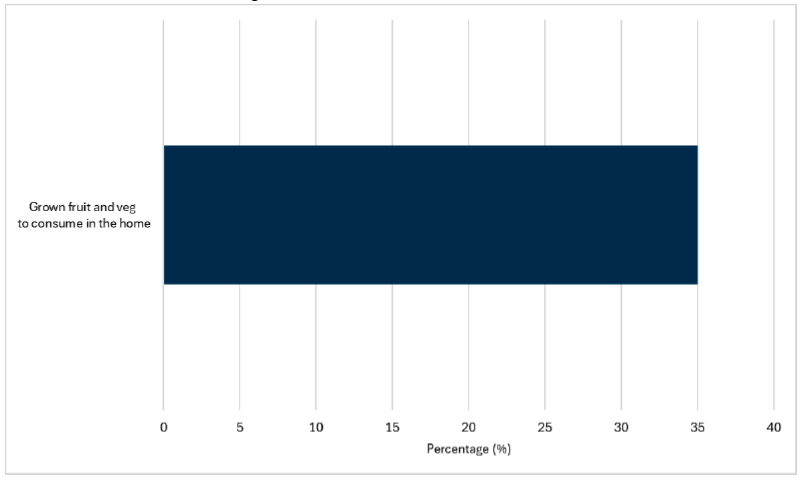
Headline 5A.2: In 2024, more than 3 in 10 adults (who had a garden or allotment) had grown fruit and vegetables to consume in the home. This increases in households with children.
Source: NatureScot, NatureScot Opinion Survey 2024
Baseline 5A.2: In 2024, 35% of adults had grown fruit and vegetables to consume in the home in their garden or allotment. A baseline for indicator 5A.2 will be set when 2025 data is available.
In the NatureScot Opinion Survey, respondents with a private garden or an allotment were asked if they had taken specific nature-friendly actions in these spaces over the last year. Overall, just over four-fifths (83%) of these respondents had undertaken at least one of the nature-friendly activities. Within this, households with children were more likely to have undertaken at least one of the nature-friendly activities (90%) than those without (80%).
In regard to whether they had grown fruit and vegetables to consume in the home, 35% of respondents had. Similarly, households with children were more likely to have grown fruit and vegetables (43%) than households without children (32%).
Indicator 1C.1 also contains relevant data, as it explores consumer related changes to eating habits and food-related behaviours from the Food and You 2 survey for Scotland. Within this, one of the changes quantified was in regard to starting to grow fruit and/or vegetables in the last 12 months.
Sub-outcome 5B. People in Scotland are educated about good and sustainable food and make positive food choices
The Good Food Nation Plan states that children should have frequent opportunities to participate in a variety of food-related educational experiences and activities. Indicators under this sub-outcome highlight the impact of long supported Scottish Government funded initiatives to improve education around good and sustainable food.
The Food for Thought fund, delivered through Education Scotland, for example, provides support to develop pupils’ knowledge about sustainable food production by growing their own produce, cooking and trying out new recipes, and gaining an appreciation of the value of locally produced food (see note under Indicator 5B.2 setting out current situation with regards to funding). The Food for Life Scotland programme works with public sector caterers to support them to achieve the Food for Life Served Here (FFLSH) certification, a framework for serving more fresh, sustainable, and Scottish food in schools and other public sector settings, including universities and colleges, visitor attractions and care homes.
The Royal Highland Education Trust (RHET) also continue to deliver a successful and well-respected programme of farm visits, events and online engagement opportunities for school children. The programme provides a distinctive insight into the origins of food, helping to foster a sense of pride and knowledge among young people about what and how food is produced in their local areas. At this stage, data for a quantitative Indicator are not currently available. Further work, in conjunction with RHET, to develop a suitable indicator and measurements will take place.
This sub-outcome is also supported by evidence on the degree to which people in Scotland are making more sustainable food choices, as captured through food and diet questions in the Scottish Climate Survey.
Indicator 5B.1: Number of local authorities with a Food for Life Served Here certification
Headline 5B.1: Half of local authorities have a Food for Life Served Here (FFLSH) certification for some or all of their sch ool meals services.
A Food for Life Scotland Award Holders interactive map is available on the FFLS web-page. This gives further details on the level of certification held (bronze, silver and gold), number of primary and secondary schools in each area and an estimate of daily meals served. As of November 2025 there were 16 local authorities with a bronze certification, 2 with a silver certification and 1 with a gold certification for school meals services; 1 local authority also had FFLSH for their care homes.
Source: Soil Association Scotland, Management Information of FFLSH scheme
Baseline 5B.1: The latest data for indicator 5B.1 shows that 16 of Scotland's 32 local authorities have a Food for Life Served Here certification at bronze, silver or gold in 2025.
Funded by the Scottish Government, and delivered by Soil Association Scotland, the Food for Life Scotland programme focuses on increasing fresh, sustainable and Scottish food served in schools across Scotland and across the wider public sector.
Half of local authorities have a Food for Life Served Here (FFLSH) certification for some or all of their school meals services. The remaining authorities are not included in Food for Life Scotland’s (FFLS) existing central data collection, but the FFLSH certification, and support, can be taken up at any time for caterers who would like to work towards FFLSH.
Food for Life Served Here (FFLSH) is independently assessed on an annual basis and Food for Life Scotland offers free funded support to local authorities, health boards, and other public sector caterers.
Indicator 5B.2: Number of school learners reached by the Food for Thought Programme
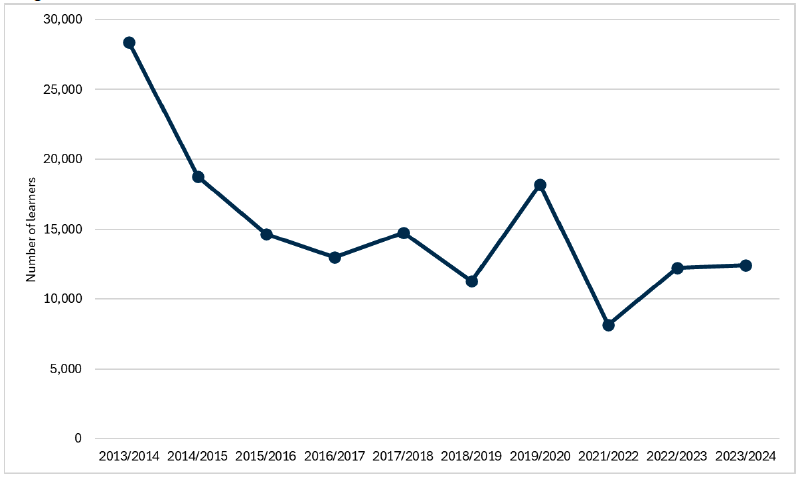
Headline 5B.2: Since the opening of the Food for Thought Fund, the number of learners reached each year has decreased over time.
Source: Education Scotland, Food For Thought Management Information
Baseline 5B.2: The latest data for indicator 5B.2 is that in 2023/24, there were 12,425 learners reached by the Food for Thought Programme. A baseline for indicator 5B.2 will be set when data collection resumes.
The Food for Thought Education Fund gives financial support to develop Food and Health as a context for learning.
The fund has been paused for the 2025/2026 financial year to allow an evaluation, analysing past projects for impact and best practices of the fund to date, to be undertaken. Data collection for this indicator will resume when a food education fund is reinstated.
Indicator 5B.3: Proportion of households reporting to undertake sustainable food actions
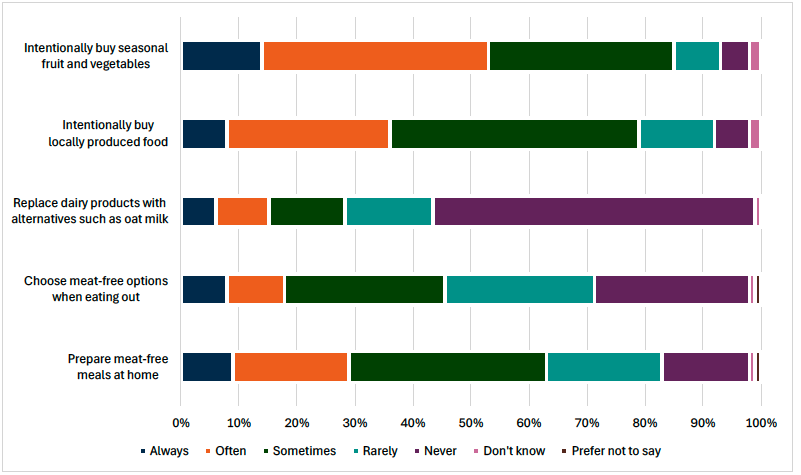
Headline 5B.3: Over half of households report always or often intentionally buying seasonal fruit and vegetables in 2024, whilst over a third report always or often buying locally produced food.
Source: Scottish Government, Scottish Climate Survey 2024
Baseline 5B.3: In 2024, 53% of people reported that they always or often intentionally bought seasonal fruit and vegetables, and 36% of people reported that they always or often intentionally buy locally produced food. This is the baseline for indicator 5B.3.
The Scottish Climate Survey is a nationally representative survey of Scottish adults’ awareness, understanding and experiences of climate change-related issues. The next data collection for the survey is planned for Autumn 2026, with the proposal to run every two years. Patterns of climate-relevant behaviours around food and diet in the survey include consumption of meat, dairy products and seasonal and locally produced food.
The key findings from the 2024 Scottish Climate Survey found that around one-in-three respondents (29%) reported always or often preparing meat-free meals at home, around one-in-seven (15%) reported always or often replacing dairy products with non-dairy alternatives and over half (53%) reported always or often intentionally buying seasonal fruit and vegetables, while 36% reported always or often intentionally buying locally produced food.
Sub-outcome 5C: Scotland has a thriving ‘food culture’ that supports overall health and wellbeing
Headline 5C: A thriving ‘food culture’ in Scotland is expected to support overall health and wellbeing of the Scottish population. However, a suitable indicator to assess and monitor this has not been identified at this stage, with further work required to develop indicators.
The term ‘food culture’ is used in diverse ways within policy and the academic literature pertaining to food. A previous review of Scotland’s food culture suggested that a simple working definition is that ‘food culture’ refers to ‘shared practices and meanings relating to food’.[184] This can include a range of concepts such as how people source food, our tastes and preferences as a population (and the diversity within this), our perceptions of quality and the value we place on sustainability, health and other factors. It is also arguable that there is not a single ‘food culture’, but many diverse ‘food cultures’ in Scotland across different communities.[185]
We have not identified, at this stage, a suitable quantitative indicator that could be used to assess and monitor Scotland’s food culture. Further work to develop a suitable indicator is required.
Contact
Email: resasfoodresearch@gov.scot