
Good Food Nation plan: initial monitoring framework
The first monitoring framework for the national Good Food Nation Plan establishes a baseline for evaluating Scotland’s food system. It sets out 51 high-level indicators used to monitor progress towards the six overarching outcomes outlined in the national Good Food Nation Plan.
2. Monitoring and Reporting
Interpreting the Indicator Framework
This report sets out the final list of initial indicators for the first National Good Food Nation Plan, as well as additional supporting evidence which - taken together - forms a high-level assessment of Scotland’s food system in 2025.
In doing so, this report therefore establishes a ‘baseline’, or a common reference point, across a suite of relevant data indicators that will serve as a future analytical framework to monitor how Scotland’s food system is evolving in the longer-term across many different and interconnected characteristics. It will ultimately be used by policymakers - and the Scottish Food Commission - as a tool to assess whether the Good Food Nation Plan is bringing about the positive change required to move Scotland’s food system closer to one that aligns with the six ambitious Outcomes set out in the National Plan.
This initial framework consists of 51 high-level indicators that relate to each of the six national outcomes which are outlined in the final Plan drawn from mainly existing secondary data sets. The six Outcomes contained within the national Plan have been structured under 19 sub-outcomes for the purposes of this framework, although it should be noted that the sub-outcomes do not have legal meaning within the Good Food Nation Plan and simply function as a way to structure the indicators set out in the framework and, under some sub-outcomes, we have not identified a suitable data indicator. This report presents the latest data for each indicator and provides a ‘headline’ assessment which notes whether the indicator has moved in a positive, negative or neutral direction in recent years.[3] This report also provides a link to each data source, sets out further relevant supporting evidence and explanatory information and any limitations to interpreting these indicators. Further detailed data breakdowns for each indicator are published in supporting Excel documents.[4]
While we have related indicators to a single Outcome for practical purposes, we understand that our food system is complex in nature, and we recognise that many indicators could be related or grouped under multiple Outcomes. For example, reductions in diet-related diseases (indicators 3C.1 and 3C.2) and improvements in the Scottish diet towards realising the Scottish Dietary Goals (indicators 3A.2 and 3A.3) are explicitly included as indicators under Outcome 3. However, should these indicators move in a positive direction, these indicators could also contribute to realising ambitions under Outcome 4 through improving the health of the workforce in the food and drink sector for example, and Outcome 5 through fostering a more positive food culture that places more value on the consumption of healthy foods.
In reading this report it is also important to recognise that the national Good Food Nation Plan is assessed at a necessarily high-level. The indicators identified are not exhaustive and far more information and data on Scotland’s food system is held outwith this document and embedded in other related strategies and plans which indirectly relate to the subject of food. Over time, this body of evidence - and the indicators that are drawn from it - will continue to evolve and shape future food policy in Scotland.
There are also several areas drawn out in this report which - whilst recognised as an important part of reaching our Good Food Nation ambitions - are difficult to measure using existing data. These areas include, but are not limited to: Scotland’s ‘food environment(s)’, climate adaptation within our food system, Scotland’s soil health, measures of animal welfare, metrics that link diet and food with mental health outcomes, equality and diversity metrics of the workforce in the food and drink sector, community growing activities, Scotland’s food culture and Scotland’s contribution to global food system change. There are also areas where proxy indicators have been used in this framework, but where more relevant data could be made available in the future that better aligns to the Good Food Nation Outcomes.
Addressing these evidence gaps, and improving the existing data indicators, will be a priority for future Good Food Nation plans. We will continue to work through collaboration with research institutions and other stakeholders in drawing upon the latest evidence on the Scottish food system.[5] There will also be a role for the Scottish Food Commission in helping to provide strategic direction and scrutiny of efforts to improve the monitoring framework.
The food system and food policy also cuts across many Scottish Government policy areas and existing Scottish Government strategies, plans and programmes. We have ensured - as far as practicable - alignment with approaches across a number of areas. The Plan sets out links to relevant documents and legislation in different policy areas in part 4 of the Plan, including: Just Transition, Community Wealth Building, Human Rights, Planning, Biodiversity, Environment, Fair Work, Food Safety, standards and Public Health Nutrition, International Trade, Getting it Right for Every Child, the Population Health Framework, Land Reform, the National Marine Plan and the Vision for Agriculture.
Finally, we have been clear that the initial indicator framework developed for the first plan is just a starting point and as time passes, this framework will be continuously reviewed to improve upon the way we measure progress against the national Good Food Nation Outcomes. This will also need to reflect future reviews of the Plan, for example, to align with new targets.
Future Reporting Cycles
This first national Plan sets a ‘baseline’ for assessing future progress towards the six Outcomes. Being able to assess on a regular basis how Scotland’s food system is performing is an essential element in our efforts to become a Good Food Nation.
Figure 1 sets out when we expect to report on progress through updating the data used in this publication and determining which indicators have shown improvements or deteriorations. It is our intention to review the Scottish food data landscape on an on-going basis after the publication of the first plan, taking into account developments across different parts of the food system.
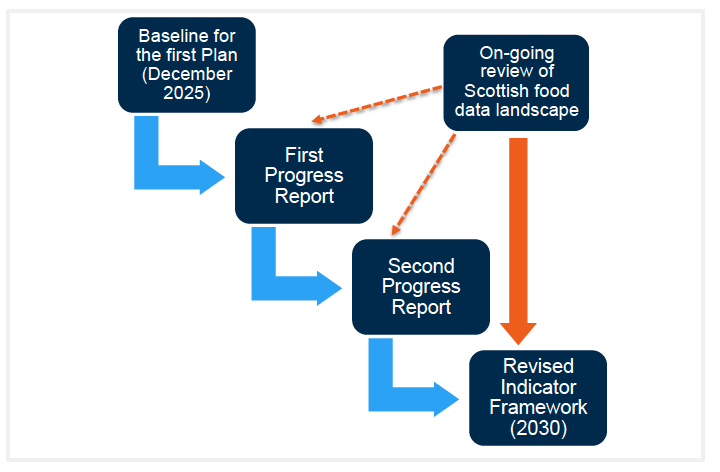
We intend to formally update Good Food Nation indicator data (where new data is available) against the baseline in this document at least twice within the period the first plan is formally in place - aligning with the formal progress report process set out in the Good Food Nation Act. As set out in the Plan, before the end of 2030 the Scottish Government is also required to decide whether or not to revise the first plan - having regard to any recommendations made by the Scottish Food Commission - and thereafter publish a revised plan. Alongside that revised plan, we will also seek to publish a revised indicator framework which will formally incorporate any changes to the indicators to reflect availability of new data or any significant changes to the Plan (such as the introduction of new targets).
If significant new sources of data emerge before 2030 these could be included in the progress report as ‘interim indicators’. This recognises the legal position that we cannot formally change the indicators or measures used to assess progress of the Plan before it is formally revised.
Development of New Indicators
When assessing the inclusion of data indicators in the Plan, we needed to be satisfied that data met the following criteria:
- Relevance: The indicator should relate to key elements of the Good Food Nation Outcomes
- Representativeness: The indicator should be as representative as possible of the key characteristics of the Outcomes set out in the monitoring framework
- Data availability: Data for the indicator is readily available and accessible for use by a wide range of stakeholders
- Sensitivity: The indicator should be sensitive enough to detect changes over time, particularly in relation to the lifespan of the Good Food Nation Plan
- Understanding: The indicator should be easily understandable by a wide range of stakeholders including non-experts, to ensure effective communication
- Practicality: The indicator should be cost-effective to use and have low resource requirements for data collection and analysis
When considering any new data indicators in the future, it is important that each proposed new indicator meets these criteria. There have been two substantive changes to the indicators set out in the proposed Draft Plan laid before parliament in June 2025.
The first change was to ‘Indicator 3B.1 - Mean BMI of adults’. This has been replaced with the ‘Proportion of Adult Population with a healthy weight’. This was to ensure improved alignment with the indicators used in the Population Health Framework as set out in the Scottish Health Observatory Dashboard - and aligns with the target to increase the proportion of adults with a healthy weight set out in Annex C of the Plan.
The second change was to add a further indicator under Outcome 1 in relation to the drop off in breastfeeding. This reflects the fact that there is a target or ‘stretch aim’ in Annex C of the Good Food Nation Plan in relation to drop off rates in breastfeeding.
Data for Indicators in Local Authority and Health Board Plans
Under section 10 of the Good Food Nation (Scotland) Act 2022, all local authorities and territorial health boards will be required to publish a Good Food Nation Plan within 12 months of the day the relevant section comes into force. These plans must also set out indicators or other measures by which progress in achieving the outcomes may be assessed at a local authority or health board level. Relevant authorities have flexibility to define their own outcomes and select their own indicators.
Scottish Government is also aware that the Living Good Food Nation Lab[6] intends to publish further accessible indicator data at local authority and health board level in due course which relevant authorities may wish to refer to when considering the indicators within their own plans.
Contact
Email: resasfoodresearch@gov.scot