
Making the Case for Nature: insights from Scotland's Natural Capital analyses
This report is an analytical review consolidating Scotland's Natural Capital evidence base. Synthesises over a decade of analyses to distil key insights to help inform better decision-making across government, business, and society.
Theme 4: Risks to Scotland’s natural capital
Natural capital is at risk from the impacts of climate change and a broad range of pressures and drivers, such as land use change and pollution, putting the benefits we derive from nature also at risk, see Figure 30.
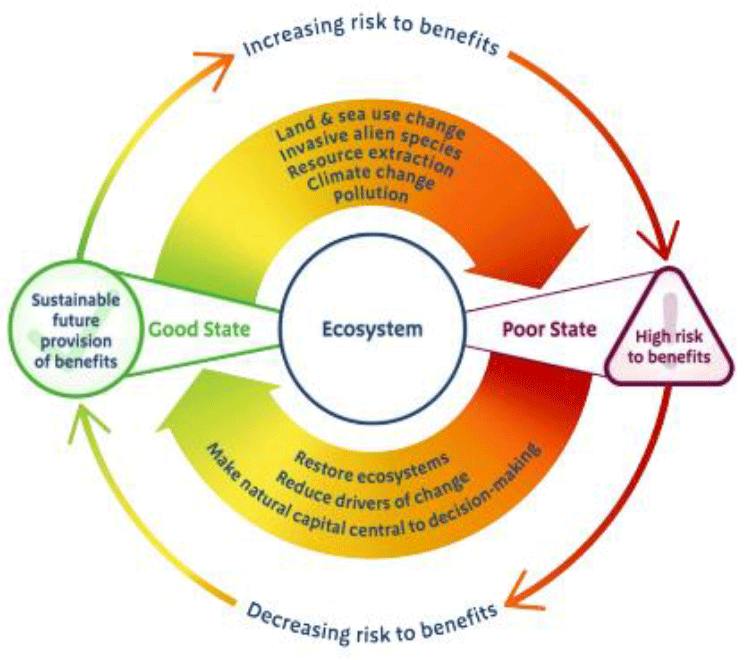
Graphic text below:
Ecosystem
Good State
Sustainable future provision of benefits
Transition to Poor State involves increasing risk to benefits
Factors leading from Good State to Poor State:
Land & sea use change
Invasive alien species
Resource extraction
Climate change
Pollution
Poor State
High risk to benefits
Transition to Good State involves decreasing risk to benefits
Actions for transitioning from Poor State back to Good State:
Restore ecosystems
Reduce drivers of change
4.1. Climate risks to Scotland’s natural capital
The ‘Climate Change Impacts on Natural Capital’ [39] highlights the risks to society and the economy through changes in ecological processes caused by climate change. The research project found that Scotland’s climate has already experienced change; this is expected to continue and become more pronounced.
Figure 31 highlights the climate change risks to natural capital. All of these impacts have implications for our environment, economy, and wellbeing.
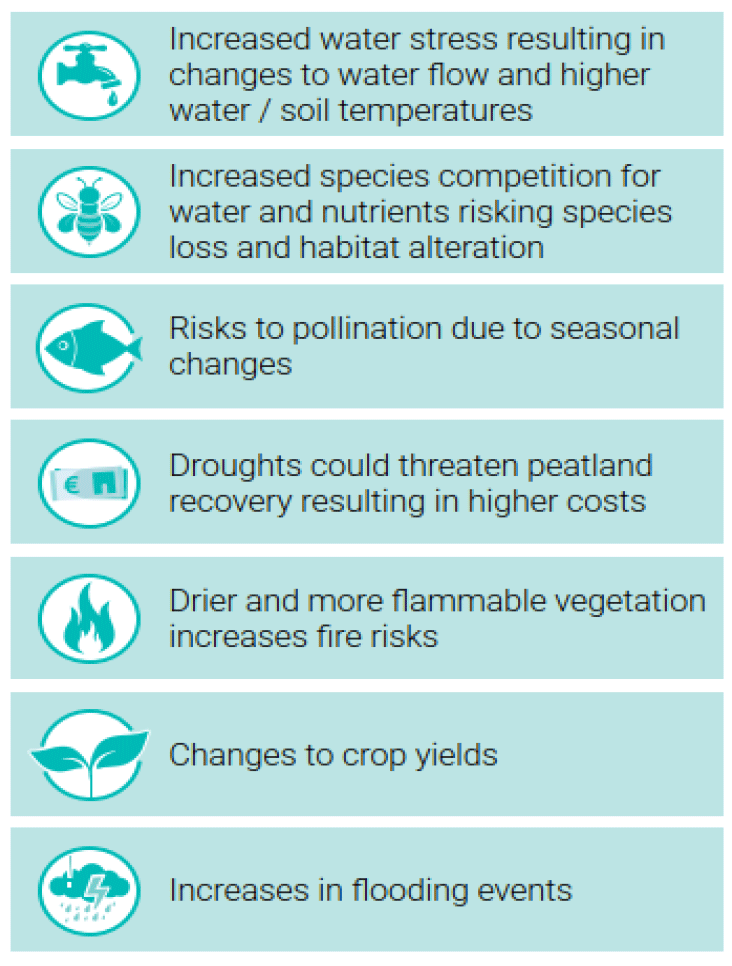
Graphic text below:
climate change risks to natural capital include:
- Increased water stress resulting in changes to water flow and higher water/ soil temperatures
- Increased species competition for water and nutrients risking species loss and habitat alteration
- Risks to pollination due to seasonal changes
- Droughts could threaten peatland recovery resulting in higher costs
- Drier and more flammable vegetation increases fire risks
- Changes to crop yields
- Increases in flooding events
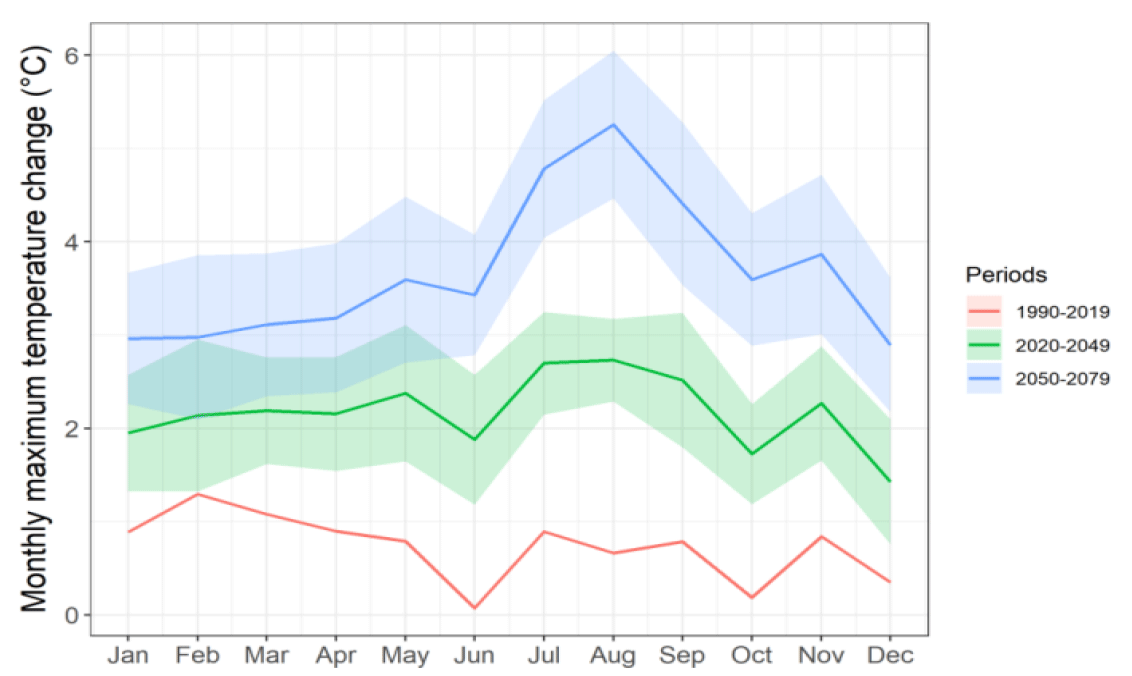
Figure 32 shows the projections calculated by the study for changes in maximum temperature by month (compared to 1960–1989 baseline) for the periods 2020-2049 and 2050-2079. These changes have serious consequences for Scotland’s natural capital. Temperature changes can result in changes to ecological and ecosystem function. This can impact work to achieve Net Zero, such as peatland restoration and woodland planting.
The study highlights that Scotland’s natural capital has the potential to mitigate or exacerbate climate change. Peatlands as a potential source or sink is a clear example. Scotland’s peatlands have degraded as a result of land use change over the last 100 years and drainage for agriculture and forestry. The extent of blanket bog in Scotland is dependent on climate which puts the carbon stored in peat bogs at risk. This emphasises the ‘win-win’ of early action on peatland restoration which will significantly reduce later costs. Healthy functioning ecosystems provide an important foundation for adaptation to climate change by land managers and society in general.
4.2. GDP risks from nature decline
In ‘Managing Nature Risks: From Understanding to Action’ [40], the significant dependency of the global economy on nature was highlighted. The report estimated that US$58 trillion (approximately £43 trillion) of economic value generation – 55% of the world’s total GDP – was moderately or highly dependent on nature. It highlighted that five industries’ direct operations are 100% highly dependent on inputs and services provided by nature: agriculture; forestry; fishing and aquaculture; food, beverage and tobacco; and construction. As outlined in Theme 1, these are some of Scotland’s most important industries that are at risk.
‘Assessing the Materiality of Nature-Related Financial Risks for the UK’ [41] provided a detailed scenario analysis of nature-related risks to the UK financial sector, both in the near-term and the longer-term. The findings demonstrate that biodiversity loss and environmental degradation create material risks for the UK economy and financial sector, in addition to their wider social and biodiversity impacts. These impacts are near and present. The study estimated that global nature degradation could lead to GDP in the UK being 6% lower than it would have been otherwise by the 2030s. This value is greater than the GDP loss from the Global Financial Crisis in 2007-8. While the agricultural sector is at the greatest relative risk, the largest risks in monetary terms are to the services and manufacturing sectors. These risks are near-medium term but the research signals that there will be tipping points where action is irreversible.
Global nature degradation could lead to UK's GDP being 6% lower than it would have been otherwise by the 2030s. While these findings are preliminary, all the evidence points to them being conservative. The evidence clearly demonstrates these risks will increase over time with the potential for crossing tipping points.
An example of a sector reliant on natural capital and facing risks to its supply chain is the whisky sector, see Box 6.
Box 6: Whisky case study [42]
The whisky industry is an important component of Scottish cultural heritage and a source of revenue to the economy. To make whisky, a supply of good quality and quantity of water, cereal crops, and yeast is needed and distillation and maturation must occur in Scotland by law.
Around 90% of the barley requirements for whisky are sourced in Scotland. Whisky production is one of the four main industries that sources water directly from Scottish rivers [43].
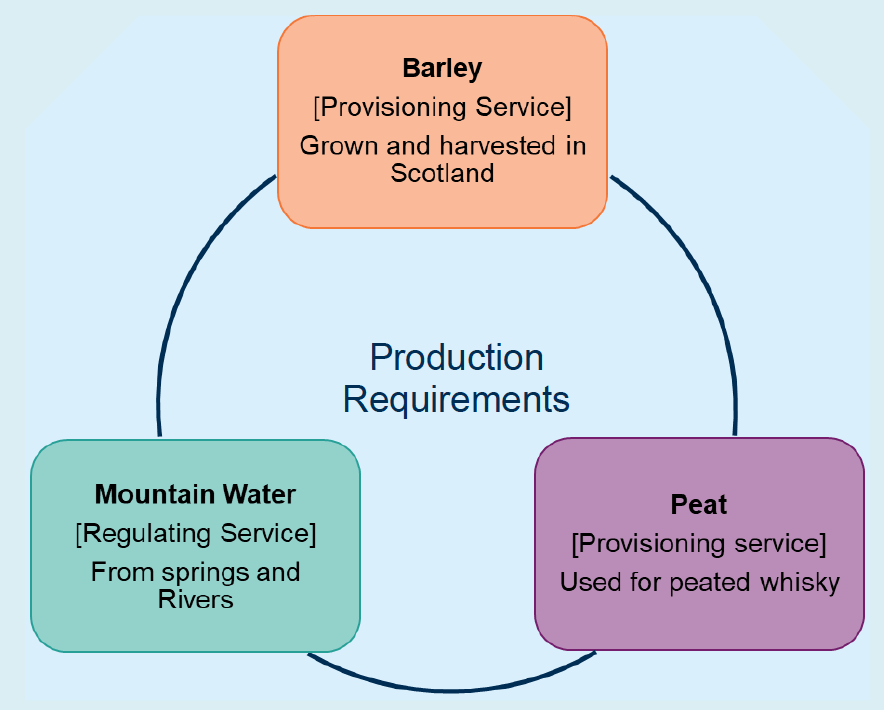
Risks to the whisky sector
Drought frequency is expected to increase, resulting in a reduced and intermittent water supply, which could decrease or halt production [42].
Although UK winter wheat agriculture is expected to remain viable over the next 50-100 years, an increased occurrence and intensity of heatwaves, droughts, and heavy rainfall events will create challenges for maintaining stability in annual crop yield.
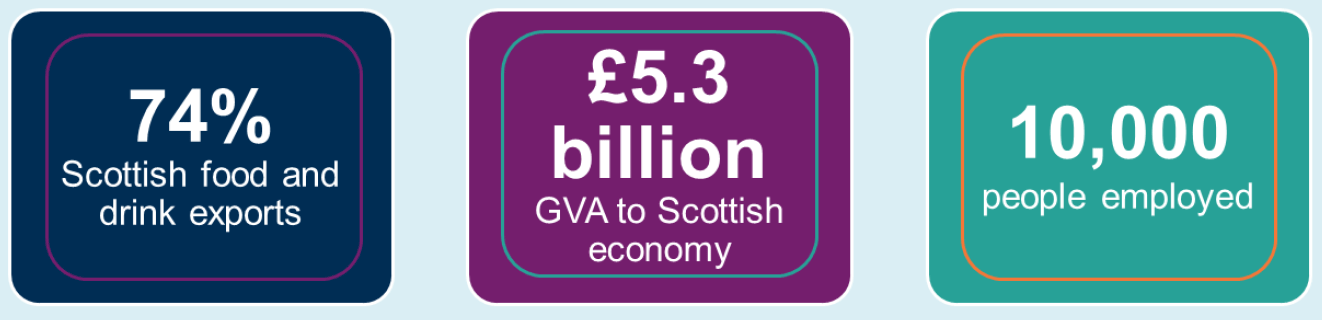
Economic contribution of whisky to the Scottish economy
4.3. Summary of key points – Risks to Scotland’s natural capital
Scotland’s climate is already experiencing change, but this is expected to continue and become more pronounced. Climate change poses a key risk to Scotland’s environment, wellbeing, public safety and the economy.
Climate change impacts will vary across different types of natural capital and ecosystem services. It is expected to lead to significant habitat alteration and changes in ecological processes. For peatlands, severe drought would risk drying of exposed soils and increased wildfire danger. Flooding events could increase the risk of invasive species, increased erosion and diffuse pollution.
Degraded or lost habitats can have important repercussions for the economy, including higher insurance costs, and a decline in productivity (through extreme weather events and urban heating).
Global nature degradation could lead to a 6% reduction in GDP in the UK compared to a business-as-usual baseline. This value is greater than the GDP loss from the Global Financial Crisis in 2007-8.
The impacts of both climate and nature loss would have a very material impact on UK GDP, equivalent to several lost years of growth. Climate change and environmental degradation are occurring in parallel and are interconnected.
Contact
Email: Georgia-Lee.Smith@gov.scot