
Making the Case for Nature: insights from Scotland's Natural Capital analyses
This report is an analytical review consolidating Scotland's Natural Capital evidence base. Synthesises over a decade of analyses to distil key insights to help inform better decision-making across government, business, and society.
Key Insights from Scotland’s Natural Capital
To bring out the key insights on Scotland’s natural capital, this report has been structured under the following key themes.
Theme 1
Natural Capital’s economic contribution is significant
Theme 2
There has been a long-term decline in nature, demanding stronger action
Theme 3
Nature-related tourism and recreation boost our economy and health and wellbeing
Theme 4
There are risks to Scotland’s natural capital
Theme 5
Making the case for investment in natural capital
Natural capital is “the renewable and non-renewable stocks of natural assets, including geology, soil, air, water and plants and animals that combine to yield a flow of benefits to people.”
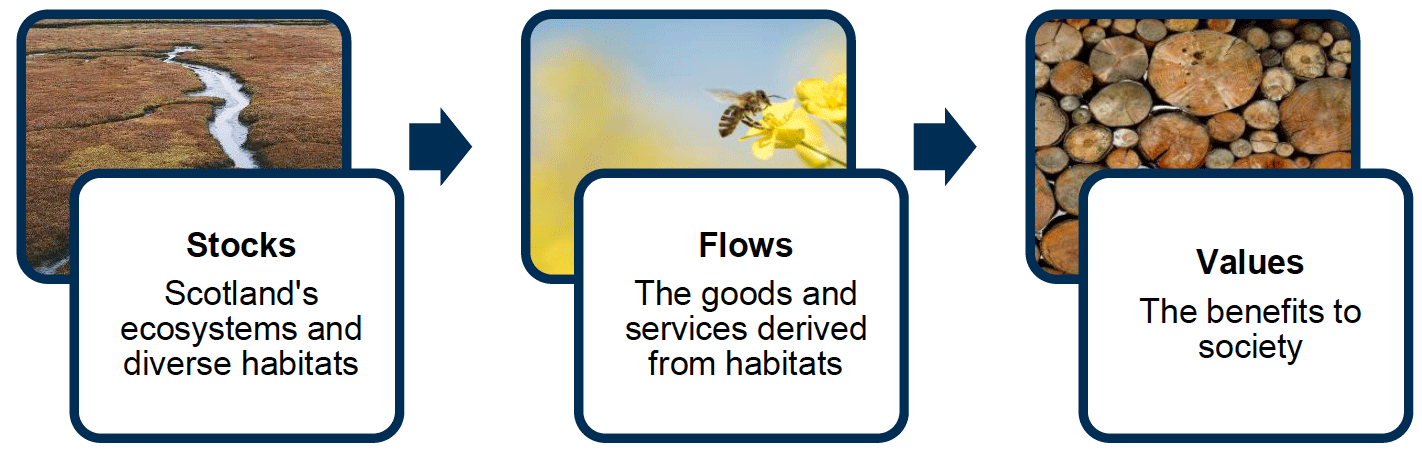
Graphic text below:
Stocks: Scotland's ecosystems and diverse habitats
Flows: The goods and services derived from habitats
Values: The benefits to society
Scotland's natural environment is central to our identity as a nation. It is fundamental to our health, our quality of life, and our economy. We are a nature-rich country, possessing a wide range of species and varied ecosystems, such as our large areas of blanket bog and Caledonian forest.
Scotland’s nature provides a key source of overall wealth of the nation, including its contribution to the economy, or providing resilience to climate change and to the health and wellbeing of the population. Scotland’s natural assets provide direct and indirect inputs, which in turn underpin large parts of our national economy and support a significant number of jobs.
Scotland and its people receive many benefits from natural capital, but its depletion has resulted in increasing risks to the economy and wellbeing.
The Scottish Government has an ambition to rebuild natural capital in its ‘National Strategy for Economic Transformation’. By committing to taking a natural capital approach, the role of our natural environment and its value as an asset within our economy and society can be more easily recognised. This aims to support and inform more sustainable policy choices, meaning both current and future generations can enjoy and benefit from our natural environment.
Since the release of the ‘UK National Ecosystem Assessment’ and the first edition of the ‘Scottish Natural Capital Asset Index’ (NCAI) in 2011, there has been a fast-growing body of analysis on natural capital in Scotland. This ranges from the annual ‘Natural Capital Accounts’ to bespoke research pieces such as the ‘Importance of Natural Capital to the Scottish Economy’.
The purpose of this report is to synthesise this evidence and identify key insights that can be applied across policy and practice.
To support this, the following key themes of natural capital in Scotland have been identified:
Theme 1: Natural capital’s economic contribution is significant
The UK Natural Capital Accounts in 2024 (based on 2022 data) reports that the total annual value of natural capital in Scotland is estimated at £38.7 billion (£5.9 billion when non-renewables such as oil and gas are excluded).
The data presented in the Natural Capital Accounts provides the headline estimates for the value of nature to the economy and society, highlighting the reliance on nature. This should be interpreted as the minimum value of the services provided by the natural environment in Scotland as many ecosystem services are not able to be monetised yet. While still significant, non-renewable resources represent a declining share of natural wealth whilst renewable resources are increasing in relative terms.
Nature provides services that contribute significantly to the Scottish economy. It is estimated that over £40 billion of Scotland’s total economic output is supported by natural capital, accounting for around 14 per cent of Scotland’s total output and around 260,000 jobs.
The industries most dependent on natural capital are among the most important sectors for the Scottish economy, such as agriculture and whisky. Risks to natural capital can translate into risks to these industries and the economy.
Nature provides services that are easily excluded from and undervalued in decision making. The challenge is to make nature’s values visible so these can be accounted for and lead to more sustainable and robust decisions.
Overall, the clear message is that nature is essential and, in most cases, irreplaceable in supporting economic prosperity and key Scottish industries.
Theme 2: Long-term decline in nature in Scotland, demanding stronger action
Scotland has shown long-term declines in nature, but more recent data for both terrestrial and marine ecosystems has been highlighting a picture of stabilisation.
The Natural Capital Asset Index (NCAI) has been developed in Scotland to assess the capacity of terrestrial ecosystems to provide benefits to society. The most recent results, released in 2025, show that the index has improved slightly over the past 20 years but has plateaued since its peak in 2017. Over the long-term, the NCAI has demonstrated a substantial downward trend in natural capital between 1950 and 1990, likely driven by factors such as habitat loss and fragmentation, management changes, and development.
Overall, nature’s decline has implications for the economy and society and the overall ability of nature to provide benefits to people. There has been progress to restore ecosystems such as peatlands and move towards nature-friendly land and sea use. However, efforts to recover natural capital in Scotland still have a long way to go to meet the needs of people and nature.
Theme 3: Nature-related tourism and recreation boost our economy and health and wellbeing
Nature provides significant health and wellbeing benefits. Air pollution removal by vegetation in Scotland resulted in avoided health impacts worth £140 million annually. Annual cost savings to the NHS in Scotland due to nature-related recreation activities is estimated at £870 million.
New research shows that NHS Scotland open green spaces provide direct health benefits to approximately 205,000 adults each year, with an annual value of £82 million which is what it would cost the NHS to provide the same benefits through healthcare services. These spaces increase health and wellbeing and reduce pressure on the health service.
The ‘Scotland Visitor Survey 2023’ found that 70% of visitors stated that scenery and landscape was a key reason they chose to visit Scotland. Tourism contributes more than £4 billion to the Scottish economy each year, with 40% of tourism spend a result of nature-based tourism.
Recent evidence in Scotland and the UK is showing encouraging results for Green Social Prescribing. This is supporting people to engage in nature-based interventions and activities to improve their mental and/or physical health. Nature-based activities are a relatively cost-efficient way to support people across a wide spectrum of mental health needs and offer value for money.
Theme 4: Risks to Scotland’s natural capital
Scotland’s climate is already experiencing change, but this is expected to continue and become more pronounced. Climate change poses a key risk to Scotland’s environment, wellbeing, and economy.
Climate change impacts will vary across different types of natural capital and ecosystem services. It is expected to lead to significant habitat alteration and changes in ecological processes. Scotland’s natural capital has the potential to mitigate or exacerbate climate change. For peatlands, severe drought would risk drying of soils and increased wildfire danger, but early action can reduce these risks.
Degraded or lost habitats can have important repercussions for the economy, including higher insurance costs and a decline in productivity (through extreme weather events, urban heating, and supply chain interruptions).
A UK study on ‘Assessing the Materiality of Nature-Related Financial Risks for the UK’, estimated that global nature degradation could lead to a 6% reduction in GDP in the UK compared to a business-as-usual baseline. This value is greater than the GDP loss from the Global Financial Crisis in 2007-8.
Theme 5: Making the case for investment in natural capital
Solutions to address nature-related risks and opportunities are increasingly becoming mainstream in Scotland. These include restoring ecosystems, making natural capital central to decision making, and enabling new opportunities in nature markets.
To make the case for investment in natural capital, it needs to be embedded in decision making. HM Treasury Green Book and Defra’s ENCA provide guidance to take nature into account to inform decisions. Many businesses reliant on natural capital are including nature-related impacts and dependencies to make more sustainable decisions. Analysis of the benefits of peatland restoration in Scotland helps to make the case for investment. It demonstrates the significant value for money and also demonstrates that it is more cost effective to act early.
Both public funding and private finance will be essential to ensure sufficient investment to meet nature restoration goals. Scotland is playing a leading role in the development of high integrity natural capital markets with the 2024 ‘Natural Capital Market Framework’.
The ‘Facility for Investment Ready Nature in Scotland’ (FIRNS) provides funding to grow the use of private investment and market-based mechanisms for the restoration of Scotland’s nature. Since 2023, FIRNS has created almost £4.8 million of support for nature-based investment in Scotland.
Investment in Scotland’s nature and biodiversity markets is currently focused on investment in woodland creation and peatland restoration. 81% of UK ‘Woodland Carbon Code’ projects and 87% of ‘Peatland Code’ projects are in Scotland. Other opportunities are emerging, including an ‘Ecosystem Restoration Code’ to act as a new high-integrity market mechanism which goes beyond carbon.
Contact
Email: Georgia-Lee.Smith@gov.scot