
Making the Case for Nature: insights from Scotland's Natural Capital analyses
This report is an analytical review consolidating Scotland's Natural Capital evidence base. Synthesises over a decade of analyses to distil key insights to help inform better decision-making across government, business, and society.
Theme 3: Nature-related tourism and recreation boost our economy and health and wellbeing
3.1. Nature provides significant health and wellbeing benefits
Nature provides significant health and wellbeing benefits, which are outlined in the Natural Capital Accounts for Scotland.
The economy is reliant on natural capital to support the health of the population and workforce. An example would be green and blue spaces close to where people live and work, which can provide a wide range of physical and mental health benefits as well as underpin workforce productivity.
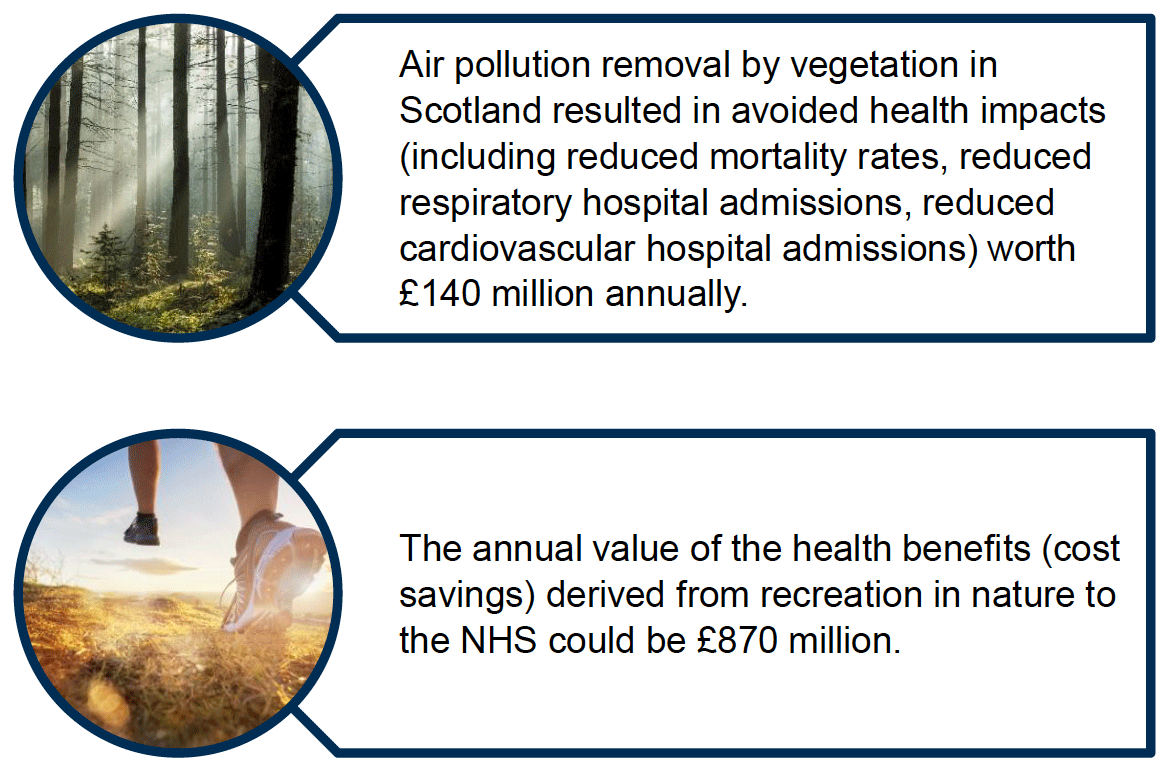
Natural assets, such as trees or vegetation, remove air pollutants, which helps to reduce the damages to health resulting from poor air quality. Physical activity undertaken outdoors can help to deliver cost savings to the health service as well. See Figure 24 for recent evidence on these natural capital benefits to health. It is likely that health impacts are undervalued in the Natural Capital Accounts as the health benefits from water quality are not included [11].
Graphic text below:
- Air pollution removal by vegetation in Scotland resulted in avoided health impacts (including reduced mortality rates, reduced respiratory hospital admissions, reduced cardiovascular hospital admissions) worth £140 million annually.
- The annual value of the health benefits (cost savings) derived from recreation in nature to the NHS could be £870 million.
Declines or improvements in natural capital will have direct and indirect effects on the health of the population. Urban populations in particular benefit from being able to visit green spaces – meaning they experience many of the positive impacts.
Air pollution especially impacts on the more vulnerable members of society – the very young and the elderly, or those with existing health conditions such as asthma, respiratory and heart disease. There are also various socioeconomic factors involved making air quality an inequality issue. Air quality is poorest in large, urban areas and can impact people from minority backgrounds and in deprived areas the most [29].
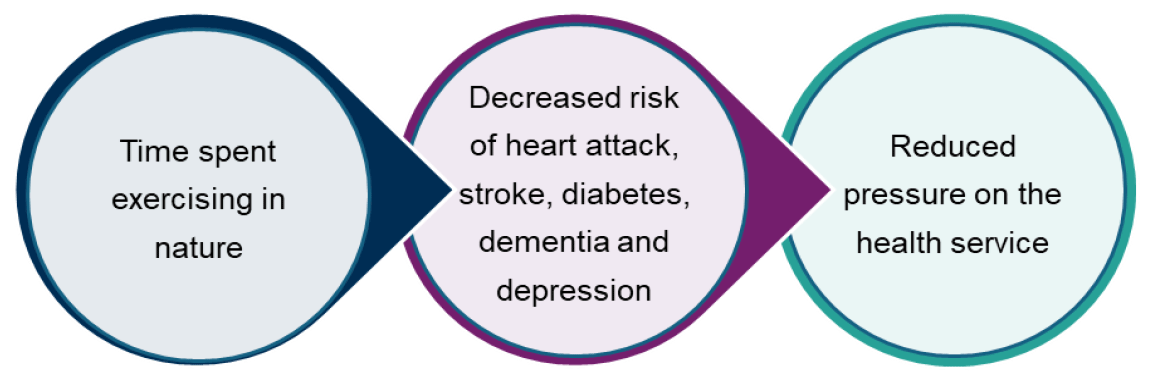
There is a case for investing in nature to result in better health outcomes; this results in less pressure on the NHS and less of the national budget being spent on treating illnesses which may be preventable. This budget can then be allocated elsewhere. This aligns with the Preventative Approach set out in Scotland’s Population Health Framework [30] that has a strong focus on “primary prevention”, actions that are designed to prevent problems occurring in the first place. Figure 25 highlights some of the benefits derived from active time spent in nature.
Graphic text below:
The benefits of exercise in nature. Time spent exercising in nature leads to a decreased risk of heart attack, stroke, diabetes, dementia and depression which leads to reduced pressure on the health service.
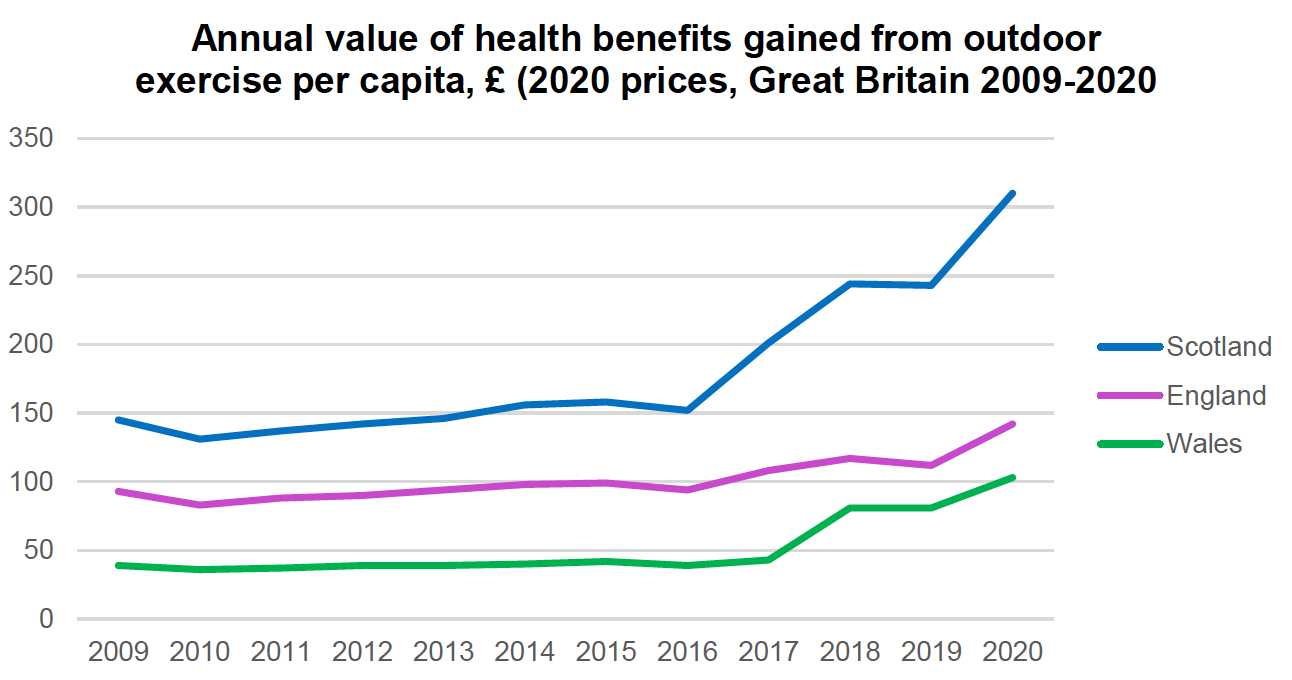
Scotland has the highest level of average health benefits per person from nature-based recreation and outdoor exercise, shown in Figure 26. There has been a strong upward trend since 2009 [31]. A significant portion of adults in Scotland visit the outdoors regularly. Scottish people are on average less healthy, which could imply that the relative contribution from outdoor exercise is greater than the UK average, resulting in a larger decrease in health costs and improvement in health outcomes.
Box 4: Valuing the health and wellbeing benefits of the NHS Scotland’s outdoor estate (June 2025) [32]
The study is the first to assess the value of the existing natural capital within the estate of a health service. It looked at the use of NHS Scotland’s green, blue or open spaces and attributed an economic value associated with the health and wellbeing benefits of visits. It uses its own survey to derive these values.
Two non-market valuation methods were used to assess the health and wellbeing benefits of the NHS outdoor estate:
- ONS exposure-based method: This method assumes individuals who spend at least 120 minutes a week in the outdoors receive a set amount of health benefits (such as increased cardiovascular health and increased mental health) with an assigned monetary value based on the NHS resources needed to achieve this health gain, expressed as additional quality-adjusted years of life.
- a Contingent Valuation method: This method studies the willingness to pay (interpreted as annual value) for open spaces at local NHS Scotland sites with usable open spaces.
The study finds that around half of the adult population visited an NHS Scotland open space in the past year. Around 122 million visits were made annually, an average of 330,000 visits per day. The majority of visitors visit frequently and only a small number make occasional visits.
A typical visit includes using the spaces to relax and take part in low-impact activities meaning that most of the benefits are likely to be linked to mental health and wellbeing.
Using the exposure method, the direct annual health benefits from time spent in NHS Scotland’s open spaces to approximately 205,000 adults each year was estimated at just under £82 million.
When the results of this study have been benchmarked to other studies, they suggest that the health and wellbeing benefits from exposure to NHS Scotland open spaces are substantial and on par with the benefits from other public open spaces.
Furthermore, the results indicate that these spaces also provide other benefits that extend beyond direct health and wellbeing to the individual.
Overall, this study highlights the current and potential social and economic value generated by investments in NHS Scotland open spaces, both at the health board and national levels.
The value of many ecosystem services is dependent on the location of natural assets in relation to the proximity of populations living close enough to benefit from these services.
For example, the value of services such as air pollution removal and recreation is dependent on the number of households or businesses who can potentially benefit from close proximity. This means their value is often much higher in urban areas rather than rural areas where less people would benefit.
For policy, this has the important implication to consider location to population (among other factors) in considering investments in natural capital. This has the potential to maximise positive outcomes by targeting the right population.
3.2. Tourism in Scotland is heavily reliant on nature
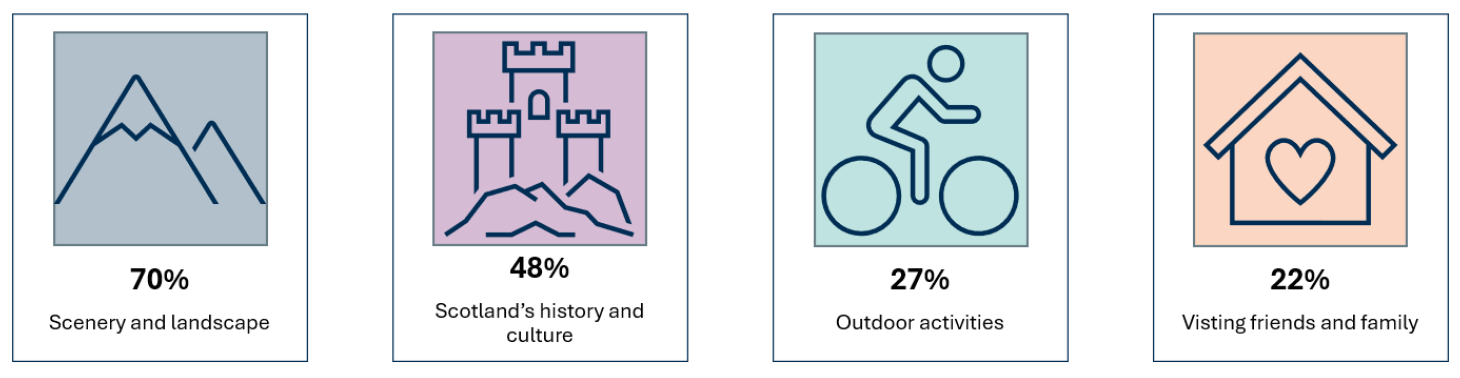
The ‘Scotland Visitor Survey 2023’ [33] found that 70% of visitors to Scotland stated that the scenery and landscape was a key reason for them to visit Scotland. In addition, 27% of visitors also mentioned outdoor activities, see Figure 27. Both of these reasons are heavily dependent on the state of Scottish nature.
Graphic text below:
The top reasons for choosing Scotland as a tourist destination include- 70% said the scenery and landscape, 48% chose Scotland’s history and culture, 27% said outdoor activities and 22% said visiting friends and family.
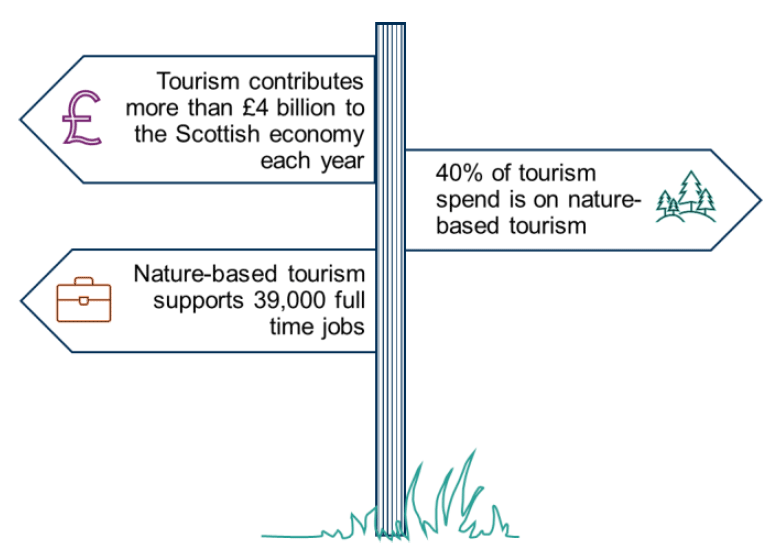
NatureScot reports that tourism contributes more than £4 billion to the Scottish economy annually and that nature-related tourism accounts for around 40% of total expenditure.
Graphic text below:
Tourism contributes more than £4billion to the Scottish economy each year. 40% of tourism spend is on nature-based tourism, this supports 39,000 full time jobs.
A detailed analysis in 2019 for Defra in ‘The Ecosystem Contribution to Tourism and Outdoor Leisure’ [35] estimated that tourism and outdoor leisure related to the natural environment generates a GVA output of £1.2 billion annually in Scotland. The report highlights that coastal margins and marine habitats make up the largest contribution to tourism and outdoor leisure activities across the UK.
3.3. Nature and health case study
Scotland’s Natural Health Service is an initiative that is aimed at leveraging Scotland’s natural environment to improve health and wellbeing and reduce pressure on the NHS; its approach is outlined in Figure 29.
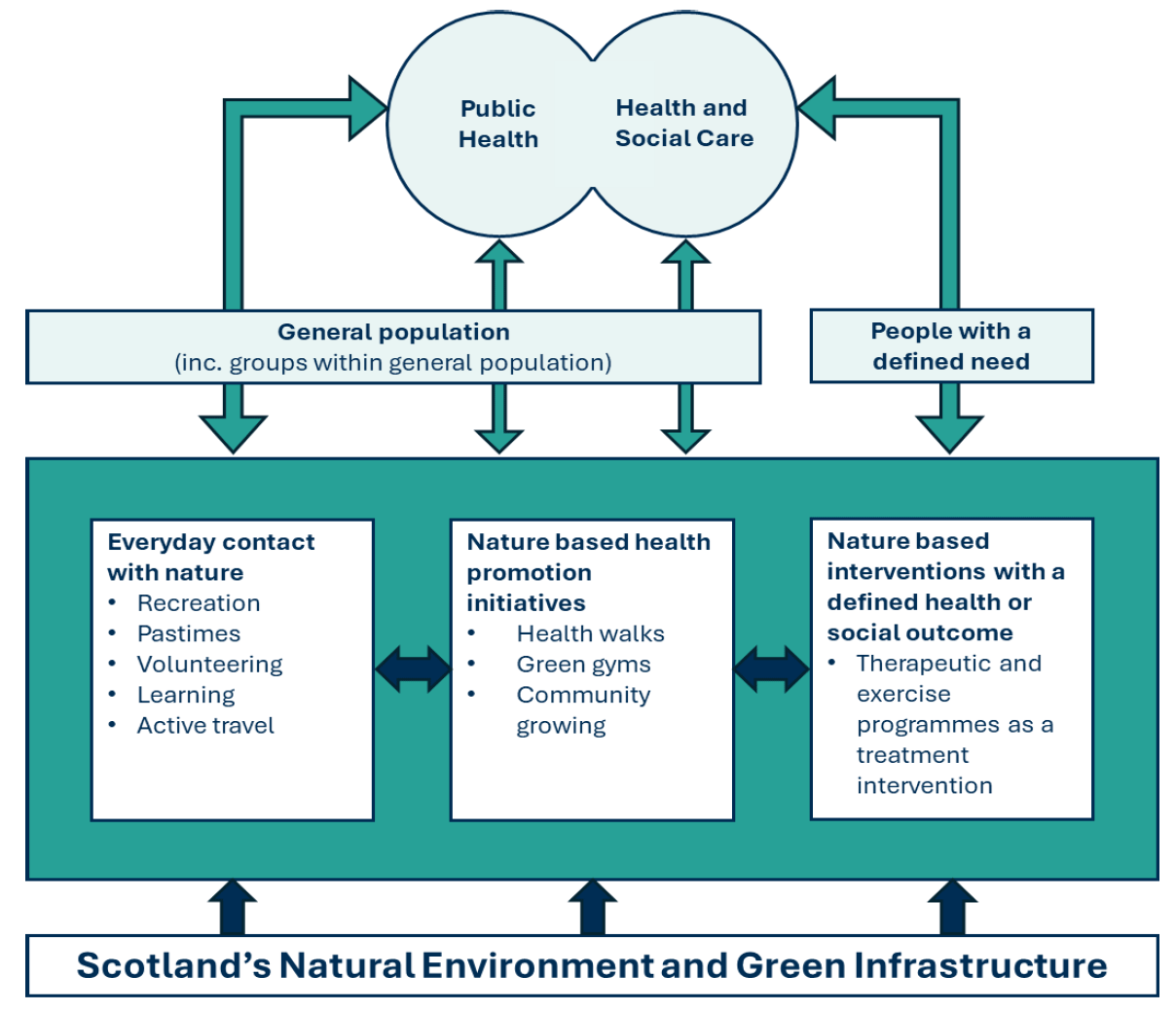
Graphic text below:
Public Health
Health and Social Care
Target Groups
General population (including groups within general population)
People with a defined need
Types of Engagement with Nature
Everyday Contact with Nature
- Recreation
- Pastimes
- Volunteering
- Learning
- Active travel
Nature-Based Health Promotion Initiatives
- Health walks
- Green gyms
- Community growing
Nature-Based Interventions with a Defined Health or Social Outcome
Therapeutic and exercise programmes as a treatment intervention
Scotland’s Natural Environment and Green Infrastructure
One way of using the natural environment to improve health and wellbeing is through Green Social Prescribing to help tackle and prevent mental illness. This involves supporting participants to access nature-based activities by linking nature-based providers and the social prescribing system. This can involve hands-on activities that are more physical, as well as outdoor therapy.
‘The National Evaluation of the Preventing and Tackling Mental Ill Health through Green Social Prescribing Project’ was a cross-governmental initiative from 2021 to 2023 to improve the use of nature-based settings and activities to improve mental health and wellbeing. The cost of the scheme was estimated at £507 per person and the social return on investment was estimated to be £1.88 of wellbeing for individual participants for every £1 invested [37].
Compared to other mental health interventions, nature-based activities are a relatively cost-efficient way to support people across a wide spectrum of mental health needs. Nature-based activities can form part of preventative care and offer more value for money.
An example of a recent Scottish pilot can be found in Box 5.
Box 5: Green Health Partnerships
In Scotland, Green Health Partnerships in Dundee, North Ayrshire, and Highlands were set up in 2018 to “encourage the health, social care, environment, leisure, sport and active travel sectors to collaborate in making better use of local green space as a health-promoting resource.” In North Ayrshire, where there is a rural-urban and mainland and island communities mix, two methods were used to embed green prescribing - a formal physical activity referral pathway called ‘Active North Ayrshire’ and social prescribing through different health and social care pathways, such as via a community link worker or pharmacist. The evaluation of the first three years highlighted the effectiveness of the pilot in facilitating green health opportunities and capacity building across sectors.
3.4. Summary of key points – Nature-related tourism and recreation boost our economy and health and wellbeing
Nature provides significant health and wellbeing benefits. Air pollution removal by vegetation in Scotland resulted in avoided health impacts worth £140 million annually. Annual cost savings to the NHS in Scotland due to nature-related recreation activities is estimated at £870 million.
It is estimated that NHS Scotland open spaces provide health benefits to approximately 205,000 adults each year when other forms of exposure from visits to outdoor spaces across Scotland are considered. This has an annual value of £73 million; these open spaces provide health and wellbeing benefits whilst reducing pressure on the NHS.
70% of visitors stated that the scenery and landscape was the top reason they chose to visit Scotland. Tourism contributes more than £4 billion to the Scottish economy each year, with 40% of tourism spend a result of nature-based tourism.
Recent evidence in Scotland and the UK is showing encouraging results for Green Social Prescribing. Nature-based activities are a relatively cost-efficient way to support people across a wide spectrum of mental health needs and offer good value for money.
Contact
Email: Georgia-Lee.Smith@gov.scot