
Making the Case for Nature: insights from Scotland's Natural Capital analyses
This report is an analytical review consolidating Scotland's Natural Capital evidence base. Synthesises over a decade of analyses to distil key insights to help inform better decision-making across government, business, and society.
Theme 2: Long-term decline in nature in Scotland, demanding stronger action
Scotland accounts for around 32% of the total UK land area with a population share of 8%. The predominant habitat types in Scotland's land cover are mountains, moorland, and heath (26%) and enclosed farmland (25%). Other key habitat types are woodland (13%) and semi-natural grasslands (10%). Between 1990 and 2021, while urban areas increased the most in relative terms (46%), woodlands increased the most in area. While 27% of land area in Scotland was farmland in 1990, by 2021 this area had decreased by 141,382 hectares to 25%, with 99,397 hectares of farmland becoming woodland [22].
2.1. State of nature in Scotland
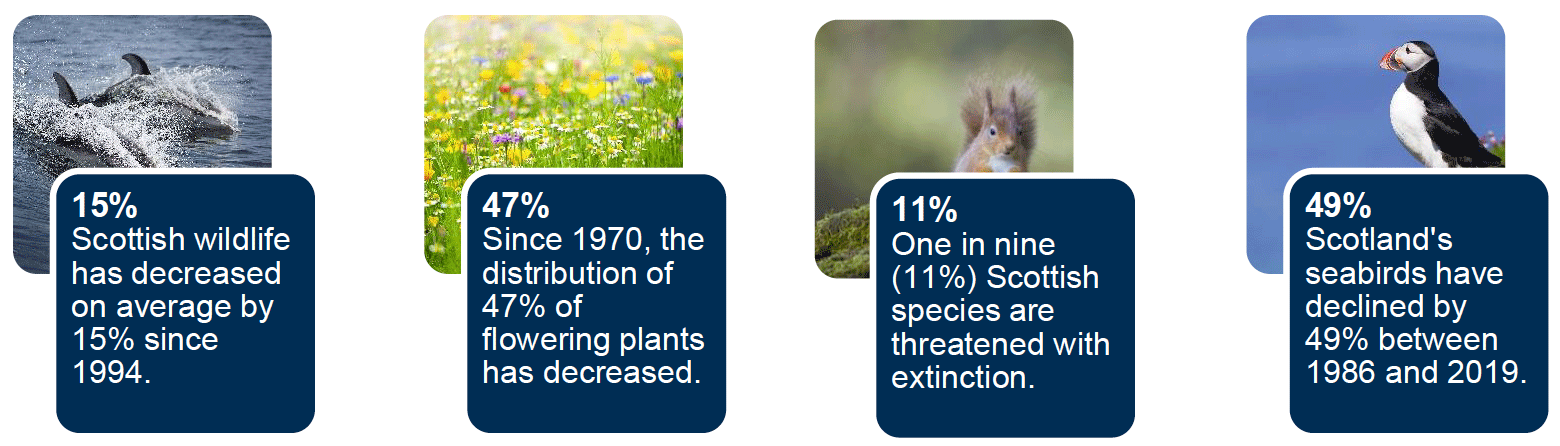
The ‘2023 State of Nature Scotland Report’ [23] highlights that Scotland – mirroring UK-wide trends – is a highly nature-depleted country. Figure 16 presents recent data on key trends in biodiversity in Scotland. As an example, for over 400 terrestrial and freshwater species, abundance across Scotland has fallen by 15%, on average, since 1994.
Graphic text below:
The key findings from the State of Nature Scotland 2023 report are that Scottish wildlife has decreased by 15% since 1994, since 1970, the distribution of 47% of flowering plants has decreased, one in 9 (11%) Scottish species are threatened with extinction, Scottish seabirds have declined by 49% between 1986 and 2019.
Nature’s decline has implications for the economy and society. The ability of our natural environment to provide benefits to people – such as removing pollution from air and water and alleviating flooding impacts – has been in decline since 1950.
There has been some evidence of stabilisation in natural capital trends with progress to restore ecosystems and move towards nature-friendly land and sea use. However, the ‘2023 State of Nature Scotland Report’ [23] highlights that efforts to recover natural capital in Scotland still have a long way to go to meet the needs of people and nature.
To provide further insight on the state and trends of natural capital in Scotland, recent findings from the ‘Natural Capital Asset Index’ [5] and the ‘Natural Capital Accounts’ [6] are explored below.
2.2. Natural Capital Asset Index
The ‘Natural Capital Asset Index’ (NCAI) [5] is produced every 2 years by NatureScot who are Scotland’s agency for nature. It was first developed in 2011 and is used as the data source for the National Indicator ‘Increase our natural capital’ in the Scottish Government’s ‘National Performance Framework’[2] (NPF) [24].
The index helps assess the capacity of terrestrial ecosystems to provide benefits to society. The NCAI [5] uses a number of data inputs to calculate how ecosystem services contribute to the wellbeing of citizens in Scotland such as habitat type, quality and their potential to deliver ecosystem services.
2.2.1. Long term trends
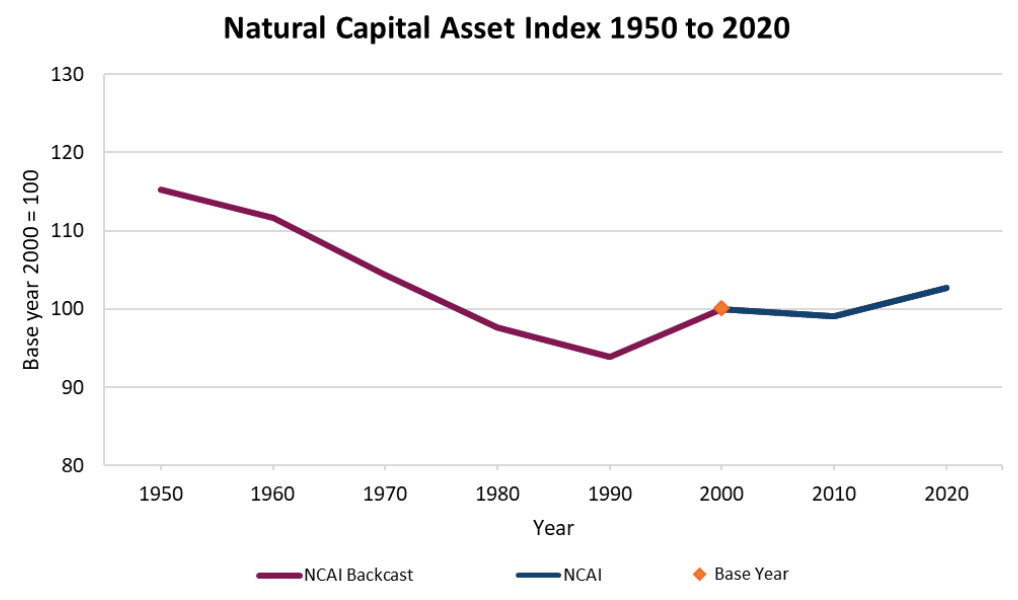
Back casting to 1950 was attempted to establish NCAI [5] trends over a longer period, albeit data availability pre-2000 was not consistent with data from 2000 onwards. The results shown in Figure 17 demonstrate a substantial downward trend in natural capital between 1950 and 1990, likely driven by factors such as habitat loss and fragmentation, management changes, and development [5].
2.2.2. Recent trends
The most recent results, released in 2025, show that the index has improved slightly over the past 20 years but shows overall decline from 1950s and 1960s.
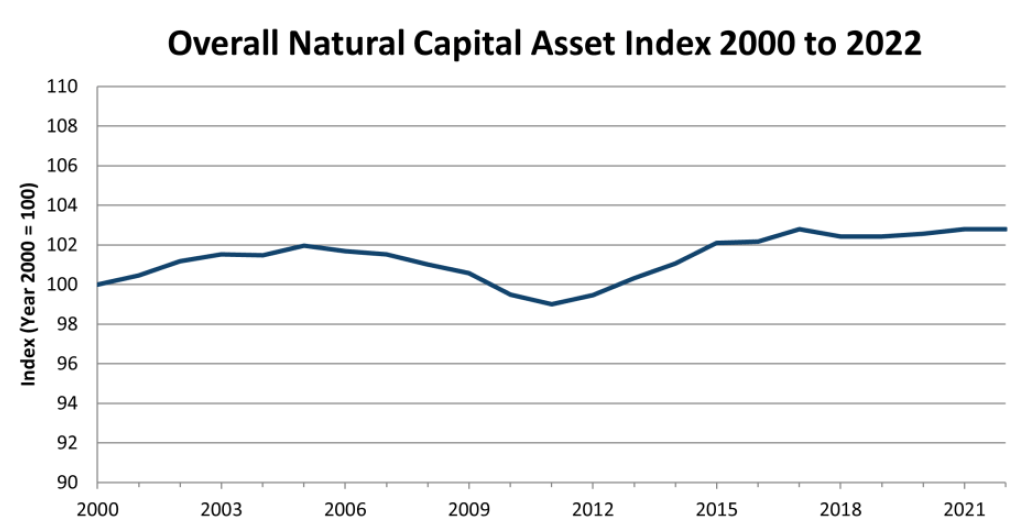
The NCAI [5] is now 2.8 percentage points above year 2000 levels, indicating an increase in Scottish nature’s ability to deliver benefits. Over the short-term (2019 to 2022), natural capital is classed as being ‘maintained’.
Whilst provisioning, regulating, and cultural ecosystem services have all increased relative to the 2000 base year, minimal growth has been recorded since 2019, indicating ecosystem service contributions to wellbeing are stable, but are not improving.
Figure 19 outlines the results for 2000-2022 by habitat type for their ability to deliver nature’s benefits. This shows that overall coastal, inland surface water, grassland, and woodland have all improved over this period. This overall picture can mask differing trends. For example, for woodlands, the improvement has been driven by an increase in extent while woodland condition has decreased.
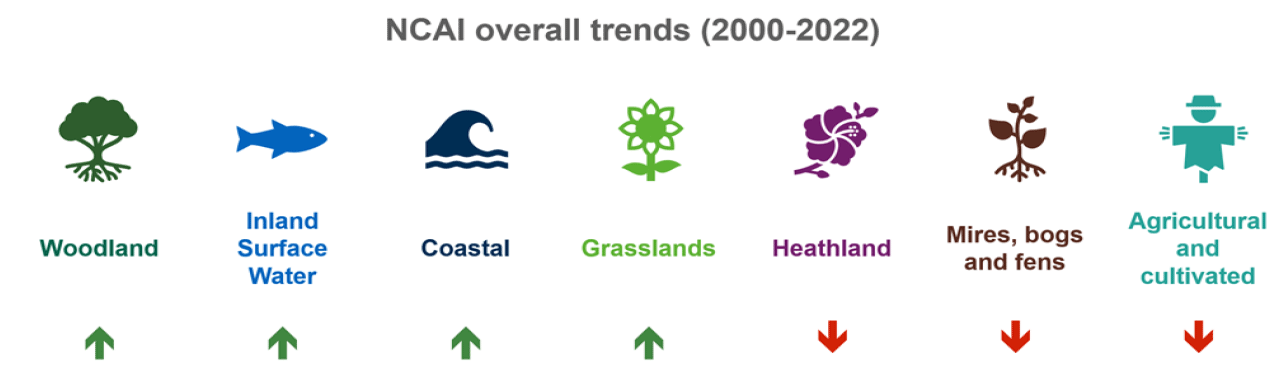
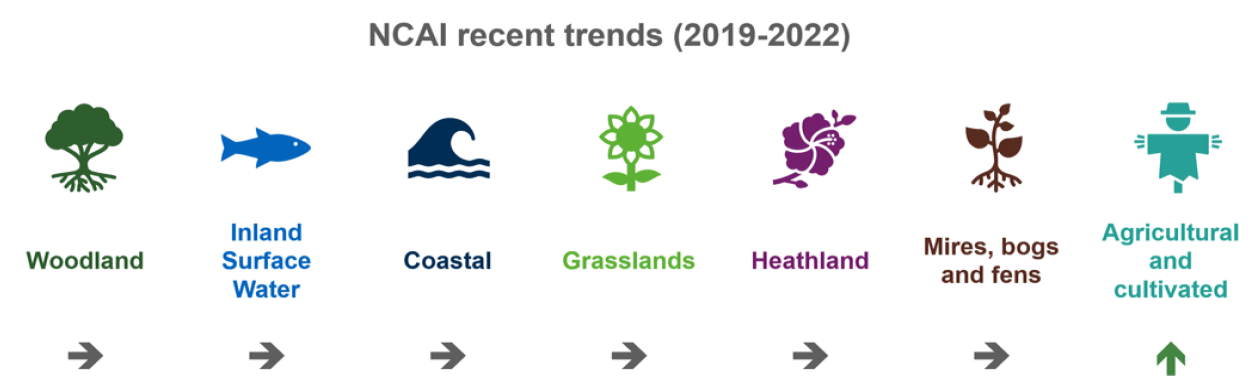
Figure 20 highlights that looking at more recent trends for 2019-2022 in the NCAI [5], all habitats were stable in terms of their ability to deliver benefits, except for agriculture, which has increased. This is likely due to decreased fertiliser use and increased habitat extent.
While we have seen improvements to the overall NCAI score since 2000, there is still a long way to go before Scottish nature has the capacity to deliver benefits to wellbeing that were seen over the longer term.
2.3. Natural Capital Accounts
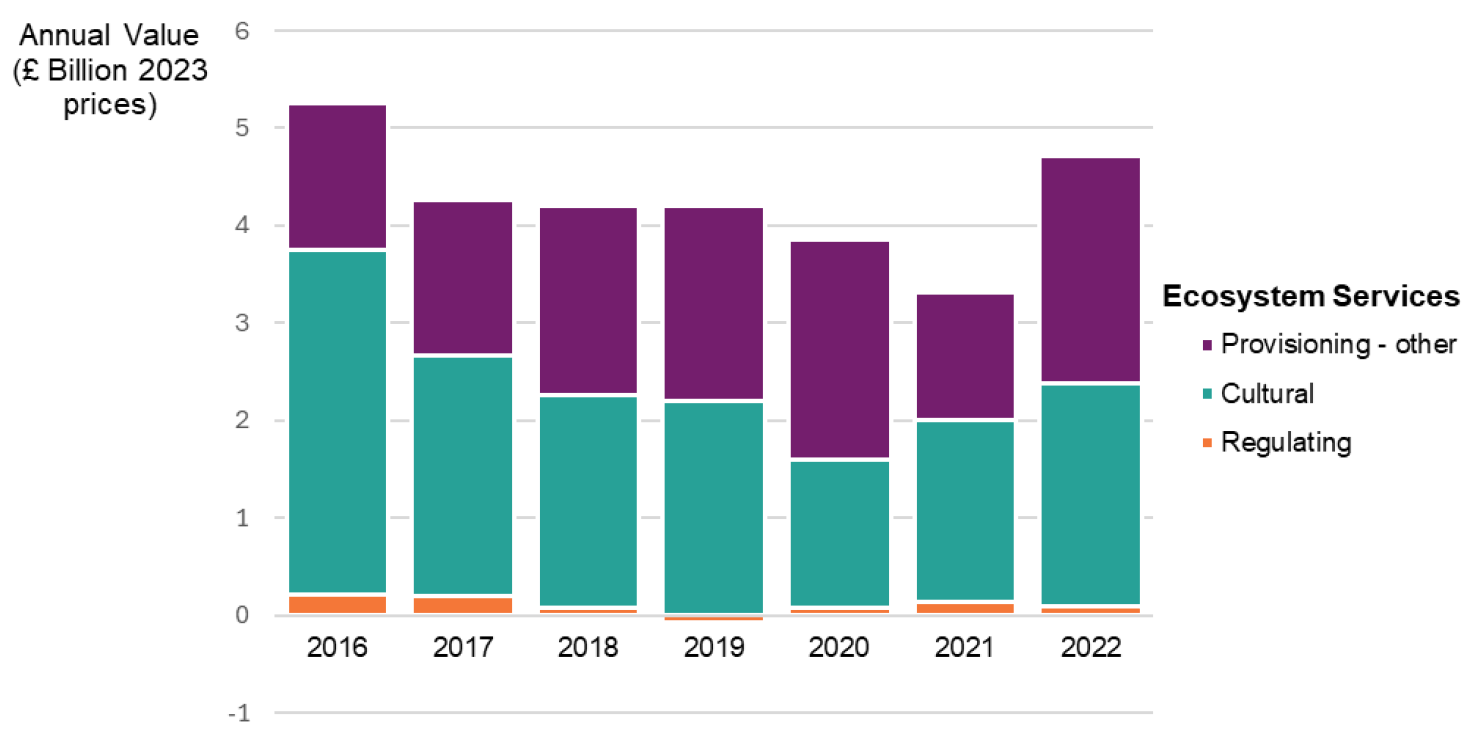
Figure 21 outlines the trends from the ‘Natural Capital Accounts for Scotland’ [11]. The trends are shown without non-renewable ecosystem services such as oil and gas and coal provisioning. Renewable energy has also been excluded due to volatile prices to better capture the trend of other ecosystem services and the value from natural assets.
The trends from the accounts highlight that:
- From 2017-2022 the annual value of natural capital was decreasing, mainly driven by changes in regulating and cultural services as provisioning services such as timber and fish capture were increasing during this time.
- Cultural services had a lower value in 2020 which is likely due to a reduction in visits to nature as a result of COVID-19 pandemic-related travel restrictions.
- In 2019, the annual value of regulating services in Scotland was negative, this was driven by emissions generated by degraded peatlands. Since then, woodlands have sequestered more carbon than emitted by peatlands.
The main difference between the NCA and the NCAI is how they represent value. The NCA measure the quantity and value of ecosystem service flows in monetary terms (consistent with national economic accounting standards) and the NCAI provide insights on value by measuring the health of an asset and the ability of nature to deliver benefits [25]
Both measures show a stable trend in natural capital in Scotland with minimal growth. More information on the differences of both measures can be found at: The Natural Capital Asset Index and the Natural Capital Accounts – How Do They Compare?
2.4. Marine trends in Scotland
NPF Commitment – “A marine environment which is clean, healthy, safe, productive and biologically diverse, managed to meet the long-term needs of nature and people” [24].
The previous sections looked particularly at the trends in terrestrial ecosystems. This section focuses on marine trends in Scotland.
Scotland’s marine environment is among the most diverse in the world and includes many different species and habitats.
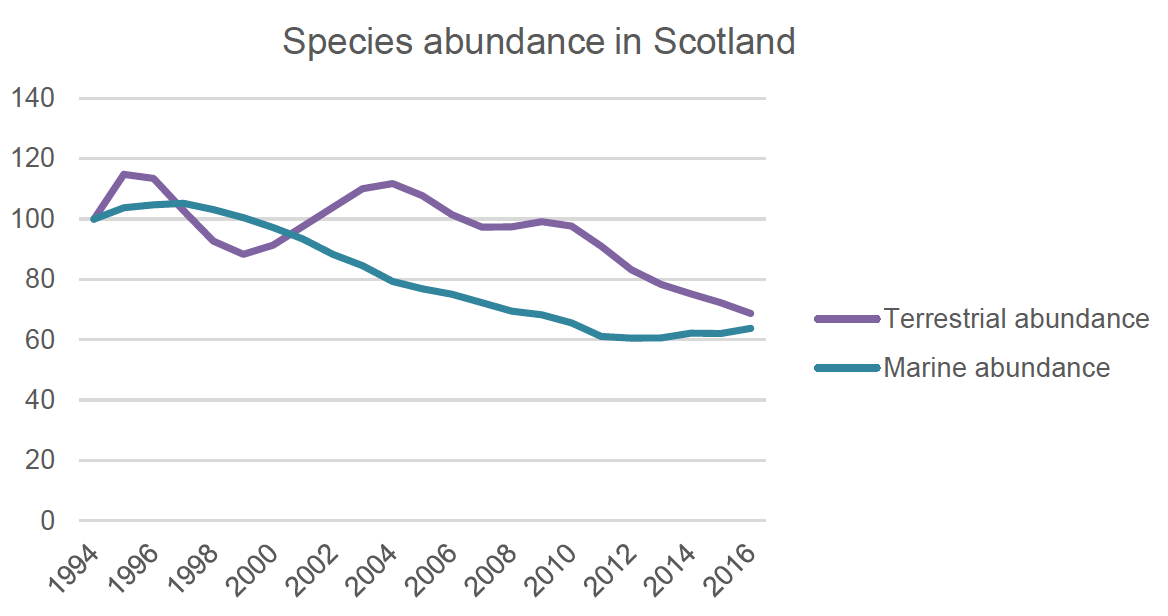
Overall marine abundance has been in decline, as shown in Figure 22 (alongside terrestrial indicators for comparison). From 1994 to 2016 the average abundance of 11 species of breeding seabird fell by 36%. However, since 2016 it appears to be stabilising.
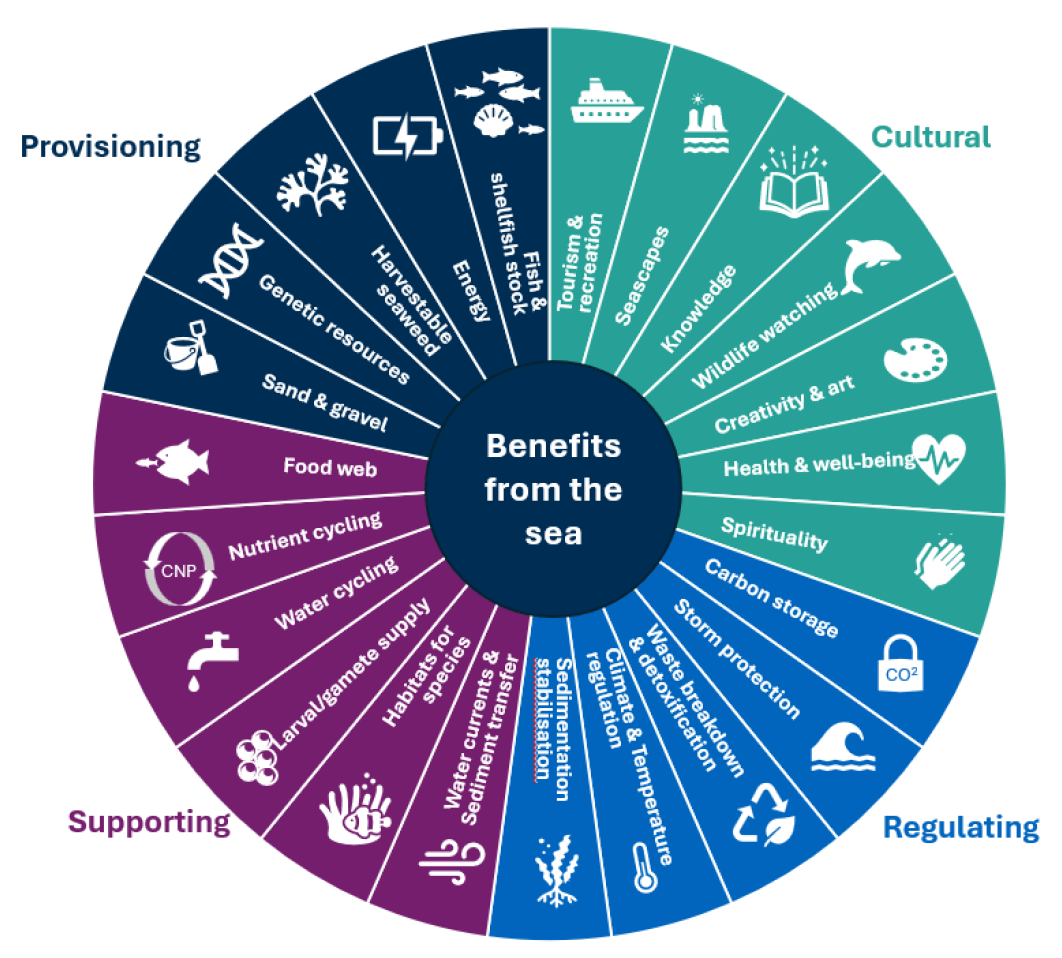
Examples of the diverse range of ecosystem services provided by marine habitats are outlined in Figure 23.
Graphic text below:
Benefits from the Sea
Provisioning
- Fish and shellfish stock
- Energy
- Harvestable seaweed
- Genetic resources
- Sand and gravel
Supporting
- Food web
- Nutrient cycling
- Water cycling
- Larval/gamete supply
- Habitats for species
- Water currents and sediment transfer
Cultural
- Tourism & recreation
- Seascapes
- Knowledge
- Wildlife watching
- Creativity and art
- Health and well-being
- Spirituality
Regulating
- Carbon storage
- Storm protection
- Waste breakdown and detoxification
- Climate and temperature regulation
- Sedimentation and stabilisation
Climate change has a significant impact on the coastal and marine environment. Impacts include sea level rise affecting coastal areas and resulting in risks to homes and businesses, as well as temperature increases that can impact marine species distribution.
2.5. Summary of key points – Long-term decline in nature in Scotland, demanding stronger action
‘The Scottish Biodiversity Strategy 2045’ [28] sets out a clear ambition: for Scotland to be Nature Positive by 2030, and to have restored and regenerated biodiversity across the country by 2045. Scotland has shown long-term declines in nature, but more recent data for both terrestrial and marine ecosystems has been highlighting a picture of stabilisation.
The ‘Natural Capital Asset Index’ (NCAI) helps assess the capacity of terrestrial ecosystems to provide benefits to society. The NCAI is now 2.8 percentage points above year 2000 levels, indicating an increase in Scottish nature’s ability to deliver benefits. Over the short-term (2019 to 2022), natural capital is classed as being ‘maintained’. In the long term, the index highlights that Scotland’s nature’s ability to deliver benefits has been in decline but has stabilised more recently.
Overall, nature’s decline has implications for the economy and society, and its ability to provide benefits to people. There has been progress to restore ecosystems and move towards nature-friendly land and sea use. However, efforts to recover natural capital in Scotland still have a long way to go to meet the needs of people and nature [23].
Contact
Email: Georgia-Lee.Smith@gov.scot