
Child poverty in the UK and Scotland
This report provides an evidence-based baseline to better understand child poverty rates across the UK nations and the respective contributions of Scottish and UK Government policies to tackling child poverty since 2010 in Scotland.
Supporting children and families to thrive
Key findings
- Interventions to support children and families to thrive are largely devolved. As such, there are differing approaches across the UK in how children and families are supported and contributions cannot be assessed. Instead, this chapter draws key learnings for Scotland.
- Early Years interventions are critical to child development and long-term outcomes. Sustained, preventative and family-centred support is most effective when embedded within wider strategies and supported by robust evaluation and continuous policy learning.
- Childcare is devolved across the UK. In England it is more closely linked to work incentives, while Scotland places greater emphasis on wellbeing and equality. Despite these differences, both systems face shared challenges around affordability, access and system sustainability, particularly for lower-income families.
- The UK Government operates measures across the whole of the UK intended to help families with childcare costs. This support is provided through tax-free childcare and Universal Credit childcare costs. Despite providing important financial support, both schemes face challenges which limit their accessibility and impact.
This chapter examines policy efforts from across the UK to support children and families to thrive. It adopts a different approach from the previous three chapters.
Policy interventions aimed at enhancing life chances and supporting children and families to thrive are largely delivered at the devolved level. This means it is not easy to identify contributions from UK-wide policy directly to Scotland’s child poverty agenda.
As a result, this chapter draws on selected examples of policy actions and interventions from Scotland, England, and Wales, focusing on the lessons they offer across the policy life cycle to inform future child poverty policy development and delivery in Scotland.
Supporting families to thrive in the early years
The Family Nurse Partnership (FNP) is a preventative intervention that supports young parents, namely young mothers, during pregnancy and the early years. It is delivered through a home-visiting programme and seeks to improve outcomes for both parents and children across a range of domains, including health, education and employment.
The FNP was introduced in England in 2007, with policy implementation in Scotland following in 2010. The programme provides a rare example of a shared policy intervention implemented separately in England and Scotland which allows for comparative learning across different policy and delivery contexts. Implementation differs in that England’s model is opt-in and locally commissioned, whereas in Scotland FNP is centrally co-ordinated through NHS Health Board delivery – with provision spanning all 11 mainland health boards.
In England, the FNP has been identified as contributing to holistic, preventative early intervention, supporting young and often disadvantaged parents across multiple domains, including, maternal health and child development.[92] It is commonly positioned as one component of a wider offer, alongside services such as health visiting and Family Hubs. However, stakeholders have critiqued the programme for focusing on too narrow a group (first-time mothers, primarily aged under 20 years).[93] Further, a randomised control trial published in 2015, found no evidence of benefit following participation in FNP on a range of health outcomes (i.e. smoking cessation, birthweight, emergency hospital visits for the child) .[94] Indeed, the researchers deemed that the FNP in England does not represent a cost effective intervention to achieve health outcomes.[95]
In contrast, more recent analysis, using data linkage, has allowed for longer term follow-up of FNP parents and children and has found the programme improved child attainment by the end of reception year and at Key Stage 1.[96]
In Scotland, the programme is delivered at a national level through health boards. It is a key component of the early years landscape as it operates alongside the Universal Health Visiting Pathway to provide targeted, intensive support to families with higher levels of need. Further, FNP has been extended to include eligible first-time parents up to age 25.
In Scotland, formative evaluation in the early stages of programme implementation allowed for an iterative process where learnings were being feedback to refine implementation,[97] while a natural-experiment evaluation using administrative data has been able to link FNP participation with a small number of positive outcomes for child and parent, including: fewer new development concerns identified at 27-30 months; child registered with a dentist by 24 months post-partum; increased prevalence of breastfeeding; and reduced child exposure to second hand smoke.[98]
The differences in policy approaches to the FNP highlight the value of piloting and continued evaluation in the early stages of policy development and implementation. The contrasting outcomes observed in England and Scotland highlight how the same programme can operate differently across distinct policy and service contexts. The divergence in policy direction is also likely to reflect broader political and strategic priorities to tackling child poverty, and supporting families, since 2010 (see chapter on Strategic approaches to tackling child poverty since 2010).
Early Years interventions are critical to child development and long-term outcomes. Sustained, preventative and family-centred support is most effective when embedded within wider strategies and supported by robust evaluation and continuous policy learning.
There are other examples of good practice from across the UK which highlight how nations have supported children to thrive during the early years, with the two focus boxes below illustrating these in terms of long-term policy development and progression. The first focus box explores the evolution from Sure Start to Best Start Family Hubs in England over the past 28 years, while the second examines the iterative design and refinement of Flying Start in Wales – the Welsh Government’s flagship early years programme.
Focus Box: Holistic, integrated, whole family support in England
Context
Sure Start was launched in 1998 as a key anti-poverty initiative, creating community-based ‘one-stop shops’ bringing together health, education, social services and the voluntary sector under one umbrella to offer a range of diverse support for families. From 2003, these programmes evolved into Children’s Centres, expanding early years childcare and parental/carer support. By 2010, England had 3,290 centres, with over 80% of 4-year olds living within 2.5 kilometres of one. [99] However, funding fell sharply after 2010, declining by £1.4 billion between 2010/11 and 2023/24.[100]
Policy actions
In 2021, the UK Government introduced the Family Hubs and Start for Life Programmes[101] to provide integrated, whole family support for children and young people. Although welcomed by stakeholders, [102] funding - £301.75 million over 2022-2025 – was modest in comparison to earlier Sure Start Children’s Centres funding levels.102 In 2025, the UK Government’s Best Start in Life Strategy committed £900 million over three years to rollout Best Start Family Hubs across all local authorities in England aiming to deliver a more connected, prevention-focused system of support.
Distinctiveness
Best Start in Life recognises the policy models that have come before and seeks to draw on the strengths of these earlier programmes to retain effective elements, while adapting to current needs and evidence.
Outcomes and impact
A range of evidence highlights the positive impact of Sure Start on child outcomes, particularly physical health outcomes[103] and social and emotional skills99– with the long term benefits reported to be likely to significantly exceed the costs of later intervention.99 The Evaluation on Children’s Centres in England reports the positive impact on the home learning and family environment,[104] improvements in maternal wellbeing and mental health, and some small positive effects across early childhood outcomes.[105] In addition, Family Hub models highlight the value of locally co-ordinated support, clearer pathways to services, and improved experience for families navigating multiple forms of support.[106]
Key learnings for Scotland
- Stable funding is essential to maintain quality of service and reach. To develop long term impacts required multi-year, sustained investment. Early progress under the Sure Start programme was undermined by budget cuts.
- Place-based, integrated and family-centred support services. Co-locating services reduces fragmentation in the support system providing clear access points for families and assisting with early intervention.
- A robust evidence base underpins effective policy development. Sure Start, Children’s Centres benefitted from evaluation and research. This allowed governments to understand what worked, for whom, and under what conditions. Embedding evaluation across the policy life cycle supports continuous improvement, accountability and can help build the case for sustained investment.
Focus Box: The Flying Start Programme in Wales: enriching experiences for children in the early years
Context
The Flying Start Programme was launched by the Welsh Government in 2006 with the intention to improve outcomes for children during the early years in the most disadvantaged areas of Wales. The Programme consists of four core elements: funded, part-time high-quality childcare for two year olds; enhanced health visitor support; access to parenting support; and, support for speech, language and communication development.[107]
Policy actions
Since the Programme’s introduction, it has been expanded in 2012 [108] and again in 2022/2023.[109] The expansions have consisted of new geographical areas being eligible for all four components of the programme and increasing the number of childcare offers made to eligible children. In 2024/25, 40,943 children received Flying Start Services (6.3% higher than expected).[110]
Distinctiveness
The long running programme has adopted a phased and targeted approach to rollout alongside a comprehensive evaluation approach. This allows for learnings to be fed into refinement of the Programme as it is scaled.
The Programme is also underpinned by broader strategies, including the Rights of Children and Young Persons (Wales) Measure 2011 and the Well-being of Future Generations (Wales) Act 2015. The former embeds a child-rights based approach and the latter promotes longer-term, integrated thinking, with a particular focus on improving prevention, equity and sustainability.
Outcomes and impact
Reported benefits from families using Flying Start include both positive impacts on child development, as well as enhanced parenting knowledge and skills.[111]
Analysis of Flying Start outcomes using linked data highlights possible contribution in the areas of achievement in the Foundation phase baseline assessments,[112] improved educational outcomes (i.e. attendance, early identification of additional support needs),108 and positive health outcomes (i.e. lower levels of accident and emergency attendance, hospital admissions).[113]
Key learnings for Scotland
- The importance of sustained, integrated family support models to provide consistent, preventative support over time. This ensures joined-up support that reflects the complexity of families’ needs and supports positive outcomes.
- Using evidence and insights from data to refine support and assist approaches to scaling up. This helps interventions to remain responsive, cost-effective and grounded in good practice.
- Embedding policies in legislative and strategic frameworks to align outcomes so that there is coherence across policy areas, and cross-government accountability for delivery and outcomes.
Supporting parents and carers into work: childcare provision
Childcare operates across multiple drivers of poverty:
- Increasing income from employment. It supports parents or carers to move towards, enter, remain in, and progress within paid employment.
- Increasing income from social security and benefits in-kind. It can function as a form of social security support when subsidised or publicly funded.
- Reducing costs of living. Where funded or made more affordable, it can reduce household costs, enabling families to allocate resources to other essential costs.
- Supporting children and families to thrive. It can contribute to improved child development and wellbeing when high quality settings are prioritised.
This report places childcare within this chapter on supporting children and families to thrive, reflecting the analytical lens adopted. This recognises childcare as a key intervention in improving outcomes for children and families, while acknowledging its important role across all drivers of poverty reduction.
As such, this section provides an overview of the approaches to childcare adopted in Scotland and England, and their impacts.
Policy context
Childcare is a devolved matter. Therefore England and Scotland adopt different approaches. The policy context looks first at the early years (before starting school), and the primary years of schooling.
Early Learning and Childcare
Scottish Early Learning and Childcare (ELC) provision is a universal offer of 1140 hours per year for all three and four year olds, with targeted provision available for eligible two year olds. This offer has been in place since August 2021. The ELC offer is framed around three high-level outcomes: improving child development and narrowing the poverty-related outcomes gap; improving family wellbeing; and increasing parental ability to take up or sustain work, training or study.[114]
In England, funded childcare starts earlier though for working parents only. There are 30 hours of funded childcare available for eligible working parents for children aged 9 months old – up until they begin primary school. This then reduces to 15 hours of free childcare for 3 and 4 year olds, but this offer is for all parents, including those who do not work (which compares to 30 hours in Scotland). The 30 hours for working parents in England in the early years is designed to financially support working families, through a significant financial relief, while also incentivising work.
School Age Childcare
In Scotland, school age childcare is intended to contribute to:
- Tackling child poverty. Parents from targeted families are able to access childcare that supports them to take up, sustain and/or increase their hours of work.
- Improving outcomes for children and families. Reducing inequalities by supporting and increasing access to integrated childcare, food and activities.[115]
The Scottish Government adopted a ‘test and learn’ approach[116] to policy development and delivery. This involved piloting and refining different models of provision through initiatives such as: the Access to Childcare Fund; the Extra Time Programme, delivered in partnership with the Scottish Football Association; and, the school age childcare Early Adopter Communities.
By contrast, England’s approach is characterised by a time-bound expansion. The National Wraparound Childcare Programme aims to ensure that by 2026 all parents of primary school-age children can access local, term-time childcare from 8 am to 6 pm, reflecting a focus on rapid scale-up.
Despite some policy differences, both Scotland and England face similar challenges in relation to affordability and access, which are discussed below.
Affordability
Affordable childcare plays a critical role in supporting families to move towards or into work, study or training. However, data from both Scotland and England highlights persistent affordability challenges across early learning and childcare and school age childcare provision.
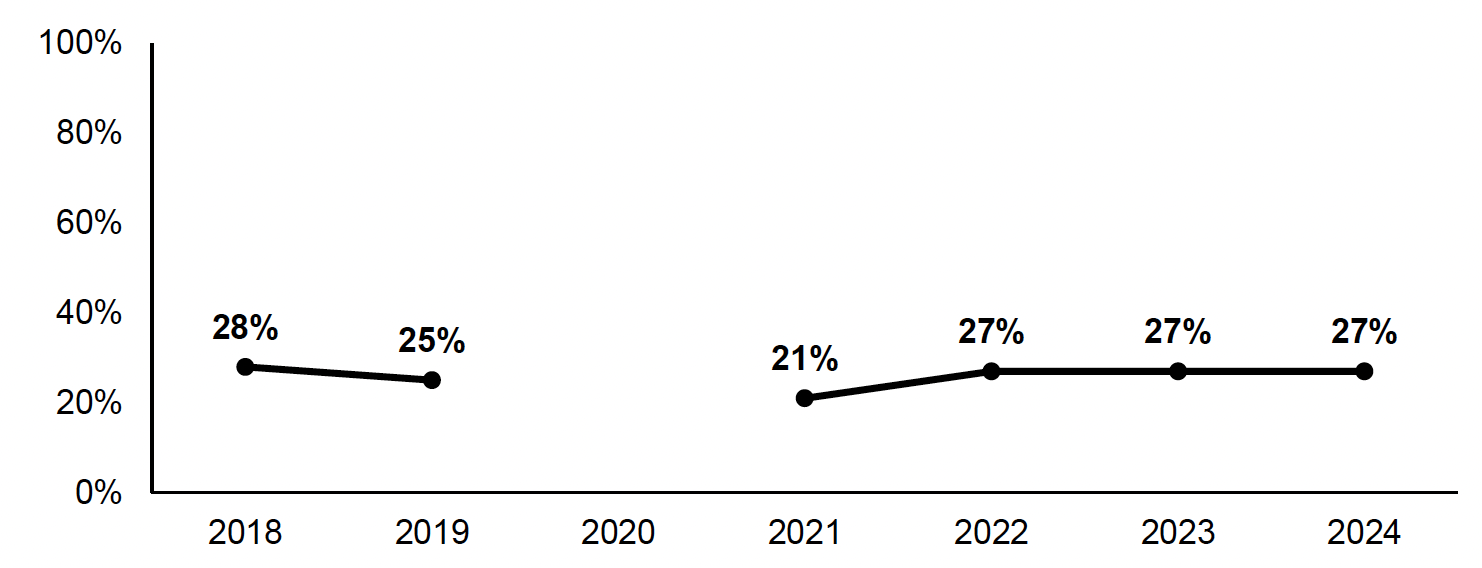
In Scotland, 27% of households with children aged 0 to 11 years who pay for childcare report difficulty meeting childcare costs (Figure 22). Affordability pressures are particularly pronounced for lower income households, with families with children aged 0 to 11 in the bottom 30% of the income distribution who pay for childcare spending a higher proportion of their income on it than those in the top 70% (13% and 8%, respectively). At the same time, a higher proportion of households with children aged 0 to 11 in the bottom 30% of the income distribution report spending no money on childcare compared to the top 70% (82% and 67%, respectively) (see Indicator 11 in the Child Poverty Measurement Framework).
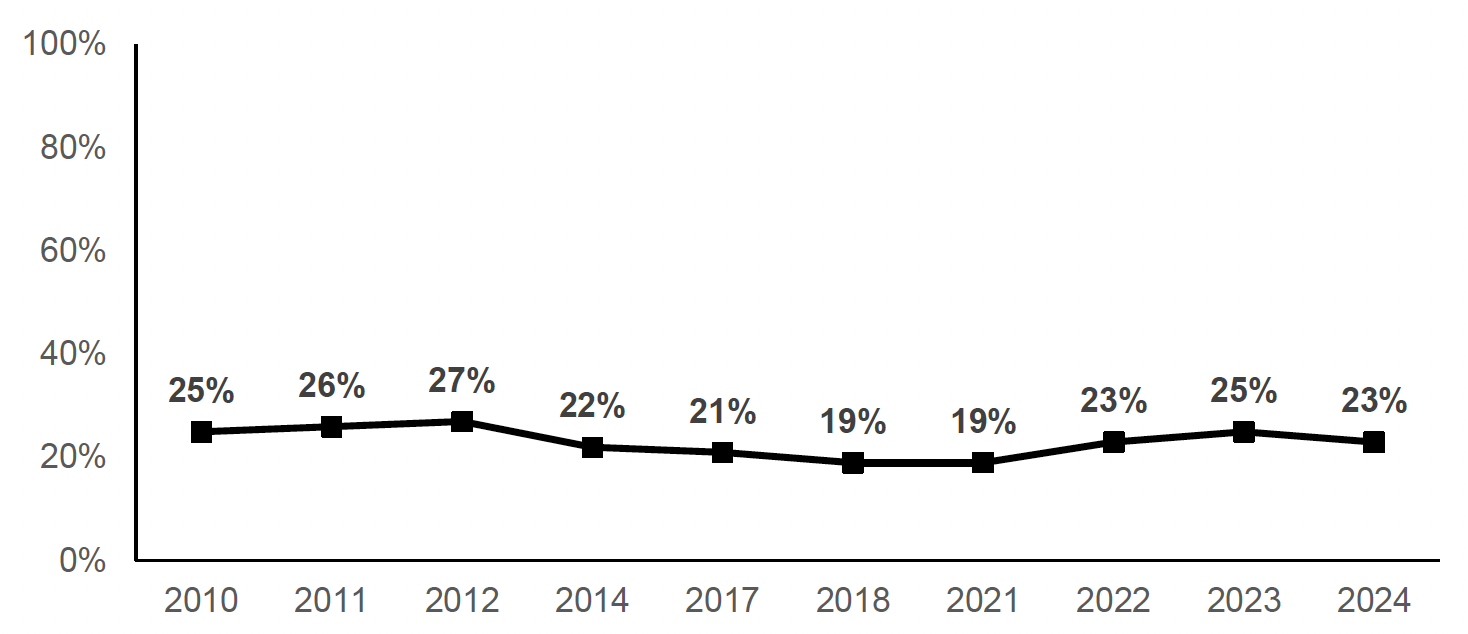
Evidence from England reflects a similar pattern. [117] Data from the childcare and early years survey of parents indicates that 23% of families with children aged 0 to 14 years find it difficult or very difficult to meet their childcare costs (Figure 23).116
There are, however, UK Government measures which operate across the whole of the UK (including Scotland) intended to assist families with childcare costs. This support is provided through tax-free childcare and Universal Credit childcare costs. The former means that the UK Government contributes £2 for every £8 paid in by families, up to a capped amount, while the latter enables eligible families on Universal Credit to reclaim up to 85% of childcare costs. It is important to note that the two schemes cannot be used simultaneously, limiting flexibility.
In March 2026, 45,730 children in Scotland had used tax-free childcare accounts – the highest level recorded since the policy was introduced.[118] While the scheme is generally perceived as easy to sign up for, some parents report that they would have benefitted from earlier awareness, pointing to a gap in communication and outreach. Further, tax-free childcare is commonly viewed by parents as a complementary form of support alongside funded hours policies and it plays an important role in helping families balance work, childcare and affordability. Its impact is particularly significant for less affluent households, where this combination of support can substantially reduce costs. This is especially evidenced for certain family types, such as lone parent families, who may rely more heavily on external and paid forms of childcare support.[119]
Meanwhile, research highlights that the Universal Credit childcare element is frequently perceived by parents and carers as difficult to understand. A key barrier to take up is the limited clarity around how reimbursement applies to individual family circumstances and the amount that will be received.[120] In addition, the requirement to pay childcare costs upfront before reclaiming them can create financial barriers, while the monthly assessment process is often viewed as an administrative burden.[121]
Access
Early Learning and Childcare
Accessible and flexible childcare that aligns with parents’/carers’ working patterns is essential for reducing barriers to work, particularly for families living on low-incomes.
In the 2025 parental survey for the evaluation of early learning and childcare, while 61% reported they did not experience challenges accessing childcare; 39% stated they had. The most common issues were: not enough places available locally; a lack of flexibility in opening hours/sessions; and, a lack of provision during school holidays.[122]
Similar findings are shared in England where the childcare and early years survey reports 40% of parents with children under 4 years find the number of childcare places locally to be ‘about right’, but 39% felt there were not enough places. Parents were also asked about desired changes to local childcare provision with a desire for more flexibility and the provision of more childcare during school holidays.116
Scotland and England also share systemic and policy implementation issues surrounding the childcare sector. For example, funded ELC provision in Scotland has encountered challenges across the recruitment and retention of staff[123] and sustainability of private and third sector providers.[124] Similarly, in England, early childcare policy has raised concerns surrounding: sustainability of the childcare sector;[125] the balance between universal and targeted provision;[126] the eligibility criteria being detrimental to, and a barrier for, parents looking to move into work;[127]and, child wellbeing, development and school readiness.[128]
School Age Childcare
Policy approaches to school age childcare in Scotland and England emphasise improving access and flexibility, though they differ in how these objectives are pursued.
In Scotland, the School Age Childcare Early Adopter Communities bring together learning from an ongoing programme of policy activity and represent a targeted, iterative and place-based approach to joining-up the childcare system. Focused in six specific local authority areas, they develop integrated, locally responsive models of childcare that provide flexible, year round provision, including term-time wraparound care as well as holiday provision. The iterative design enables continuous refinement and the generation of evidence to information national policy, with early evaluation findings suggesting provision is accessible, affordable and high quality. The Scottish Government’s 2024 commitment to extend the Early Adopter Communities to children from 9 months further strengthens this whole-system approach, aligning early learning and school-age childcare to support a more equitable, sustainable childcare system.
By contrast, England’s approach is characterised by a national time-bound expansion of provision. The National Wraparound Childcare Programme aims to ensure that by 2026 all parents of primary school-age children can access local, term-time childcare from 8 am to 6 pm, reflecting a focus on rapid scale-up within an existing childcare market. However, this model is more focused on availability than affordability, with funding largely focused on start-up support for providers rather than ongoing subsidies for families. Additionally, holiday provision is addressed separately through the Holiday Activities and Food Programme, resulting in a less integrated, year-round system compared to Scotland’s emerging programme.
Overall, these approaches illustrate two distinct policy models. Scotland emphasises system redesign through targeted, place-based, person-centred and integrated tests of change, while England focuses on system expansion through universal, centrally driven programmes. A key area of convergence, however, is the rollout of universal breakfast clubs, with both governments[129] committed to ensuring access for all primary school pupils as part of wider efforts to support families and reduce poverty.
Childcare is devolved across the UK, with England linking provision more closely to work incentives, while Scotland places greater emphasis on wellbeing and equality. Despite these differences, both systems face shared challenges around affordability, access and system sustainability, particularly for lower-income families. Financial support schemes can help offset some costs, but barriers such as limited awareness and complexity constrain take-up and accessibility.
Contact
Email: TCPU@gov.scot