
Child poverty in the UK and Scotland
This report provides an evidence-based baseline to better understand child poverty rates across the UK nations and the respective contributions of Scottish and UK Government policies to tackling child poverty since 2010 in Scotland.
Strategic overview of approaches to tackling child poverty since 2010
Key findings
- Strategic approaches to tackling child poverty vary markedly across the UK and devolved administrations. For example, the UK repealed the Child Poverty Act 2010, moving away from statutory income-based targets, while Scotland introduced statutory targets through the Child Poverty (Scotland) Act 2017, reflecting different approaches to target-setting.
- Long-term policy scope and sustained commitment to action appear to have shaped the effectiveness of devolved strategies. In Scotland, this is emphasised through a holistic approach to supporting families, which has been present throughout but has deepened over time.
- The most recent UK Government Child Poverty Strategy is intended to complement work across the UK nations and has a clear commitment to reducing child poverty with an increased emphasis on improving wider outcomes for children and families. This offers the potential to support efforts in poverty reductions in Scotland, and elsewhere.
This chapter summarises strategic approaches to tackling child poverty since 2010 across the four UK nations. We consider the contextual information for each strategy. Strategies for inclusion were selected based on the following criteria:
- The strategy has a primary policy focus on tackling poverty
- The strategy has been published, or developed, after 2010
- The strategy relates to a strategic direction in Scotland, the UK as a whole, or in Northern Ireland or Wales.
Child poverty is a high-priority and rapidly evolving policy area across the UK. Many of the most recent strategies included have been published within the past 12 months, and Northern Ireland’s Anti-Poverty Strategy remains in draft form. As a result, these documents set out planned actions for the coming years, meaning that policy direction and pace may develop over time.
It is also important to recognise the diversity of the UK policy landscape. Approaches to tackling child poverty vary considerably across nations reflecting differing political priorities, socio-economic contexts, and implementation timelines. Further, differences in devolution arrangements add further complexity to cross-UK comparisons. Variations in devolved powers affect both the range of policy levers available to each administration and the degree to which strategies can align with broader cross-government priorities. As such, each approach to tackling child poverty must be understood within its specific national, institutional, and governance context.
Overall, fourteen strategies have been included as per Table 4:
|
Year |
Country |
Strategy Title |
Time period |
|---|---|---|---|
|
2011 |
Scotland |
2011 – 2014 |
|
|
2011 |
UK / England |
A New Approach to Child Poverty, Child Poverty Strategy |
2011 – 2014 |
|
2011 |
Wales |
2011 – 2014 |
|
|
2011 |
Northern Ireland |
Improving Children's Life Chances [15] |
2011 – 2015 |
|
2014 |
Scotland |
2014 – 2016 |
|
|
2014 |
UK / England |
2014 – 2016 |
|
|
2015 |
Wales |
2015 – 2023 |
|
|
2016 |
Northern Ireland |
Delivering Social Change [16] |
2016 – 2022 |
|
2018 |
Scotland |
Every Child, Every Chance, Tackling Child Poverty Delivery Plan |
2018 – 2022 |
|
2022 |
Scotland |
Best Start, Bright Futures, Tackling Child Poverty Delivery Plan |
2022 – 2026 |
|
2024 |
Wales |
2024 – 2034 |
|
|
2025 |
UK / England |
Our Children, Our Future, Child Poverty Strategy |
2025 – 2035 |
|
2025 |
Northern Ireland |
2025 – 2035 |
|
|
2026 |
Scotland |
Bringing Hope, Building Futures, Tackling Child Poverty Delivery Plan |
2026 - 2031 |
Strategic approaches across the UK and devolved administrations
Scotland
In Scotland, the majority of the period since 2010 has focused on moving towards income-based child poverty targets (Figure 5). From 2010 to 2016, the targets were set out under UK legislation, specifically the Child Poverty Act 2010, while from 2017 onwards this has been through the targets set out under Scottish legislation and the Child Poverty (Scotland) Act 2017 (The Act). This means that Scotland is the only country within the UK that has had consistent child poverty targets.
The Act, alongside setting out statutory targets, also included provisions on measurement, accountability and reporting. This included: the development of delivery plans across time bound periods; the publication of annual progress reports; the establishment of the Poverty and Inequality Commission; and, the requirement for annual local child poverty action reports to highlight measures taken at the local level.
So far, the Scottish Government has published three delivery plans spanning the 13 year period: Every Child, Every Chance (2018-2022); Best Start, Bright Futures (2022-2026); and, Bringing Hope, Building Futures (2026-2031). Prior to 2017, tackling child poverty in Scotland was aligned with the statutory targets set out in the Child Poverty Act 2010. During this time, two strategies were published – the first strategy in 2011 and a second strategy in 2014.
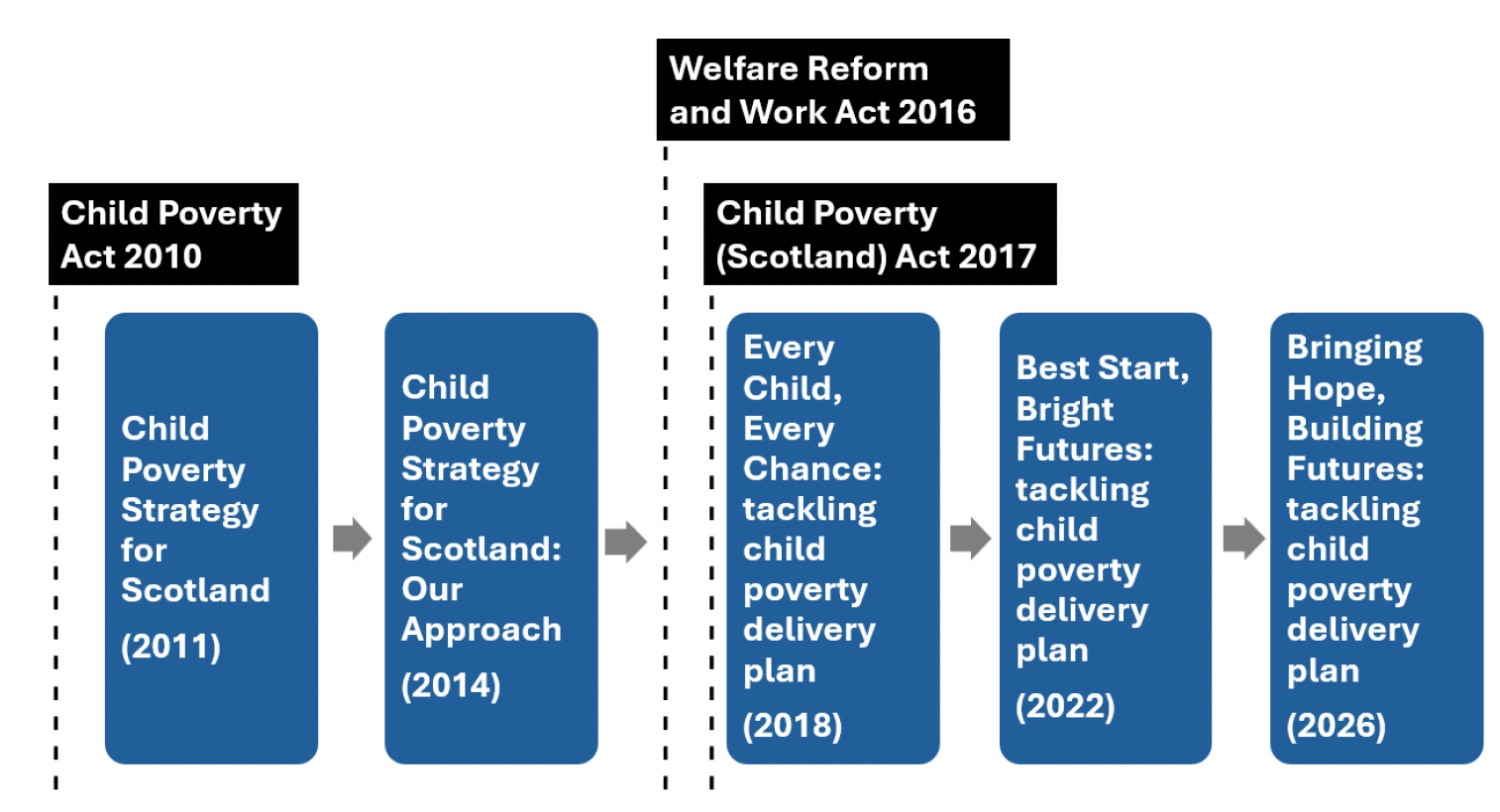
The policy direction and scope of Scottish strategies have evolved over time. Early strategies in the 2010s focused on high-level outcomes, such as maximising household resources, improving wellbeing and life chances, and place-based approaches. Since 2018, delivery plans have focused on operational delivery, setting out specific actions that strengthen the link between strategic action and implementation.
The tackling child poverty delivery plans are structured around the key drivers of child poverty: income from employment; costs of living; and income from social security and benefits in-kind. The poverty drivers have provided the overall framing for each delivery plan since 2018, while placing growing emphasis on the interconnected and multidimensional nature of poverty through supporting children and families to thrive.
Since 2010, Scottish Government child poverty strategies have emphasised supporting families as key to improving outcomes for children. This holistic approach, which recognises the need to address both child and adult circumstances through a mix of preventative and crisis support, has been present throughout but has deepened over time. Further, while early redistributive efforts were constrained by UK austerity,[17] expanded devolved powers after the Scotland Act 2016 enabled a more explicit redistributive approach, notably through the Scottish Child Payment. There has also been a sustained focus on family groups at greater risk of poverty – formalised through the priority family types identified in 2018 and broadened in the 2026 tackling child poverty delivery plan to include additional factors such as gender and other forms of marginalisation. The latest delivery plan also places increased emphasis on the depth of poverty and the need for sustained and multi-faceted support for families experiencing poverty.
Overall, this reflects a deepening understanding of poverty in Scotland, supported by a robust evidence base. It also demonstrates a sustained commitment to reducing inequalities and improving outcomes for children and families most affected by poverty.
In Scotland, there has been a strong commitment to tackling child poverty over the past sixteen years. This has enabled depth of understanding, underpinned by a strong analytical base.
UK
Throughout this report, the UK is used as the unit for reporting on UK-wide poverty data and policy action. As England does not have a devolved government, references to the UK should be understood as reflecting policy decisions that primarily apply in England, alongside reserved matters that also affect Scotland, Wales and Northern Ireland.
UK child poverty strategies have shifted over time (Figure 6). Strategies published in 2011 and 2014 were developed under the statutory requirements set out by the Child Poverty Act 2010. However, the Welfare Reform Act repealed much of the Child Poverty Act, including the legally binding 2020 child poverty targets. The Welfare Reform Act sought to reduce public spending on working-age benefits, and reframed child poverty away from income-based measures towards measures of employment, educational attainment and life chances. Following a change in political leadership, a new child poverty strategy was published in 2025 by the UK Government – with a renewed policy focus on tackling child poverty.
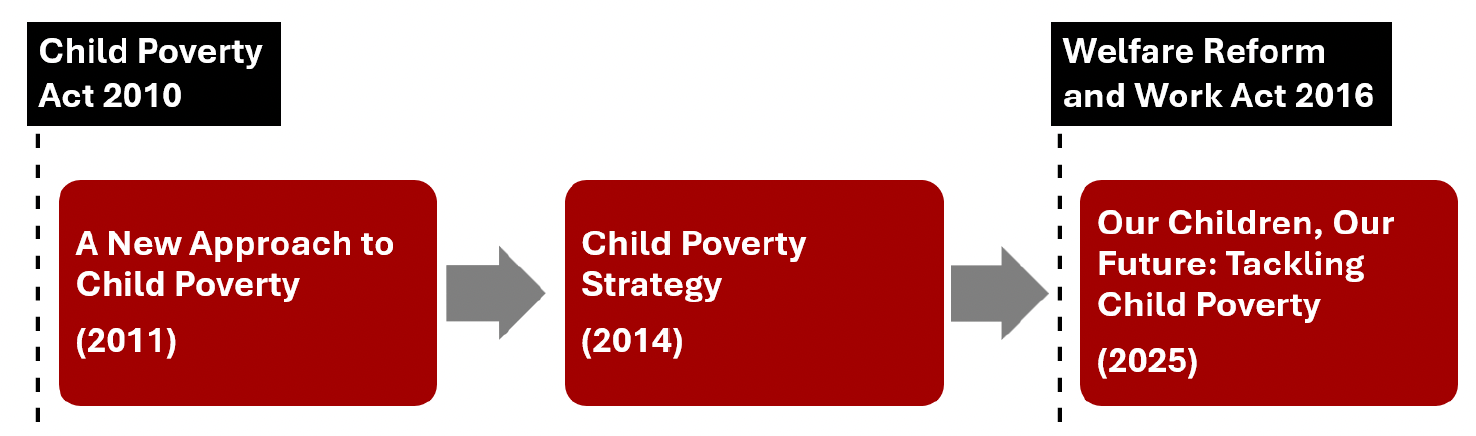
Child poverty strategies published in 2011 and 2014 emphasised paid work, financial independence and early intervention as a means of ‘breaking’ intergenerational cycles of poverty. While the strategies also referenced wider drivers, such as low earnings and educational attainment, their overall framing prioritised employment, life chances and behavioural factors. As a result, emphasis was placed on individual and family-level responsibility rather than on structural or redistributive measures to poverty reduction. Meanwhile, the child poverty strategy, Our Children, Our Future, published in 2025, covers a ten year period, and adopts a broader approach, recognising work alone cannot address child poverty. For example, the chapter on ‘boosting family income’ highlights the benefits of paid work for families and the future life chances of children, while acknowledging that these benefits are contingent on wider conditions and that paid work must be complemented by an effective social security system. This strategy is also accompanied by explicit redistributive policy measures, such as removal of the two-child limit, expansion of free school meals in England, and the reform of the child maintenance service. To support these policies, modelling has estimated that reform of child maintenance will result in 20,000 fewer children living in relative poverty across the UK,[18] while the removal of the two-child limit will lift 450,000 children out of relative poverty across the UK.[19]
The focus of these redistributive interventions, centred towards children rather than adult labour market behaviours, also shows a shift in the intended beneficiaries of child poverty strategies between the 2010s and 2025. Earlier strategies largely focused on adult outcomes, with children as indirect beneficiaries, whereas the 2025 Child Poverty Strategy places greater emphasis on children’s outcomes within a holistic family context. Further, the 2025 strategy, in an associated evidence pack on child poverty, recognises, and considers the needs of, vulnerable groups at higher risk of poverty, including: larger families (3 or more children), minority ethnic households, disabled families, lone parent families, and families with young children. These groups mirror the families identified in 2018 by the Scottish Government as at greater risk of poverty, suggesting persistent structural inequalities across the UK.
Efforts to reduce child poverty in the UK have varied over time. The latest 2025 strategy is intended to complement work across the four UK nations and has a clear commitment to reducing child poverty, with an increased emphasis on improving wider outcomes for children and families.
Wales
The Children and Families (Wales) Measure 2010 aims to improve the wellbeing of children and families across Wales through: promoting early intervention and prevention; improving co-ordination and integration across support services; and, reducing child poverty.
The Measure commits the Welsh Government to ‘prepare and publish a strategy for contributing to the eradication of child poverty in Wales’, with progress reports to be published every three years. It also places statutory duties on Welsh Ministers, local authorities and other Welsh public bodies to tackle child poverty in ways consistent with the national strategy.
Since the introduction of the Measure, Wales have published three child poverty strategies – in 2011, 2015 and 2024 (Figure 7). While the Measure does not set statutory child poverty targets, the earlier strategies were bound to the requirements set out in the Child Poverty Act 2010 and therefore were committed to achieving the child poverty targets set out by the UK Government.
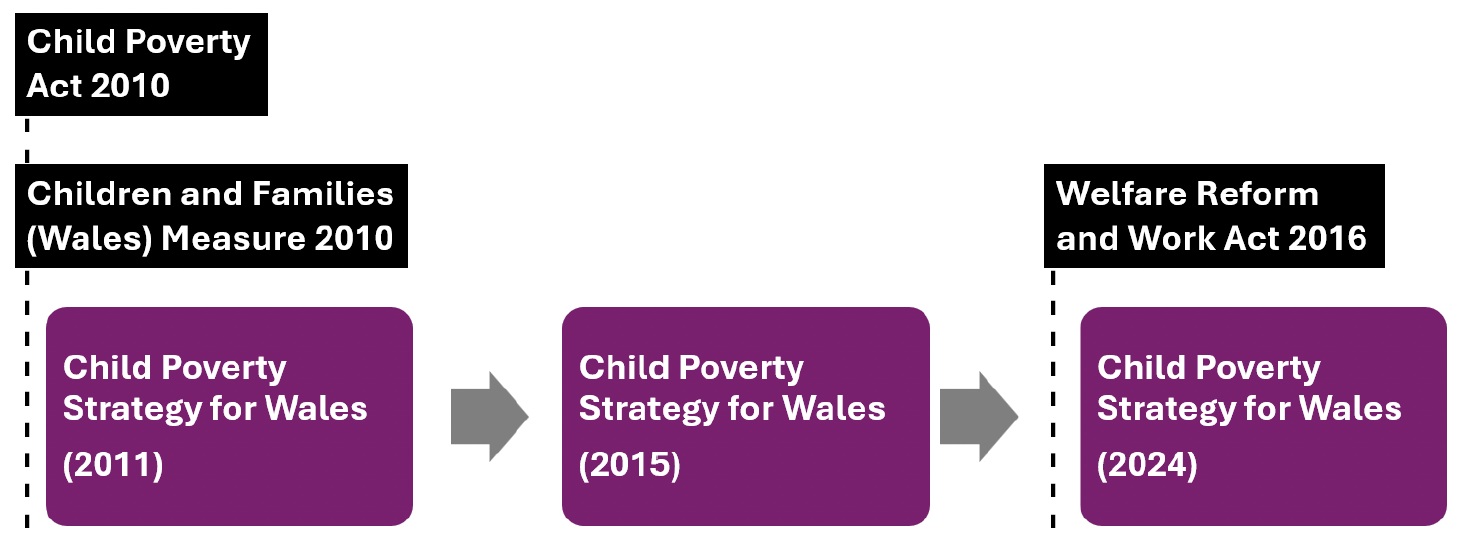
Since 2011 there has been a growing emphasis across strategies on wellbeing and quality of life, alongside a rights-based framing of child poverty, which has been strengthened by sustained commitment to, and embedding of, the United Nations Convention of the Rights of the Child (UNCRC). The focus on wellbeing and quality of life is evidenced in the focus box on Flying Start in Wales which can be found in supporting families to thrive in the early years.
The 2011 Child Poverty Strategy prioritised employability, with two of the three strategic objectives focused on: reducing the number of workless households; and, improving skills to enable secure and well-paid employment. Since 2015, strategies have adopted a more holistic approach, combining action across employment and skills with income maximisation, cost reduction, fair work and cross-government responsibility. This shift reflects a broader conceptualisation of poverty and a recognition of the limits of employment-focused interventions.
Further, the Welsh strategic approach has been grounded in a consistent understanding of poverty as a long-term lack of resources affecting both living standards and participation in society. Under this framing, the Welsh Government focuses on devolved levers, recognising that key powers over taxation and welfare remain reserved to the UK Government. As a result, the 2024 Child Poverty Strategy adopts a pragmatic aim: ‘to contribute to the eradication of poverty but [also] to eradicating the worst effects of poverty on children and young people’.
Long-term policy scope in Wales, as reflected in its sustained commitment to embedding wellbeing and children’s rights across legislation and policy, has been important to tackling child poverty alongside a strategic focus on devolved levers.
Northern Ireland
The timing and form of anti-poverty strategies in Northern Ireland have been shaped by periods of Executive instability resulting in extended gaps between strategies. Since 2010, three strategies have been published. Two focused explicitly on tackling child poverty in 201115 and 2016,16 followed by a broader cross-cutting, anti-poverty strategy in 2025 (Figure 8). The most recent strategy was issued in 2025 in draft form as part of a consultation exercise, and is therefore still under development and subject to revision.
Child poverty strategies in Northern Ireland have been non-statutory since the repeal of the obligations under the Child Poverty Act 2010, but under Section 28E of the Northern Ireland Act 1998 the Northern Ireland Executive are expected to ‘adopt a strategy setting out how it proposes to tackle poverty, social exclusion and patterns of deprivation based on objective need’. The 2011 and 2016 child poverty strategies were developed within the framework of Lifetime Opportunities, the Northern Ireland Executive’s overarching anti-poverty and social inclusion strategy published in 2006. This legal and strategy context helps to explain the subsequent shift towards a broader, cross-cutting anti-poverty strategy in 2025, rather than the development of a further strategy specifically focused on children and young people.
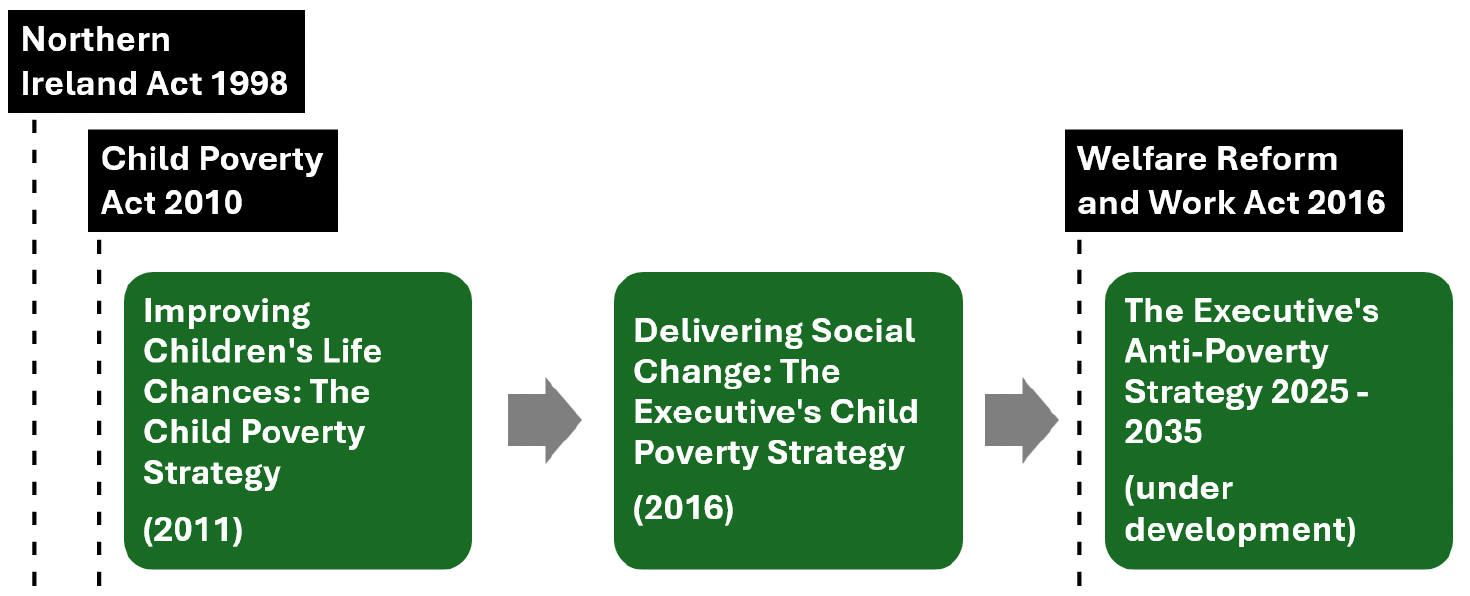
Northern Ireland has maintained a relatively consistent policy scope across all three strategies. Paid work is consistently framed as a crucial mechanism in reducing poverty, although this emphasis is articulated more holistically in the 2025 Anti-Poverty Strategy (i.e. placing greater weight on wider employability and skills development and on tackling structural labour market factors such as low pay and insecure work). Additionally, tackling intergenerational poverty is a consistent strategic priority.
As previously noted, the earlier two strategies were aligned with the Child Poverty Act 2010 and were therefore committed to achieving the statutory child poverty targets in 2020. By contrast, the most recent draft Anti-Poverty Strategy moves away from a target-based approach, adopting a flexible, ten-year framework to be delivered within fiscal constraints.
Northern Ireland has a duty to publish strategies on tackling poverty and social exclusion, but these are not required to focus specifically on tackling child poverty. Political instability has significantly shaped the timing, form and continuity of anti-poverty strategies.
Contact
Email: TCPU@gov.scot