
Child poverty in the UK and Scotland
This report provides an evidence-based baseline to better understand child poverty rates across the UK nations and the respective contributions of Scottish and UK Government policies to tackling child poverty since 2010 in Scotland.
Increasing income from social security
Key findings
- Most benefits with the greatest potential to impact child poverty are reserved to the UK Government. However, since the establishment of Social Security Scotland, a package of devolved benefits have been developed. These are often more generous than the UK benefits they have replaced, or are entirely new (such as the Scottish Child Payment) with no direct equivalent in the UK Government social security system.
- Low UK benefit levels, alongside periods of benefit freezes have constrained progress in reducing child poverty. In this context, Scottish Government action has frequently acted to mitigate these negative impacts.
- UK Government welfare reforms introduced since 2010 have had mixed impacts on child poverty. Universal Credit simplified benefit administration and transitions between benefits – with many families experiencing an improvement in their financial circumstances. However, some groups – particularly families that include a disabled household member – have been made worse off.
- Child Benefitprovides valuable support to keep families above the absolute poverty threshold. The introduction of an effective means test through the High Income Benefit Charge (HIBC) has impacted take-up rates for the benefit and the unequal application of the HIBC particularly disadvantages lone parent households.
- UK-wide schemes such as Healthy Start have played an important role in shaping early years nutritional and financial support. However, devolved policies in Scotland – including Best Start Foods and the three Best Start Grants– have gone further by increasing payment levels, reducing stigma, and providing clear evidence of reductions in material deprivation, food insecurity and financial stress among low‑income families with young children.
- The two-child limit substantially increased child poverty by disproportionately affecting larger families. Its removal by the UK Government from April 2026 is expected to significantly reduce child poverty. This will enable the Scottish Government to redirect previously planned mitigation funding towards enhancing devolved benefits and delivering wider whole family support. The impact of this change may be constrained by other welfare restrictions that continue to constrain family incomes.
This report does not include any comparisons in indicator data for increasing income from social security. Different delivery mechanisms make direct comparisons difficult (as based on the child poverty measurement framework). Instead, this section of the report portrays how policies have diverged and summarises evidence of impact from evaluations available.
Introduction to the policy landscape
Powers over social security in Scotland are currently shared by the UK and Scottish Governments. Up until 2016 social security in Scotland was reserved to the UK Government. The Scotland Act 2016 devolved significant new social security powers to the Scottish Government. The Social Security (Scotland) Act 2018 which followed set out the establishment of a new agency, Social Security Scotland, to deliver the devolved benefits. This meant that up until 2018 all benefit recipients across Scotland received broadly the same benefits as people across the UK.
Since the introduction of Social Security Scotland in 2018 the landscape changed and families could then access support provided by both the Scottish and UK Governments, making it harder to disentangle their contribution to poverty trends. Still, most of the benefits with the potential to have the largest impact on child poverty are reserved to the UK government (such as the child element of Universal Credit).
For the purpose of this chapter we are focusing on reserved policies that are anticipated to have the largest direct impact on child poverty rates in Scotland. These are: Universal Credit; Child Benefit; benefits for families in the early years; and the two-child limit. Other chapters in this report cover other benefits: the employment chapter refers to Parental Pay/Leave policies, while the cost of living chapter covers other benefits relating to directly reducing households’ spending on essentials.
Universal Credit
Universal Credit was introduced in the UK as part of the Welfare Reform Act 2012. The new system replaced six ‘legacy benefits’ into one payment. These benefits included Child Tax Credit, Working Tax Credit, Income-related Employment and Support Allowance, Income-based Jobseekers Allowance, Income Support and Housing Benefit.
Evidence[41] to monitor the impact of Universal Credit has shown that many families have seen an improvement in their finances as a result of this reform. Across the UK, almost half (47%) of households affected by the Universal Credit reform gained at least £200 per year. Couples with children are most likely to gain financially, compared to the legacy system, with 72% of families with children also gaining at least £200 per year. However, some households are worse off as a result of the Universal Credit reforms, such as households with over £16,000 in assets, as capital rules previously did not apply to Working Tax Credit or Child Tax Credit under the legacy system. Families receiving health related benefits have experienced the most significant effects of the reform. Depending on the combination of disability and incapacity benefits they receive, these households may be either substantially better or significantly worse off. While not separately assessed, it is anticipated that similar scale impacts will be seen in Scotland.
The level at which Universal Credit payments are set has a direct impact on poverty rates. Scotland has used a significant amount of its devolved budget to mitigate aspects of UK-wide Social Security policy. While this contributes to poverty reduction, it represents one element within a broader set of drivers. The following sections explore the impact of Child Benefit as well as how specific devolved interventions have been implemented in Scotland to support low income families.
UK Government welfare reforms implemented since 2010 have had mixed impacts. While households with children are generally likely to have experienced improvements in their finances following the introduction of Universal Credit, others have been adversely affected.
Child Benefit
Child Benefit is a long-standing policy, introduced under the Child Benefit Act 1975. It was a universal entitlement at a set rate. The rate was later altered to a higher payment for the first or only child and a lower rate for subsequent children. While the structure of the benefit has remained relatively unchanged, payment levels increased significantly from 1998 as part of wider efforts to increase financial support for families with children. As of May 2026, Child Benefit is set at £27.05 per week for the eldest or only child and £17.90 per week for each additional child.[42]
Since 2013, Child Benefit has effectively become means tested through the introduction of the High Income Benefit Charge (HIBC). As of April 2026 the threshold sits at £60,000, with the benefit fully withdrawn at £80,000 following a slow taper. [43] The HIBC was introduced alongside broader UK Government welfare reforms in the context of reducing the benefits bill (further detail on welfare reforms and the labour market).
Child Benefit boosts household incomes directly as a cash transfer which can help to keep families above the poverty threshold. Indeed, moving from universal support to a more targeted approach was also intended to support those families most in need whilst rationalising the child benefit system.43
The introduction of the HIBC is likely to have affected Child Benefit take-up among parents, with rates declining from 97% in 2012 to 87% in 2025.[44] There are concerns that the HIBC is inequitable in its application. As it is assessed on an individual income basis rather than total household income, families with a single earner just above the threshold can lose some or all of their Child Benefit, while dual‑earner households with higher combined incomes may retain full eligibility. This can be particularly disadvantageous to lone parent households who often face more acute financial pressures than households with more than one earner.[45]
UK Government Child Benefit provides valuable support which can help to keep families above the absolute poverty threshold. The introduction of an effective means test through the High Income Benefit Charge (HIBC) has impacted take-up rates for the benefit and the unequal application of the HIBC particularly disadvantages lone parent households.
Social security benefits from pregnancy and early years
Both the Scottish and UK Governments have introduced a range of measures to support families during their children’s early years.
Pregnancy onwards
The Scottish Government developed the Best Start Grant following the devolution of responsibility for the Sure Start Maternity Grant which was administered by the Department of Work and Pensions. The new Best Start Grant expanded the support provided with new payments for families.
The Sure Start Maternity Grant provides £500 for the birth of a first child and, with some exceptions for multiple births, does not provide support for second and subsequent children. The Best Start Grant Pregnancy and Baby Payment increased provision for a first child to £600 in Scotland. Additionally, a £300 Pregnancy and Baby Payment is made for each qualifying second or subsequent child.
Best Start Grant also introduced two additional £250 payments: the Early Learning Payment and the School Age Payment. The 2025 evaluation shows that by providing support at key transition points in a child's early years, the majority of Best Start The evaluation shows that Grant recipients use the money for child-related expenses and say the payments help to buy their child items at key transition points, such as starting nursery or school. The majority of respondents agreed the payments reduced their financial worries. [46]
Healthy food
The Healthy Start Scheme was rolled out across the UK from 2006. Evidence[47] shows that the scheme helped families to buy essentials such as milk, formula, fruit, vegetables and baby food. The Healthy Start vouchers were recognised as providing both a nutritional and financial safety net for some low income families. The scheme also supported families by making healthy food more affordable and improving their food security.
In 2019, the Healthy Start Scheme was replaced by Best Start Foods in Scotland. A key difference is that the amount paid is higher under the Scottish scheme.[48] In addition, payments under Best Start Foods are made via a payment card used like a normal bank card, this was a change from Healthy Start which used vouchers, although Healthy Start has also been delivered through a similar payment card since 2022. Overall the evaluation demonstrated that Best Start Foods had built upon Healthy Start, reducing stigma, offering a wider range of foods, as well as supporting healthy choices and household finances.[49] A later evaluation confirmed that parents continue to use Best Start Foods to buy a wide range of healthy foods for their child.46
Wider social security support
Through devolved powers, the Scottish Government expanded on the range of benefits provided to families. The Best Start Grants and Best Start Foods mentioned above, sit as part of a wider package of five family payments. These are then complemented by the Scottish Child Payment, a new benefit that does not have a comparator at UK level. This means that the current package of social security benefits for families in Scotland is wider and more generous than in England.
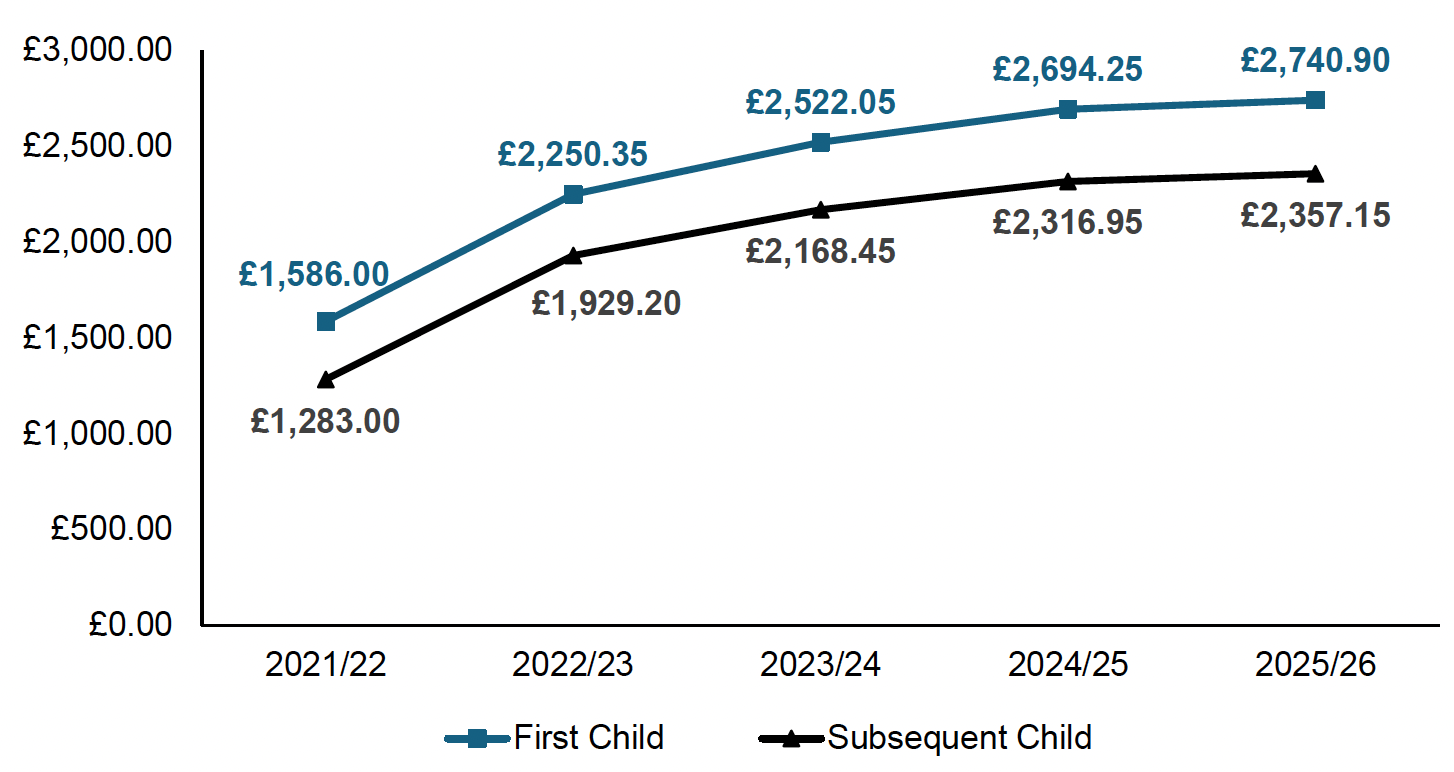
Specifically looking at Scotland, since the introduction of the Five Family Payments, the real-term value (in 2025/26 prices) for a couple household with a newborn baby has increased year on year since 2021 with the most recent annual value reaching £2,740.90 for a first child and £2,357.15 for any subsequent children (Figure 15). These increases reflect both the uprating of these benefits using the Consumer Price Inflation (CPI) rate for each financial year but also the incorporation of any relevant policy changes, such as increases to the financial value of any of the payments, into the value of the Five Family Payments.
In addition, take-up of the Scottish Child Payment has risen over time, reaching 97% for children under 6 and 92% for children between 6 and 15 in 2024/25 (see Indicator 23 in the Child Poverty Measurement Framework). While the take-up rate for children between 6 and 15 is slightly lower it is important to note that Scottish Child Payment was only extended to this age group from 2022 onwards.
The evaluation of the Five Family Payments demonstrates that these payments have helped to reduce material deprivation for low income families in Scotland. 81% of Scottish Child Payment recipients, 70% of Best Start Foods recipients and 76% of Best Start Grant recipients say that the support received reduced their money worries. Survey research also shows that the Scottish Child Payment stopped some recipients from borrowing money and the payments helped to reduce food insecurity. Families with three or more children were particularly likely to report positive outcomes across these measures.46
UK Government schemes such as Healthy Start have been influential in setting a standard for the provision of nutritional and financial support in the early years. However, devolved policies in Scotland - including the Five Family Payments - have gone further by increasing payment levels, reducing stigma, and demonstrating clear evidence of reduced material deprivation, food insecurity and financial stress among low‑income families with young children.
The two-child limit
The two-child limit, implemented by the UK Government in 2017, limited benefit payments under Universal Credit to the first two children in a family, resulting in a disproportionate negative impact for families with three or more children. Indeed, the two-child limit has been described by the current UK Government as the biggest single driver of child poverty, and they enacted legislation ending the policy from April 2026 as a key commitment of their child poverty strategy, Our Children, Our Future. In Scotland, data has also shown increases to poverty rates amongst families with three or more children with wider evidence linking poverty increases to the two-child limit policy.[50]
The impact of removing the two-child limit across the UK is estimated to be substantial. UK Government modelling shows that by 2030 there will be 600,000 fewer individuals in relative low income after housing costs as a result of removing the policy, including 450,000 children.[51] Scottish Government modelling estimates 20,000 children being kept out of relative child poverty by 2026/27, rising to 30,000 children by 2030-31 as a result of this policy alone.23
The removal of the two-child limit will positively impact larger families, but it is also worth highlighting that families from minority ethnic backgrounds will also benefit as a quarter of children (25%) in families with three or more children also live in a minority ethnic household.[52] Analysis conducted by the Joseph Rowntree Foundation highlights that for larger families in Scotland it is the amount received in benefit payments that is inadequate, rather than a lack of awareness or limited take-up.[53] Research on the cost of a child in Scotland has also demonstrated that while the share of costs covered by social security and benefits in-kind is broadly similar for in-work families with one or two children, there is a substantial shortfall for the share of costs covered for in-work families with three or more children. The two-child limit is a key driver of this disparity.[54]
As noted above, the Scottish Government had committed to mitigating the two-child limit prior to the UK Government decision that the policy was to come to an end. An indirect impact of the UK Government’s decision to scrap the two-child limit is that the Scottish Government has been able to reinvest the funding that had been allocated to the two-child payment into additional measures to tackle child poverty. This includes additional support for Whole Family Support or increases to the value of the Scottish Child Payment amongst other policies. Impacts of these increases to welfare will be monitored going forwards.
The removal of the two-child limit must be viewed alongside the wider welfare reforms outlined in the chapter above on increasing income from employment. These include the benefit cap which limits the support a working age household can receive[55] and Universal Credit rules that pay lower rates to under‑25s.[56] In addition, the benefit freeze from 2015 to 2019 reduced the real value of payments, and its effects persist despite subsequent uprating. As outlined in the cost of living chapter below, ongoing constraints, such as the freeze in local housing allowance rates, further limit support. Together, these caps, freezes and age-related rules mean that some families may see little or no income gain from the removal of the two‑child limit.
The two-child limit substantially increased child poverty by disproportionately affecting larger families. Its removal by the UK Government from April 2026 is expected to significantly reduce child poverty, while allowing the Scottish Government to redirect planned mitigation funding into enhancing devolved benefits and providing wider whole family support. However, the overall impact of removing the two-child limit may be limited by other welfare restrictions that continue to constrain family incomes.
Each devolved nation has introduced policy interventions to mitigate the impacts of the UK Government welfare reforms, but the focus box below highlights the particular impact of the welfare reform mitigation package in Northern Ireland.
Focus Box: Northern Ireland and their welfare reform mitigation package: alleviating the financial impacts of changes to the UK social security system
Context
Welfare reform measures, undertaken by the UK Government since 2010, were intended to simplify the benefits system, make it more affordable and build stronger incentives for individuals to move into paid employment or increase their hours.[57] However, some of the most disadvantaged families were disproportionately affected by welfare reforms due to their inability to move into paid employment or increase their hours. This resulted in being unable to respond to reforms in the intended manner and, most importantly, a financial loss to the household as benefits were cut.[58]
Policy actions
Welfare reform mitigations were introduced in Northern Ireland in 2016.[59] These mitigations, known as, Welfare Supplementary Payments (WSPs), were intended to offset the negative impact of the UK welfare reforms. WSP currently provides financial support to those adversely affected by UK-wide reforms including: Benefit Cap; Personal Independence Payment; Carer Payments; Social Sector Size Criteria (also known as the ‘bedroom tax’).[60] Discretionary Support is also part of the wider welfare mitigation package (introduced to replace the UK Social Fund). These welfare mitigation payments continue, with the extension of funding to the end of March 2028 announced in March 2025.
Distinctiveness
The package of support is comprehensive and is designed to offset the significant cuts experienced by families as a result of UK-wide welfare reforms. By contrast, Scotland has mitigated welfare reform through a mix of targeted social security payments and new devolved benefits.
Contribution and evidence
The Independent Advisory Panels (IAP) for the welfare mitigations and for Discretionary Support acknowledged the significant form of support offered through the package.[61] Specifically, the IAP on welfare mitigations reported that claimants and stakeholders were resoundingly positive about the support provided. [62] Modelling by the Northern Ireland Human Rights Commission shows an estimated annual gain per benefitted household to offset the ‘bedroom tax’ of £650 and of £2,184 for the benefit cap.[63] The Independent Review of welfare mitigations panel heard from claimants that they could not have managed without this Fund.62
Key learnings
- Value in framing welfare mitigation as part of a coherent, system wide response rather than a collection of individual policies. An integrated package demonstrates clear purpose – protecting households from welfare reform impacts – and can strengthen policy coherence, accountability and public understanding.
Contact
Email: TCPU@gov.scot