
Scottish economic insights: September 2026
Provides a summary of latest key economic statistics, forecasts and analysis on the Scottish economy.
Economic growth and business conditions
Economic growth
Despite recent global shocks, Scotland’s economy has grown in the last 6 months, with GDP growth strengthening in the second quarter (0.7%) and building on the modest growth recorded in the first quarter (0.1%). Over the year to Q2, Scotland’s economy has grown by 1.1% (UK: 1.1%).[4],[5]
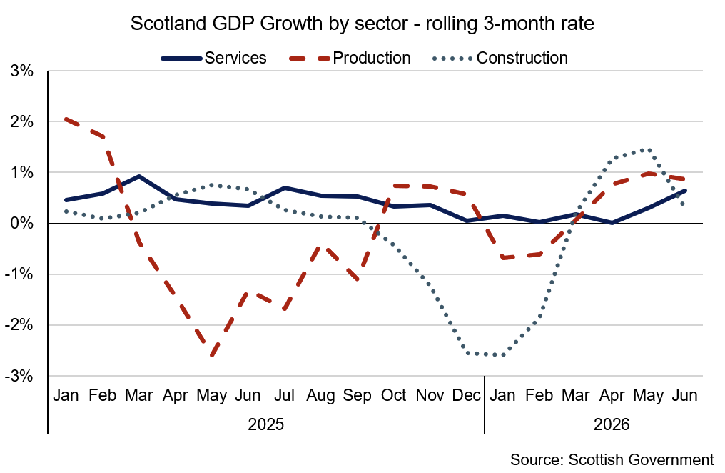
On a sector level, growth was broad based across the services (0.6%), production (0.9%), and construction (0.3%) sectors. Services sector growth strengthened to its highest 3-monthly rate since July 2025. Within the sector, consumer facing services grew by 0.5% over the quarter, partly reflecting a pick-up in growth in the Accommodation & food services sector. Over the year to Q2 services sector output grew 1.4%.
Production sector output growth strengthened to 0.9% in the second quarter (up from 0.1% in the first quarter), driven by an increase in manufacturing output which strengthened to 1.0% (up from -0.5% in the first quarter). This offset a fall in electricity and gas supply, which fell by 1.2% (down from growth of 3.7% in the first quarter). Over the year to Q2, production sector output grew by 0.4%. Construction sector growth strengthened moderately from the first quarter (0.2%), but fell by 2.0% over the year to Q2.
Business conditions
Over the last six months, business conditions have remained challenging, with businesses continuing to report weak demand, increased cost pressures and elevated economic uncertainty.
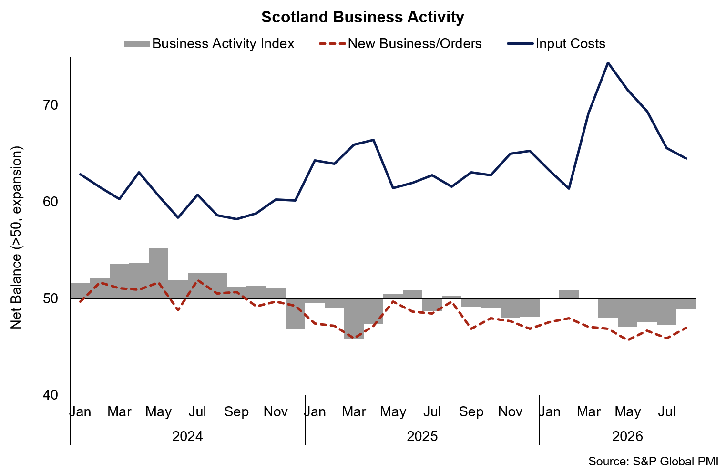
The RBS Growth Tracker business survey indicated that while business activity contracted for the fifth consecutive month in August, the rate of contraction softened as the indicator reached its highest level since March. The Business Activity Index rose to 48.9, up from 47.3 in July (a reading below 50 indicates contracting business activity). Underlying demand remained subdued, with the index showing contraction in new business orders for the 23rd consecutive month.
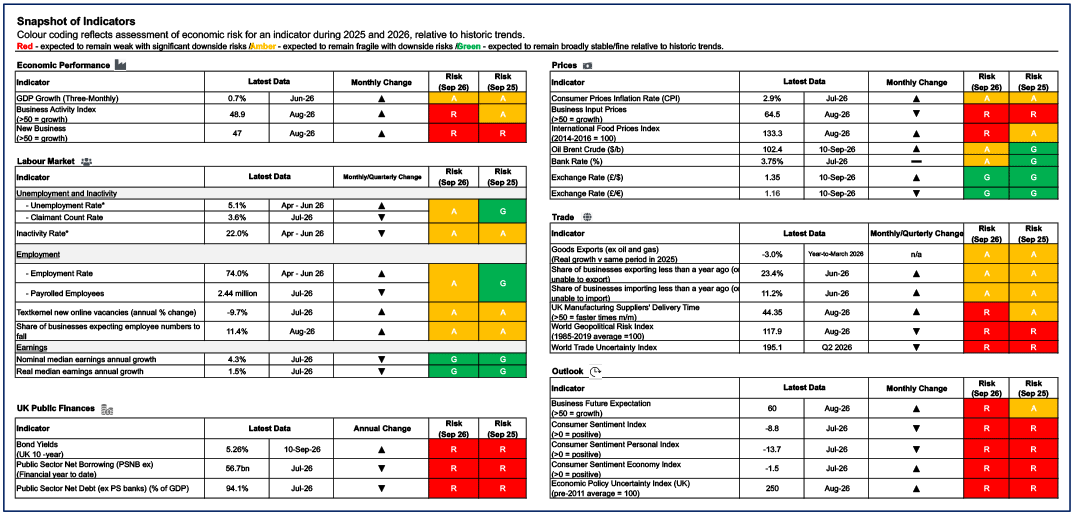
Anecdotally businesses linked the contraction in business activity to ongoing uncertainty around the Middle East, subdued demand conditions, general market slowdown, and higher utility costs. Input costs continued to rise in August but the rate of increase eased to its lowest since February, with the index falling to 64.5 (down from 65.6 in July).
Latest BICS data from August shows that falling demand remains the most reported main business concern for the coming month (14.9%), closely followed by energy prices (14.6%). The share of businesses reporting energy prices as their main concern has increased to a four-month high, amid a spike in wholesale UK natural gas prices. Businesses also continued to report concerns about worker shortages (9.3%), competition with other UK businesses (8.6%), taxation (6.4%) and inflation (5.7%), albeit to a lesser extent.
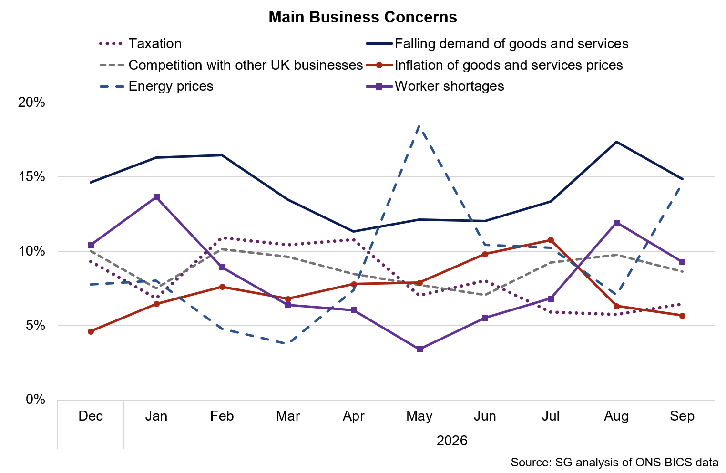
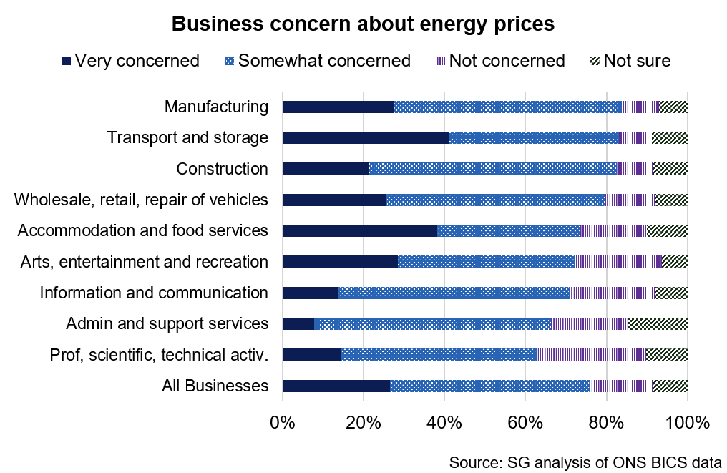
When businesses were asked specifically how concerned they were about energy prices, latest data for August shows that the share of businesses reporting to be very concerned increased while from July (26.6%, up from 23.9%). The ongoing concern around energy prices is broad based across industries, but remains most notable in resource-intensive industries such as manufacturing, and transport and storage.[6]
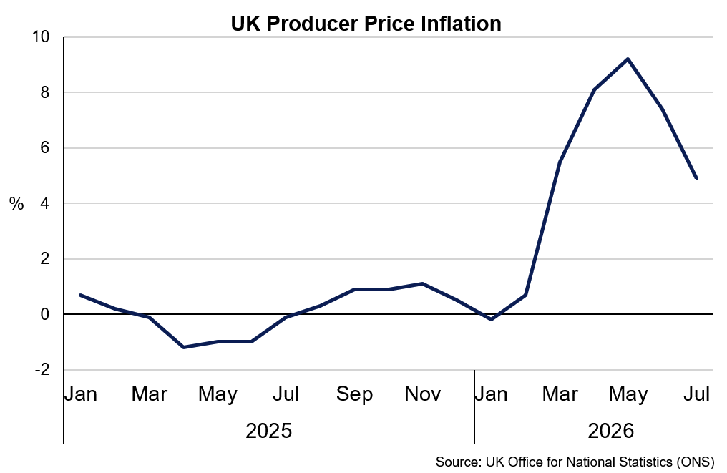
Over the last six months, business cost pressures have exacerbated, with the sharp increase in energy and fuel prices. However, the RBS Growth Tracker survey shows that input price inflation for private sector businesses has eased in August to its slowest rate since February. Similarly, latest Producer Price Inflation statistics for July show that producer input price inflation eased to 4.9%, its slowest rate since February, before the conflict.
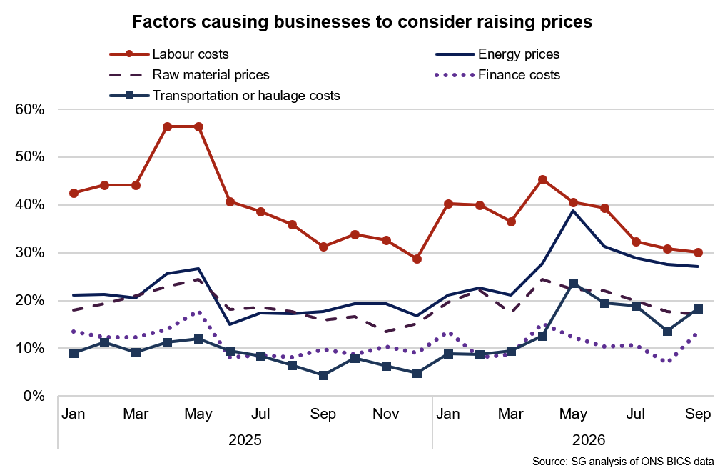
BICS data from August shows that the share of businesses expecting to increase prices in the following month fell for the fourth consecutive month (11.8%, down from 12.1%). For businesses expecting to increase prices in the coming month, labour costs continues to be the most commonly cited factor (30.1%). This is closely followed by energy prices (27.1%), which has seen an increase in being reported since the onset of the escalation in the Middle East conflict. Transportation or haulage costs have also been increasingly cited by businesses, with the share increasing again in August (18.3%). This highlights the challenges businesses are facing amid the Middle East conflict as energy and fuel costs have been on the rise.
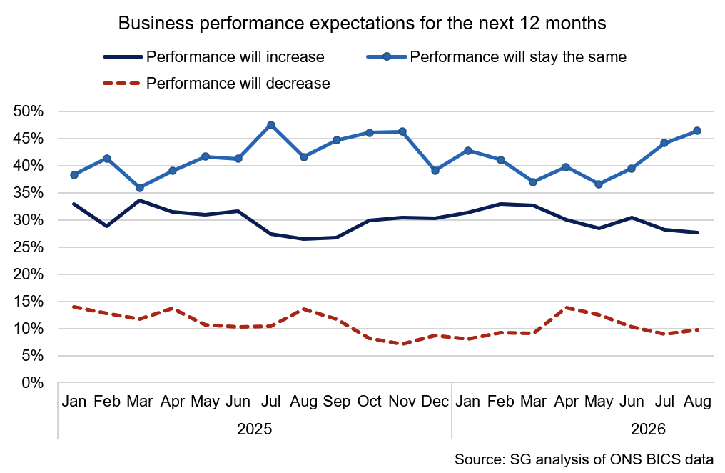
Despite ongoing challenges in business conditions, the RBS Growth Tracker business survey indicates that business optimism for growth remains strong, with the optimism index reaching a six-month high in August. However, latest BICS data from August for business performance expectations shows that there has been a mild decrease in share of businesses expecting performance to increase in the next year (27.7%, down from 28.2% in July) and a mild increase in the share expecting performance to decrease (9.8%, up from 8.9% in July). The largest share still expect performance to stay unchanged, with the share of businesses reporting so having increased between July and August to its highest share since July 2025 (46.5%).[7],[8]
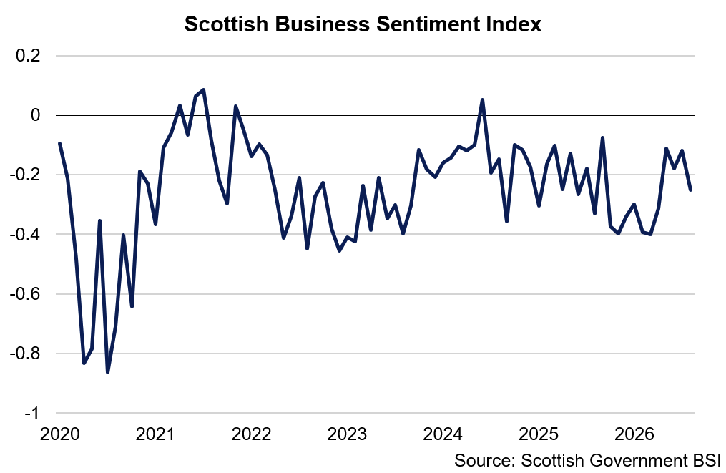
Business sentiment is a key driver of business decision making and investment. The Scottish Business Sentiment Index (BSI) provides a real-time measure of business sentiment in Scotland by analysing sentiment in news articles related to corporate and industrial developments. Latest data indicates that the BSI weakened in August to -0.25, but remains above its levels earlier in the year.
Terms of Trade
Taking a longer term perspective, ten years on the vote to leave the EU continues to set the context for a large proportion of Scotland’s trade. Box 1 below considers how trade has been effected since the end of the transition period in 2021.
Contact
Email: economic.statistics@gov.scot