
Scottish economic insights: September 2025
Provides a summary of latest key economic statistics, forecasts and analysis on the Scottish economy.
Economic growth and business conditions.
Economic growth
Scotland’s economy grew 1.2% in 2024 and has grown 0.5% through the first half of 2025. However, the pace of growth has slowed from 0.4% in Q1 2025 to 0.2% in Q2 2025.[8] There has been a similar pattern of growth at a UK level in 2025 (0.7% in Q1 followed by 0.3% in Q2).
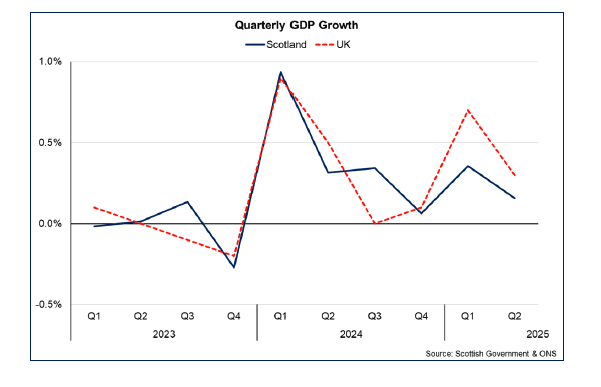
At a sector level, growth in 2025 to date has been driven by strengthening growth in the services and construction sectors, which has offset falling output in the Production sector. Within the services sector, there has been a pick-up in growth across professional scientific and technical services, and accommodation and food services with services overall growing at its strongest rate since the end of 2022. Similarly, construction has grown at its strongest rate over the same period.
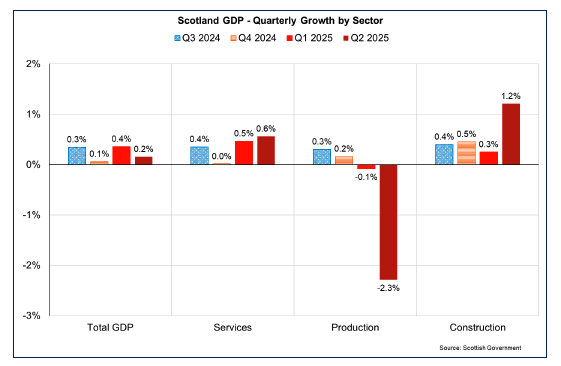
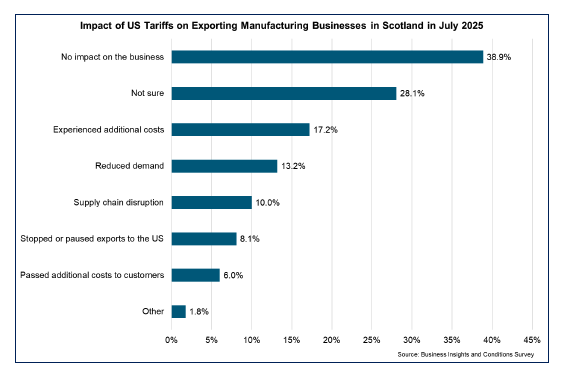
The main drag on growth in 2025 so far has been in the production sector, in which output has fallen 2.3% in the second quarter. Within this, manufacturing output has contributed the most significantly, and there are a number of factors which have influenced activity in the manufacturing sector this year, including the cessation of oil refining activity at the Grangemouth oil refinery and the increases in US tariffs, which have impacted on exporting activity in the manufacturing sector. The Business Insights and Conditions Survey (BICS) showed that 32.9% of manufacturing businesses reported being impacted by US tariffs, with 17.2% experiencing additional costs, 13.2% reduced demand and 10% supply chain disruption. [9]
Business conditions
More broadly, business surveys indicate that business activity and sentiment in the first half of the year have been impacted by weaker demand, cost pressures and wider economic uncertainty, which has continued into the third quarter.
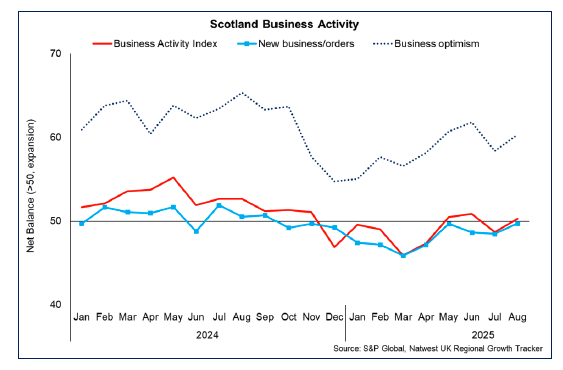
The RBS Growth Tracker business survey indicates that business activity in Scotland has remained broadly stable going into the third quarter. The business activity indicator was 50.3 in August (with a score above 50 indicating growth), following a modest fall in July, and is consistent with a pattern of generally weakening activity since the end of last year.[10]
Furthermore, new business activity has been in marginally negative territory for the past eleven months indicating that the inflow of new work orders has been gradually falling over this period.
This pattern is also reflective of business concerns in recent months. BICS results show that there has been a slight moderation in concerns regarding taxation, inflation, and energy prices, while falling demand for goods and services has re-emerged as the leading concern among businesses, with 18.8% of businesses citing such concerns.
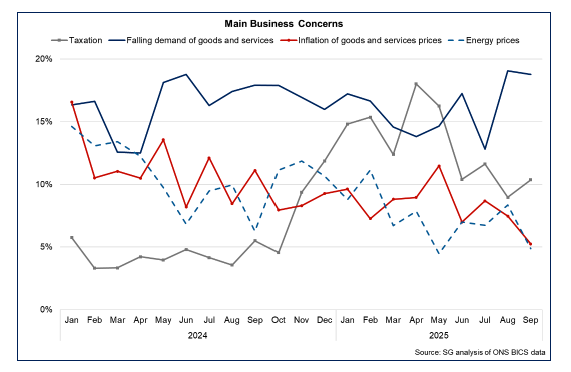
Despite concerns regarding inflation and energy prices moderating in the first half of the year, cost pressures remain a significant challenge for businesses. The Scottish Business Monitor for Q2 2025 reported that 83% of businesses experienced higher total business costs in the previous 3 months or are expecting to in the following 6 months.[11]
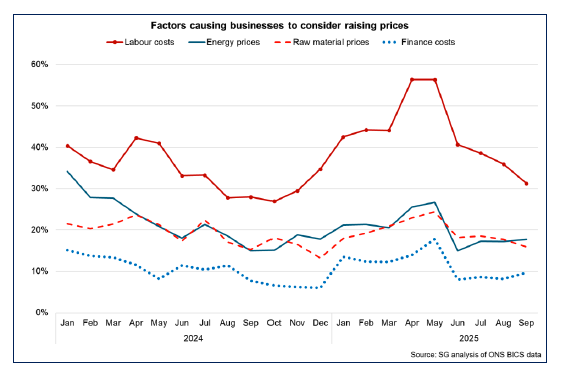
Labour costs remain a key source of cost pressures with 31.2% of businesses in August reporting that they are a factor causing them to consider raising prices. This share has fallen over the previous 6 months yet remains notably higher than other factors such as energy prices (17.8%) and raw materials (15.9%). The Scottish Chambers of Commerce Quarterly Economic Indicator for Q2 2025 reported that pressure from labour costs had risen by 15% in one year, with 86% of firms citing they were experiencing increased pressure from labour costs, compared to 75% for the same quarter in 2024.[12]
The source of labour cost pressures continue to partly come from ongoing robust pay growth at the start of the year, but also the increase in employer NICs from April. The introduction of the increase was reflected in rising business concerns about taxation over that period, which have since eased although remain more elevated than in 2024.
The Scottish Business Monitor reported that 63% of businesses have already implemented adjustments to reflect the increase in employer contributions; however, 38% of businesses anticipate more future adjustments will be needed.
This reflects the breadth of cost pressures and uncertainty, domestic and international, which have continued to create challenging business conditions in the first half of the year, weighing down on activity. That said, business optimism has been resilient in the first half of the year, strengthening from a drop in the second half of last year. However, latest business survey data suggest this has broadly levelled off going into the third quarter of the year and remains lower than at the same point last year.
The combination of cost pressures, risks of weak demand and subdued business optimism has resulted in businesses continuing to remain tentative to committing to capital investment. BICS data for July to September note that, while 46.4% of firms do not expect any limits to capital expenditure, 16.5% expect uncertainty about demand or business prospects to limit capital expenditure and 15.6% a shortage of internal finance.
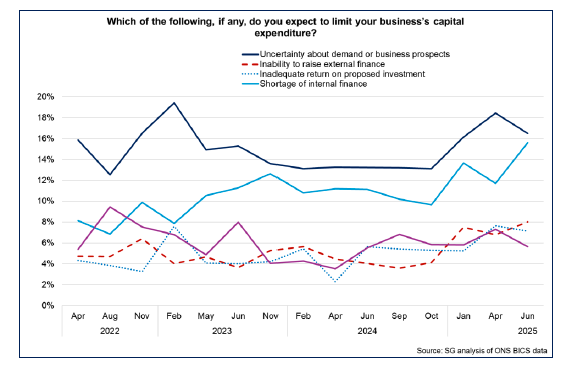
The Scottish Business Monitor for the second quarter shows that the net balance of firms reporting an increase in new capital investment remained significantly negative (-18.6) and, although this has improved moderately from the previous 6 months, remained significantly lower than the net balances since the end of 2023.
Box 2: Insights on Scottish business use of AI technologies
Artificial intelligence (AI) technologies are an increasingly integral part of the economy, both in their development and use by households, businesses and governments. The pace of these developments in recent years has been rapid and they are impacting and shaping the evolution of how many businesses operate. This box provides the latest insights from the Business Insights and Conditions Survey (BICS) on how Scottish businesses are interacting with AI technologies.
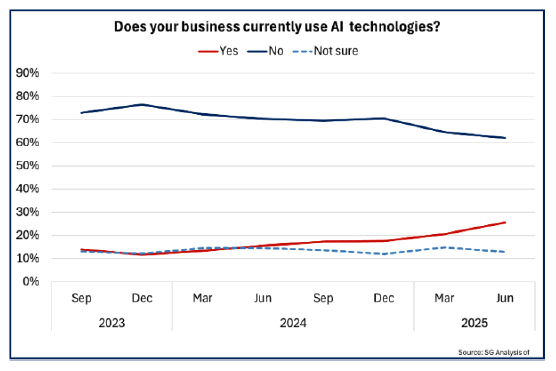
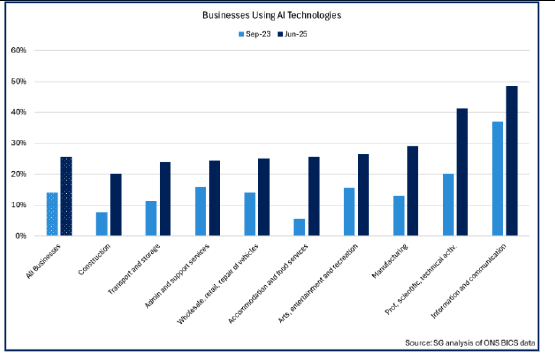
Latest BICS data for June shows that 25.5% of businesses in Scotland report to be using AI technologies. This share has gradually grown in recent years from 14.0% in September 2023 with larger businesses more likely to report using AI technologies (38.4%) compared to smaller businesses (24.1%).
AI technology usage differs across sectors with the Information and Communication sector unsurprisingly reporting the highest share of business users (48.5%) followed by Professional Scientific, Technical Activities (41.4%). Notably lower shares of businesses in Construction (20.1%) and Transport and Storage (24.1%) report to be using AI. Nonetheless, we have seen an increased share of business across all sectors using AI technologies in recent years, reflecting the broad application it can have to different businesses operations.
The types of AI being used by businesses in Scotland vary but the most commonly reported technologies are Large Language Models (LLMs) for text generation (11.8%) and Machine Learning for data processing (9.7%), followed by visual content creation (8.5%). There is some sectoral variation in terms of what technologies are most likely to be reported in use by businesses. For instance, businesses within the Information and Communication sector are more likely to report using LLMs (41.5%) than machine learning (20.8%). This differs from sectors such as the Manufacturing sector and the Transport and Storage sector, where businesses are more likely to report using Machine Learning technologies (11.2% and 13.6%, respectively) than LLMs (7.2% and 5.4%, respectively). This likely reflects the different business use cases for AI technologies in different sectors.
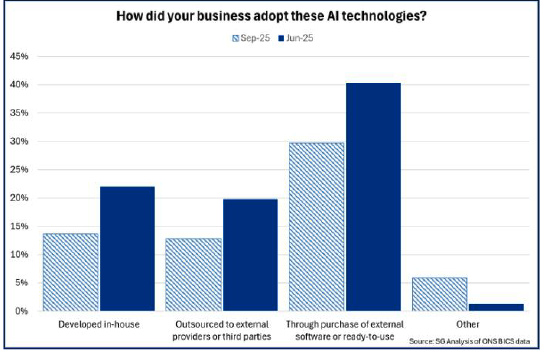
BICS data also indicate that most businesses take advantage of third-party solutions to adopt AI technologies, with the majority of businesses adopting AI through purchase of external software or via ready-to-use AI technologies (40.4%). This emphasises the importance of specialised skills in developing AI technologies and the importance of experienced suppliers to make AI accessible to businesses. Nonetheless, an increasing proportion of businesses report to be developing AI technologies in-house, with 22.1% of businesses reporting to do so, up from 13.7% in September 2023.
The main reason Scottish businesses opt to use AI is to improve business operations (49.0%) and this is consistent across sectors, with smaller shares of businesses using AI technologies to provide, or personalise, products or services to customers (13.9%) and to develop a new product or service (7.8%). The high proportion of businesses reporting to be using AI for the purpose of improving business operations is partly reflective of the challenging business environment, with businesses seeking to find sustainable efficiencies and cost reductions. This trend suggests that businesses are adopting AI not with the intention of necessarily replacing staff, but augmenting existing task to enhance operational efficiency.
A further 29.1% of businesses report they are not sure what they are currently using AI for. This may partly reflect that some businesses are still exploring the possible uses for AI technologies, with AI likely to be a relatively new concept for a proportion of Scottish businesses.
There are some challenges reported by businesses seeking to introduce AI technologies into their business operations. The main reason for delays in adopting AI is due to the business’ level of expertise in AI (14.6%) followed by difficulty identifying business use cases (10.6%). However, 42.9% of respondents say they have not experienced any factors that have prevented or delayed them adopting AI.
In summary, evidence from BICS shows that AI uptake among businesses is growing steadily, driven primarily by the need to improve operational efficiency in a challenging business environment. However, barriers to adoption, such as limited expertise and unclear business use cases, persist, reflecting the specialised nature of AI technologies. The reliance of Scottish businesses on external AI solutions underscores the importance of a robust supply chain and accessible expertise to support AI adoption by businesses.
Contact
Email: economic.statistics@gov.scot