
Publication - Research and analysis
Scottish economic bulletin: December 2025
Provides a summary of latest key economic statistics, forecasts and analysis on the Scottish economy.
Labour Market
The labour market has loosened over the past year and earnings growth has slowed.
Employment, Unemployment, and Inactivity
- Scotland’s labour market continued to have low unemployment in the third quarter of the year, however conditions have loosened compared to last year with falls in the number of payrolled employees, subdued recruitment activity and weaker pay growth.
- The labour Force Survey (LFS) shows Scotland’s unemployment rate remained low in the third quarter of the year, falling 0.1 percentage points (p.p) over to quarter to 3.7% (UK: 5%), albeit it has risen 0.4 percentage points over the year (UK: +0.7 p.p).[16]
- Scotland’s Claimant Count unemployment rate (3.5%) also remains low relative to the UK as a whole (4.4%) with the number of claimants of unemployment related benefits rising 2.2% (2,200) in October to 105,100 and is down 6% (6,700) over the past year.[17],[18]
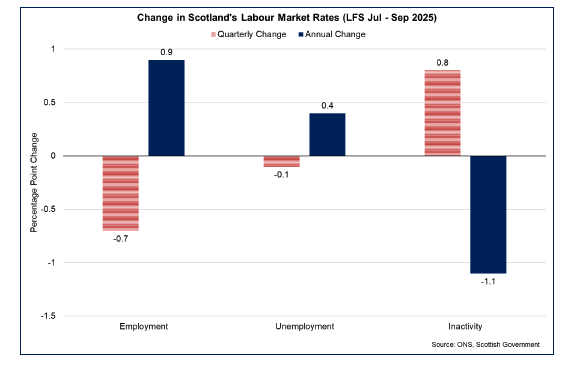
- The LFS for the third quarter of 2025 also shows that alongside the fall in unemployment over the quarter, the employment rate fell 0.7 p.p to 74.3% and the inactivity rate increased by 0.8 p.p to 22.8%. Compared to last year, both indicators remain stronger with the employment rate up 0.9 p.p and the inactivity rate down by 1.1 p.p.
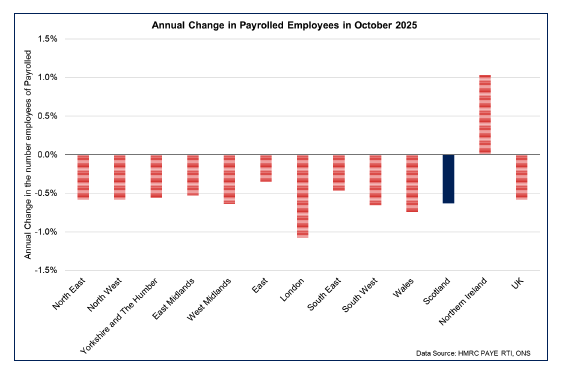
- However, Pay as you Earn (PAYE) Real Time Information data indicates that the number of payrolled employees in Scotland is currently falling back from its recent peak of 2.64 million in July 2024. Latest data for October 2025 shows that payrolled employees fell by 0.1% (c. 1,800 employees) over the month to 2.45 million and has fallen by 0.6% (15,500) over the past year.[19]
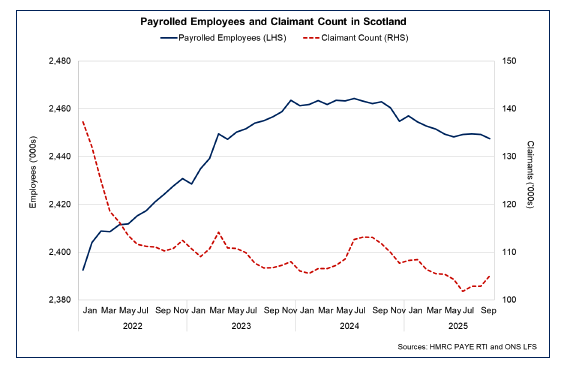
- This trend over the past year is similar across most other parts of the UK with the number of payrolled employees in Scotland falling back to its lowest level since May 2023.
Recruitment Activity
- Business survey data indicates that demand for labour and recruitment activity has remained relatively subdued in the second half of the year and has been impacted by factors including the weakness in new business orders growth, increased labour costs and elevated economic uncertainty.
- PMI business survey indicates that private sector businesses have tended to report that they have been reducing their staffing levels over the past year in Scotland and at a UK level. Latest data indicates that this continued to happen in November, albeit to a lesser extent than earlier in the year and to a lesser extent than at a UK level.[20]
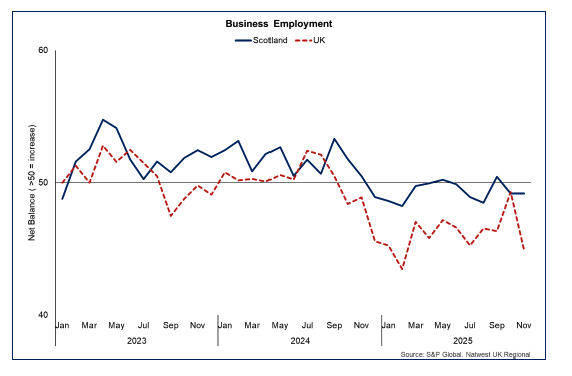
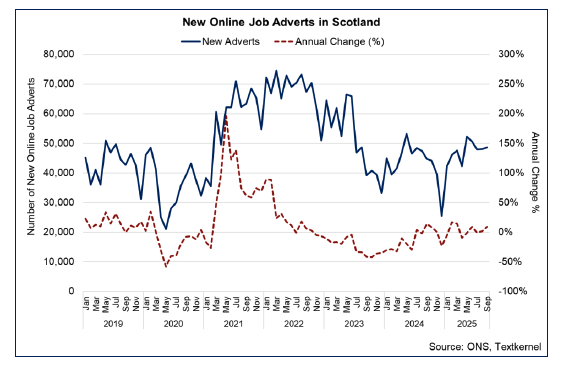
- The slight improvement in the employment indicator over the past year is reflective of the ONS Textkernel data which shows that recruitment activity has been stabilising and the number of new online job adverts posted has increased. In September, there were c. 49,000 new online job adverts posted in Scotland, up 8.7% from September last year.[21]
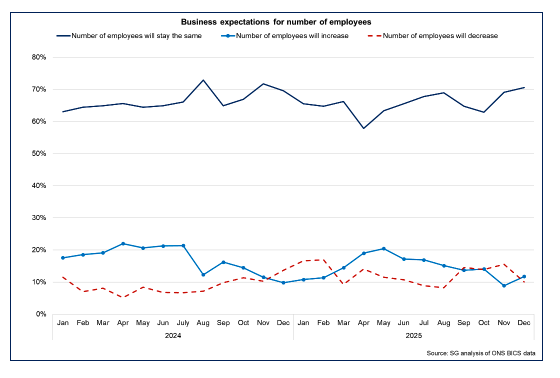
- BICS data also indicates a largely balanced outlook for labour demand as we approach the end of the year. Over the second half of the 2025, the share of businesses expecting their number of employees to decrease has remained broadly stable (10.1% in December), while there has been a decreasing share expecting employee numbers to increase (11.8%) and an increasing share expecting them to stay the same (70.6%).
Earnings
- Earnings growth has remained robust in 2025, however latest data indicates the pace of growth has slowed notably in October.
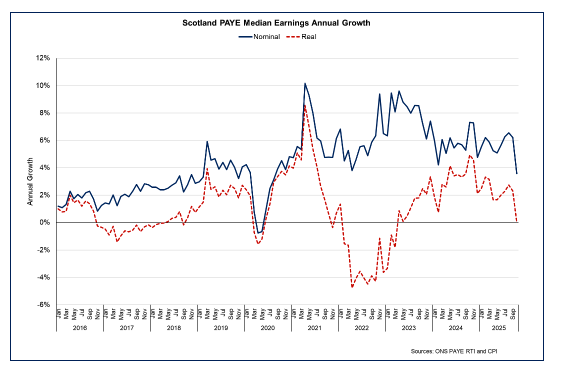
- Nominal median monthly PAYE pay in Scotland (£2,581) grew by 3.6% on an annual basis in October, with the pace of growth falling to its slowest rate since August 2020. In real terms, adjusting for inflation of annual inflation of 3.6%, earnings growth was flat (0.0%).[22]
- At a UK level, the Bank of England and the Office for Budget Responsibility (OBR) indicate that earnings growth is likely to slow further over the coming year, though by less than previously expected. Bank of England’s business survey intelligence suggests that pay settlements will slow from 3.7% in 2025 to average around 3.5% in 2026. The OBR forecast UK nominal weekly earnings growth to slow to 3.3% in 2026 and to 0.6% growth in real terms, as inflationary pressures continue to soften and the labour market loosens.[23],[24],[25]
Contact
Email: economic.statistics@gov.scot