
Publication - Research and analysis
Scottish economic bulletin: December 2025
Provides a summary of latest key economic statistics, forecasts and analysis on the Scottish economy.
Business Conditions
Business activity remains subdued though business optimism strengthened in November.
Business Activity
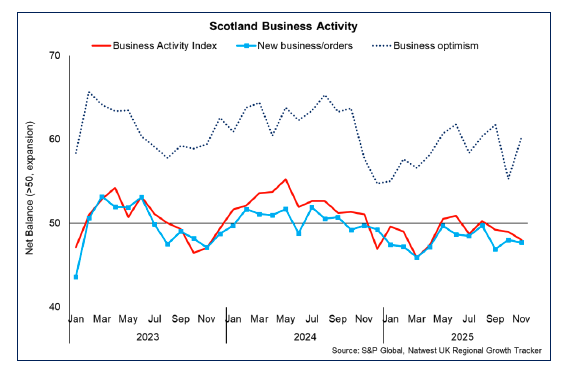
- Business surveys for October and November present a mixed picture, with evidence indicating that business activity in Scotland remains subdued in the fourth quarter of the year.
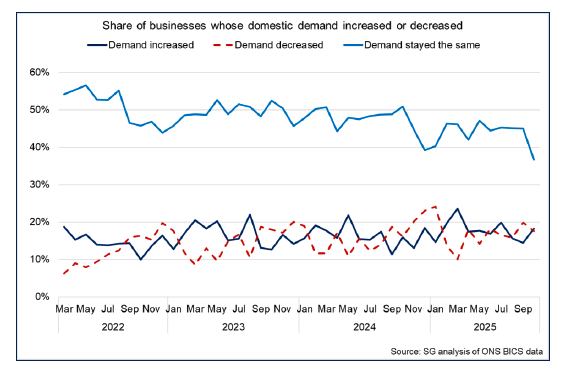
- The latest Business Insights and Conditions Survey (BICS) showed that in October, the largest share of respondents continued to report that their business performance had stayed the same from the previous year (42.3%, down from 50.5% in September), while the proportion of businesses reporting their performance increased, rose to 25.4% in October (up from 20.4% in September).[7]
- However, the latest RBS Growth Tracker Survey indicates that business activity contracted for a third consecutive month in November, and at its fastest rate since April 2025, with the index falling to 48.0 (a reading below 50 indicates contracting business activity). Furthermore, the new work orders index continued to fall for the fourteenth consecutive month, with respondents citing reduced client spending and uncertain economic conditions resulting in reduced sales.[8]
- BICS data however points towards some improvements in demand conditions over the month to October, with 18.3% reporting that domestic demand rose (up from 14.4% in September), while 17.6% of businesses reported that domestic demand fell from the previous month (down from 19.8% in September). The largest share of businesses still report that demand has stayed the same in October (36.6%).
Business Concerns
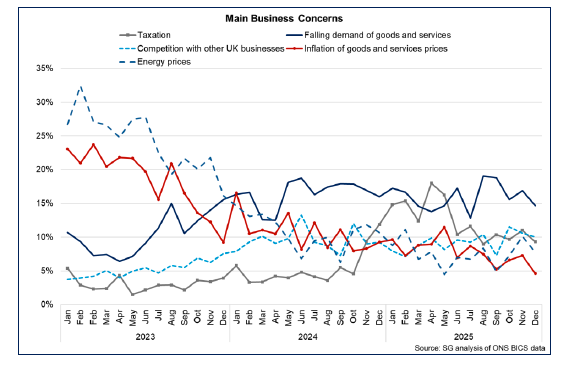
- Key business concerns over 2025 have been falling demand and taxation, and increasingly, competition with other domestic businesses. BICS data for December shows that falling demand for goods and services continues to be the most commonly cited concern by businesses in Scotland (14.7% of businesses), followed by competition with other businesses (10.0%) and taxation (9.3%).
- Concern regarding taxation has fallen from its recent peak of 18.0% in April when the increase in employer National Insurance Contributions was implemented. It has remained broadly stable in the final quarter of 2025 around the UK Budget, however, remains elevated compared to 2024.
Business Costs
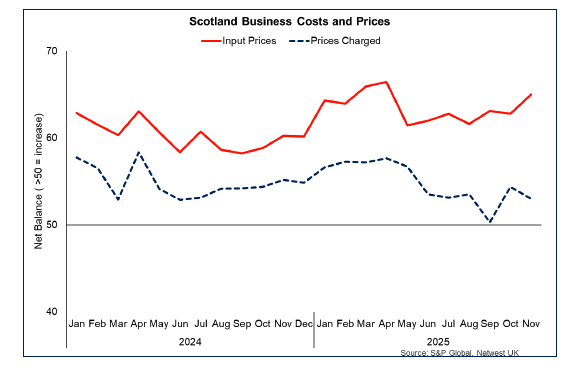
- The RBS Growth Tracker business survey indicated that input price inflation picked up in November to its highest rate since April 2025, with businesses citing salary and supplier price increases. Output prices also continued to rise, though at a slower rate than in October. While some businesses passed costs on to clients, others’ ability to do so was impacted by competitive market conditions and subdued demand.[9]
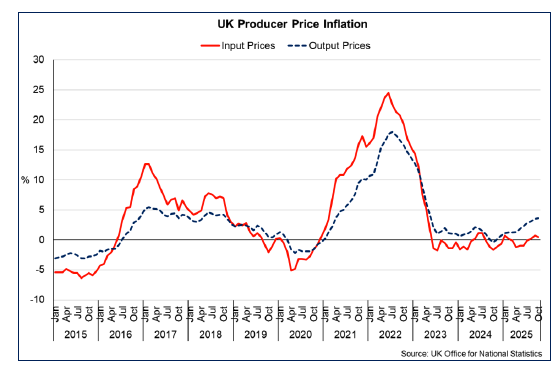
- ONS Producer Price Inflation (PPI) data also shows some evidence of producers raising output prices in October. While input price inflation for producers eased slightly to 0.5% in the year to October (down from 0.7% in September), output prices inflation rose to 3.6% (up from 3.5% in September).[10]
- Nonetheless, challenging demand conditions means that not all business are passing through costs. BICS indicators show that the proportion of businesses expecting the prices of their goods and services to rise, fell from 12.6% in November to 9.7% in December, the lowest proportion since August 2024. Instead, 68.2% of businesses expect the price of their goods and services to stay the same while 1.3% expect their prices to fall.
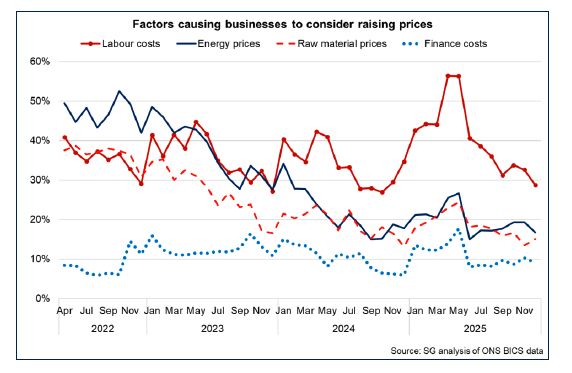
- Labour costs continue to be the most frequently mentioned driver of businesses considering raising prices in December (28.7%), although it was reported at its lowest rate since 2024. Labour costs as a driver for price increases was followed by energy prices (16.8%) and raw material prices (15.1%).
Business Optimism
- Despite these challenging conditions, the RBS Growth Tracker shows that business optimism rose in November from October’s nine-month low with private sector businesses in Scotland more hopeful that business activity will improve in the coming year.[11]
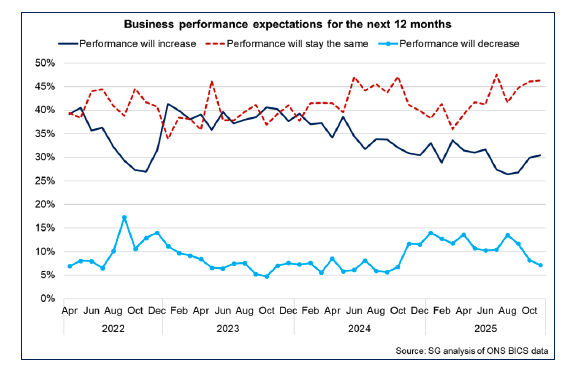
- This improvement in optimism is also reflected in BICS data, which shows that an increasing share of businesses expect performance to improve. In November, 30.4% of businesses expect performance to increase in the next year, up from 29.9% in October, while the share of businesses expecting performance to decrease fell to 7.1%. 46.3% of businesses expect performance to remain unchanged.
Contact
Email: economic.statistics@gov.scot