
Scottish economic bulletin: December 2025
Provides a summary of latest key economic statistics, forecasts and analysis on the Scottish economy.
Box: AI technologies: Adoption by Scottish businesses and potential influence on the economic outlook
The advancement of Artificial Intelligence (AI) technologies has resulted in them becoming an increasingly integral part of the economy, both in their development and use by households, businesses and governments. The future path of AI and its impacts is highly uncertain, however it is widely expected to have a growing influence on the economic outlook and have the potential to positively impact global productivity growth.
This Box provides latest data insights on how Scottish businesses are adopting AI technologies and also sets out how AI is shaping latest global and UK economic forecasts.
AI adoption by Scottish businesses.
In Scotland, latest Business Insights and Conditions Survey (BICS) data for September 2025 shows that an increasing share of businesses are using AI technologies (26.7%, up from 14.0% in September 2023) with larger businesses more likely to report using AI (45.7%) than smaller businesses (24.5%).[12]
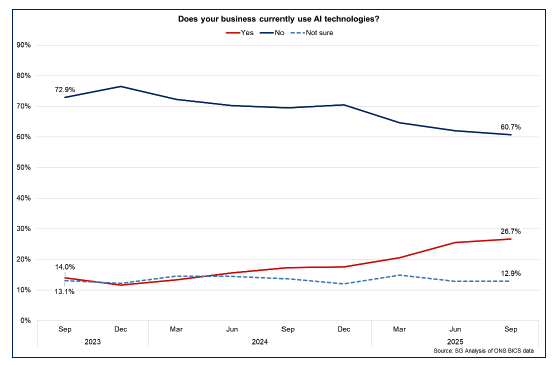
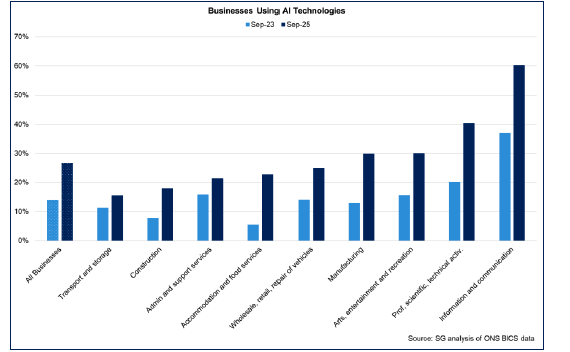
As might be expected, the Information and Communication sector shows the highest share of businesses using AI (60.3%) followed by Professional Scientific, Technical Activities (40.4%), however we have seen an increased share of business across all sectors adopting AI technologies in recent years, reflecting the broad application it has to different businesses operations.
The types of AI being used by businesses in Scotland vary, but the most commonly reported technologies are Large Language Models (LLMs) for text generation (13.4%) and Machine Learning for data processing (10.7%), followed by visual content creation (9.0%).
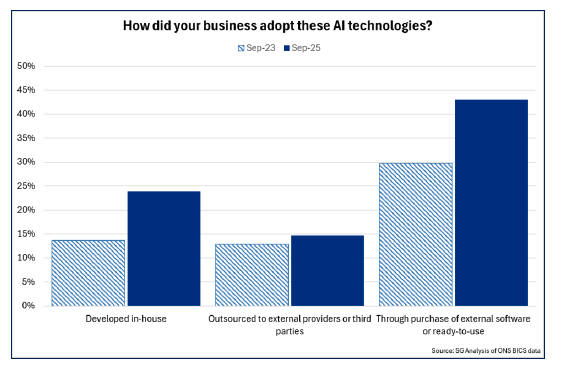
In adopting AI technologies, most businesses continue to purchase external software or ready-to-use AI technologies (43.0%), emphasising the importance of specialised skills in developing AI technologies and providing accessible supply chains to businesses. Nonetheless, an increasing proportion of businesses report to be developing AI technologies in-house (23.9%, up from 13.7% in September 2023).
The main reason Scottish businesses opt to use AI, across sectors, is to improve business operations (53.6%). 49.3% of businesses are not sure what impact the AI technologies that they are planning to adopt will have on their workforce headcount, while 33.2% expect no change, 15.3% expect their headcount to decrease and 2.2% expect headcount to increase.
There are some challenges reported by businesses seeking to introduce AI technologies into their business operations. The main reason for delays in adopting AI is due to the business’ level of expertise in AI (14.1%) followed by difficulty identifying business use cases (10.7%). However, 43.2% of respondents say they have not been prevented or experienced delays in them adopting AI.
AI potential influence on economic outlook.
The evidence from BICS shows that AI uptake among businesses is growing steadily. Looking ahead, AI is having an increasing influence on the economic outlook at a global level. In the short term, this partly reflects the surge in AI investment, however forecasts for the medium and longer term reflect the potential positive effects on productivity growth.
In their global economic outlook, the OECD set out that the extent and timing of productivity gains related to the adoption of AI is highly uncertain, but it is possible that such gains could become more visible than currently anticipated over the next two years.[13]
At a UK level, the OBR central estimate is that AI will boost UK productivity growth by around 0.2 percentage points within their forecast horizon, with scenario analysis suggesting AI could potentially increase annual productivity growth by anywhere between 0.0 and 0.8 percentage points over the next decade.[14]
There remains significant uncertainty around both the size and timing of potential productivity gains from AI reflecting, amongst other factors, the uncertain path of future technology developments and the rate at which AI technologies continue to be adopted. Downside risks to the economic outlook from AI also remain present, including if the gains from AI investment fall short of expectations and the potential impacts that revaluations could have across technology and wider markets.[15]
Contact
Email: economic.statistics@gov.scot