
Scotland's Artificial Intelligence strategy 2026-2031
Artificial Intelligence (AI) is reshaping economies, industries and public services around the world. This is our five-year strategy to harness the potential of AI to drive responsible and inclusive growth across our economy and make a positive difference at every level of society.
AI Action Plan
The AI Stack
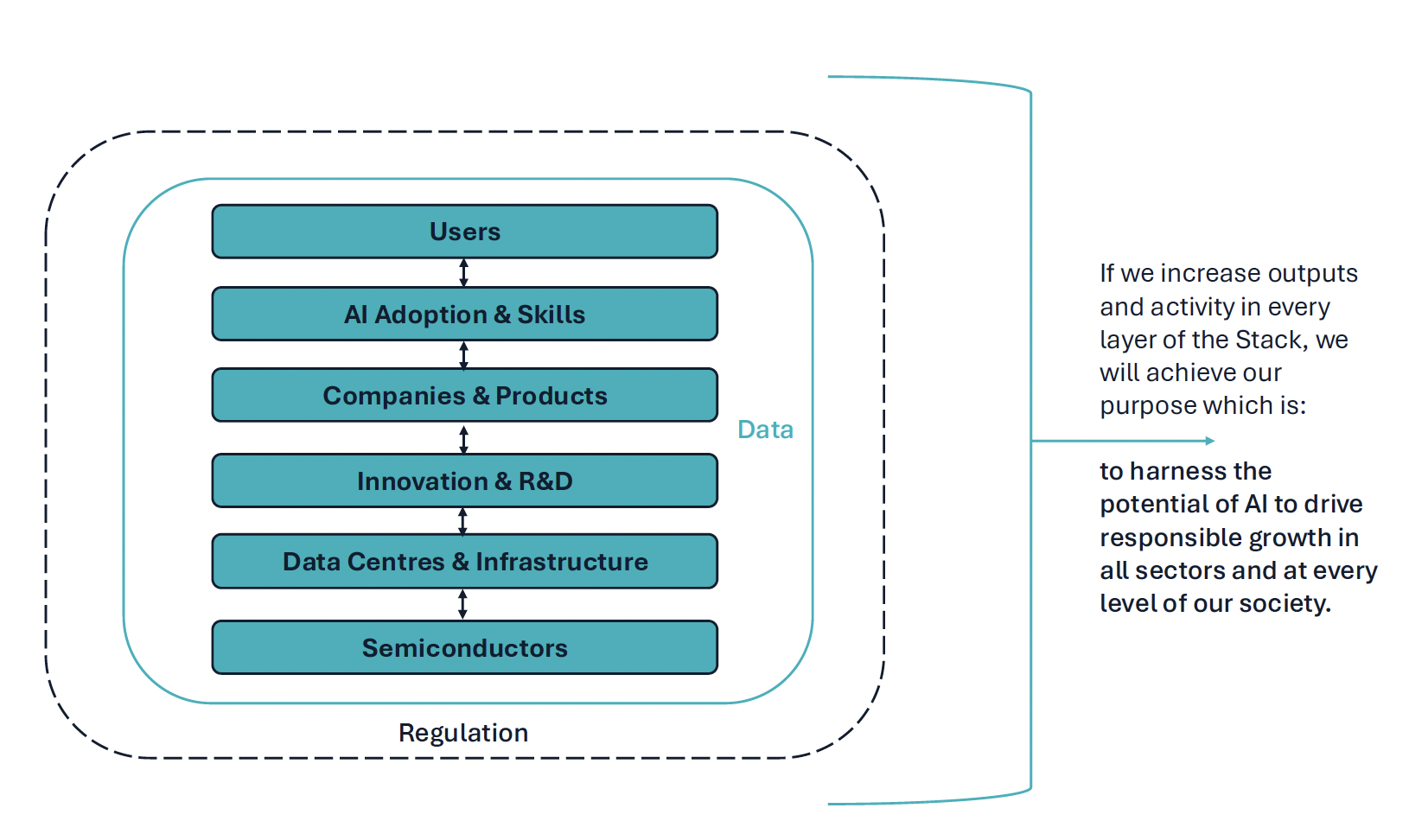
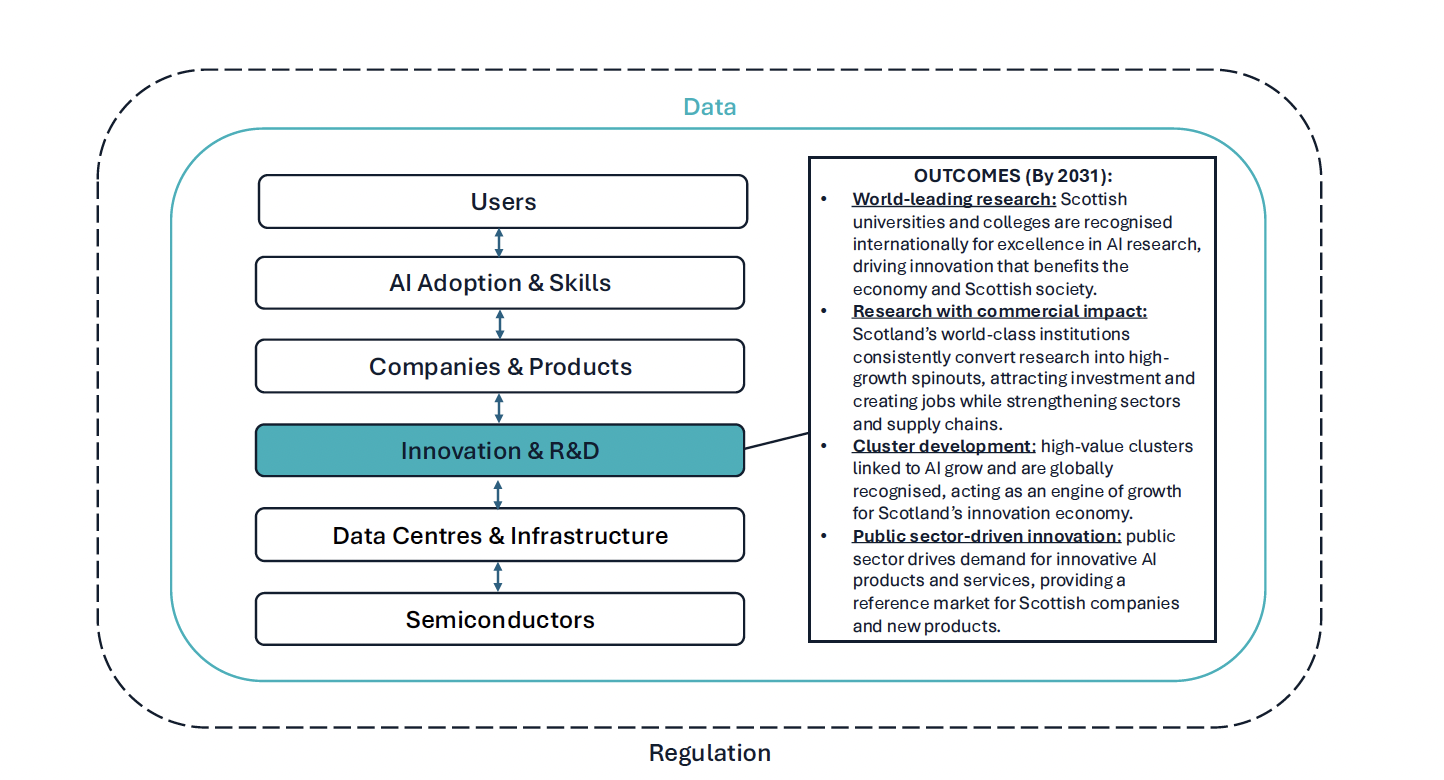
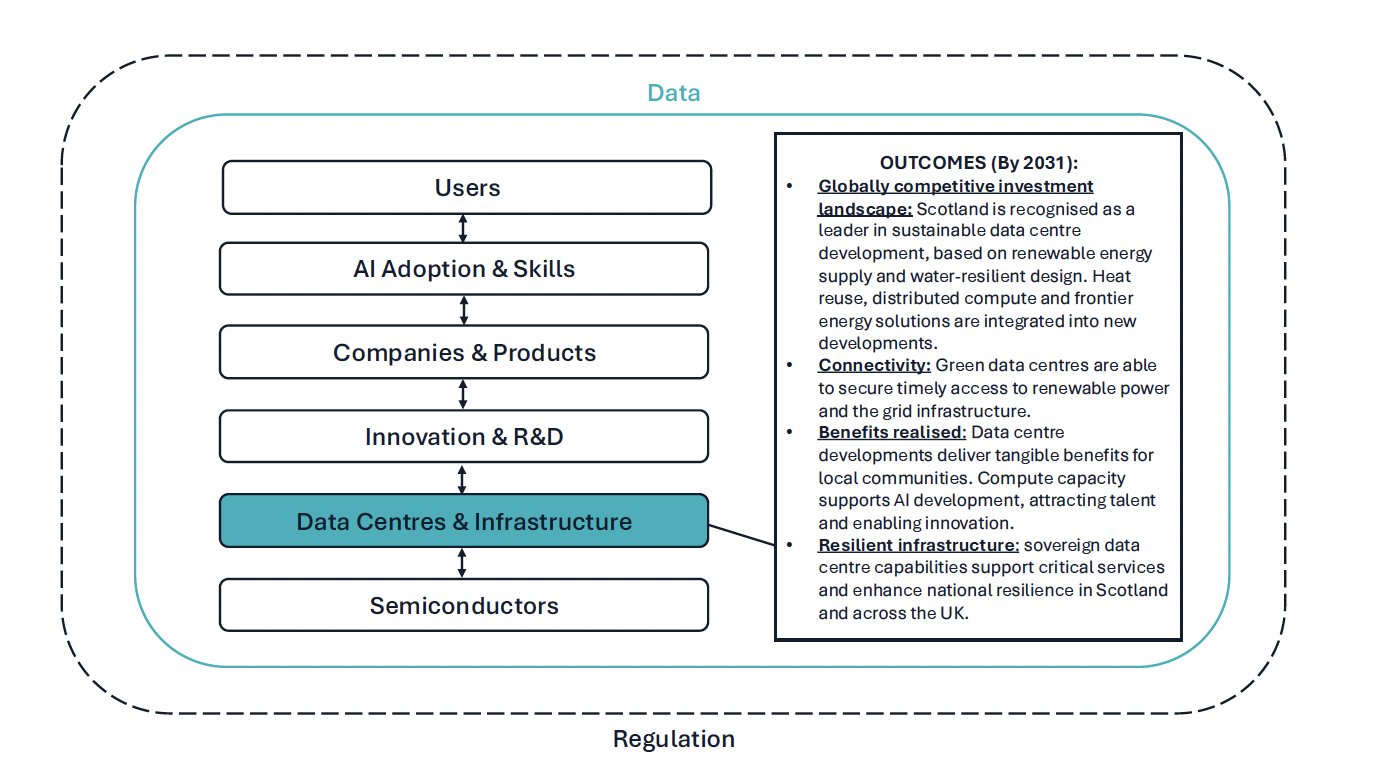
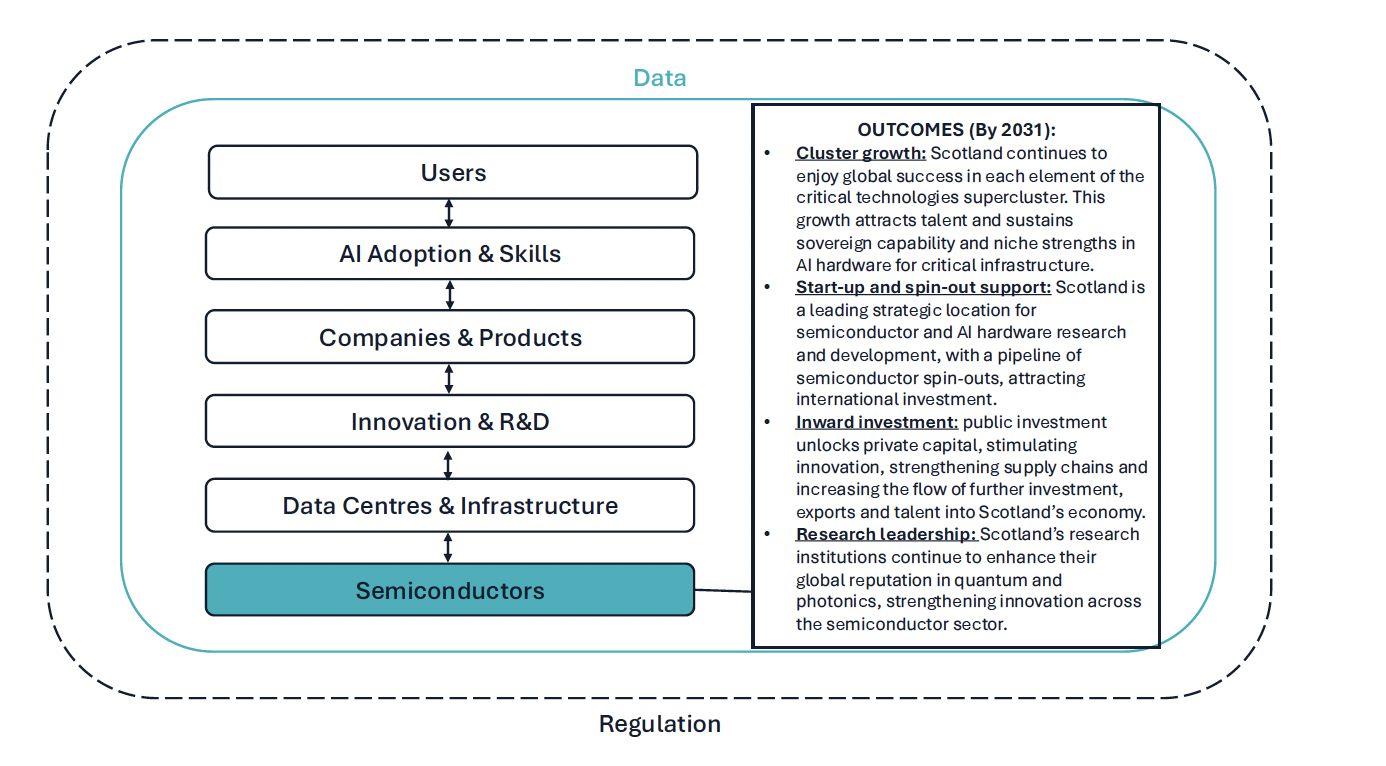
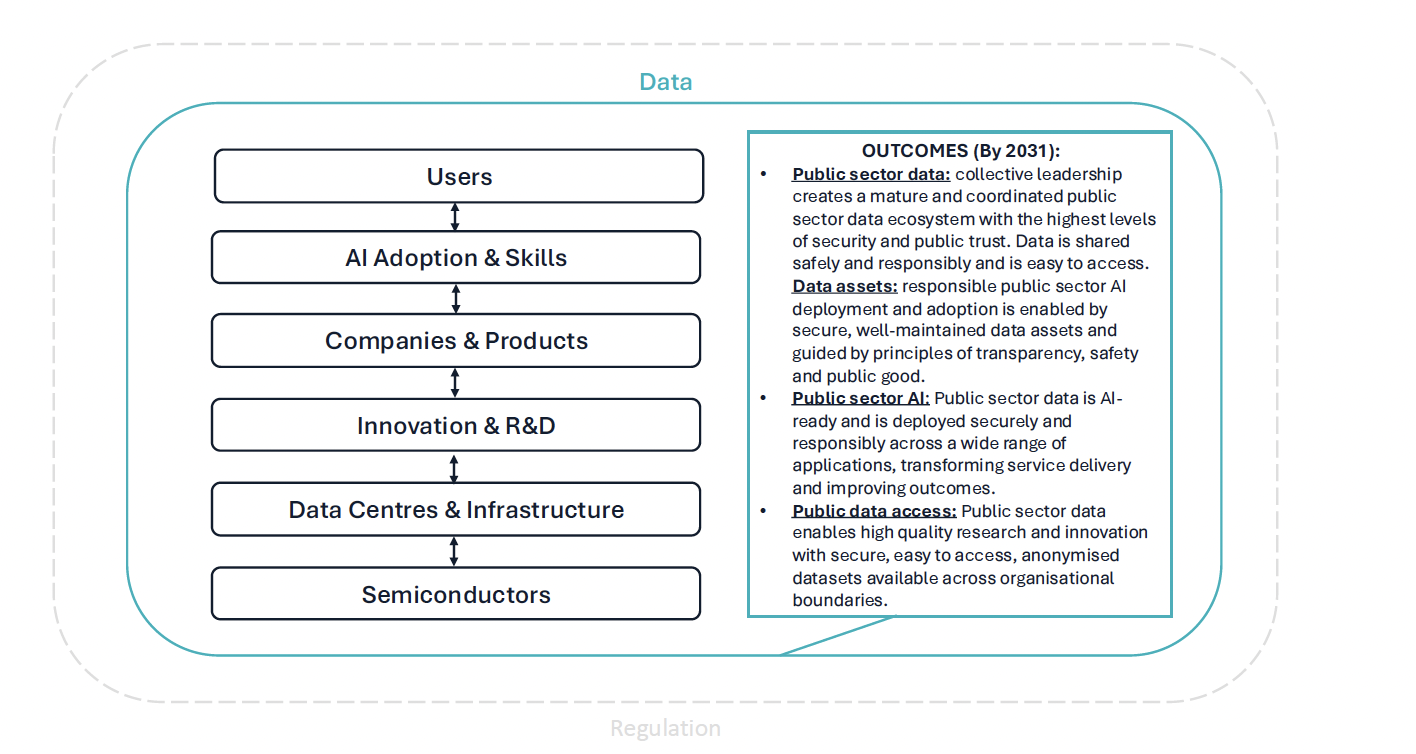
To fulfil the purpose and achieve the outcomes of this Strategy, the Scottish Government has adopted a radical new approach to the problem of how government may determine, organise and deliver an effective response to an accelerating technology with implications for all areas of policy, in the form of the AI Stack.
- Users
- AI Adoption & Skills
- Companies & Products
- Innovation & R&D
- Data Centres & Infrastructure
- Semiconductors
- Data
- Regulation
If we increase outputs and activity in every layer of the Stack, we will achieve our purpose which is: to harness the potential of AI to drive responsible growth in all sectors and at every level of our society.
The AI Stack aligns with Scotland’s AI ecosystem and represents ‘AI’ in its broadest sense, encompassing all current and emerging applications. In this way, the Stack provides a frame of reference which is able to adapt as new forms of AI are developed.
The Stack sets out non-hierarchical relationships between different components, or layers, all of which need to work together to deliver social and economic good. The position of each layer does not reflect its value or importance. All layers have interdependencies on and interact with all other layers.
The two encircling layers (data and regulation) appear as they do in the model to illustrate the extent to which they sit around, as well as within, all other layers. For example, AI innovation is data-dependent but also develops solutions to the technological and other challenges of AI-scale data processing.
In the sections that follow, our AI Action Plan sets out a case for change in relation to each layer of the AI Stack along with an initial set of immediate actions which will ensure progress against our outcomes.
To ensure the AI Action Plan can evolve as technology develops, it will be delivered in three phases. This iteration outlines the actions for phase 1. We will publish updates for phase 2 in 2027 and phase 3 in 2029, ensuring our actions continue to drive progress towards our 2031 outcomes.
If we deliver our actions and outcomes, we will achieve our purpose.
Layer 1
Users
As AI becomes more embedded within public services, citizens are increasingly interacting with AI not only through private digital platforms but through essential services such as health and social care. While non-digital routes to accessing public services will still exist, AI offers clear benefits such as reducing administrative burdens, improving access to information and assisting clinical and care decision making. However, its use also introduces new considerations around transparency, understanding and trust.
- Users
- OUTCOMES (By 2031):
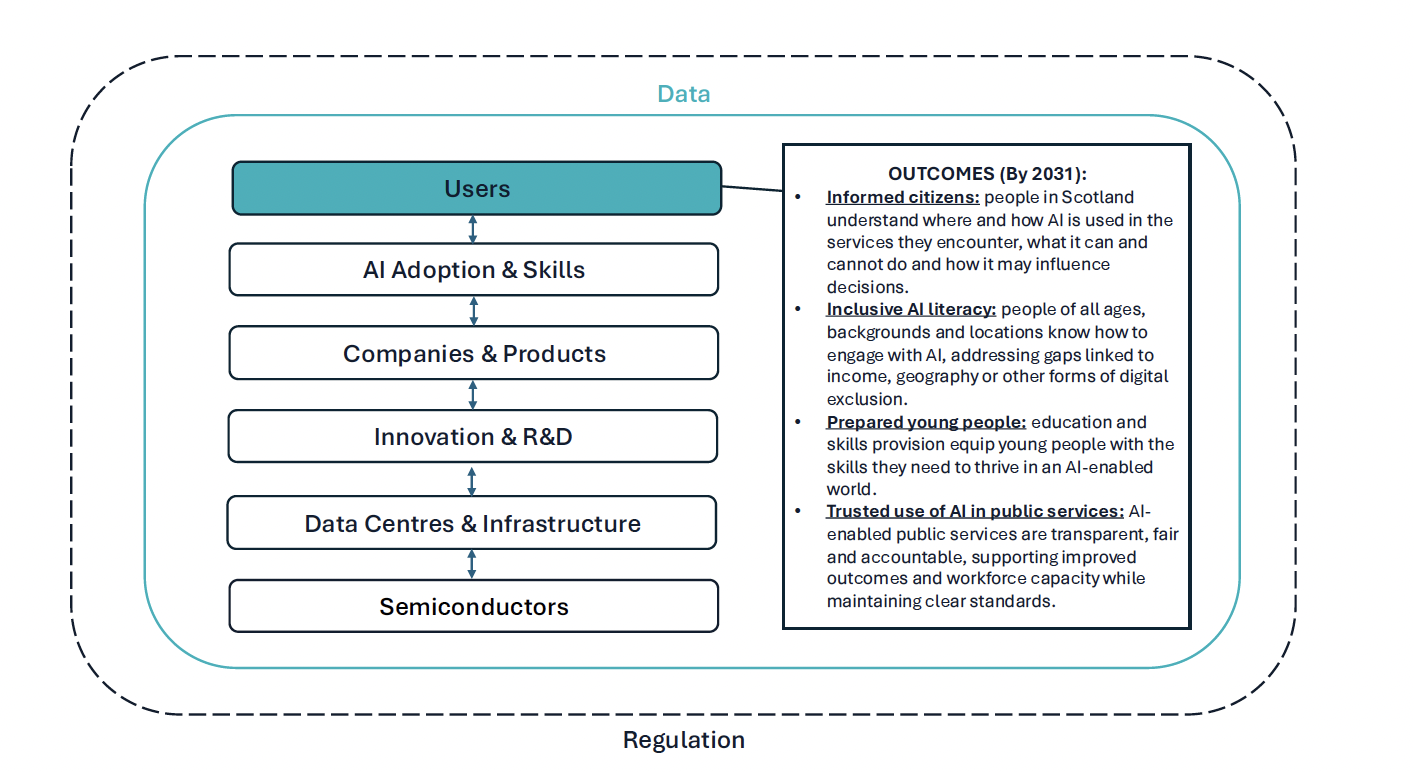
- Informed citizens: people in Scotland understand where and how AI is used in the services they encounter, what it can and cannot do and how it may influence decisions.
- Inclusive AI literacy: people of all ages, backgrounds and locations know how to engage with AI, addressing gaps linked to income, geography or other forms of digital exclusion.
- Prepared young people: education and skills provision equip young people with the skills they need to thrive in an AI-enabled world.
- Trusted use of AI in public services: AIenabled public services are transparent, fair and accountable, supporting improved outcomes and workforce capacity while maintaining clear standards.
- AI Adoption & Skills
- Companies & Products
- Innovation & R&D
- Data Centres & Infrastructure
- Semiconductors
- Data
- Regulation
The Digital Strategy for Scotland[33] sets a clear, shared vision for a nation where digital connects people to opportunities, supports economic growth and delivers improved public services. It establishes the foundations for inclusion, infrastructure and digital skills, and it recognises that ethical and inclusive digital transformation is key to delivering these ambitions.
The 2021 AI strategy[34] brought a vision for trustworthy, ethical and inclusive AI, guided by principles designed to ensure fairness, accountability and respect for human rights. That strategy established the ground for this strategy which in turn is building upon it and incorporating the pace and scale at which citizens now interact with AI‑enabled digital systems.
Citizens’ confidence and understanding of AI will vary significantly, particularly for those with lower levels of digital access and skills. Without sufficient AI literacy and clear communication, people may not understand when or how AI is involved in decisions that affect them, or what safeguards apply. As public services adopt AI at greater scale, supporting citizens to engage confidently and understand their rights, it becomes increasingly important to maintain trust and ensure equitable outcomes.
A human and user‑centred approach through the Scottish Approach to Service Design is needed to complement and reinforce the principles of trustworthy AI. In this way, this Strategy can ensure that citizens’ experience of AI‑enabled systems supports their ability to engage confidently and fairly with digital life, helping to make the vision of a connected, inclusive and prosperous Scotland a reality.
Actions and Outcomes
Actions
By 2027, the Scottish Government will:
Establish an independent Expert Advisory Board to provide advice and direction on the work of AI Scotland, ensuring that its programmes uphold Scotland’s trusted, ethical, inclusive and values‑led approach to AI.
Launch a nationwide engagement programme to listen to concerns and develop solutions that ensure public trust and confidence.
Implement a rigorous, trusted framework to ensure safe, ethical and efficient use of AI across health and social care services.
Promote materials to ensure an understanding of AI and its role in everyday life, strengthening AI literacy through universally open access to AI learning.
Work with public sector bodies and organisations to increase visibility and awareness of AI use across the public sector.
Work with public sector bodies and organisations to increase confidence and trust in how AI is governed and applied, strengthening ethical and inclusive approaches, transparency and capability for AI use within public services.
Outcomes
By 2031, we will see widespread literacy and confidence in engaging with AI. This means:
Informed citizens – People in Scotland understand where and how AI is used in the services they encounter; what it can and cannot do; and how it may influence decisions.
Inclusive AI literacy – People of all ages, backgrounds and locations know how to engage with AI which will address gaps linked to income, geography or other forms of digital exclusion.
Prepared young people – Education and skills provision equip young people with the skills they need to thrive in an increasingly AI-enabled world, helping learners to engage effectively with emerging technologies.
Trusted use of AI in public services – AI‑enabled public services are transparent, fair and accountable, supporting improved outcomes and workforce capacity while maintaining clear standards.
Case Study: Using AI to strengthen Safeguarding
Citizens Advice Scotland
The Extra Help Unit (EHU) within Citizens Advice Scotland (CAS) supports people in highly vulnerable situations with complex energy-related complaints. Between 2022 and 2024, the service experienced sustained crisis-level demand, handling 35,000 cases in 2024 with around 70% requiring urgent intervention. Traditional expansions in capacity and process change could not keep pace with need.
Through the Scottish Government’s CivTech 8 programme, the EHU partnered with HelpFirst to develop an AI-enabled triage and safeguarding tool for high volume, high risk casework. Launched in October 2024, the system identifies and prioritises cases with indicators of significant harm, flags immediate safeguarding risks in real time, and alerts caseworkers instantly to support rapid and proportionate intervention. Crucially, the tool is designed to augment, rather than replace, the professional judgement of skilled caseworkers, ensuring decisions remain grounded in human expertise.
The tool has delivered measurable benefits: faster escalation of high risk cases, improved workforce resilience, more effective use of operational capacity, and stronger safeguarding governance through consistent, auditable risk identification. It has also deepened understanding of service users, with recent data showing that 75% of referrals involve people with mental or physical health conditions.
The EHU’s AI-enabled safeguarding system demonstrates how well governed technology can enhance human decision making, protect vulnerable citizens, and build more resilient public services.
Layer 2
Adoption and Skills
AI adoption by organisations across all sectors of the economy helps deliver benefits and/or mitigate risks. Successful adoption does not necessarily mean the wholesale integration of AI into a business’s operational model. It means that the organisation’s leadership group has thought through the implications of AI for their data and operations, and in the context of its market position and future business strategy. It also means they have considered how to support their workforce in accessing upskilling opportunities and embedding AI safely and securely in their work.
- Users
- AI Adoption & Skills
- OUTCOMES (By 2031):
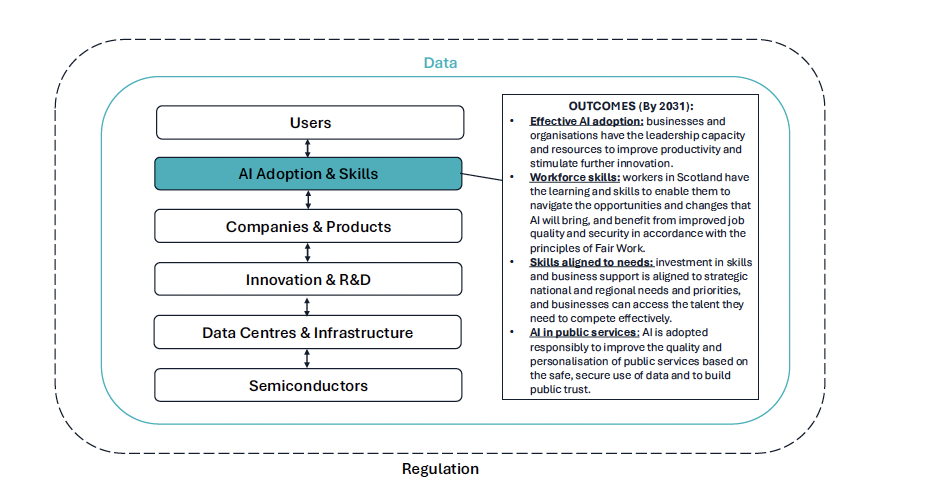
- Effective AI adoption: businesses and organisations have the leadership capacity and resources to improve productivity and stimulate further innovation.
- IWorkforce skills: workers in Scotland have the learning and skills to enable them to navigate the opportunities and changes that AI will bring, and benefit from improved job quality and security in accordance with the principles of Fair Work.
- Skills aligned to needs: investment in skills and business support is aligned to strategic national and regional needs and priorities, and businesses can access the talent they need to compete effectively.
- AI in public services: AI is adopted responsibly to improve the quality and personalisation of public services based on the safe, secure use of data and to build public trust.
- Companies & Products
- Innovation & R&D
- Data Centres & Infrastructure
- Semiconductors
- Data
- Regulation
Between July 2024 and June 2025, there were 5,700 job postings that required at least one AI skill across Scotland[35]. However, in March 2025, 61.9% of Scottish SMEs that responded to the latest Business Insights and Conditions Survey (BICS), reported that they are not using AI technologies[36]. Research suggests that there are acute skills shortages, particularly amongst small businesses and many firms do not offer any data or AI training for executives or staff.
This evidence makes a strong case for a renewed, national AI adoption programme that builds on learning from the initial 2025-26 programme. It should also leverage assets, such as the AI Adoption Framework being developed by The Data Lab, to provide targeted support and clear guidance with a focus on enabling organisational leaders to understand and respond to the potential of AI and the need for change.
As the adoption of AI accelerates across Scotland’s business base, a concurrent shift is needed in the public and third sectors. The Digital Public Services Delivery Plan sets a clear direction for ethical, transparent and outcomes-driven use of AI, supported by the Scottish AI Register. Embedding these principles will help ensure Scotland’s public services can lead by example and support confident, responsible AI adoption nationwide by helping to build public trust.[37]
AI has the potential to transform work across sectors, impacting tasks and relationships. Ensuring this change aligns with Scotland’s Fair Work principles[38] is crucial. Successful AI adoption requires an engaged and skilled workforce. Fair work practices that involve workers and promote upskilling will help organisations adapt and leverage AI effectively.
SME AI Adoption Programme
To begin to address these challenges, in its Programme for Government 2025-26, the Scottish Government announced a £1 million SME AI Adoption Programme, delivered in collaboration with Scotland’s enterprise agencies and The Data Lab,providing support for SMEs to more effectively adopt AI into their business operations.
The SME AI Adoption Programme was developed to increase awareness, build confidence and provide practical support for AI adoption among Scottish SMEs. It focused on helping businesses understand the potential of AI, develop leadership capability and begin implementing early AI projects through a blend of awareness raising activity, skills development and hands-on assistance.
Through roadshows, courses and case studies, the programme introduced SMEs to the benefits of AI and how it could be applied within their organisations. Targeted grants, mentoring and technical support enabled firms to explore priority use cases and progress initial AI projects, while leadership development strengthened the capability of senior leaders to drive responsible adoption. Dedicated rural activity ensured that businesses across Scotland, including those in remote areas, could access support.
More than 500 SMEs have engaged with the programme. Over 80 firms have been identified and scoped early AI use cases. More than 120 senior leaders participated in leadership development and over 160 companies received hands-on assistance, mentoring or exploration funding. The programme also generated a strong evidence base on SME readiness, informing future initiatives to support more advanced AI adoption and scale-up activity.
Actions and Outcomes
Actions
By 2027, the Scottish Government will:
Roll out a revitalised national AI adoption programme to accelerate SME productivity and competitiveness.
Pilot a new AI Leadership Academy for leaders of Scottish SMEs.
Introduce a standardised AI readiness tool for SMEs, social enterprises and public bodies.
Expand short, modular AI literacy training focusing on practical use cases, ethics and assurance.
Establish a Future Jobs Panel to assess AI’s workforce impact and guide national skills planning.
Outcomes
By 2031, we will see effective adoption of workforce skills via accessible pathways.. This means:
Effective AI adoption – Businesses and other organisations have the leadership capacity and resources to embed AI responsibly to improve productivity and stimulate further innovation.Workforce skills – Workers in Scotland have the learning and skills to enable them to navigate the opportunities and changes that AI will bring and benefit from improved job quality and security in accordance with the principles of Fair Work.
Skills aligned to needs – Investment in skills and business support is aligned to strategic national and regional needs and priorities and businesses are able to access the talent they need to compete effectively.
AI in the public sector – AI is adopted responsibly to improve the quality and personalisation of public services based on the safe, secure use of data and to build public trust.
Case Study: Using AI to Scale Circular Lighting Manufacturing
EGG Lighting
EGG Lighting is a Scottish manufacturer delivering high-tech, circular lighting solutions through remanufacture, smart controls, and digital tracking.
With the support of the SME AI Adoption Programme EGG moved from ad-hoc use of AI to structured, business-wide adoption. Marketing teams have used AI to generate first draft content and cut preparation time by around 60%. Assembly and workshop teams have replaced paper-based processes with AI-assisted digital forms, saving 30–40 minutes per delivery and improving traceability. Developers are delivering internal applications far faster, producing working dashboards in days instead of weeks. Clear data use guidance has also ensured that staff can adopt AI safely and consistently.
AI has streamlined EGG’s operations, with marketing teams using it to generate first draft content and cut preparation time by around 60%. Assembly and workshop teams have replaced paper-based processes with AI-assisted digital forms, saving 30–40 minutes per delivery and improving traceability. Developers are delivering internal applications far faster, producing working dashboards in days instead of weeks. Clear data use guidance has also ensured that staff can adopt AI safely and consistently.
AI adoption at EGG is now part of how the business delivers, grows and proves performance. AI tools are actively used by staff, delivering an estimated £40k–£60k cost avoidance. EGG has scaled output without increasing headcount and now sees faster product iteration, supporting sensor-enabled lighting growth.
Layer 3
Companies and Products
Scotland has the entrepreneurs, research and support networks to produce world-leading AI companies.
- Users
- AI Adoption & Skills
- Companies & Products
- OUTCOMES (By 2031):
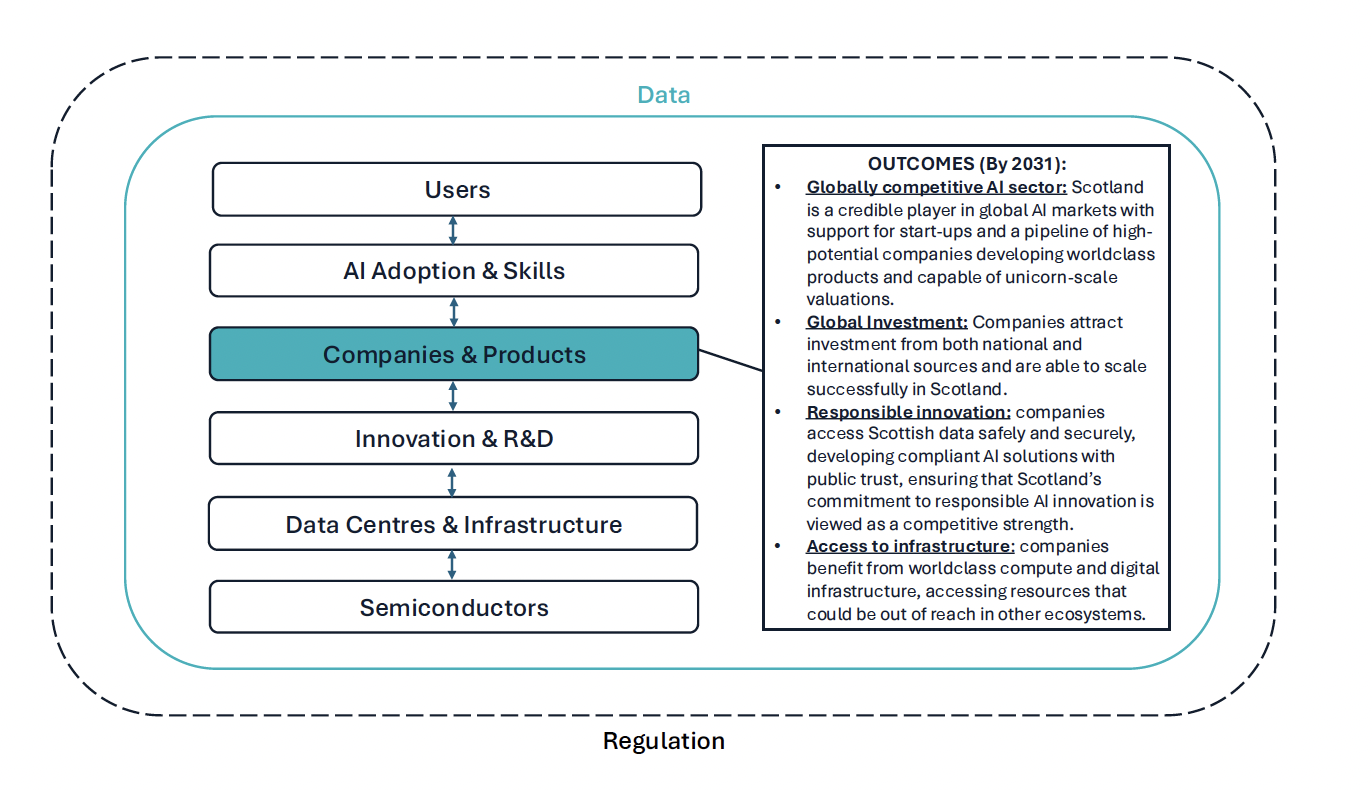
- Globally competitive AI sector: Scotland is a credible player in global AI markets with support for start-ups and a pipeline of highpotential companies developing worldclass products and capable of unicorn-scale valuations.
- Global Investment: Companies attract investment from both national and international sources and are able to scale successfully in Scotland.
- Responsible innovation: companies access Scottish data safely and securely, developing compliant AI solutions with public trust, ensuring that Scotland’s commitment to responsible AI innovation is viewed as a competitive strength.
- Access to infrastructure: companies benefit from worldclass compute and digital infrastructure, accessing resources that could be out of reach in other ecosystems.
- Innovation & R&D
- Data Centres & Infrastructure
- Semiconductors
- Data
- Regulation
McKinsey’s global survey found that 71% of global leaders see sovereign AI as an existential or strategic imperative, driven by concerns over dependency on foreign models and infrastructure.[39] Countries are increasingly treating sovereign AI as a strategic necessity because the ability to control your own compute, data and models is now a central factor in national competitiveness.
For Scotland, having home‑grown AI companies will help to ensure control over sensitive data, especially in areas like health, public services and national infrastructure. Every successful AI company produces specialised, high productivity roles and these jobs anchor skilled workers in Scotland, rather than losing them to other countries. These jobs also support a wider ecosystem, including universities and colleges, start-ups, incubators and investors to create long-term economic resilience.
Being a producer, not just a consumer of AI, ensures Scotland isn’t left behind as AI reshapes global economies. AI is becoming a core driver of competitiveness and countries that build their own AI capabilities, capture the value, set standards and shape how the technology is used. Those that do not, risk falling behind.
Actions and Outcomes
Actions
By 2027, the Scottish Government will:
Pilot an AI scale‑up Accelerator connecting high‑growth companies with experienced entrepreneurs and investment networks.
Deliver at least one national stakeholder event, focussed on convening and celebrating Scotland’s AI companies and the wider ecosystem.
Work with ecosystem partners to undertake a national assessment of AI company needs, mapping barriers to scaling across sectors and identifying requirements in compute, data access, talent, investment and export readiness.
Work with existing asset owners to increase the accessibility of compute power for Scotland’s AI companies.
Co-ordinate activity with Techscaler[40] and public agencies to strengthen international investor engagement and increase visibility of Scottish AI firms.
Outcomes
By 2031, we will see a Scottish ecosystem which supports companies to access talent, compute power and innovation. This means:
A globally competitive AI sector – Scotland is a credible player in global AI markets with support for start-ups and a pipeline of high-potential companies developing world-class products and capable of unicorn-scale valuations.
Global Investment – Companies attract investment from both national and international sources and are able to scale successfully in Scotland.
Responsible innovation – Companies access Scottish data safely and securely, developing compliant AI solutions with public trust, ensuring that Scotland’s commitment to responsible AI innovation is viewed as a competitive strength.
Access to enabling infrastructure including compute – Companies benefit from world-class compute and digital infrastructure, accessing resources that could be out of reach in other ecosystems.
Case Study – Using AI to Help Enterprises Cut Hiring Time and Costs
Gigged.AI
Gigged.AI, based in Glasgow, works with enterprises in the UK and beyond, including Fortune 500 and FTSE 100 companies, to fill critical skill gaps and keep projects on track.
Digital roadmaps within large enterprises are ambitious and timelines for delivery are accelerating, yet many leaders are still facing month-long waits to onboard critical hires. The result is that projects stall, spend increases and transformation slows.
Gigged.AI’s project hiring platform uses artificial intelligence and proprietary talent matching algorithms to reduce time and cost in sourcing tech expertise.
Gigged.AI’s on demand talent feature provides access to vetted contractors across more than 500 skills, supported by an AI-powered Statement of Work (SoW) generator that converts requirements into outcome based or time and materials SoWs within minutes. Alongside this, its Workforce Intelligence capability maps internal skills and existing AI agents, using real time analytics to highlight opportunities for internal mobility and productivity gains.
Gigged.AI also focuses on key challenges such as transparency, using its proprietary algorithm to provide weighted scores and clear justification for each match; data quality, supported by SFIA accredited skills taxonomy; and compliance, delivered through integrated IR35/W2/1099 checks and vetting via partners Amiqus and QDOS.
Together, these capabilities deliver measurable impact for enterprises, including 30% lower contingent hiring costs, a 50% faster time‑to‑hire, averaging five days from SoW creation to onboarding, and a 15% improvement in employee retention through enhanced internal mobility.
Layer 4
Innovation, Research and Development
Scotland has an internationally recognised research base and strong academic performance in AI related fields, yet this excellence is not converting into economic impact at the scale it should. There is significant potential to build further upon universities’ and colleges’ impact and contribution to Scotland’s regional and national economies.
- Users
- AI Adoption & Skills
- Companies & Products
- Innovation & R&D
- OUTCOMES (By 2031):
- World-leading research: Scottish universities and colleges are recognised internationally for excellence in AI research, driving innovation that benefits the economy and Scottish society.
- Research with commercial impact: Scotland’s world-class institutions consistently convert research into highgrowth spinouts, attracting investment and creating jobs while strengthening sectors and supply chains.
- Cluster development: high-value clusters linked to AI grow and are globally recognised, acting as an engine of growth for Scotland’s innovation economy.
- Public sector-driven innovation: public sector drives demand for innovative AI products and services, providing a reference market for Scottish companies and new products
- Data Centres & Infrastructure
- Semiconductors
- Data
- Regulation
Scotland’s universities continue to perform strongly internationally in research around AI and related disciplines. However, whilst Scotland consistently produces high quality scientific and technological research we can go much further in translating it into commercial products or services.
The issue is not the quality of research, but the limited translation of that research into economic value, leaving significant potential underused. To capture the economic opportunities from its world leading research, Scotland must strengthen its innovation ecosystem, ensuring ideas move from research to commercial application more effectively.
The strategic opportunity is not only economic but competitive. Scotland has the research assets and institutional infrastructure necessary to position itself as a leader in ethical, inclusive, trustworthy and mission-driven AI. This is an area where global demand is growing and regulatory expectations are rising. We will only achieve this however if we make best use of our intellectual property, strengthen our position in international markets, increase access to venture funding and attract inward investment into emerging technology clusters. We must expand the concept of our AI ecosystem to one that embraces appropriate academic and business partnerships across the globe.
Actions and Outcomes
Actions
By 2027, the Scottish Government will:
Launch an innovation programme that applies commercial and research expertise in AI to the delivery of public services.
Establish a national cluster scheme, aligning AI as a critical enabling technology across all clusters.
Develop financial support and guidance to enable clusters to emerge, grow and compete internationally, making best use of global research partnerships.
Work with delivery partners to pilot a new approach to university commercialisation, bringing together all the essential elements of commercialisation into a Venture Creator.[41]
By progressing with the initiatives identified in the Scottish Spin-out Report with our ecosystem partners, we will continue to strengthen Scotland’s research commercialisation pipeline.
Outcomes
By 2031, we will see a strong pipeline from research institutions to commercial impact. This means:
World-Leading AI research – Scottish universities and colleges are recognised internationally for excellence in AI research, driving innovation that benefits the economy and Scottish society.
Research with commercial impact – Scotland’s world-class institutions consistently convert research into high-growth spin-outs, attracting investment and creating jobs while strengthening sectors and supply chains.
Cluster development – High-value clusters linked to AI grow and are globally recognised, acting as an engine of growth for Scotland’s innovation economy.
Public Service driven innovation – Public sector drives demand for innovative AI products and services, providing a reference market for Scottish companies and new products.
Case Study – Using AI to Transform Chemical Manufacturing
Chemify
Chemify, a University of Glasgow spin out, uses artificial intelligence and robotics to automate and accelerate chemical synthesis.
Traditional synthesis is slow, labour intensive and highly dependent on specialist expertise, leading many organisations to face long development cycles, high failure rates and escalating costs. Chemify set out to apply AI to overcome these barriers, supported by UK and Scottish Government innovation programmes and Scottish Enterprise.
Chemify has built an AI-enabled platform that integrates robotics, machine learning and cloud-based software to design, execute and optimise chemical reactions automatically. By digitising the entire workflow, the company created a standardised, repeatable approach to synthesis. It invested in proprietary algorithms and purpose-built hardware and partnered with major pharmaceutical and research organisations to validate and scale the technology. In 2025, Chemify raised a significant Series B round to expand its engineering capability and accelerate global commercialisation.
Chemify has reduced development timelines from months to days in selected projects, opened a £12 million Chemifarm facility in Maryhill to support international pharma partnerships, and created over 180 high-skilled jobs across chemistry, engineering and data science. It has attracted major investment, including a $50 million Series B raise, and strengthened Scotland’s position as a global leader in digital chemistry and life sciences. Its platform is now helping drive greater productivity, sustainability and innovation across high value manufacturing.
Layer 5
Data Centres and Infrastructure
In an increasingly digitised global economy, the ability to host critical national infrastructure such as data centres is central to data sovereignty and the development of domestic AI skills and capabilities to realise economic growth and societal value. Governments around the world are actively competing to attract leading global technology firms. Establishing AI and advanced compute infrastructure within a country’s borders is widely recognised as being strategically and economically significant.
- Users
- AI Adoption & Skills
- Companies & Products
- Data Centres & Infrastructure
- OUTCOMES (By 2031):
- Globally competitive investment landscape: Scotland is recognised as a leader in sustainable data centre development, based on renewable energy supply and water-resilient design. Heat reuse, distributed compute and frontier energy solutions are integrated into new developments.
- Connectivity: Green data centres are able to secure timely access to renewable power and the grid infrastructure.
- Benefits realised: Data centre developments deliver tangible benefits for local communities. Compute capacity supports AI development, attracting talent and enabling innovation.
- Resilient infrastructure: sovereign data centre capabilities support critical services and enhance national resilience
- Semiconductors
- Data
- Regulation
Infrastructure is often the anchor of investment and innovation, with companies more inclined to cluster activity, talent and capital around existing assets. A strong and diverse AI infrastructure base in Scotland will therefore catalyse growth across the wider AI stack, supporting skills development, research and the practical application of AI across the economy.
Water infrastructure
Whilst many modern datacentres are significantly reducing water consumption, sustainable management of precious water resources remains a critical consideration. Scottish Water is therefore advising the data centre industry on several fronts: guiding location decisions to support the most sustainable use of water; encouraging the reuse of treated wastewater; and promoting the adoption of closed-loop systems to reduce overall demand.
Improving Grid Connection Timescales
For Scotland to compete in this global race to secure digital infrastructure capabilities, its electricity grid infrastructure must be capable of servicing strategically important investment opportunities such as data centres. Despite Scotland’s strengths in generating renewable energy, the ability to realise the full benefits of this resource in our AI ambitions requires changes to current grid infrastructure and the means of accessing it.
While this is an area of policy reserved to the UK Government, the National Energy Systems Operator (NESO)’s Grid Connection Reform Process[42] is a welcome development. The Scottish Government is engaging collaboratively with NESO, and the UK Government on its Connections Accelerator Service, to enable projects to be connected as soon as feasible.
Improving Hyperscale Investor Confidence
The Scottish Government and its enterprise agencies are developing the Scottish Green Compute proposition: AI powered by clean energy in Scotland. For identified sites with proximity to necessary infrastructure, the option of local authority-designated ‘Green AI-Ready’ zones will be explored. Subject to local authority decisions, where conditions are supportive, planning approvals/designations could be utilised within Local Development Plans.
Strengthening Distributed Compute Deployment
Hyperscale data centres secure significant capital investment and associated benefits but this alone will not secure a comprehensive set of digital capabilities. The potential for distributed compute throughout Scotland has been enabled by investment in a national fibre backbone. Realising this potential, where local considerations are favourable, will support an improved offer to investors.
Distributed compute offers a quicker route to deployment, subject to local agreements. The aim of securing distributed compute – and its associated benefits around AI utilisation, inference capabilities and heat reuse – will be a major focus moving forward. Priority tasks are understanding what is limiting deployment of distributed compute and what programme of activity can be developed to overcome this.
Actions and Outcomes
Actions
By 2027, the Scottish Government will:
Work with UK Government and ecosystem partners to ensure effective delivery of the Lanarkshire AI Growth Zone and support the identification of further investment.
Work with partners to explore the development of a dedicated AI Accelerator linked to the Lanarkshire AI Growth Zone.
Work with potential investors to progress the pipeline of data centre investment opportunities through the promotion of Scotland’s strengths in renewables, digital connectivity and water infrastructure.
Work with partners to identify and mobilise heat offtake opportunities on data centre sites, correlating sites to planned district heat networks.
Publish guidance on what factors are prevalent in a ‘green’ data centre.
Outcomes
By 2031, we will see investment in Scotland’s digital, energy and water infrastructure maximising benefits for the wider good. This means:
Globally competitive investment landscape – Scotland is recognised as a leader in sustainable data centre development based on renewable energy supply, water-resilient design and sustainable water stewardship. Heat reuse, distributed compute and frontier energy solutions are integrated into new developments.
Benefits realised – Data centre developments deliver tangible benefits for local communities. Compute capacity supports AI development, attracting talent and enabling innovation.
Resilient infrastructure – Sovereign data centre capabilities support critical services and enhance national resilience in Scotland and across the UK.
Connectivity – Green data centres are able to secure timely access to renewable power and the grid infrastructure.
Case Study – Community Led Renewable Energy Transforms the Isle of Eigg
Isle of Eigg Heritage Trust & Eigg Electric
The Isle of Eigg in Scotland is the first island in the world to generate all its electricity from renewable energy. Isle of Eigg Heritage Trust manages the island for the community while Eigg Electric runs a renewable microgrid supplying 24-hour electricity.
Formerly, Eigg lacked mains electricity, faced limited infrastructure, and relied on noisy, costly diesel generators operating only a few hours a day. The island’s geographical location also meant connecting to the mainland power network was not viable.
To address this, the community designed an off grid renewable system combining hydro, wind and solar power. The system delivers 90–95% renewable electricity through a 24-hour microgrid supported by battery storage. Eigg’s renewable system now includes a 110 kW hydro scheme, 24 kW of wind generation and an expanding solar array that has helped boost total capacity to 280 kW. The island has upgraded transformers and distribution infrastructure to support new homes, electric vehicles and continued growth. The Scottish Government has committed £859,648 through the CARES programme to strengthen community energy on Eigg, including a recent £185,662 award from the 2025/26 Community Energy Generation Growth Fund to further advance the island’s decarbonisation plans.
Eigg became the world’s first community to run entirely on renewable electricity in 2008, replacing diesel with reliable, 24‑hour power that has lowered costs for residents. Since the community buyout, the population has grown by 75%, supported by better infrastructure, new businesses and sustainable tourism, and the island has earned major awards including the £300,000 NESTA Big Green Challenge and the Ashden UK Gold Award. With new investment set to double generation capacity within three years, Eigg is now on track to achieve zero‑emission heating, cooking and transport by 2030.
Layer 6
Semiconductors
The strategic importance of semiconductors and related microprocessor technologies in the AI era cannot be overstated. As AI models grow exponentially in size and complexity, the demand for specialised processing hardware, energy-efficient architectures, high-throughput accelerators, and photonics-enabled connectivity is surging.
- Users
- AI Adoption & Skills
- Companies & Products
- Innovation & R&D
- Data Centres & Infrastructure
- Semiconductors
- OUTCOMES (By 2031):
- Cluster growth: Scotland continues to enjoy global success in each element of the critical technologies supercluster. This growth attracts talent and sustains sovereign capability and niche strengths in AI hardware for critical infrastructure.
- Start-up and spin-out support: Scotland is a leading strategic location for semiconductor and AI hardware research and development, with a pipeline of semiconductor spin-outs, attracting international investment.
- Inward investment: public investment unlocks private capital, stimulating innovation, strengthening supply chains and increasing the flow of further investment, exports and talent into Scotland’s economy.
- Research leadership: Scotland’s research institutions continue to enhance their global reputation in quantum and photonics, strengthening innovation across the semiconductor sector.
- Data
- Regulation
For Scotland, supporting and accelerating existing capabilities is a prerequisite for national competitiveness in AI, and an opportunity to capitalise on existing niche capability. AI adoption across the economy depends on access to advanced compute technologies, while global investors increasingly assess the strength of a country’s semiconductor ecosystem when making decisions.
Other countries such as Finland, Denmark, New Zealand and Japan are already embedding semiconductor and photonics capability into national AI strategies and investing in regional fabrication and research hubs. Scotland can do likewise but differentiate globally by leading in low‑energy, semiconductor‑enabled data centre and edge‑AI technologies.
Scotland’s Critical Technologies supercluster coordinates action across the four mutually supportive sub-sectors of photonics, quantum, semiconductors and connectivity and sensing. The semiconductor cluster is diverse and growing rapidly, with over 50 companies across the full supply-chain, multiple open-access industrial facilities and a turnover of over £1.2 billion annually[43]. Specialisms include image sensors, AI architectures, advanced packaging for space and photonics and automotive applications.
Scotland has substantial opportunities in semiconductor architectures, power electronics, high-speed connectivity between processors and quantum computing hardware. Work in these areas involves the Edinburgh University Scottish Microelectronics Centre[44], Glasgow University, the James Watt Nanofabrication Centre[45], Strathclyde University, the National Advanced Semiconductor Packaging and Integration Centre (NASPIC)[46], the Fraunhofer Centre for Applied Photonics[47] and companies like Sivers Photonics[48] and Vector Photonics[49].
Focusing on growing markets and niche strengths in photonics, semiconductor chip design, power electronics and advanced packaging, Scotland can deliver sovereign capability in key parts of the supply-chain. This will enable Scotland to compete on focused innovation for selected applications. By leaning into these capabilities, we can target higher-value market segments and higher value-add manufacturing, strengthening the domestic ecosystem to reach global markets.
Actions and Outcomes
Actions
By 2027, the Scottish Government will:
Engage Scotland’s CTSAB (Critical Technologies Supercluster Advisory Board) to identify strengths and coordinate research and development.
Enable the growth of high potential AI hardware spin-outs by working with the CTSAB to ensure that support, infrastructure and investment priorities are aligned with Scotland’s Deeptech strengths.
Ensure that future workforce planning reflects the needs of Scotland’s advanced technology industries by working with academia and public bodies to align the response to skills demand.
Outcomes
By 2031, we will see strong and growing technology clusters with capacity to support data centres. This means:
Inward investment– Public investment unlocks private capital, stimulating innovation, driving cluster productivity, strengthening supply chains and increasing the flow of further investment, exports and talent into Scotland’s economy.Start-up and spin-out support – Scotland is a leading strategic location for semiconductor and AI hardware research and development, prototyping and production, with a pipeline of semiconductor spin-outs.
Cluster growth – Scotland continues to enjoy global success in each element of the critical technologies supercluster. This growth attracts talent and sustains sovereign capability and niche strengths in AI hardware for critical infrastructure.
Research leadership - Scotland’s research institutions continue to enhance their global reputation in quantum and photonics, strengthening the scientific base that supports innovation across the semiconductor sector.
Case Study – Semiconductor Innovation in Scotland
Quantcore
Quantcore designs and manufactures advanced, superconducting components in Scotland to support both quantum computing and emerging low-energy classical computing systems.
Advanced computing systems can require extremely precise hardware made from superconducting materials. These materials can operate with very low energy loss, making them attractive not only for quantum computing but also for future classical processors designed to handle AI workloads more efficiently. However, manufacturing such components is complex and usually completely dependent on overseas suppliers, which can slow innovation and increase costs.
To address this, Quantcore established a specialist fabrication capability in Glasgow to design and produce superconducting circuits, components and sensors. They supply both standard and custom superconducting components, enabling universities, start-ups and established companies to prototype and test new ideas in quantum systems and energy efficient AI hardware.
By building this capability within Scotland, they reduce reliance on international supply chains and shorten development cycles. Their work provides locally manufactured superconducting devices for UK researchers and industry, supports the development of quantum processors and next generation low power computing systems and enables exploration of more energy efficient AI hardware architectures.
Quantcore’s work strengthens Scotland’s growing advanced computing and semiconductor ecosystem, helping build a sovereign supply chain for quantum technologies.
Layer 7
Data
Scotland has strong foundations for the effective use of public sector data, with clear national strategies, trusted governance frameworks and established delivery mechanisms. However despite this progress, the full value of public data as a national asset is not yet being realised[50].
- Users
- AI Adoption & Skills
- Companies & Products
- Innovation & R&D
- Data Centres & Infrastructure
- Semiconductors
- Data
- OUTCOMES (By 2031):
- Public sector data: collective leadership creates a mature and coordinated public sector data ecosystem with the highest levels of security and public trust. Data is shared safely and responsibly and is easy to access.
- Data assets: responsible public sector AI deployment and adoption is enabled by secure, well-maintained data assets and guided by principles of transparency, safety and public good.
- Public sector AI: Public sector data is AIready and is deployed securely and responsibly across a wide range of applications, transforming service delivery and improving outcomes.
- Public data access: Public sector data enables high quality research and innovation with secure, easy to access, anonymised datasets available across organisational boundaries.
- Regulation
Data remains fragmented across systems and organisations. Access processes can be slow and complex, and infrastructure and workforce capability have not consistently kept pace with the scale, speed and interoperability required to support modern digital services and AI-driven innovation.
As other nations accelerate investment and streamline secure access, there is a growing risk that Scotland falls behind in research competitiveness, private investment and the development of data-enabled products and services.
The strategic direction set out by the Scottish Government through the Digital Strategy for Scotland: Sustainable Digital Public Services Delivery Plan[51] recognises public sector data as a central driver of more targeted, personalised and preventative services and highlights the need for improved data sharing, stronger information governance and greater data literacy.
Delivering this vision requires coordinated action to modernise secure data infrastructure, simplify and standardise access and enable safe reuse of data at pace and scale. Strengthening these foundations will unlock insights, support collaboration and create the conditions for trustworthy AI adoption, while ensuring that economic and social value generated from public data is returned to public services and the people of Scotland[52].
Actions and Outcomes
Actions
By 2027, the Scottish Government will:
Launch a data matchmaking pilot enabling organisations to access trusted public‑sector datasets, to support data-driven innovation.
Work with public sector organisations to identify the barriers and enablers affecting access to public sector data for AI, ensuring that programmes address shared challenges and support responsible use.
Launch an innovation programme that applies commercial and research expertise in AI to the delivery of public services.
Deliver a more coordinated public sector approach to data through a joint leadership group with Local Government.
Outcomes
By 2031, we will see collective leadership of data-sharing enabling safe, accessible use of data. This means:
Public sector data – Collective leadership creates a mature and coordinated public sector data ecosystem with the highest levels of security and public trust. Data is shared safely and responsibly and is easy to access when needed.
Data assets – Responsible public sector AI deployment and adoption is enabled by secure, well-maintained data assets and guided by principles of transparency, safety and public good.
Public sector AI – Public sector data is AI-ready and is deployed securely and responsibly across a wide range of applications, transforming service delivery and improving outcomes.
Public data access – Public sector data enables high quality research and innovation with secure, easy to access, anonymised datasets available across organisational boundaries.’
Case Study – Trustworthy and Safe AI Lifecycle Framework
National Physical Laboratory (NPL)
NPL, the UK’s National Metrology Institute, is improving the safety and trustworthiness of AI in Scotland through its Data Science & AI Hub at the University of Strathclyde. The Hub supports work across a strategic partnership involving NPL, Strathclyde and the University of Surrey, developing frameworks that help ensure AI systems are measurably safe, reliable and trustworthy.
AI introduces unique challenges because it relies on data, learns from experience and changes over time. Traditional methods for software testing and assurance cannot fully address these evolving risks. NPL identified the need for a structured way to measure trust and safety in AI systems, giving organisations clearer insight into how models behave and where risks may emerge.
In response, NPL created a practical framework that adapts software development and testing processes to account for AI specific risks. It sets out clear steps for documenting, managing and mitigating risk, supported by trustworthiness metrics that can be measured throughout development. The approach has already been applied in areas including medical technologies, autonomous systems and manufacturing, and has been shared globally, influencing international best practice for trustworthy AI.
This work provides a repeatable, evidence-based method for assessing and assuring the trust and safety of AI systems. It helps developers and decisionmakers act on measurable insights, supports government and industry as they move towards emerging standards, and contributes to safer, more confident adoption of AI across sectors such as healthcare, transport and high value manufacturing.
Layer 8
Regulation
People in Scotland require certainty in respect of their rights to privacy, the proper safeguarding of personal data and intellectual property and their well-being. Businesses in Scotland (the ‘Companies and Products’ layer) require clarity in relation to the regulatory environment in which they do business.
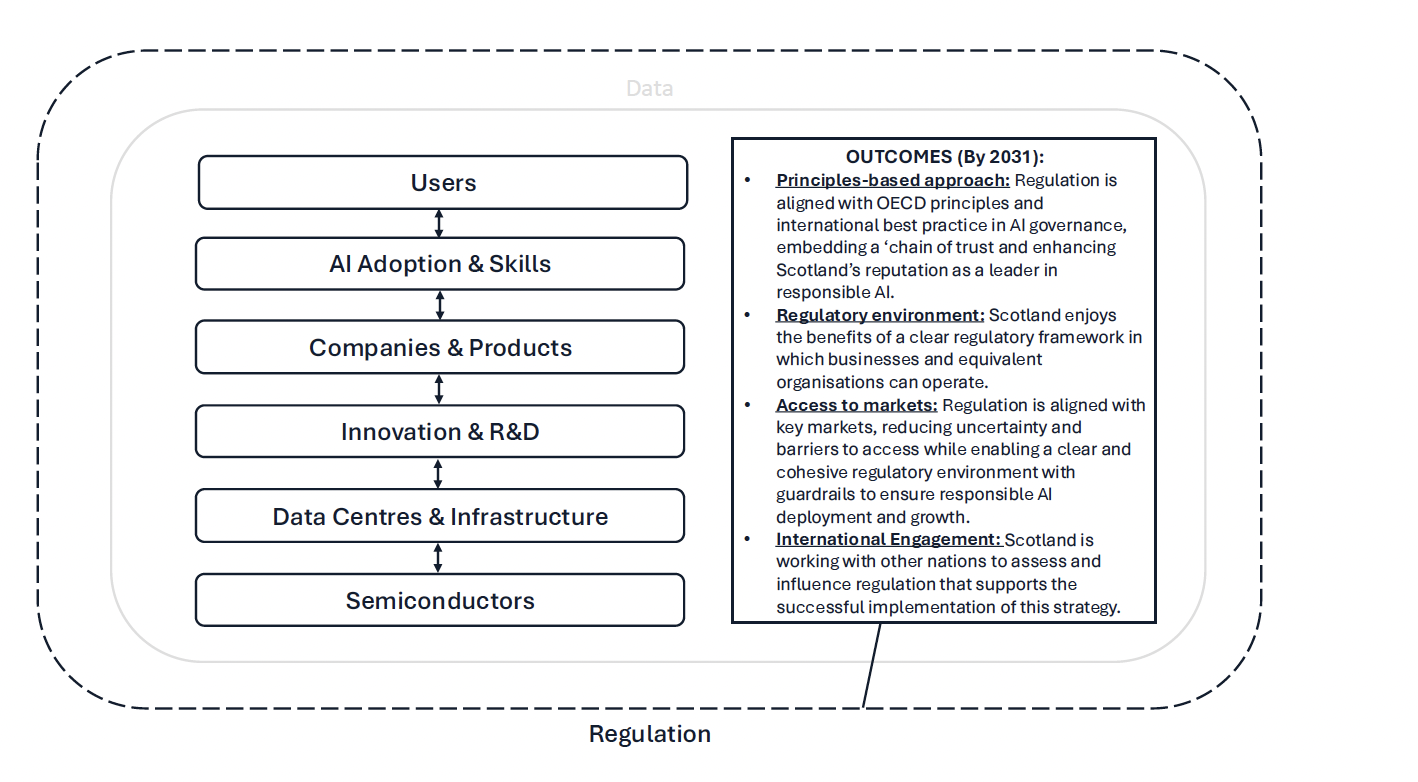
- Users
- AI Adoption & Skills
- Companies & Products
- Innovation & R&D
- Data Centres & Infrastructure
- Semiconductors
- Data
- Regulation
- OUTCOMES (By 2031):
- Principles-based approach: Regulation is aligned with OECD principles and international best practice in AI governance, embedding a ‘chain of trust and enhancing Scotland’s reputation as a leader in responsible AI.
- Regulatory environment: Scotland enjoys the benefits of a clear regulatory framework in which businesses and equivalent organisations can operate.
- Access to markets: Regulation is aligned with key markets, reducing uncertainty and barriers to access while enabling a clear and cohesive regulatory environment with guardrails to ensure responsible AI deployment and growth.
- International Engagement: Scotland is working with other nations to assess and influence regulation that supports the successful implementation of this strategy.
Effective regulation can provide certainty at every level of the AI stack and help build business, investor and public confidence in AI. This requires collaboration and joint efforts by the Scottish and UK Governments, ensuring alignment between the Scottish and UK regulatory environments.
This strategy reaffirms the commitment in Scotland’s first AI Strategy[53] that delivery would be guided by the OECD’s principles, creating a ‘chain of trust’ and enhancing Scotland’s reputation as an ethical place to do business.
This means that this Strategy, and the regulatory framework which has either been (or which is in the process of being) adopted by expert regulators around the UK and in Scotland are aligned on matters of principle. Specific reference to the OECD principles in UK legislation, regulations or guidance would place this alignment on a more certain footing.
Sectoral regulation and ‘sandboxes’
In specific sectors where Scotland may have greater latitude around regulation, our approach will be driven by a determination to ensure that users are safeguarded from any potential negative impacts or risks arising from the use of AI in relation to individuals and their personal data. This can be tested through the use of ‘sandboxes’[54], controlled environments in which changes to regulations can be tested. The Financial Conduct Authority (FCA) currently offers a regulatory sandbox and the UK Government has built on this example to develop proposals for a cross-economy ‘AI Growth Lab’[55]. We will work with these and other examples, innovating where appropriate to ensure that our businesses are well placed to understand regulatory impacts and opportunities.
The EU AI Act goes further than the scope and aims of the UK Government’s interventions in relation to AI regulation with statutory obligations imposed on providers of general-purpose AI models and the classification of certain AI models as presenting ‘systemic risk’ (Article 51).
In any crossover or interaction between a non-statutory and a statutory regulatory regime, the heavier burden of compliance falls on actors within the non-statutory framework, to prove rather than state compliance and provide such evidence as may be required, under whatever terms the statutory authority stipulates.
For these reasons (as well as the Scottish Government’s established position on alignment with European institutions and markets), the Scottish Government intends to advocate for UK-level regulation of AI which addresses (so far as is practicable) the need for Scottish ventures and businesses to be able to access European markets, investment and opportunities.
Actions and Outcomes
Actions
By 2027, the Scottish Government will:
Advocate on behalf of the AI sector and users of AI in Scotland, for a UK Government approach to AI regulation which places the OECD’s five values-based principles for the responsible stewardship of trustworthy AI on a statutory footing, and which also enables alignment with it.
Review and report on the scope and requirement to regulate to put in place additional appropriate sector-specific safeguards in relation to potential negative impacts or risks arising from the use of AI, where these impact on devolved areas.
As part of the review, taking the opportunity to demonstrate closer alignment with the EU AI Act.
Publish a report on the scope and requirement for AI regulation in Scotland.
Outcomes
By 2031, we will see alignment with OECD principles and best practice in responsible AI governance. This means:
Principles-based approach – Regulation is aligned with OECD principles and international best practice in AI governance, embedding a ‘chain of trust’ and enhancing Scotland’s reputation as a leader in responsible AI.
Regulatory environment – Scotland enjoys the benefits of a clear regulatory framework in which businesses and equivalent organisations can operate.
Access to markets – Regulation is aligned with key markets, reducing uncertainty and barriers to access while enabling a clear and cohesive regulatory environment with guardrails to ensure responsible AI deployment and growth.
International Engagement – Scotland is working with other nations to assess and influence regulation that supports the successful implementation of this strategy.
Risks and Mitigations
As we deliver the actions in this Strategy, we will continue to deepen our understanding of the risks that AI growth may create. Not all risks are known at this stage, and the nature of these risks will evolve as technology develops and adoption increases.
The Scottish Government will work closely with its stakeholders, including trade unions, community groups, industry, academia and public sector partners, to explore emerging impacts and respond appropriately. The table below sets out the key risks identified so far and the measures in this Strategy that begin to address them.
Impact assessments will be undertaken as policies and implementation plans are developed to identify and address potential effects on equality, human rights, privacy, environmental sustainability and other relevant considerations. Conducted at an early stage, these assessments will inform decision-making, support compliance with statutory duties and ensure that AI adoption is responsible, transparent and aligned with Scotland’s values and legal obligations.
Risks
Privacy & Data Protection
AI systems may misuse personal data or operate without clear safeguards or accountability.
Mitigating outcomes
Alignment with Scotland’s Cyber Resilience Framework to reduce vulnerabilities across sectors and ensure AI is deployed responsibly and accountably.
Risks
Workforce Impacts
AI may change roles, increase skills demands and create uncertainty.
Mitigating outcomes
Quality jobs and future capability are supported through accessible reskilling. Fair Work principles are embedded in how changes are implemented.
Risks
Environmental impacts
AI increases energy use, water consumption and hardware needs, creating broader environmental pressures.
Mitigating outcomes
Energy efficiency in data centres is improved through renewable powered compute and environmental considerations guide AI infrastructure planning.
Risks
Renewable Energy Capacity
AI infrastructure increases demand for electricity, heat and water, putting pressure on renewable systems.
Mitigating outcomes
Renewable-powered compute, water-secure data centre development and energy-aware planning reduce pressure on energy systems and support sustainable infrastructure growth.
Risks
Gender Inequality
AI systems can reproduce or amplify gender-based inequalities present in data or design.
Mitigating outcomes
Impacts are identified and mitigated, with equality considerations embedded in workforce planning and AI governance.
Risks
Sovereign Infrastructure
Insufficient domestic compute or data infrastructure may reduce competitiveness and limit innovation.
Mitigating outcomes
Domestic infrastructure capability is strengthened, and sustainable data centre development supports long-term competitiveness and innovation.
Risks
Sector Specific Impacts
AI disrupts business models, IP ownership and skills demand.
Mitigating outcomes
Sectoral impacts are identified and managed through industry engagement and policy alignment, ensuring AI adoption supports rather than undermines sectors.
Contact
Email: aiscotland@gov.scot