
Prevention toolkit
The Prevention toolkit curates some of the latest tools in active use across the Scottish public sector to analyse prevention. It provides practical guidance on how to use these tools and links to further resources.
Tool 7 – Appraisal
The Tool
- Economic appraisal is a tool for comprehensively understanding the rationale, options, estimated costs and benefits, and expected value for money of an intervention.
Use this to
- Assess the value for money of prevention interventions by systematically comparing costs and benefits over time, including avoided future costs.
- Make forward‑looking investment decisions, especially where upfront costs are incurred to reduce longer‑term demand on public services.
You end up with
- A clear economic case for or against investing in a preventative intervention. This is typically more extensive form of appraisal tool than the avoided cost modelling approach in Tool 6.
- An understanding of when benefits materialise, which is especially important for preventative interventions policies with long payback periods.
Who can use this?
- Economic appraisal can be used by a range of stakeholders, including at all levels of Government, the private and third sectors.
- It is recommended that economist/ analytical support is sought when developing an appraisal.
How does this tool support prevention thinking?
- Economic appraisal supports the case for preventative investment by providing a proportionate model for illustrating how an intervention could lead to reduced demand for public services and improving wider economy and societal outcomes.
Using the Tool
This guidance summarises the HM Treasury Green Book, which is the foundation document for economic appraisal in the UK. More detail and examples are found in the Green Book guidance.
This walks users through a process for understanding the rationale for intervention, what options are available, how to comprehensively measure costs and benefits, and value for money.
The Green Book explains that appraisal is one stage in a wider 6 stage process – called the “ROAMEF Cycle” - which provides a structure for the stages in the development of a proposal. These stages are Rationale, Options, Appraisal, Monitoring, Evaluation, Feedback and are set out in Figure 14.
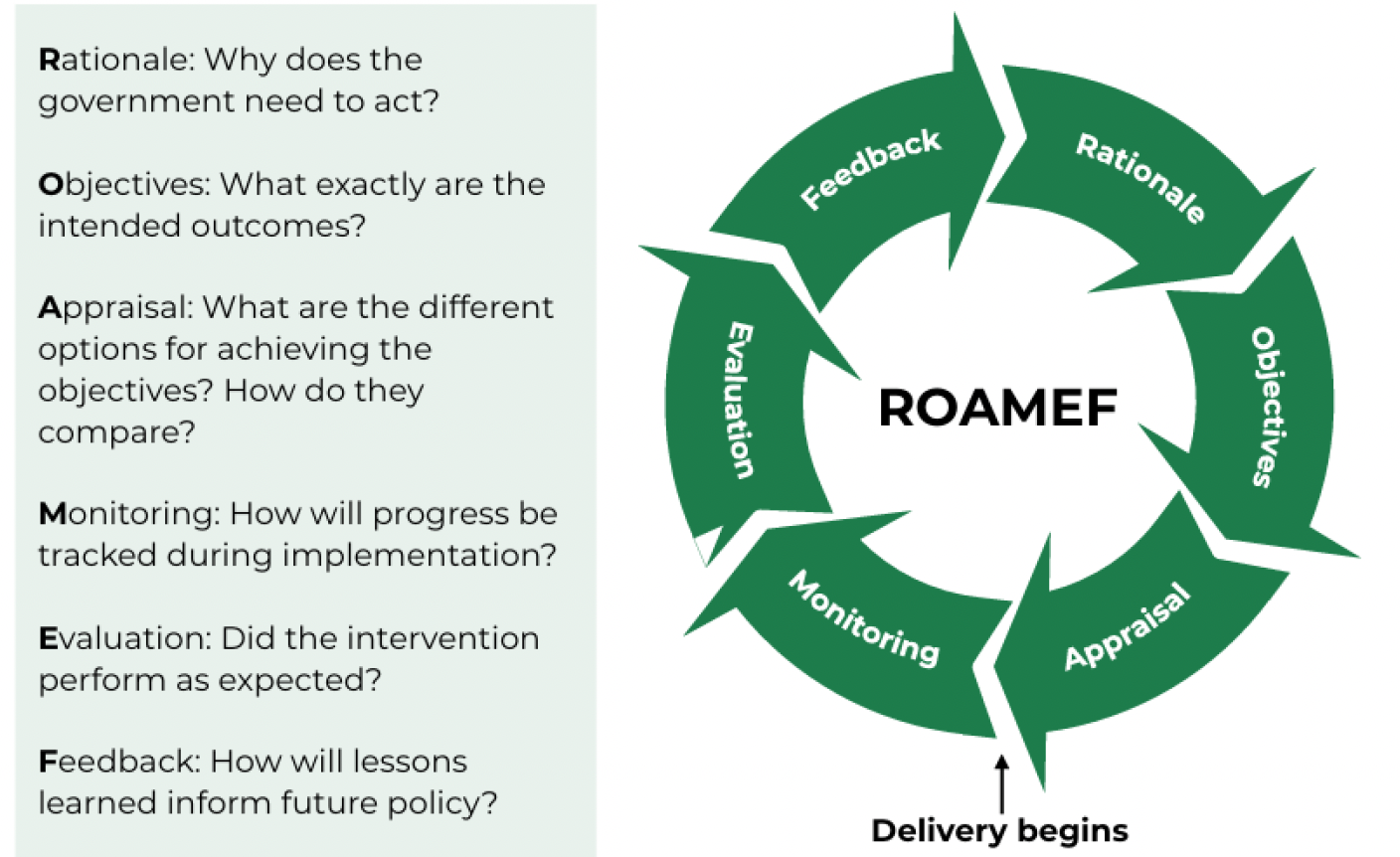
Figure 14 shows the "ROAMEF" cycle which stands for Rationale, Objectives, Appraisal, Monitoring, Evaluation and Feedback. This sets out the key stages in the HM Treasury Green Book appraisal guidance -
Rationale: Why does the government need to act?
Objectives: What exactly are the intended outcomes?
Appraisal: What are the different options for achieving the objectives? How do they compare?
Monitoring: How will progress be tracked during implementation?
Evaluation: Did the intervention perform as expected?
Feedback: How will lessons learned inform future policy?
It is illustrated as a wheel, with one stage leading to the next, before coming full circle (once you reach the final stage "feedback") and then starting again. The diagram also shows that delivery of an intervention begins between the appraisal stage (valuing costs and benefits before a policy is implemented) and monitoring (tracking impact once the policy is implemented).
Source: UK Green Book
Steps in the Green Book Appraisal
Green Book appraisal includes guidance on each stage, but focusses in particular on the “appraisal” stage (stage 3). The steps in a Green Book appraisal are as follows:
- Step 1 - Rationale for intervention – Green Book appraisal begins with a clear articulation of why public intervention is needed. What problem is the intervention trying to solve or what outcome is it trying to improve? In a prevention context, where benefits can often be seen over the longer term, this requires framing the rationale not only in terms of current pressures, but in terms of future harm, risk, or avoidable cost. For example, without early intervention, individuals at high risk of type 2 diabetes are likely to develop chronic conditions, leading to increased NHS costs, reduced quality of life, and long-term productivity losses.
- Step 2 - Objectives and success criteria - Once the rationale is established, the Green Book requires clear objectives against which options can be assessed. A theory of change is often used to link inputs (e.g. programme delivery) to outputs and outcomes (short- and long-term), including key assumptions. An example objective could be reduce the incidence of type 2 diabetes among high-risk adults by improving diet, physical activity, and weight management over a 3-year period. Success criteria may include reduced progression rates to diabetes, improved BMI, and increased physical activity levels.
- Step 3 - Option development and long listing - The Green Book emphasises the importance of considering a range of credible options, rather than appraisal of a single solution. This is particularly important for prevention, where there are often multiple ways of intervening earlier or further upstream. Prevention relevant options may vary by timing (early, mid stage, or late prevention), Coverage (universal or targeted), Intensity or duration of support. In the diabetes example, options might include universal public health campaigns promoting healthy lifestyles, targeted lifestyle coaching for individuals with pre-diabetes, or clinically supervised weight management programmes, Each varies in cost, reach, and expected impact.
- Step 4 - Valuing costs and benefits – Cost-benefit analysis (CBA) is at the heart of Green Book appraisal. It involves identifying, quantifying, and—where possible—monetising all significant costs and benefits associated with an intervention over its lifetime. This requires a structured approach to capturing both the full range of impacts (including direct, indirect, and wider effects) and their timing, ensuring that all relevant consequences are considered. Costs could be capital, operational, and administrative spending, while the benefits can include service savings, improved outcomes, and broader social or economic gains. Where monetisation is not possible, impacts should still be clearly described and, where appropriate, supported with alternative metrics or qualitative evidence. For example, a lifestyle intervention for individuals at risk of type 2 diabetes includes programme delivery costs (e.g. staff, coaching, materials), while benefits could arise over time through fewer diagnoses and complications, reduced NHS treatment costs, and improved quality of life for participants.
- Step 5 – Discounting, risk and distributional impacts – The Green Book requires future costs and benefits to be discounted to reflect time preference (i.e. benefits today are valued more than in the future). This is particularly important for prevention, where benefits may occur many years later. Uncertainty should be addressed through sensitivity analysis, testing how results change under different assumptions (e.g. impact size, participation rates). Distributional impacts should also be considered, identifying who benefits and when, as prevention often targets disadvantaged groups. For example, long-term healthcare savings from avoided diabetes cases are discounted to present value; results are tested under different assumptions about behaviour change and adherence; additional consideration is given to impacts on higher-risk or deprived populations.
- Step 6 - Monitoring, evaluation, and iteration - Finally, the Green Book highlights the importance of evaluation and feedback. Evaluation is considered in more detail in Tool 8 of this Toolkit.
Where to find more information/ support
For more information on appraisal, see the HM Treasury Green Book.
Resources
- In Scottish Government, the Centre of Expertise for Evaluation and Appraisal is driving forward a culture of appraisal and evaluation in Scottish Government
Contact
Email: PreventionUnit@gov.scot