
Prevention toolkit
The Prevention toolkit curates some of the latest tools in active use across the Scottish public sector to analyse prevention. It provides practical guidance on how to use these tools and links to further resources.
Prevention Lens 1 – Prevention through the Life Course
For prevention policy and analysis, taking a life course perspective is important because many outcomes such as health, employment, and wellbeing are shaped by experiences and events that accumulate over time. Risks and disadvantages often begin early in life and can compound if not addressed, leading to more complex and costly problems later on.
By focusing on how these patterns develop across different stages of life, prevention can target the root causes of issues rather than their symptoms.
A life course approach also highlights the importance of timing, showing that interventions at key stages - particularly in early childhood and during major transitions - can have disproportionately large and lasting impacts. This is illustrated by the “Heckman curve”, which shows the return on investment of intervention decreases with age (Figure 15). This strengthens the case for early and sustained investment in prevention, as it helps shift trajectories, reduce inequalities, and deliver benefits that extend across individuals’ lives and into future generations.
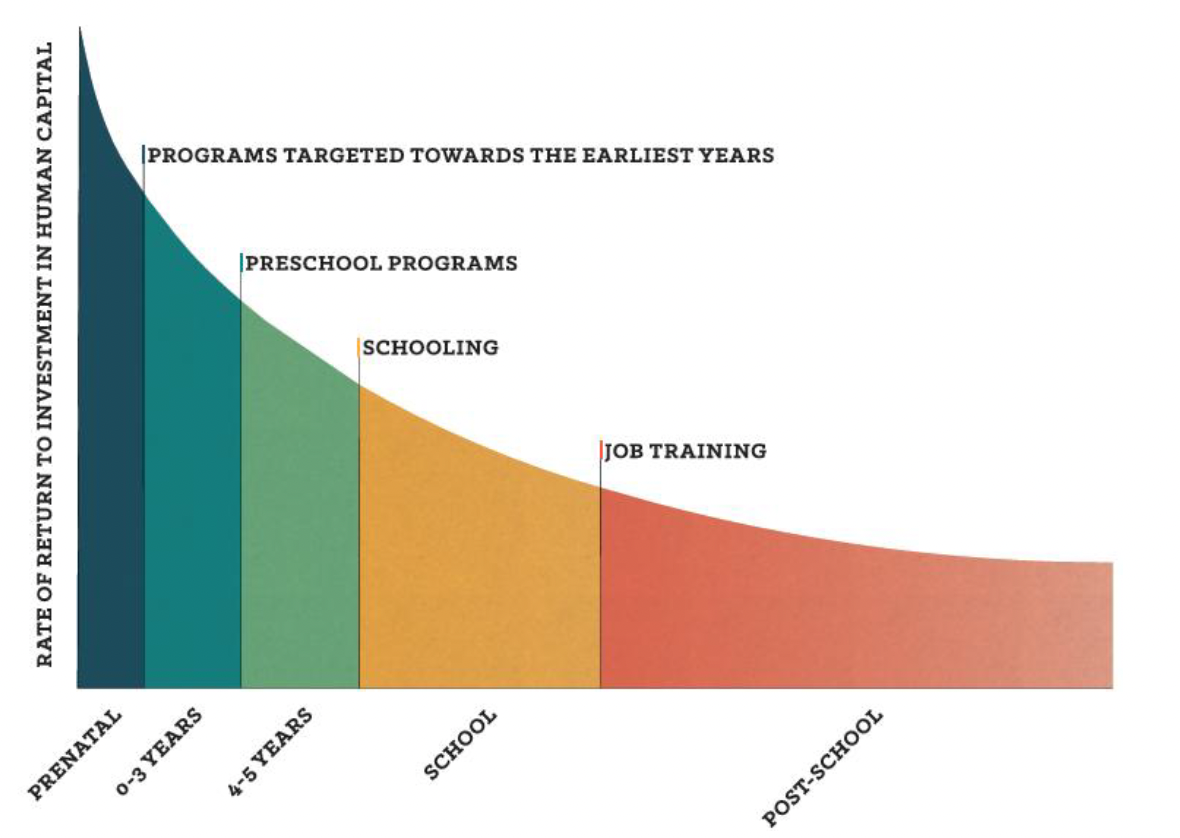
Source: Heckman Equation
Applying a Life Course Lens to the Prevention Toolkit
Taking a life course lens means using prevention tools in a way that recognises that outcomes are shaped by circumstances and events across different stages of life—from early childhood through to older age. Rather than analysing interventions in isolation or at a single point in time, this approach connects them into a coherent pathway of influence over time.
Looking at different sections of this Toolkit, this means:
- Defining prevention - Using a life course lens could show that in addition to thinking about the “levels of prevention” (primary, secondary, tertiary), you may wish to consider how interventions fall across different life stages. A primary intervention in early years, may have a bigger impact than a primary intervention later in life.
- Mapping drivers – A life course approach to understanding demand could involve mapping how early experiences and risk factors accumulate over time, leading to future service use. For example, childhood disadvantage may increase the likelihood of poor health, unemployment, or contact with the justice system later in life. The driver mapping tools could be used to think about pathways and “critical moments” (e.g. school transitions, entry to work, retirement) where demand is most likely to emerge. This supports a more preventative approach by highlighting where early intervention could disrupt these trajectories and reduce long-term demand across multiple services.
- Preventative budgeting and outcomes – approaches for considering planned preventative spend against key outcomes could be adjusted to consider how resources are distributed across different stages of life and whether investment is weighted toward prevention or reactive services. For example, the budget tagging tools provided in the Toolkit can be combined with further indicators to classify planned spending according to the life stage (e.g. early years, working age, older people), revealing imbalances or gaps. This enables decision makers to consider whether shifting resources earlier in the life course could improve outcomes and reduce long-term system pressure. The Prevention Unit is considering this in future iterations of the budget tagging tool.
- Estimating benefits – A life course lens in evaluation and appraisal emphasises the importance of capturing long-term and cross-sector outcomes, as many benefits of early intervention only materialise over time. Appraisal can model how impacts accumulate across the life course, while evaluation frameworks can track outcomes over extended periods. This approach also highlights the need to consider distributional impacts, as interventions at different life stages may affect inequalities differently. Applying this lens ensures that decisions properly account for delayed benefits and intergenerational effects, which are central to prevention.
- Decision-making - Using multi criteria analysis through a life course lens could allow decision makers to explicitly compare interventions that operate at different life stages but contribute to shared long-term outcomes. Criteria can be designed to reflect life course priorities, such as early intervention impact, prevention of escalation, or support during key transitions. Weighting could be used to prioritise interventions that deliver benefits earlier in life or reduce lifelong disadvantage. This helps ensure that options are assessed not only on short-term performance, but on their contribution to improving outcomes across the whole life course.
The benefits of applying a life course lens to prevention
Applying a life course lens could help nuance and strengthen the case for preventative investment. For example, it could
- highlighting the value of intervening earlier to alter life trajectories, rather than responding to outcomes once they have become entrenched.
- strengthen the case for early investment by making visible the accumulation of benefits over time, even where short-term returns are limited.
- support joined-up policy by aligning action across sectors (e.g. health, education, employment) with a focus on how outcomes are interconnected across the life course.
- improve targeting by identifying when and for whom interventions will be most effective, including key life stages or transition points.
- support understanding of how disadvantage builds over time and how prevention can narrow gaps if applied early and consistently.
More information and support
The Prevention Unit are considering how life course can feature more in prevention analysis and will update this section of the Toolkit in future, including with use cases developed in future. Contact: PreventionUnit@gov.scot.
Additional resources
- See World Health Organisation report on applying life course approaches in practice
Contact
Email: PreventionUnit@gov.scot